THE EUROPEAN UNION
(EU)
THE EUROPEAN UNION (EU)
What is it?
What is the European Union?
A unique economic and political partnership between 27 democratic
European countries.
What are its aims?
Peace, prosperity and freedom for its 498 million citizens — in a fairer,
safer world.
What results so far?
Frontier-free travel and trade, the euro (the single European currency),
safer food and a greener environment, better living standards in poorer
regions, joint action on crime and terror, cheaper phone calls, millions of
opportunities to study abroad … and much more besides.
How does it work?
To make these things happen, EU countries set up bodies to run the EU
and adopt its legislation. The main ones are:
the European Parliament (representing the people of Europe);
the Council of the European Union (representing national governments);
the European Commission (representing the common EU interest).
WHY EUROPEAN UNION MADE?
Why?
I. Peace and stability
II. Bringing Europe together again
III. Safety and security
IV. Economic and social solidarity
V. Identity and diversity in a globalised world
VI. Values
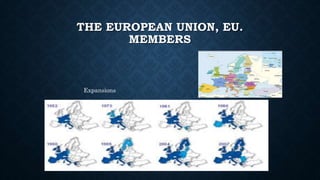
THE EUROPEAN UNION, EU MEMBERS
• Austria
• Belgium
• Bulgaria
• Cyprus
• Czech Republic
• Denmark
• Estonia
• Finland
• France
• Germany
• Greece
• Hungary
• Ireland
• Italy
• Latvia
• Luxembourg
• Netherlands
• Portugal
• Slovakia
• Lithuania
• Malta
• Poland
• Romania
• Spain
• Slovenia
• Sweden
• United Kingdom
THE EUROPEAN UNION, EU.
MEMBERS
Expansions
THE EUROPEAN UNION, EU.
TREATIES
• 1952 - Treaty establishing the European Coal and
• Community
• 1958 - Treaty of Rome
• 1967 - Merger Treaty
• 1987 - Single European Act (SEA)
• 1993- Treaty on European Union
• 1999 - Treaty of Amsterdam
• 2003 - Treaty of Nice
• 2009 – Treaty of Lisbon
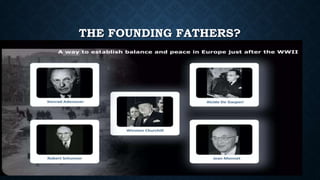
THE FOUNDING FATHERS?
THE EUROPEAN UNION, EU.
STRUCTURE
European Parliament
Is made up of Elected Members of the European Parliament (MEP’s).
Elections are held every 5 years
Council of the European Union
The council is made up of national ministers who with the European
Parliament, adopt EU law
European Commission
Is made up of appointed Commissioners and the EU’s civil service.
The Commission is responsible for the day-to-day running of the the
EU and ensures EU treaties are being complied with.
The Commission is also responsible for proposing legislation and
carrying out decisions made by the European Council and Parliamen
THE EUROPEAN UNION, EU.
STRUCTURE.
Court of Justice of the European Communities
EU law courts.
Are Responsible for interpreting EU law and ensuring it is carried out.
European Court of Auditors
Reviews and audits the financing of the EU’s institutions activities.
Is composed of one member from each EU member state.
European Ombudsman
Investigates complaints made by a citizen or resident of the Union about
maladministration by EU institutions and bodies
European Data Protection Supervisor
It’s duty is to uphold data protection standards in EU institutions and bodies
and plays advising role on data protection legislation.
THE EUROPEAN UNION, EU.
GOVERNANCE, WHO’S WHO?
• JOSE MANUEL BARROSO (Portugal) – President of the Commission.
• CATHERINE ASHTON (UK) - High Representative
• for Foreign Affairs and Commission vice_president.
• Herman Van Rompuy (Belgium) - President of the
• Council.
THE EUROPEAN UNION, EU.
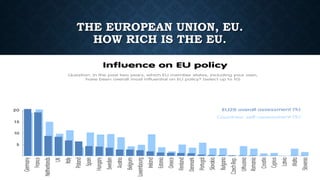
HOW RICH IS THE EU.
THE EUROPEAN UNION, EU.
INTERNATIONAL RELATIONS
International representation of the EU is handled by
Common Foreign and Security policy, determined by
the European Council or in terms of economic trade,
dealt with by the European Commission. The chief EU
diplomat in both situations is the High Representative
Catherine Ashton. Some degree of defence cooperation is described within the
Common Security
and Defence Policy
THE EUROPEAN UNION, EU.
INTERNATIONAL RELATIONS, OVERVIEW
An economic powerhouse of nearly half a billion people,
the European Union has an important role in global affairs
– and its weight is growing as EU countries increasingly
make foreign policy decisions as a bloc.
The EU is building relations with the republics of central
Asia.
The EU holds regular summits with the United States,
Japan, Canada and, more recently, Russia, India and China.
EU relations with these and other countries cut across
many fields, including education, the environment, crime
and human rights.
THE EUROPEAN UNION, EU.
INTERNATIONAL RELATIONS, CANDIDATES
Seven countries in the Balkans region aspire to become EU members. Croatia and the Former
Yugoslav Republic of Macedonia (FYROM) have been officially accepted as candidates for EU
membership. The EU considers five other western Balkan countries as potential candidates:
Albania, Bosnia and Herzegovina, Kosovo, Montenegro and Serbia. Kosovo declared itself
independent from Serbia in 2008, but there is still no international agreement on its status. The
EU is actively seekingdiplomatic solution while providing practical help. Some 1 900 justice experts
and police officers have been sent by the EU to help strengthen the rule of law.The European
Union, EU. International Relations, Candidates.
THE EUROPEAN UNION, EU.
INTERNATIONAL RELATIONS, USA
The EU is committed to an effective and balanced
partnership with the US, its biggest trade partner. In
2007, the two sides created the Transatlantic Economic
Council, a political body that oversees efforts to
strengthen economic ties. More recently the EU and
the US concluded a plan for closer cooperation on
crisis management and conflict prevention. The EU is
also looking to work with the US on climate change
and on improving the banking system in wake of the
financial crisis.
THE EUROPEAN UNION, EU.
INTERNATIONAL RELATIONS, RUSSIA.
• The EU and Russia are working on a new agreement to
• govern their relations. The talks began in July 2008 but
• were suspended for several months after conflict
• between Russia and Georgia. The two sides are seeking
• more cooperation on all fronts, recognising their
• growing ties. In particular, the EU wants to work more
• closely with Russia to ensure energy supplies. Russia
• supplies a large share of Europe’s oil and gas but those
• flows have been repeatedly disrupted by disputes
• between Russia and transit countries, mainly Ukraine
THE EUROPEAN UNION, EU.
UK PUBLIC OPINION, INFORMATION.
•18% of UK respondents felt informed about the EU compared to 12% and 15% in,
respectively, 2002 and 2006. However, 83% 2 said they knew little or nothing about
the EU.
• Only a tiny minority of the British public “strongly” agreed that the information
available on EU affairs was simple and clear (4%), and a third (34%) agreed to some
extent.
• Respondents felt that EU reports on television, radio and, particularly, in the
written press were too negative. Almost half (48%) perceived a negative bias in press
reports.
• More than half of the British public (54%) indicated that they did not want to
receive more information about the EU.
• British citizens mainly expect their government to inform them about the European
Union and its decisions (43%).
THE EUROPEAN UNION, EU.
UK PUBLIC OPINION, EU SUPPORT
.
• Respondents were divided about the “image” of the EU: of those taking a
position, about half had a rather positive image of the EU (37%), while the
other half took the opposite view (40%).
• Similarly, 37% of respondents felt the economic benefits of the UK being a
member of the EU outweighed the costs and 40% took an opposite
viewpoint.
• Taking an overview of the questions concerning the EU’s “image” and the
“cost-benefit analysis” of membership, respondents aged 55 and over (34%)
and those with the lowest level of education (39%) were the most likely to
evaluate the EU and the UK’s membership consistently negatively.
THE EUROPEAN UNION, EU.
UK PUBLIC OPINION, CONTRIBUTION
.
• When asked to estimate the UK’s net contribution to the EU budget, only
6% of respondents said it was below 3% of GNI (the actual figure is 0.21%
(2007)). On average, respondents estimated that the UK
transferred, annually, 23% of GNI to the EU. Just under half of respondents
(48%) did not or could not answer.
• Politically, 44% felt that the UK had a lot or a fair amount of influence on
the way EU laws are made. Half (51%), on the other hand, felt that the UK
had little or very little influence.
THE EUROPEAN UNION, EU.
UK PUBLIC OPINION, POLICIES
.
• Most respondents acknowledged that the EU had a
role in tackling some of the most pressing topical issues
– each of them having clear international dimensions
(70%).
• Presented with areas where EU membership could be
beneficial, a convincing majority agreed on these
benefits: the single market (67%), a cleaner
environment (58%), more weight in trade negotiations
(58%). They were least convinced about improved
working conditions (49%).
THE EUROPEAN UNION, EU.
UK PUBLIC OPINION, POLICIES.
•The perception that consumers were benefiting from the single
market was exceptionally high in the youngest segment (15-24 yearolds: 81%), among the most educated (78%) and those
living in
large cities (72%). Those who felt informed about the EU were more
likely to confirm such benefits (74%) than those who knew little or
nothing about EU matters – which was generally true for all benefits
tested.
• Most interviewees would care (at least a bit) if any of these
benefits were lost, e.g. by not being a member of the EU. Roughly
one in six (16%), though, would not mind losing these benefits if the
UK were not a member of the EU.
THE EUROPEAN UNION, EU.
FUTURE
The future of the EU over the coming years is likely to be
slow, but with continual progress towards integration.
This is like to be held back by the wide range of cultures and
economic conditions in different EU members.
The European model is constantly evolving with the joining of
eastern nations that are poor in comparison with other EU
countries. Increasing the complexity of the union’s governance
and increasing range of culture within the EU.
The range of cultural and historical differences are highly
sensitive. This includes matters including the use of language.
Such as in the French Republic, where there is growing
resentment about the supremacy of the English language
globally and within the EU.
THE END

THE EUROPEAN UNION (EU).pptx

  • 1.
  • 2.
    THE EUROPEAN UNION(EU) What is it? What is the European Union? A unique economic and political partnership between 27 democratic European countries. What are its aims? Peace, prosperity and freedom for its 498 million citizens — in a fairer, safer world. What results so far? Frontier-free travel and trade, the euro (the single European currency), safer food and a greener environment, better living standards in poorer regions, joint action on crime and terror, cheaper phone calls, millions of opportunities to study abroad … and much more besides. How does it work? To make these things happen, EU countries set up bodies to run the EU and adopt its legislation. The main ones are: the European Parliament (representing the people of Europe); the Council of the European Union (representing national governments); the European Commission (representing the common EU interest).
  • 3.
    WHY EUROPEAN UNIONMADE? Why? I. Peace and stability II. Bringing Europe together again III. Safety and security IV. Economic and social solidarity V. Identity and diversity in a globalised world VI. Values
  • 4.
    THE EUROPEAN UNION,EU MEMBERS • Austria • Belgium • Bulgaria • Cyprus • Czech Republic • Denmark • Estonia • Finland • France
  • 5.
    • Germany • Greece •Hungary • Ireland • Italy • Latvia • Luxembourg • Netherlands • Portugal • Slovakia • Lithuania • Malta • Poland • Romania • Spain • Slovenia • Sweden • United Kingdom
  • 6.
    THE EUROPEAN UNION,EU. MEMBERS Expansions
  • 7.
    THE EUROPEAN UNION,EU. TREATIES • 1952 - Treaty establishing the European Coal and • Community • 1958 - Treaty of Rome • 1967 - Merger Treaty • 1987 - Single European Act (SEA) • 1993- Treaty on European Union • 1999 - Treaty of Amsterdam • 2003 - Treaty of Nice • 2009 – Treaty of Lisbon
  • 8.
  • 9.
    THE EUROPEAN UNION,EU. STRUCTURE European Parliament Is made up of Elected Members of the European Parliament (MEP’s). Elections are held every 5 years Council of the European Union The council is made up of national ministers who with the European Parliament, adopt EU law European Commission Is made up of appointed Commissioners and the EU’s civil service. The Commission is responsible for the day-to-day running of the the EU and ensures EU treaties are being complied with. The Commission is also responsible for proposing legislation and carrying out decisions made by the European Council and Parliamen
  • 10.
    THE EUROPEAN UNION,EU. STRUCTURE. Court of Justice of the European Communities EU law courts. Are Responsible for interpreting EU law and ensuring it is carried out. European Court of Auditors Reviews and audits the financing of the EU’s institutions activities. Is composed of one member from each EU member state. European Ombudsman Investigates complaints made by a citizen or resident of the Union about maladministration by EU institutions and bodies European Data Protection Supervisor It’s duty is to uphold data protection standards in EU institutions and bodies and plays advising role on data protection legislation.
  • 11.
    THE EUROPEAN UNION,EU. GOVERNANCE, WHO’S WHO? • JOSE MANUEL BARROSO (Portugal) – President of the Commission. • CATHERINE ASHTON (UK) - High Representative • for Foreign Affairs and Commission vice_president. • Herman Van Rompuy (Belgium) - President of the • Council.
  • 12.
    THE EUROPEAN UNION,EU. HOW RICH IS THE EU.
  • 13.
    THE EUROPEAN UNION,EU. INTERNATIONAL RELATIONS International representation of the EU is handled by Common Foreign and Security policy, determined by the European Council or in terms of economic trade, dealt with by the European Commission. The chief EU diplomat in both situations is the High Representative Catherine Ashton. Some degree of defence cooperation is described within the Common Security and Defence Policy
  • 14.
    THE EUROPEAN UNION,EU. INTERNATIONAL RELATIONS, OVERVIEW An economic powerhouse of nearly half a billion people, the European Union has an important role in global affairs – and its weight is growing as EU countries increasingly make foreign policy decisions as a bloc. The EU is building relations with the republics of central Asia. The EU holds regular summits with the United States, Japan, Canada and, more recently, Russia, India and China. EU relations with these and other countries cut across many fields, including education, the environment, crime and human rights.
  • 15.
    THE EUROPEAN UNION,EU. INTERNATIONAL RELATIONS, CANDIDATES Seven countries in the Balkans region aspire to become EU members. Croatia and the Former Yugoslav Republic of Macedonia (FYROM) have been officially accepted as candidates for EU membership. The EU considers five other western Balkan countries as potential candidates: Albania, Bosnia and Herzegovina, Kosovo, Montenegro and Serbia. Kosovo declared itself independent from Serbia in 2008, but there is still no international agreement on its status. The EU is actively seekingdiplomatic solution while providing practical help. Some 1 900 justice experts and police officers have been sent by the EU to help strengthen the rule of law.The European Union, EU. International Relations, Candidates.
  • 16.
    THE EUROPEAN UNION,EU. INTERNATIONAL RELATIONS, USA The EU is committed to an effective and balanced partnership with the US, its biggest trade partner. In 2007, the two sides created the Transatlantic Economic Council, a political body that oversees efforts to strengthen economic ties. More recently the EU and the US concluded a plan for closer cooperation on crisis management and conflict prevention. The EU is also looking to work with the US on climate change and on improving the banking system in wake of the financial crisis.
  • 17.
    THE EUROPEAN UNION,EU. INTERNATIONAL RELATIONS, RUSSIA. • The EU and Russia are working on a new agreement to • govern their relations. The talks began in July 2008 but • were suspended for several months after conflict • between Russia and Georgia. The two sides are seeking • more cooperation on all fronts, recognising their • growing ties. In particular, the EU wants to work more • closely with Russia to ensure energy supplies. Russia • supplies a large share of Europe’s oil and gas but those • flows have been repeatedly disrupted by disputes • between Russia and transit countries, mainly Ukraine
  • 18.
    THE EUROPEAN UNION,EU. UK PUBLIC OPINION, INFORMATION. •18% of UK respondents felt informed about the EU compared to 12% and 15% in, respectively, 2002 and 2006. However, 83% 2 said they knew little or nothing about the EU. • Only a tiny minority of the British public “strongly” agreed that the information available on EU affairs was simple and clear (4%), and a third (34%) agreed to some extent. • Respondents felt that EU reports on television, radio and, particularly, in the written press were too negative. Almost half (48%) perceived a negative bias in press reports. • More than half of the British public (54%) indicated that they did not want to receive more information about the EU. • British citizens mainly expect their government to inform them about the European Union and its decisions (43%).
  • 19.
    THE EUROPEAN UNION,EU. UK PUBLIC OPINION, EU SUPPORT . • Respondents were divided about the “image” of the EU: of those taking a position, about half had a rather positive image of the EU (37%), while the other half took the opposite view (40%). • Similarly, 37% of respondents felt the economic benefits of the UK being a member of the EU outweighed the costs and 40% took an opposite viewpoint. • Taking an overview of the questions concerning the EU’s “image” and the “cost-benefit analysis” of membership, respondents aged 55 and over (34%) and those with the lowest level of education (39%) were the most likely to evaluate the EU and the UK’s membership consistently negatively.
  • 20.
    THE EUROPEAN UNION,EU. UK PUBLIC OPINION, CONTRIBUTION . • When asked to estimate the UK’s net contribution to the EU budget, only 6% of respondents said it was below 3% of GNI (the actual figure is 0.21% (2007)). On average, respondents estimated that the UK transferred, annually, 23% of GNI to the EU. Just under half of respondents (48%) did not or could not answer. • Politically, 44% felt that the UK had a lot or a fair amount of influence on the way EU laws are made. Half (51%), on the other hand, felt that the UK had little or very little influence.
  • 21.
    THE EUROPEAN UNION,EU. UK PUBLIC OPINION, POLICIES . • Most respondents acknowledged that the EU had a role in tackling some of the most pressing topical issues – each of them having clear international dimensions (70%). • Presented with areas where EU membership could be beneficial, a convincing majority agreed on these benefits: the single market (67%), a cleaner environment (58%), more weight in trade negotiations (58%). They were least convinced about improved working conditions (49%).
  • 22.
    THE EUROPEAN UNION,EU. UK PUBLIC OPINION, POLICIES. •The perception that consumers were benefiting from the single market was exceptionally high in the youngest segment (15-24 yearolds: 81%), among the most educated (78%) and those living in large cities (72%). Those who felt informed about the EU were more likely to confirm such benefits (74%) than those who knew little or nothing about EU matters – which was generally true for all benefits tested. • Most interviewees would care (at least a bit) if any of these benefits were lost, e.g. by not being a member of the EU. Roughly one in six (16%), though, would not mind losing these benefits if the UK were not a member of the EU.
  • 23.
    THE EUROPEAN UNION,EU. FUTURE The future of the EU over the coming years is likely to be slow, but with continual progress towards integration. This is like to be held back by the wide range of cultures and economic conditions in different EU members. The European model is constantly evolving with the joining of eastern nations that are poor in comparison with other EU countries. Increasing the complexity of the union’s governance and increasing range of culture within the EU. The range of cultural and historical differences are highly sensitive. This includes matters including the use of language. Such as in the French Republic, where there is growing resentment about the supremacy of the English language globally and within the EU.
  • 24.