Infrastructure finance in Iraq: Mitigating risks and protecting investors 
Anders Jönsson 
Global Relations Secretariat 
OECD 
Baghdad, 2 February 2014
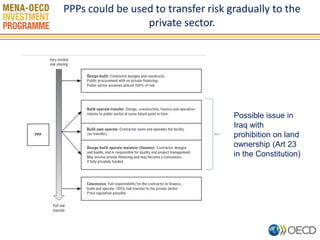
PPPs could be used to transfer risk gradually to the private sector. 
2 
Possible issue in Iraq with prohibition on land ownership (Art 23 in the Constitution)
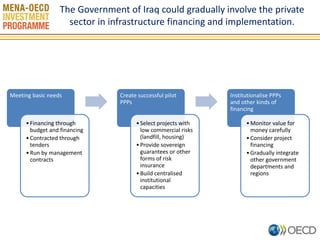
The Government of Iraq could gradually involve the private sector in infrastructure financing and implementation. 
3 
Meeting basic needs 
•Financing through budget and financing 
•Contracted through tenders 
•Run by management contracts 
Create successful pilot PPPs 
•Select projects with low commercial risks (landfill, housing) 
•Provide sovereign guarantees or other forms of risk insurance 
•Build centralised institutional capacities 
Institutionalise PPPs and other kinds of financing 
•Monitor value for money carefully 
•Consider project financing 
•Gradually integrate other government departments and regions
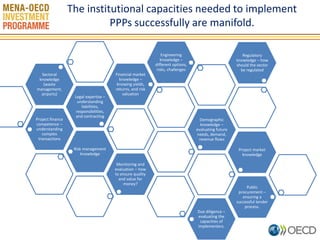
The institutional capacities needed to implement PPPs successfully are manifold. 
4 
Project finance competence – understanding complex transactions 
Legal expertise – understanding liabilities, responsibilities, and contracting 
Sectoral knowledge (waste management, airports) 
Financial market knowledge – knowing yields, returns, and risk valuation 
Engineering knowledge – different options, risks, challenges 
Demographic knowledge – evaluating future needs, demand, revenue flows 
Risk management knowledge 
Project market knowledge 
Regulatory knowledge – how should the sector be regulated 
Monitoring and evaluation – how to ensure quality and value for money? 
Due diligence – evaluating the capacities of implementers. 
Public procurement – ensuring a successful tender process.
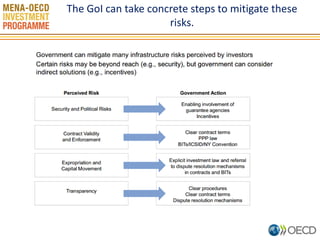
The GoI can take concrete steps to mitigate these risks. 
5
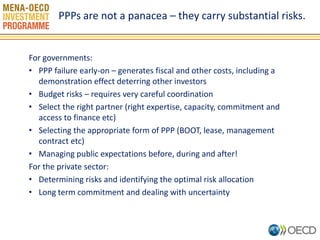
For governments: 
•PPP failure early-on – generates fiscal and other costs, including a demonstration effect deterring other investors 
•Budget risks – requires very careful coordination 
•Select the right partner (right expertise, capacity, commitment and access to finance etc) 
•Selecting the appropriate form of PPP (BOOT, lease, management contract etc) 
•Managing public expectations before, during and after! 
For the private sector: 
•Determining risks and identifying the optimal risk allocation 
•Long term commitment and dealing with uncertainty 
PPPs are not a panacea – they carry substantial risks.
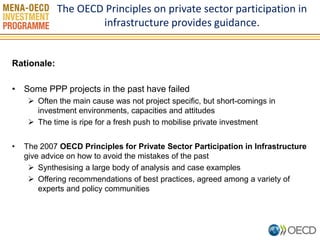
The OECD Principles on private sector participation in infrastructure provides guidance. 
Rationale: 
•Some PPP projects in the past have failed 
Often the main cause was not project specific, but short-comings in investment environments, capacities and attitudes 
The time is ripe for a fresh push to mobilise private investment 
•The 2007 OECD Principles for Private Sector Participation in Infrastructure give advice on how to avoid the mistakes of the past 
Synthesising a large body of analysis and case examples 
Offering recommendations of best practices, agreed among a variety of experts and policy communities
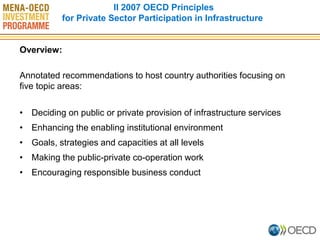
Overview: 
Annotated recommendations to host country authorities focusing on five topic areas: 
•Deciding on public or private provision of infrastructure services 
•Enhancing the enabling institutional environment 
•Goals, strategies and capacities at all levels 
•Making the public-private co-operation work 
•Encouraging responsible business conduct 
II 2007 OECD Principles for Private Sector Participation in Infrastructure
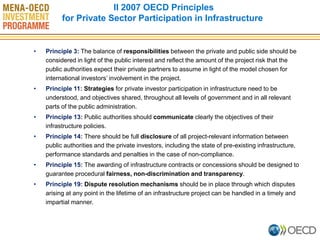
•Principle 3: The balance of responsibilities between the private and public side should be considered in light of the public interest and reflect the amount of the project risk that the public authorities expect their private partners to assume in light of the model chosen for international investors’ involvement in the project. 
•Principle 11: Strategies for private investor participation in infrastructure need to be understood, and objectives shared, throughout all levels of government and in all relevant parts of the public administration. 
•Principle 13: Public authorities should communicate clearly the objectives of their infrastructure policies. 
•Principle 14: There should be full disclosure of all project-relevant information between public authorities and the private investors, including the state of pre-existing infrastructure, performance standards and penalties in the case of non-compliance. 
•Principle 15: The awarding of infrastructure contracts or concessions should be designed to guarantee procedural fairness, non-discrimination and transparency. 
•Principle 19: Dispute resolution mechanisms should be in place through which disputes arising at any point in the lifetime of an infrastructure project can be handled in a timely and impartial manner. 
II 2007 OECD Principles 
for Private Sector Participation in Infrastructure
Summary 
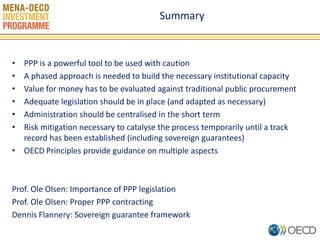
•PPP is a powerful tool to be used with caution 
•A phased approach is needed to build the necessary institutional capacity 
•Value for money has to be evaluated against traditional public procurement 
•Adequate legislation should be in place (and adapted as necessary) 
•Administration should be centralised in the short term 
•Risk mitigation necessary to catalyse the process temporarily until a track record has been established (including sovereign guarantees) 
•OECD Principles provide guidance on multiple aspects 
Prof. Ole Olsen: Importance of PPP legislation 
Prof. Ole Olsen: Proper PPP contracting 
Dennis Flannery: Sovereign guarantee framework 
10

Jönsson: Infrastructure finance in Iraq

  • 1.
    Infrastructure finance inIraq: Mitigating risks and protecting investors Anders Jönsson Global Relations Secretariat OECD Baghdad, 2 February 2014
  • 2.
    PPPs could beused to transfer risk gradually to the private sector. 2 Possible issue in Iraq with prohibition on land ownership (Art 23 in the Constitution)
  • 3.
    The Government ofIraq could gradually involve the private sector in infrastructure financing and implementation. 3 Meeting basic needs •Financing through budget and financing •Contracted through tenders •Run by management contracts Create successful pilot PPPs •Select projects with low commercial risks (landfill, housing) •Provide sovereign guarantees or other forms of risk insurance •Build centralised institutional capacities Institutionalise PPPs and other kinds of financing •Monitor value for money carefully •Consider project financing •Gradually integrate other government departments and regions
  • 4.
    The institutional capacitiesneeded to implement PPPs successfully are manifold. 4 Project finance competence – understanding complex transactions Legal expertise – understanding liabilities, responsibilities, and contracting Sectoral knowledge (waste management, airports) Financial market knowledge – knowing yields, returns, and risk valuation Engineering knowledge – different options, risks, challenges Demographic knowledge – evaluating future needs, demand, revenue flows Risk management knowledge Project market knowledge Regulatory knowledge – how should the sector be regulated Monitoring and evaluation – how to ensure quality and value for money? Due diligence – evaluating the capacities of implementers. Public procurement – ensuring a successful tender process.
  • 5.
    The GoI cantake concrete steps to mitigate these risks. 5
  • 6.
    For governments: •PPPfailure early-on – generates fiscal and other costs, including a demonstration effect deterring other investors •Budget risks – requires very careful coordination •Select the right partner (right expertise, capacity, commitment and access to finance etc) •Selecting the appropriate form of PPP (BOOT, lease, management contract etc) •Managing public expectations before, during and after! For the private sector: •Determining risks and identifying the optimal risk allocation •Long term commitment and dealing with uncertainty PPPs are not a panacea – they carry substantial risks.
  • 7.
    The OECD Principleson private sector participation in infrastructure provides guidance. Rationale: •Some PPP projects in the past have failed Often the main cause was not project specific, but short-comings in investment environments, capacities and attitudes The time is ripe for a fresh push to mobilise private investment •The 2007 OECD Principles for Private Sector Participation in Infrastructure give advice on how to avoid the mistakes of the past Synthesising a large body of analysis and case examples Offering recommendations of best practices, agreed among a variety of experts and policy communities
  • 8.
    Overview: Annotated recommendationsto host country authorities focusing on five topic areas: •Deciding on public or private provision of infrastructure services •Enhancing the enabling institutional environment •Goals, strategies and capacities at all levels •Making the public-private co-operation work •Encouraging responsible business conduct II 2007 OECD Principles for Private Sector Participation in Infrastructure
  • 9.
    •Principle 3: Thebalance of responsibilities between the private and public side should be considered in light of the public interest and reflect the amount of the project risk that the public authorities expect their private partners to assume in light of the model chosen for international investors’ involvement in the project. •Principle 11: Strategies for private investor participation in infrastructure need to be understood, and objectives shared, throughout all levels of government and in all relevant parts of the public administration. •Principle 13: Public authorities should communicate clearly the objectives of their infrastructure policies. •Principle 14: There should be full disclosure of all project-relevant information between public authorities and the private investors, including the state of pre-existing infrastructure, performance standards and penalties in the case of non-compliance. •Principle 15: The awarding of infrastructure contracts or concessions should be designed to guarantee procedural fairness, non-discrimination and transparency. •Principle 19: Dispute resolution mechanisms should be in place through which disputes arising at any point in the lifetime of an infrastructure project can be handled in a timely and impartial manner. II 2007 OECD Principles for Private Sector Participation in Infrastructure
  • 10.
    Summary •PPP isa powerful tool to be used with caution •A phased approach is needed to build the necessary institutional capacity •Value for money has to be evaluated against traditional public procurement •Adequate legislation should be in place (and adapted as necessary) •Administration should be centralised in the short term •Risk mitigation necessary to catalyse the process temporarily until a track record has been established (including sovereign guarantees) •OECD Principles provide guidance on multiple aspects Prof. Ole Olsen: Importance of PPP legislation Prof. Ole Olsen: Proper PPP contracting Dennis Flannery: Sovereign guarantee framework 10