Create. Innovate. Grow! 
A new policy agenda to maximize the innovative 
contributions of Europe’s creative industries 
ECIA Final Conference 
Conclusions WG on Access to Finance 
Amsterdam, 27th November 2014
Edgar Garcia 
ECIA’s WG 
Coordinator on 
Access to Finance
ECIA’s WG on Access to Finance members 
• Michela Michilli – Concrete Action FAME (FILAS) 
• Marija Popovic - Concrete Action CI-Factor (EDC) 
• Miguel Rivas – CLAND, Audiovisual and Digital Cluster 
Andalucía 
• Jenny Kornmacher - Hamburg Kreativ Gesellschaft 
Gmbh 
• Ragnar Siil –Estonia Ministry of Culture 
• Henri Monceau – Cabinet of the Minister for Economy, 
Wallonia 
• Johanna Bolhoven – Creative England 
• Thierry Baujard – Media Deals 
• Edgar Garcia Casellas – Coordinator of the WG (ICEC)
Current framework 
• The on-going financial and economic crisis has an important impact on the 
adoption of public funding initiatives for the CCIs . 
• Growing acknowledgement of the economic performance of the cultural and 
creative sectors. 
• The cultural and creative sector can become the basis for economic recovery 
and potential growth in Europe. 
• The sector’s role as an upcoming attraction for private funding should be equally 
supported and enforced. 
• The digital shift places the creative sector in the need to reassess business 
models.
Key issues and challenges on Access to Finance 
• Creative sector’s main challenge 
• To find innovative business models, which would allow them to 
achieve investment readiness within the new digital 
environment.
Assessment of current policies and policy initiatives 
Examples of policies and initiatives Cross-sectoral 
Invest. 
Awareness 
Alternative 
financing Leverage 
Cross-border 
Level Score 
(1-5) 
MEDIA Production Guarantee Fund 
Pan European Guarantee for film production x x 
x 
EU 4* 
Belgian Tax shelter for films 
Key finance instrument for film finance x x 
x 
Nat. 4* 
OSEO Guarantee 
Offer risk mitigation to innovative SME x x Nat. 3 
Film London PFM (Production Finance Market) 
x 
http://filmlondon.org.uk/PFM 
x x 
Key finance market supported by MEDIA 
EU 4* 
EASY Early stage investors 
www.earlystageinvestors.org/ 
Pilot project for cross border investment 
x x x 
x 
EU 2 
FILAS VC Fund http://www.filasinternational.eu/ 
Regional fund for CI x X Reg. 3
CIM Venture 
Pan European CI Investment Fund x x 
x 
EU 1 
Caisse des Depots VC fund „Heritage and Creation“ 
Development fund for established CI x Nat. 3 
VC Fonds Kreativwirtschaft Berlin 
http://www.ibb-bet.de/vc_fonds_kreativ.0.html?&L=1 
Public private fund focussing on CI 
x x Reg. 4* 
European Regional Development Fund (ERDF) 
Key regional fund x x EU 3 
How to grow platform 
CI Online platform x x 
x 
EU 3 
European Angels Fund (EAF) 
http://www.eif.org/what_we_do/equity/eaf/index.ht 
m EIF co angel fund 
x x x EU 1 
Enterprise Investment Scheme (EIS 
http://www.hmrc.gov.uk/eis/ 
Key UK scheme to support innovation 
x x x Nat. 4* 
Seed4Start www.seed4start.org 
Pilot project on cross border investment x x x 
x 
EU 2
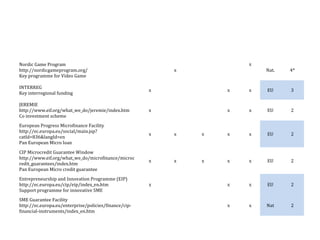
Nordic Game Program 
http://nordicgameprogram.org/ 
Key programme for Video Game 
x 
x 
Nat. 4* 
INTERREG 
Key interregional funding x x x EU 3 
JEREMIE 
http://www.eif.org/what_we_do/jeremie/index.htm 
x x x EU 2 
Co investment scheme 
European Progress Microfinance Facility 
http://ec.europa.eu/social/main.jsp? 
catId=836&langId=en 
Pan European Micro loan 
x x x x x EU 2 
CIP Microcredit Guarantee Window 
http://www.eif.org/what_we_do/microfinance/microc 
redit_guarantees/index.htm 
Pan European Micro credit guarantee 
x x x x x EU 2 
Entrepreneurship and Innovation Programme (EIP) 
http://ec.europa.eu/cip/eip/index_en.htm 
Support programme for innovative SME 
x x x EU 2 
SME Guarantee Facility 
http://ec.europa.eu/enterprise/policies/finance/cip-financial- 
instruments/index_en.htm 
x x Nat 2
First steps towards a benchmarking: the best rated practices 
and policy initiatives 
• Detection of already undertaken policies and upcoming policy initiatives in the field of 
access to finance for CCIs, which have been be reviewed according to their 
effectiveness in replying to one or more of the key issues identified. 
• To explore and analyze key schemes through: 
 their goals, results and context 
 the role of the private and public sector 
 their cross sector/spill over character 
 their replication potential 
 the success or failure factors
First steps towards a benchmarking: the best rated practices 
and policy initiatives 
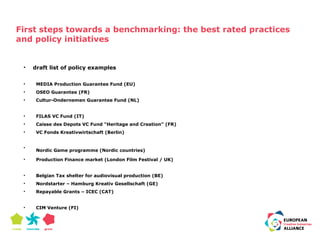
• draft list of policy examples 
• MEDIA Production Guarantee Fund (EU) 
• OSEO Guarantee (FR) 
• Cultur-Ondernemen Guarantee Fund (NL) 
• FILAS VC Fund (IT) 
• Caisse des Depots VC Fund “Heritage and Creation” (FR) 
• VC Fonds Kreativwirtschaft (Berlin) 
• Nordic Game programme (Nordic countries) 
• Production Finance market (London Film Festival / UK) 
• Belgian Tax shelter for audiovisual production (BE) 
• Nordstarter – Hamburg Kreativ Gesellschaft (GE) 
• Repayable Grants – ICEC (CAT) 
• CIM Venture (FI)
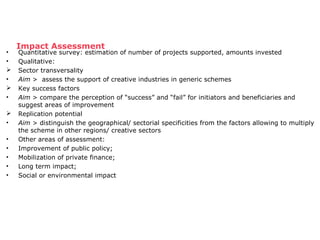
Impact Assessment • Quantitative survey: estimation of number of projects supported, amounts invested 
• Qualitative: 
 Sector transversality 
• Aim > assess the support of creative industries in generic schemes 
 Key success factors 
• Aim > compare the perception of “success” and “fail” for initiators and beneficiaries and 
suggest areas of improvement 
 Replication potential 
• Aim > distinguish the geographical/ sectorial specificities from the factors allowing to multiply 
the scheme in other regions/ creative sectors 
• Other areas of assessment: 
• Improvement of public policy; 
• Mobilization of private finance; 
• Long term impact; 
• Social or environmental impact
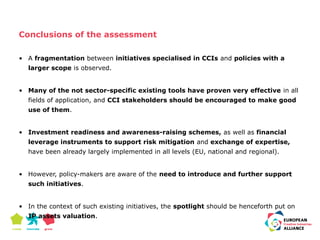
Conclusions of the assessment 
• A fragmentation between initiatives specialised in CCIs and policies with a 
larger scope is observed. 
• Many of the not sector-specific existing tools have proven very effective in all 
fields of application, and CCI stakeholders should be encouraged to make good 
use of them. 
• Investment readiness and awareness-raising schemes, as well as financial 
leverage instruments to support risk mitigation and exchange of expertise, 
have been already largely implemented in all levels (EU, national and regional). 
• However, policy-makers are aware of the need to introduce and further support 
such initiatives. 
• In the context of such existing initiatives, the spotlight should be henceforth put on 
IP assets valuation.
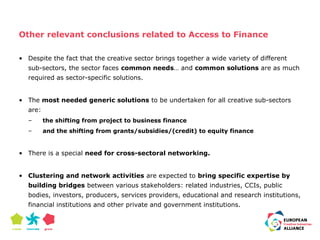
Other relevant conclusions related to Access to Finance 
• Despite the fact that the creative sector brings together a wide variety of different 
sub-sectors, the sector faces common needs… and common solutions are as much 
required as sector-specific solutions. 
• The most needed generic solutions to be undertaken for all creative sub-sectors 
are: 
– the shifting from project to business finance 
– and the shifting from grants/subsidies/(credit) to equity finance 
• There is a special need for cross-sectoral networking. 
• Clustering and network activities are expected to bring specific expertise by 
building bridges between various stakeholders: related industries, CCIs, public 
bodies, investors, producers, services providers, educational and research institutions, 
financial institutions and other private and government institutions.
Other relevant conclusions related to Access to Finance 
• There is a need to identify the creative sub-sectors that actually dispose the most 
or least advanced market intelligence and that consequently are the most or least 
attractive for investors. 
• A crucial point is the bond between new CCI business models and an innovative 
use of ICT services.
Other relevant conclusions related to Access to Finance 
• Conclusions of the “Investor’s Survey” (Taking the Pulse of Investors, traditional 
and alternative Finance Sources in Financing the CI) resulting from the CI-Factor 
work ended in February 2013. 
• 82% of the investors invest in ICT-based companies 
• Thus, a thorough ICT understanding across the creative sector, is expected to 
attract more investors to all creative sub-sectors. 
• A challenge: to transfer knowledge through synergies between highly 
innovative and less ICT-aware creative industries. 
• The creative-sectors the least targeted for finance are: the performing arts, 
architecture and crafts. 
• Thus, its professionalization by the involvement of experienced and specialized 
M&A consultants is crucial in order for cultural organizations to emerge with new 
competitive and innovative business models .
Other relevant conclusions related to Access to Finance 
• Conclusions of the “Investor’s Survey” (Taking the Pulse of Investors, traditional 
and alternative Finance Sources in Financing the CI) resulting from the CI-Factor 
work ended in February 2013. 
• Investors show special interest for the following sub-sectors: Software, 
Games, Advertising, Film/TV programming and Publishing. 
• Investors find more interest in investing in start-ups. 
• Conclusion: there is a particular need to encourage these companies to 
become investment-ready from an early-stage.
Methodology 
• a) identification of the main key issues and challenges, based on previous 
• literature and information from stakeholders. 
• b) collection of case studies covering 4 categories 
• *Funds 
• *Guarantee schemes 
• *Public initiatives 
• *Trainings and support schemes 
• c) conduct of online survey addressed to initiators and beneficiaries 
representing 
• and having participated in support schemes of the above mentioned categories 
• d) benchmarking and impact assessment of the chosen sampled cases, 
comparing the categories taking into consideration 8 specific criteria
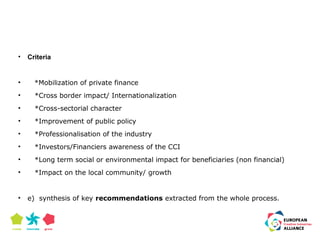
• Criteria 
• *Mobilization of private finance 
• *Cross border impact/ Internationalization 
• *Cross-sectorial character 
• *Improvement of public policy 
• *Professionalisation of the industry 
• *Investors/Financiers awareness of the CCI 
• *Long term social or environmental impact for beneficiaries (non financial) 
• *Impact on the local community/ growth 
• e) synthesis of key recommendations extracted from the whole process.
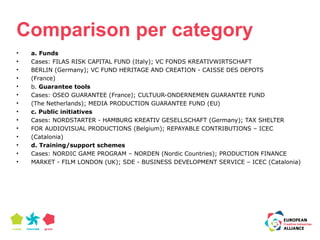
Comparison per category 
• a. Funds 
• Cases: FILAS RISK CAPITAL FUND (Italy); VC FONDS KREATIVWIRTSCHAFT 
• BERLIN (Germany); VC FUND HERITAGE AND CREATION - CAISSE DES DEPOTS 
• (France) 
• b. Guarantee tools 
• Cases: OSEO GUARANTEE (France); CULTUUR-ONDERNEMEN GUARANTEE FUND 
• (The Netherlands); MEDIA PRODUCTION GUARANTEE FUND (EU) 
• c. Public initiatives 
• Cases: NORDSTARTER - HAMBURG KREATIV GESELLSCHAFT (Germany); TAX SHELTER 
• FOR AUDIOVISUAL PRODUCTIONS (Belgium); REPAYABLE CONTRIBUTIONS – ICEC 
• (Catalonia) 
• d. Training/support schemes 
• Cases: NORDIC GAME PROGRAM – NORDEN (Nordic Countries); PRODUCTION FINANCE 
• MARKET - FILM LONDON (UK); SDE - BUSINESS DEVELOPMENT SERVICE – ICEC (Catalonia)
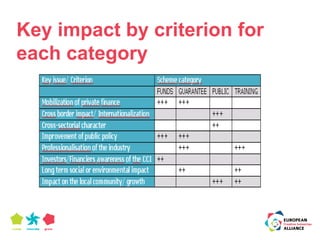
Key impact by criterion for 
each category
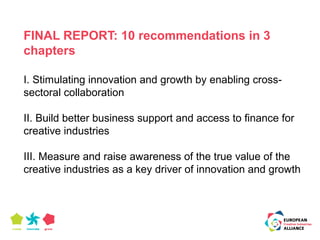
FINAL REPORT: 10 recommendations in 3 
chapters 
I. Stimulating innovation and growth by enabling cross-sectoral 
collaboration 
II. Build better business support and access to finance for 
creative industries 
III. Measure and raise awareness of the true value of the 
creative industries as a key driver of innovation and growth
I. Stimulating innovation and growth by 
enabling cross-sectoral collaboration 
Recommendations: 
1) Introduce creative innovation voucher schemes 
2) Stimulate cross-sectoral innovation through public-private 
innovation challenges
II. Build better business support and access to 
finance for creative industries 
Recommendations: 
3) Test and review existing business services and 
financing schemes 
4) Develop and support capacity building in regional 
clusters 
5) Enable and support internationalization efforts in cluster 
organizations
II. Build better business support and access to 
finance for creative industries 
Recommendations: 
6) Launch new and innovative financing schemes to 
support early stage SMEs 
7) Stimulate investor awareness through effective 
regional eco-systems 
8) Support new initiatives to define how to achieve 
better IP valuation for creative SMEs
III. Measure and raise awareness of the true 
value of the creative industries as a key driver 
of innovation and growth 
Recommendations: 
9) Incentivize and support stronger advocacy for creative 
industries 
10) Map and measure the effects and value of the 
creative industries in the wider economy
II. Build better business support and access to 
finance for creative industries 
Recommendations: 
3)Test and review existing business services and 
financing schemes 
Member States and regions should test new and review 
their existing business support and financing schemes to 
examine whether these services are being used by CIs. If 
the needs of CIs are shown to be inadequately addressed, 
meaning that they do not benefit from these schemes, this 
should be seen as a systemic error that needs to be 
addressed. The EC should also contribute to oversee such 
efforts on policy improvements as part of their country-specific 
recommendations on the National Reform 
Programmes to boost growth and jobs.
Creative Industries Friendliness 
• An important part of the work of ECIA has been 
to assess existing business support programmes, 
to ensure they are fit-for-purpose for use by 
creative businesses. A toolkit has been 
developed to identify the defining characteristics 
of support suitable for creatives. 
• http://www.cluster2020live.eu/creative-industry- 
friendly-test
II. Build better business support and access to 
finance for creative industries 
Recommendations: 
6) Launch new and innovative financing schemes to 
support early stage SMEs 
Member states and regional authorities should introduce 
new and innovative forms of financing for creative SMEs. 
New financing schemes should build on emerging trends 
such as microcredits, refundable contributions, peer-to-peer 
lending, crowdfunding, etc.
• These need to be taken into consideration and given 
credibility by the public sector thus providing smart 
solutions to finding equity funds and becoming 
internationally investment-ready. 
• Mitigating risk between public and private financing is 
an important aspect of new schemes which may have a 
positive impact on the general professionalization of the 
sector. 
• Crowdfunding in particular seems to be the most 
promising trend in alternative financing; cooperation of 
public bodies with crowdfunding platforms could be 
achieved through a regulatory framework promoting 
such initiatives from short-term project-based to long-term 
business-based.
Repayable Contributions (RC) 
• RC is a new tool for project finance in the CCS launched 
by the ICEC. 
• The programme is designed to shift the companies’ 
mentality from a subsidy dependency to a shared risk 
attitude between the public and private sector. It aims 
thereby at improving competitiveness and financial 
sustainability among companies in the CCS. 
• RC provide financial support to CCIs so that they can 
move forward with their projects, provided these are 
market oriented. They offer funding based on company 
risk and do not make provision from charging interests. 
On successful projects, the ICEC recovers a proportion of 
the amount granted. 
• Produced an overall 89% return of the closed cases.
Growth support of Creative Businesses 
through repayable loans 
• Creative England’s innovative Creative Business Loan 
programme offers interest free business loans of up to 
£150,000 to support creative and digital businesses 
across the English regions. 
• The Fund totals £3.5million (to-date) and has been 
running annually since July 2012 – the first two loan funds 
were so successful and heavily over-subscribed that the 
decision was taken to increase the third round of loan 
funding from £1,000,000 to £1,500,000.
NORDSTARTER 
• Nordstarter is the world’s first regional and public 
crowdfunding platform, established by the City of 
Hamburg (Hamburg Kreativ Gesellschaft) in autumn 
2011. Stakeholders within the Cis present their projects 
online, promote their cause in a campaign and convince 
the crowd to support them financially in order to realize 
their ideas. 
• Nordstarter has been able to fund 113 great projects with 
about 700.000 Euros via the crowd. The success rate in 
2014 was 62%. 
• www.nordstarter.org
II. Build better business support and access to 
finance for creative industries 
Recommendations: 
7) Stimulate investor awareness through effective 
regional eco-systems 
Member States and regional/local authorities should 
encourage private investors to invest in early stage 
creative SMEs by facilitating community building 
between specialised creative clusters in effective 
regional ecosystems and early stage investors.
Developing effective ecosystems led by professional 
cluster organisations can potentially have significant 
impact on stimulating private investments in creative 
industries. 
Effective clusters are known to accumulate sector 
experience and knowhow, which is much needed for 
investors in order to invest in creative industries. 
A need to facilitate regional matchmaking and 
community building between creative clusters and 
investors. The task of the cluster organisations is not 
only to prepare the creative SMEs to meet the 
investors, but also to prepare the investors to asses, 
valuate and fully understand the creative SMEs.
The Venture Capital (VC) Fonds 
Kreativwirtschaft Berlin 
• VC Fonds Kreativwirtschaft is a joint initiative of 
Investitionsbank Berlin (IBB) and the State of Berlin 
which was launched in 2008. It has a volume of € 30M 
and is partially backed by the European Union’s 
European Regional Development Fund (ERDF). The limit 
per investment in a company is 3 million EUR. VC Fonds 
Kreativwirtschaft covers maximum 50% of a financing 
round. The rest is backed by private co-investors. 
• http://www.ibb-bet.de/vc_fonds_kreativ.0.html?&L=1
Creative Business Cup (CBC) 
• CBC is a global initiative, network and marketplace 
supporting entrepreneurs from the creative industry in 
scaling and growing their business. CBC unleashes the 
potential for growth among creative entrepreneurs, and 
their contribution to creative and innovative solutions in 
other industries by providing training, matchmaking and 
mentoring. 
• http://www.creativebusinesscup.com
FILAS – an early stage VC Fund for CIs 
• FILAS, the Financial Agency of Lazio Region (Italy), 
has a long outstanding role in the Region financing and 
supporting innovative high-growth potential companies. 
FILAS has several financial tools customized to the 
different life cycles of entrepreneurships. In 2002, FILAS 
has designed, launched and implemented the first 
regional Early Stage Venture Capital fund in Europe 
financed through structural funds that is for most to 
support the CIs. 
• The FILAS early stage VC fund was set up with support 
of the ERDF (2007-2013) with a budget of € 24 M.
II. Build better business support and access to 
finance for creative industries 
Recommendations: 
8) Support new initiatives to define how to achieve 
better IP valuation for creative SMEs 
The European Commission, Member States and regions 
should support new initiatives to investigate and define 
how further actions can be taken to provide better IP 
valuation for creative SMEs.
Training investors, bankers, accountants and 
entrepreneurs in IP valuation 
• St’art, an investment fund for creative industries involved 
in the European project “Wallonia, European Creative 
District”, has run a two-day pilot training about 
investments awareness in the creative industries in May 
2014. One of the most important and popular modules 
was on the valuation of intangible assets (a combination 
of juridical framework of intangible assets, and the 
accountancy know-how). 
• www.creativewallonia.be/wecd 
www.start-invest.be/
Discovering IP! 
• Discover.IP is a project of Austria Wirtschaftsservice 
(AWS) in cooperation with the Austrian Patent Office 
(ÖPA). The aim is to help companies to recognize their 
intellectual property (IP) and discover how to best use it 
as a business asset. 
• Experts of AWS and the ÖPA offer personal interviews 
with company owners and collect relevant information for 
an optimal utilization of the IP for the company, including 
confidentiality agreements, patents, trades, copyright, 
cooperation contracts etc. The company finally receives 
an extensive report containing all the collected 
information.
Feelings 
• The programme ‘Feelings – Intangible value creation and 
experienced value’, run by Tekes, The Finnish Funding 
Agency for Innovation, envisions that in 2030 Finland 
will be the leading country in business driven by 
intangibles. 
• The programme encourages companies to exploit their 
intangible assets better, including brands, reputation and 
knowledge capital. It also offers funding for academic 
research in the area of intangible value creation and 
customer experiences. The programme runs from 2012- 
2018 with a budget of 100 M€. 
• http://www.tekes.fi/en/programmes-and-services/ 
tekes-programmes/feelings/
www.ECIAplatform.eu 
edgarcia@gencat.cat

Edgar Garcia Casellas: Key issues and challenges regarding access to finance

  • 2.
    Create. Innovate. Grow! A new policy agenda to maximize the innovative contributions of Europe’s creative industries ECIA Final Conference Conclusions WG on Access to Finance Amsterdam, 27th November 2014
  • 3.
    Edgar Garcia ECIA’sWG Coordinator on Access to Finance
  • 4.
    ECIA’s WG onAccess to Finance members • Michela Michilli – Concrete Action FAME (FILAS) • Marija Popovic - Concrete Action CI-Factor (EDC) • Miguel Rivas – CLAND, Audiovisual and Digital Cluster Andalucía • Jenny Kornmacher - Hamburg Kreativ Gesellschaft Gmbh • Ragnar Siil –Estonia Ministry of Culture • Henri Monceau – Cabinet of the Minister for Economy, Wallonia • Johanna Bolhoven – Creative England • Thierry Baujard – Media Deals • Edgar Garcia Casellas – Coordinator of the WG (ICEC)
  • 5.
    Current framework •The on-going financial and economic crisis has an important impact on the adoption of public funding initiatives for the CCIs . • Growing acknowledgement of the economic performance of the cultural and creative sectors. • The cultural and creative sector can become the basis for economic recovery and potential growth in Europe. • The sector’s role as an upcoming attraction for private funding should be equally supported and enforced. • The digital shift places the creative sector in the need to reassess business models.
  • 6.
    Key issues andchallenges on Access to Finance • Creative sector’s main challenge • To find innovative business models, which would allow them to achieve investment readiness within the new digital environment.
  • 7.
    Assessment of currentpolicies and policy initiatives Examples of policies and initiatives Cross-sectoral Invest. Awareness Alternative financing Leverage Cross-border Level Score (1-5) MEDIA Production Guarantee Fund Pan European Guarantee for film production x x x EU 4* Belgian Tax shelter for films Key finance instrument for film finance x x x Nat. 4* OSEO Guarantee Offer risk mitigation to innovative SME x x Nat. 3 Film London PFM (Production Finance Market) x http://filmlondon.org.uk/PFM x x Key finance market supported by MEDIA EU 4* EASY Early stage investors www.earlystageinvestors.org/ Pilot project for cross border investment x x x x EU 2 FILAS VC Fund http://www.filasinternational.eu/ Regional fund for CI x X Reg. 3
  • 8.
    CIM Venture PanEuropean CI Investment Fund x x x EU 1 Caisse des Depots VC fund „Heritage and Creation“ Development fund for established CI x Nat. 3 VC Fonds Kreativwirtschaft Berlin http://www.ibb-bet.de/vc_fonds_kreativ.0.html?&L=1 Public private fund focussing on CI x x Reg. 4* European Regional Development Fund (ERDF) Key regional fund x x EU 3 How to grow platform CI Online platform x x x EU 3 European Angels Fund (EAF) http://www.eif.org/what_we_do/equity/eaf/index.ht m EIF co angel fund x x x EU 1 Enterprise Investment Scheme (EIS http://www.hmrc.gov.uk/eis/ Key UK scheme to support innovation x x x Nat. 4* Seed4Start www.seed4start.org Pilot project on cross border investment x x x x EU 2
  • 9.
    Nordic Game Program http://nordicgameprogram.org/ Key programme for Video Game x x Nat. 4* INTERREG Key interregional funding x x x EU 3 JEREMIE http://www.eif.org/what_we_do/jeremie/index.htm x x x EU 2 Co investment scheme European Progress Microfinance Facility http://ec.europa.eu/social/main.jsp? catId=836&langId=en Pan European Micro loan x x x x x EU 2 CIP Microcredit Guarantee Window http://www.eif.org/what_we_do/microfinance/microc redit_guarantees/index.htm Pan European Micro credit guarantee x x x x x EU 2 Entrepreneurship and Innovation Programme (EIP) http://ec.europa.eu/cip/eip/index_en.htm Support programme for innovative SME x x x EU 2 SME Guarantee Facility http://ec.europa.eu/enterprise/policies/finance/cip-financial- instruments/index_en.htm x x Nat 2
  • 10.
    First steps towardsa benchmarking: the best rated practices and policy initiatives • Detection of already undertaken policies and upcoming policy initiatives in the field of access to finance for CCIs, which have been be reviewed according to their effectiveness in replying to one or more of the key issues identified. • To explore and analyze key schemes through:  their goals, results and context  the role of the private and public sector  their cross sector/spill over character  their replication potential  the success or failure factors
  • 11.
    First steps towardsa benchmarking: the best rated practices and policy initiatives • draft list of policy examples • MEDIA Production Guarantee Fund (EU) • OSEO Guarantee (FR) • Cultur-Ondernemen Guarantee Fund (NL) • FILAS VC Fund (IT) • Caisse des Depots VC Fund “Heritage and Creation” (FR) • VC Fonds Kreativwirtschaft (Berlin) • Nordic Game programme (Nordic countries) • Production Finance market (London Film Festival / UK) • Belgian Tax shelter for audiovisual production (BE) • Nordstarter – Hamburg Kreativ Gesellschaft (GE) • Repayable Grants – ICEC (CAT) • CIM Venture (FI)
  • 12.
    Impact Assessment •Quantitative survey: estimation of number of projects supported, amounts invested • Qualitative:  Sector transversality • Aim > assess the support of creative industries in generic schemes  Key success factors • Aim > compare the perception of “success” and “fail” for initiators and beneficiaries and suggest areas of improvement  Replication potential • Aim > distinguish the geographical/ sectorial specificities from the factors allowing to multiply the scheme in other regions/ creative sectors • Other areas of assessment: • Improvement of public policy; • Mobilization of private finance; • Long term impact; • Social or environmental impact
  • 13.
    Conclusions of theassessment • A fragmentation between initiatives specialised in CCIs and policies with a larger scope is observed. • Many of the not sector-specific existing tools have proven very effective in all fields of application, and CCI stakeholders should be encouraged to make good use of them. • Investment readiness and awareness-raising schemes, as well as financial leverage instruments to support risk mitigation and exchange of expertise, have been already largely implemented in all levels (EU, national and regional). • However, policy-makers are aware of the need to introduce and further support such initiatives. • In the context of such existing initiatives, the spotlight should be henceforth put on IP assets valuation.
  • 14.
    Other relevant conclusionsrelated to Access to Finance • Despite the fact that the creative sector brings together a wide variety of different sub-sectors, the sector faces common needs… and common solutions are as much required as sector-specific solutions. • The most needed generic solutions to be undertaken for all creative sub-sectors are: – the shifting from project to business finance – and the shifting from grants/subsidies/(credit) to equity finance • There is a special need for cross-sectoral networking. • Clustering and network activities are expected to bring specific expertise by building bridges between various stakeholders: related industries, CCIs, public bodies, investors, producers, services providers, educational and research institutions, financial institutions and other private and government institutions.
  • 15.
    Other relevant conclusionsrelated to Access to Finance • There is a need to identify the creative sub-sectors that actually dispose the most or least advanced market intelligence and that consequently are the most or least attractive for investors. • A crucial point is the bond between new CCI business models and an innovative use of ICT services.
  • 16.
    Other relevant conclusionsrelated to Access to Finance • Conclusions of the “Investor’s Survey” (Taking the Pulse of Investors, traditional and alternative Finance Sources in Financing the CI) resulting from the CI-Factor work ended in February 2013. • 82% of the investors invest in ICT-based companies • Thus, a thorough ICT understanding across the creative sector, is expected to attract more investors to all creative sub-sectors. • A challenge: to transfer knowledge through synergies between highly innovative and less ICT-aware creative industries. • The creative-sectors the least targeted for finance are: the performing arts, architecture and crafts. • Thus, its professionalization by the involvement of experienced and specialized M&A consultants is crucial in order for cultural organizations to emerge with new competitive and innovative business models .
  • 17.
    Other relevant conclusionsrelated to Access to Finance • Conclusions of the “Investor’s Survey” (Taking the Pulse of Investors, traditional and alternative Finance Sources in Financing the CI) resulting from the CI-Factor work ended in February 2013. • Investors show special interest for the following sub-sectors: Software, Games, Advertising, Film/TV programming and Publishing. • Investors find more interest in investing in start-ups. • Conclusion: there is a particular need to encourage these companies to become investment-ready from an early-stage.
  • 18.
    Methodology • a)identification of the main key issues and challenges, based on previous • literature and information from stakeholders. • b) collection of case studies covering 4 categories • *Funds • *Guarantee schemes • *Public initiatives • *Trainings and support schemes • c) conduct of online survey addressed to initiators and beneficiaries representing • and having participated in support schemes of the above mentioned categories • d) benchmarking and impact assessment of the chosen sampled cases, comparing the categories taking into consideration 8 specific criteria
  • 19.
    • Criteria •*Mobilization of private finance • *Cross border impact/ Internationalization • *Cross-sectorial character • *Improvement of public policy • *Professionalisation of the industry • *Investors/Financiers awareness of the CCI • *Long term social or environmental impact for beneficiaries (non financial) • *Impact on the local community/ growth • e) synthesis of key recommendations extracted from the whole process.
  • 20.
    Comparison per category • a. Funds • Cases: FILAS RISK CAPITAL FUND (Italy); VC FONDS KREATIVWIRTSCHAFT • BERLIN (Germany); VC FUND HERITAGE AND CREATION - CAISSE DES DEPOTS • (France) • b. Guarantee tools • Cases: OSEO GUARANTEE (France); CULTUUR-ONDERNEMEN GUARANTEE FUND • (The Netherlands); MEDIA PRODUCTION GUARANTEE FUND (EU) • c. Public initiatives • Cases: NORDSTARTER - HAMBURG KREATIV GESELLSCHAFT (Germany); TAX SHELTER • FOR AUDIOVISUAL PRODUCTIONS (Belgium); REPAYABLE CONTRIBUTIONS – ICEC • (Catalonia) • d. Training/support schemes • Cases: NORDIC GAME PROGRAM – NORDEN (Nordic Countries); PRODUCTION FINANCE • MARKET - FILM LONDON (UK); SDE - BUSINESS DEVELOPMENT SERVICE – ICEC (Catalonia)
  • 21.
    Key impact bycriterion for each category
  • 22.
    FINAL REPORT: 10recommendations in 3 chapters I. Stimulating innovation and growth by enabling cross-sectoral collaboration II. Build better business support and access to finance for creative industries III. Measure and raise awareness of the true value of the creative industries as a key driver of innovation and growth
  • 23.
    I. Stimulating innovationand growth by enabling cross-sectoral collaboration Recommendations: 1) Introduce creative innovation voucher schemes 2) Stimulate cross-sectoral innovation through public-private innovation challenges
  • 24.
    II. Build betterbusiness support and access to finance for creative industries Recommendations: 3) Test and review existing business services and financing schemes 4) Develop and support capacity building in regional clusters 5) Enable and support internationalization efforts in cluster organizations
  • 25.
    II. Build betterbusiness support and access to finance for creative industries Recommendations: 6) Launch new and innovative financing schemes to support early stage SMEs 7) Stimulate investor awareness through effective regional eco-systems 8) Support new initiatives to define how to achieve better IP valuation for creative SMEs
  • 26.
    III. Measure andraise awareness of the true value of the creative industries as a key driver of innovation and growth Recommendations: 9) Incentivize and support stronger advocacy for creative industries 10) Map and measure the effects and value of the creative industries in the wider economy
  • 27.
    II. Build betterbusiness support and access to finance for creative industries Recommendations: 3)Test and review existing business services and financing schemes Member States and regions should test new and review their existing business support and financing schemes to examine whether these services are being used by CIs. If the needs of CIs are shown to be inadequately addressed, meaning that they do not benefit from these schemes, this should be seen as a systemic error that needs to be addressed. The EC should also contribute to oversee such efforts on policy improvements as part of their country-specific recommendations on the National Reform Programmes to boost growth and jobs.
  • 28.
    Creative Industries Friendliness • An important part of the work of ECIA has been to assess existing business support programmes, to ensure they are fit-for-purpose for use by creative businesses. A toolkit has been developed to identify the defining characteristics of support suitable for creatives. • http://www.cluster2020live.eu/creative-industry- friendly-test
  • 29.
    II. Build betterbusiness support and access to finance for creative industries Recommendations: 6) Launch new and innovative financing schemes to support early stage SMEs Member states and regional authorities should introduce new and innovative forms of financing for creative SMEs. New financing schemes should build on emerging trends such as microcredits, refundable contributions, peer-to-peer lending, crowdfunding, etc.
  • 30.
    • These needto be taken into consideration and given credibility by the public sector thus providing smart solutions to finding equity funds and becoming internationally investment-ready. • Mitigating risk between public and private financing is an important aspect of new schemes which may have a positive impact on the general professionalization of the sector. • Crowdfunding in particular seems to be the most promising trend in alternative financing; cooperation of public bodies with crowdfunding platforms could be achieved through a regulatory framework promoting such initiatives from short-term project-based to long-term business-based.
  • 31.
    Repayable Contributions (RC) • RC is a new tool for project finance in the CCS launched by the ICEC. • The programme is designed to shift the companies’ mentality from a subsidy dependency to a shared risk attitude between the public and private sector. It aims thereby at improving competitiveness and financial sustainability among companies in the CCS. • RC provide financial support to CCIs so that they can move forward with their projects, provided these are market oriented. They offer funding based on company risk and do not make provision from charging interests. On successful projects, the ICEC recovers a proportion of the amount granted. • Produced an overall 89% return of the closed cases.
  • 32.
    Growth support ofCreative Businesses through repayable loans • Creative England’s innovative Creative Business Loan programme offers interest free business loans of up to £150,000 to support creative and digital businesses across the English regions. • The Fund totals £3.5million (to-date) and has been running annually since July 2012 – the first two loan funds were so successful and heavily over-subscribed that the decision was taken to increase the third round of loan funding from £1,000,000 to £1,500,000.
  • 33.
    NORDSTARTER • Nordstarteris the world’s first regional and public crowdfunding platform, established by the City of Hamburg (Hamburg Kreativ Gesellschaft) in autumn 2011. Stakeholders within the Cis present their projects online, promote their cause in a campaign and convince the crowd to support them financially in order to realize their ideas. • Nordstarter has been able to fund 113 great projects with about 700.000 Euros via the crowd. The success rate in 2014 was 62%. • www.nordstarter.org
  • 34.
    II. Build betterbusiness support and access to finance for creative industries Recommendations: 7) Stimulate investor awareness through effective regional eco-systems Member States and regional/local authorities should encourage private investors to invest in early stage creative SMEs by facilitating community building between specialised creative clusters in effective regional ecosystems and early stage investors.
  • 35.
    Developing effective ecosystemsled by professional cluster organisations can potentially have significant impact on stimulating private investments in creative industries. Effective clusters are known to accumulate sector experience and knowhow, which is much needed for investors in order to invest in creative industries. A need to facilitate regional matchmaking and community building between creative clusters and investors. The task of the cluster organisations is not only to prepare the creative SMEs to meet the investors, but also to prepare the investors to asses, valuate and fully understand the creative SMEs.
  • 36.
    The Venture Capital(VC) Fonds Kreativwirtschaft Berlin • VC Fonds Kreativwirtschaft is a joint initiative of Investitionsbank Berlin (IBB) and the State of Berlin which was launched in 2008. It has a volume of € 30M and is partially backed by the European Union’s European Regional Development Fund (ERDF). The limit per investment in a company is 3 million EUR. VC Fonds Kreativwirtschaft covers maximum 50% of a financing round. The rest is backed by private co-investors. • http://www.ibb-bet.de/vc_fonds_kreativ.0.html?&L=1
  • 37.
    Creative Business Cup(CBC) • CBC is a global initiative, network and marketplace supporting entrepreneurs from the creative industry in scaling and growing their business. CBC unleashes the potential for growth among creative entrepreneurs, and their contribution to creative and innovative solutions in other industries by providing training, matchmaking and mentoring. • http://www.creativebusinesscup.com
  • 38.
    FILAS – anearly stage VC Fund for CIs • FILAS, the Financial Agency of Lazio Region (Italy), has a long outstanding role in the Region financing and supporting innovative high-growth potential companies. FILAS has several financial tools customized to the different life cycles of entrepreneurships. In 2002, FILAS has designed, launched and implemented the first regional Early Stage Venture Capital fund in Europe financed through structural funds that is for most to support the CIs. • The FILAS early stage VC fund was set up with support of the ERDF (2007-2013) with a budget of € 24 M.
  • 39.
    II. Build betterbusiness support and access to finance for creative industries Recommendations: 8) Support new initiatives to define how to achieve better IP valuation for creative SMEs The European Commission, Member States and regions should support new initiatives to investigate and define how further actions can be taken to provide better IP valuation for creative SMEs.
  • 40.
    Training investors, bankers,accountants and entrepreneurs in IP valuation • St’art, an investment fund for creative industries involved in the European project “Wallonia, European Creative District”, has run a two-day pilot training about investments awareness in the creative industries in May 2014. One of the most important and popular modules was on the valuation of intangible assets (a combination of juridical framework of intangible assets, and the accountancy know-how). • www.creativewallonia.be/wecd www.start-invest.be/
  • 41.
    Discovering IP! •Discover.IP is a project of Austria Wirtschaftsservice (AWS) in cooperation with the Austrian Patent Office (ÖPA). The aim is to help companies to recognize their intellectual property (IP) and discover how to best use it as a business asset. • Experts of AWS and the ÖPA offer personal interviews with company owners and collect relevant information for an optimal utilization of the IP for the company, including confidentiality agreements, patents, trades, copyright, cooperation contracts etc. The company finally receives an extensive report containing all the collected information.
  • 42.
    Feelings • Theprogramme ‘Feelings – Intangible value creation and experienced value’, run by Tekes, The Finnish Funding Agency for Innovation, envisions that in 2030 Finland will be the leading country in business driven by intangibles. • The programme encourages companies to exploit their intangible assets better, including brands, reputation and knowledge capital. It also offers funding for academic research in the area of intangible value creation and customer experiences. The programme runs from 2012- 2018 with a budget of 100 M€. • http://www.tekes.fi/en/programmes-and-services/ tekes-programmes/feelings/
  • 43.