ppp: Point to Point ProtocolBabugouda Patil7th  EC  SJCE 1
OSI reference model
Introduction to PPP
SLIP v/s PPP
Features of PPP
Functions of PPP
PPP Frame
PPP Operation
Applications2Contents:
OSI Reference modelOSI:  OPEN SYSTEM INTERCONNECTION
The purpose of the OSI model is to open communication between different systems without requiring changes to the logic of the hardware and software.
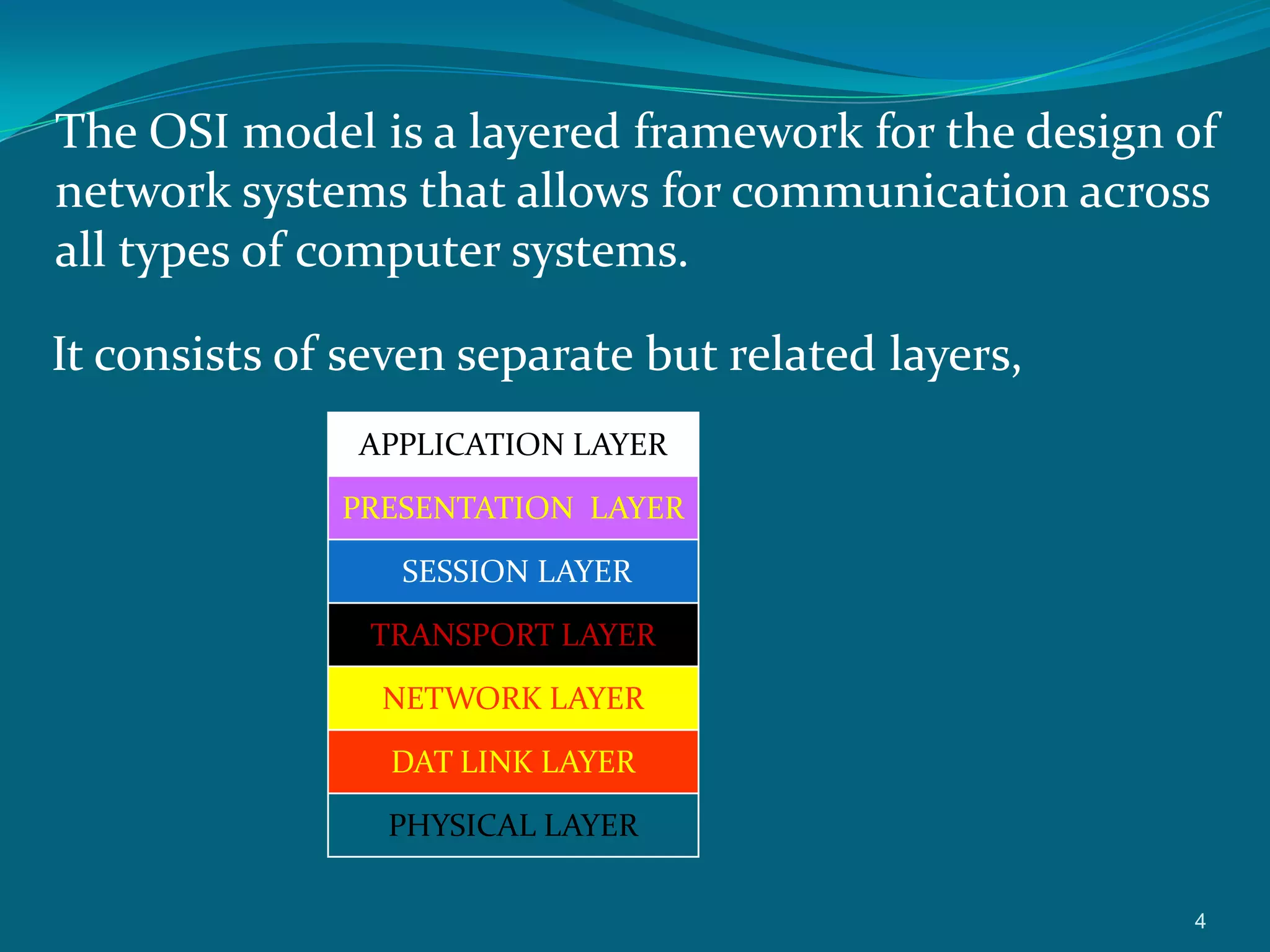
Is a set of protocols that allows any two difference system to communicate regardless of their underlying  architecture. 4The OSI model is a layered framework for the design of network systems that allows for communication across all types of computer systems. It consists of seven separate but related layers, APPLICATION LAYERPRESENTATION  LAYER SESSION LAYERTRANSPORT LAYERNETWORK LAYERDAT LINK LAYERPHYSICAL LAYER
INTRODUCTION TO PPP:In networking, the Point-to-Point Protocol, or PPP, is a data link protocol.
 PPP is commonly used in establishing a direct connection between two networking nodes. It can provide connection authentication, transmission encryption privacy, and compression.WHY POINT TO POINT:When computer is connected to ISP via the modem, theISP and the computer made the two common points onthe network and hence the protocol which operatesbetween these 2 points is called Point to Point protocol. 5
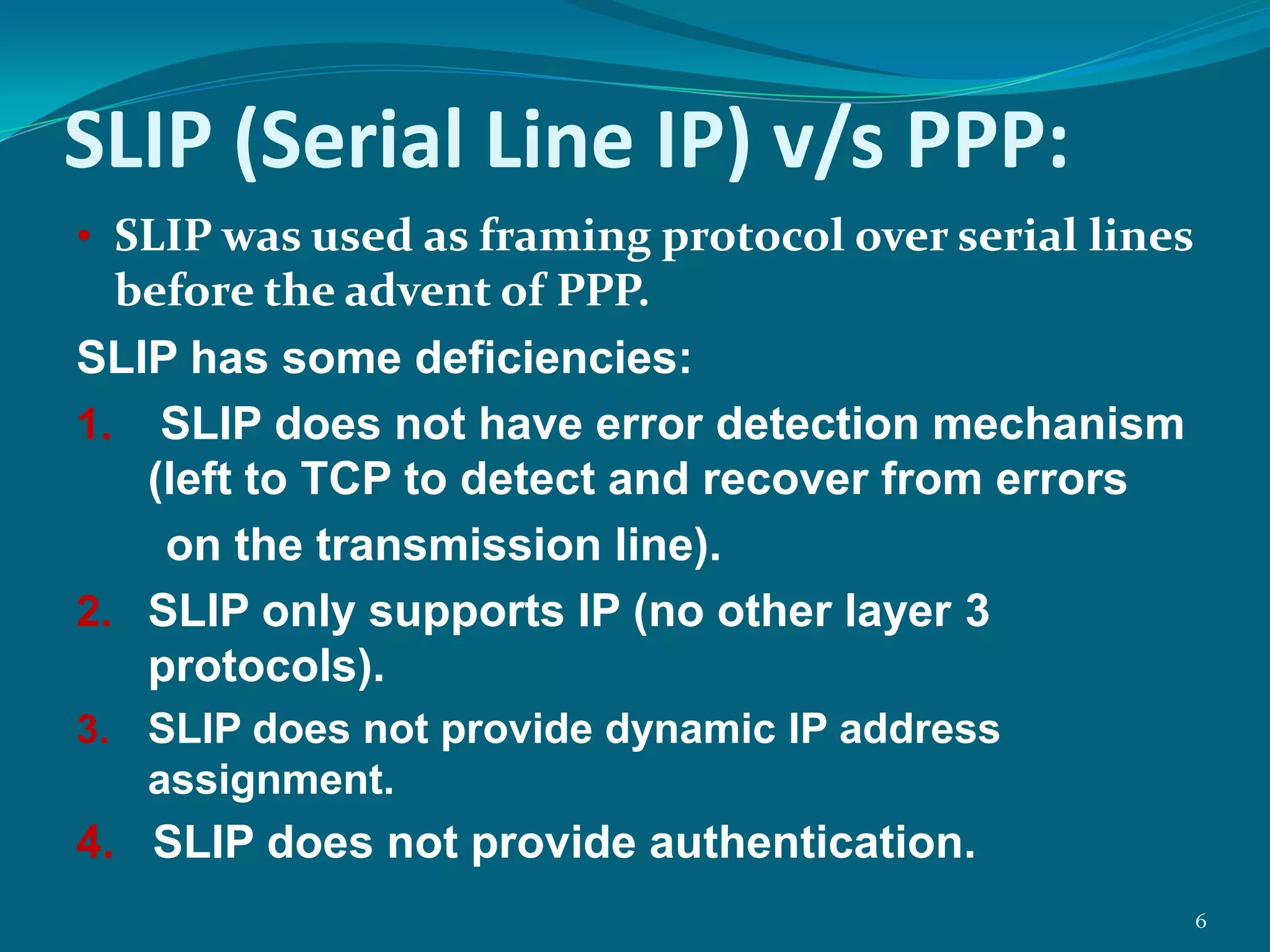
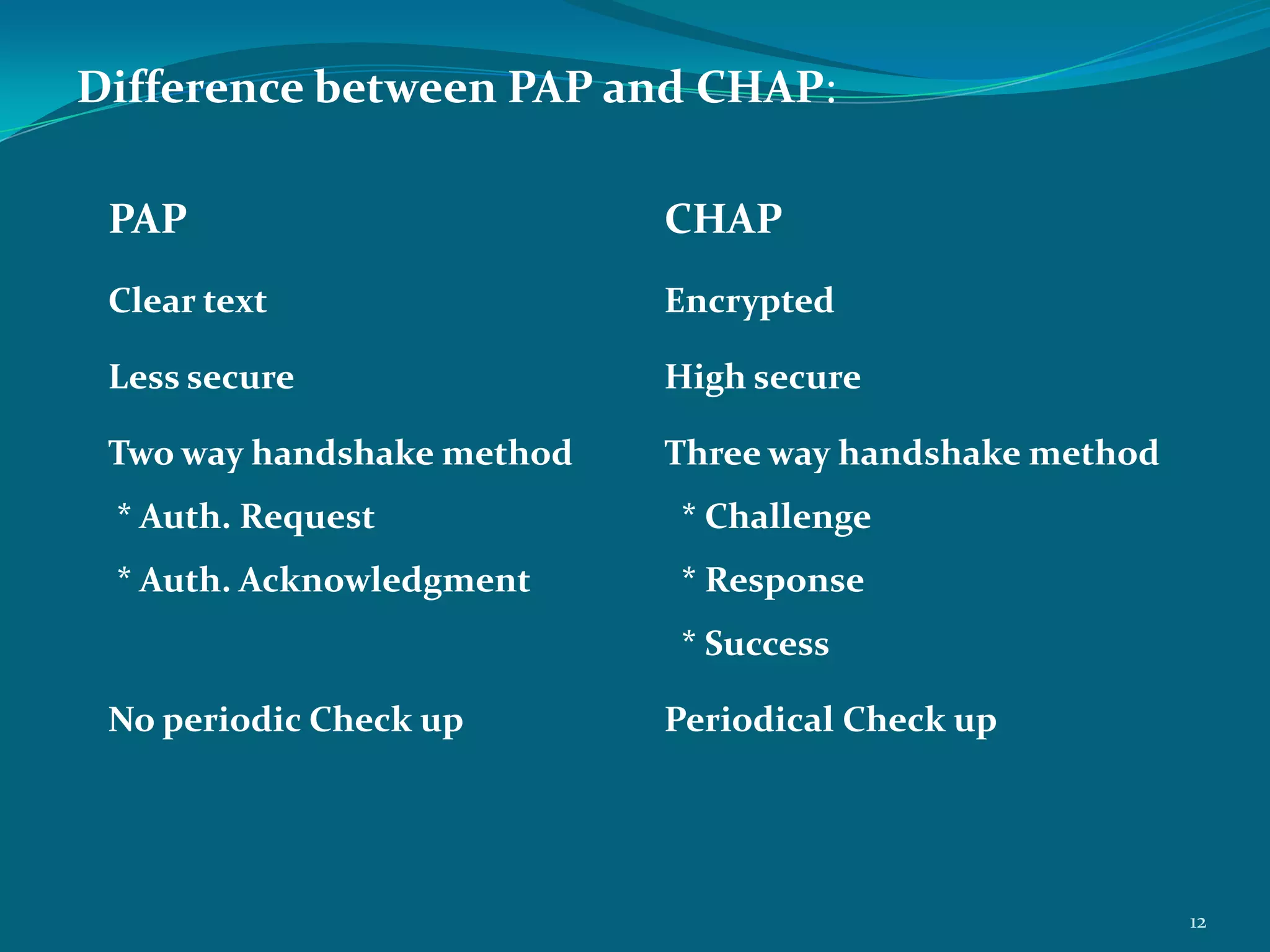
SLIP (Serial Line IP) v/s PPP:SLIP was used as framing protocol over serial lines before the advent of PPP.SLIP has some deficiencies: SLIP does not have error detection mechanism (left to TCP to detect and recover from errors       on the transmission line).SLIP only supports IP (no other layer 3 protocols).SLIP does not provide dynamic IP address            assignment.4.   SLIP does not provide authentication.6
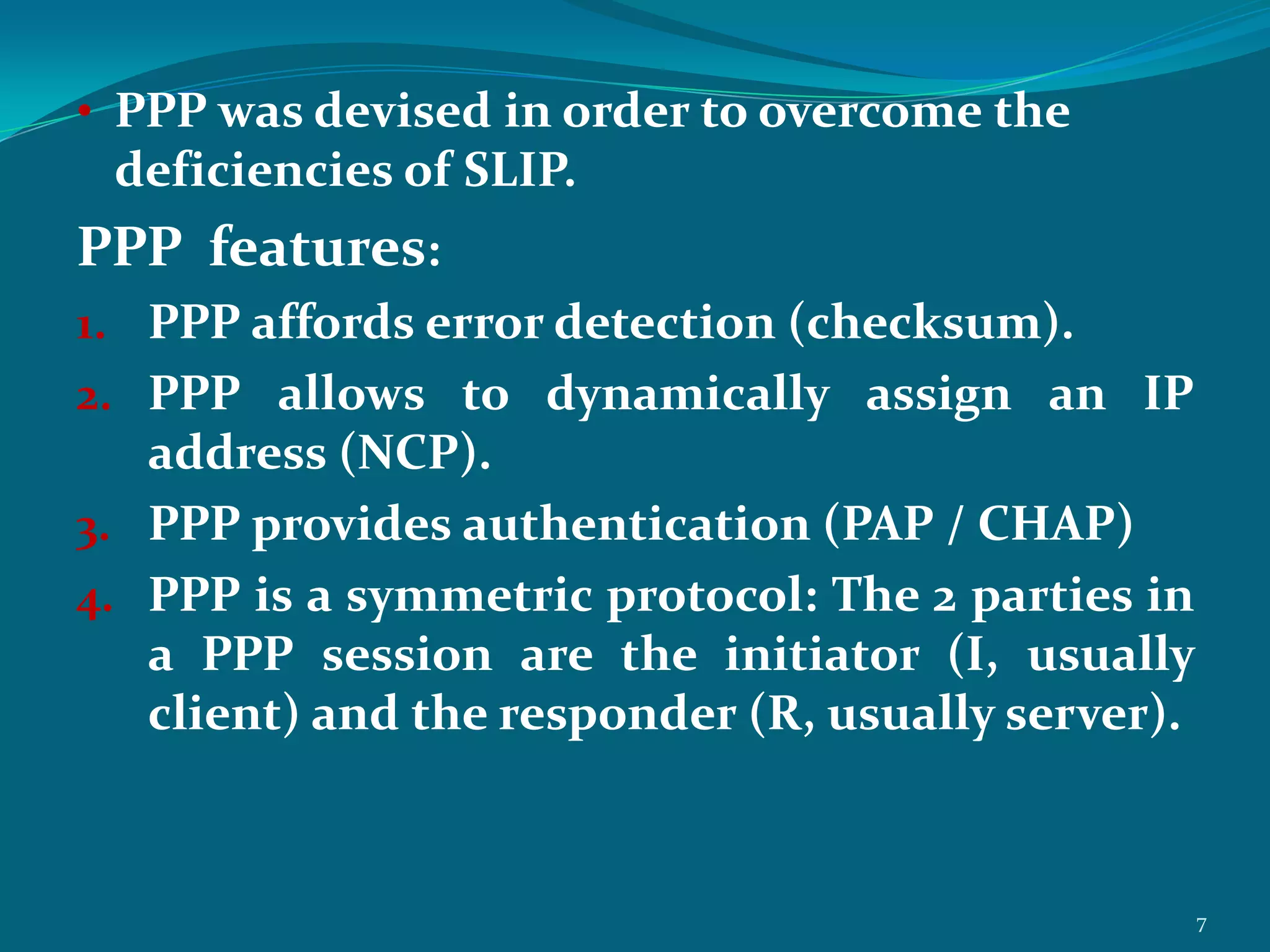
PPP was devised in order to overcome the deficiencies of SLIP.PPP  features:PPP affords error detection (checksum).PPP allows to dynamically assign an IP address (NCP).PPP provides authentication (PAP / CHAP)PPP is a symmetric protocol: The 2 parties in a PPP session are the initiator (I, usually client) and the responder (R, usually server).7
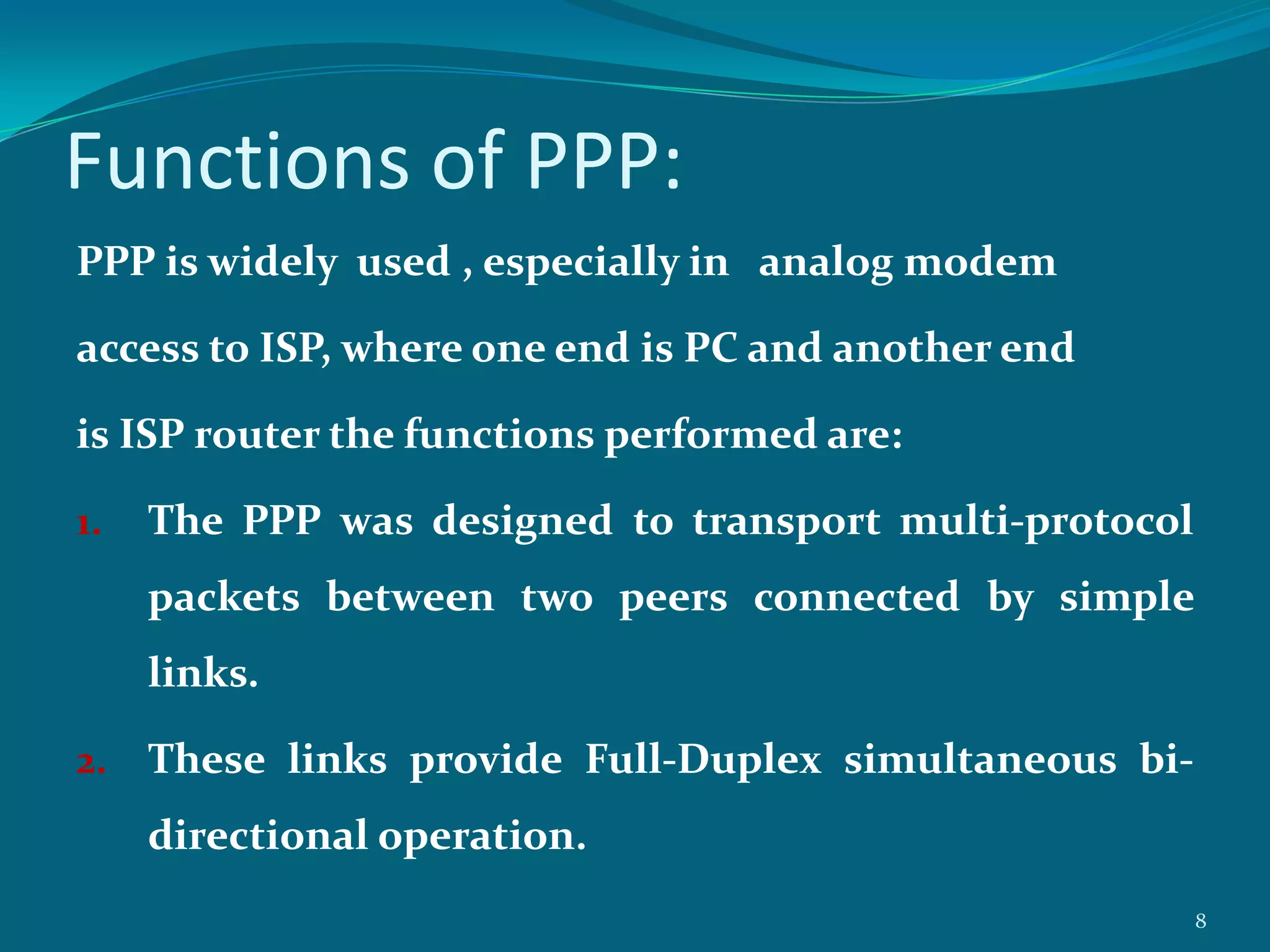
Functions of PPP:PPP is widely  used , especially in   analog modemaccess to ISP, where one end is PC and another endis ISP router the functions performed are:The PPP was designed to transport multi-protocol packets between two peers connected by simple links.These links provide Full-Duplex simultaneous bi-directional operation.8
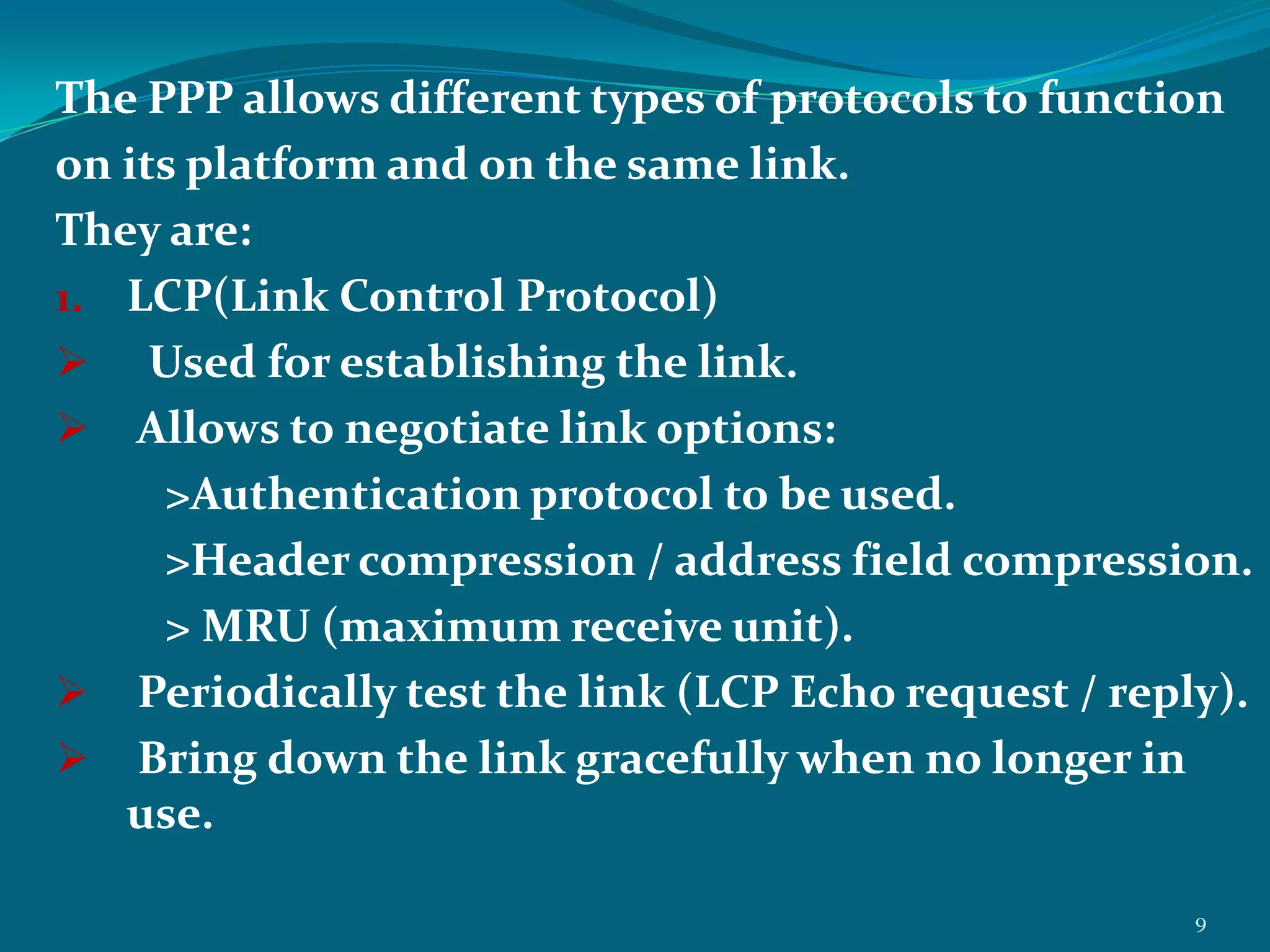
The PPP allows different types of protocols to functionon its platform and on the same link. They are:LCP(Link Control Protocol)  Used for establishing the link.
 Allows to negotiate link options:          >Authentication protocol to be used.          >Header compression / address field compression.          > MRU (maximum receive unit). Periodically test the link (LCP Echo request / reply).

Ppp

  • 1.
    ppp: Point toPoint ProtocolBabugouda Patil7th EC SJCE 1
  • 2.
  • 3.
  • 4.
  • 5.
  • 6.
  • 7.
  • 8.
  • 9.
  • 10.
    OSI Reference modelOSI: OPEN SYSTEM INTERCONNECTION
  • 11.
    The purpose ofthe OSI model is to open communication between different systems without requiring changes to the logic of the hardware and software.
  • 12.
    Is a setof protocols that allows any two difference system to communicate regardless of their underlying architecture. 4The OSI model is a layered framework for the design of network systems that allows for communication across all types of computer systems. It consists of seven separate but related layers, APPLICATION LAYERPRESENTATION LAYER SESSION LAYERTRANSPORT LAYERNETWORK LAYERDAT LINK LAYERPHYSICAL LAYER
  • 13.
    INTRODUCTION TO PPP:Innetworking, the Point-to-Point Protocol, or PPP, is a data link protocol.
  • 14.
    PPP iscommonly used in establishing a direct connection between two networking nodes. It can provide connection authentication, transmission encryption privacy, and compression.WHY POINT TO POINT:When computer is connected to ISP via the modem, theISP and the computer made the two common points onthe network and hence the protocol which operatesbetween these 2 points is called Point to Point protocol. 5
  • 15.
    SLIP (Serial LineIP) v/s PPP:SLIP was used as framing protocol over serial lines before the advent of PPP.SLIP has some deficiencies: SLIP does not have error detection mechanism (left to TCP to detect and recover from errors on the transmission line).SLIP only supports IP (no other layer 3 protocols).SLIP does not provide dynamic IP address assignment.4. SLIP does not provide authentication.6
  • 16.
    PPP was devisedin order to overcome the deficiencies of SLIP.PPP features:PPP affords error detection (checksum).PPP allows to dynamically assign an IP address (NCP).PPP provides authentication (PAP / CHAP)PPP is a symmetric protocol: The 2 parties in a PPP session are the initiator (I, usually client) and the responder (R, usually server).7
  • 17.
    Functions of PPP:PPPis widely used , especially in analog modemaccess to ISP, where one end is PC and another endis ISP router the functions performed are:The PPP was designed to transport multi-protocol packets between two peers connected by simple links.These links provide Full-Duplex simultaneous bi-directional operation.8
  • 18.
    The PPP allowsdifferent types of protocols to functionon its platform and on the same link. They are:LCP(Link Control Protocol) Used for establishing the link.
  • 19.
    Allows tonegotiate link options: >Authentication protocol to be used. >Header compression / address field compression. > MRU (maximum receive unit). Periodically test the link (LCP Echo request / reply).
  • 20.
    Bring downthe link gracefully when no longer in use. 9
  • 21.
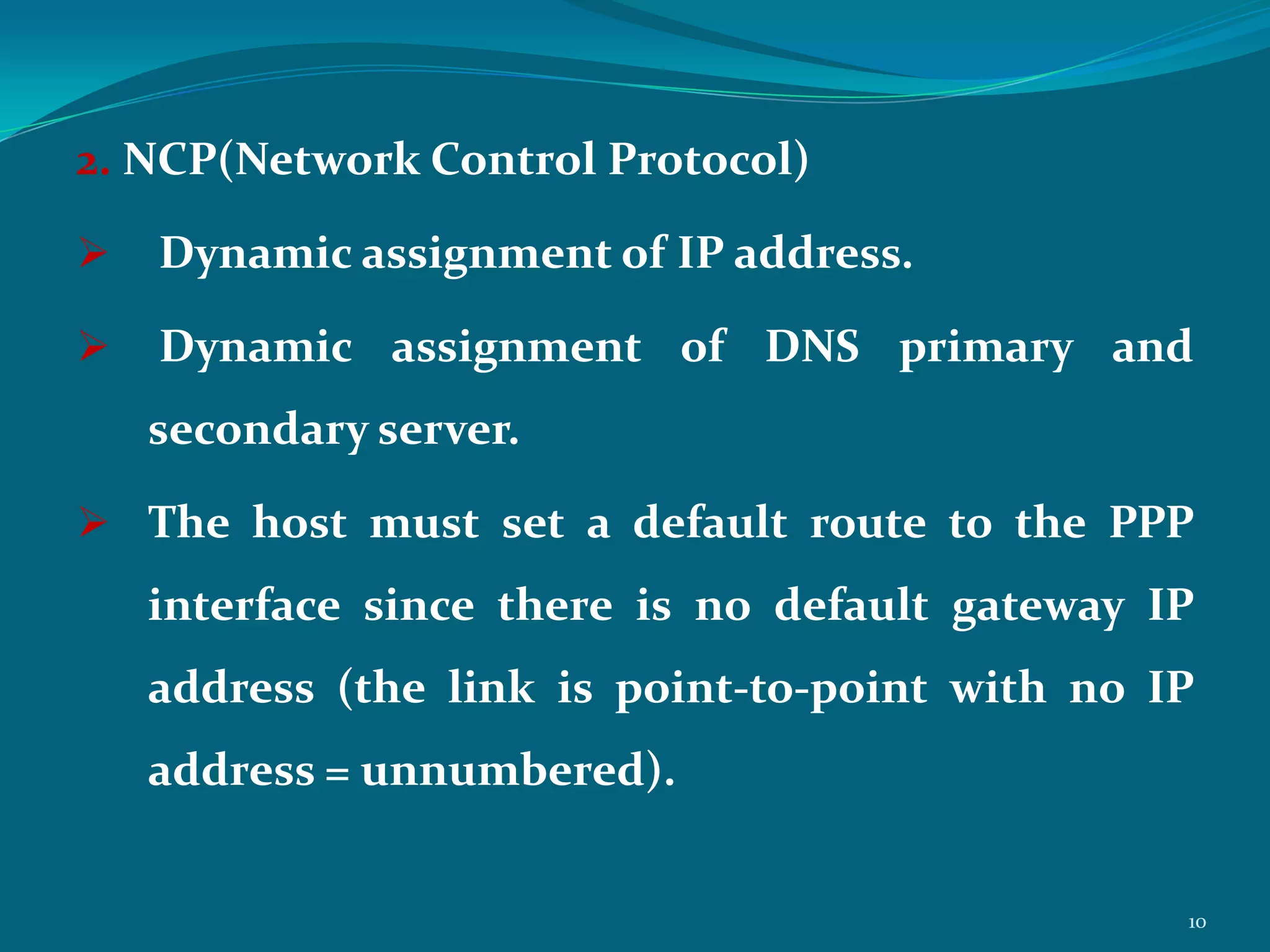
    2. NCP(Network ControlProtocol) Dynamic assignment of IP address.
  • 22.
    Dynamic assignmentof DNS primary and secondary server.
  • 23.
    The host mustset a default route to the PPP interface since there is no default gateway IP address (the link is point-to-point with no IP address = unnumbered).10
  • 24.
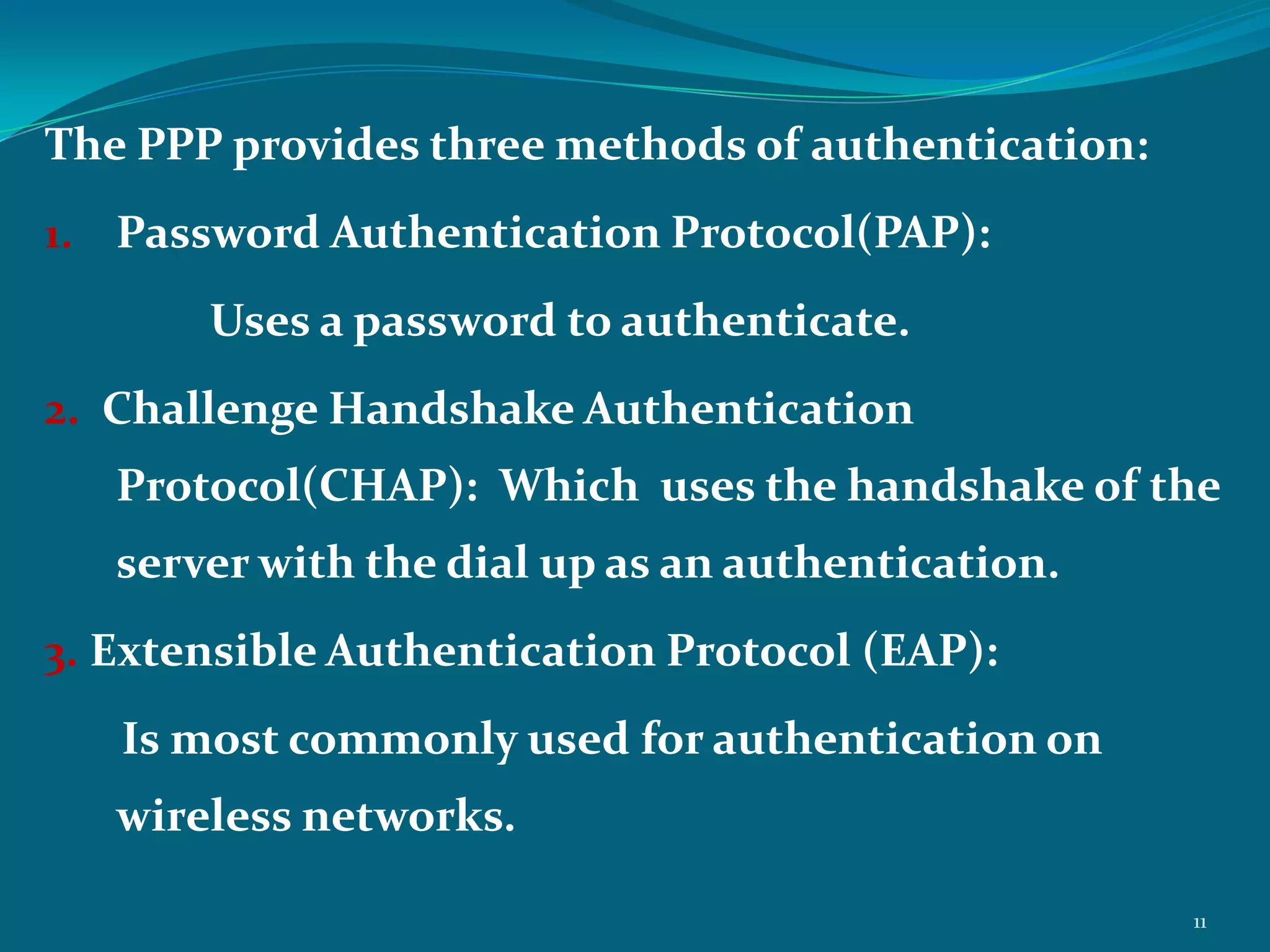
    The PPP providesthree methods of authentication:Password Authentication Protocol(PAP): Uses a password to authenticate.2. Challenge Handshake Authentication Protocol(CHAP): Which uses the handshake of the server with the dial up as an authentication. 3. Extensible Authentication Protocol (EAP): Is most commonly used for authentication on wireless networks.11
  • 25.
  • 26.
  • 27.
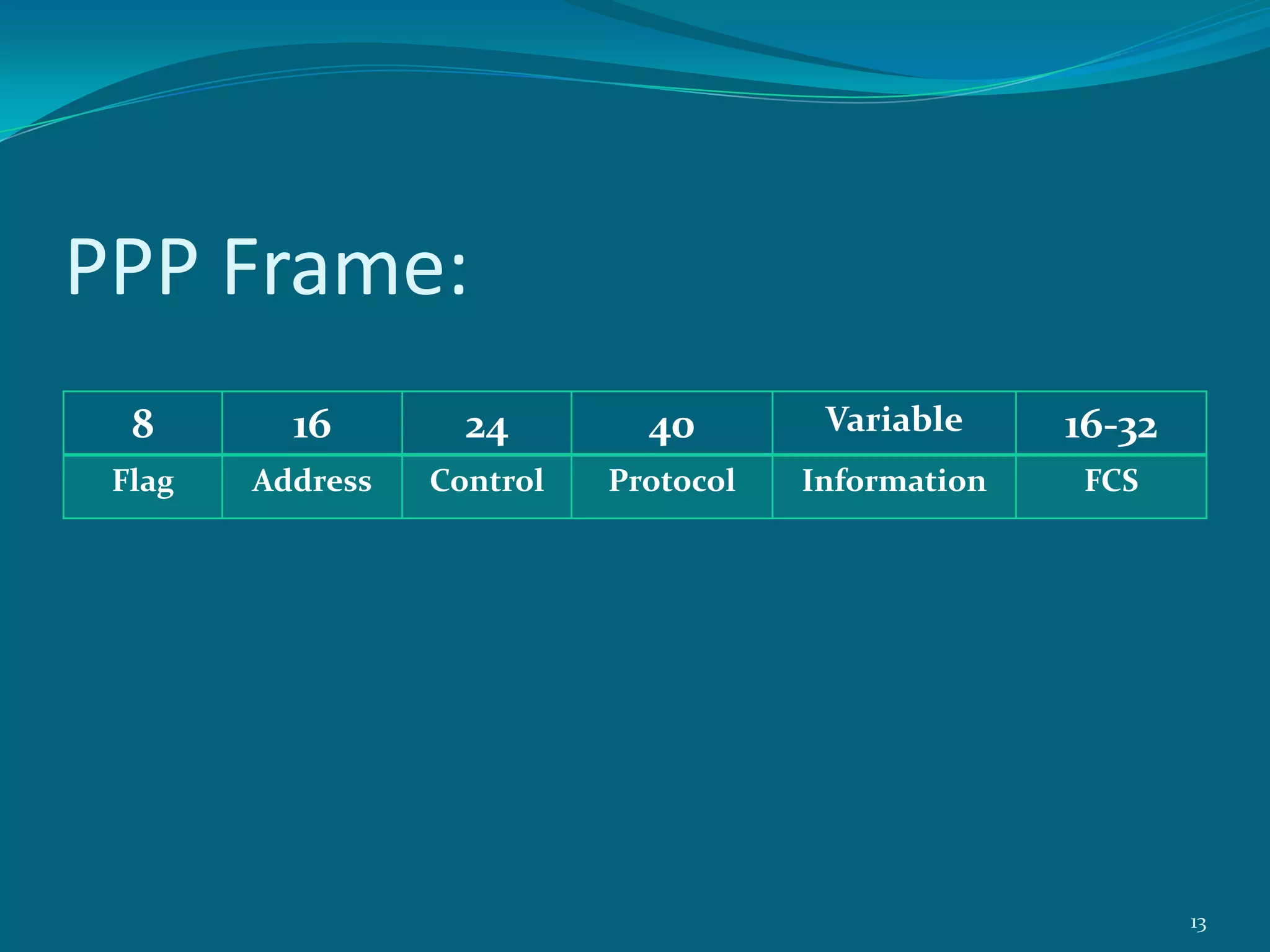
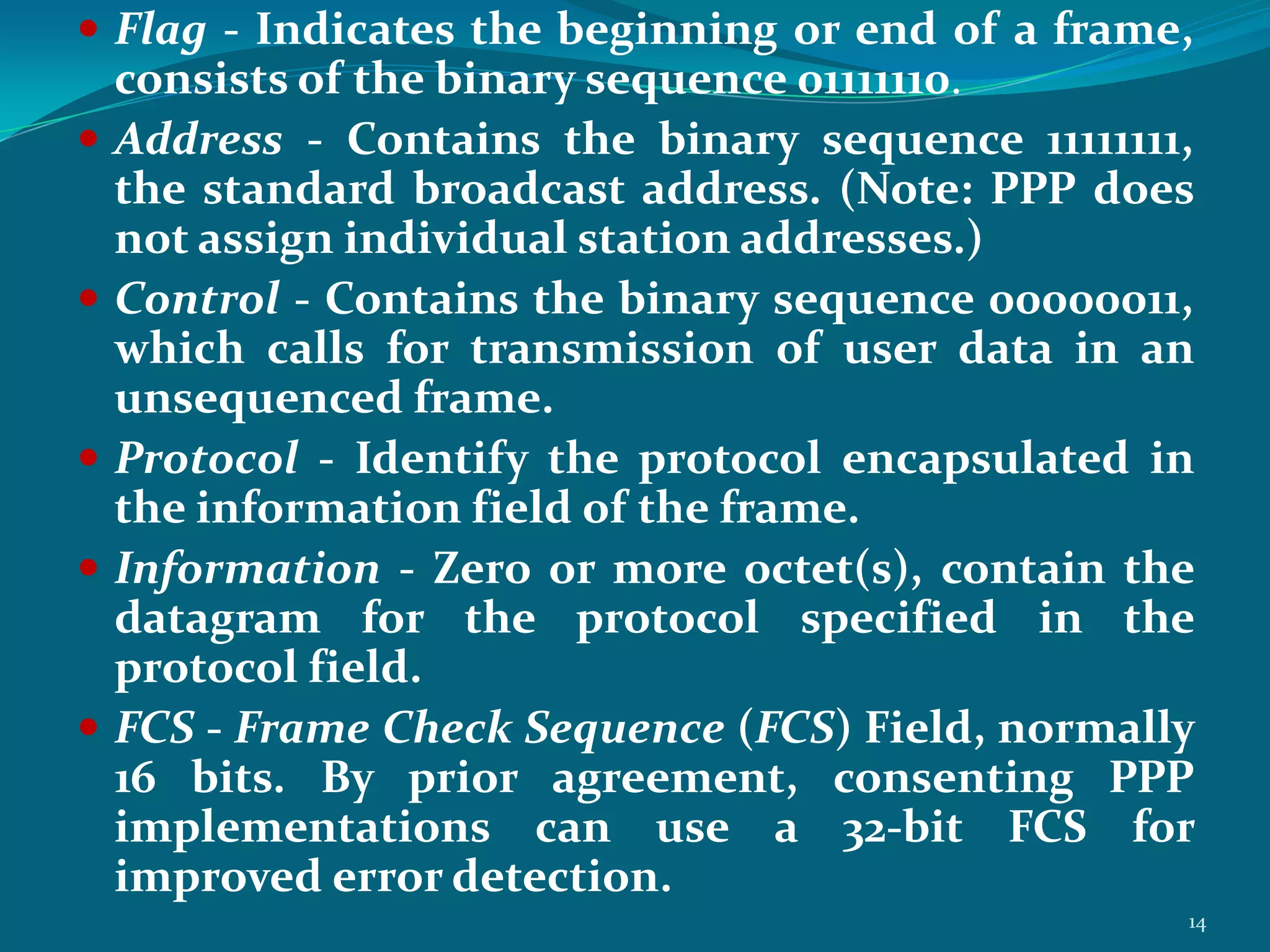
    Flag - Indicatesthe beginning or end of a frame, consists of the binary sequence 01111110.Address - Contains the binary sequence 11111111, the standard broadcast address. (Note: PPP does not assign individual station addresses.)Control - Contains the binary sequence 00000011, which calls for transmission of user data in an unsequenced frame.Protocol - Identify the protocol encapsulated in the information field of the frame.Information - Zero or more octet(s), contain the datagram for the protocol specified in the protocol field.FCS - Frame Check Sequence (FCS) Field, normally 16 bits. By prior agreement, consenting PPP implementations can use a 32-bit FCS for improved error detection.14
  • 28.
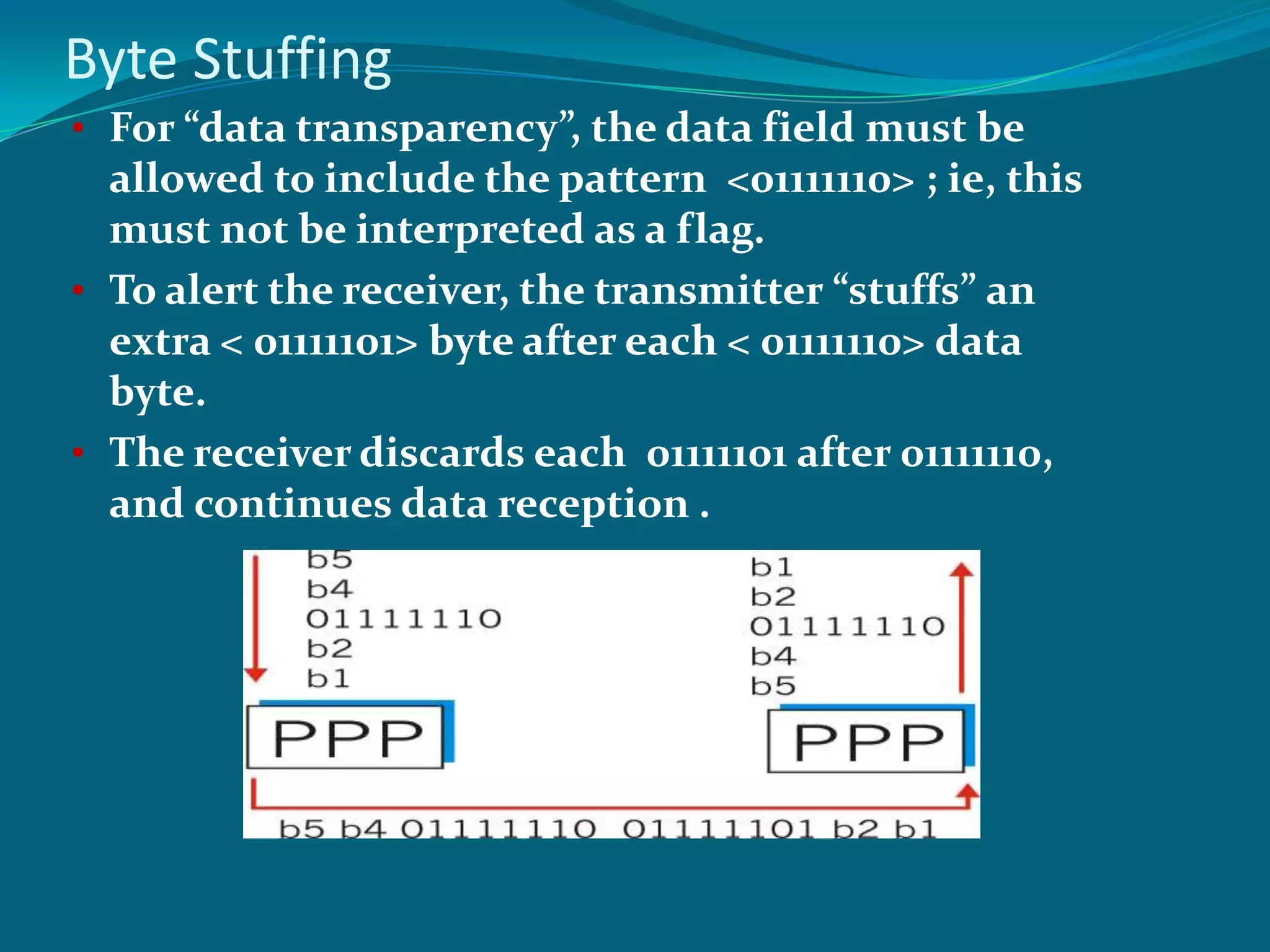
    Byte StuffingFor “datatransparency”, the data field must be allowed to include the pattern <01111110> ; ie, this must not be interpreted as a flag.
  • 29.
    To alert thereceiver, the transmitter “stuffs” an extra < 01111101> byte after each < 01111110> data byte.
  • 30.
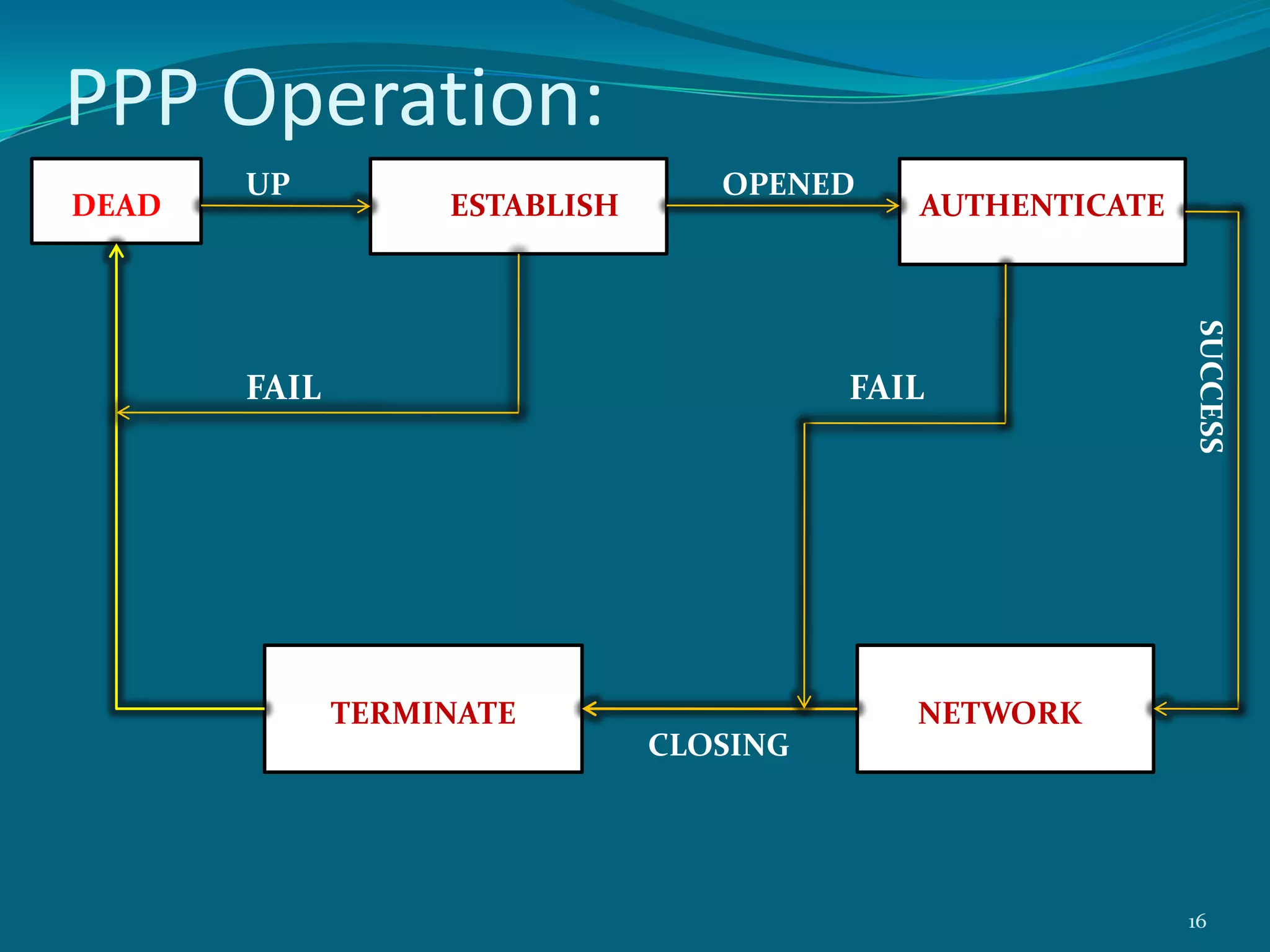
    The receiver discardseach 01111101 after 01111110, and continues data reception .PPP Operation:16UPOPENEDDEADESTABLISHAUTHENTICATEFAILFAILSUCCESSTERMINATENETWORKCLOSING
  • 31.
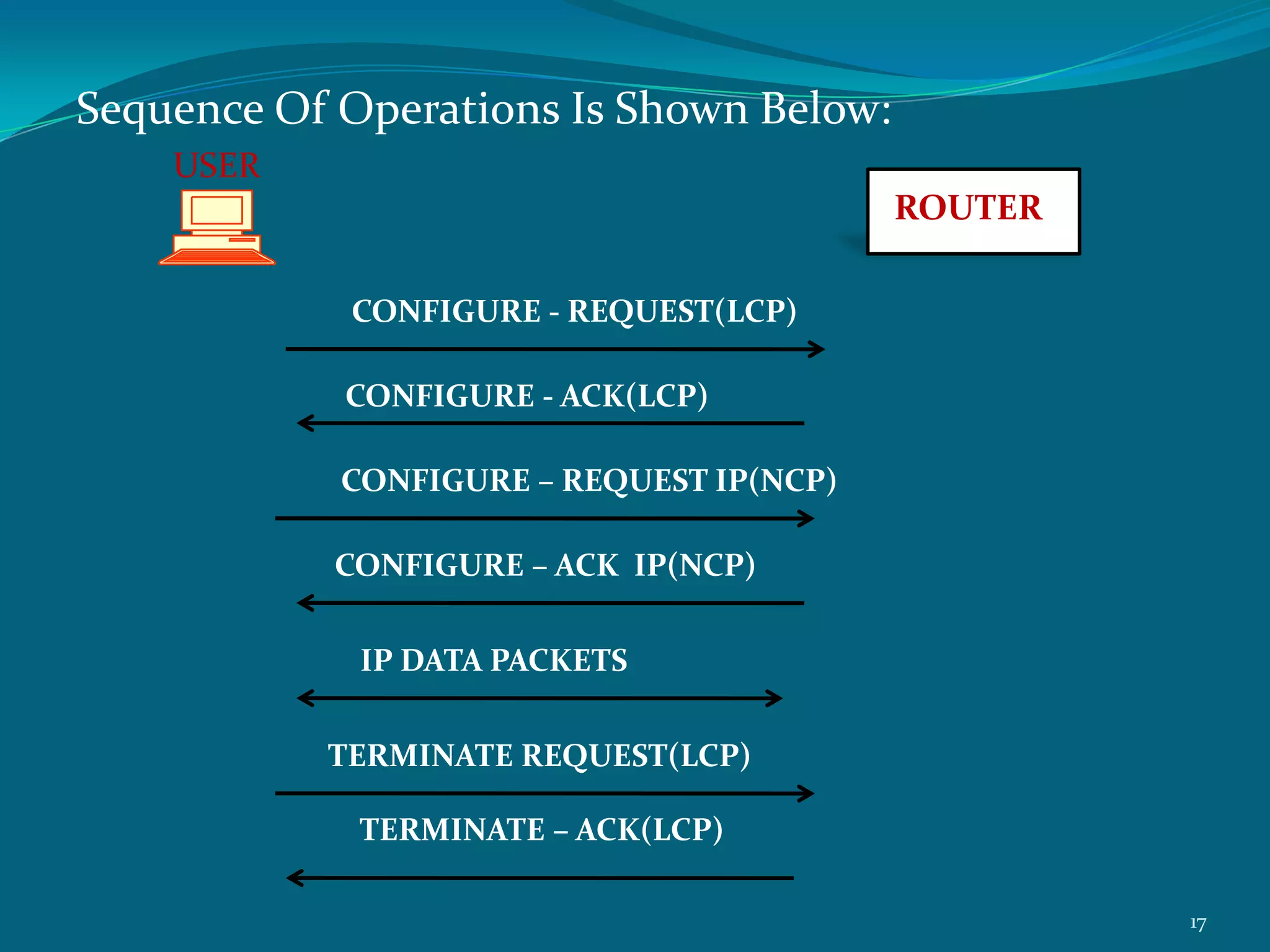
    Sequence Of OperationsIs Shown Below: USER17ROUTERCONFIGURE - REQUEST(LCP) CONFIGURE - ACK(LCP)CONFIGURE – REQUEST IP(NCP) CONFIGURE – ACK IP(NCP) IP DATA PACKETS TERMINATE REQUEST(LCP) TERMINATE – ACK(LCP)
  • 32.
    Application of PPP:PPP(Point to Point Protocol) is very popular: used in dial up connection between residential Host and ISP; On SONET/SDH connections.PPP is extremely simple (the simplest in the Data Link protocol family) and very streamlined. 18
  • 33.