DUST OF SNOW
BY:ROBERT FROST
SUMMARY
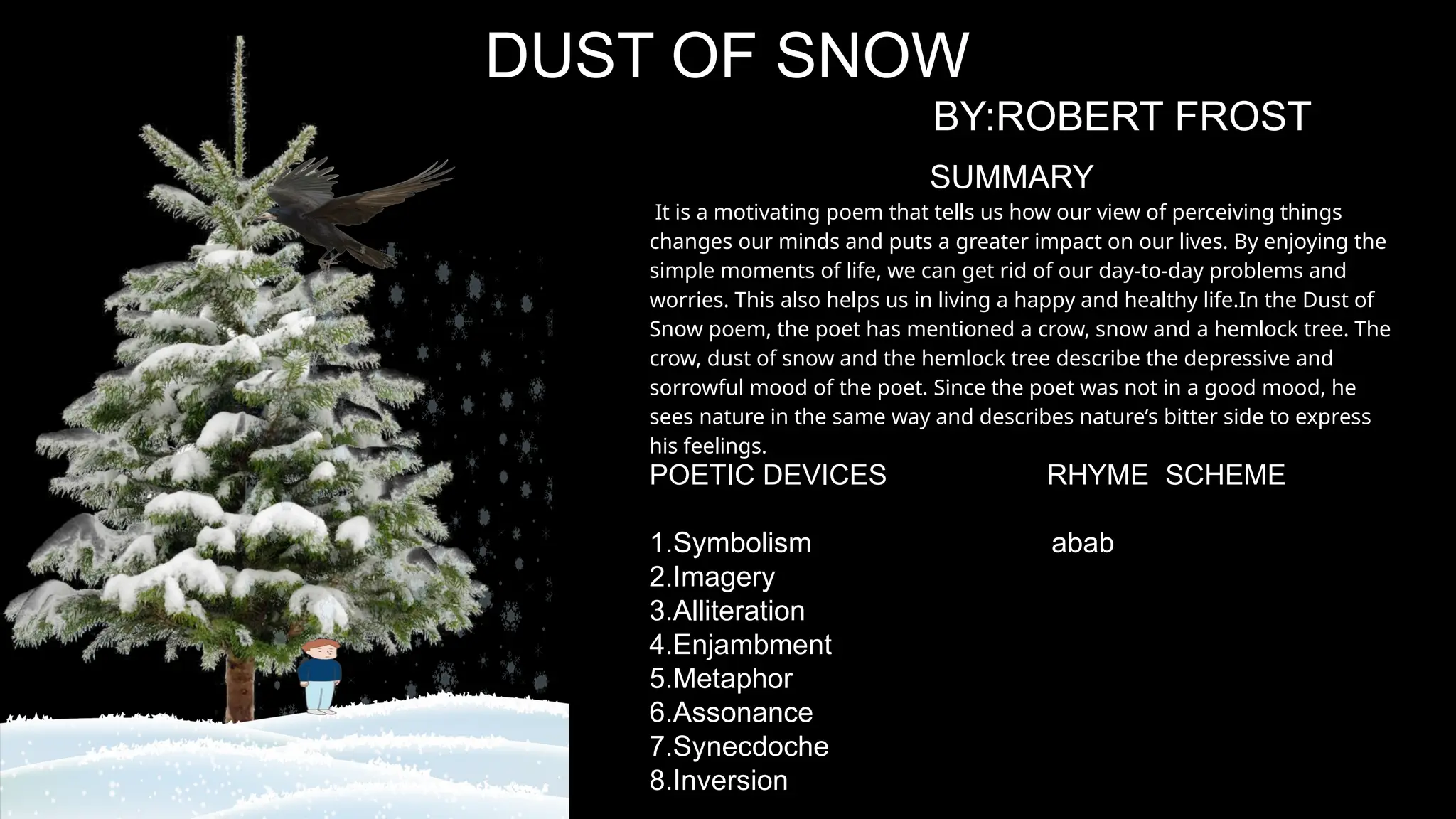
It is a motivating poem that tells us how our view of perceiving things
changes our minds and puts a greater impact on our lives. By enjoying the
simple moments of life, we can get rid of our day-to-day problems and
worries. This also helps us in living a happy and healthy life.In the Dust of
Snow poem, the poet has mentioned a crow, snow and a hemlock tree. The
crow, dust of snow and the hemlock tree describe the depressive and
sorrowful mood of the poet. Since the poet was not in a good mood, he
sees nature in the same way and describes nature’s bitter side to express
his feelings.
POETIC DEVICES RHYME SCHEME
1.Symbolism abab
2.Imagery
3.Alliteration
4.Enjambment
5.Metaphor
6.Assonance
7.Synecdoche
8.Inversion
SUMMARY
The poem expresses the idea that the world will
end someday, either by Fire or by Ice. Here, the
poet has compared Fire and Ice with the self-
destructing emotions of human beings. The fire
and ice poem beautifully describes how humans
let their emotions rule over them. They have no
control over their desires. They work towards
achieving their desires, but the more they work,
the more they get trapped in them. Thus, they
never feel satisfied and destroy their life. In a
similar way, the poet thinks that fire and ice will
lead to the destruction of the world.
FIRE AND ICE
BY:ROBERT FROST
POETIC DEVICES RHYME SCHEME
1.Symbolism Stanza - 1 = abaa
2.Imagery Stanza - 2 = ababa
3.Personification
4.Anaphora
5.Alliteration
6.Assonance
7.Enjambment
8.Metaphor
9.Antithesis
A Tiger in the zoo
-LESLIE NORRIS
● Imagery
● Symbolism
● Oxymoron
● Personification
● Alliteration
● Metaphor
● Repetition
● Enjambment
● Metonymy
● Consonance
● Assonance
POETIC DEVICES
abcb and abcd
RHYME SCHEME
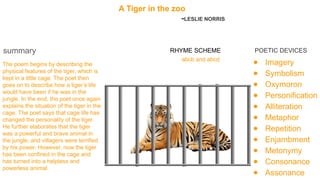
The poem begins by describing the
physical features of the tiger, which is
kept in a little cage. The poet then
goes on to describe how a tiger’s life
would have been if he was in the
jungle. In the end, the poet once again
explains the situation of the tiger in the
cage. The poet says that cage life has
changed the personality of the tiger.
He further elaborates that the tiger
was a powerful and brave animal in
the jungle, and villagers were terrified
by his power. However, now the tiger
has been confined in the cage and
has turned into a helpless and
powerless animal.
summary
The Ball Poem
-JOHN BERRYMAN
POETIC DEVICES
RHYME SCHEME
He was playing with his ball. The ball skipped from his
hand and went into the nearby water body. The poet
says that this sight of the boy losing his favorite ball
made him think about the boy and his reaction to this
situation. He further says that the boy was helplessly
looking into the water where his ball had gone. He was
sad and was trembling with fear. He got so immersed
in his sorrow that he kept standing near the harbour for
a very long time and kept on looking for his ball. The
poet says that he could console him that he may get
new balls or he could also give him some money to buy
another ball. But he stops himself from doing so
because he thinks that the money may bring a new ball
but will not bring the memories and feelings attached to
the lost ball. He further says that the time has come for
the boy to learn his responsibilities. Here the poet
wants to say that now the boy will learn the toughest
lesson of life. The lesson of accepting the harsh
realities of life that one day we will lose our loved ones
and our loved things.
Anaphora
Assonance
Imagery
repetition
No Rhyme Scheme
SUMMARY
AMANDA
-ROBIN KLEIN
POETIC DEVICES
● Repetition
● Allusion
● Alliteration
● Metaphor
● Anaphora
● Transferred
Epithet
RHYME SCHEME
aaba, ccc, aaba
SUMMARY
The poem is about a little girl, Amanda,
who is constantly pointed out by her
mother for making mistakes. Robin Klein
has beautifully expressed the girl’s
feelings in the poem about how she is
controlled and instructed by her mother
for small things. The poem conveys an
important message that children should
never be deprived of their freedom. They
should not feel that their parents
constantly nag them for every single
thing they do. It’s the responsibility of the
parents to bring up their children in such
a way that they understand their
viewpoint instead of getting frustrated.
Children should not feel that an orphan
has more freedom than them.
How to Tell Wild Animals
SUMMARY
RHYME SCHEME
POETIC DEVICES
● Allusion
● Alliteration
● Enjambment
● Metaphor
● Simile
● Assonance
babcc
The poem suggests some
dangerous ways to identify
wild animals. In the poem,
clues have been given to
identify the names of the
animals. The poem consists
of 6 stanzas, and in each
stanza, a wild animal is
defined by its characteristics
and features. This poem is
like solving a puzzle and
identifying the animals. It’s
an exciting and funny poem.
-carolyn Wells
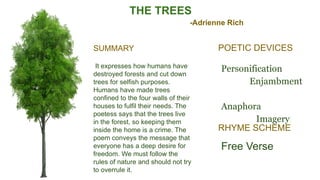
THE TREES
-Adrienne Rich
POETIC DEVICES
SUMMARY
RHYME SCHEME
Personification
Enjambment
Anaphora
Imagery
Free Verse
It expresses how humans have
destroyed forests and cut down
trees for selfish purposes.
Humans have made trees
confined to the four walls of their
houses to fulfil their needs. The
poetess says that the trees live
in the forest, so keeping them
inside the home is a crime. The
poem conveys the message that
everyone has a deep desire for
freedom. We must follow the
rules of nature and should not try
to overrule it.
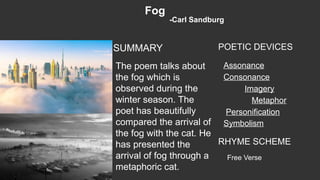
Fog
-Carl Sandburg
POETIC DEVICES
RHYME SCHEME
SUMMARY
Assonance
Consonance
Imagery
Metaphor
Personification
Symbolism
Free Verse
The poem talks about
the fog which is
observed during the
winter season. The
poet has beautifully
compared the arrival of
the fog with the cat. He
has presented the
arrival of fog through a
metaphoric cat.
The Tale of Custard the Dragon
-Ogden Nash
POETIC DEVICES
RHYME SCHEME
SUMMARY
Ballad
Simile
Metaphor
Repetition
Onomatopoeia
Alliteration
Allusion
Irony
Aabb
aabbcc
A little girl named Belinda is described
in this poem with many pets whom
she had named. She has named the
black kitten Ink, the grey mouse Blink,
the yellow dog Mustard and the
coward dragon Custard. The poet has
beautifully described all these
characters in the poem. He says that
all of them are very brave except the
dragon. But his perception changes
when the dragon saves everyone from
the attack of pirates on Belinda’s
house.
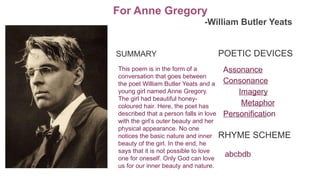
For Anne Gregory
-William Butler Yeats
POETIC DEVICES
SUMMARY
RHYME SCHEME
Assonance
Consonance
Imagery
Metaphor
Personification
abcbdb
This poem is in the form of a
conversation that goes between
the poet William Butler Yeats and a
young girl named Anne Gregory.
The girl had beautiful honey-
coloured hair. Here, the poet has
described that a person falls in love
with the girl’s outer beauty and her
physical appearance. No one
notices the basic nature and inner
beauty of the girl. In the end, he
says that it is not possible to love
one for oneself. Only God can love
us for our inner beauty and nature.
A Letter to God
-G.L.Fuentes
Summary
Theme
Characters
Lencho
Postmaster
Blind Faith in the Mercy of God
Humanity
Nature and its Destructive Side
A poor farmer named Lencho, a dedicated
farmer, was devastated by a hailstorm that
destroyed his crops. Despite his sadness, he
had a strong faith in God and wrote a letter to
God requesting one hundred pesos to save
his family from starvation. The
postmaster, a fellow farmer,
noticed the letter and praised
the farmer's faith. He asked the post office
employees to contribute money as charity, but the money
collected was less than Lencho's request. The postmaster then sent the
money to the farmer. The next day, Lencho found the money in an
envelope, but was upset to find only seventy pesos. He wrote another
letter to God, expressing his frustration and blaming the post office
employees for the theft. He urged God to send the rest of the money, but
requested not to send it through the mail.
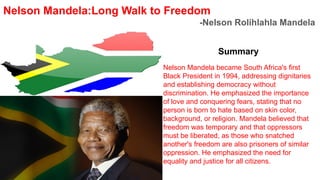
Nelson Mandela:Long Walk to Freedom
-Nelson Rolihlahla Mandela
Summary
Nelson Mandela became South Africa's first
Black President in 1994, addressing dignitaries
and establishing democracy without
discrimination. He emphasized the importance
of love and conquering fears, stating that no
person is born to hate based on skin color,
background, or religion. Mandela believed that
freedom was temporary and that oppressors
must be liberated, as those who snatched
another's freedom are also prisoners of similar
oppression. He emphasized the need for
equality and justice for all citizens.
His First Flight
-Liam O’ Flaherty
Theme:-courage and self-confidence
Characters:-Young Seagull,Mother
Seagull ,Father Seagull
Summary:- A young seagull, fearing his
wings, feared taking his first flight. His
siblings, with smaller wings, bravely flew in
the open air. His parents threatened him, but
he remained steadfast. One day, the family
flew to a plateau, taunting him for his
cowardice. After being starving, he begged
his mother for food, and she brought him fish.
He fell outward, feeling terrified. His wings
spread outward, and he soared higher,
skimming through waves and diving with his
siblings.
Black Aeroplane
-Frederick Forsyth
Theme:-Overcoming fears forces one to
learn, and embracing risk-taking also helps
one to overcome the fear of failure.
Summary:-A pilot, en route from France to
England, encounters black clouds and
loses control of his plane. He notices
another plane with no lights on its wings
and follows it, blindly following the other
pilot due to the lack of radio signals and
low fuel tank. The pilot lands safely on the
runway with the help of the other pilot. The
pilot asks the reception about the other
pilot who saved his life, but the woman in
the control center tells him that there was
no other plane in the night sky other than
Form the Diary of Anne Frank
-Anne Frank
Summary:-Anne, a lonely girl, initially felt
uncomfortable writing her thoughts in her diary, "Kitty." She
considered her diary a loyal friend and loved her family,
especially her father. On June 20, 1942, Anne's class was
nervous about their exam results, and she felt that about a
quarter of the class were dummies who should be kept
back in the same class.Anne's math teacher, Mr. Keesing,
was annoyed by her talkative nature and punished her
with extra homework. He assigned her an essay on 'A
Chatterbox', which she justified as a way to improve
herself. However, her mother's trait inherited the trait, and
she was assigned a second essay, 'An Incorrigible
Chatterbox'.In the third lesson, Mr. Keesing assigned her
another essay, 'Quack, Quack, Quack, Said Mistress
Chatterbox,' as a punishment for her incorrigible habit.
Anne's friend, Sanne, wrote the essay in satirical verse,
which was enjoyed by her teacher. Since then, Anne has
been allowed to talk in class and has never been assigned
any extra homework by Mr. Keesing.
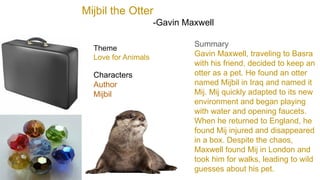
Mijbil the Otter
-Gavin Maxwell
Characters
Author
Mijbil
Theme
Love for Animals
Summary
Gavin Maxwell, traveling to Basra
with his friend, decided to keep an
otter as a pet. He found an otter
named Mijbil in Iraq and named it
Mij. Mij quickly adapted to its new
environment and began playing
with water and opening faucets.
When he returned to England, he
found Mij injured and disappeared
in a box. Despite the chaos,
Maxwell found Mij in London and
took him for walks, leading to wild
guesses about his pet.
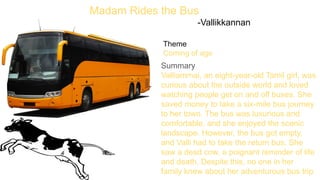
Madam Rides the Bus
-Vallikkannan
Theme
Coming of age
Summary
Valliammai, an eight-year-old Tamil girl, was
curious about the outside world and loved
watching people get on and off buses. She
saved money to take a six-mile bus journey
to her town. The bus was luxurious and
comfortable, and she enjoyed the scenic
landscape. However, the bus got empty,
and Valli had to take the return bus. She
saw a dead cow, a poignant reminder of life
and death. Despite this, no one in her
family knew about her adventurous bus trip.
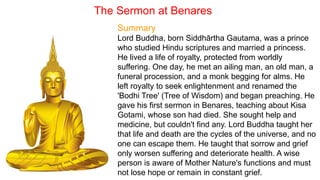
The Sermon at Benares
Summary
Lord Buddha, born Siddhārtha Gautama, was a prince
who studied Hindu scriptures and married a princess.
He lived a life of royalty, protected from worldly
suffering. One day, he met an ailing man, an old man, a
funeral procession, and a monk begging for alms. He
left royalty to seek enlightenment and renamed the
'Bodhi Tree' (Tree of Wisdom) and began preaching. He
gave his first sermon in Benares, teaching about Kisa
Gotami, whose son had died. She sought help and
medicine, but couldn't find any. Lord Buddha taught her
that life and death are the cycles of the universe, and no
one can escape them. He taught that sorrow and grief
only worsen suffering and deteriorate health. A wise
person is aware of Mother Nature's functions and must
not lose hope or remain in constant grief.
The Proposal
-Anton Chekov
Characters
Stepan Stepanovitch
Chubukov
Natalya Stepanovna
Ivan Vassilevitch Lomov
Summary
Ivan Lomov visits Stephan Chubukov, a wealthy neighbor,
seeking his twenty-five-year-old daughter, Natalya
Stepanovna's hand in marriage. Lomov, a wealthy man, initially
assumes he is asking for money. However, when Chubukov
learns about the proposal, he embraces him and calls Natalya.
They discuss their cordial relationship, but Natalya objects to
his disputed land, Oxen Meadows. Lomov has a palpitation
attack, and Natalya's father, Chubukov, accidentally mentions
the proposal to Natalya. Natalya calls Chubukov back, and
they discuss their dogs, leading to a heated argument. Natalya
asks her father to wake up Lomov, and they agree to marry.
However, the quarrel persists as Natalya claims her dog
Squeezer is better than Lomov's Guess. Lomov refuses to
accept that his dog is worse than Natalya's dog.
A Baker from Goa
-Lucio Rodrigues
Goa, once ruled by the
Portuguese, has a rich Portuguese
culture, with baking being the
traditional profession for the Goan
people. Bakers, known as 'paders',
would sell baked loaves in the
street, making a jingling sound with
bamboo. The villagers enjoyed
these loaves and baskets for
children. The bakers wore a single-
piece frock called Kabai, reaching
up to their knees. Baking became
the most profitable profession in
Goa, leading to prosperous lives
and a jackfruit-like physical
appearance.
Coorg
-Lokesh Abrol
Coorg, the smallest district of
Karnataka, is a beautiful
destination between Mangalore
and Mysore, known for its
evergreen forests, spices, and
coffee plantations. The region
attracts many tourists from
September to March, and its
people are independent and have
a Greek or Arabic connection. The
Coorg Regiment, one of the most
significant regiments in the Indian
Army, is based in the area. The
region is also home to the first
Indian Commander-in-Chief,
General Cariappa. Visitors can
enjoy high-adventure sports and
explore the diverse animals found
in the region.
Tea from Assam
-Arup Kumar Datta
Two friends, Rajvir and Pranjol, were
traveling to Assam and bought fresh
tea. They discussed the region's
special tea, which is consumed daily
worldwide. They learned about
Assam's largest tea plantations and
the origin of tea. They heard Chinese
legends about tea being created when
tea leaves accidentally fell into boiling
water, and Indian legend of
Bodhidharma's eyelids growing tea
plants. They arrived at Mariani
Junction and visited Dhekiabari Tea
Estate, where they met Pranjol's
father, who was amazed by Rajvir's
knowledge about tea plantations and
wanted to learn more.
தலைப்பு:- தூய்மையான காற்றைப்
பெறுவதற்குரிய வழிமுறைகளைப
உதவிக்குறிப்பு:-
மனிதனின் நலமான
வாழ்வுக்கு தூய்மையான காற்று முக்கியம்.
1. உள்ளடக்குதல் (Containment) :- உற்பத்தியில் இருந்து வெளிவரும் மாசுகள்
காற்றில் கலப்பதை தடுத்தல்.
2. மாற்றுதல் (Replacement) :- மாசுகளின் அளவைக் குறைப்பதற்கு புதிய
நுட்பங்களைகையாளுதல்.
3. நீர்க்கச் செய்தல் (Dilution) :- காற்றிலுள்ள மாசுகளின்
அடர்த்தியை நீர்க்கச் செய்து அவைகளை இயற்கையில்
இலைகளின் மூலம் நீக்குதல்.
4. சட்டம் இயற்றுதல் (Legislation) :- காற்றுமாசுறுதலை
தடுப்பதற்கு சட்டங்களை விதித்து செயலாற்றுதல்.
5. பன்னாட்டு செயல்கள் (International Action) :- உலக சுகாதார
நிறுவனம் இரண்டு பன்னாட்டு மாசு கணக்கீடு நிலையங்களை
வாஷிங்டன் மற்றும் லண்டனிலும், 3 வட்டார நிலையங்களை
டோக்கியோ, மாஸ்கோ மற்றும் நாக்பூரிலும் மற்றும் 20 ஆய்வுக்
கூடங்களை நாட்டின் வெவ்வேறு பகுதியிலும் நிறுவியுள்ளது.
செயல்முறைகள்:-
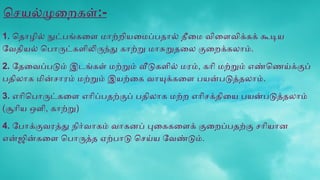
1. தொழில் நுட்பங்களை மாற்றியமைப்பதால் தீமை விளைவிக்கக் கூடிய
வேதியல் பொருட்களிலிருந்து காற்று மாசுறுதலை குறைக்கலாம்.
2. தேவைப்படும் இடங்கள் மற்றும் வீடுகளில் மரம், கரி மற்றும் எண்ணெய்க்குப்
பதிலாக மின்சாரம் மற்றும் இயற்கை வாயுக்களை பயன்படுத்தலாம்.
3. எரிபொருட்களை எரிப்பதற்குப் பதிலாக மற்ற எரிசக்தியை பயன்படுத்தலாம்
(சூரிய ஒளி, காற்று)
4. போக்குவரத்து நிர்வாகம் வாகனப் புகைகளைக் குறைப்பதற்கு சரியான
என்ஜின்களை பொருத்த ஏற்பாடு செய்ய வேண்டும்.
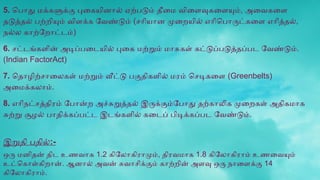
5. பொது மக்களுக்கு புகையினால் ஏற்படும் தீமை விளைவுகளையும், அவைகளை
தடுத்தல் பற்றியும் விளக்க வேண்டும் (சரியான முறையில் எரிபொருட்களை எரித்தல்,
நல்ல காற்றோட்டம்)
6. சட்டங்களின் அடிப்படையில் புகை மற்றும் மாசுகள் கட்டுப்படுத்தப்பட வேண்டும்.
(Indian FactorAct)
7. தொழிற்சாலைகள் மற்றும் வீட்டு பகுதிகளில் மரம் செடிகளை (Greenbelts)
அமைக்கலாம்.
8. எரிநட்சத்திரம் போன்ற அச்சுறுத்தல் இருக்கும்போது தற்காலிக முறைகள் அதிகமாக
சுற்று சூழல் பாதிக்கப்பட்ட இடங்களில் கடைப் பிடிக்கப்பட வேண்டும்.
ஒரு மனிதன் திட உணவாக 1.2 கிலோகிராமும், திரவமாக 1.8 கிலோகிராம் உணவையும்
உட்கொள்கிறான். ஆனால் அவன் சுவாசிக்கும் காற்றின் அளவு ஒரு நாளைக்கு 14
கிலோகிராம்.
இறுதி பதில்:-

english class 10 mind map form part 1 book

  • 1.
    DUST OF SNOW BY:ROBERTFROST SUMMARY It is a motivating poem that tells us how our view of perceiving things changes our minds and puts a greater impact on our lives. By enjoying the simple moments of life, we can get rid of our day-to-day problems and worries. This also helps us in living a happy and healthy life.In the Dust of Snow poem, the poet has mentioned a crow, snow and a hemlock tree. The crow, dust of snow and the hemlock tree describe the depressive and sorrowful mood of the poet. Since the poet was not in a good mood, he sees nature in the same way and describes nature’s bitter side to express his feelings. POETIC DEVICES RHYME SCHEME 1.Symbolism abab 2.Imagery 3.Alliteration 4.Enjambment 5.Metaphor 6.Assonance 7.Synecdoche 8.Inversion
  • 2.
    SUMMARY The poem expressesthe idea that the world will end someday, either by Fire or by Ice. Here, the poet has compared Fire and Ice with the self- destructing emotions of human beings. The fire and ice poem beautifully describes how humans let their emotions rule over them. They have no control over their desires. They work towards achieving their desires, but the more they work, the more they get trapped in them. Thus, they never feel satisfied and destroy their life. In a similar way, the poet thinks that fire and ice will lead to the destruction of the world. FIRE AND ICE BY:ROBERT FROST POETIC DEVICES RHYME SCHEME 1.Symbolism Stanza - 1 = abaa 2.Imagery Stanza - 2 = ababa 3.Personification 4.Anaphora 5.Alliteration 6.Assonance 7.Enjambment 8.Metaphor 9.Antithesis
  • 3.
    A Tiger inthe zoo -LESLIE NORRIS ● Imagery ● Symbolism ● Oxymoron ● Personification ● Alliteration ● Metaphor ● Repetition ● Enjambment ● Metonymy ● Consonance ● Assonance POETIC DEVICES abcb and abcd RHYME SCHEME The poem begins by describing the physical features of the tiger, which is kept in a little cage. The poet then goes on to describe how a tiger’s life would have been if he was in the jungle. In the end, the poet once again explains the situation of the tiger in the cage. The poet says that cage life has changed the personality of the tiger. He further elaborates that the tiger was a powerful and brave animal in the jungle, and villagers were terrified by his power. However, now the tiger has been confined in the cage and has turned into a helpless and powerless animal. summary
  • 4.
    The Ball Poem -JOHNBERRYMAN POETIC DEVICES RHYME SCHEME He was playing with his ball. The ball skipped from his hand and went into the nearby water body. The poet says that this sight of the boy losing his favorite ball made him think about the boy and his reaction to this situation. He further says that the boy was helplessly looking into the water where his ball had gone. He was sad and was trembling with fear. He got so immersed in his sorrow that he kept standing near the harbour for a very long time and kept on looking for his ball. The poet says that he could console him that he may get new balls or he could also give him some money to buy another ball. But he stops himself from doing so because he thinks that the money may bring a new ball but will not bring the memories and feelings attached to the lost ball. He further says that the time has come for the boy to learn his responsibilities. Here the poet wants to say that now the boy will learn the toughest lesson of life. The lesson of accepting the harsh realities of life that one day we will lose our loved ones and our loved things. Anaphora Assonance Imagery repetition No Rhyme Scheme SUMMARY
  • 5.
    AMANDA -ROBIN KLEIN POETIC DEVICES ●Repetition ● Allusion ● Alliteration ● Metaphor ● Anaphora ● Transferred Epithet RHYME SCHEME aaba, ccc, aaba SUMMARY The poem is about a little girl, Amanda, who is constantly pointed out by her mother for making mistakes. Robin Klein has beautifully expressed the girl’s feelings in the poem about how she is controlled and instructed by her mother for small things. The poem conveys an important message that children should never be deprived of their freedom. They should not feel that their parents constantly nag them for every single thing they do. It’s the responsibility of the parents to bring up their children in such a way that they understand their viewpoint instead of getting frustrated. Children should not feel that an orphan has more freedom than them.
  • 6.
    How to TellWild Animals SUMMARY RHYME SCHEME POETIC DEVICES ● Allusion ● Alliteration ● Enjambment ● Metaphor ● Simile ● Assonance babcc The poem suggests some dangerous ways to identify wild animals. In the poem, clues have been given to identify the names of the animals. The poem consists of 6 stanzas, and in each stanza, a wild animal is defined by its characteristics and features. This poem is like solving a puzzle and identifying the animals. It’s an exciting and funny poem. -carolyn Wells
  • 7.
    THE TREES -Adrienne Rich POETICDEVICES SUMMARY RHYME SCHEME Personification Enjambment Anaphora Imagery Free Verse It expresses how humans have destroyed forests and cut down trees for selfish purposes. Humans have made trees confined to the four walls of their houses to fulfil their needs. The poetess says that the trees live in the forest, so keeping them inside the home is a crime. The poem conveys the message that everyone has a deep desire for freedom. We must follow the rules of nature and should not try to overrule it.
  • 8.
    Fog -Carl Sandburg POETIC DEVICES RHYMESCHEME SUMMARY Assonance Consonance Imagery Metaphor Personification Symbolism Free Verse The poem talks about the fog which is observed during the winter season. The poet has beautifully compared the arrival of the fog with the cat. He has presented the arrival of fog through a metaphoric cat.
  • 9.
    The Tale ofCustard the Dragon -Ogden Nash POETIC DEVICES RHYME SCHEME SUMMARY Ballad Simile Metaphor Repetition Onomatopoeia Alliteration Allusion Irony Aabb aabbcc A little girl named Belinda is described in this poem with many pets whom she had named. She has named the black kitten Ink, the grey mouse Blink, the yellow dog Mustard and the coward dragon Custard. The poet has beautifully described all these characters in the poem. He says that all of them are very brave except the dragon. But his perception changes when the dragon saves everyone from the attack of pirates on Belinda’s house.
  • 10.
    For Anne Gregory -WilliamButler Yeats POETIC DEVICES SUMMARY RHYME SCHEME Assonance Consonance Imagery Metaphor Personification abcbdb This poem is in the form of a conversation that goes between the poet William Butler Yeats and a young girl named Anne Gregory. The girl had beautiful honey- coloured hair. Here, the poet has described that a person falls in love with the girl’s outer beauty and her physical appearance. No one notices the basic nature and inner beauty of the girl. In the end, he says that it is not possible to love one for oneself. Only God can love us for our inner beauty and nature.
  • 11.
    A Letter toGod -G.L.Fuentes Summary Theme Characters Lencho Postmaster Blind Faith in the Mercy of God Humanity Nature and its Destructive Side A poor farmer named Lencho, a dedicated farmer, was devastated by a hailstorm that destroyed his crops. Despite his sadness, he had a strong faith in God and wrote a letter to God requesting one hundred pesos to save his family from starvation. The postmaster, a fellow farmer, noticed the letter and praised the farmer's faith. He asked the post office employees to contribute money as charity, but the money collected was less than Lencho's request. The postmaster then sent the money to the farmer. The next day, Lencho found the money in an envelope, but was upset to find only seventy pesos. He wrote another letter to God, expressing his frustration and blaming the post office employees for the theft. He urged God to send the rest of the money, but requested not to send it through the mail.
  • 12.
    Nelson Mandela:Long Walkto Freedom -Nelson Rolihlahla Mandela Summary Nelson Mandela became South Africa's first Black President in 1994, addressing dignitaries and establishing democracy without discrimination. He emphasized the importance of love and conquering fears, stating that no person is born to hate based on skin color, background, or religion. Mandela believed that freedom was temporary and that oppressors must be liberated, as those who snatched another's freedom are also prisoners of similar oppression. He emphasized the need for equality and justice for all citizens.
  • 13.
    His First Flight -LiamO’ Flaherty Theme:-courage and self-confidence Characters:-Young Seagull,Mother Seagull ,Father Seagull Summary:- A young seagull, fearing his wings, feared taking his first flight. His siblings, with smaller wings, bravely flew in the open air. His parents threatened him, but he remained steadfast. One day, the family flew to a plateau, taunting him for his cowardice. After being starving, he begged his mother for food, and she brought him fish. He fell outward, feeling terrified. His wings spread outward, and he soared higher, skimming through waves and diving with his siblings. Black Aeroplane -Frederick Forsyth Theme:-Overcoming fears forces one to learn, and embracing risk-taking also helps one to overcome the fear of failure. Summary:-A pilot, en route from France to England, encounters black clouds and loses control of his plane. He notices another plane with no lights on its wings and follows it, blindly following the other pilot due to the lack of radio signals and low fuel tank. The pilot lands safely on the runway with the help of the other pilot. The pilot asks the reception about the other pilot who saved his life, but the woman in the control center tells him that there was no other plane in the night sky other than
  • 14.
    Form the Diaryof Anne Frank -Anne Frank Summary:-Anne, a lonely girl, initially felt uncomfortable writing her thoughts in her diary, "Kitty." She considered her diary a loyal friend and loved her family, especially her father. On June 20, 1942, Anne's class was nervous about their exam results, and she felt that about a quarter of the class were dummies who should be kept back in the same class.Anne's math teacher, Mr. Keesing, was annoyed by her talkative nature and punished her with extra homework. He assigned her an essay on 'A Chatterbox', which she justified as a way to improve herself. However, her mother's trait inherited the trait, and she was assigned a second essay, 'An Incorrigible Chatterbox'.In the third lesson, Mr. Keesing assigned her another essay, 'Quack, Quack, Quack, Said Mistress Chatterbox,' as a punishment for her incorrigible habit. Anne's friend, Sanne, wrote the essay in satirical verse, which was enjoyed by her teacher. Since then, Anne has been allowed to talk in class and has never been assigned any extra homework by Mr. Keesing.
  • 15.
    Mijbil the Otter -GavinMaxwell Characters Author Mijbil Theme Love for Animals Summary Gavin Maxwell, traveling to Basra with his friend, decided to keep an otter as a pet. He found an otter named Mijbil in Iraq and named it Mij. Mij quickly adapted to its new environment and began playing with water and opening faucets. When he returned to England, he found Mij injured and disappeared in a box. Despite the chaos, Maxwell found Mij in London and took him for walks, leading to wild guesses about his pet.
  • 16.
    Madam Rides theBus -Vallikkannan Theme Coming of age Summary Valliammai, an eight-year-old Tamil girl, was curious about the outside world and loved watching people get on and off buses. She saved money to take a six-mile bus journey to her town. The bus was luxurious and comfortable, and she enjoyed the scenic landscape. However, the bus got empty, and Valli had to take the return bus. She saw a dead cow, a poignant reminder of life and death. Despite this, no one in her family knew about her adventurous bus trip.
  • 17.
    The Sermon atBenares Summary Lord Buddha, born Siddhārtha Gautama, was a prince who studied Hindu scriptures and married a princess. He lived a life of royalty, protected from worldly suffering. One day, he met an ailing man, an old man, a funeral procession, and a monk begging for alms. He left royalty to seek enlightenment and renamed the 'Bodhi Tree' (Tree of Wisdom) and began preaching. He gave his first sermon in Benares, teaching about Kisa Gotami, whose son had died. She sought help and medicine, but couldn't find any. Lord Buddha taught her that life and death are the cycles of the universe, and no one can escape them. He taught that sorrow and grief only worsen suffering and deteriorate health. A wise person is aware of Mother Nature's functions and must not lose hope or remain in constant grief.
  • 18.
    The Proposal -Anton Chekov Characters StepanStepanovitch Chubukov Natalya Stepanovna Ivan Vassilevitch Lomov Summary Ivan Lomov visits Stephan Chubukov, a wealthy neighbor, seeking his twenty-five-year-old daughter, Natalya Stepanovna's hand in marriage. Lomov, a wealthy man, initially assumes he is asking for money. However, when Chubukov learns about the proposal, he embraces him and calls Natalya. They discuss their cordial relationship, but Natalya objects to his disputed land, Oxen Meadows. Lomov has a palpitation attack, and Natalya's father, Chubukov, accidentally mentions the proposal to Natalya. Natalya calls Chubukov back, and they discuss their dogs, leading to a heated argument. Natalya asks her father to wake up Lomov, and they agree to marry. However, the quarrel persists as Natalya claims her dog Squeezer is better than Lomov's Guess. Lomov refuses to accept that his dog is worse than Natalya's dog.
  • 19.
    A Baker fromGoa -Lucio Rodrigues Goa, once ruled by the Portuguese, has a rich Portuguese culture, with baking being the traditional profession for the Goan people. Bakers, known as 'paders', would sell baked loaves in the street, making a jingling sound with bamboo. The villagers enjoyed these loaves and baskets for children. The bakers wore a single- piece frock called Kabai, reaching up to their knees. Baking became the most profitable profession in Goa, leading to prosperous lives and a jackfruit-like physical appearance. Coorg -Lokesh Abrol Coorg, the smallest district of Karnataka, is a beautiful destination between Mangalore and Mysore, known for its evergreen forests, spices, and coffee plantations. The region attracts many tourists from September to March, and its people are independent and have a Greek or Arabic connection. The Coorg Regiment, one of the most significant regiments in the Indian Army, is based in the area. The region is also home to the first Indian Commander-in-Chief, General Cariappa. Visitors can enjoy high-adventure sports and explore the diverse animals found in the region. Tea from Assam -Arup Kumar Datta Two friends, Rajvir and Pranjol, were traveling to Assam and bought fresh tea. They discussed the region's special tea, which is consumed daily worldwide. They learned about Assam's largest tea plantations and the origin of tea. They heard Chinese legends about tea being created when tea leaves accidentally fell into boiling water, and Indian legend of Bodhidharma's eyelids growing tea plants. They arrived at Mariani Junction and visited Dhekiabari Tea Estate, where they met Pranjol's father, who was amazed by Rajvir's knowledge about tea plantations and wanted to learn more.
  • 20.
  • 21.
    உதவிக்குறிப்பு:- மனிதனின் நலமான வாழ்வுக்கு தூய்மையானகாற்று முக்கியம். 1. உள்ளடக்குதல் (Containment) :- உற்பத்தியில் இருந்து வெளிவரும் மாசுகள் காற்றில் கலப்பதை தடுத்தல். 2. மாற்றுதல் (Replacement) :- மாசுகளின் அளவைக் குறைப்பதற்கு புதிய நுட்பங்களைகையாளுதல்.
  • 22.
    3. நீர்க்கச் செய்தல்(Dilution) :- காற்றிலுள்ள மாசுகளின் அடர்த்தியை நீர்க்கச் செய்து அவைகளை இயற்கையில் இலைகளின் மூலம் நீக்குதல். 4. சட்டம் இயற்றுதல் (Legislation) :- காற்றுமாசுறுதலை தடுப்பதற்கு சட்டங்களை விதித்து செயலாற்றுதல்.
  • 23.
    5. பன்னாட்டு செயல்கள்(International Action) :- உலக சுகாதார நிறுவனம் இரண்டு பன்னாட்டு மாசு கணக்கீடு நிலையங்களை வாஷிங்டன் மற்றும் லண்டனிலும், 3 வட்டார நிலையங்களை டோக்கியோ, மாஸ்கோ மற்றும் நாக்பூரிலும் மற்றும் 20 ஆய்வுக் கூடங்களை நாட்டின் வெவ்வேறு பகுதியிலும் நிறுவியுள்ளது.
  • 24.
    செயல்முறைகள்:- 1. தொழில் நுட்பங்களைமாற்றியமைப்பதால் தீமை விளைவிக்கக் கூடிய வேதியல் பொருட்களிலிருந்து காற்று மாசுறுதலை குறைக்கலாம். 2. தேவைப்படும் இடங்கள் மற்றும் வீடுகளில் மரம், கரி மற்றும் எண்ணெய்க்குப் பதிலாக மின்சாரம் மற்றும் இயற்கை வாயுக்களை பயன்படுத்தலாம். 3. எரிபொருட்களை எரிப்பதற்குப் பதிலாக மற்ற எரிசக்தியை பயன்படுத்தலாம் (சூரிய ஒளி, காற்று) 4. போக்குவரத்து நிர்வாகம் வாகனப் புகைகளைக் குறைப்பதற்கு சரியான என்ஜின்களை பொருத்த ஏற்பாடு செய்ய வேண்டும்.
  • 25.
    5. பொது மக்களுக்குபுகையினால் ஏற்படும் தீமை விளைவுகளையும், அவைகளை தடுத்தல் பற்றியும் விளக்க வேண்டும் (சரியான முறையில் எரிபொருட்களை எரித்தல், நல்ல காற்றோட்டம்) 6. சட்டங்களின் அடிப்படையில் புகை மற்றும் மாசுகள் கட்டுப்படுத்தப்பட வேண்டும். (Indian FactorAct) 7. தொழிற்சாலைகள் மற்றும் வீட்டு பகுதிகளில் மரம் செடிகளை (Greenbelts) அமைக்கலாம். 8. எரிநட்சத்திரம் போன்ற அச்சுறுத்தல் இருக்கும்போது தற்காலிக முறைகள் அதிகமாக சுற்று சூழல் பாதிக்கப்பட்ட இடங்களில் கடைப் பிடிக்கப்பட வேண்டும். ஒரு மனிதன் திட உணவாக 1.2 கிலோகிராமும், திரவமாக 1.8 கிலோகிராம் உணவையும் உட்கொள்கிறான். ஆனால் அவன் சுவாசிக்கும் காற்றின் அளவு ஒரு நாளைக்கு 14 கிலோகிராம். இறுதி பதில்:-