Hall, Accounting Information Systems, 8e
©2013 Cengage Learning. All Rights Reserved. May not be scanned, copied or duplicated, or posted to a publicly accessible website,in whole or in part.
Accounting Information Systems, 8e
James A. Hall
Chapter 1
The Information System:
An Accountant’s Perspective
Hall, Accounting Information Systems, 8e
©2013 Cengage Learning. All Rights Reserved. May not be scanned, copied or duplicated, or posted to a publicly accessible website,in whole or in part.
Objectives for Chapter 1
 Recognize the primary information flows within the
business environment.
 Understand the difference between accounting
information systems and management information
systems.
 Understand the difference between financial transactions
and non-financial transactions.
 Know the principal features of the general model for
information systems.
 Understand the organizational structure and functional
areas of a business.
 Be able to distinguish between external auditing, internal
auditing, and advisory services as they related to
accounting information systems. 2
Hall, Accounting Information Systems, 8e
©2013 Cengage Learning. All Rights Reserved. May not be scanned, copied or duplicated, or posted to a publicly accessible website,in whole or in part.
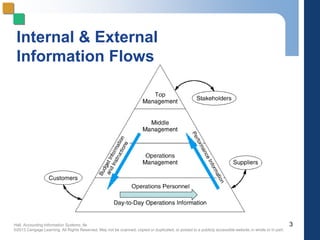
Internal & External
Information Flows
3
Hall, Accounting Information Systems, 8e
©2013 Cengage Learning. All Rights Reserved. May not be scanned, copied or duplicated, or posted to a publicly accessible website,in whole or in part.
Internal Information Flows
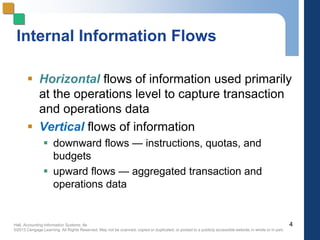
 Horizontal flows of information used primarily
at the operations level to capture transaction
and operations data
 Vertical flows of information
 downward flows — instructions, quotas, and
budgets
 upward flows — aggregated transaction and
operations data
4
Hall, Accounting Information Systems, 8e
©2013 Cengage Learning. All Rights Reserved. May not be scanned, copied or duplicated, or posted to a publicly accessible website,in whole or in part.
Information Objectives
 The goal of an information system is
to support
 To support the stewardship function of
management,
 To support management decision
making, and
 To support the firm’s day-to-day
operations.
5
Hall, Accounting Information Systems, 8e
©2013 Cengage Learning. All Rights Reserved. May not be scanned, copied or duplicated, or posted to a publicly accessible website,in whole or in part.
What is an Information System?
An information system is the set of
formal procedures by which data are
collected, processed into information,
and distributed to users.
6
Hall, Accounting Information Systems, 8e
©2013 Cengage Learning. All Rights Reserved. May not be scanned, copied or duplicated, or posted to a publicly accessible website,in whole or in part.
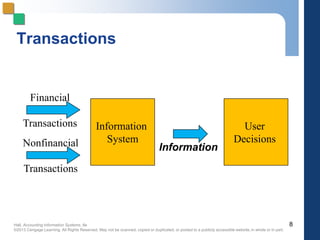
Transactions
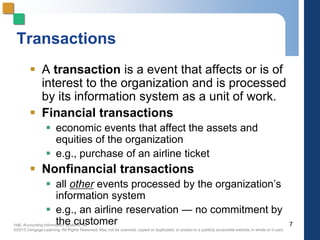
 A transaction is a event that affects or is of
interest to the organization and is processed
by its information system as a unit of work.
 Financial transactions
 economic events that affect the assets and
equities of the organization
 e.g., purchase of an airline ticket
 Nonfinancial transactions
 all other events processed by the organization’s
information system
 e.g., an airline reservation — no commitment by
the customer 7
Hall, Accounting Information Systems, 8e
©2013 Cengage Learning. All Rights Reserved. May not be scanned, copied or duplicated, or posted to a publicly accessible website,in whole or in part.
Transactions
8
Financial
Transactions
Nonfinancial
Transactions
Information
System
User
Decisions
Information
Hall, Accounting Information Systems, 8e
©2013 Cengage Learning. All Rights Reserved. May not be scanned, copied or duplicated, or posted to a publicly accessible website,in whole or in part.
What is an
Accounting Information System?
 Accounting is an information system.
 It identifies, collects, processes, and
communicates economic information about
a firm using a wide variety of technologies.
 It captures and records the financial effects
of the firm’s transactions.
 It distributes transaction information to
operations personnel to coordinate many
key tasks.
9
Hall, Accounting Information Systems, 8e
©2013 Cengage Learning. All Rights Reserved. May not be scanned, copied or duplicated, or posted to a publicly accessible website,in whole or in part.
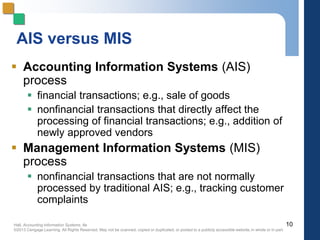
AIS versus MIS
 Accounting Information Systems (AIS)
process
 financial transactions; e.g., sale of goods
 nonfinancial transactions that directly affect the
processing of financial transactions; e.g., addition of
newly approved vendors
 Management Information Systems (MIS)
process
 nonfinancial transactions that are not normally
processed by traditional AIS; e.g., tracking customer
complaints
10
Hall, Accounting Information Systems, 8e
©2013 Cengage Learning. All Rights Reserved. May not be scanned, copied or duplicated, or posted to a publicly accessible website,in whole or in part.
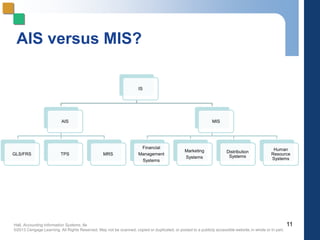
AIS versus MIS?
11
IS
AIS
GLS/FRS TPS MRS
MIS
Financial
Management
Systems
Marketing
Systems
Distribution
Systems
Human
Resource
Systems
Hall, Accounting Information Systems, 8e
©2013 Cengage Learning. All Rights Reserved. May not be scanned, copied or duplicated, or posted to a publicly accessible website,in whole or in part.
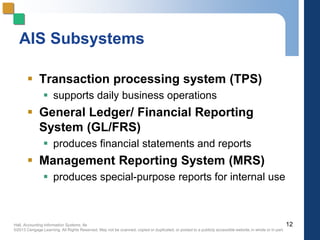
AIS Subsystems
 Transaction processing system (TPS)
 supports daily business operations
 General Ledger/ Financial Reporting
System (GL/FRS)
 produces financial statements and reports
 Management Reporting System (MRS)
 produces special-purpose reports for internal use
12
Hall, Accounting Information Systems, 8e
©2013 Cengage Learning. All Rights Reserved. May not be scanned, copied or duplicated, or posted to a publicly accessible website,in whole or in part.
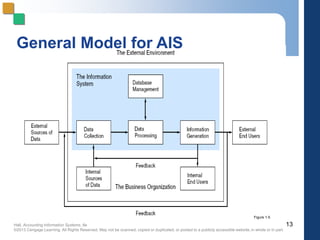
13
Figure 1-5
General Model for AIS
Hall, Accounting Information Systems, 8e
©2013 Cengage Learning. All Rights Reserved. May not be scanned, copied or duplicated, or posted to a publicly accessible website,in whole or in part.
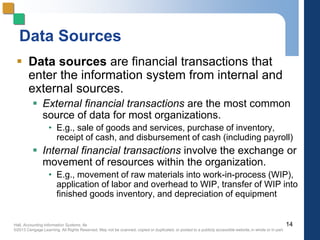
Data Sources
 Data sources are financial transactions that
enter the information system from internal and
external sources.
 External financial transactions are the most common
source of data for most organizations.
• E.g., sale of goods and services, purchase of inventory,
receipt of cash, and disbursement of cash (including payroll)
 Internal financial transactions involve the exchange or
movement of resources within the organization.
• E.g., movement of raw materials into work-in-process (WIP),
application of labor and overhead to WIP, transfer of WIP into
finished goods inventory, and depreciation of equipment
14
Hall, Accounting Information Systems, 8e
©2013 Cengage Learning. All Rights Reserved. May not be scanned, copied or duplicated, or posted to a publicly accessible website,in whole or in part.
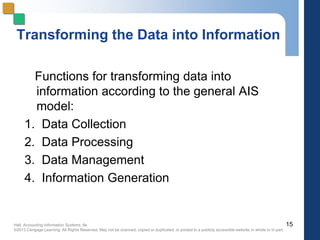
Transforming the Data into Information
Functions for transforming data into
information according to the general AIS
model:
1. Data Collection
2. Data Processing
3. Data Management
4. Information Generation
15
Hall, Accounting Information Systems, 8e
©2013 Cengage Learning. All Rights Reserved. May not be scanned, copied or duplicated, or posted to a publicly accessible website,in whole or in part.
1. Data Collection
 Capturing transaction data
 Recording data onto forms
 Validating and editing the data
16
Hall, Accounting Information Systems, 8e
©2013 Cengage Learning. All Rights Reserved. May not be scanned, copied or duplicated, or posted to a publicly accessible website,in whole or in part.
2. Data Processing
• Classifying
• Transcribing
• Sorting
• Batching
17
• Merging
• Calculating
• Summarizing
• Comparing
Hall, Accounting Information Systems, 8e
©2013 Cengage Learning. All Rights Reserved. May not be scanned, copied or duplicated, or posted to a publicly accessible website,in whole or in part.
3. Data Management
 Storing
 Retrieving
 Deleting
18
Hall, Accounting Information Systems, 8e
©2013 Cengage Learning. All Rights Reserved. May not be scanned, copied or duplicated, or posted to a publicly accessible website,in whole or in part.
4. Information Generation
 Compiling
 Arranging
 Formatting
 Presenting
19
Hall, Accounting Information Systems, 8e
©2013 Cengage Learning. All Rights Reserved. May not be scanned, copied or duplicated, or posted to a publicly accessible website,in whole or in part.
Characteristics of Useful Information
 Regardless of physical form or technology,
useful information has the following
characteristics:
 Relevance: serves a purpose
 Timeliness: no older than the time period of the
action it supports
 Accuracy: free from material errors
 Completeness: all information essential to a decision
or task is present
 Summarization: aggregated in accordance with the
user’s needs
20
Hall, Accounting Information Systems, 8e
©2013 Cengage Learning. All Rights Reserved. May not be scanned, copied or duplicated, or posted to a publicly accessible website,in whole or in part.
Organizational Structure
 The structure of an organization helps to allocate
 responsibility
 authority
 accountability
 Segmenting by business function is a very
common method of organizing.
21
Hall, Accounting Information Systems, 8e
©2013 Cengage Learning. All Rights Reserved. May not be scanned, copied or duplicated, or posted to a publicly accessible website,in whole or in part.
Functional Segmentation
 Materials Management
 purchasing, receiving and stores
 Production
 production planning, quality control, and
maintenance
 Marketing
 Distribution
 Personnel
 Finance
 Accounting
 Information Technology
22
Hall, Accounting Information Systems, 8e
©2013 Cengage Learning. All Rights Reserved. May not be scanned, copied or duplicated, or posted to a publicly accessible website,in whole or in part.
Accounting Independence
 Information reliability requires accounting
independence.
 Accounting activities must be separate and
independent of the functional areas maintaining
resources.
 Accounting supports these functions with
information but does not actively participate.
 Decisions makers in these functions require that
such vital information be supplied by an
independent source to ensure its integrity.
23
Hall, Accounting Information Systems, 8e
©2013 Cengage Learning. All Rights Reserved. May not be scanned, copied or duplicated, or posted to a publicly accessible website,in whole or in part.
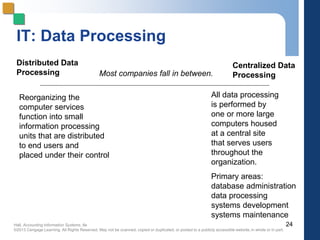
IT: Data Processing
24
Centralized Data
Processing
Distributed Data
Processing Most companies fall in between.
All data processing
is performed by
one or more large
computers housed
at a central site
that serves users
throughout the
organization.
Primary areas:
database administration
data processing
systems development
systems maintenance
Reorganizing the
computer services
function into small
information processing
units that are distributed
to end users and
placed under their control
Hall, Accounting Information Systems, 8e
©2013 Cengage Learning. All Rights Reserved. May not be scanned, copied or duplicated, or posted to a publicly accessible website,in whole or in part.
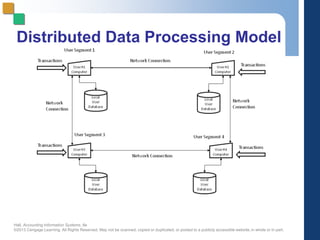
Distributed Data Processing Model
Hall, Accounting Information Systems, 8e
©2013 Cengage Learning. All Rights Reserved. May not be scanned, copied or duplicated, or posted to a publicly accessible website,in whole or in part.
Accountants’ Unique Roles in AIS
 Accountants must be able to clearly convey their
needs to the systems professionals who design
the system.
 The accountant should actively participate
in systems development projects to ensure
appropriate systems design.
26
Hall, Accounting Information Systems, 8e
©2013 Cengage Learning. All Rights Reserved. May not be scanned, copied or duplicated, or posted to a publicly accessible website,in whole or in part.
Accountants as System Designers
 Accountants are the domain experts and
responsible for the conceptual design of the AIS.
 Conceptual system design involves specifying
the criteria for identifying delinquent customers
and the information that needs to be reported.
 As the domain expert, the accountant
determines the nature of the information
required, its sources, its destination, and the
accounting rules that need to be applied. 27
Hall, Accounting Information Systems, 8e
©2013 Cengage Learning. All Rights Reserved. May not be scanned, copied or duplicated, or posted to a publicly accessible website,in whole or in part.
Accountants as System Auditors
External (Financial) Audits
Internal Audit
Fraud Audit
28
Hall, Accounting Information Systems, 8e
©2013 Cengage Learning. All Rights Reserved. May not be scanned, copied or duplicated, or posted to a publicly accessible website,in whole or in part.
External (Financial) Audit
 Independent attestation regarding the
fairness of the presentation of financial
statements
 Two types of evidence
 Tests of controls
 Substantive tests
29
Hall, Accounting Information Systems, 8e
©2013 Cengage Learning. All Rights Reserved. May not be scanned, copied or duplicated, or posted to a publicly accessible website,in whole or in part.
Attest Service versus Advisory Services
 SOX restricts non-audit services to clients.
Auditor may not provide:
 bookkeeping or other services related to the accounting records or
financial statements of the audit client
 financial information systems design and implementation
 appraisal or valuation services, fairness opinions, or contribution-in-
kind reports
 actuarial services
 internal audit outsourcing services
 management functions or human resources
 broker or dealer, investment adviser, or investment banking
services
 legal services and expert services unrelated to the audit
 any other service that the Board determines, by regulation, is
impermissible.
30
Hall, Accounting Information Systems, 8e
©2013 Cengage Learning. All Rights Reserved. May not be scanned, copied or duplicated, or posted to a publicly accessible website,in whole or in part.
Internal Audit
 an independent appraisal function
established within an organization to
examine and evaluate its activities as a
service to the organization.
 Different constituencies from external audit
31
Hall, Accounting Information Systems, 8e
©2013 Cengage Learning. All Rights Reserved. May not be scanned, copied or duplicated, or posted to a publicly accessible website,in whole or in part.
Fraud Audit
 investigate anomalies and gather evidence
of fraud that may lead to criminal
conviction.
 Initiated
 When corporate management suspects
employee fraud.
 Or, boards of directors hire fraud
auditors to investigate their own
suspected executives
32
Hall, Accounting Information Systems, 8e
©2013 Cengage Learning. All Rights Reserved. May not be scanned, copied or duplicated, or posted to a publicly accessible website,in whole or in part.
The Role of the Audit Committee
A subcommittee of the Board of Directors
that has special responsibilities regarding
audits.
 an independent “check and balance” for
the internal audit function and liaison with
external auditors
 Usually three people (outsiders)
 SOX requires one to be a “financial expert”
33

Pp 01-new

  • 1.
    Hall, Accounting InformationSystems, 8e ©2013 Cengage Learning. All Rights Reserved. May not be scanned, copied or duplicated, or posted to a publicly accessible website,in whole or in part. Accounting Information Systems, 8e James A. Hall Chapter 1 The Information System: An Accountant’s Perspective
  • 2.
    Hall, Accounting InformationSystems, 8e ©2013 Cengage Learning. All Rights Reserved. May not be scanned, copied or duplicated, or posted to a publicly accessible website,in whole or in part. Objectives for Chapter 1  Recognize the primary information flows within the business environment.  Understand the difference between accounting information systems and management information systems.  Understand the difference between financial transactions and non-financial transactions.  Know the principal features of the general model for information systems.  Understand the organizational structure and functional areas of a business.  Be able to distinguish between external auditing, internal auditing, and advisory services as they related to accounting information systems. 2
  • 3.
    Hall, Accounting InformationSystems, 8e ©2013 Cengage Learning. All Rights Reserved. May not be scanned, copied or duplicated, or posted to a publicly accessible website,in whole or in part. Internal & External Information Flows 3
  • 4.
    Hall, Accounting InformationSystems, 8e ©2013 Cengage Learning. All Rights Reserved. May not be scanned, copied or duplicated, or posted to a publicly accessible website,in whole or in part. Internal Information Flows  Horizontal flows of information used primarily at the operations level to capture transaction and operations data  Vertical flows of information  downward flows — instructions, quotas, and budgets  upward flows — aggregated transaction and operations data 4
  • 5.
    Hall, Accounting InformationSystems, 8e ©2013 Cengage Learning. All Rights Reserved. May not be scanned, copied or duplicated, or posted to a publicly accessible website,in whole or in part. Information Objectives  The goal of an information system is to support  To support the stewardship function of management,  To support management decision making, and  To support the firm’s day-to-day operations. 5
  • 6.
    Hall, Accounting InformationSystems, 8e ©2013 Cengage Learning. All Rights Reserved. May not be scanned, copied or duplicated, or posted to a publicly accessible website,in whole or in part. What is an Information System? An information system is the set of formal procedures by which data are collected, processed into information, and distributed to users. 6
  • 7.
    Hall, Accounting InformationSystems, 8e ©2013 Cengage Learning. All Rights Reserved. May not be scanned, copied or duplicated, or posted to a publicly accessible website,in whole or in part. Transactions  A transaction is a event that affects or is of interest to the organization and is processed by its information system as a unit of work.  Financial transactions  economic events that affect the assets and equities of the organization  e.g., purchase of an airline ticket  Nonfinancial transactions  all other events processed by the organization’s information system  e.g., an airline reservation — no commitment by the customer 7
  • 8.
    Hall, Accounting InformationSystems, 8e ©2013 Cengage Learning. All Rights Reserved. May not be scanned, copied or duplicated, or posted to a publicly accessible website,in whole or in part. Transactions 8 Financial Transactions Nonfinancial Transactions Information System User Decisions Information
  • 9.
    Hall, Accounting InformationSystems, 8e ©2013 Cengage Learning. All Rights Reserved. May not be scanned, copied or duplicated, or posted to a publicly accessible website,in whole or in part. What is an Accounting Information System?  Accounting is an information system.  It identifies, collects, processes, and communicates economic information about a firm using a wide variety of technologies.  It captures and records the financial effects of the firm’s transactions.  It distributes transaction information to operations personnel to coordinate many key tasks. 9
  • 10.
    Hall, Accounting InformationSystems, 8e ©2013 Cengage Learning. All Rights Reserved. May not be scanned, copied or duplicated, or posted to a publicly accessible website,in whole or in part. AIS versus MIS  Accounting Information Systems (AIS) process  financial transactions; e.g., sale of goods  nonfinancial transactions that directly affect the processing of financial transactions; e.g., addition of newly approved vendors  Management Information Systems (MIS) process  nonfinancial transactions that are not normally processed by traditional AIS; e.g., tracking customer complaints 10
  • 11.
    Hall, Accounting InformationSystems, 8e ©2013 Cengage Learning. All Rights Reserved. May not be scanned, copied or duplicated, or posted to a publicly accessible website,in whole or in part. AIS versus MIS? 11 IS AIS GLS/FRS TPS MRS MIS Financial Management Systems Marketing Systems Distribution Systems Human Resource Systems
  • 12.
    Hall, Accounting InformationSystems, 8e ©2013 Cengage Learning. All Rights Reserved. May not be scanned, copied or duplicated, or posted to a publicly accessible website,in whole or in part. AIS Subsystems  Transaction processing system (TPS)  supports daily business operations  General Ledger/ Financial Reporting System (GL/FRS)  produces financial statements and reports  Management Reporting System (MRS)  produces special-purpose reports for internal use 12
  • 13.
    Hall, Accounting InformationSystems, 8e ©2013 Cengage Learning. All Rights Reserved. May not be scanned, copied or duplicated, or posted to a publicly accessible website,in whole or in part. 13 Figure 1-5 General Model for AIS
  • 14.
    Hall, Accounting InformationSystems, 8e ©2013 Cengage Learning. All Rights Reserved. May not be scanned, copied or duplicated, or posted to a publicly accessible website,in whole or in part. Data Sources  Data sources are financial transactions that enter the information system from internal and external sources.  External financial transactions are the most common source of data for most organizations. • E.g., sale of goods and services, purchase of inventory, receipt of cash, and disbursement of cash (including payroll)  Internal financial transactions involve the exchange or movement of resources within the organization. • E.g., movement of raw materials into work-in-process (WIP), application of labor and overhead to WIP, transfer of WIP into finished goods inventory, and depreciation of equipment 14
  • 15.
    Hall, Accounting InformationSystems, 8e ©2013 Cengage Learning. All Rights Reserved. May not be scanned, copied or duplicated, or posted to a publicly accessible website,in whole or in part. Transforming the Data into Information Functions for transforming data into information according to the general AIS model: 1. Data Collection 2. Data Processing 3. Data Management 4. Information Generation 15
  • 16.
    Hall, Accounting InformationSystems, 8e ©2013 Cengage Learning. All Rights Reserved. May not be scanned, copied or duplicated, or posted to a publicly accessible website,in whole or in part. 1. Data Collection  Capturing transaction data  Recording data onto forms  Validating and editing the data 16
  • 17.
    Hall, Accounting InformationSystems, 8e ©2013 Cengage Learning. All Rights Reserved. May not be scanned, copied or duplicated, or posted to a publicly accessible website,in whole or in part. 2. Data Processing • Classifying • Transcribing • Sorting • Batching 17 • Merging • Calculating • Summarizing • Comparing
  • 18.
    Hall, Accounting InformationSystems, 8e ©2013 Cengage Learning. All Rights Reserved. May not be scanned, copied or duplicated, or posted to a publicly accessible website,in whole or in part. 3. Data Management  Storing  Retrieving  Deleting 18
  • 19.
    Hall, Accounting InformationSystems, 8e ©2013 Cengage Learning. All Rights Reserved. May not be scanned, copied or duplicated, or posted to a publicly accessible website,in whole or in part. 4. Information Generation  Compiling  Arranging  Formatting  Presenting 19
  • 20.
    Hall, Accounting InformationSystems, 8e ©2013 Cengage Learning. All Rights Reserved. May not be scanned, copied or duplicated, or posted to a publicly accessible website,in whole or in part. Characteristics of Useful Information  Regardless of physical form or technology, useful information has the following characteristics:  Relevance: serves a purpose  Timeliness: no older than the time period of the action it supports  Accuracy: free from material errors  Completeness: all information essential to a decision or task is present  Summarization: aggregated in accordance with the user’s needs 20
  • 21.
    Hall, Accounting InformationSystems, 8e ©2013 Cengage Learning. All Rights Reserved. May not be scanned, copied or duplicated, or posted to a publicly accessible website,in whole or in part. Organizational Structure  The structure of an organization helps to allocate  responsibility  authority  accountability  Segmenting by business function is a very common method of organizing. 21
  • 22.
    Hall, Accounting InformationSystems, 8e ©2013 Cengage Learning. All Rights Reserved. May not be scanned, copied or duplicated, or posted to a publicly accessible website,in whole or in part. Functional Segmentation  Materials Management  purchasing, receiving and stores  Production  production planning, quality control, and maintenance  Marketing  Distribution  Personnel  Finance  Accounting  Information Technology 22
  • 23.
    Hall, Accounting InformationSystems, 8e ©2013 Cengage Learning. All Rights Reserved. May not be scanned, copied or duplicated, or posted to a publicly accessible website,in whole or in part. Accounting Independence  Information reliability requires accounting independence.  Accounting activities must be separate and independent of the functional areas maintaining resources.  Accounting supports these functions with information but does not actively participate.  Decisions makers in these functions require that such vital information be supplied by an independent source to ensure its integrity. 23
  • 24.
    Hall, Accounting InformationSystems, 8e ©2013 Cengage Learning. All Rights Reserved. May not be scanned, copied or duplicated, or posted to a publicly accessible website,in whole or in part. IT: Data Processing 24 Centralized Data Processing Distributed Data Processing Most companies fall in between. All data processing is performed by one or more large computers housed at a central site that serves users throughout the organization. Primary areas: database administration data processing systems development systems maintenance Reorganizing the computer services function into small information processing units that are distributed to end users and placed under their control
  • 25.
    Hall, Accounting InformationSystems, 8e ©2013 Cengage Learning. All Rights Reserved. May not be scanned, copied or duplicated, or posted to a publicly accessible website,in whole or in part. Distributed Data Processing Model
  • 26.
    Hall, Accounting InformationSystems, 8e ©2013 Cengage Learning. All Rights Reserved. May not be scanned, copied or duplicated, or posted to a publicly accessible website,in whole or in part. Accountants’ Unique Roles in AIS  Accountants must be able to clearly convey their needs to the systems professionals who design the system.  The accountant should actively participate in systems development projects to ensure appropriate systems design. 26
  • 27.
    Hall, Accounting InformationSystems, 8e ©2013 Cengage Learning. All Rights Reserved. May not be scanned, copied or duplicated, or posted to a publicly accessible website,in whole or in part. Accountants as System Designers  Accountants are the domain experts and responsible for the conceptual design of the AIS.  Conceptual system design involves specifying the criteria for identifying delinquent customers and the information that needs to be reported.  As the domain expert, the accountant determines the nature of the information required, its sources, its destination, and the accounting rules that need to be applied. 27
  • 28.
    Hall, Accounting InformationSystems, 8e ©2013 Cengage Learning. All Rights Reserved. May not be scanned, copied or duplicated, or posted to a publicly accessible website,in whole or in part. Accountants as System Auditors External (Financial) Audits Internal Audit Fraud Audit 28
  • 29.
    Hall, Accounting InformationSystems, 8e ©2013 Cengage Learning. All Rights Reserved. May not be scanned, copied or duplicated, or posted to a publicly accessible website,in whole or in part. External (Financial) Audit  Independent attestation regarding the fairness of the presentation of financial statements  Two types of evidence  Tests of controls  Substantive tests 29
  • 30.
    Hall, Accounting InformationSystems, 8e ©2013 Cengage Learning. All Rights Reserved. May not be scanned, copied or duplicated, or posted to a publicly accessible website,in whole or in part. Attest Service versus Advisory Services  SOX restricts non-audit services to clients. Auditor may not provide:  bookkeeping or other services related to the accounting records or financial statements of the audit client  financial information systems design and implementation  appraisal or valuation services, fairness opinions, or contribution-in- kind reports  actuarial services  internal audit outsourcing services  management functions or human resources  broker or dealer, investment adviser, or investment banking services  legal services and expert services unrelated to the audit  any other service that the Board determines, by regulation, is impermissible. 30
  • 31.
    Hall, Accounting InformationSystems, 8e ©2013 Cengage Learning. All Rights Reserved. May not be scanned, copied or duplicated, or posted to a publicly accessible website,in whole or in part. Internal Audit  an independent appraisal function established within an organization to examine and evaluate its activities as a service to the organization.  Different constituencies from external audit 31
  • 32.
    Hall, Accounting InformationSystems, 8e ©2013 Cengage Learning. All Rights Reserved. May not be scanned, copied or duplicated, or posted to a publicly accessible website,in whole or in part. Fraud Audit  investigate anomalies and gather evidence of fraud that may lead to criminal conviction.  Initiated  When corporate management suspects employee fraud.  Or, boards of directors hire fraud auditors to investigate their own suspected executives 32
  • 33.
    Hall, Accounting InformationSystems, 8e ©2013 Cengage Learning. All Rights Reserved. May not be scanned, copied or duplicated, or posted to a publicly accessible website,in whole or in part. The Role of the Audit Committee A subcommittee of the Board of Directors that has special responsibilities regarding audits.  an independent “check and balance” for the internal audit function and liaison with external auditors  Usually three people (outsiders)  SOX requires one to be a “financial expert” 33