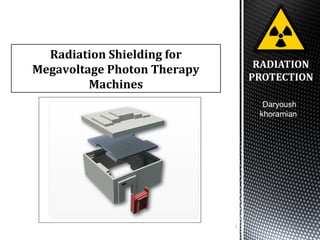
Radiation Shielding for
Megavoltage Photon Therapy
Machines
RADIATION
PROTECTION
1
Daryoush
khoramian
2
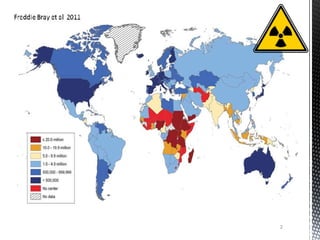
The International Agency for Research on
Cancer(IARC) recently estimated that 7.6
million deaths worldwide were due to cancer
with 12.7 million new cases per year being
reported worldwide
Breast cancer in females and lung cancer in
males are the most frequently diagnosed cancers
( Freddie Bray et al 2011)
 Approximately 50% of all cancer patients will
receive radiation therapyradiation therapy during their course of
illness ( Basker et al 2012 )
Basic principles
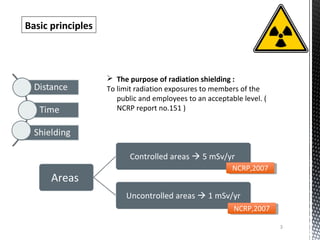
 The purpose of radiation shielding :
To limit radiation exposures to members of the
public and employees to an acceptable level. (
NCRP report no.151 )
Areas
Uncontrolled areas  1 mSv/yr
Controlled areas  5 mSv/yr
NCRP,2007
NCRP,2007
3
The purpose of radiation shielding :
To reduce the effective equivalent dose from a linear accelerator to a point
outside the room to a sufficiently low level.
4
In radiation therapy rooms
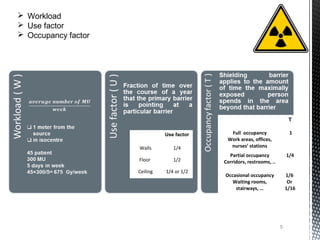
 Workload
 Use factor
 Occupancy factor
Use factor
Walls 1/4
Floor 1/2
Ceiling 1/4 or 1/2
T
Full occupancy
Work areas, offices,
nurses’ stations
1
Partial occupancy
Corridors, restrooms, ..
1/4
Occasional occupancy
Waiting rooms,
stairways, …
1/6
Or
1/16
5
6
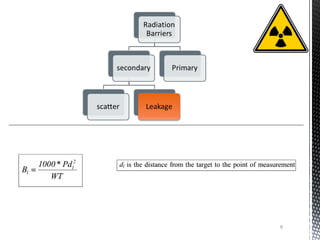
Barriers
7
8
9
10
11
12
13
TVL in 16
MV
TVL in 16
MV
14
 It’s toxic
 lead is not self supporting  needs to be held in place
 Relatively transparent to neutrons but decrease energy of neutrons by inelastic scattering
15
16
17
18
19
20
Overall size
 The couch radius : 9’
 Back wall  end of couch : 21’
 22’×20’ clear area
 Height : 9’-10’
21
Machine orientation
Parallel to
the maze
Orthogonal to
the maze Special design
22
Maze vs. direct door
 Where the available space
is minimal
 Doors are Very heavy
( several tons )
 Very expensive
 In order to reduce the radiation dose near
the entrance
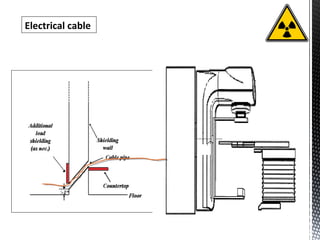
 Is a route for ventilation ducts and electrical
conduits
23
Ducts
24
Electrical cable
25
Special Considerations
26
Skyshine Radiations
27
References :
1.Baskar, Rajamanickam, Lee, Kuo Ann, Yeo, Richard, & Yeoh, Kheng-Wei. (2012). Cancer
and radiation therapy: current advances and future directions. International journal of medical
sciences, 9(3), 193.
2.Biggs, Peter J. (2010). Radiation Shielding for Megavoltage Photon Therapy Machines:
Boston: sn.
3.Deye, James A, Rodgers, JE, Wu, RK, Biggs, PJ, McCall, RC, & McGinley, PH. (2005).
Structural Shielding Design and Evaluation from Megavoltage X-and Gamma-Ray Radiotherapy
Facilities. National Cancer Institute, Rockville, Maryland.
4.INTERNATIONAL ATOMIC ENERGY AGENCY, RADIATION PROTECTION IN THE
DESIGN OF RADIOTHERAPY FACILITIES, IAEA, Vienna (2005).
5.Khan, Faiz M, & Khan, FM. (2003). The physics of radiation therapy (Vol. 3): Lippincott
Williams & Wilkins Philadelphia.
6.Turner, James Edward, & Kelsey, Charles A. (1995). Atoms, radiation, and radiation
protection: Wiley New York.
Thank you
Any question ?

Radiation Shielding for Mega-voltage Photon Therapy Machines

  • 1.
    Radiation Shielding for MegavoltagePhoton Therapy Machines RADIATION PROTECTION 1 Daryoush khoramian
  • 2.
    2 The International Agencyfor Research on Cancer(IARC) recently estimated that 7.6 million deaths worldwide were due to cancer with 12.7 million new cases per year being reported worldwide Breast cancer in females and lung cancer in males are the most frequently diagnosed cancers ( Freddie Bray et al 2011)  Approximately 50% of all cancer patients will receive radiation therapyradiation therapy during their course of illness ( Basker et al 2012 )
  • 3.
    Basic principles  Thepurpose of radiation shielding : To limit radiation exposures to members of the public and employees to an acceptable level. ( NCRP report no.151 ) Areas Uncontrolled areas  1 mSv/yr Controlled areas  5 mSv/yr NCRP,2007 NCRP,2007 3
  • 4.
    The purpose ofradiation shielding : To reduce the effective equivalent dose from a linear accelerator to a point outside the room to a sufficiently low level. 4 In radiation therapy rooms
  • 5.
     Workload  Usefactor  Occupancy factor Use factor Walls 1/4 Floor 1/2 Ceiling 1/4 or 1/2 T Full occupancy Work areas, offices, nurses’ stations 1 Partial occupancy Corridors, restrooms, .. 1/4 Occasional occupancy Waiting rooms, stairways, … 1/6 Or 1/16 5
  • 6.
  • 7.
  • 8.
  • 9.
  • 10.
  • 11.
  • 12.
  • 13.
  • 14.
    14  It’s toxic lead is not self supporting  needs to be held in place  Relatively transparent to neutrons but decrease energy of neutrons by inelastic scattering
  • 15.
  • 16.
  • 17.
  • 18.
  • 19.
  • 20.
    20 Overall size  Thecouch radius : 9’  Back wall  end of couch : 21’  22’×20’ clear area  Height : 9’-10’
  • 21.
    21 Machine orientation Parallel to themaze Orthogonal to the maze Special design
  • 22.
    22 Maze vs. directdoor  Where the available space is minimal  Doors are Very heavy ( several tons )  Very expensive  In order to reduce the radiation dose near the entrance  Is a route for ventilation ducts and electrical conduits
  • 23.
  • 24.
  • 25.
  • 26.
  • 27.
    27 References : 1.Baskar, Rajamanickam,Lee, Kuo Ann, Yeo, Richard, & Yeoh, Kheng-Wei. (2012). Cancer and radiation therapy: current advances and future directions. International journal of medical sciences, 9(3), 193. 2.Biggs, Peter J. (2010). Radiation Shielding for Megavoltage Photon Therapy Machines: Boston: sn. 3.Deye, James A, Rodgers, JE, Wu, RK, Biggs, PJ, McCall, RC, & McGinley, PH. (2005). Structural Shielding Design and Evaluation from Megavoltage X-and Gamma-Ray Radiotherapy Facilities. National Cancer Institute, Rockville, Maryland. 4.INTERNATIONAL ATOMIC ENERGY AGENCY, RADIATION PROTECTION IN THE DESIGN OF RADIOTHERAPY FACILITIES, IAEA, Vienna (2005). 5.Khan, Faiz M, & Khan, FM. (2003). The physics of radiation therapy (Vol. 3): Lippincott Williams & Wilkins Philadelphia. 6.Turner, James Edward, & Kelsey, Charles A. (1995). Atoms, radiation, and radiation protection: Wiley New York.
  • 28.