© 2013 Armstrong Teasdale LLP
Employment & Labor Law Update

           Presented by:
           Dan O’Toole


© 2013 Armstrong Teasdale LLP
Thomas v. McKeever’s Enterprises, Inc.
 ___ S.W.3d ___,2012 WL 4771364 (Mo. App. 2012)

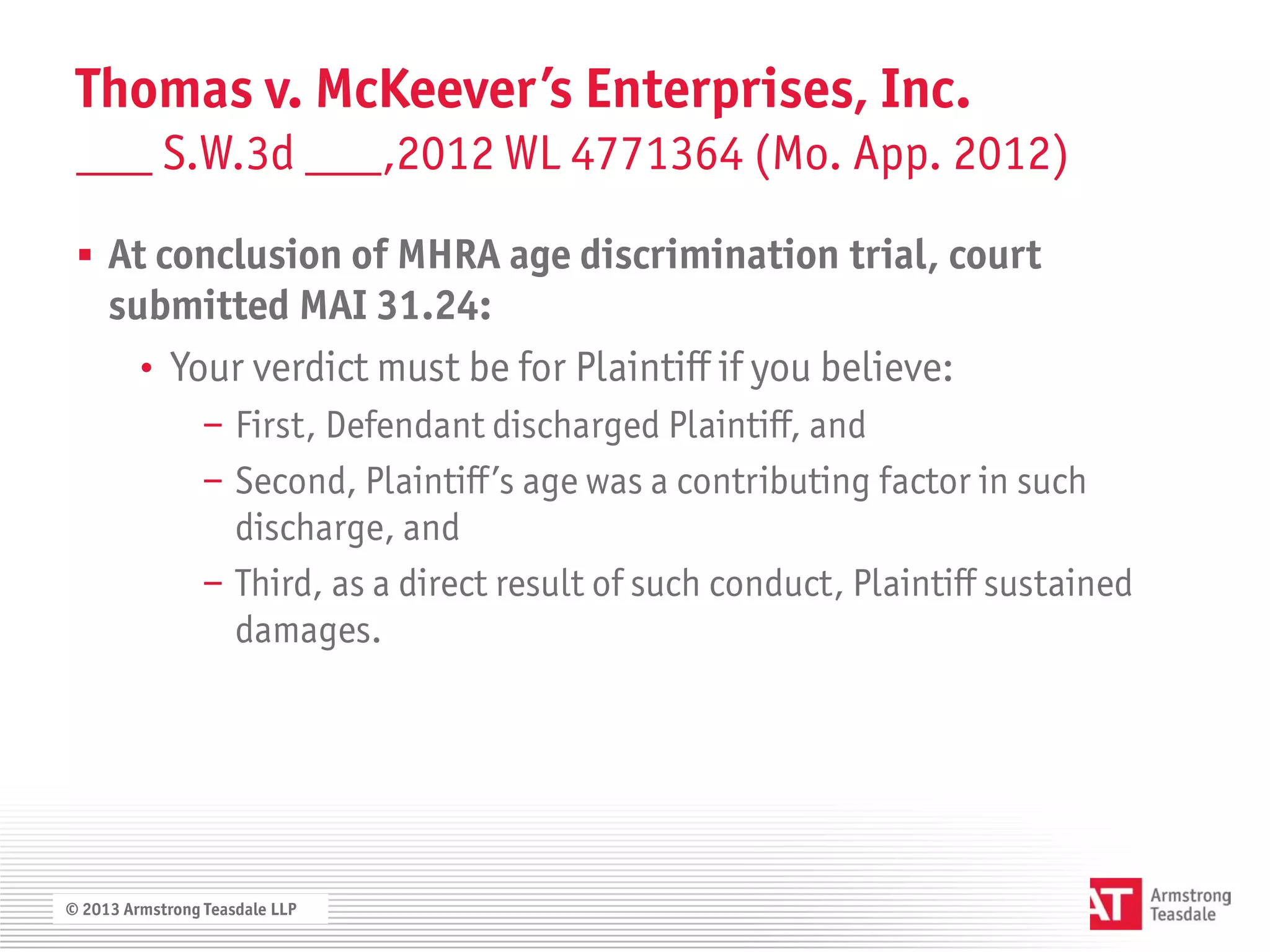
  At conclusion of MHRA age discrimination trial, court
     submitted MAI 31.24:
       • Your verdict must be for Plaintiff if you believe:
                 − First, Defendant discharged Plaintiff, and
                 − Second, Plaintiff’s age was a contributing factor in such
                   discharge, and
                 − Third, as a direct result of such conduct, Plaintiff sustained
                   damages.


© 2013 Armstrong Teasdale LLP
Thomas (cont.)

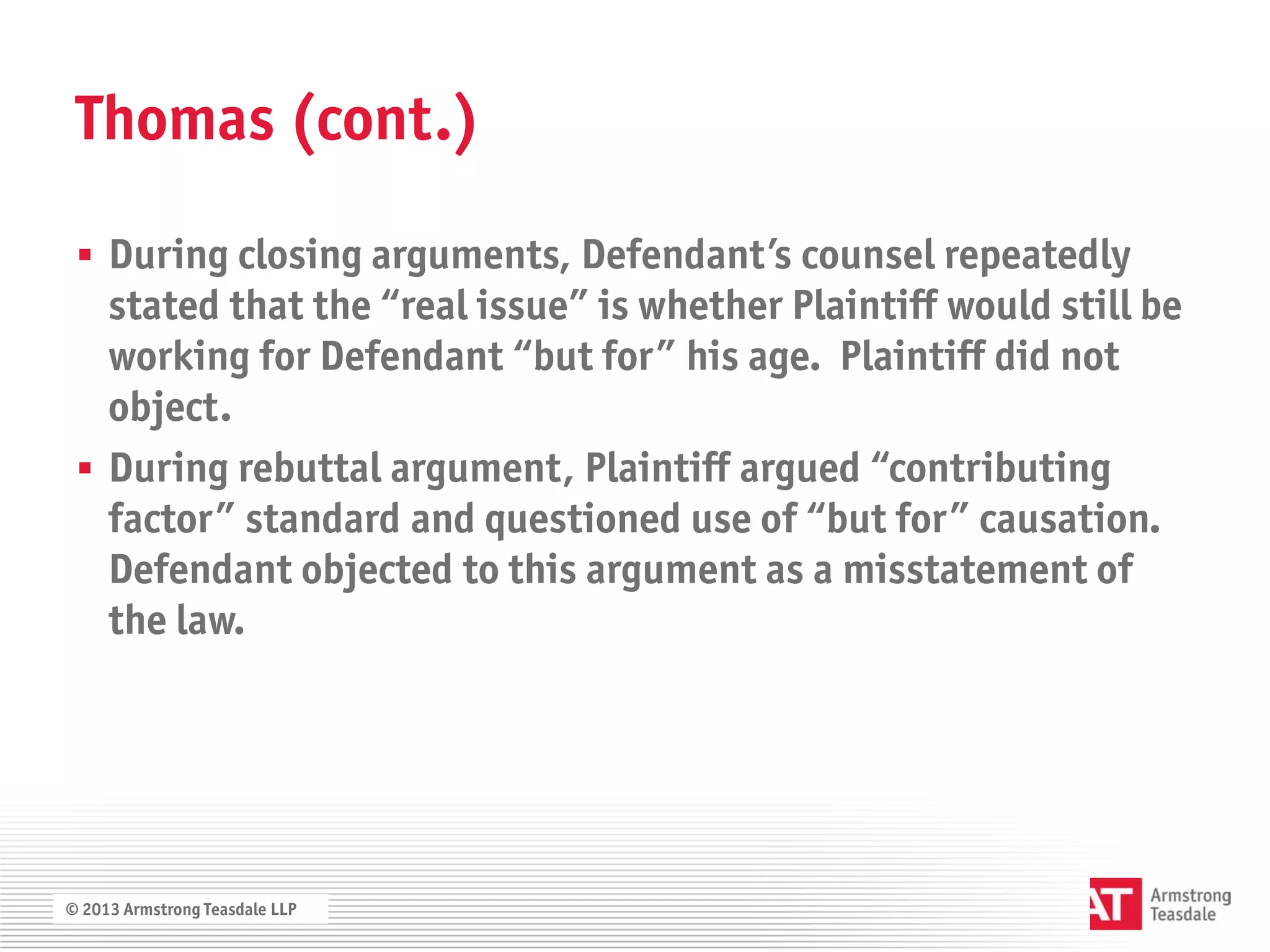
  During closing arguments, Defendant’s counsel repeatedly
   stated that the “real issue” is whether Plaintiff would still be
   working for Defendant “but for” his age. Plaintiff did not
   object.
  During rebuttal argument, Plaintiff argued “contributing
   factor” standard and questioned use of “but for” causation.
   Defendant objected to this argument as a misstatement of
   the law.


© 2013 Armstrong Teasdale LLP
Thomas (cont.)

  The trial court sustained the objection and gave an oral
   curative instruction affirming the “but for” standard.
  Court of Appeals reverses. MHRA prohibits any unfair
   treatment based on age and Plaintiff must only prove that age
   contributed to Plaintiff’s discharge.


© 2013 Armstrong Teasdale LLP
Hill v. City of St. Louis
 371 S.W.3d 66 (Mo. App. 2012)
  Trial court did not abuse its discretion in:
         • Allowing Plaintiff’s counsel to inform jury that Sheriff
             Murphy had no personal financial liability in the case.
         •   Allowing an expert to testify about the symbolism of a
             noose.
         •   Allowing an expert to testify about significance of EEOC
             guidance and reasonableness of City’s efforts to prevent
             harassment and discrimination.
         •   Remitting punitive damages from $350,000 to $75,000.
         •   Awarding $326,000 in attorney fees rather than the
             $421,270.25 requested.

© 2013 Armstrong Teasdale LLP
Reed v. McDonald’s Corporation
 363 S.W.3d 134 (Mo.App. 2012)

  Teenage restaurant worker alleged that she was sexually
   harassed by Assistant Manager.
  Reed complained and was offered but declined a transfer.
  Assistant Manager was suspended and eventually terminated
   but visited the restaurant during his suspension and while
   Reed was working.


© 2013 Armstrong Teasdale LLP
Reed (cont.)
  Factual issue on the Farragher defense:
         1) Defense requires proof that employer exercised reasonable care
            to prevent and promptly correct any harassing behavior; and
         2) Employee failed to take advantage of preventative or corrective
            opportunities provided by the employer or to avoid harm
            otherwise.
            − Franchisee provided Reed a copy of its policies.
            − Franchisee posted anti-harassment posters.
            − Franchisee immediately suspended and then terminated
                Assistant Manager after the complaint against him.


© 2013 Armstrong Teasdale LLP
Reed (cont.)
                 − Reed testified “that she does not recall that Franchisee’s policies
                   were explained to her.”
                 − Franchisee allowed Assistant Manager to visit restaurant during his
                   suspension.
                 − Franchisee failed to protect her privacy from the employees
                   regarding Reed’s sexual encounters with the Assistant Manager.


© 2013 Armstrong Teasdale LLP
Grissom v. First National Insurance Agency
 364 S.W.3d 728 (Mo. App. 2012)

  Grissom alleged that Welker (the sole owner) sexually
   harassed her until he received a letter from Grissom’s
   attorney asking him to stop.
  Grissom was fired 180 days after Welker received the
   attorney’s letter.
  Trial court granted summary judgment on the sexual
   harassment claim because Grissom testified in deposition
   that the harassment stopped after Welker received her
   attorney’s letter.
  Welker denied receiving the letter.


© 2013 Armstrong Teasdale LLP
Grissom (cont.)
  Court of Appeals reversed. Grissom’s termination could be
   viewed as part of a continuing violation. Only one act within
   a continuing violation needs to be timely.
  Lesson: No good deed goes unpunished. Letter of
   recommendation Welker wrote after Grissom’s termination is
   proof undercutting Welker’s justification for termination.


© 2013 Armstrong Teasdale LLP
Farrow v. St. Francis Medical Center
 2012 WL 451882 (Mo. App. 2012)
  Farrow given notice of discharge on December 10, 2008.
  Farrow files a grievance which goes through a five step
   grievance process and is finally rejected on March 2, 2009.
  Farrow filed a charge of sexual harassment and retaliation
   with the MCHR on July 27, 2009 and thereafter files a lawsuit.


© 2013 Armstrong Teasdale LLP
Farrow (cont.)

  Circuit Court grants summary judgment against Farrow
   because her claims are time-barred. Court of Appeals affirms.
  The grievance procedure, by its nature, is a remedy for a prior
   decision and the employment relationship was already
   severed by the discharge.


© 2013 Armstrong Teasdale LLP
Tate v. AutoZoners, LLC
 363 S.W.3d 179 (Mo. App. 2012)
  Tate filed a sexual harassment case under the MHRA and
   obtained a $10,000 verdict.
  Tate’s attorney sought $229,000 in attorneys fees and costs
   which the trial court, without explanation, reduced to
   $129,000.
  The trial court did not abuse its discretion.


© 2013 Armstrong Teasdale LLP
Hervey v. Missouri Department of Corrections
 379 S.W.3d 156 (Mo. banc 2012)

      Trial court erred in giving instruction patterned after MAI 31.24
       • Your verdict must be for the Plaintiff if you believe:
                − First, Defendant discharged Plaintiff;
       − Second, disability was a contributing factor in such
           discharge;
       − Third, as a result of such conduct, Plaintiff sustained damage.
  Jury instruction was erroneous because it did not require jury to
   find the Plaintiff was “disabled,” which is an essential element of
   Plaintiff's claim.
  Supreme Court reverses judgment and remands the case for trial.


© 2013 Armstrong Teasdale LLP
Hervey (cont.)

  510.265 RSMo. limits punitive damages to the greater of:
         1. $500,000; or
         2. “five times the net amount of the judgment awarded to
               Plaintiff against Defendant.”


© 2013 Armstrong Teasdale LLP
Hervey (cont.)
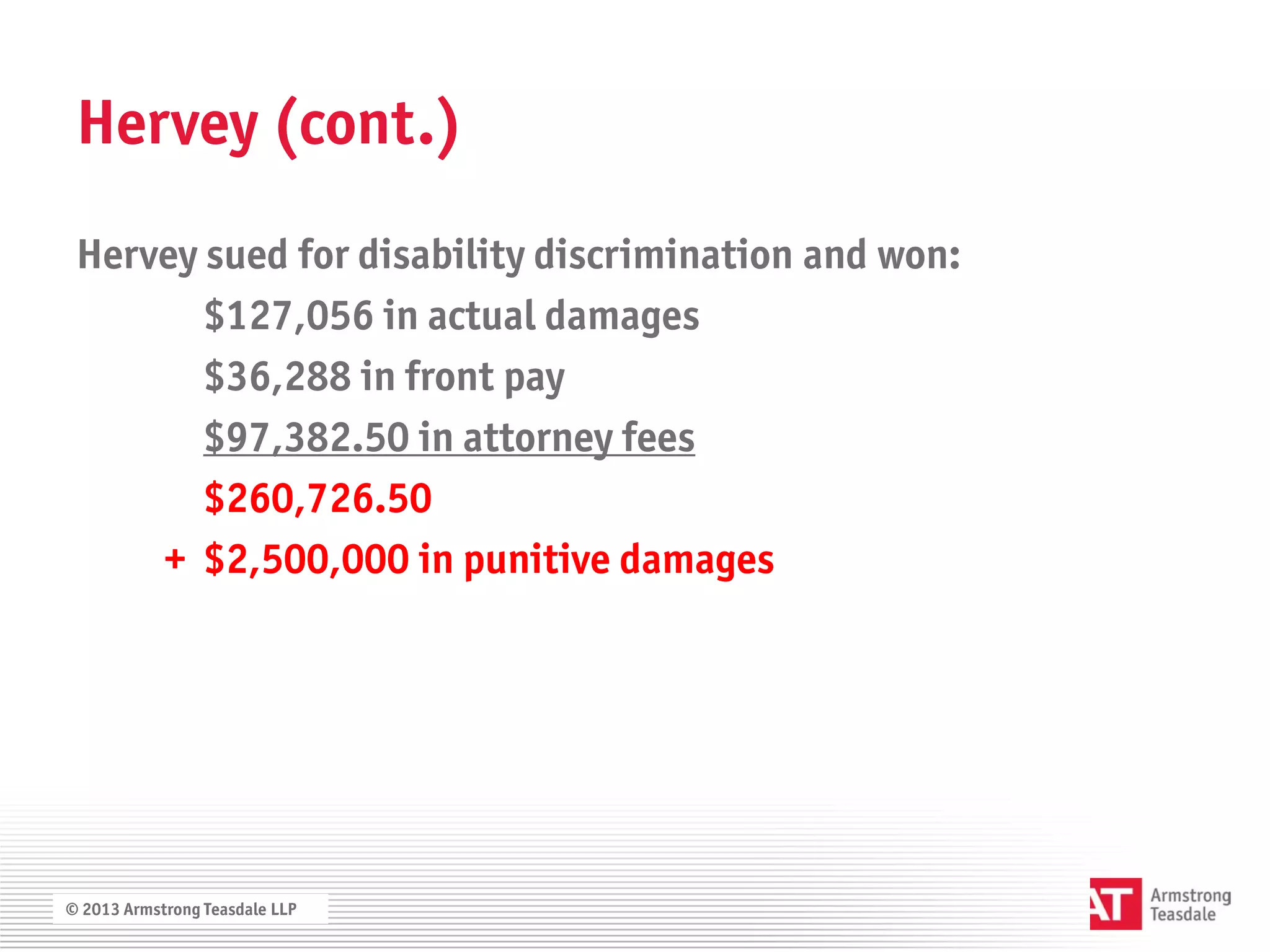
 Hervey sued for disability discrimination and won:
        $127,056 in actual damages
        $36,288 in front pay
        $97,382.50 in attorney fees
        $260,726.50
     + $2,500,000 in punitive damages


© 2013 Armstrong Teasdale LLP
Hervey (cont.)

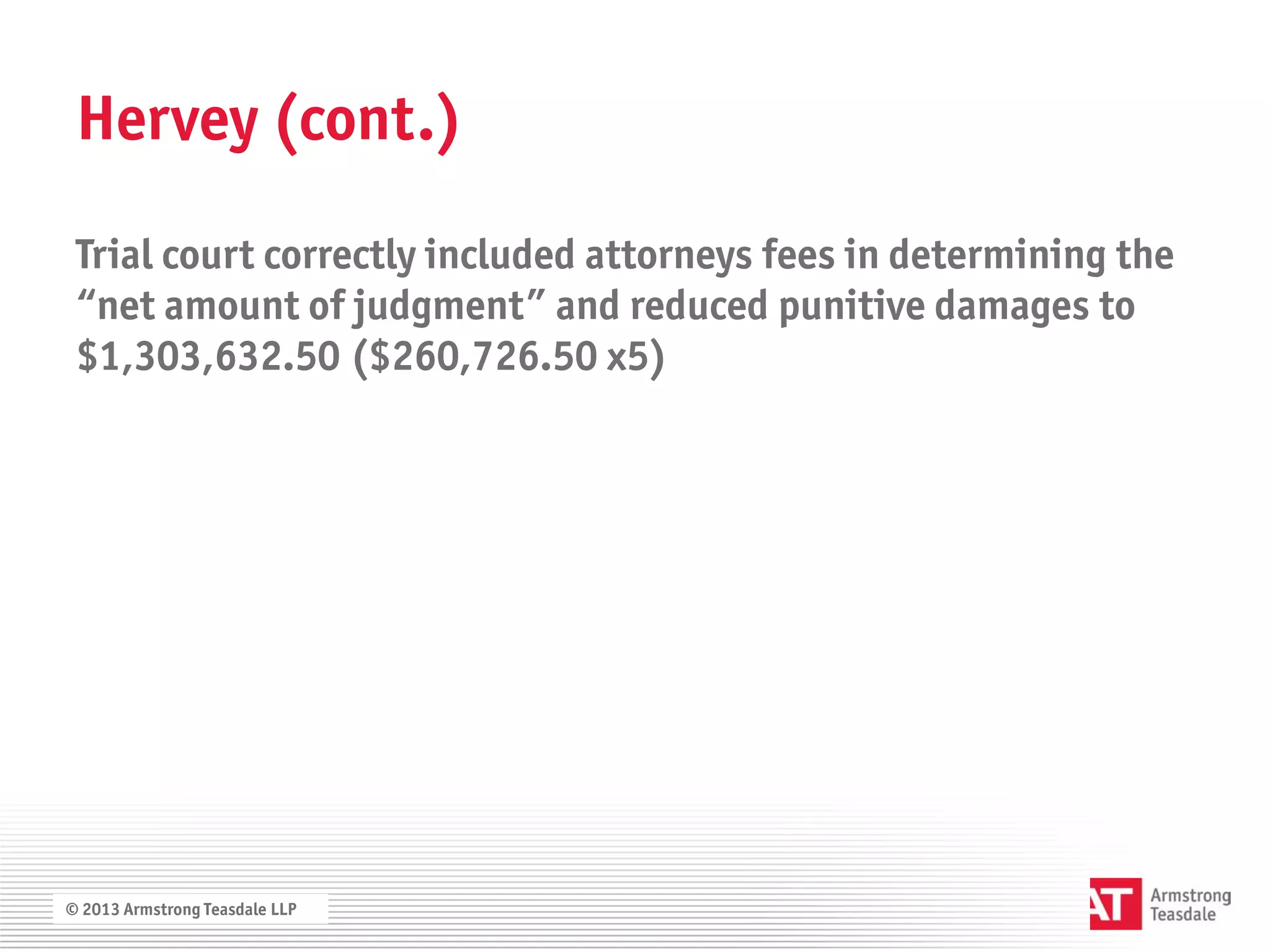
 Trial court correctly included attorneys fees in determining the
 “net amount of judgment” and reduced punitive damages to
 $1,303,632.50 ($260,726.50 x5)


© 2013 Armstrong Teasdale LLP
Doe v. Kansas City, Missouri School District
372 S.W.3d 43 (Mo. App. 2012)

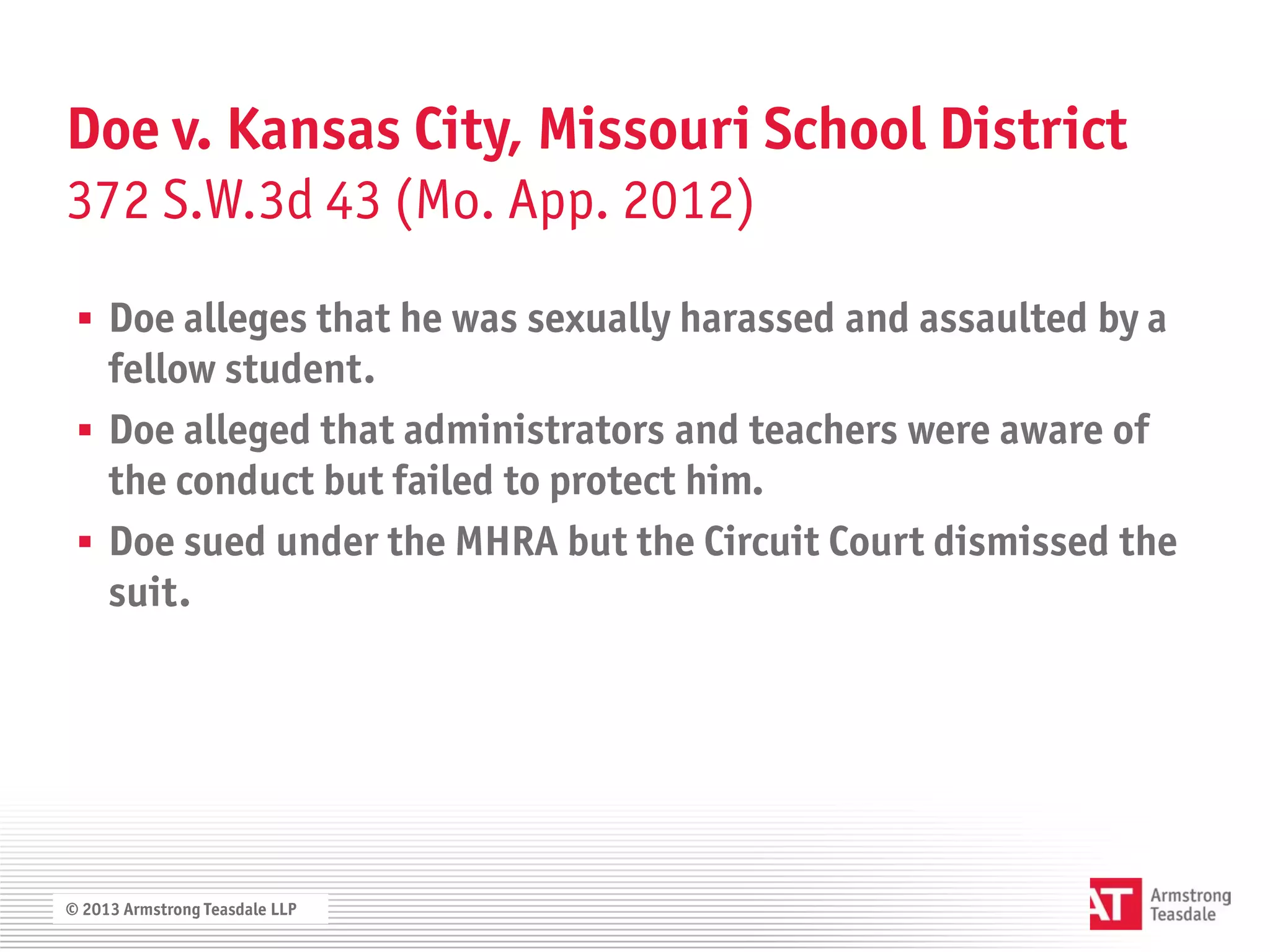
  Doe alleges that he was sexually harassed and assaulted by a
   fellow student.
  Doe alleged that administrators and teachers were aware of
   the conduct but failed to protect him.
  Doe sued under the MHRA but the Circuit Court dismissed the
   suit.


© 2013 Armstrong Teasdale LLP
Doe (cont.)

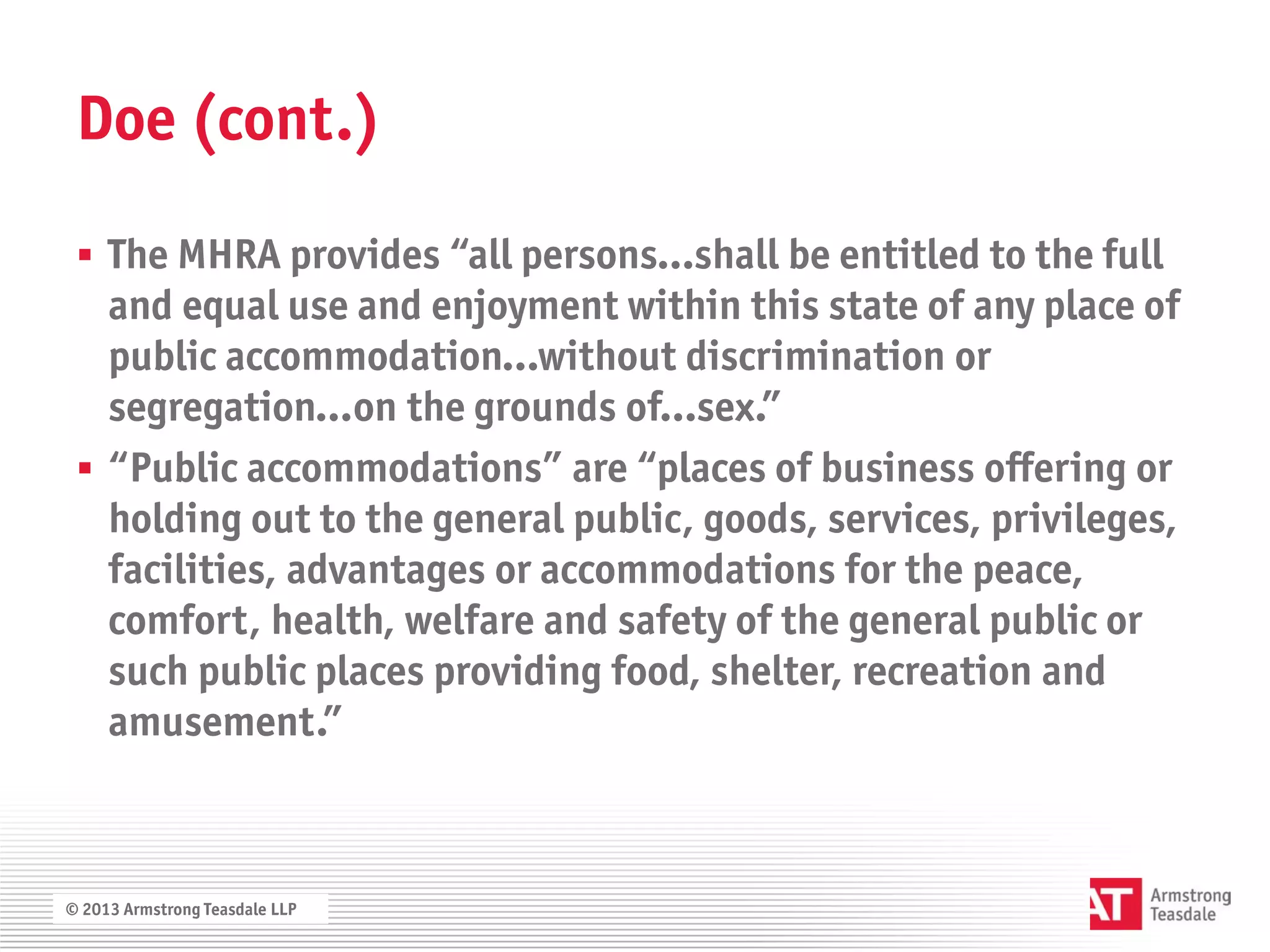
  The MHRA provides “all persons…shall be entitled to the full
   and equal use and enjoyment within this state of any place of
   public accommodation…without discrimination or
   segregation…on the grounds of…sex.”
  “Public accommodations” are “places of business offering or
   holding out to the general public, goods, services, privileges,
   facilities, advantages or accommodations for the peace,
   comfort, health, welfare and safety of the general public or
   such public places providing food, shelter, recreation and
   amusement.”


© 2013 Armstrong Teasdale LLP
Doe (cont.)

  Court of Appeals finds that school is a place of public
   accommodation and reverses dismissal of Doe’s claims.
  School District will be liable if it knew or should have known
   of actionable harassment and failed to take prompt and
   effective remedial action.


© 2013 Armstrong Teasdale LLP
Marzette v. Anheuser-Busch, Inc.
 371 S.W.3d 49(Mo. App. 2012)

  Security guards sued Anheuser-Busch in state court for
   discrimination under the MHRA.
  As part of application process, guards agreed to arbitration as
   exclusive remedy for any disputes.
  Trial court denied Anheuser-Busch’s motion to compel
   arbitration.


© 2013 Armstrong Teasdale LLP
Marzette (cont.)

  Arbitration agreements must contain the elements of a valid
   contract: offer, acceptance, bargained-for-consideration.
  Anheuser-Busch’s willingness to consider applicant for
   employment does not constitute consideration.
  Anheuser-Busch’s offer of employment cannot constitute
   consideration because it was not the motive for the promise
   to arbitrate.
     • Application said: “no promise regarding employment has
       been made.”


© 2013 Armstrong Teasdale LLP
Jones v. Paradies
 380 S.W.3d 13 (Mo. App. 2012)
  Plaintiff brought suit against directors of a corporation in
   their individual capacities alleging tortious interference with
   contract between Plaintiff and corporation.
  Individual defendants sought to compel arbitration pursuant
   to arbitration clause in contract between Plaintiff and
   corporation.
  Individual defendants were not signatories to contract
   containing arbitration provision and therefore could not
   compel arbitrations.


© 2013 Armstrong Teasdale LLP
You Should be Able to Demonstrate That
 You Have Treated the Employee Fairly
  Elements of fairness
         • knowledge of rules
         • knowledge of consequences
         • conduct
         • sufficient investigation
         • warnings (if appropriate)
         • consistency


© 2013 Armstrong Teasdale LLP
Hunter v. United Parcel Service, Inc.
 697 F.3d 697 (8th Cir. 2012)
  Woman with gender identity disorder applied for employment
   with UPS.
  After her application was rejected, she sued for
   discrimination on the basis of gender, sexual orientation and
   disability.
  UPS’ ignorance of Hunter’s disorder shields it from
   discrimination liability.


© 2013 Armstrong Teasdale LLP
Macy v. Bureau of Alcohol, Tobacco,
 Firearms and Explosives
 EEOC Appeal No. 0120120821 (April 20, 2012)
  Male applicant sought position at the ATF’s crime lab.
  ATF rejected application after learning that he was in the
   process of transitioning to a woman.
  Applicant was told that position was eliminated due to
   budget cuts but later learned that someone else had been
   hired.
  EEOC found that applicant stated viable claim for gender
   discrimination.


© 2013 Armstrong Teasdale LLP
Marez v. Saint-Gobain
 688 F.3d 958 (8th Cir. 2012)
  Marez discharged within weeks of informing her employer of
   her impending need for FMLA leave.
  Marez sues for violation of FMLA and shows that others who
   engaged in the same conduct were not discharged.
  Marez awarded $413,000 in damages plus over $100,000 in
   attorney’s fees.
  Decisionmaker’s ignorance of Marez’s request for FMLA is not
   a defense because of the “cat’s paw” theory.


© 2013 Armstrong Teasdale LLP
Nigro v. St. Joseph Medical Center
 371 S.W.3d 808 (Mo. App. 2012)
  Potential employer contacts St. Joseph seeking information
   regarding Nigro’s employment.
  St. Joseph provides honest information regarding Nigro’s
   numerous deficiencies.
  Potential employer rejects Nigro’s application and Nigro sues
   for defamation.
  St. Joseph eventually obtains dismissal of Nigro’s lawsuit
   based on the truthfulness of its response and the release
   contained in the reference request.


© 2013 Armstrong Teasdale LLP
Templemire v. W&M Welding, Inc.
 ___ S.W.3d __, 2012 WL 6681950 (Mo. App. 2012)
 Until the Missouri Supreme Court instructs otherwise, courts
 must continue to apply the “exclusive cause” standard to
 workers compensation retaliation suits.


© 2013 Armstrong Teasdale LLP
House Bill 1540

  Amends workers compensation statute to legislatively
   overrule Hooker v. Robinson which excluded co-workers from
   exclusivity bar.
  Recovery against co-worker still available if co-worker
   “engaged in an affirmative negligent act that purposefully
   and dangerously caused or increased the risk of injury.”
  HB 1540 passed by a veto-proof majority and Governor has
   signed it into law.


© 2013 Armstrong Teasdale LLP
Wyman v. Missouri Department of Mental Health
 376 S.W.3d 16 (Mo. App. 2012)

  Workers Compensation retaliation claim against the state
     under §287.780 barred by sovereign immunity.


© 2013 Armstrong Teasdale LLP
Coleman v. Court of Appeals of Maryland
 132 S. Ct. 1327 (2012)

  Coleman brought FMLA action against state entity claiming
   improper denial of leave of self-care.
  District Court dismissed based on sovereign immunity and
   Fourth Circuit affirmed.
  States are immune from suits for damages unless they waive
   immunity or Congress validly abrogates immunity.


© 2013 Armstrong Teasdale LLP
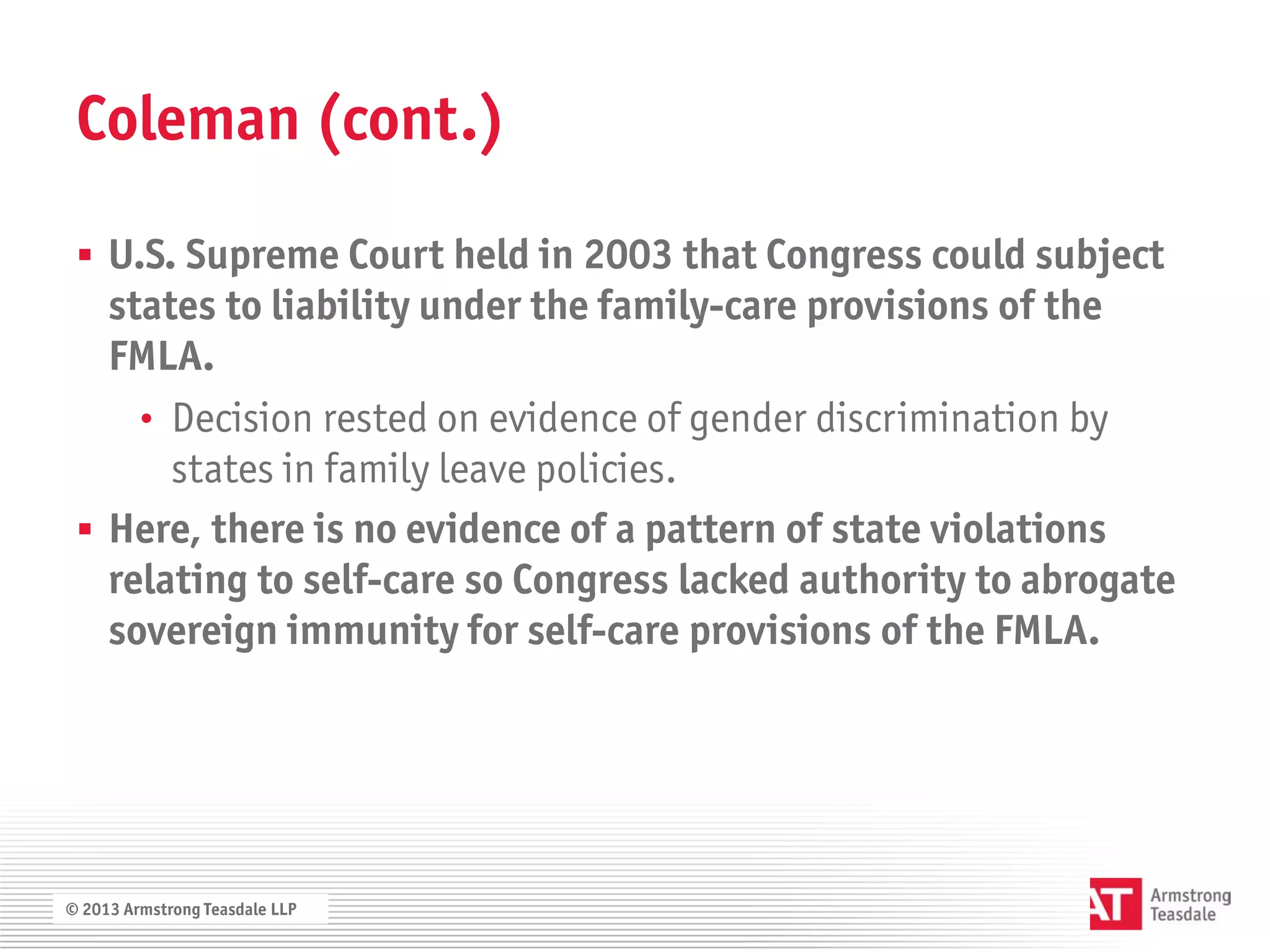
Coleman (cont.)

  U.S. Supreme Court held in 2003 that Congress could subject
   states to liability under the family-care provisions of the
   FMLA.
     • Decision rested on evidence of gender discrimination by
       states in family leave policies.
  Here, there is no evidence of a pattern of state violations
   relating to self-care so Congress lacked authority to abrogate
   sovereign immunity for self-care provisions of the FMLA.


© 2013 Armstrong Teasdale LLP
EEOC Strategic Enforcement Plan

 Recruiting and hiring practices
       • Intentional discrimination and disparate impact
 Protecting vulnerable workers (immigrants, disabled, youths)
       • Educating employees about their rights
 Emerging issues
       • ADAAA (accommodation, undue hardship, direct threat)
       • Lesbian, gay, bisexual, transgender issues
 Harassment


© 2013 Armstrong Teasdale LLP
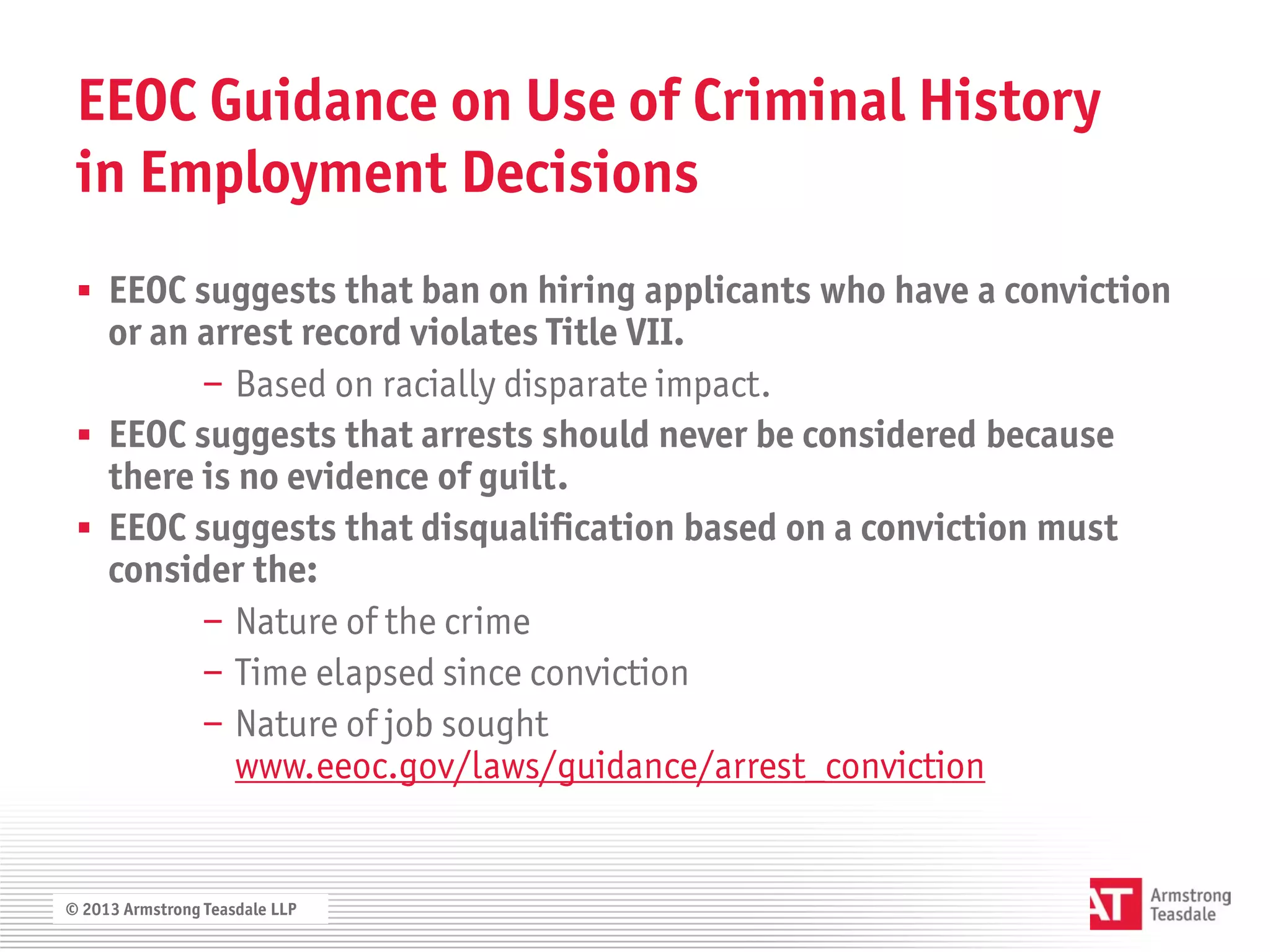
EEOC Guidance on Use of Criminal History
 in Employment Decisions
  EEOC suggests that ban on hiring applicants who have a conviction
   or an arrest record violates Title VII.
         − Based on racially disparate impact.
  EEOC suggests that arrests should never be considered because
   there is no evidence of guilt.
  EEOC suggests that disqualification based on a conviction must
   consider the:
         − Nature of the crime
         − Time elapsed since conviction
         − Nature of job sought
            www.eeoc.gov/laws/guidance/arrest_conviction


© 2013 Armstrong Teasdale LLP
Contact Information
                                        Dan O’Toole
                                dotoole@armstrongteasdale.com
                                        314.621.5070


© 2013 Armstrong Teasdale LLP

Employment & Labor Law for the Year 2013

  • 1.
    © 2013 ArmstrongTeasdale LLP
  • 2.
    Employment & LaborLaw Update Presented by: Dan O’Toole © 2013 Armstrong Teasdale LLP
  • 3.
    Thomas v. McKeever’sEnterprises, Inc. ___ S.W.3d ___,2012 WL 4771364 (Mo. App. 2012)  At conclusion of MHRA age discrimination trial, court submitted MAI 31.24: • Your verdict must be for Plaintiff if you believe: − First, Defendant discharged Plaintiff, and − Second, Plaintiff’s age was a contributing factor in such discharge, and − Third, as a direct result of such conduct, Plaintiff sustained damages. © 2013 Armstrong Teasdale LLP
  • 4.
    Thomas (cont.) During closing arguments, Defendant’s counsel repeatedly stated that the “real issue” is whether Plaintiff would still be working for Defendant “but for” his age. Plaintiff did not object.  During rebuttal argument, Plaintiff argued “contributing factor” standard and questioned use of “but for” causation. Defendant objected to this argument as a misstatement of the law. © 2013 Armstrong Teasdale LLP
  • 5.
    Thomas (cont.) The trial court sustained the objection and gave an oral curative instruction affirming the “but for” standard.  Court of Appeals reverses. MHRA prohibits any unfair treatment based on age and Plaintiff must only prove that age contributed to Plaintiff’s discharge. © 2013 Armstrong Teasdale LLP
  • 6.
    Hill v. Cityof St. Louis 371 S.W.3d 66 (Mo. App. 2012)  Trial court did not abuse its discretion in: • Allowing Plaintiff’s counsel to inform jury that Sheriff Murphy had no personal financial liability in the case. • Allowing an expert to testify about the symbolism of a noose. • Allowing an expert to testify about significance of EEOC guidance and reasonableness of City’s efforts to prevent harassment and discrimination. • Remitting punitive damages from $350,000 to $75,000. • Awarding $326,000 in attorney fees rather than the $421,270.25 requested. © 2013 Armstrong Teasdale LLP
  • 7.
    Reed v. McDonald’sCorporation 363 S.W.3d 134 (Mo.App. 2012)  Teenage restaurant worker alleged that she was sexually harassed by Assistant Manager.  Reed complained and was offered but declined a transfer.  Assistant Manager was suspended and eventually terminated but visited the restaurant during his suspension and while Reed was working. © 2013 Armstrong Teasdale LLP
  • 8.
    Reed (cont.) Factual issue on the Farragher defense: 1) Defense requires proof that employer exercised reasonable care to prevent and promptly correct any harassing behavior; and 2) Employee failed to take advantage of preventative or corrective opportunities provided by the employer or to avoid harm otherwise. − Franchisee provided Reed a copy of its policies. − Franchisee posted anti-harassment posters. − Franchisee immediately suspended and then terminated Assistant Manager after the complaint against him. © 2013 Armstrong Teasdale LLP
  • 9.
    Reed (cont.) − Reed testified “that she does not recall that Franchisee’s policies were explained to her.” − Franchisee allowed Assistant Manager to visit restaurant during his suspension. − Franchisee failed to protect her privacy from the employees regarding Reed’s sexual encounters with the Assistant Manager. © 2013 Armstrong Teasdale LLP
  • 10.
    Grissom v. FirstNational Insurance Agency 364 S.W.3d 728 (Mo. App. 2012)  Grissom alleged that Welker (the sole owner) sexually harassed her until he received a letter from Grissom’s attorney asking him to stop.  Grissom was fired 180 days after Welker received the attorney’s letter.  Trial court granted summary judgment on the sexual harassment claim because Grissom testified in deposition that the harassment stopped after Welker received her attorney’s letter.  Welker denied receiving the letter. © 2013 Armstrong Teasdale LLP
  • 11.
    Grissom (cont.) Court of Appeals reversed. Grissom’s termination could be viewed as part of a continuing violation. Only one act within a continuing violation needs to be timely.  Lesson: No good deed goes unpunished. Letter of recommendation Welker wrote after Grissom’s termination is proof undercutting Welker’s justification for termination. © 2013 Armstrong Teasdale LLP
  • 12.
    Farrow v. St.Francis Medical Center 2012 WL 451882 (Mo. App. 2012)  Farrow given notice of discharge on December 10, 2008.  Farrow files a grievance which goes through a five step grievance process and is finally rejected on March 2, 2009.  Farrow filed a charge of sexual harassment and retaliation with the MCHR on July 27, 2009 and thereafter files a lawsuit. © 2013 Armstrong Teasdale LLP
  • 13.
    Farrow (cont.) Circuit Court grants summary judgment against Farrow because her claims are time-barred. Court of Appeals affirms.  The grievance procedure, by its nature, is a remedy for a prior decision and the employment relationship was already severed by the discharge. © 2013 Armstrong Teasdale LLP
  • 14.
    Tate v. AutoZoners,LLC 363 S.W.3d 179 (Mo. App. 2012)  Tate filed a sexual harassment case under the MHRA and obtained a $10,000 verdict.  Tate’s attorney sought $229,000 in attorneys fees and costs which the trial court, without explanation, reduced to $129,000.  The trial court did not abuse its discretion. © 2013 Armstrong Teasdale LLP
  • 15.
    Hervey v. MissouriDepartment of Corrections 379 S.W.3d 156 (Mo. banc 2012)  Trial court erred in giving instruction patterned after MAI 31.24 • Your verdict must be for the Plaintiff if you believe: − First, Defendant discharged Plaintiff; − Second, disability was a contributing factor in such discharge; − Third, as a result of such conduct, Plaintiff sustained damage.  Jury instruction was erroneous because it did not require jury to find the Plaintiff was “disabled,” which is an essential element of Plaintiff's claim.  Supreme Court reverses judgment and remands the case for trial. © 2013 Armstrong Teasdale LLP
  • 16.
    Hervey (cont.) 510.265 RSMo. limits punitive damages to the greater of: 1. $500,000; or 2. “five times the net amount of the judgment awarded to Plaintiff against Defendant.” © 2013 Armstrong Teasdale LLP
  • 17.
    Hervey (cont.) Herveysued for disability discrimination and won: $127,056 in actual damages $36,288 in front pay $97,382.50 in attorney fees $260,726.50 + $2,500,000 in punitive damages © 2013 Armstrong Teasdale LLP
  • 18.
    Hervey (cont.) Trialcourt correctly included attorneys fees in determining the “net amount of judgment” and reduced punitive damages to $1,303,632.50 ($260,726.50 x5) © 2013 Armstrong Teasdale LLP
  • 19.
    Doe v. KansasCity, Missouri School District 372 S.W.3d 43 (Mo. App. 2012)  Doe alleges that he was sexually harassed and assaulted by a fellow student.  Doe alleged that administrators and teachers were aware of the conduct but failed to protect him.  Doe sued under the MHRA but the Circuit Court dismissed the suit. © 2013 Armstrong Teasdale LLP
  • 20.
    Doe (cont.) The MHRA provides “all persons…shall be entitled to the full and equal use and enjoyment within this state of any place of public accommodation…without discrimination or segregation…on the grounds of…sex.”  “Public accommodations” are “places of business offering or holding out to the general public, goods, services, privileges, facilities, advantages or accommodations for the peace, comfort, health, welfare and safety of the general public or such public places providing food, shelter, recreation and amusement.” © 2013 Armstrong Teasdale LLP
  • 21.
    Doe (cont.) Court of Appeals finds that school is a place of public accommodation and reverses dismissal of Doe’s claims.  School District will be liable if it knew or should have known of actionable harassment and failed to take prompt and effective remedial action. © 2013 Armstrong Teasdale LLP
  • 22.
    Marzette v. Anheuser-Busch,Inc. 371 S.W.3d 49(Mo. App. 2012)  Security guards sued Anheuser-Busch in state court for discrimination under the MHRA.  As part of application process, guards agreed to arbitration as exclusive remedy for any disputes.  Trial court denied Anheuser-Busch’s motion to compel arbitration. © 2013 Armstrong Teasdale LLP
  • 23.
    Marzette (cont.) Arbitration agreements must contain the elements of a valid contract: offer, acceptance, bargained-for-consideration.  Anheuser-Busch’s willingness to consider applicant for employment does not constitute consideration.  Anheuser-Busch’s offer of employment cannot constitute consideration because it was not the motive for the promise to arbitrate. • Application said: “no promise regarding employment has been made.” © 2013 Armstrong Teasdale LLP
  • 24.
    Jones v. Paradies 380 S.W.3d 13 (Mo. App. 2012)  Plaintiff brought suit against directors of a corporation in their individual capacities alleging tortious interference with contract between Plaintiff and corporation.  Individual defendants sought to compel arbitration pursuant to arbitration clause in contract between Plaintiff and corporation.  Individual defendants were not signatories to contract containing arbitration provision and therefore could not compel arbitrations. © 2013 Armstrong Teasdale LLP
  • 25.
    You Should beAble to Demonstrate That You Have Treated the Employee Fairly  Elements of fairness • knowledge of rules • knowledge of consequences • conduct • sufficient investigation • warnings (if appropriate) • consistency © 2013 Armstrong Teasdale LLP
  • 26.
    Hunter v. UnitedParcel Service, Inc. 697 F.3d 697 (8th Cir. 2012)  Woman with gender identity disorder applied for employment with UPS.  After her application was rejected, she sued for discrimination on the basis of gender, sexual orientation and disability.  UPS’ ignorance of Hunter’s disorder shields it from discrimination liability. © 2013 Armstrong Teasdale LLP
  • 27.
    Macy v. Bureauof Alcohol, Tobacco, Firearms and Explosives EEOC Appeal No. 0120120821 (April 20, 2012)  Male applicant sought position at the ATF’s crime lab.  ATF rejected application after learning that he was in the process of transitioning to a woman.  Applicant was told that position was eliminated due to budget cuts but later learned that someone else had been hired.  EEOC found that applicant stated viable claim for gender discrimination. © 2013 Armstrong Teasdale LLP
  • 28.
    Marez v. Saint-Gobain 688 F.3d 958 (8th Cir. 2012)  Marez discharged within weeks of informing her employer of her impending need for FMLA leave.  Marez sues for violation of FMLA and shows that others who engaged in the same conduct were not discharged.  Marez awarded $413,000 in damages plus over $100,000 in attorney’s fees.  Decisionmaker’s ignorance of Marez’s request for FMLA is not a defense because of the “cat’s paw” theory. © 2013 Armstrong Teasdale LLP
  • 29.
    Nigro v. St.Joseph Medical Center 371 S.W.3d 808 (Mo. App. 2012)  Potential employer contacts St. Joseph seeking information regarding Nigro’s employment.  St. Joseph provides honest information regarding Nigro’s numerous deficiencies.  Potential employer rejects Nigro’s application and Nigro sues for defamation.  St. Joseph eventually obtains dismissal of Nigro’s lawsuit based on the truthfulness of its response and the release contained in the reference request. © 2013 Armstrong Teasdale LLP
  • 30.
    Templemire v. W&MWelding, Inc. ___ S.W.3d __, 2012 WL 6681950 (Mo. App. 2012) Until the Missouri Supreme Court instructs otherwise, courts must continue to apply the “exclusive cause” standard to workers compensation retaliation suits. © 2013 Armstrong Teasdale LLP
  • 31.
    House Bill 1540  Amends workers compensation statute to legislatively overrule Hooker v. Robinson which excluded co-workers from exclusivity bar.  Recovery against co-worker still available if co-worker “engaged in an affirmative negligent act that purposefully and dangerously caused or increased the risk of injury.”  HB 1540 passed by a veto-proof majority and Governor has signed it into law. © 2013 Armstrong Teasdale LLP
  • 32.
    Wyman v. MissouriDepartment of Mental Health 376 S.W.3d 16 (Mo. App. 2012)  Workers Compensation retaliation claim against the state under §287.780 barred by sovereign immunity. © 2013 Armstrong Teasdale LLP
  • 33.
    Coleman v. Courtof Appeals of Maryland 132 S. Ct. 1327 (2012)  Coleman brought FMLA action against state entity claiming improper denial of leave of self-care.  District Court dismissed based on sovereign immunity and Fourth Circuit affirmed.  States are immune from suits for damages unless they waive immunity or Congress validly abrogates immunity. © 2013 Armstrong Teasdale LLP
  • 34.
    Coleman (cont.) U.S. Supreme Court held in 2003 that Congress could subject states to liability under the family-care provisions of the FMLA. • Decision rested on evidence of gender discrimination by states in family leave policies.  Here, there is no evidence of a pattern of state violations relating to self-care so Congress lacked authority to abrogate sovereign immunity for self-care provisions of the FMLA. © 2013 Armstrong Teasdale LLP
  • 35.
    EEOC Strategic EnforcementPlan  Recruiting and hiring practices • Intentional discrimination and disparate impact  Protecting vulnerable workers (immigrants, disabled, youths) • Educating employees about their rights  Emerging issues • ADAAA (accommodation, undue hardship, direct threat) • Lesbian, gay, bisexual, transgender issues  Harassment © 2013 Armstrong Teasdale LLP
  • 36.
    EEOC Guidance onUse of Criminal History in Employment Decisions  EEOC suggests that ban on hiring applicants who have a conviction or an arrest record violates Title VII. − Based on racially disparate impact.  EEOC suggests that arrests should never be considered because there is no evidence of guilt.  EEOC suggests that disqualification based on a conviction must consider the: − Nature of the crime − Time elapsed since conviction − Nature of job sought www.eeoc.gov/laws/guidance/arrest_conviction © 2013 Armstrong Teasdale LLP
  • 37.
    Contact Information Dan O’Toole dotoole@armstrongteasdale.com 314.621.5070 © 2013 Armstrong Teasdale LLP