

Non Convertible Debentures
Abhilasha Kumari
College of Legal Studies, UPES
B.B.A. LL.B.(Hons.)
5th Year
Features
•Instrument of loan
•No voting rights
•Interest paid at a fixed rate
•Debenture holders are the creditors of the company
carrying a fixed rate of interest.
• redeemed after a fixed period of time.
• Debentures may be either secured or unsecured.
• Interest payable on a debenture is a charge against
profit and hence it is a tax deductible expenditure.
•Interest on debenture is payable even if there is a
loss.
Features
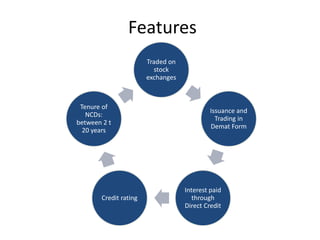
Traded on
stock
exchanges
Issuance and
Trading in
Demat Form
Interest paid
through
Direct Credit
Credit rating
Tenure of
NCDs:
between 2 t
20 years
Types of debenture
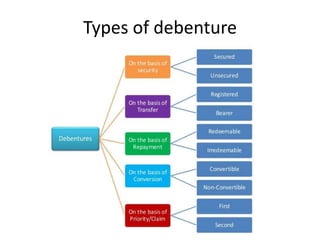
On the basis of Convertibility-
(A) Non Convertible Debentures (NCD): These
instruments retain the debt character and can not
be converted into equity shares.
(B) Partly Convertible Debentures (PCD): A part of
these instruments are converted into Equity shares
in the future at notice of the issuer.
(C) Fully convertible Debentures (FCD): These are
fully convertible into Equity shares at the issuer's
notice.
(D) Optionally Convertible Debentures (OCD): The
investor has the option to either convert these
debentures into shares at price decided by the
issuer/agreed upon at the time of issue.
On the basis of Security-
(A)Secured Debentures: These instruments are
secured by a charge on the fixed assets of the
issuer company
(B) Unsecured Debentures: These instrument
are unsecured in the sense that if the issuer
defaults on payment of the interest or
principal amount, the investor has to be along
with other unsecured creditors of the
company
On the basis of Redeemability-
(A)Redeemable Debentures: It refers to the
debentures which are issued with a condition
that the debentures will be redeemed at a
fixed date or upon demand, or after notice, or
under a system of periodical drawings.
(B) Perpetual or Irredeemable Debentures: A
Debenture, in which no time is fixed for the
company to pay back the money, is an
irredeemable debenture.
On the basis of Registration-
(A) A Registered Debentures: Registered
debentures are made out in the name of a
particular person, who is registered by the
company as holder on the Register of
debenture holders.
(B) Bearer debentures: Bearer debentures on
the other hand, are made out to bearer, and
are negotiable instruments, and so transferable
by mere delivery like share warrants.
BROAD REGULATORY FRAMEWORK
FOR DEBT SECURITIES
(a) SEBI (ICDR) Regulations 2009
(b) Listing Agreement for Debentures issued
through public issue/Rights issue.
(c) Listing agreement for privately placed
Debentures
(d) SEBI (Issue and Listing of Debt Securities)
Regulations, 2008
(e) SEBI (Public Offer and Listing of Securitised
Debt Instruments) Regulations, 2008
(f) The Companies Act, 2013
(g) Companies (Share Capital and Debentures)
Rules, 2014
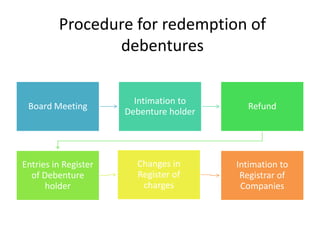
Procedure for redemption of
debentures
Board Meeting
Intimation to
Debenture holder
Refund
Entries in Register
of Debenture
holder
Changes in
Register of
charges
Intimation to
Registrar of
Companies
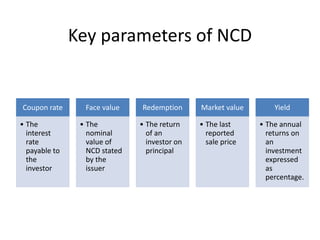
Key parameters of NCD
Coupon rate
• The
interest
rate
payable to
the
investor
Face value
• The
nominal
value of
NCD stated
by the
issuer
Redemption
• The return
of an
investor on
principal
Market value
• The last
reported
sale price
Yield
• The annual
returns on
an
investment
expressed
as
percentage.
Key points
Section 2 (30) of the Companies Act, 2013
define inclusively debenture.
Section 44- debenture as movable property.
create a DRR account out of the profits of the
company
An issue of debenture for more than five
hundred members or any number of public
without creating a debenture trust is prohibited.
No company shall issue any debentures
carrying any voting rights.
Private placement
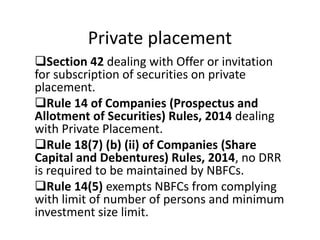
Section 42 dealing with Offer or invitation
for subscription of securities on private
placement.
Rule 14 of Companies (Prospectus and
Allotment of Securities) Rules, 2014 dealing
with Private Placement.
Rule 18(7) (b) (ii) of Companies (Share
Capital and Debentures) Rules, 2014, no DRR
is required to be maintained by NBFCs.
Rule 14(5) exempts NBFCs from complying
with limit of number of persons and minimum
investment size limit.
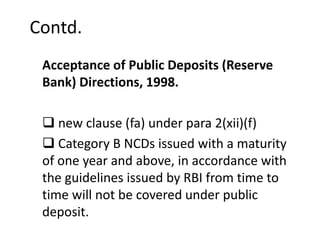
Contd.
Acceptance of Public Deposits (Reserve
Bank) Directions, 1998.
 new clause (fa) under para 2(xii)(f)
 Category B NCDs issued with a maturity
of one year and above, in accordance with
the guidelines issued by RBI from time to
time will not be covered under public
deposit.
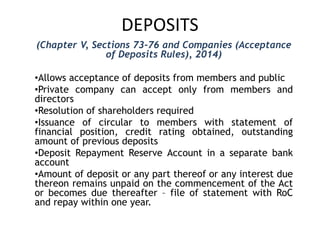
DEPOSITS
(Chapter V, Sections 73-76 and Companies (Acceptance
of Deposits Rules), 2014)
•Allows acceptance of deposits from members and public
•Private company can accept only from members and
directors
•Resolution of shareholders required
•Issuance of circular to members with statement of
financial position, credit rating obtained, outstanding
amount of previous deposits
•Deposit Repayment Reserve Account in a separate bank
account
•Amount of deposit or any part thereof or any interest due
thereon remains unpaid on the commencement of the Act
or becomes due thereafter – file of statement with RoC
and repay within one year.
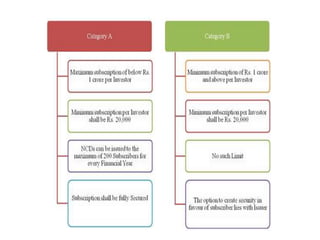
Issue of NCDs by private placement
(NBFCs)
RBI Circular- DNBR (PD) CC No.021/03.10.001/2014-15
2 categories:
a) With a maximum subscription of less than
Rs. 1 crore (Category A)
b) With a minimum subscription of Rs. 1
crore and above
Eligibility criteria to issue the NCDs
of less than one year
•Having a tangible net worth as per the latest audited
balance sheet, of not less than Rs.4 crore;
•been sanctioned working capital limit by bank/s or all-
India FIs; and
•The borrowing account of the company is classified as a
Standard Asset by the financing banks/ institutions.
• valid credit rating of P-2 or equivalent for the issue from
one of the rating agencies specified by Reserve Bank of India
from time to time, for the purpose.
Zero coupon bonds: - refer to those bonds
which are sold at a discount from its eventual
maturity value and have zero interest rate.
Deep discount bond:- It refers to those bonds
which are sold at discount value by the
company and on maturity face value is paid to
the investors.
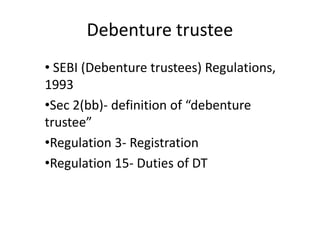
Debenture trustee
• SEBI (Debenture trustees) Regulations,
1993
•Sec 2(bb)- definition of “debenture
trustee”
•Regulation 3- Registration
•Regulation 15- Duties of DT
Role of Debenture trustees
•Enforce security in the interest of the debenture holders
•protecting the interest of the debenture holders
•Exercise due diligence to ensure compliance by the body
corporate
•Take possession of trust property
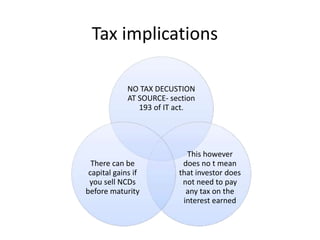
Tax implications
NO TAX DECUSTION
AT SOURCE- section
193 of IT act.
This however
does no t mean
that investor does
not need to pay
any tax on the
interest earned
There can be
capital gains if
you sell NCDs
before maturity
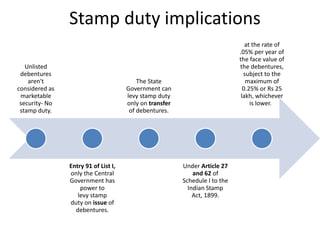
Stamp duty implications
Unlisted
debentures
aren't
considered as
marketable
security- No
stamp duty.
Entry 91 of List I,
only the Central
Government has
power to
levy stamp
duty on issue of
debentures.
The State
Government can
levy stamp duty
only on transfer
of debentures.
Under Article 27
and 62 of
Schedule I to the
Indian Stamp
Act, 1899.
at the rate of
.05% per year of
the face value of
the debentures,
subject to the
maximum of
0.25% or Rs 25
lakh, whichever
is lower.
THANK YOU

Non Convertible Debentures

  • 1.
    Non Convertible Debentures AbhilashaKumari College of Legal Studies, UPES B.B.A. LL.B.(Hons.) 5th Year
  • 2.
    Features •Instrument of loan •Novoting rights •Interest paid at a fixed rate •Debenture holders are the creditors of the company carrying a fixed rate of interest. • redeemed after a fixed period of time. • Debentures may be either secured or unsecured. • Interest payable on a debenture is a charge against profit and hence it is a tax deductible expenditure. •Interest on debenture is payable even if there is a loss.
  • 3.
    Features Traded on stock exchanges Issuance and Tradingin Demat Form Interest paid through Direct Credit Credit rating Tenure of NCDs: between 2 t 20 years
  • 4.
  • 5.
    On the basisof Convertibility- (A) Non Convertible Debentures (NCD): These instruments retain the debt character and can not be converted into equity shares. (B) Partly Convertible Debentures (PCD): A part of these instruments are converted into Equity shares in the future at notice of the issuer. (C) Fully convertible Debentures (FCD): These are fully convertible into Equity shares at the issuer's notice. (D) Optionally Convertible Debentures (OCD): The investor has the option to either convert these debentures into shares at price decided by the issuer/agreed upon at the time of issue.
  • 6.
    On the basisof Security- (A)Secured Debentures: These instruments are secured by a charge on the fixed assets of the issuer company (B) Unsecured Debentures: These instrument are unsecured in the sense that if the issuer defaults on payment of the interest or principal amount, the investor has to be along with other unsecured creditors of the company
  • 7.
    On the basisof Redeemability- (A)Redeemable Debentures: It refers to the debentures which are issued with a condition that the debentures will be redeemed at a fixed date or upon demand, or after notice, or under a system of periodical drawings. (B) Perpetual or Irredeemable Debentures: A Debenture, in which no time is fixed for the company to pay back the money, is an irredeemable debenture.
  • 8.
    On the basisof Registration- (A) A Registered Debentures: Registered debentures are made out in the name of a particular person, who is registered by the company as holder on the Register of debenture holders. (B) Bearer debentures: Bearer debentures on the other hand, are made out to bearer, and are negotiable instruments, and so transferable by mere delivery like share warrants.
  • 9.
    BROAD REGULATORY FRAMEWORK FORDEBT SECURITIES (a) SEBI (ICDR) Regulations 2009 (b) Listing Agreement for Debentures issued through public issue/Rights issue. (c) Listing agreement for privately placed Debentures (d) SEBI (Issue and Listing of Debt Securities) Regulations, 2008 (e) SEBI (Public Offer and Listing of Securitised Debt Instruments) Regulations, 2008 (f) The Companies Act, 2013 (g) Companies (Share Capital and Debentures) Rules, 2014
  • 10.
    Procedure for redemptionof debentures Board Meeting Intimation to Debenture holder Refund Entries in Register of Debenture holder Changes in Register of charges Intimation to Registrar of Companies
  • 11.
    Key parameters ofNCD Coupon rate • The interest rate payable to the investor Face value • The nominal value of NCD stated by the issuer Redemption • The return of an investor on principal Market value • The last reported sale price Yield • The annual returns on an investment expressed as percentage.
  • 12.
    Key points Section 2(30) of the Companies Act, 2013 define inclusively debenture. Section 44- debenture as movable property. create a DRR account out of the profits of the company An issue of debenture for more than five hundred members or any number of public without creating a debenture trust is prohibited. No company shall issue any debentures carrying any voting rights.
  • 14.
    Private placement Section 42dealing with Offer or invitation for subscription of securities on private placement. Rule 14 of Companies (Prospectus and Allotment of Securities) Rules, 2014 dealing with Private Placement. Rule 18(7) (b) (ii) of Companies (Share Capital and Debentures) Rules, 2014, no DRR is required to be maintained by NBFCs. Rule 14(5) exempts NBFCs from complying with limit of number of persons and minimum investment size limit.
  • 15.
    Contd. Acceptance of PublicDeposits (Reserve Bank) Directions, 1998.  new clause (fa) under para 2(xii)(f)  Category B NCDs issued with a maturity of one year and above, in accordance with the guidelines issued by RBI from time to time will not be covered under public deposit.
  • 16.
    DEPOSITS (Chapter V, Sections73-76 and Companies (Acceptance of Deposits Rules), 2014) •Allows acceptance of deposits from members and public •Private company can accept only from members and directors •Resolution of shareholders required •Issuance of circular to members with statement of financial position, credit rating obtained, outstanding amount of previous deposits •Deposit Repayment Reserve Account in a separate bank account •Amount of deposit or any part thereof or any interest due thereon remains unpaid on the commencement of the Act or becomes due thereafter – file of statement with RoC and repay within one year.
  • 17.
    Issue of NCDsby private placement (NBFCs) RBI Circular- DNBR (PD) CC No.021/03.10.001/2014-15 2 categories: a) With a maximum subscription of less than Rs. 1 crore (Category A) b) With a minimum subscription of Rs. 1 crore and above
  • 18.
    Eligibility criteria toissue the NCDs of less than one year •Having a tangible net worth as per the latest audited balance sheet, of not less than Rs.4 crore; •been sanctioned working capital limit by bank/s or all- India FIs; and •The borrowing account of the company is classified as a Standard Asset by the financing banks/ institutions. • valid credit rating of P-2 or equivalent for the issue from one of the rating agencies specified by Reserve Bank of India from time to time, for the purpose.
  • 20.
    Zero coupon bonds:- refer to those bonds which are sold at a discount from its eventual maturity value and have zero interest rate. Deep discount bond:- It refers to those bonds which are sold at discount value by the company and on maturity face value is paid to the investors.
  • 21.
    Debenture trustee • SEBI(Debenture trustees) Regulations, 1993 •Sec 2(bb)- definition of “debenture trustee” •Regulation 3- Registration •Regulation 15- Duties of DT
  • 22.
    Role of Debenturetrustees •Enforce security in the interest of the debenture holders •protecting the interest of the debenture holders •Exercise due diligence to ensure compliance by the body corporate •Take possession of trust property
  • 23.
    Tax implications NO TAXDECUSTION AT SOURCE- section 193 of IT act. This however does no t mean that investor does not need to pay any tax on the interest earned There can be capital gains if you sell NCDs before maturity
  • 24.
    Stamp duty implications Unlisted debentures aren't consideredas marketable security- No stamp duty. Entry 91 of List I, only the Central Government has power to levy stamp duty on issue of debentures. The State Government can levy stamp duty only on transfer of debentures. Under Article 27 and 62 of Schedule I to the Indian Stamp Act, 1899. at the rate of .05% per year of the face value of the debentures, subject to the maximum of 0.25% or Rs 25 lakh, whichever is lower.
  • 25.

Editor's Notes

  • #8 1. But all debentures, whether redeemable or irredeemable become payable on the company going into liquidation. However, after the commencement of the Companies Act, 2013, now a company cannot issue perpetual or irredeemable debentures.
  • #9 1. Registered debentures- Such debentures are transferable in the same manner as shares by means of a proper instrument of transfer duly stamped and executed and satisfying the other requirements specified in Section 56 of the Companies Act, 2013.
  • #13 1. Section 2 (30) of the Companies Act, 2013 define inclusively debenture as “debenture” includes debenture stock, bonds or any other instrument of a company evidencing a debt, whether constituting a charge on the assets of the company or not.
  • #25 1. n terms of order bearing S.O. 2189(E) dated September 12, 2008, issued by the Department of Revenue, Ministry of Finance, it is required that the issuer will pay the stamp duty on issue of debentures, being a marketable security transferable (a) by endorsement or by a separate instrument of transfer (b) by delivery; at the rate of .05% per year of the face value of the debentures, subject to the maximum of 0.25% or Rs 25 lakh, whichever is lower.   In terms of the provisions of this order, a company issuing debentures is required to pay stamp duty only if debentures are treated as “marketable security”. Hence, it is important to analyse the expression “marketable security”. The expression, "marketable security" is defined under Section 2(16-A) of the Indian Stamp Act, 1899 to mean a security of such a description as to be capable of being sold in any stock market in India or in the United Kingdom.