RENAISSANCE
         Prepared to:
Mam Augusta Rosario A. Villamater

         Prepared by:
      Hannah May Rosales
From 15th century:
•Malatestiana library was founded by Malatesta
Novello

•   The Papal collections were brought together by
    Pope Nicholas V.

•libraries of humanist and their enlightened patrons
provided a nucleus around which an "academy" of
scholars congregated in each Italian city of
consequence.
In the 16th and 17th century:
•Sixtus V bisected Bramante's Cortile del Belvedere with a
cross-wing to house the Apostolic Library in suitable
magnificence.
• the Vallicelliana, formed from the books of Saint Filippo
Neri, with other distinguished libraries such as that of
Cesare Baronio
• the Biblioteca Angelica founded by the Augustinian
Angelo Rocca, which was the only truly public library in
Counter-Reformation Rome
• the Biblioteca Alessandrina which Pope Alexander
 VII endowed the University of Rome; the Biblioteca
Casanatense of the Cardinal Girolamo Casanate; and
finally the Biblioteca Corsiniana founded by the
bibliophile Clement XII Corsini
From 17th century and 18th century: (golden age of
libraries)
Important libraries were founded such as:
•Bodleian Library at Oxford
•the British Museum Library in London
•the Mazarine Library and the Bibliothèque Sainte-
Geneviève in Paris
•Austrian National Library in Vienna, the National
Central Library in Florence, the Prussian State Library
in Berlin, the Załuski Library in Warsaw and the M.E.
Saltykov-Shchedrin State Public Library of St
Petersburg
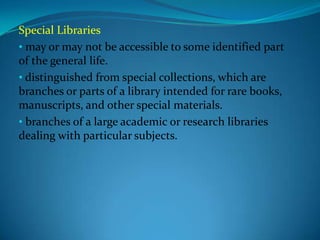
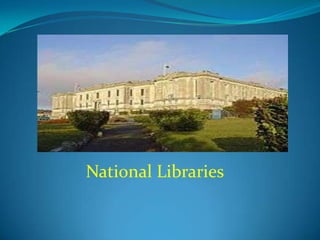
National Libraries
• serves as national repository of information
• rarely allow citizens to borrow books
Research Libraries
• contains an in-depth collection of material on one or
more subjects
• supports scholarly research
• most often an academic or national library
• can be either reference library, which does not lend
its holdings or a lending library, which does lend all or
some of its holdings.
Reference Libraries
• does not lend books and other items; instead, they
must be read at the library itself.
• historical and unique
Examples of reference libraries:
1. British Library in London
2. Bodleian Library at Oxford University


Reference sections may be referred to as
“reading rooms” which may also include newspapers
    and periodicals
Radical Reference Libraries
• libraries that are committed to social justice.
• committed to ensuring that activists and reporters had
to access to information they might need.
Year 2004 - the first Radical Reference library was
created for the Republican Convention
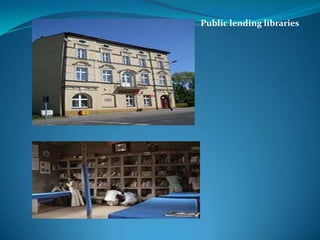
Public or public lending library
• provides a service to the general public and makes at
least some of its books available for borrowing
• serves as community organizations that provide free
services and events to the public, such as reading groups
and toddler story time.
The American Library Association - continues to play a
major role in libraries to this day, with its public library
focused division
Stack system - which involved keeping a library’s
collection of books in a space separate from the reading
room
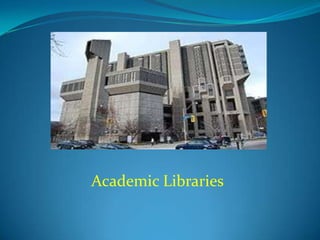
Academic Libraries
• to provide resources and research support for students
and faculty of the educational institution
• generally located on the campuses of colleges and
universities and serve primarily the students and faculty
of that and other academic institutions
• hosted in post-secondary educational institutions,
such as colleges and universities.
• provides a quiet study space for students on campus; it
may also provide group study space, such as meeting
rooms.
Children’s Libraries
• special collections of books intended for juvenile
readers and usually kept in separate rooms of general
public libraries.
• educational agency seeking to acquaint the young with
the world’s literature and to cultivate a love for reading.
Popular programs offered in public libraries are:
Summer reading programs for children, families and
adults
Special Libraries
• may or may not be accessible to some identified part
of the general life.
• distinguished from special collections, which are
branches or parts of a library intended for rare books,
manuscripts, and other special materials.
• branches of a large academic or research libraries
dealing with particular subjects.
National Libraries
Public lending libraries
Academic Libraries

Powerpoint presentation in intro to information science

  • 1.
    RENAISSANCE Prepared to: Mam Augusta Rosario A. Villamater Prepared by: Hannah May Rosales
  • 2.
    From 15th century: •Malatestianalibrary was founded by Malatesta Novello • The Papal collections were brought together by Pope Nicholas V. •libraries of humanist and their enlightened patrons provided a nucleus around which an "academy" of scholars congregated in each Italian city of consequence.
  • 3.
    In the 16thand 17th century: •Sixtus V bisected Bramante's Cortile del Belvedere with a cross-wing to house the Apostolic Library in suitable magnificence. • the Vallicelliana, formed from the books of Saint Filippo Neri, with other distinguished libraries such as that of Cesare Baronio • the Biblioteca Angelica founded by the Augustinian Angelo Rocca, which was the only truly public library in Counter-Reformation Rome • the Biblioteca Alessandrina which Pope Alexander VII endowed the University of Rome; the Biblioteca Casanatense of the Cardinal Girolamo Casanate; and finally the Biblioteca Corsiniana founded by the bibliophile Clement XII Corsini
  • 4.
    From 17th centuryand 18th century: (golden age of libraries) Important libraries were founded such as: •Bodleian Library at Oxford •the British Museum Library in London •the Mazarine Library and the Bibliothèque Sainte- Geneviève in Paris •Austrian National Library in Vienna, the National Central Library in Florence, the Prussian State Library in Berlin, the Załuski Library in Warsaw and the M.E. Saltykov-Shchedrin State Public Library of St Petersburg
  • 5.
    National Libraries • servesas national repository of information • rarely allow citizens to borrow books Research Libraries • contains an in-depth collection of material on one or more subjects • supports scholarly research • most often an academic or national library • can be either reference library, which does not lend its holdings or a lending library, which does lend all or some of its holdings.
  • 6.
    Reference Libraries • doesnot lend books and other items; instead, they must be read at the library itself. • historical and unique Examples of reference libraries: 1. British Library in London 2. Bodleian Library at Oxford University Reference sections may be referred to as “reading rooms” which may also include newspapers and periodicals
  • 7.
    Radical Reference Libraries •libraries that are committed to social justice. • committed to ensuring that activists and reporters had to access to information they might need. Year 2004 - the first Radical Reference library was created for the Republican Convention Public or public lending library • provides a service to the general public and makes at least some of its books available for borrowing • serves as community organizations that provide free services and events to the public, such as reading groups and toddler story time.
  • 8.
    The American LibraryAssociation - continues to play a major role in libraries to this day, with its public library focused division Stack system - which involved keeping a library’s collection of books in a space separate from the reading room Academic Libraries • to provide resources and research support for students and faculty of the educational institution • generally located on the campuses of colleges and universities and serve primarily the students and faculty of that and other academic institutions • hosted in post-secondary educational institutions, such as colleges and universities.
  • 9.
    • provides aquiet study space for students on campus; it may also provide group study space, such as meeting rooms. Children’s Libraries • special collections of books intended for juvenile readers and usually kept in separate rooms of general public libraries. • educational agency seeking to acquaint the young with the world’s literature and to cultivate a love for reading. Popular programs offered in public libraries are: Summer reading programs for children, families and adults
  • 10.
    Special Libraries • mayor may not be accessible to some identified part of the general life. • distinguished from special collections, which are branches or parts of a library intended for rare books, manuscripts, and other special materials. • branches of a large academic or research libraries dealing with particular subjects.
  • 11.
  • 12.
  • 13.