Evaluation 4 -Who are your
audience and what did you learn
from your feedback?
Who are the audience?
In order to create a successful production, it has to be advertised,
promoted, and constructed for a specific audience who are interested in
this particular genre and style of film, and therefore who would watch it.
This is why we do research into target audiences.
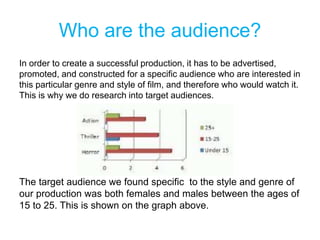
The target audience we found specific to the style and genre of
our production was both females and males between the ages of
15 to 25. This is shown on the graph above.
Genre and Audience Appeal
Genre needs to be considered in relation to target
audiences because the audience understand genre, and
that is how they differentiate between films they like and
would watch, and films they wouldn’t watch.
With the intention of uncovering which group of people
would enjoy the horror genre of our production who we
could aim it at, we sent out questionnaires asking multiple
different people their preferential genre.
Audience Theory
Uses and Gratification Theory
Uses and gratification theory – there are 4 needs of an audience that
media seeks to gratify
• Diversion
• Personal relationships
• Personal identities
• Surveillance
Diversion refers to providing an escape from everyday reality,
distracting and diverting a persons attention. This is deemed to be a
pleasurable stress relieving activity.
Personal relationships refers to the way people often bond over a film
they may watch together. This is through talking about the film and
sharing what they liked or disliked about the film.
Audience Theory – 2
Hypodermic Needle Theory
The hypodermic needle theory is that the media is like a needle which
injects ideas, attitudes and beliefs into the audience. Although the
majority of audiences are now increasingly aware of this concept, it is a
common occurrence with horror films. This is especially amongst
children as they are passive users of the media and are easily
influenced and unaware of massive influence the media can have on
their naive minds.
For example, this is demonstrated in the Jamie Bulger case, where he
violently murdered a young child because of something he had
watched.
This is why according to the BBFC our film would be rated a 15,
potentially leaving it inaccessible to young children, inadvertently
preventing such cases.
Genre Representations
Our genre has been represented to our audience, and
made recognisable as a horror through the use of generic
conventions such as; colour schemes, style, fast editing
pace, music, themes, the sting, and lighting.
Generally in films, women are naturally portrayed as the
nurturing, vulnerable, submissive characters. We have
challenged this convention through our female antagonist
Evylin. Although it is not particularly uncommon to have a
female antagonist in horror films, it doesn’t occur often,
therefore challenges conventions of a genre and makes our
more interesting film to watch.
What did we get from our
feedback?
• In order to get feedback from our audience we set up a
focus group consisting of a number of students and
teachers, who were all invited to view our trailer in our
media class room. The focus group was a small sample
of people, we hope represents the rest of our audience.
We got extremely positive feedback from our focus
group. It was clear that the genre of our trailer was
obvious to our audience. Finally, the trailer was
successful in interesting the audience, and leaving them
wanting more.
Skills development and audience
• Previously, in our AS coursework, minimal audience
research was done. The effect of this was that we were
unaware of who our audience would be, and what their
preferences and opinions would be regarding genres,
and therefore our production wasn't as successful as it
could have been. Whereas this year significant amounts
of time and effort have been spent conducting both
primary and secondary research for our production. This
included a questionnaire, and research into the
audiences of similar films on websites such as IMDb.
Our research gave us a more accurate idea of what our
audience expects of a film and a particular genre, in this
case horror.
Skills development and audience
• Additionally, this year the genre of our
production was established more effectively
through locations and time. In order to
conform to the generic conventions of a
horror, we filmed in more secluded locations,
at night time, and used lower lighting.
Whereas last year, the whole of our
production was filmed in daylight, which
wasn't effective in allowing the production to
be recognised as a thriller.
Is our trailer successful
• Ultimately I believe our trailer was successful
with regards to targeting a specific audience.
This was achieved first through effectively
identifying the audience most appropriate for
our genre, and type of film, and then through
ensuring we conformed to certain generic
conventions of horrors to make our
production recognisable to this audience. The
audience has always been considered in our
production, with the intention of targeting
them as specifically as possible.

Powerpoint eval 3

  • 1.
    Evaluation 4 -Whoare your audience and what did you learn from your feedback?
  • 2.
    Who are theaudience? In order to create a successful production, it has to be advertised, promoted, and constructed for a specific audience who are interested in this particular genre and style of film, and therefore who would watch it. This is why we do research into target audiences. The target audience we found specific to the style and genre of our production was both females and males between the ages of 15 to 25. This is shown on the graph above.
  • 3.
    Genre and AudienceAppeal Genre needs to be considered in relation to target audiences because the audience understand genre, and that is how they differentiate between films they like and would watch, and films they wouldn’t watch. With the intention of uncovering which group of people would enjoy the horror genre of our production who we could aim it at, we sent out questionnaires asking multiple different people their preferential genre.
  • 4.
    Audience Theory Uses andGratification Theory Uses and gratification theory – there are 4 needs of an audience that media seeks to gratify • Diversion • Personal relationships • Personal identities • Surveillance Diversion refers to providing an escape from everyday reality, distracting and diverting a persons attention. This is deemed to be a pleasurable stress relieving activity. Personal relationships refers to the way people often bond over a film they may watch together. This is through talking about the film and sharing what they liked or disliked about the film.
  • 5.
    Audience Theory –2 Hypodermic Needle Theory The hypodermic needle theory is that the media is like a needle which injects ideas, attitudes and beliefs into the audience. Although the majority of audiences are now increasingly aware of this concept, it is a common occurrence with horror films. This is especially amongst children as they are passive users of the media and are easily influenced and unaware of massive influence the media can have on their naive minds. For example, this is demonstrated in the Jamie Bulger case, where he violently murdered a young child because of something he had watched. This is why according to the BBFC our film would be rated a 15, potentially leaving it inaccessible to young children, inadvertently preventing such cases.
  • 6.
    Genre Representations Our genrehas been represented to our audience, and made recognisable as a horror through the use of generic conventions such as; colour schemes, style, fast editing pace, music, themes, the sting, and lighting. Generally in films, women are naturally portrayed as the nurturing, vulnerable, submissive characters. We have challenged this convention through our female antagonist Evylin. Although it is not particularly uncommon to have a female antagonist in horror films, it doesn’t occur often, therefore challenges conventions of a genre and makes our more interesting film to watch.
  • 7.
    What did weget from our feedback? • In order to get feedback from our audience we set up a focus group consisting of a number of students and teachers, who were all invited to view our trailer in our media class room. The focus group was a small sample of people, we hope represents the rest of our audience. We got extremely positive feedback from our focus group. It was clear that the genre of our trailer was obvious to our audience. Finally, the trailer was successful in interesting the audience, and leaving them wanting more.
  • 8.
    Skills development andaudience • Previously, in our AS coursework, minimal audience research was done. The effect of this was that we were unaware of who our audience would be, and what their preferences and opinions would be regarding genres, and therefore our production wasn't as successful as it could have been. Whereas this year significant amounts of time and effort have been spent conducting both primary and secondary research for our production. This included a questionnaire, and research into the audiences of similar films on websites such as IMDb. Our research gave us a more accurate idea of what our audience expects of a film and a particular genre, in this case horror.
  • 9.
    Skills development andaudience • Additionally, this year the genre of our production was established more effectively through locations and time. In order to conform to the generic conventions of a horror, we filmed in more secluded locations, at night time, and used lower lighting. Whereas last year, the whole of our production was filmed in daylight, which wasn't effective in allowing the production to be recognised as a thriller.
  • 10.
    Is our trailersuccessful • Ultimately I believe our trailer was successful with regards to targeting a specific audience. This was achieved first through effectively identifying the audience most appropriate for our genre, and type of film, and then through ensuring we conformed to certain generic conventions of horrors to make our production recognisable to this audience. The audience has always been considered in our production, with the intention of targeting them as specifically as possible.