04/03/21
How my film engages with its audience and how I would
distribute it Sam de Bruin
Target audience
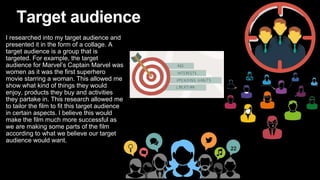
I researched into my target audience and
presented it in the form of a collage. A
target audience is a group that is
targeted. For example, the target
audience for Marvel’s Captain Marvel was
women as it was the first superhero
movie starring a woman. This allowed me
show what kind of things they would
enjoy, products they buy and activities
they partake in. This research allowed me
to tailor the film to fit this target audience
in certain aspects. I believe this would
make the film much more successful as
we are making some parts of the film
according to what we believe our target
audience would want.
My Target audience
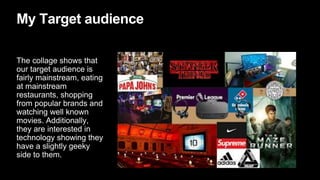
The collage shows that
our target audience is
fairly mainstream, eating
at mainstream
restaurants, shopping
from popular brands and
watching well known
movies. Additionally,
they are interested in
technology showing they
have a slightly geeky
side to them.
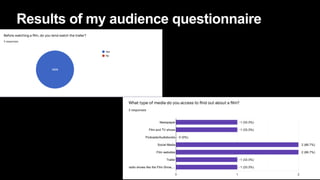
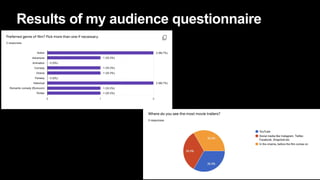
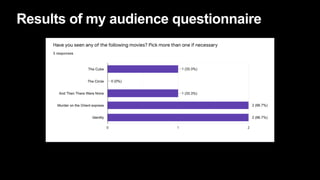
Results of my audience questionnaire
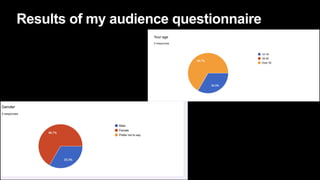
Conclusion of my audience questionnaire
The audience questionnaire has shown me the demographics and
specifics I need to include when making a film opening and how I would
market it. I have concluded that all generations and ages look at trailers
before watching a movie, due to how it gives them a brief overview and
shows the sheer excitement of a movie. Additionally, I would market on all
social media platforms including FaceBook and Snapchat, to make sure
all ages are targeted in the social media campaign. Additionally, I gained
knowledge on what films they liked and didn’t like, giving me a look at
what made them good and what made them bad.
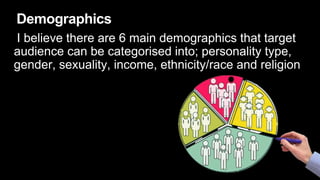
Demographics
I believe there are 6 main demographics that target
audience can be categorised into; personality type,
gender, sexuality, income, ethnicity/race and religion
Personality type
Someones personality can alter their decision on whether they would like to
watch a movie or not. For example, people interested in sports and partying are
going to have different opinions on what they want in a film to someone who
plays computer games and focuses on school work. Because of this, me and my
group need to make sure we have a firm grasp on the personality type of our
target audience and make sure we are targeting the right group.
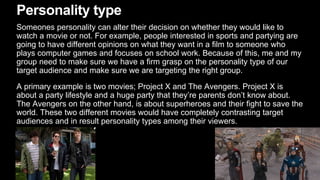
A primary example is two movies; Project X and The Avengers. Project X is
about a party lifestyle and a huge party that they’re parents don’t know about.
The Avengers on the other hand, is about superheroes and their fight to save the
world. These two different movies would have completely contrasting target
audiences and in result personality types among their viewers.
Gender
Gender can decide whether someone watches a film
according to the cast of the film. If a film features woman
star role or a predominantly woman cast, females may be
more inclined to watch it. Some production companies will
target specific genders when making a film, making gender
one of the most important factors when thinking about a
target audience
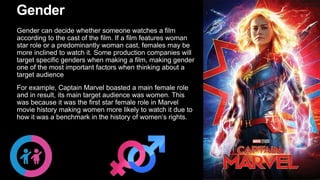
For example, Captain Marvel boasted a main female role
and in result, its main target audience was women. This
was because it was the first star female role in Marvel
movie history making women more likely to watch it due to
how it was a benchmark in the history of women’s rights.
Sexuality
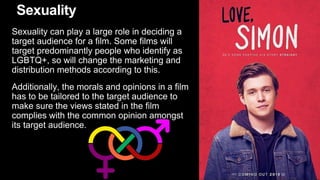
Sexuality can play a large role in deciding a
target audience for a film. Some films will
target predominantly people who identify as
LGBTQ+, so will change the marketing and
distribution methods according to this.
Additionally, the morals and opinions in a film
has to be tailored to the target audience to
make sure the views stated in the film
complies with the common opinion amongst
its target audience.
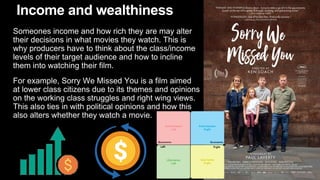
Income and wealthiness
Someones income and how rich they are may alter
their decisions in what movies they watch. This is
why producers have to think about the class/income
levels of their target audience and how to incline
them into watching their film.
For example, Sorry We Missed You is a film aimed
at lower class citizens due to its themes and opinions
on the working class struggles and right wing views.
This also ties in with political opinions and how this
also alters whether they watch a movie.
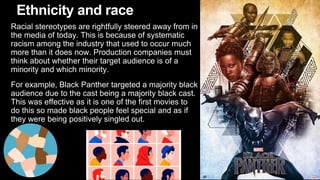
Ethnicity and race
Racial stereotypes are rightfully steered away from in
the media of today. This is because of systematic
racism among the industry that used to occur much
more than it does now. Production companies must
think about whether their target audience is of a
minority and which minority.
For example, Black Panther targeted a majority black
audience due to the cast being a majority black cast.
This was effective as it is one of the first movies to
do this so made black people feel special and as if
they were being positively singled out.
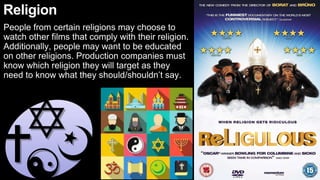
Religion
People from certain religions may choose to
watch other films that comply with their religion.
Additionally, people may want to be educated
on other religions. Production companies must
know which religion they will target as they
need to know what they should/shouldn’t say.
Demographic conclusion
Our film will target a mainstream audience who enjoys films such as the Maze
Runner and Sherlock Holmes the series. We will mainly target people of a
straight sexuality as we boast no homosexual/other sexuality in our film making it
ineffective to market. Additionally, I would market it mainly to men as it shows
only one female role opposed to 4 main male roles. The audience could be of
any income, as the characters vary from rich to poor in our film, making it
suitable for any kind of income.
What a film distributor actually does
• Deciphers:
• Who the target audience is and the best way to reach them through advertising
• What the USP’s of the film are and how to positively exploit them to reach a
wider audience
• When the best time to release the film is; at what times of the year will it give the
most “bums in seats” and if successful, when to release the film onto other
media platforms such as Netflix, Amazon Prime or releasing it on DVD
• How they will market the film and how much of their budget they will allocate to
different forms of advertising
According to the contents of the FDA educational resource
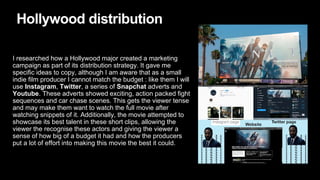
Hollywood distribution
I researched how a Hollywood major created a marketing
campaign as part of its distribution strategy. It gave me
specific ideas to copy, although I am aware that as a small
indie film producer I cannot match the budget : like them I will
use Instagram, Twitter, a series of Snapchat adverts and
Youtube. These adverts showed exciting, action packed fight
sequences and car chase scenes. This gets the viewer tense
and may make them want to watch the full movie after
watching snippets of it. Additionally, the movie attempted to
showcase its best talent in these short clips, allowing the
viewer the recognise these actors and giving the viewer a
sense of how big of a budget it had and how the producers
put a lot of effort into making this movie the best it could.
Tenet - continued
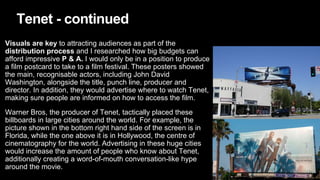
Visuals are key to attracting audiences as part of the
distribution process and I researched how big budgets can
afford impressive P & A. I would only be in a position to produce
a film postcard to take to a film festival. These posters showed
the main, recognisable actors, including John David
Washington, alongside the title, punch line, producer and
director. In addition, they would advertise where to watch Tenet,
making sure people are informed on how to access the film.
Warner Bros, the producer of Tenet, tactically placed these
billboards in large cities around the world. For example, the
picture shown in the bottom right hand side of the screen is in
Florida, while the one above it is in Hollywood, the centre of
cinematography for the world. Advertising in these huge cities
would increase the amount of people who know about Tenet,
additionally creating a word-of-mouth conversation-like hype
around the movie.
Independent film distribution
Independent films don’t have the financial support to launch a global distribution
campaign like Tenet, for example, did. Small, independent film companies would
utilise social media, however, most importantly a website in an attempt to create
hype for a movie.
Example one - Bait
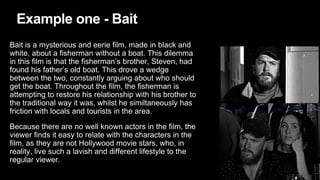
Bait is a mysterious and eerie film, made in black and
white, about a fisherman without a boat. This dilemma
in this film is that the fisherman’s brother, Steven, had
found his father’s old boat. This drove a wedge
between the two, constantly arguing about who should
get the boat. Throughout the film, the fisherman is
attempting to restore his relationship with his brother to
the traditional way it was, whilst he similtaneously has
friction with locals and tourists in the area.
Because there are no well known actors in the film, the
viewer finds it easy to relate with the characters in the
film, as they are not Hollywood movie stars, who, in
reality, live such a lavish and different lifestyle to the
regular viewer.
Bait - continued
Bait is an auteur (arthouse) inependent film much more
like our own production than the Hollywood productions
that I investigated. Therefore, I researched its website
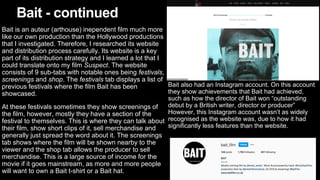
and distribution process carefully. Its website is a key
part of its distribution strategy and I learned a lot that I
could translate onto my film Suspect. The website
consists of 9 sub-tabs with notable ones being festivals,
screenings and shop. The festivals tab displays a list of
previous festivals where the film Bait has been
showcased.
At these festivals sometimes they show screenings of
the film, however, mostly they have a section of the
festival to themselves. This is where they can talk about
their film, show short clips of it, sell merchandise and
generally just spread the word about it. The screenings
tab shows where the film will be shown nearby to the
viewer and the shop tab allows the producer to sell
merchandise. This is a large source of income for the
movie if it goes mainstream, as more and more people
will want to own a Bait t-shirt or a Bait hat.
Bait also had an Instagram account. On this account
they show achievements that Bait had achieved,
such as how the director of Bait won “outstanding
debut by a British writer, director or producer”
However, this Instagram account wasn’t as widely
recognised as the website was, due to how it had
significantly less features than the website.
Example two - Sorry We Missed You
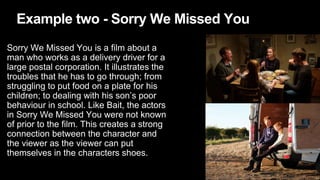
Sorry We Missed You is a film about a
man who works as a delivery driver for a
large postal corporation. It illustrates the
troubles that he has to go through; from
struggling to put food on a plate for his
children; to dealing with his son’s poor
behaviour in school. Like Bait, the actors
in Sorry We Missed You were not known
of prior to the film. This creates a strong
connection between the character and
the viewer as the viewer can put
themselves in the characters shoes.
Sorry We Missed You - continued
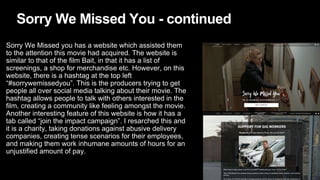
Sorry We Missed you has a website which assisted them
to the attention this movie had acquired. The website is
similar to that of the film Bait, in that it has a list of
screenings, a shop for merchandise etc. However, on this
website, there is a hashtag at the top left
“#sorrywemissedyou”. This is the producers trying to get
people all over social media talking about their movie. The
hashtag allows people to talk with others interested in the
film, creating a community like feeling amongst the movie.
Another interesting feature of this website is how it has a
tab called “join the impact campaign”. I resarched this and
it is a charity, taking donations against abusive delivery
companies, creating tense scenarios for their employees,
and making them work inhumane amounts of hours for an
unjustified amount of pay.
Independent film website conclusion
As I have shown, film websites can be extremely
effective when done well, however, in initially gaining
that hype around a film, not many people will be
looking at their website. Social media campaigns, I
believe, are the most effective at doing this. If the film
caught onto social media, it would have people talking
about it for days, creating hype around the film and in
effect would increase the amount of people watching
the film.
Film festivals
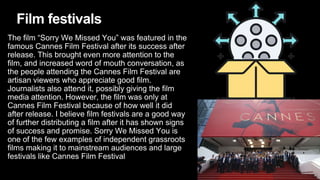
The film “Sorry We Missed You” was featured in the
famous Cannes Film Festival after its success after
release. This brought even more attention to the
film, and increased word of mouth conversation, as
the people attending the Cannes Film Festival are
artisan viewers who appreciate good film.
Journalists also attend it, possibly giving the film
media attention. However, the film was only at
Cannes Film Festival because of how well it did
after release. I believe film festivals are a good way
of further distributing a film after it has shown signs
of success and promise. Sorry We Missed You is
one of the few examples of independent grassroots
films making it to mainstream audiences and large
festivals like Cannes Film Festival
Verve and Warp
Verve and Warp are two examples of production
companies, shedding light to small, independent film
producers. They give them a platform to show their
media on, as they are two of the most upcoming,
exciting and respected production companies in the UK.
Pitching our idea to these production companies is
definitely a route my team and I are considering, as if it
passes through, the distribution is mostly done by them.
However, the chances of our film concept being
accepted by companies of these calibre, despite them
saying they support individual producers, are very slim.
Nevertheless, what do we have to lose.
Final conclusion
There are endless amounts of ways to distribute an independent film and my
group and I will definitely be exploring them. I believe a social media campaign
would be best to start off with, uploading clips of our movie to streaming sites
such as TikTok, Instagram and Facebook to build up hype and conversation for
our film. Then, if the film gets attention, we could explore the possibility of
pitching to a company such as Verve or Warp who specialise in giving the lime
light to small producers. If accepted, these companies would give us a platform
for our film to be released on, alongside a distribution campaign done by them,
meaning the responsibility would be taken out of our hands, and into the trained
professionals.

Film distribution final copy

  • 1.
    04/03/21 How my filmengages with its audience and how I would distribute it Sam de Bruin
  • 2.
    Target audience I researchedinto my target audience and presented it in the form of a collage. A target audience is a group that is targeted. For example, the target audience for Marvel’s Captain Marvel was women as it was the first superhero movie starring a woman. This allowed me show what kind of things they would enjoy, products they buy and activities they partake in. This research allowed me to tailor the film to fit this target audience in certain aspects. I believe this would make the film much more successful as we are making some parts of the film according to what we believe our target audience would want.
  • 3.
    My Target audience Thecollage shows that our target audience is fairly mainstream, eating at mainstream restaurants, shopping from popular brands and watching well known movies. Additionally, they are interested in technology showing they have a slightly geeky side to them.
  • 4.
    Results of myaudience questionnaire
  • 5.
    Results of myaudience questionnaire
  • 6.
    Results of myaudience questionnaire
  • 7.
    Results of myaudience questionnaire
  • 8.
    Conclusion of myaudience questionnaire The audience questionnaire has shown me the demographics and specifics I need to include when making a film opening and how I would market it. I have concluded that all generations and ages look at trailers before watching a movie, due to how it gives them a brief overview and shows the sheer excitement of a movie. Additionally, I would market on all social media platforms including FaceBook and Snapchat, to make sure all ages are targeted in the social media campaign. Additionally, I gained knowledge on what films they liked and didn’t like, giving me a look at what made them good and what made them bad.
  • 9.
    Demographics I believe thereare 6 main demographics that target audience can be categorised into; personality type, gender, sexuality, income, ethnicity/race and religion
  • 10.
    Personality type Someones personalitycan alter their decision on whether they would like to watch a movie or not. For example, people interested in sports and partying are going to have different opinions on what they want in a film to someone who plays computer games and focuses on school work. Because of this, me and my group need to make sure we have a firm grasp on the personality type of our target audience and make sure we are targeting the right group. A primary example is two movies; Project X and The Avengers. Project X is about a party lifestyle and a huge party that they’re parents don’t know about. The Avengers on the other hand, is about superheroes and their fight to save the world. These two different movies would have completely contrasting target audiences and in result personality types among their viewers.
  • 11.
    Gender Gender can decidewhether someone watches a film according to the cast of the film. If a film features woman star role or a predominantly woman cast, females may be more inclined to watch it. Some production companies will target specific genders when making a film, making gender one of the most important factors when thinking about a target audience For example, Captain Marvel boasted a main female role and in result, its main target audience was women. This was because it was the first star female role in Marvel movie history making women more likely to watch it due to how it was a benchmark in the history of women’s rights.
  • 12.
    Sexuality Sexuality can playa large role in deciding a target audience for a film. Some films will target predominantly people who identify as LGBTQ+, so will change the marketing and distribution methods according to this. Additionally, the morals and opinions in a film has to be tailored to the target audience to make sure the views stated in the film complies with the common opinion amongst its target audience.
  • 13.
    Income and wealthiness Someonesincome and how rich they are may alter their decisions in what movies they watch. This is why producers have to think about the class/income levels of their target audience and how to incline them into watching their film. For example, Sorry We Missed You is a film aimed at lower class citizens due to its themes and opinions on the working class struggles and right wing views. This also ties in with political opinions and how this also alters whether they watch a movie.
  • 14.
    Ethnicity and race Racialstereotypes are rightfully steered away from in the media of today. This is because of systematic racism among the industry that used to occur much more than it does now. Production companies must think about whether their target audience is of a minority and which minority. For example, Black Panther targeted a majority black audience due to the cast being a majority black cast. This was effective as it is one of the first movies to do this so made black people feel special and as if they were being positively singled out.
  • 15.
    Religion People from certainreligions may choose to watch other films that comply with their religion. Additionally, people may want to be educated on other religions. Production companies must know which religion they will target as they need to know what they should/shouldn’t say.
  • 16.
    Demographic conclusion Our filmwill target a mainstream audience who enjoys films such as the Maze Runner and Sherlock Holmes the series. We will mainly target people of a straight sexuality as we boast no homosexual/other sexuality in our film making it ineffective to market. Additionally, I would market it mainly to men as it shows only one female role opposed to 4 main male roles. The audience could be of any income, as the characters vary from rich to poor in our film, making it suitable for any kind of income.
  • 17.
    What a filmdistributor actually does • Deciphers: • Who the target audience is and the best way to reach them through advertising • What the USP’s of the film are and how to positively exploit them to reach a wider audience • When the best time to release the film is; at what times of the year will it give the most “bums in seats” and if successful, when to release the film onto other media platforms such as Netflix, Amazon Prime or releasing it on DVD • How they will market the film and how much of their budget they will allocate to different forms of advertising According to the contents of the FDA educational resource
  • 18.
    Hollywood distribution I researchedhow a Hollywood major created a marketing campaign as part of its distribution strategy. It gave me specific ideas to copy, although I am aware that as a small indie film producer I cannot match the budget : like them I will use Instagram, Twitter, a series of Snapchat adverts and Youtube. These adverts showed exciting, action packed fight sequences and car chase scenes. This gets the viewer tense and may make them want to watch the full movie after watching snippets of it. Additionally, the movie attempted to showcase its best talent in these short clips, allowing the viewer the recognise these actors and giving the viewer a sense of how big of a budget it had and how the producers put a lot of effort into making this movie the best it could.
  • 19.
    Tenet - continued Visualsare key to attracting audiences as part of the distribution process and I researched how big budgets can afford impressive P & A. I would only be in a position to produce a film postcard to take to a film festival. These posters showed the main, recognisable actors, including John David Washington, alongside the title, punch line, producer and director. In addition, they would advertise where to watch Tenet, making sure people are informed on how to access the film. Warner Bros, the producer of Tenet, tactically placed these billboards in large cities around the world. For example, the picture shown in the bottom right hand side of the screen is in Florida, while the one above it is in Hollywood, the centre of cinematography for the world. Advertising in these huge cities would increase the amount of people who know about Tenet, additionally creating a word-of-mouth conversation-like hype around the movie.
  • 20.
    Independent film distribution Independentfilms don’t have the financial support to launch a global distribution campaign like Tenet, for example, did. Small, independent film companies would utilise social media, however, most importantly a website in an attempt to create hype for a movie.
  • 21.
    Example one -Bait Bait is a mysterious and eerie film, made in black and white, about a fisherman without a boat. This dilemma in this film is that the fisherman’s brother, Steven, had found his father’s old boat. This drove a wedge between the two, constantly arguing about who should get the boat. Throughout the film, the fisherman is attempting to restore his relationship with his brother to the traditional way it was, whilst he similtaneously has friction with locals and tourists in the area. Because there are no well known actors in the film, the viewer finds it easy to relate with the characters in the film, as they are not Hollywood movie stars, who, in reality, live such a lavish and different lifestyle to the regular viewer.
  • 22.
    Bait - continued Baitis an auteur (arthouse) inependent film much more like our own production than the Hollywood productions that I investigated. Therefore, I researched its website and distribution process carefully. Its website is a key part of its distribution strategy and I learned a lot that I could translate onto my film Suspect. The website consists of 9 sub-tabs with notable ones being festivals, screenings and shop. The festivals tab displays a list of previous festivals where the film Bait has been showcased. At these festivals sometimes they show screenings of the film, however, mostly they have a section of the festival to themselves. This is where they can talk about their film, show short clips of it, sell merchandise and generally just spread the word about it. The screenings tab shows where the film will be shown nearby to the viewer and the shop tab allows the producer to sell merchandise. This is a large source of income for the movie if it goes mainstream, as more and more people will want to own a Bait t-shirt or a Bait hat. Bait also had an Instagram account. On this account they show achievements that Bait had achieved, such as how the director of Bait won “outstanding debut by a British writer, director or producer” However, this Instagram account wasn’t as widely recognised as the website was, due to how it had significantly less features than the website.
  • 23.
    Example two -Sorry We Missed You Sorry We Missed You is a film about a man who works as a delivery driver for a large postal corporation. It illustrates the troubles that he has to go through; from struggling to put food on a plate for his children; to dealing with his son’s poor behaviour in school. Like Bait, the actors in Sorry We Missed You were not known of prior to the film. This creates a strong connection between the character and the viewer as the viewer can put themselves in the characters shoes.
  • 24.
    Sorry We MissedYou - continued Sorry We Missed you has a website which assisted them to the attention this movie had acquired. The website is similar to that of the film Bait, in that it has a list of screenings, a shop for merchandise etc. However, on this website, there is a hashtag at the top left “#sorrywemissedyou”. This is the producers trying to get people all over social media talking about their movie. The hashtag allows people to talk with others interested in the film, creating a community like feeling amongst the movie. Another interesting feature of this website is how it has a tab called “join the impact campaign”. I resarched this and it is a charity, taking donations against abusive delivery companies, creating tense scenarios for their employees, and making them work inhumane amounts of hours for an unjustified amount of pay.
  • 25.
    Independent film websiteconclusion As I have shown, film websites can be extremely effective when done well, however, in initially gaining that hype around a film, not many people will be looking at their website. Social media campaigns, I believe, are the most effective at doing this. If the film caught onto social media, it would have people talking about it for days, creating hype around the film and in effect would increase the amount of people watching the film.
  • 26.
    Film festivals The film“Sorry We Missed You” was featured in the famous Cannes Film Festival after its success after release. This brought even more attention to the film, and increased word of mouth conversation, as the people attending the Cannes Film Festival are artisan viewers who appreciate good film. Journalists also attend it, possibly giving the film media attention. However, the film was only at Cannes Film Festival because of how well it did after release. I believe film festivals are a good way of further distributing a film after it has shown signs of success and promise. Sorry We Missed You is one of the few examples of independent grassroots films making it to mainstream audiences and large festivals like Cannes Film Festival
  • 27.
    Verve and Warp Verveand Warp are two examples of production companies, shedding light to small, independent film producers. They give them a platform to show their media on, as they are two of the most upcoming, exciting and respected production companies in the UK. Pitching our idea to these production companies is definitely a route my team and I are considering, as if it passes through, the distribution is mostly done by them. However, the chances of our film concept being accepted by companies of these calibre, despite them saying they support individual producers, are very slim. Nevertheless, what do we have to lose.
  • 28.
    Final conclusion There areendless amounts of ways to distribute an independent film and my group and I will definitely be exploring them. I believe a social media campaign would be best to start off with, uploading clips of our movie to streaming sites such as TikTok, Instagram and Facebook to build up hype and conversation for our film. Then, if the film gets attention, we could explore the possibility of pitching to a company such as Verve or Warp who specialise in giving the lime light to small producers. If accepted, these companies would give us a platform for our film to be released on, alongside a distribution campaign done by them, meaning the responsibility would be taken out of our hands, and into the trained professionals.