Who are your audience and
what have you learned from
your audience feedback?
Initial Target Audience
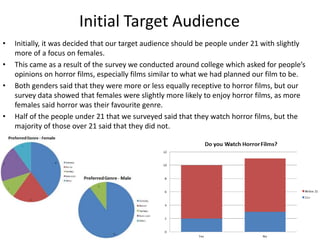
• Initially, it was decided that our target audience should be people under 21 with slightly
more of a focus on females.
• This came as a result of the survey we conducted around college which asked for people’s
opinions on horror films, especially films similar to what we had planned our film to be.
• Both genders said that they were more or less equally receptive to horror films, but our
survey data showed that females were slightly more likely to enjoy horror films, as more
females said horror was their favourite genre.
• Half of the people under 21 that we surveyed said that they watch horror films, but the
majority of those over 21 said that they did not.
Genre and Audience Appeal
• Our film can be categorised into two genres: horror and period drama. Genres are important
to people when they are deciding what to watch at the cinema as they all have preferences
and will know what type of film they feel like seeing.
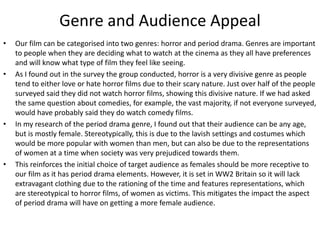
• As I found out in the survey the group conducted, horror is a very divisive genre as people
tend to either love or hate horror films due to their scary nature. Just over half of the people
surveyed said they did not watch horror films, showing this divisive nature. If we had asked
the same question about comedies, for example, the vast majority, if not everyone surveyed,
would have probably said they do watch comedy films.
• In my research of the period drama genre, I found out that their audience can be any age,
but is mostly female. Stereotypically, this is due to the lavish settings and costumes which
would be more popular with women than men, but can also be due to the representations
of women at a time when society was very prejudiced towards them.
• This reinforces the initial choice of target audience as females should be more receptive to
our film as it has period drama elements. However, it is set in WW2 Britain so it will lack
extravagant clothing due to the rationing of the time and features representations, which
are stereotypical to horror films, of women as victims. This mitigates the impact the aspect
of period drama will have on getting a more female audience.
Audience Theory
• There are two main theories that are relevant to our audience; the Uses and Gratifications
Theory, and the Hypodermic Needle Theory.
• The Uses and Gratifications Theory, by Bulmer and Kats in 1974, suggests that audiences are
active, meaning they think about what they are watching and what it means. The theory
states that there are four reasons why society uses media; diversion, personal relationships,
personal identity, and surveillance.
• Diversion, personal relationships, and personal identity are relevant to our film’s audience.
In regards to diversion, people are likely to watch our film as a form of escapism, as it is a
horror film and people can therefore look at the protagonist who is being tormented by a
spirit, and see that their own lives could be worse. People often go to see horror films in
cinemas with other people, thereby enhancing their personal relationships as they can have
a discussion about the film after viewing it. Personal identity is not always relevant to the
horror genre, but our film features a girl who is being bullied, and audiences might relate to
that and therefore sympathise with this character.
• The Hypodermic Needle Theory suggests that audiences are actually passive, meaning that
they believe everything the media tells them.
• This is relevant to horror films and why they are most often categorised as 15 or 18 films by
the BBFC, as people younger than that could watch our film and be influenced negatively by
it.
Representations, Genre and Audience
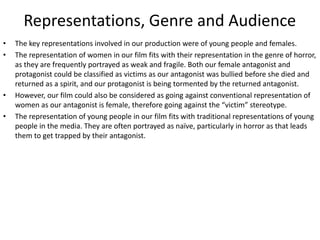
• The key representations involved in our production were of young people and females.
• The representation of women in our film fits with their representation in the genre of horror,
as they are frequently portrayed as weak and fragile. Both our female antagonist and
protagonist could be classified as victims as our antagonist was bullied before she died and
returned as a spirit, and our protagonist is being tormented by the returned antagonist.
• However, our film could also be considered as going against conventional representation of
women as our antagonist is female, therefore going against the “victim” stereotype.
• The representation of young people in our film fits with traditional representations of young
people in the media. They are often portrayed as naïve, particularly in horror as that leads
them to get trapped by their antagonist.
What does the Feedback Say?
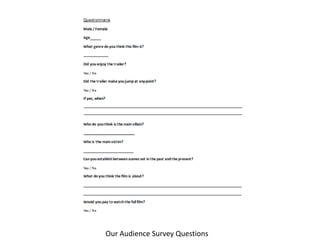
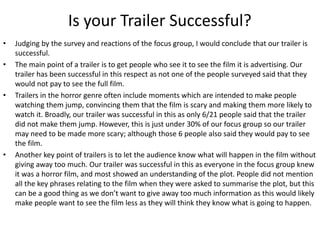
• To get feedback on our trailer, we showed the trailer to a focus group of 21 people and
surveyed them.
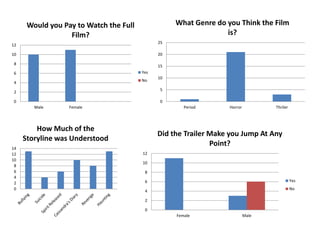
• Everyone surveyed said that they would pay to watch the full film.
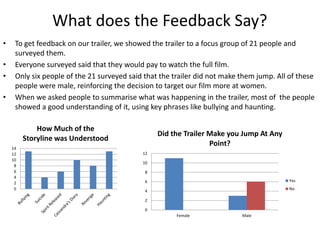
• Only six people of the 21 surveyed said that the trailer did not make them jump. All of these
people were male, reinforcing the decision to target our film more at women.
• When we asked people to summarise what was happening in the trailer, most of the people
showed a good understanding of it, using key phrases like bullying and haunting.
0
2
4
6
8
10
12
14
How Much of the
Storyline was Understood
0
2
4
6
8
10
12
Female Male
Did the Trailer Make you Jump At Any
Point?
Yes
No
Our Audience Survey Questions
Skill Development and Audience
• In the previous years coursework, I did not conduct any surveys of people in the initial
planning stages to decide what the target audience of our production would be. This meant
that I could not compare any previous ideas of what the audience should be with what I
found out through audience surveys after they watched the trailer.
• Thanks to the use of a focus group, which I did not use in my AS production, I know that our
film has an audience, as everyone in the focus group said they would pay to see it, meaning
that it can be assumed that a good proportion of the general public will also want to see the
film after seeing the trailer. In my AS production, whilst our group had gotten some
statements from people saying that they liked what we had produced, I could not be sure
that, had our production had been a real film, it would have had an audience.
• Also, in the AS Coursework I did not consider the two audience theories; Bulmer and Kats’
Uses and Gratifications Theory, and the Hypodermic Needle Theory. This meant that, when
examining why audiences would see our film, I could not back any of my conclusions up with
the knowledge of theorists.
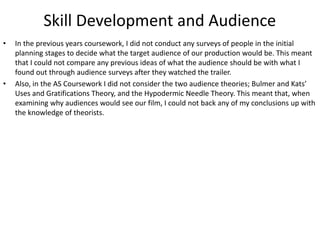
Is your Trailer Successful?
• Judging by the survey and reactions of the focus group, I would conclude that our trailer is
successful, because it attracts an audience.
• The main point of a trailer is to attract an audience to the film it is advertising, making
money for the production company/companies involved. Our trailer has been successful in
this respect as not one of the people surveyed said that they would not pay to see the full
film.
• Trailers in the horror genre often include moments which are intended to make people
watching them jump, convincing them that the film is scary and making them more likely to
watch it. Broadly, our trailer was successful in this as only 6/21 people said that the trailer
did not make them jump. However, this is just under 30% of our focus group so our trailer
may need to be made more scary; although those 6 people also said they would pay to see
the film.
• Another key point of trailers is to let the audience know what will happen in the film without
giving away too much. Our trailer was successful in this as everyone in the focus group knew
it was a horror film, and most showed an understanding of the plot. People did not mention
all the key phrases relating to the film when they were asked to summarise the plot, but this
can be a good thing as we don’t want to give away too much information as this would likely
make people want to see the film less as they will think they know what is going to happen.
0
2
4
6
8
10
12
Female Male
Did the Trailer Make you Jump At Any
Point?
Yes
No0
2
4
6
8
10
12
14
How Much of the
Storyline was Understood
0
2
4
6
8
10
12
Male Female
Would you Pay to Watch the Full
Film?
Yes
No
0
5
10
15
20
25
Period Horror Thriler
What Genre do you Think the Film
is?
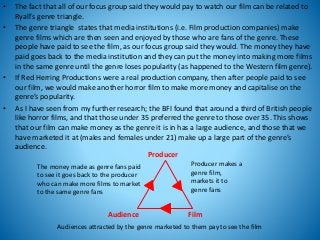
• The fact that all of our focus group said they would pay to watch our film can be related to
Ryall’s genre triangle.
• The genre triangle states that media institutions (i.e. Film production companies) make
genre films which are then seen and enjoyed by those who are fans of the genre. These
people have paid to see the film, as our focus group said they would. The money they have
paid goes back to the media institution and they can put the money into making more films
in the same genre until the genre loses popularity (as happened to the Western film genre).
• If Red Herring Productions were a real production company, then after people paid to see
our film, we would make another horror film to make more money and capitalise on the
genre’s popularity.
• As I have seen from my further research; the BFI found that around a third of British people
like horror films, and that those under 35 preferred the genre to those over 35. This shows
that our film can make money as the genre it is in has a large audience, and those that we
have marketed it at (males and females under 21) make up a large part of the genre’s
audience.
Producer
Audience Film
Producer makes a
genre film,
markets it to
genre fans
Audiences attracted by the genre marketed to them pay to see the film
The money made as genre fans paid
to see it goes back to the producer
who can make more films to market
to the same genre fans

Evaluation - Who are your audience and what have you learned from your audience feedback?

  • 1.
    Who are youraudience and what have you learned from your audience feedback?
  • 2.
    Initial Target Audience •Initially, it was decided that our target audience should be people under 21 with slightly more of a focus on females. • This came as a result of the survey we conducted around college which asked for people’s opinions on horror films, especially films similar to what we had planned our film to be. • Both genders said that they were more or less equally receptive to horror films, but our survey data showed that females were slightly more likely to enjoy horror films, as more females said horror was their favourite genre. • Half of the people under 21 that we surveyed said that they watch horror films, but the majority of those over 21 said that they did not.
  • 3.
    Genre and AudienceAppeal • Our film can be categorised into two genres: horror and period drama. Genres are important to people when they are deciding what to watch at the cinema as they all have preferences and will know what type of film they feel like seeing. • As I found out in the survey the group conducted, horror is a very divisive genre as people tend to either love or hate horror films due to their scary nature. Just over half of the people surveyed said they did not watch horror films, showing this divisive nature. If we had asked the same question about comedies, for example, the vast majority, if not everyone surveyed, would have probably said they do watch comedy films. • In my research of the period drama genre, I found out that their audience can be any age, but is mostly female. Stereotypically, this is due to the lavish settings and costumes which would be more popular with women than men, but can also be due to the representations of women at a time when society was very prejudiced towards them. • This reinforces the initial choice of target audience as females should be more receptive to our film as it has period drama elements. However, it is set in WW2 Britain so it will lack extravagant clothing due to the rationing of the time and features representations, which are stereotypical to horror films, of women as victims. This mitigates the impact the aspect of period drama will have on getting a more female audience.
  • 4.
    Audience Theory • Thereare two main theories that are relevant to our audience; the Uses and Gratifications Theory, and the Hypodermic Needle Theory. • The Uses and Gratifications Theory, by Bulmer and Kats in 1974, suggests that audiences are active, meaning they think about what they are watching and what it means. The theory states that there are four reasons why society uses media; diversion, personal relationships, personal identity, and surveillance. • Diversion, personal relationships, and personal identity are relevant to our film’s audience. In regards to diversion, people are likely to watch our film as a form of escapism, as it is a horror film and people can therefore look at the protagonist who is being tormented by a spirit, and see that their own lives could be worse. People often go to see horror films in cinemas with other people, thereby enhancing their personal relationships as they can have a discussion about the film after viewing it. Personal identity is not always relevant to the horror genre, but our film features a girl who is being bullied, and audiences might relate to that and therefore sympathise with this character. • The Hypodermic Needle Theory suggests that audiences are actually passive, meaning that they believe everything the media tells them. • This is relevant to horror films and why they are most often categorised as 15 or 18 films by the BBFC, as people younger than that could watch our film and be influenced negatively by it.
  • 5.
    Representations, Genre andAudience • The key representations involved in our production were of young people and females. • The representation of women in our film fits with their representation in the genre of horror, as they are frequently portrayed as weak and fragile. Both our female antagonist and protagonist could be classified as victims as our antagonist was bullied before she died and returned as a spirit, and our protagonist is being tormented by the returned antagonist. • However, our film could also be considered as going against conventional representation of women as our antagonist is female, therefore going against the “victim” stereotype. • The representation of young people in our film fits with traditional representations of young people in the media. They are often portrayed as naïve, particularly in horror as that leads them to get trapped by their antagonist.
  • 6.
    What does theFeedback Say? • To get feedback on our trailer, we showed the trailer to a focus group of 21 people and surveyed them. • Everyone surveyed said that they would pay to watch the full film. • Only six people of the 21 surveyed said that the trailer did not make them jump. All of these people were male, reinforcing the decision to target our film more at women. • When we asked people to summarise what was happening in the trailer, most of the people showed a good understanding of it, using key phrases like bullying and haunting. 0 2 4 6 8 10 12 14 How Much of the Storyline was Understood 0 2 4 6 8 10 12 Female Male Did the Trailer Make you Jump At Any Point? Yes No
  • 7.
  • 8.
    Skill Development andAudience • In the previous years coursework, I did not conduct any surveys of people in the initial planning stages to decide what the target audience of our production would be. This meant that I could not compare any previous ideas of what the audience should be with what I found out through audience surveys after they watched the trailer. • Thanks to the use of a focus group, which I did not use in my AS production, I know that our film has an audience, as everyone in the focus group said they would pay to see it, meaning that it can be assumed that a good proportion of the general public will also want to see the film after seeing the trailer. In my AS production, whilst our group had gotten some statements from people saying that they liked what we had produced, I could not be sure that, had our production had been a real film, it would have had an audience. • Also, in the AS Coursework I did not consider the two audience theories; Bulmer and Kats’ Uses and Gratifications Theory, and the Hypodermic Needle Theory. This meant that, when examining why audiences would see our film, I could not back any of my conclusions up with the knowledge of theorists.
  • 9.
    Is your TrailerSuccessful? • Judging by the survey and reactions of the focus group, I would conclude that our trailer is successful, because it attracts an audience. • The main point of a trailer is to attract an audience to the film it is advertising, making money for the production company/companies involved. Our trailer has been successful in this respect as not one of the people surveyed said that they would not pay to see the full film. • Trailers in the horror genre often include moments which are intended to make people watching them jump, convincing them that the film is scary and making them more likely to watch it. Broadly, our trailer was successful in this as only 6/21 people said that the trailer did not make them jump. However, this is just under 30% of our focus group so our trailer may need to be made more scary; although those 6 people also said they would pay to see the film. • Another key point of trailers is to let the audience know what will happen in the film without giving away too much. Our trailer was successful in this as everyone in the focus group knew it was a horror film, and most showed an understanding of the plot. People did not mention all the key phrases relating to the film when they were asked to summarise the plot, but this can be a good thing as we don’t want to give away too much information as this would likely make people want to see the film less as they will think they know what is going to happen.
  • 10.
    0 2 4 6 8 10 12 Female Male Did theTrailer Make you Jump At Any Point? Yes No0 2 4 6 8 10 12 14 How Much of the Storyline was Understood 0 2 4 6 8 10 12 Male Female Would you Pay to Watch the Full Film? Yes No 0 5 10 15 20 25 Period Horror Thriler What Genre do you Think the Film is?
  • 11.
    • The factthat all of our focus group said they would pay to watch our film can be related to Ryall’s genre triangle. • The genre triangle states that media institutions (i.e. Film production companies) make genre films which are then seen and enjoyed by those who are fans of the genre. These people have paid to see the film, as our focus group said they would. The money they have paid goes back to the media institution and they can put the money into making more films in the same genre until the genre loses popularity (as happened to the Western film genre). • If Red Herring Productions were a real production company, then after people paid to see our film, we would make another horror film to make more money and capitalise on the genre’s popularity. • As I have seen from my further research; the BFI found that around a third of British people like horror films, and that those under 35 preferred the genre to those over 35. This shows that our film can make money as the genre it is in has a large audience, and those that we have marketed it at (males and females under 21) make up a large part of the genre’s audience. Producer Audience Film Producer makes a genre film, markets it to genre fans Audiences attracted by the genre marketed to them pay to see the film The money made as genre fans paid to see it goes back to the producer who can make more films to market to the same genre fans