April 2011
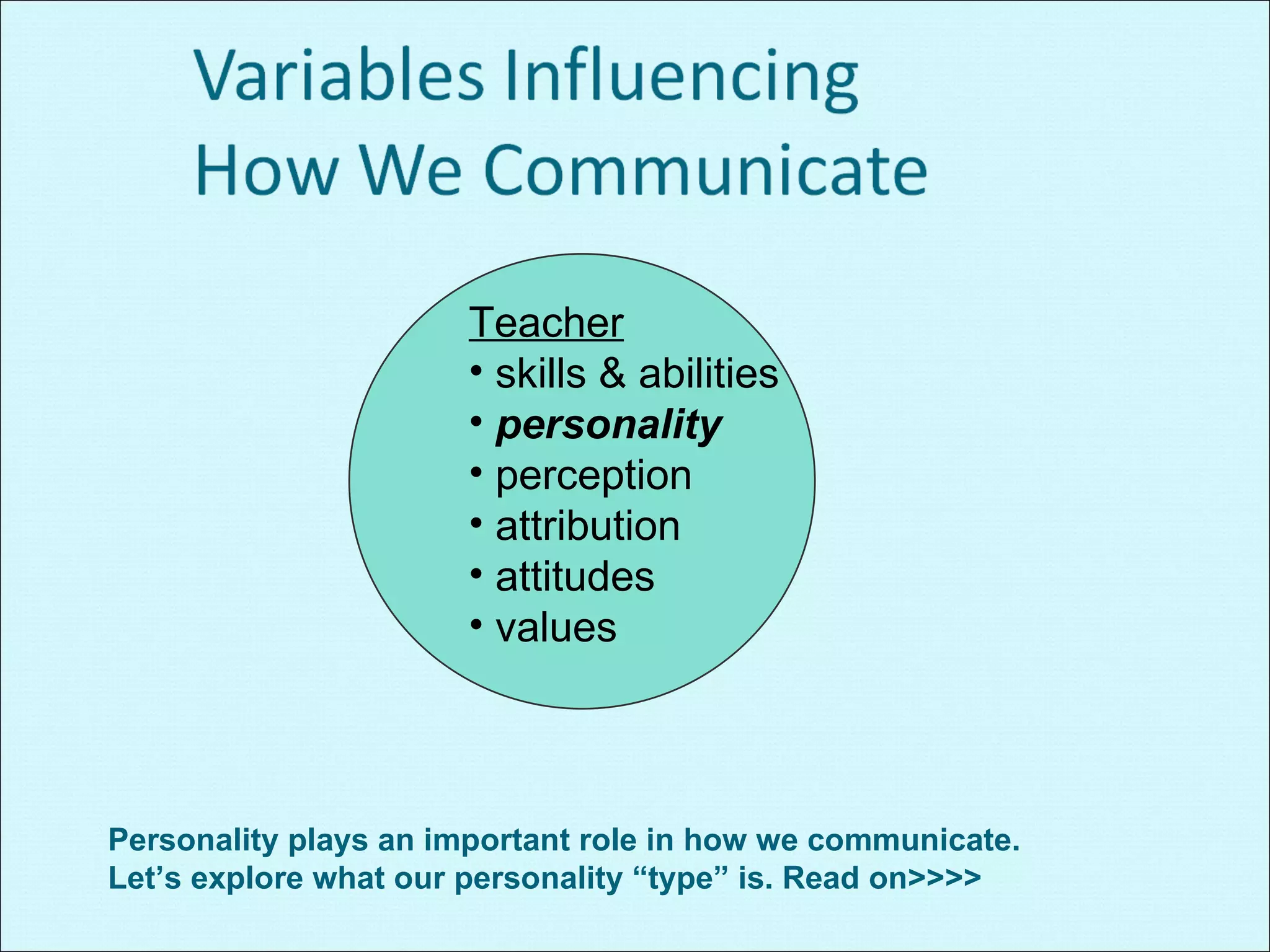
Personality plays an important role in how we communicate.  Let’s explore what our personality “type” is. Read on>>>> Teacher skills & abilities personality perception attribution attitudes values
How Will We Evaluate our Personality Profile By Taking a Myers-Briggs Type Indicator Survey It is a series of questions that when evaluated collectively will help to define of personality style It suggest that while people are fundamentally different, people are also fundamentally alike People have preference combinations for extraversion/introversion, perception, judgment It is these “preferences” that influence how we communicate
What is the Survey? It is self-report instrument, you will be the only one to see the results It non-judgmental There are no right or wrong answers It does not a measure of ability Only you can determine accuracy It does indicates preferences Well researched and documented
What Do We Mean By Preferences or Temperaments ? We may have different preferences in the way we Way we are oriented to the world around us How we perceive things Take in information Evaluate information Understanding “personality (temperaments) types” and how they interact will help to accommodate communication differences
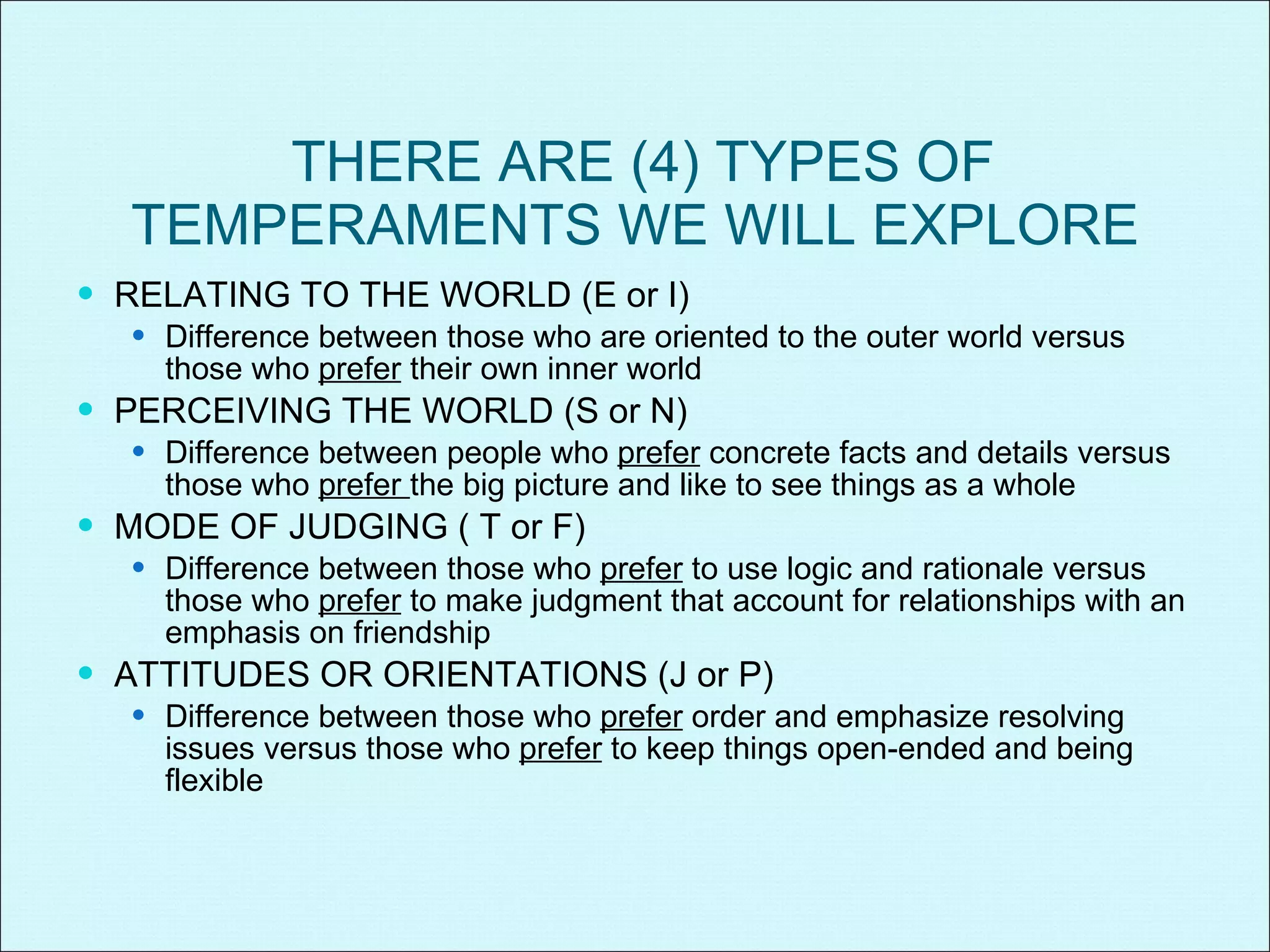
THERE ARE (4) TYPES OF TEMPERAMENTS WE WILL EXPLORE RELATING TO THE WORLD (E or I) Difference between those who are oriented to the outer world versus those who  prefer  their own inner world PERCEIVING THE WORLD (S or N) Difference between people who  prefer  concrete facts and details versus those who  prefer  the big picture and like to see things as a whole MODE OF JUDGING ( T or F) Difference between those who  prefer  to use logic and rationale versus those who  prefer  to make judgment that account for relationships with an emphasis on friendship ATTITUDES OR ORIENTATIONS (J or P) Difference between those who  prefer  order and emphasize resolving issues versus those who  prefer  to keep things open-ended and being flexible
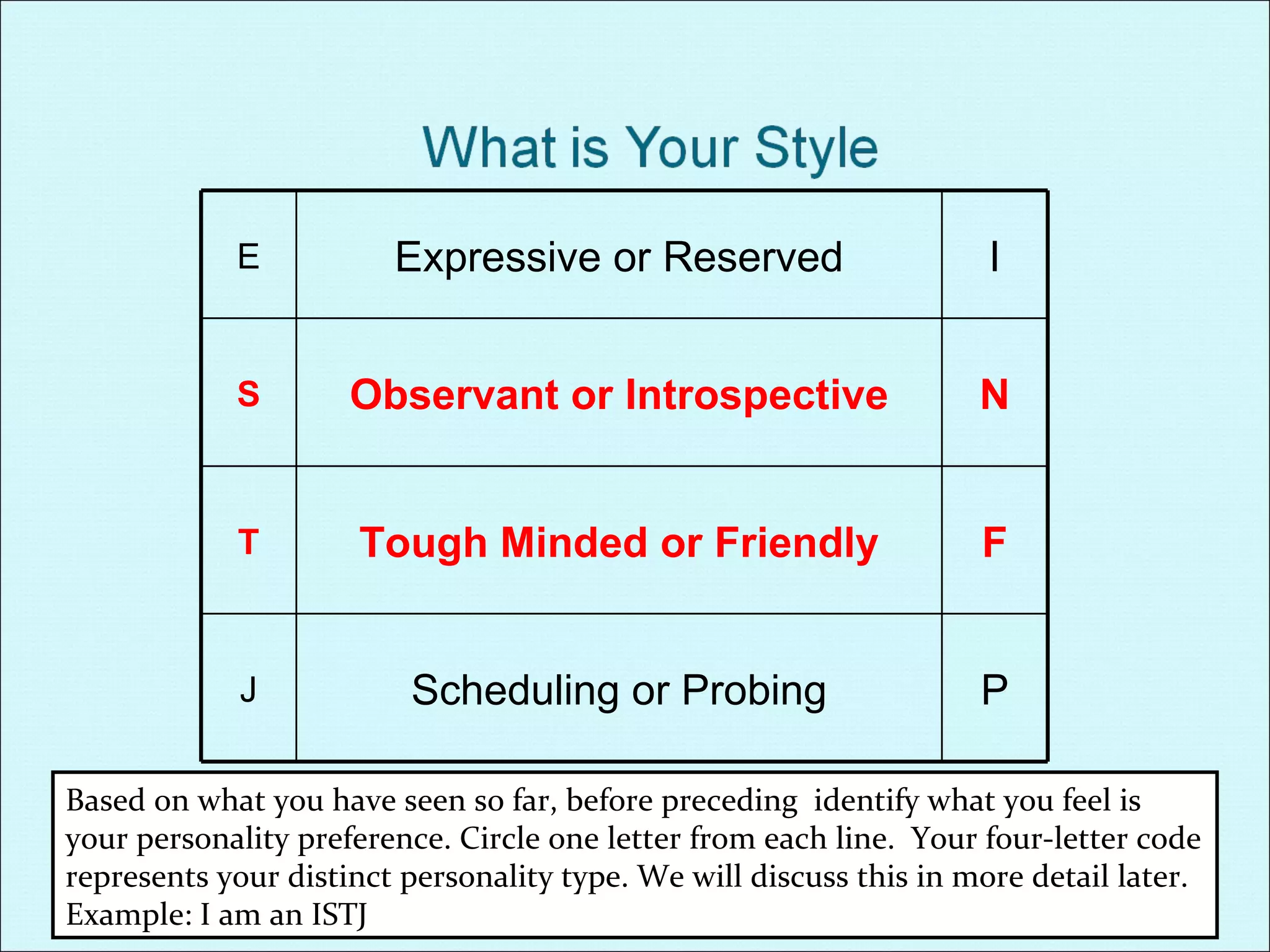
Based on what you have seen so far, before preceding  identify what you feel is your personality preference. Circle one letter from each line.  Your four-letter code represents your distinct personality type. We will discuss this in more detail later. Example: I am an ISTJ E Expressive or Reserved I S Observant or Introspective N T Tough Minded or Friendly F J Scheduling or Probing P
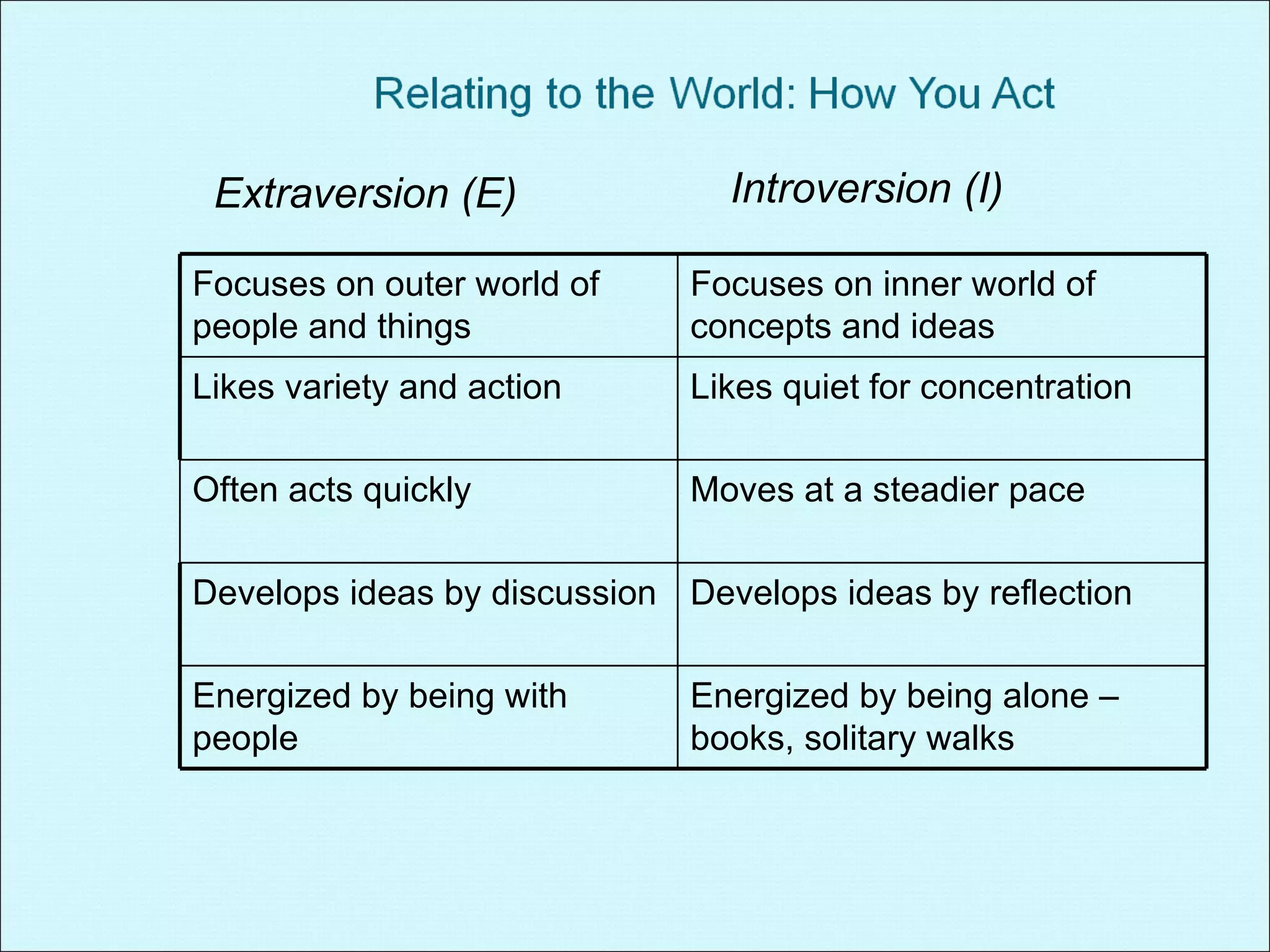
Extraversion (E) Introversion (I) Focuses on outer world of people and things Focuses on inner world of concepts and ideas Likes variety and action Likes quiet for concentration Often acts quickly Moves at a steadier pace Develops ideas by discussion Develops ideas by reflection Energized by being with people Energized by being alone – books, solitary walks
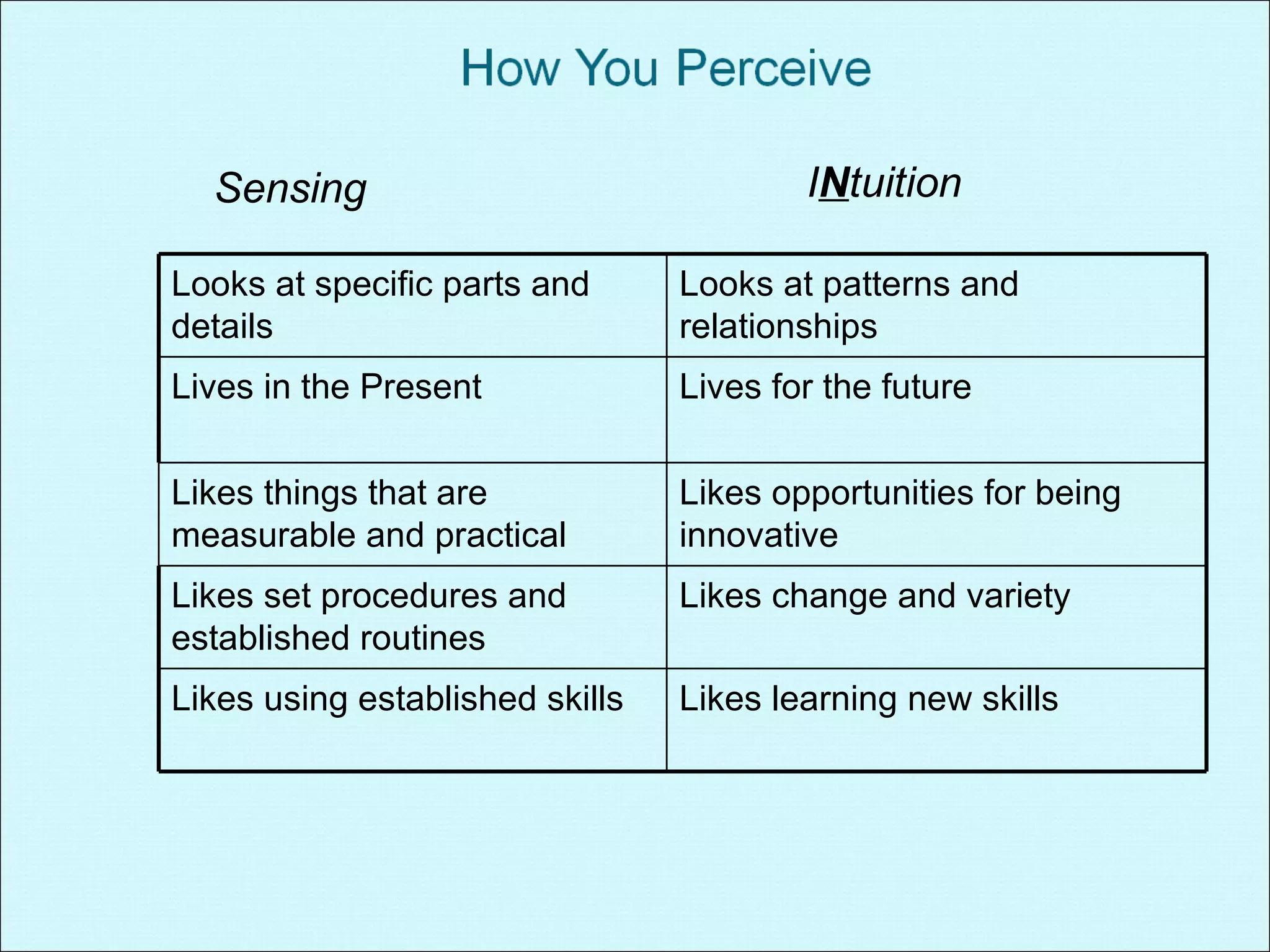
Sensing  I N tuition Looks at specific parts and details Looks at patterns and relationships Lives in the Present Lives for the future Likes things that are measurable and practical Likes opportunities for being innovative Likes set procedures and established routines Likes change and variety Likes using established skills Likes learning new skills
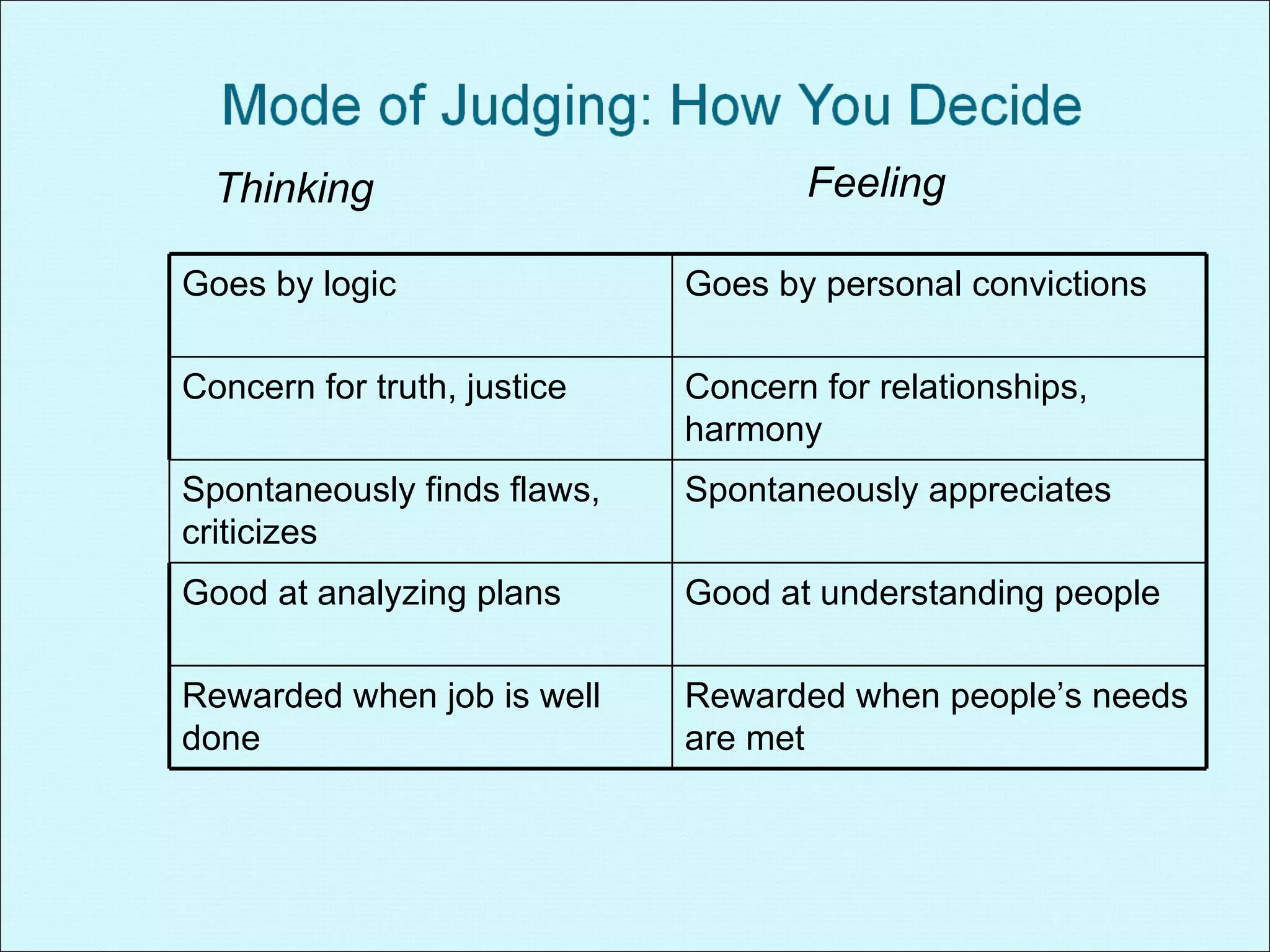
Thinking Feeling Goes by logic Goes by personal convictions Concern for truth, justice Concern for relationships, harmony Spontaneously finds flaws, criticizes Spontaneously appreciates Good at analyzing plans Good at understanding people Rewarded when job is well done Rewarded when people’s needs are met
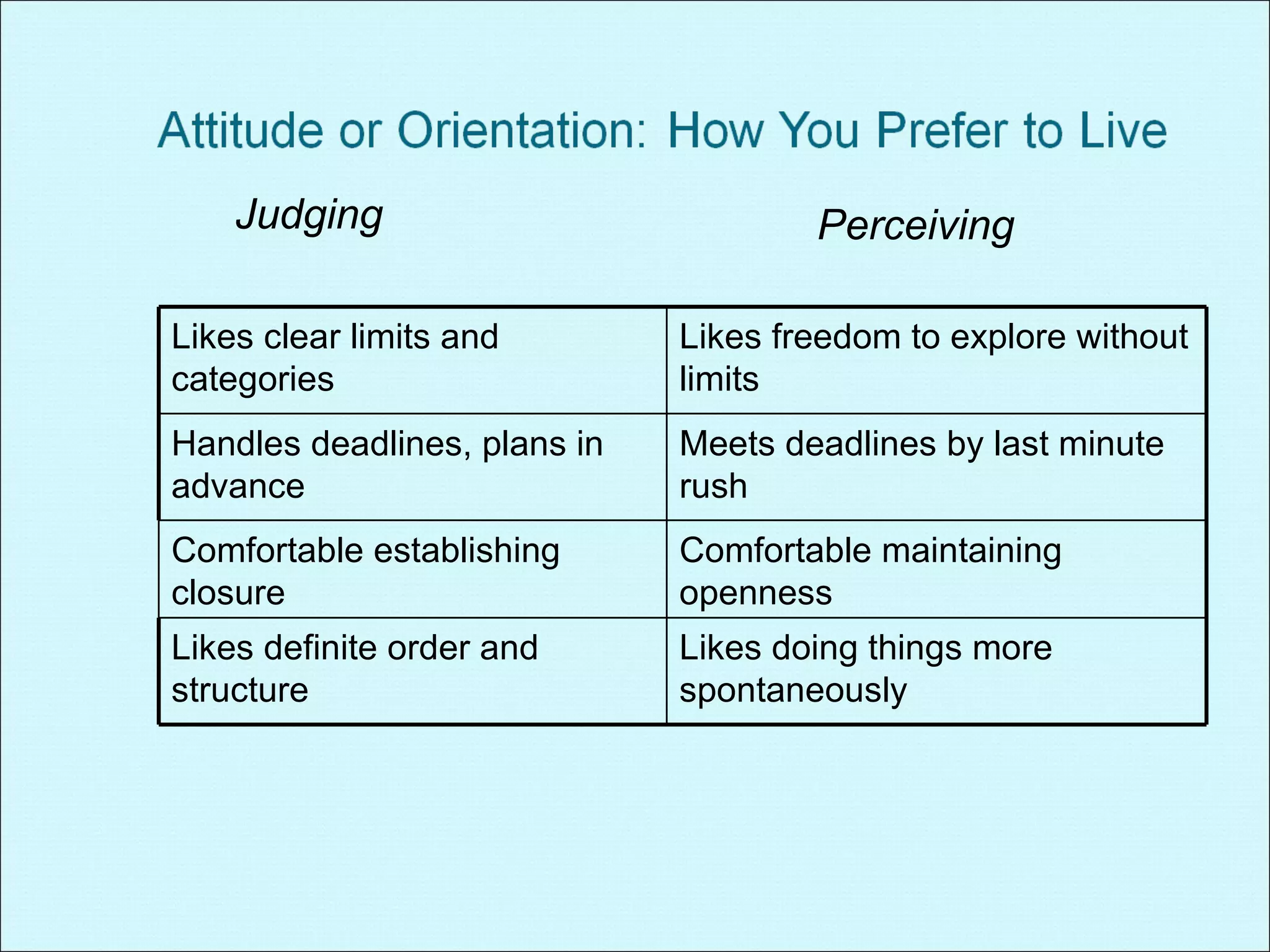
Judging Perceiving Likes clear limits and categories Likes freedom to explore without limits Handles deadlines, plans in advance Meets deadlines by last minute rush Comfortable establishing closure Comfortable maintaining openness Likes definite order and structure Likes doing things more spontaneously
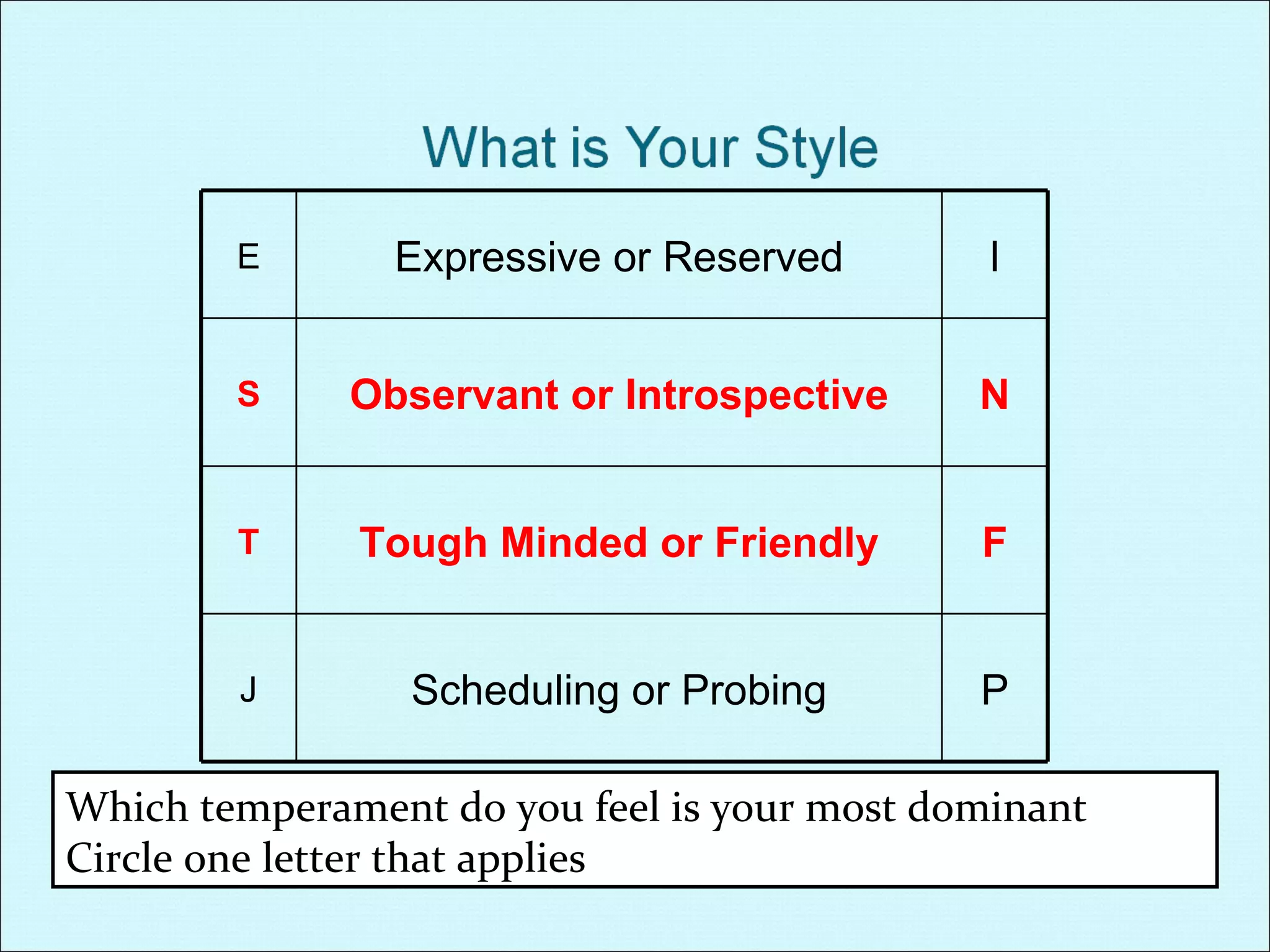
Which temperament do you feel is your most dominant Circle one letter that applies E Expressive or Reserved I S Observant or Introspective N T Tough Minded or Friendly F J Scheduling or Probing P
Do We Favor Certain Preferences ?  YES Dominant: Most developed, used, and trusted Auxiliary: Second most developed and trusted function Tertiary: Next most developed and opposite of auxiliary Inferior: is opposite of the dominant function As individuals develop and mature, they learn tertiary and inferior skills when communicating, however these functions, especially the inferior function can also be a blind spot to watch out for Make a note to yourself as to what you think is your dominant preference. We will discuss this more after we see the results of the survey.
Closing Comments How Does Know My Personality Profile Help My Communications? It helps you express yourself Understand the perspective of others Allows you to give and receive feedback Resolve conflicts
 

Mbti and communications_1

  • 1.
  • 2.
    Personality plays animportant role in how we communicate. Let’s explore what our personality “type” is. Read on>>>> Teacher skills & abilities personality perception attribution attitudes values
  • 3.
    How Will WeEvaluate our Personality Profile By Taking a Myers-Briggs Type Indicator Survey It is a series of questions that when evaluated collectively will help to define of personality style It suggest that while people are fundamentally different, people are also fundamentally alike People have preference combinations for extraversion/introversion, perception, judgment It is these “preferences” that influence how we communicate
  • 4.
    What is theSurvey? It is self-report instrument, you will be the only one to see the results It non-judgmental There are no right or wrong answers It does not a measure of ability Only you can determine accuracy It does indicates preferences Well researched and documented
  • 5.
    What Do WeMean By Preferences or Temperaments ? We may have different preferences in the way we Way we are oriented to the world around us How we perceive things Take in information Evaluate information Understanding “personality (temperaments) types” and how they interact will help to accommodate communication differences
  • 6.
    THERE ARE (4)TYPES OF TEMPERAMENTS WE WILL EXPLORE RELATING TO THE WORLD (E or I) Difference between those who are oriented to the outer world versus those who prefer their own inner world PERCEIVING THE WORLD (S or N) Difference between people who prefer concrete facts and details versus those who prefer the big picture and like to see things as a whole MODE OF JUDGING ( T or F) Difference between those who prefer to use logic and rationale versus those who prefer to make judgment that account for relationships with an emphasis on friendship ATTITUDES OR ORIENTATIONS (J or P) Difference between those who prefer order and emphasize resolving issues versus those who prefer to keep things open-ended and being flexible
  • 7.
    Based on whatyou have seen so far, before preceding identify what you feel is your personality preference. Circle one letter from each line. Your four-letter code represents your distinct personality type. We will discuss this in more detail later. Example: I am an ISTJ E Expressive or Reserved I S Observant or Introspective N T Tough Minded or Friendly F J Scheduling or Probing P
  • 8.
    Extraversion (E) Introversion(I) Focuses on outer world of people and things Focuses on inner world of concepts and ideas Likes variety and action Likes quiet for concentration Often acts quickly Moves at a steadier pace Develops ideas by discussion Develops ideas by reflection Energized by being with people Energized by being alone – books, solitary walks
  • 9.
    Sensing IN tuition Looks at specific parts and details Looks at patterns and relationships Lives in the Present Lives for the future Likes things that are measurable and practical Likes opportunities for being innovative Likes set procedures and established routines Likes change and variety Likes using established skills Likes learning new skills
  • 10.
    Thinking Feeling Goesby logic Goes by personal convictions Concern for truth, justice Concern for relationships, harmony Spontaneously finds flaws, criticizes Spontaneously appreciates Good at analyzing plans Good at understanding people Rewarded when job is well done Rewarded when people’s needs are met
  • 11.
    Judging Perceiving Likesclear limits and categories Likes freedom to explore without limits Handles deadlines, plans in advance Meets deadlines by last minute rush Comfortable establishing closure Comfortable maintaining openness Likes definite order and structure Likes doing things more spontaneously
  • 12.
    Which temperament doyou feel is your most dominant Circle one letter that applies E Expressive or Reserved I S Observant or Introspective N T Tough Minded or Friendly F J Scheduling or Probing P
  • 13.
    Do We FavorCertain Preferences ? YES Dominant: Most developed, used, and trusted Auxiliary: Second most developed and trusted function Tertiary: Next most developed and opposite of auxiliary Inferior: is opposite of the dominant function As individuals develop and mature, they learn tertiary and inferior skills when communicating, however these functions, especially the inferior function can also be a blind spot to watch out for Make a note to yourself as to what you think is your dominant preference. We will discuss this more after we see the results of the survey.
  • 14.
    Closing Comments HowDoes Know My Personality Profile Help My Communications? It helps you express yourself Understand the perspective of others Allows you to give and receive feedback Resolve conflicts
  • 15.

Editor's Notes