Federalism
Chapter 3
POWERS
OF THE
FEDERAL
GOVERN
MENT
POWERS
OF STATE
GOVERNM
ENTS
S
H
A
R
E
D
Defining Federalism
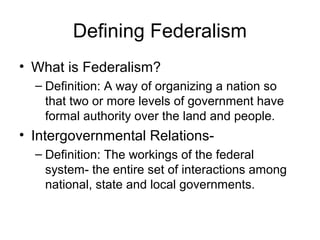
• What is Federalism?
– Definition: A way of organizing a nation so
that two or more levels of government have
formal authority over the land and people.
• Intergovernmental Relations-
– Definition: The workings of the federal
system- the entire set of interactions among
national, state and local governments.
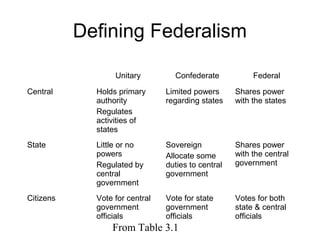
From Table 3.1
Defining Federalism
Unitary Confederate Federal
Central Holds primary
authority
Regulates
activities of
states
Limited powers
regarding states
Shares power
with the states
State Little or no
powers
Regulated by
central
government
Sovereign
Allocate some
duties to central
government
Shares power
with the central
government
Citizens Vote for central
government
officials
Vote for state
government
officials
Votes for both
state & central
officials
Defining Federalism
• Why is Federalism So Important?
– Decentralizes our politics
• More opportunities to participate
– Decentralizes our policies
• Which government should take care of which
problem?
• States can solve the same problem in different
ways.
The Constitutional Basis of
Federalism
• The Division of Power
– The U.S. Constitution
– Laws of Congress
– Treaties
– State Constitutions
– State Laws
The Constitutional Basis of
Federalism
• Establishing National Supremacy
– Implied Powers
– Commerce Powers
– The Civil War
– The Struggle for Racial Equality
The Constitutional Basis of
Federalism
• States’ Obligations to Each Other
– Full Faith and Credit
– Extradition
– Privileges and Immunities
Intergovernmental Relations
Today
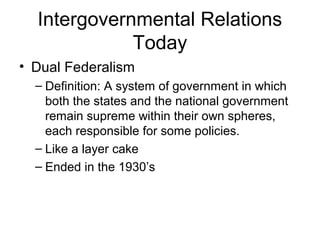
• Dual Federalism
– Definition: A system of government in which
both the states and the national government
remain supreme within their own spheres,
each responsible for some policies.
– Like a layer cake
– Ended in the 1930’s
Intergovernmental Relations
Today
• Cooperative Federalism
– Definition: A system of government in which
powers and policy assignments are shared
between states and the national government.
– Like a marble cake
– Shared costs
– Shared administration
– States follow federal guidelines
Figure 3.2
Intergovernmental Relations
Today
• Fiscal Federalism
– Definition: The pattern
of spending, taxing,
and providing grants in
the federal system; it
is the cornerstone of
the national
government’s relations
with state and local
governments.
Intergovernmental Relations
Today
• Fiscal Federalism continued:
– The Grant System: Distributing the Federal
Pie
• Categorical Grants: Federal grants that can be
used for specific purposes. They have strings
attached
– Project Grants- based on merit
– Formula Grants: amount varies based on formulas
• Block Grants: Federal grants given more or less
automatically to support broad programs.
• Grants are given to states & local governments
Intergovernmental Relations
Today
• Fiscal Federalism continued…
– The Scramble for Federal Dollars
• $300 billion in grants every year
• Universalism- a little something for everybody
– The Mandate Blues
• Mandates are the “strings” attached to federal
money
• Unfunded mandates are requirements on state &
local governments- but no money
Understanding Federalism
• Advantages for
Democracy
– Increasing access to
government
– Local problems can be
solved locally
– Hard for political
parties / interest
groups to dominate
ALL politics
• Disadvantages for
Democracy
– States have different
levels of service
– Local interest can
counteract national
interests
– Too many levels of
government- too much
money
Figure 3.4 (1999 average: $6,734)
Understanding Federalism
• Federalism and the Scope of Government
– Which level of government is best able to
solve the problem?
– Which level of government is best able to fund
solutions to the problem?

Chapter3

  • 1.
  • 2.
  • 3.
    Defining Federalism • Whatis Federalism? – Definition: A way of organizing a nation so that two or more levels of government have formal authority over the land and people. • Intergovernmental Relations- – Definition: The workings of the federal system- the entire set of interactions among national, state and local governments.
  • 4.
    From Table 3.1 DefiningFederalism Unitary Confederate Federal Central Holds primary authority Regulates activities of states Limited powers regarding states Shares power with the states State Little or no powers Regulated by central government Sovereign Allocate some duties to central government Shares power with the central government Citizens Vote for central government officials Vote for state government officials Votes for both state & central officials
  • 5.
    Defining Federalism • Whyis Federalism So Important? – Decentralizes our politics • More opportunities to participate – Decentralizes our policies • Which government should take care of which problem? • States can solve the same problem in different ways.
  • 6.
    The Constitutional Basisof Federalism • The Division of Power – The U.S. Constitution – Laws of Congress – Treaties – State Constitutions – State Laws
  • 7.
    The Constitutional Basisof Federalism • Establishing National Supremacy – Implied Powers – Commerce Powers – The Civil War – The Struggle for Racial Equality
  • 8.
    The Constitutional Basisof Federalism • States’ Obligations to Each Other – Full Faith and Credit – Extradition – Privileges and Immunities
  • 9.
    Intergovernmental Relations Today • DualFederalism – Definition: A system of government in which both the states and the national government remain supreme within their own spheres, each responsible for some policies. – Like a layer cake – Ended in the 1930’s
  • 10.
    Intergovernmental Relations Today • CooperativeFederalism – Definition: A system of government in which powers and policy assignments are shared between states and the national government. – Like a marble cake – Shared costs – Shared administration – States follow federal guidelines
  • 11.
    Figure 3.2 Intergovernmental Relations Today •Fiscal Federalism – Definition: The pattern of spending, taxing, and providing grants in the federal system; it is the cornerstone of the national government’s relations with state and local governments.
  • 12.
    Intergovernmental Relations Today • FiscalFederalism continued: – The Grant System: Distributing the Federal Pie • Categorical Grants: Federal grants that can be used for specific purposes. They have strings attached – Project Grants- based on merit – Formula Grants: amount varies based on formulas • Block Grants: Federal grants given more or less automatically to support broad programs. • Grants are given to states & local governments
  • 13.
    Intergovernmental Relations Today • FiscalFederalism continued… – The Scramble for Federal Dollars • $300 billion in grants every year • Universalism- a little something for everybody – The Mandate Blues • Mandates are the “strings” attached to federal money • Unfunded mandates are requirements on state & local governments- but no money
  • 14.
    Understanding Federalism • Advantagesfor Democracy – Increasing access to government – Local problems can be solved locally – Hard for political parties / interest groups to dominate ALL politics • Disadvantages for Democracy – States have different levels of service – Local interest can counteract national interests – Too many levels of government- too much money
  • 15.
    Figure 3.4 (1999average: $6,734) Understanding Federalism
  • 16.
    Understanding Federalism • Federalismand the Scope of Government – Which level of government is best able to solve the problem? – Which level of government is best able to fund solutions to the problem?