Session 5:
Environment and Self
7th Edition
Take Hold of Your Future
JoAnn Harris-Bowlsbey, Ed.D.
At the end of this session, students will be able to:
• Explain how self-concept is formed and how it relates to
career choice.
• Explain Holland’s theory of personality types.
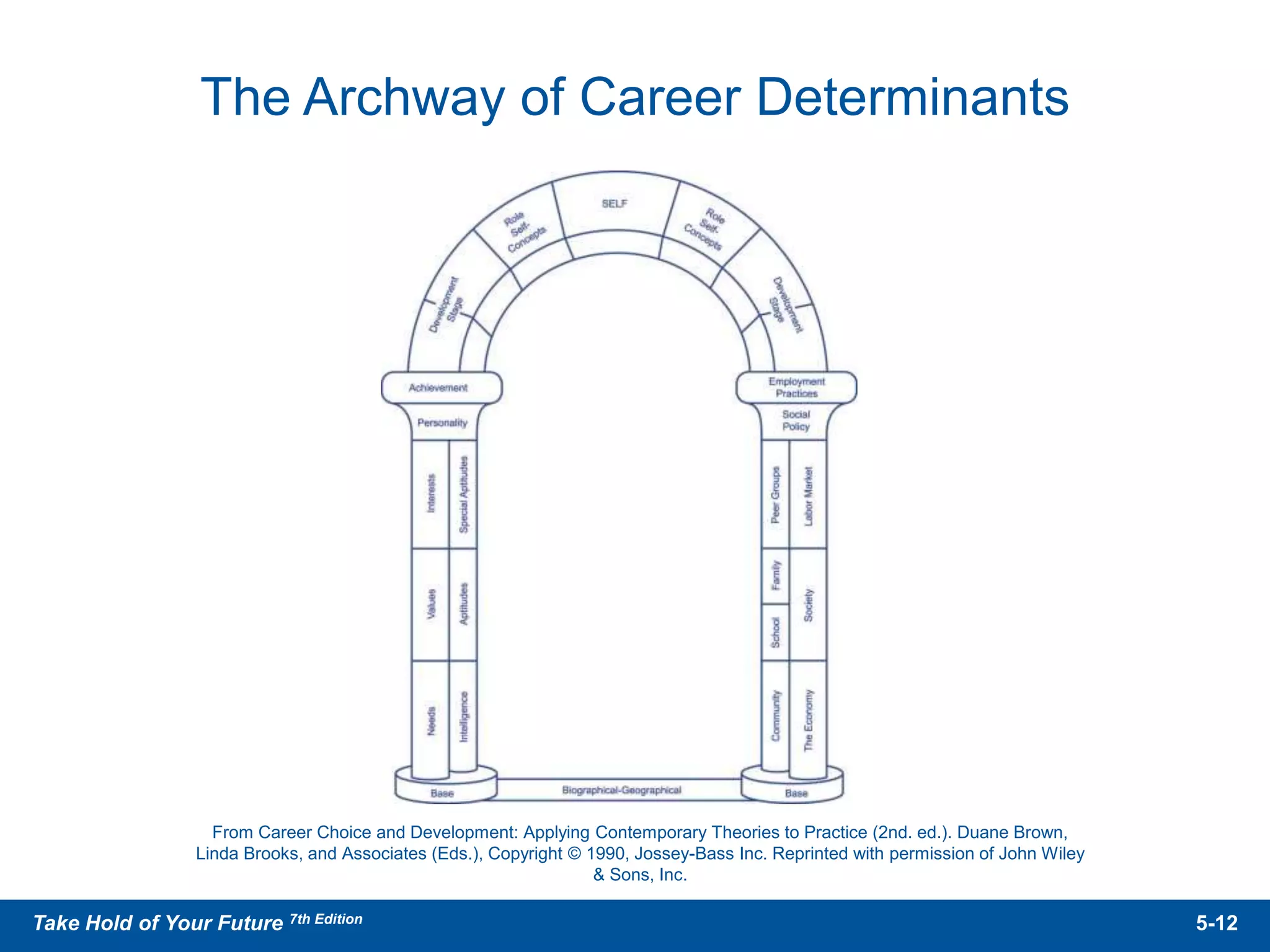
• Describe the Archway of Career Determinants and its
meaning for personal career choices.
5-2Take Hold of Your Future 7th Edition
Objectives
• Self-Concept – a picture or image of one’s self, a combination
of what we think we are, what others think we are, and what we
want to be.
Definitions
5-3Take Hold of Your Future 7th Edition
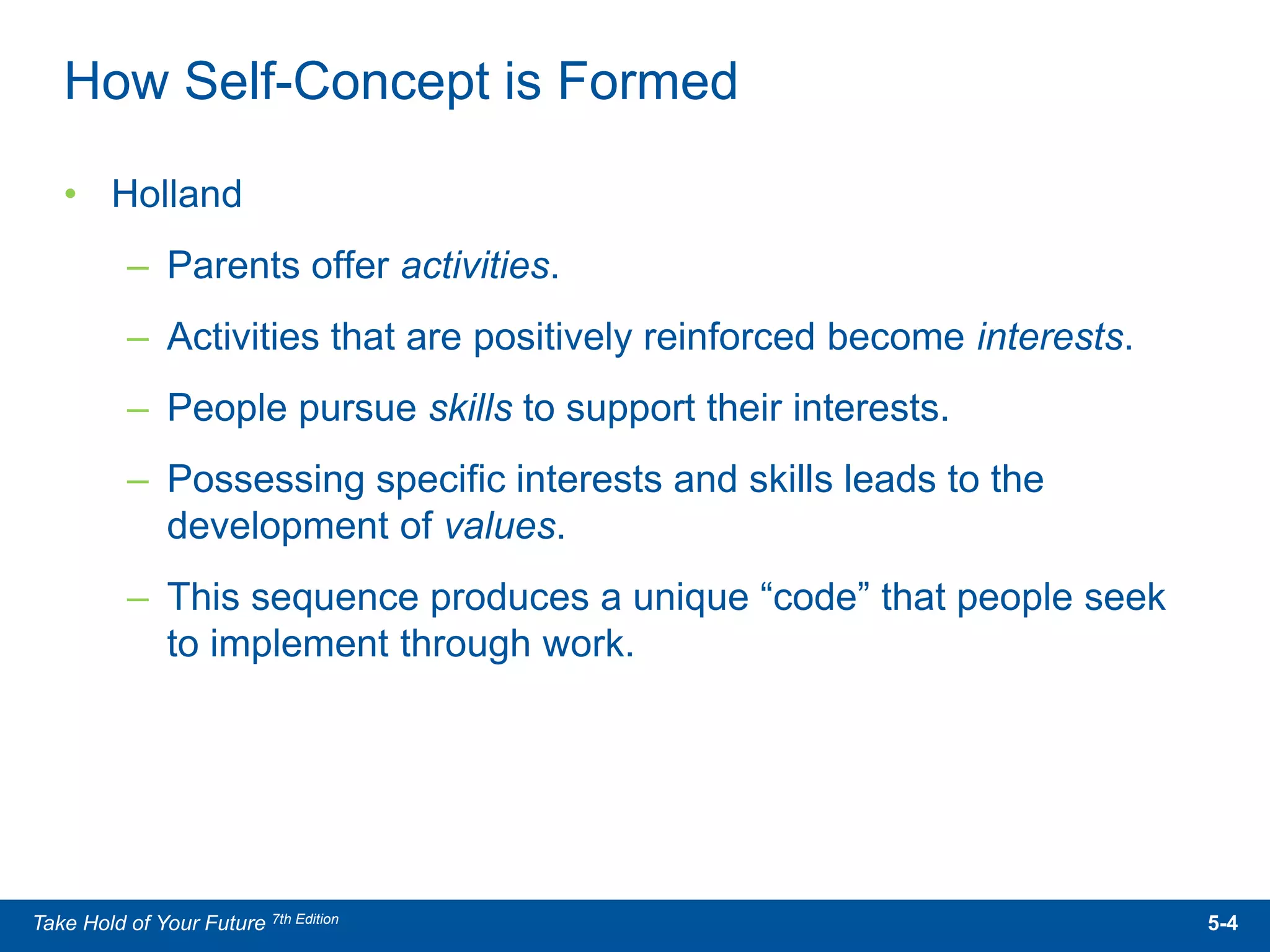
• Holland
– Parents offer activities.
– Activities that are positively reinforced become interests.
– People pursue skills to support their interests.
– Possessing specific interests and skills leads to the
development of values.
– This sequence produces a unique “code” that people seek
to implement through work.
How Self-Concept is Formed
5-4Take Hold of Your Future 7th Edition
• Super
– Self-concept formation begins very early in life.
– It is developed by the feedback that we receive from
significant others.
– Those parts of the self-concept that can apply to work are
called the vocational self-concept.
– People seek to implement their vocational self-concept in
work.
How Self-Concept is Formed (Cont’d)
5-5Take Hold of Your Future 7th Edition
• The self-concept is continually formed and modified
throughout life.
• Self-concept is the dynamic behind selection and interaction of
life roles.
• Choice of an occupation is an attempt to implement a
self-concept.
• Career choices will be difficult if the self-concept is fuzzy,
negative, or unrealistic.
How Self-Concept is Formed (Cont’d)
5-6Take Hold of Your Future 7th Edition
• What statements am I making about myself in this collage?
• What do these pictures say about who I am now, or who I want
to be in the future?
• What role models or early life events have affected this
selection of pictures?
• What occupations might be suggested by this self-information?
Discussion of Student Collages
5-7Take Hold of Your Future 7th Edition
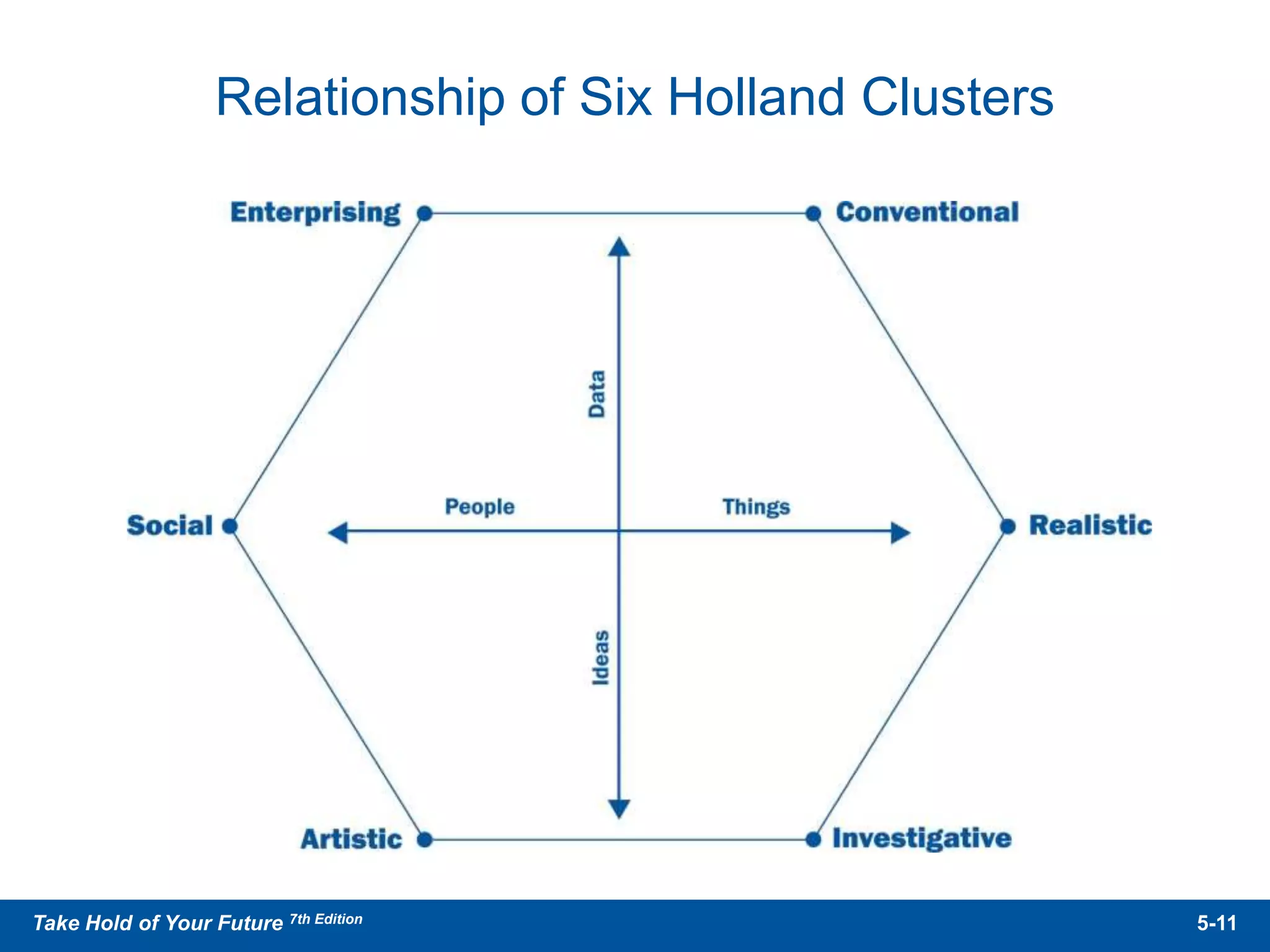
• People can be described as a combination of six different
personality types.
• Environments can be described by the same six types.
• Individuals of a given personality type are drawn to
environments of the same type.
• Satisfaction is likely when person’s type matches an
environment’s type.
Holland’s Theory
5-8Take Hold of Your Future 7th Edition
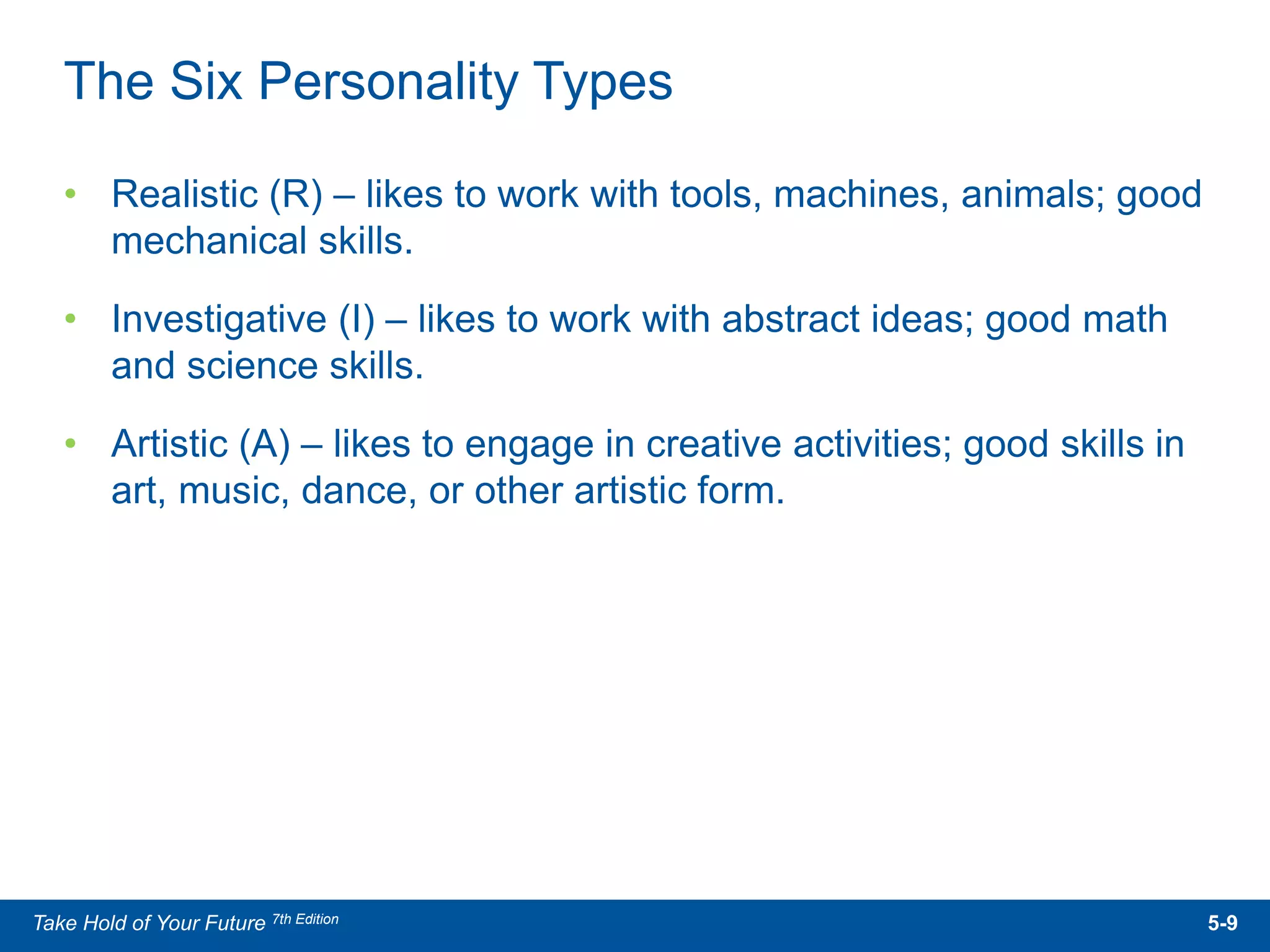
• Realistic (R) – likes to work with tools, machines, animals; good
mechanical skills.
• Investigative (I) – likes to work with abstract ideas; good math
and science skills.
• Artistic (A) – likes to engage in creative activities; good skills in
art, music, dance, or other artistic form.
The Six Personality Types
5-9Take Hold of Your Future 7th Edition
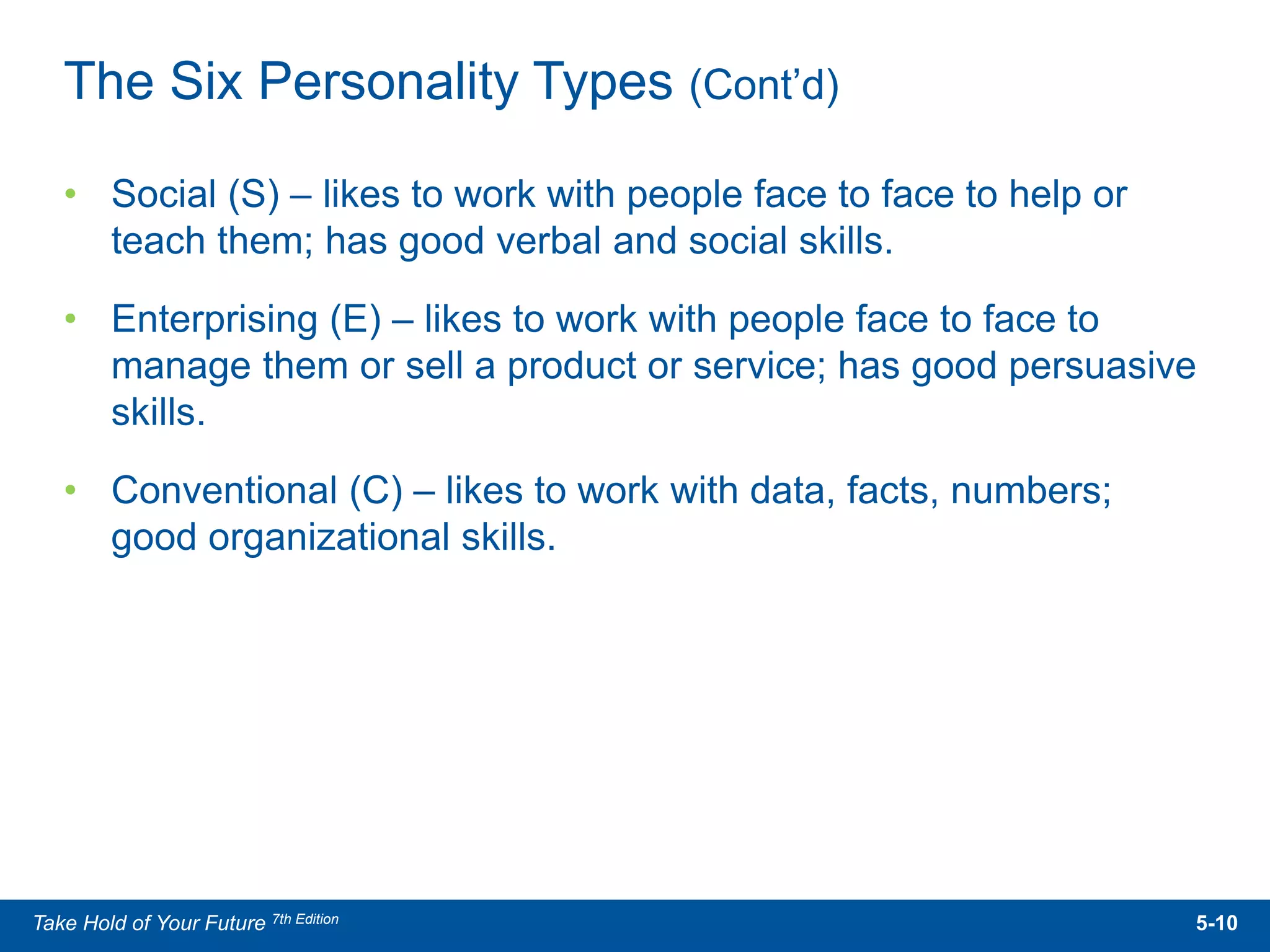
• Social (S) – likes to work with people face to face to help or
teach them; has good verbal and social skills.
• Enterprising (E) – likes to work with people face to face to
manage them or sell a product or service; has good persuasive
skills.
• Conventional (C) – likes to work with data, facts, numbers;
good organizational skills.
The Six Personality Types (Cont’d)
5-10Take Hold of Your Future 7th Edition
Relationship of Six Holland Clusters
5-11Take Hold of Your Future 7th Edition
5-12Take Hold of Your Future 7th Edition
From Career Choice and Development: Applying Contemporary Theories to Practice (2nd. ed.). Duane Brown,
Linda Brooks, and Associates (Eds.), Copyright © 1990, Jossey-Bass Inc. Reprinted with permission of John Wiley
& Sons, Inc.
The Archway of Career Determinants

Power point session5

  • 1.
    Session 5: Environment andSelf 7th Edition Take Hold of Your Future JoAnn Harris-Bowlsbey, Ed.D.
  • 2.
    At the endof this session, students will be able to: • Explain how self-concept is formed and how it relates to career choice. • Explain Holland’s theory of personality types. • Describe the Archway of Career Determinants and its meaning for personal career choices. 5-2Take Hold of Your Future 7th Edition Objectives
  • 3.
    • Self-Concept –a picture or image of one’s self, a combination of what we think we are, what others think we are, and what we want to be. Definitions 5-3Take Hold of Your Future 7th Edition
  • 4.
    • Holland – Parentsoffer activities. – Activities that are positively reinforced become interests. – People pursue skills to support their interests. – Possessing specific interests and skills leads to the development of values. – This sequence produces a unique “code” that people seek to implement through work. How Self-Concept is Formed 5-4Take Hold of Your Future 7th Edition
  • 5.
    • Super – Self-conceptformation begins very early in life. – It is developed by the feedback that we receive from significant others. – Those parts of the self-concept that can apply to work are called the vocational self-concept. – People seek to implement their vocational self-concept in work. How Self-Concept is Formed (Cont’d) 5-5Take Hold of Your Future 7th Edition
  • 6.
    • The self-conceptis continually formed and modified throughout life. • Self-concept is the dynamic behind selection and interaction of life roles. • Choice of an occupation is an attempt to implement a self-concept. • Career choices will be difficult if the self-concept is fuzzy, negative, or unrealistic. How Self-Concept is Formed (Cont’d) 5-6Take Hold of Your Future 7th Edition
  • 7.
    • What statementsam I making about myself in this collage? • What do these pictures say about who I am now, or who I want to be in the future? • What role models or early life events have affected this selection of pictures? • What occupations might be suggested by this self-information? Discussion of Student Collages 5-7Take Hold of Your Future 7th Edition
  • 8.
    • People canbe described as a combination of six different personality types. • Environments can be described by the same six types. • Individuals of a given personality type are drawn to environments of the same type. • Satisfaction is likely when person’s type matches an environment’s type. Holland’s Theory 5-8Take Hold of Your Future 7th Edition
  • 9.
    • Realistic (R)– likes to work with tools, machines, animals; good mechanical skills. • Investigative (I) – likes to work with abstract ideas; good math and science skills. • Artistic (A) – likes to engage in creative activities; good skills in art, music, dance, or other artistic form. The Six Personality Types 5-9Take Hold of Your Future 7th Edition
  • 10.
    • Social (S)– likes to work with people face to face to help or teach them; has good verbal and social skills. • Enterprising (E) – likes to work with people face to face to manage them or sell a product or service; has good persuasive skills. • Conventional (C) – likes to work with data, facts, numbers; good organizational skills. The Six Personality Types (Cont’d) 5-10Take Hold of Your Future 7th Edition
  • 11.
    Relationship of SixHolland Clusters 5-11Take Hold of Your Future 7th Edition
  • 12.
    5-12Take Hold ofYour Future 7th Edition From Career Choice and Development: Applying Contemporary Theories to Practice (2nd. ed.). Duane Brown, Linda Brooks, and Associates (Eds.), Copyright © 1990, Jossey-Bass Inc. Reprinted with permission of John Wiley & Sons, Inc. The Archway of Career Determinants