POWER
BACKUPS
•UPS[Uninterrupted power supply]
•Invertors
•Diesel generating sets
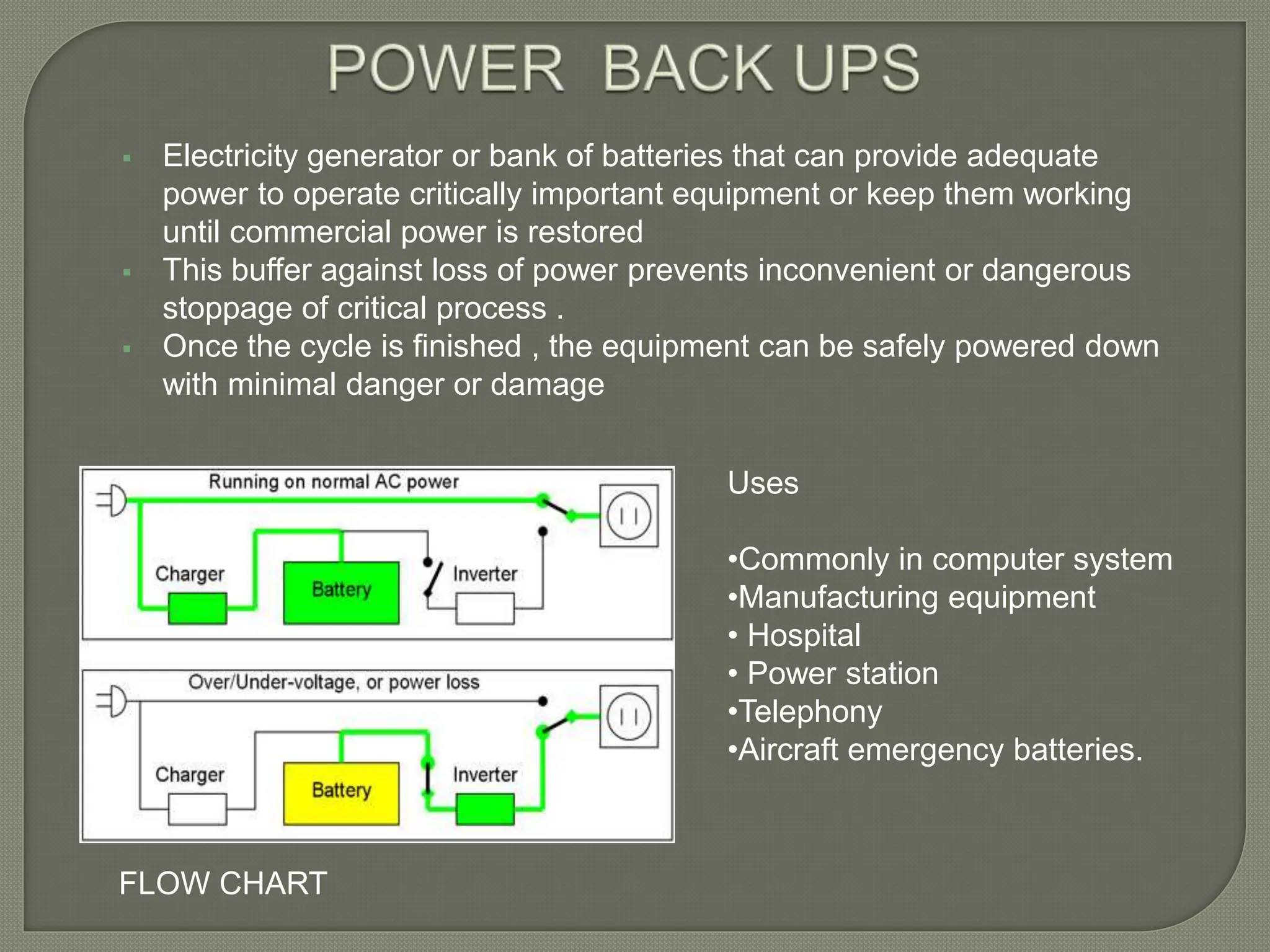
 Electricity generator or bank of batteries that can provide adequate
power to operate critically important equipment or keep them working
until commercial power is restored
 This buffer against loss of power prevents inconvenient or dangerous
stoppage of critical process .
 Once the cycle is finished , the equipment can be safely powered down
with minimal danger or damage
Uses
•Commonly in computer system
•Manufacturing equipment
• Hospital
• Power station
•Telephony
•Aircraft emergency batteries.
FLOW CHART
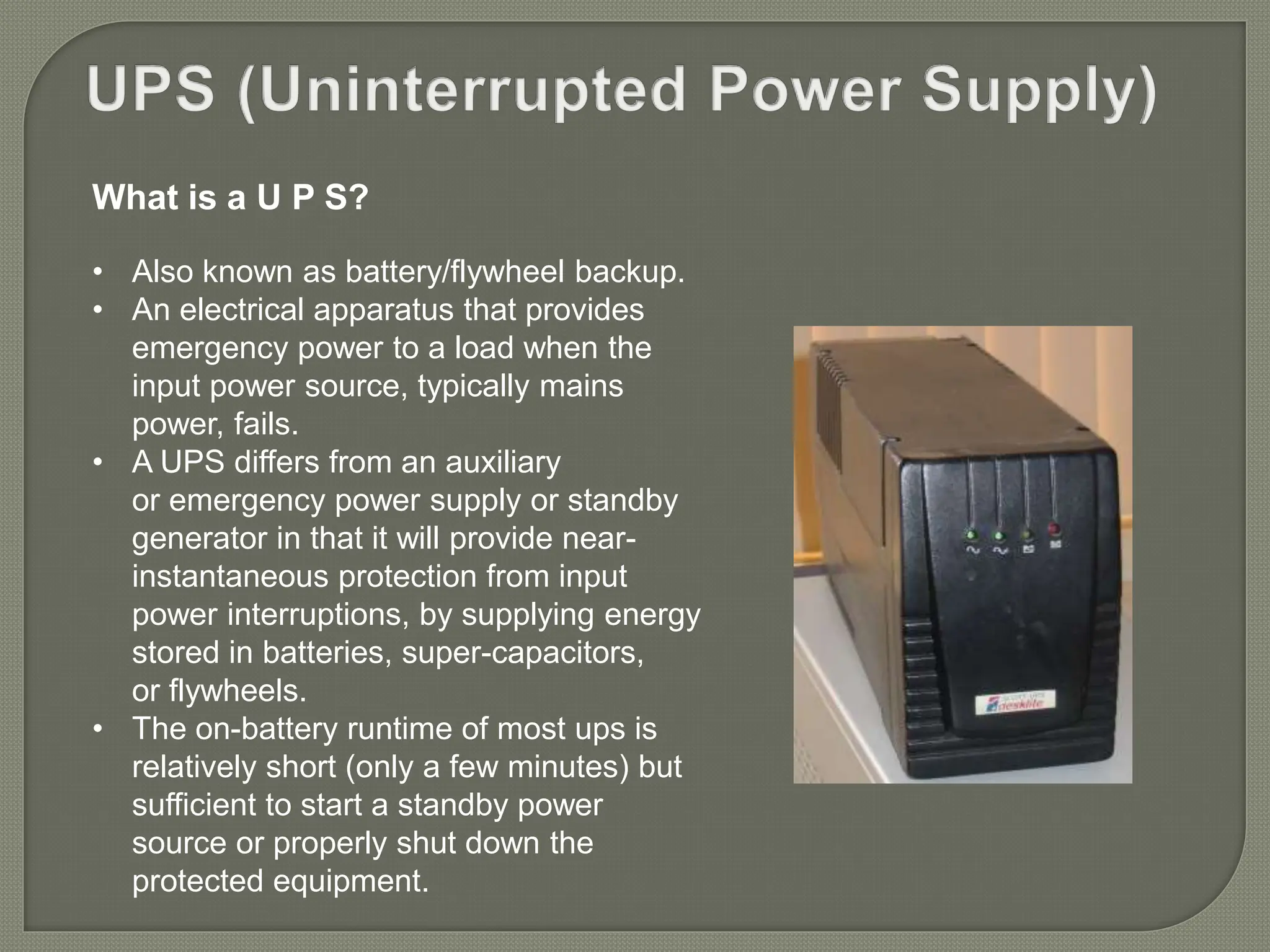
What is a U P S?
• Also known as battery/flywheel backup.
• An electrical apparatus that provides
emergency power to a load when the
input power source, typically mains
power, fails.
• A UPS differs from an auxiliary
or emergency power supply or standby
generator in that it will provide near-
instantaneous protection from input
power interruptions, by supplying energy
stored in batteries, super-capacitors,
or flywheels.
• The on-battery runtime of most ups is
relatively short (only a few minutes) but
sufficient to start a standby power
source or properly shut down the
protected equipment.
Uses
In computers, data centres, telecommunication
equipment or other electrical equipment where
an unexpected power disruption could cause
injuries, fatalities, serious business disruption or
data loss.
ADVANTAGES
1. Maintenance Of
Power
2. Continuity Of
Operation
3. Surge Protection
1. High Start Up Cost
2. Maintenance Cost
3. Energy Use
Power Range
A single computer without a video
monitor of `around 200VA rating
to large units powering entire data
centres or buildings.
DISADVANTAGES
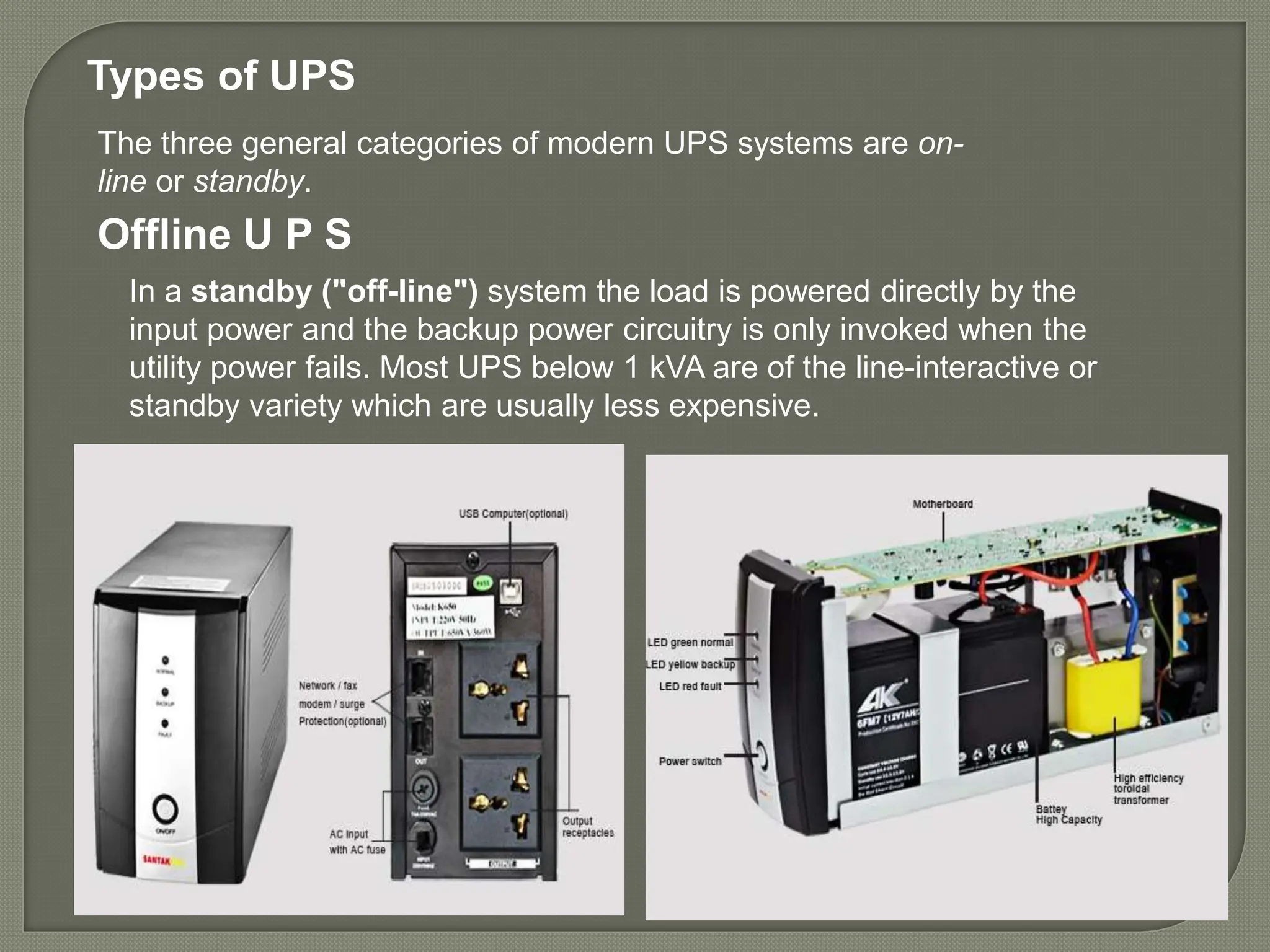
In a standby ("off-line") system the load is powered directly by the
input power and the backup power circuitry is only invoked when the
utility power fails. Most UPS below 1 kVA are of the line-interactive or
standby variety which are usually less expensive.
Offline U P S
The three general categories of modern UPS systems are on-
line or standby.
Types of UPS
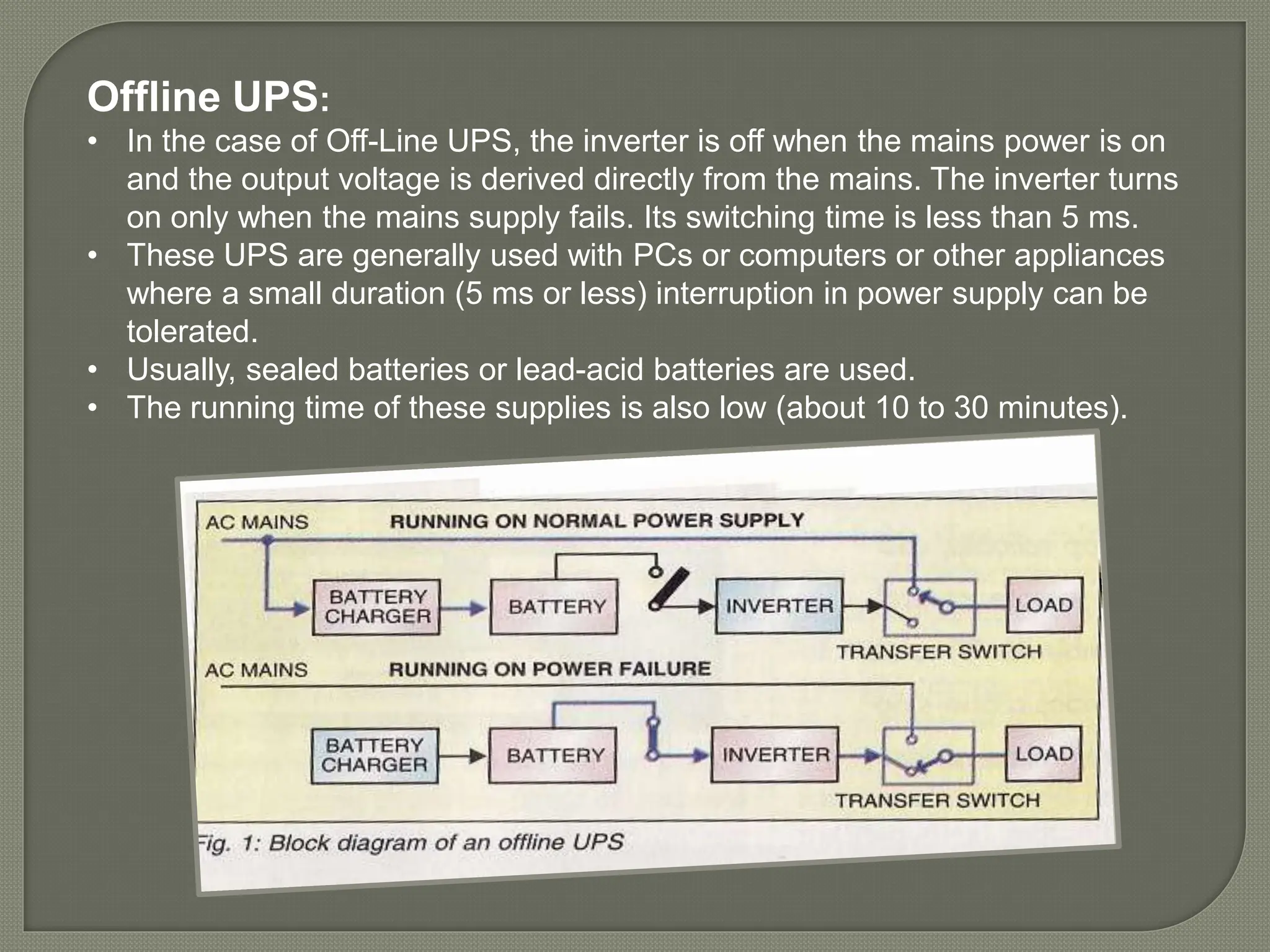
Offline UPS:
• In the case of Off-Line UPS, the inverter is off when the mains power is on
and the output voltage is derived directly from the mains. The inverter turns
on only when the mains supply fails. Its switching time is less than 5 ms.
• These UPS are generally used with PCs or computers or other appliances
where a small duration (5 ms or less) interruption in power supply can be
tolerated.
• Usually, sealed batteries or lead-acid batteries are used.
• The running time of these supplies is also low (about 10 to 30 minutes).
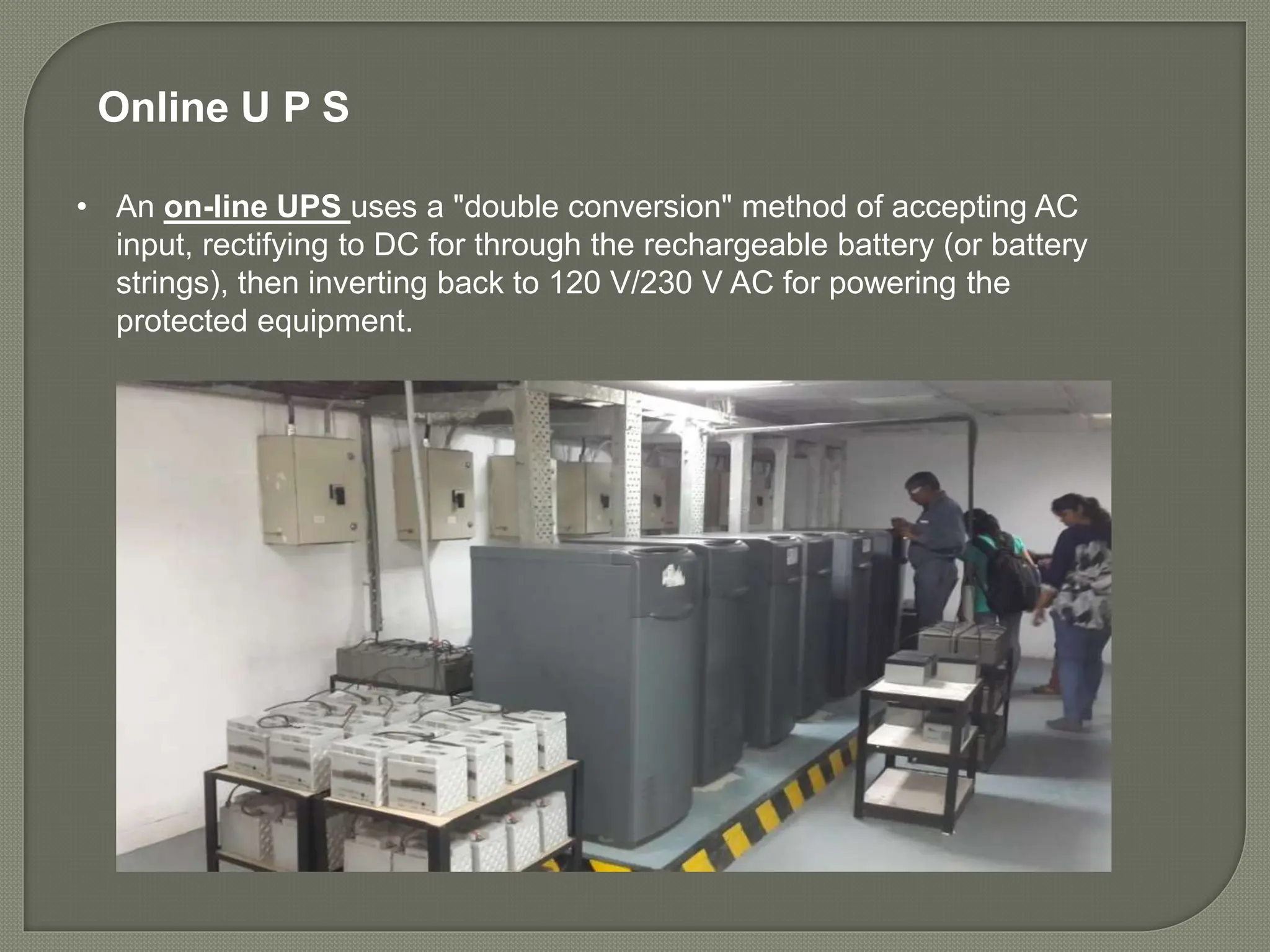
• An on-line UPS uses a "double conversion" method of accepting AC
input, rectifying to DC for through the rechargeable battery (or battery
strings), then inverting back to 120 V/230 V AC for powering the
protected equipment.
Online U P S
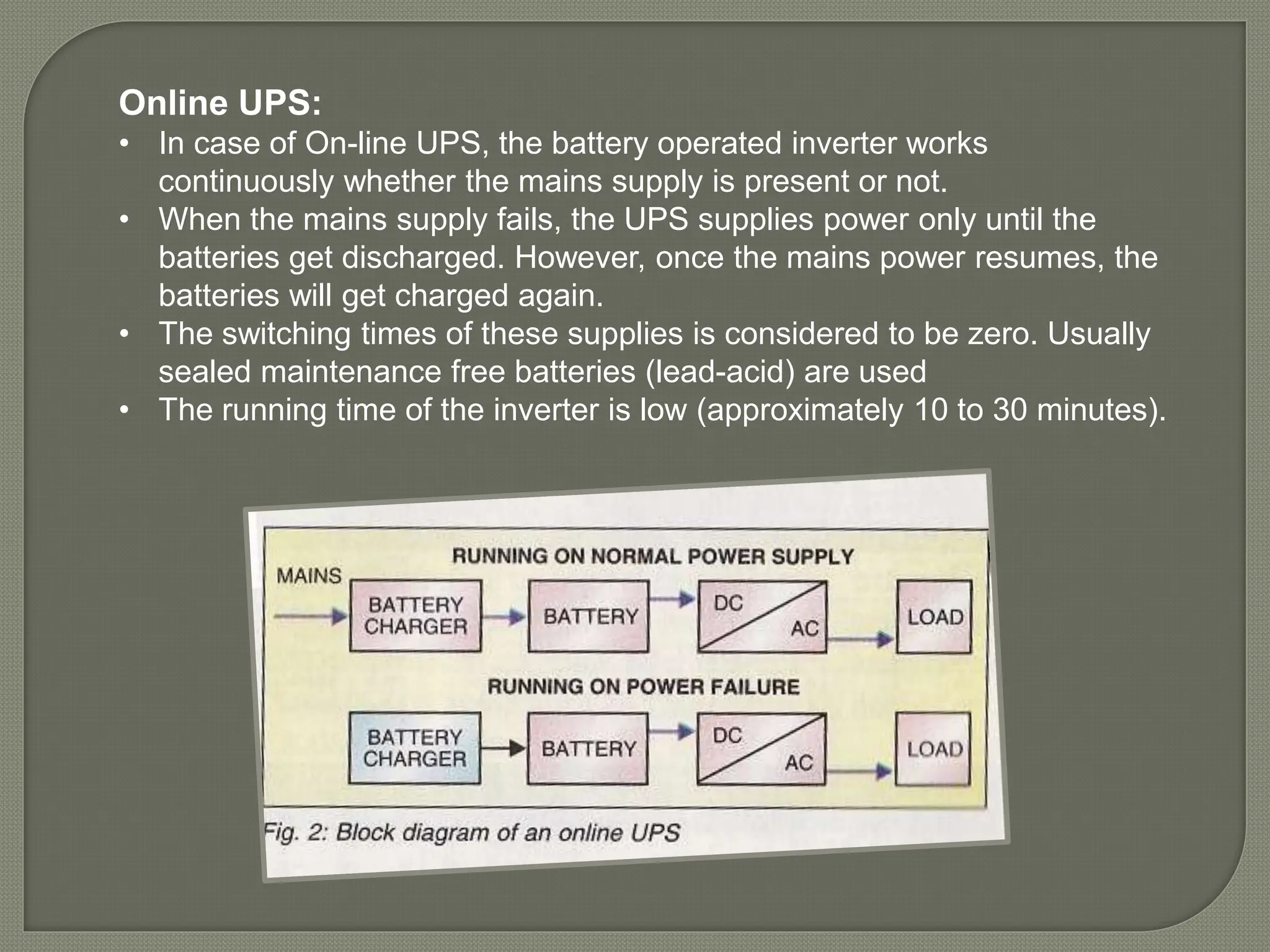
Online UPS:
• In case of On-line UPS, the battery operated inverter works
continuously whether the mains supply is present or not.
• When the mains supply fails, the UPS supplies power only until the
batteries get discharged. However, once the mains power resumes, the
batteries will get charged again.
• The switching times of these supplies is considered to be zero. Usually
sealed maintenance free batteries (lead-acid) are used
• The running time of the inverter is low (approximately 10 to 30 minutes).
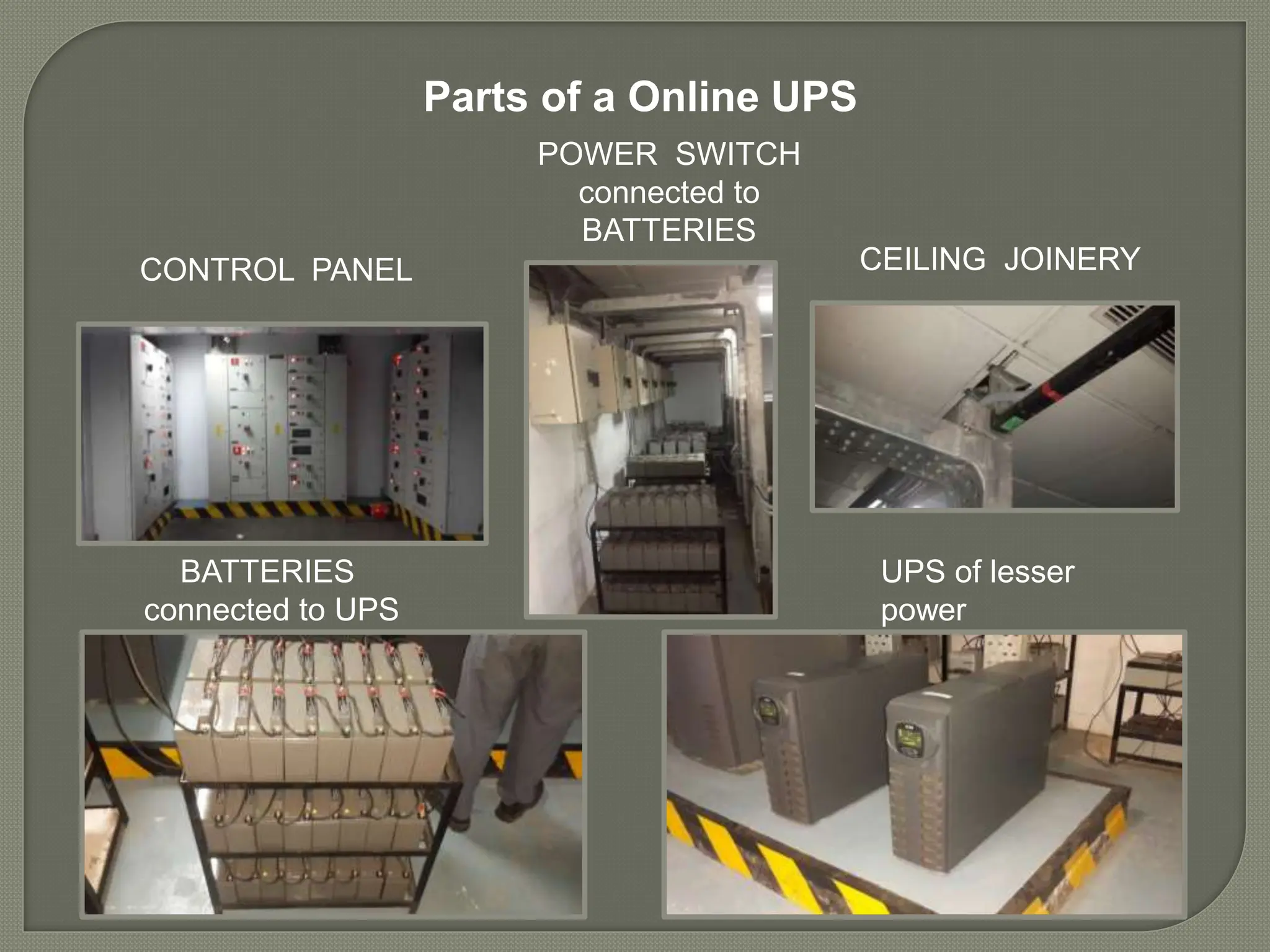
Parts of a Online UPS
CONTROL PANEL CEILING JOINERY
POWER SWITCH
connected to
BATTERIES
BATTERIES
connected to UPS
UPS of lesser
power
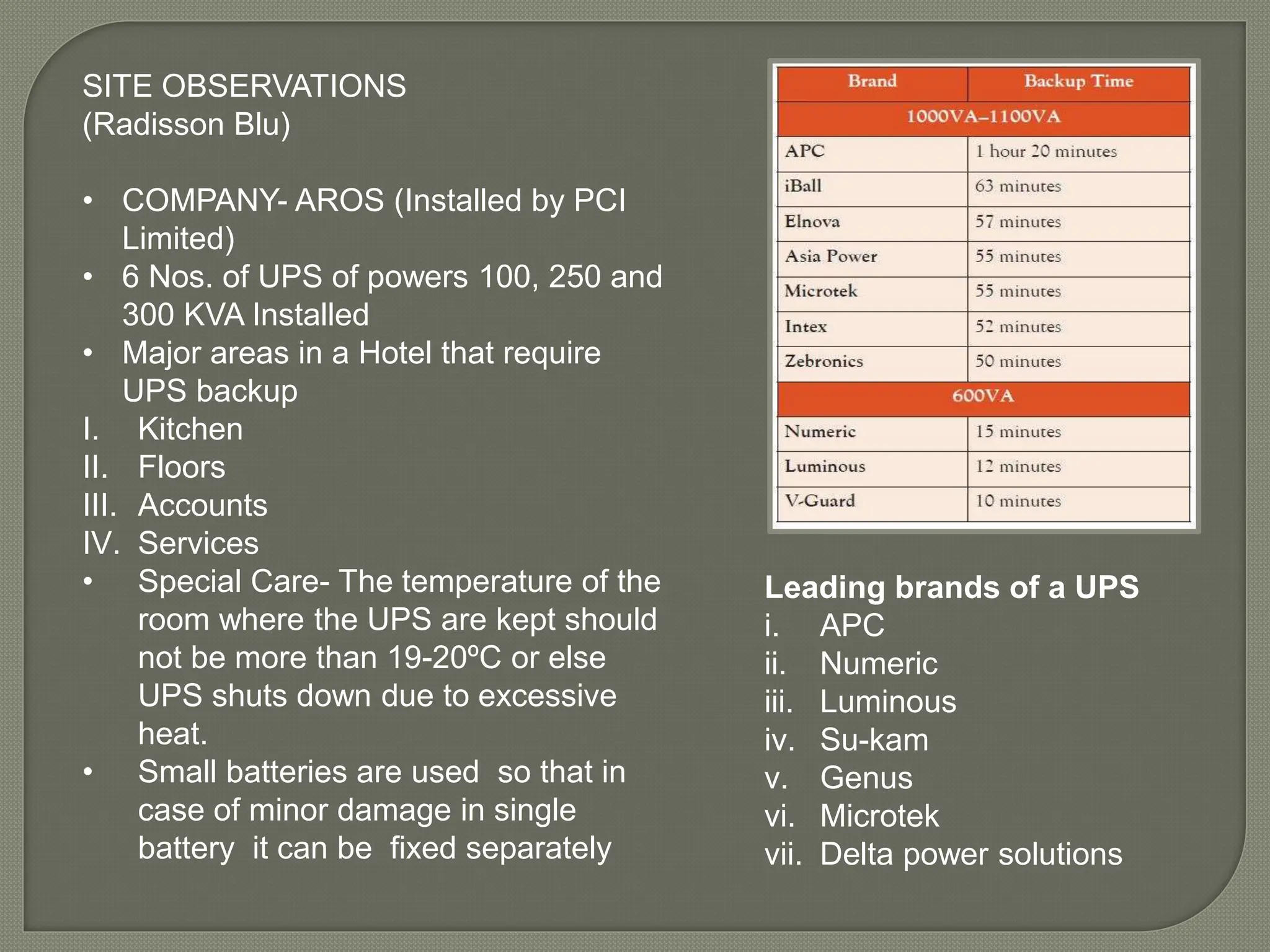
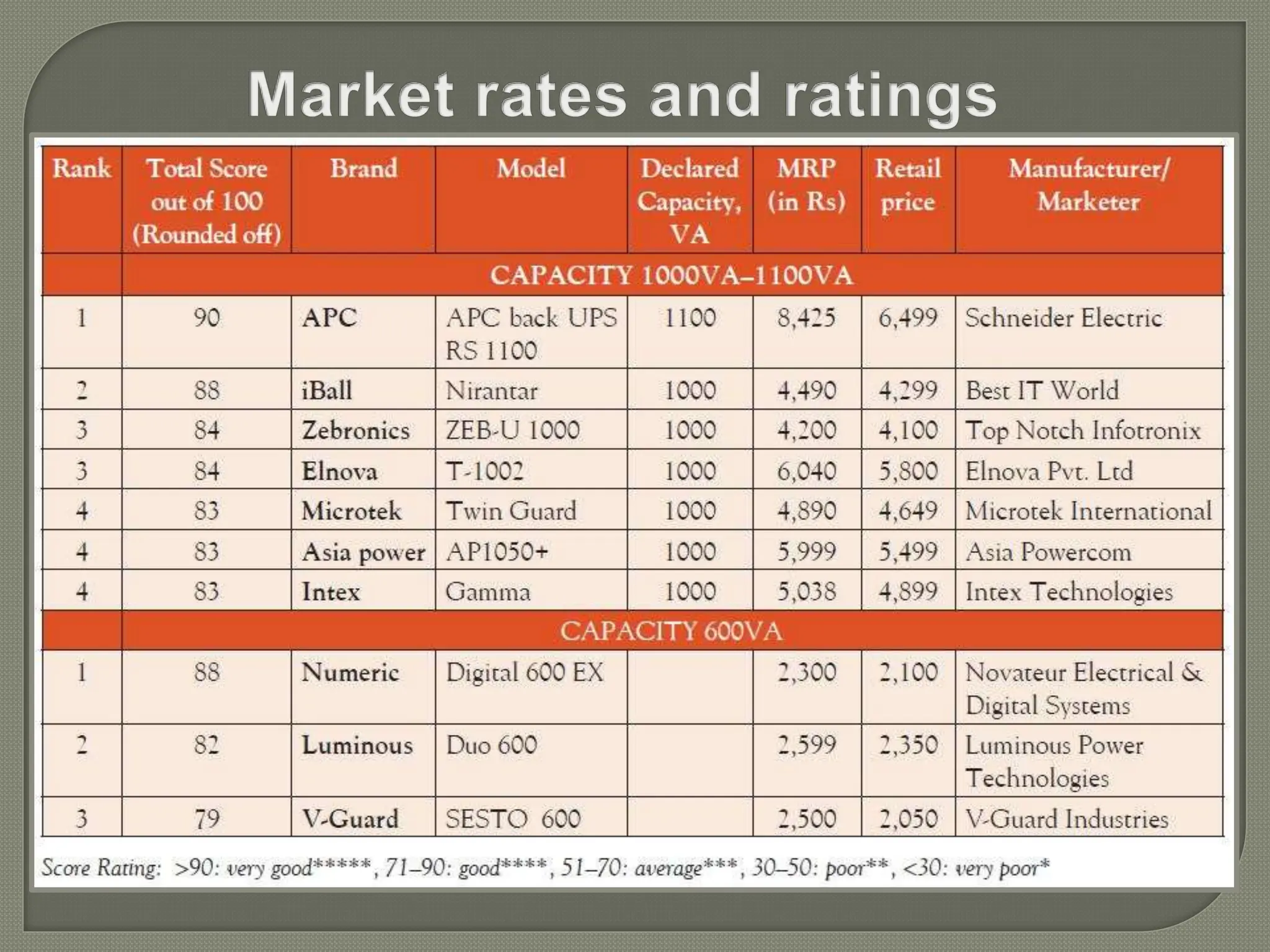
Leading brands of a UPS
i. APC
ii. Numeric
iii. Luminous
iv. Su-kam
v. Genus
vi. Microtek
vii. Delta power solutions
SITE OBSERVATIONS
(Radisson Blu)
• COMPANY- AROS (Installed by PCI
Limited)
• 6 Nos. of UPS of powers 100, 250 and
300 KVA Installed
• Major areas in a Hotel that require
UPS backup
I. Kitchen
II. Floors
III. Accounts
IV. Services
• Special Care- The temperature of the
room where the UPS are kept should
not be more than 19-20ºC or else
UPS shuts down due to excessive
heat.
• Small batteries are used so that in
case of minor damage in single
battery it can be fixed separately
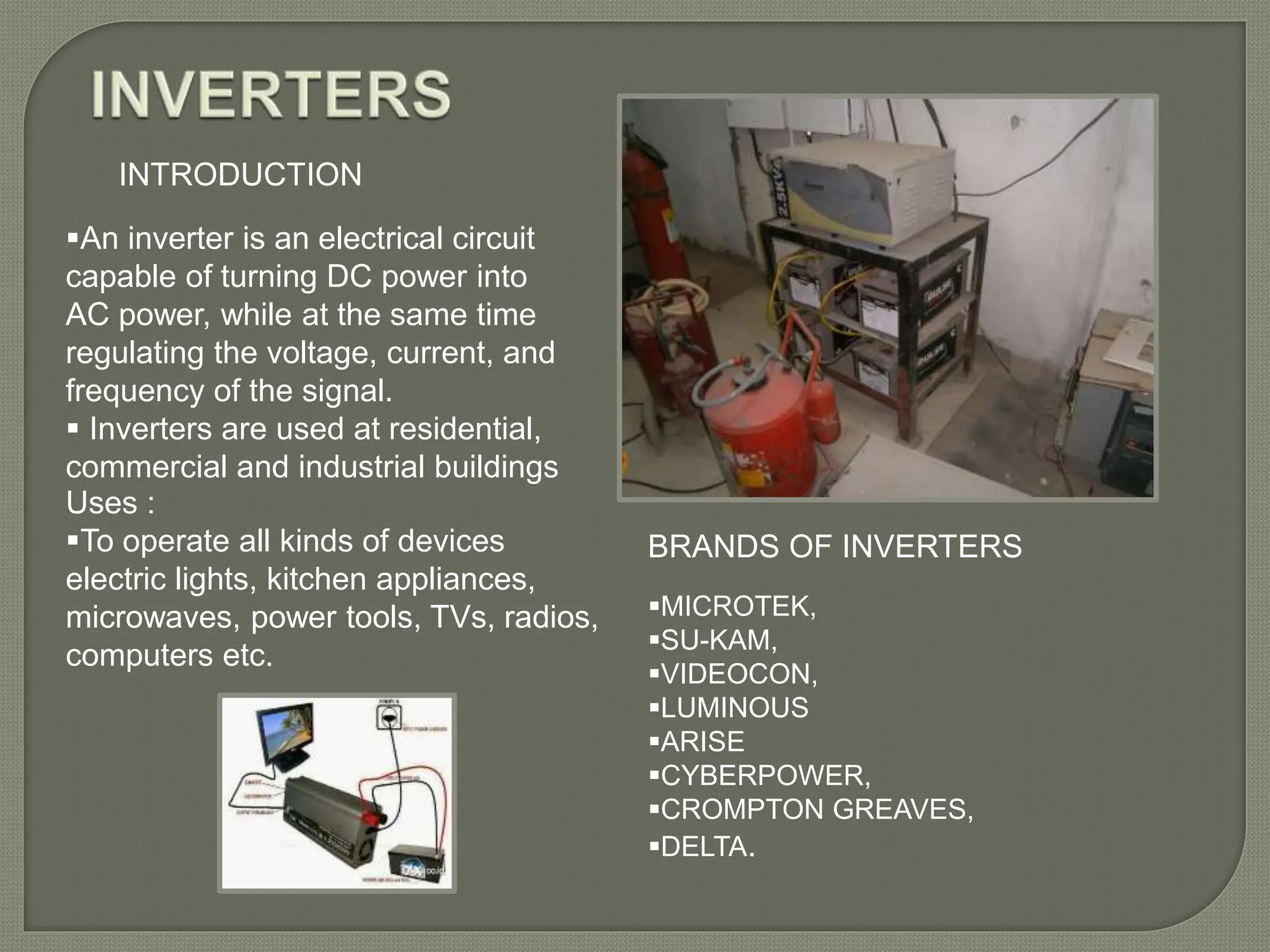
INTRODUCTION
An inverter is an electrical circuit
capable of turning DC power into
AC power, while at the same time
regulating the voltage, current, and
frequency of the signal.
 Inverters are used at residential,
commercial and industrial buildings
Uses :
To operate all kinds of devices
electric lights, kitchen appliances,
microwaves, power tools, TVs, radios,
computers etc.
MICROTEK,
SU-KAM,
VIDEOCON,
LUMINOUS
ARISE
CYBERPOWER,
CROMPTON GREAVES,
DELTA.
BRANDS OF INVERTERS
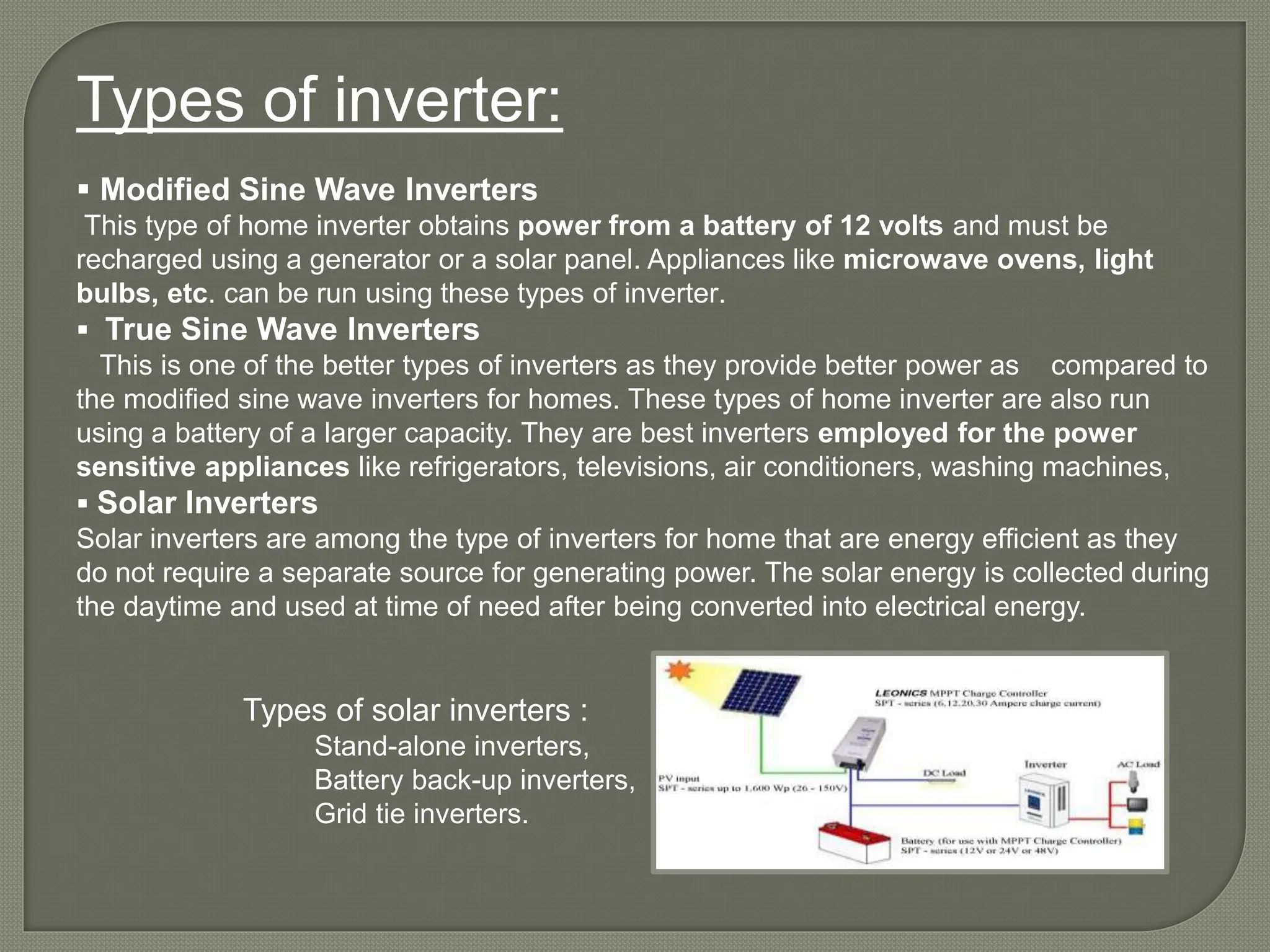
Types of inverter:
 Modified Sine Wave Inverters
This type of home inverter obtains power from a battery of 12 volts and must be
recharged using a generator or a solar panel. Appliances like microwave ovens, light
bulbs, etc. can be run using these types of inverter.
 True Sine Wave Inverters
This is one of the better types of inverters as they provide better power as compared to
the modified sine wave inverters for homes. These types of home inverter are also run
using a battery of a larger capacity. They are best inverters employed for the power
sensitive appliances like refrigerators, televisions, air conditioners, washing machines,
 Solar Inverters
Solar inverters are among the type of inverters for home that are energy efficient as they
do not require a separate source for generating power. The solar energy is collected during
the daytime and used at time of need after being converted into electrical energy.
Types of solar inverters :
Stand-alone inverters,
Battery back-up inverters,
Grid tie inverters.
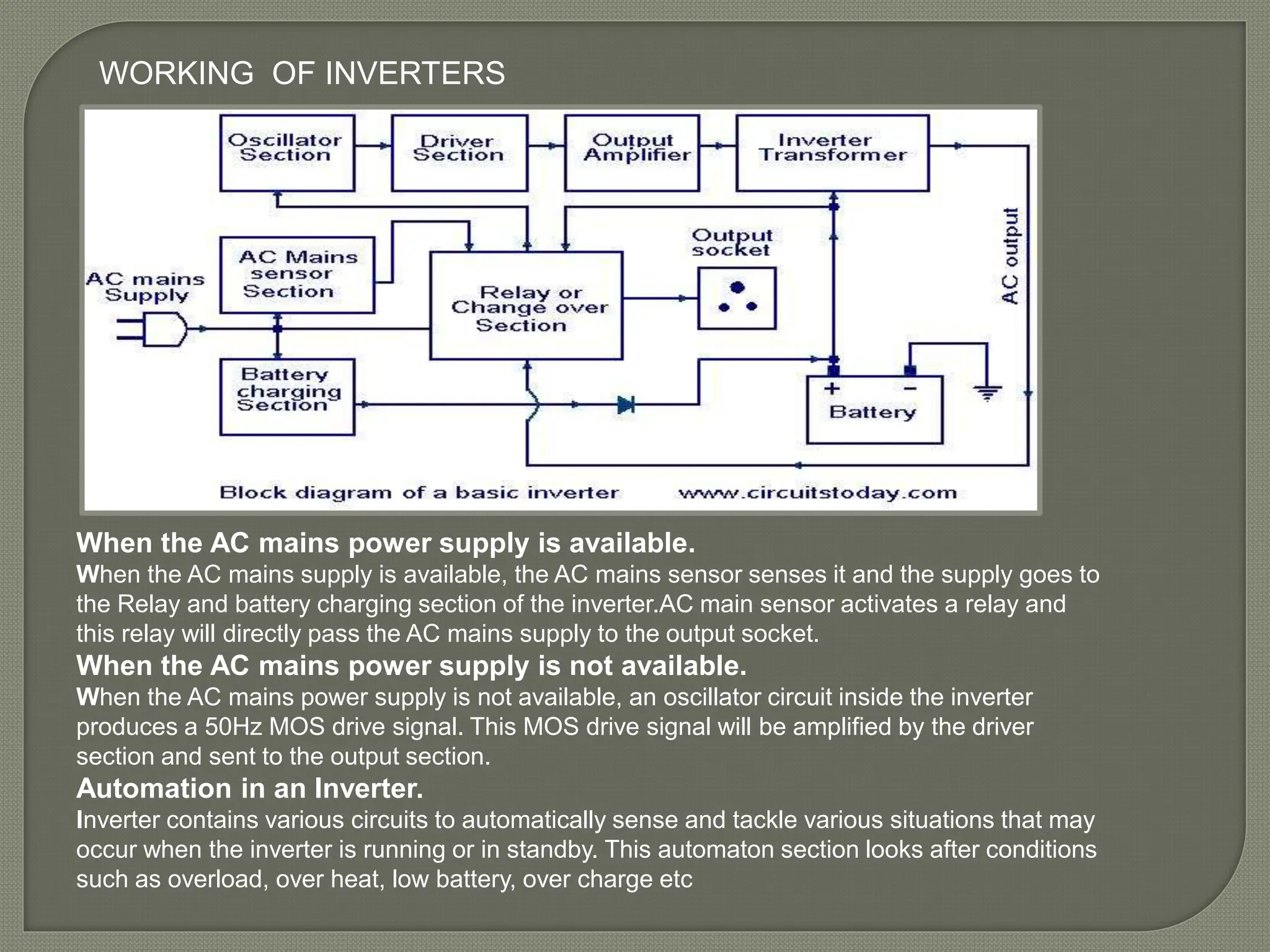
When the AC mains power supply is available.
When the AC mains supply is available, the AC mains sensor senses it and the supply goes to
the Relay and battery charging section of the inverter.AC main sensor activates a relay and
this relay will directly pass the AC mains supply to the output socket.
When the AC mains power supply is not available.
When the AC mains power supply is not available, an oscillator circuit inside the inverter
produces a 50Hz MOS drive signal. This MOS drive signal will be amplified by the driver
section and sent to the output section.
Automation in an Inverter.
Inverter contains various circuits to automatically sense and tackle various situations that may
occur when the inverter is running or in standby. This automaton section looks after conditions
such as overload, over heat, low battery, over charge etc
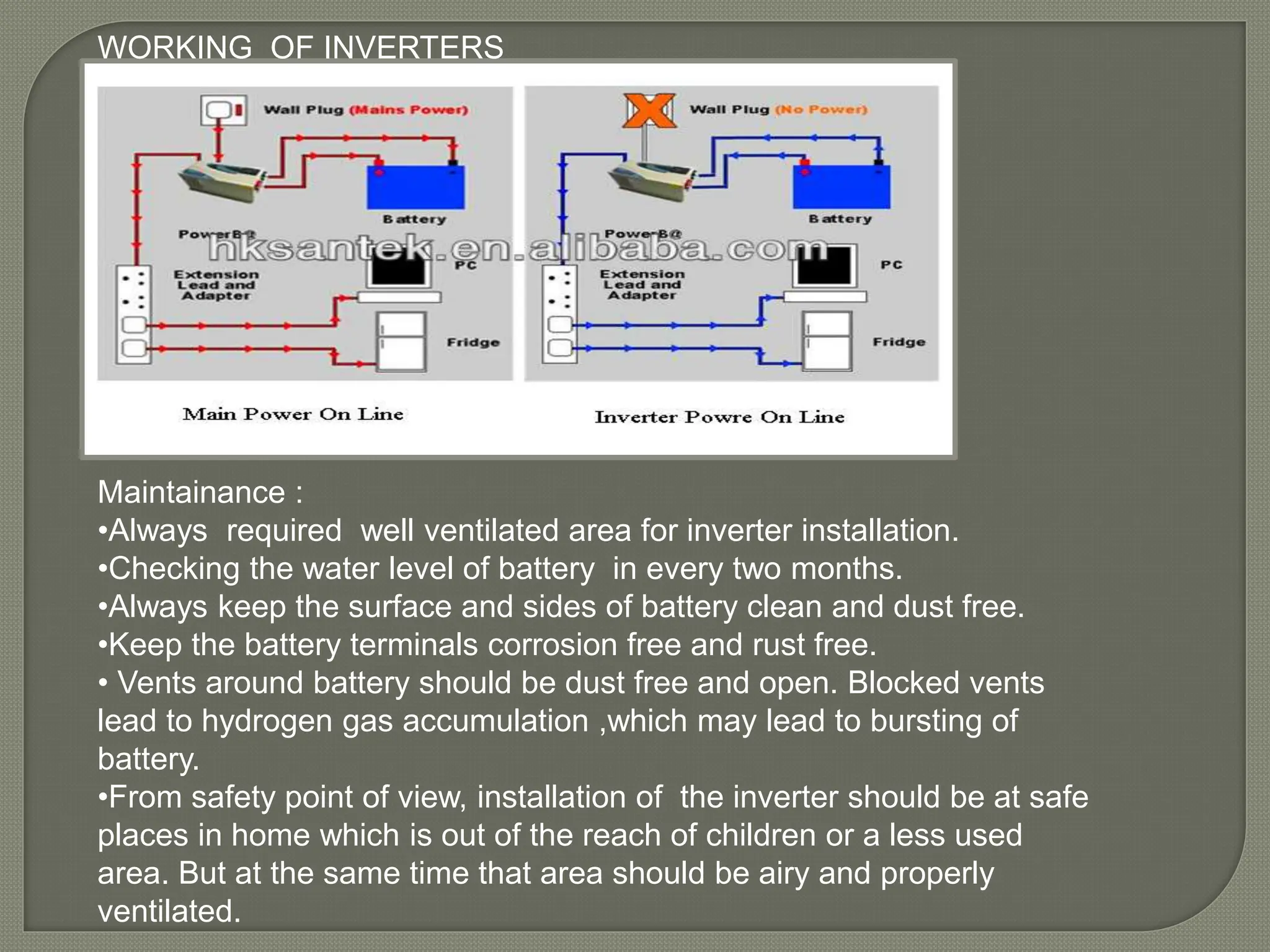
WORKING OF INVERTERS
Maintainance :
•Always required well ventilated area for inverter installation.
•Checking the water level of battery in every two months.
•Always keep the surface and sides of battery clean and dust free.
•Keep the battery terminals corrosion free and rust free.
• Vents around battery should be dust free and open. Blocked vents
lead to hydrogen gas accumulation ,which may lead to bursting of
battery.
•From safety point of view, installation of the inverter should be at safe
places in home which is out of the reach of children or a less used
area. But at the same time that area should be airy and properly
ventilated.
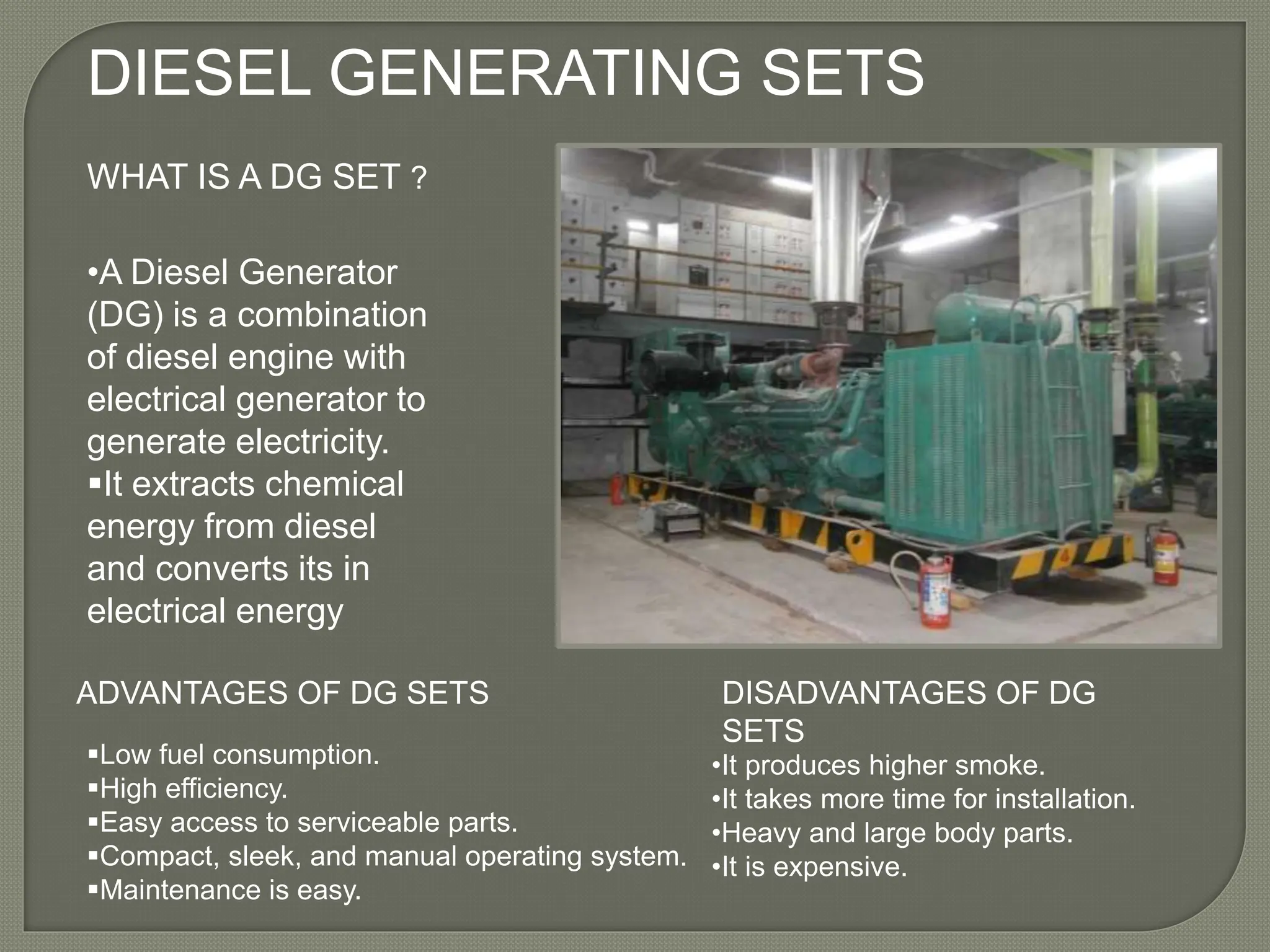
DIESEL GENERATING SETS
WHAT IS A DG SET ?
•A Diesel Generator
(DG) is a combination
of diesel engine with
electrical generator to
generate electricity.
It extracts chemical
energy from diesel
and converts its in
electrical energy
ADVANTAGES OF DG SETS
Low fuel consumption.
High efficiency.
Easy access to serviceable parts.
Compact, sleek, and manual operating system.
Maintenance is easy.
DISADVANTAGES OF DG
SETS
•It produces higher smoke.
•It takes more time for installation.
•Heavy and large body parts.
•It is expensive.
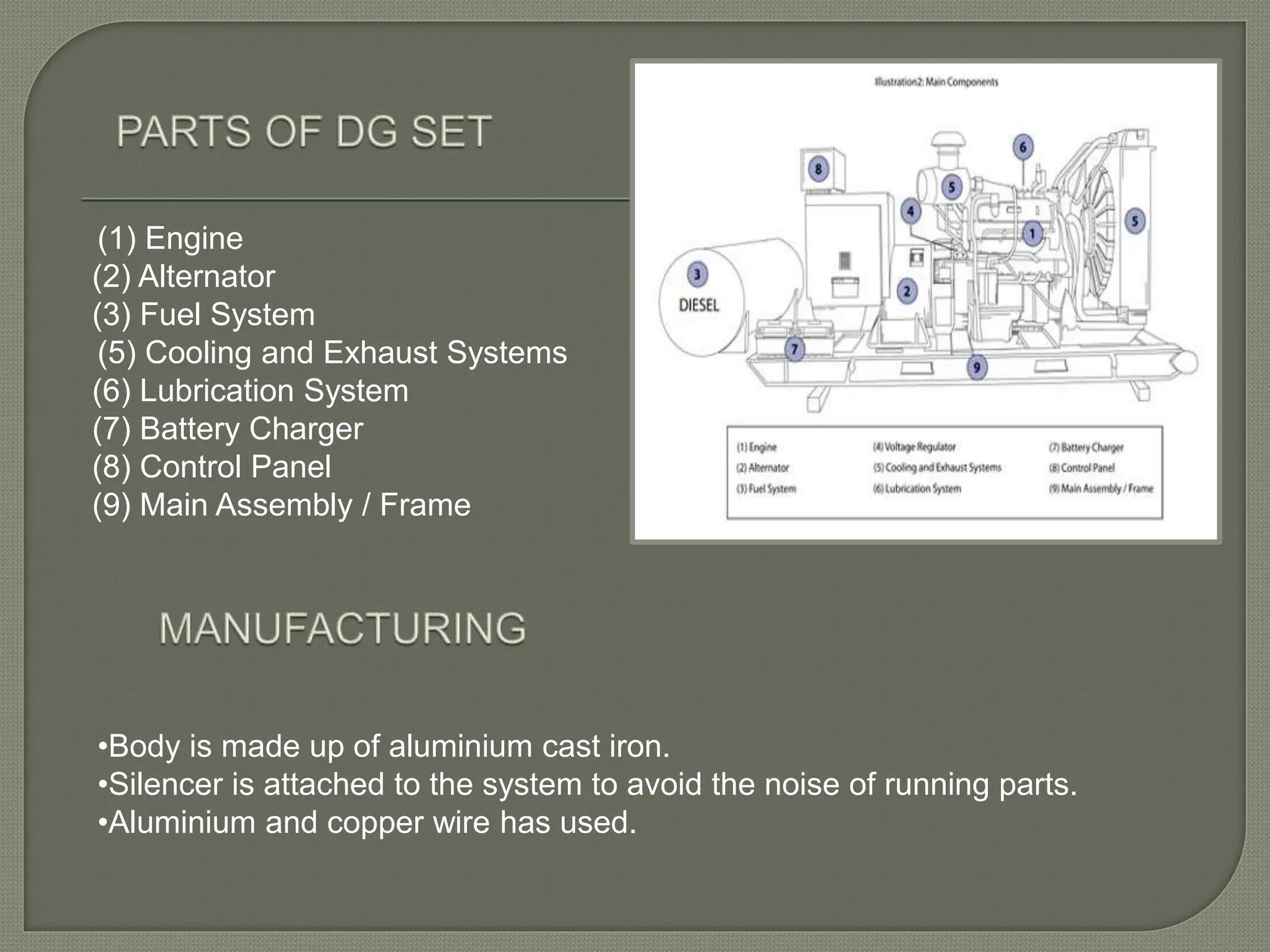
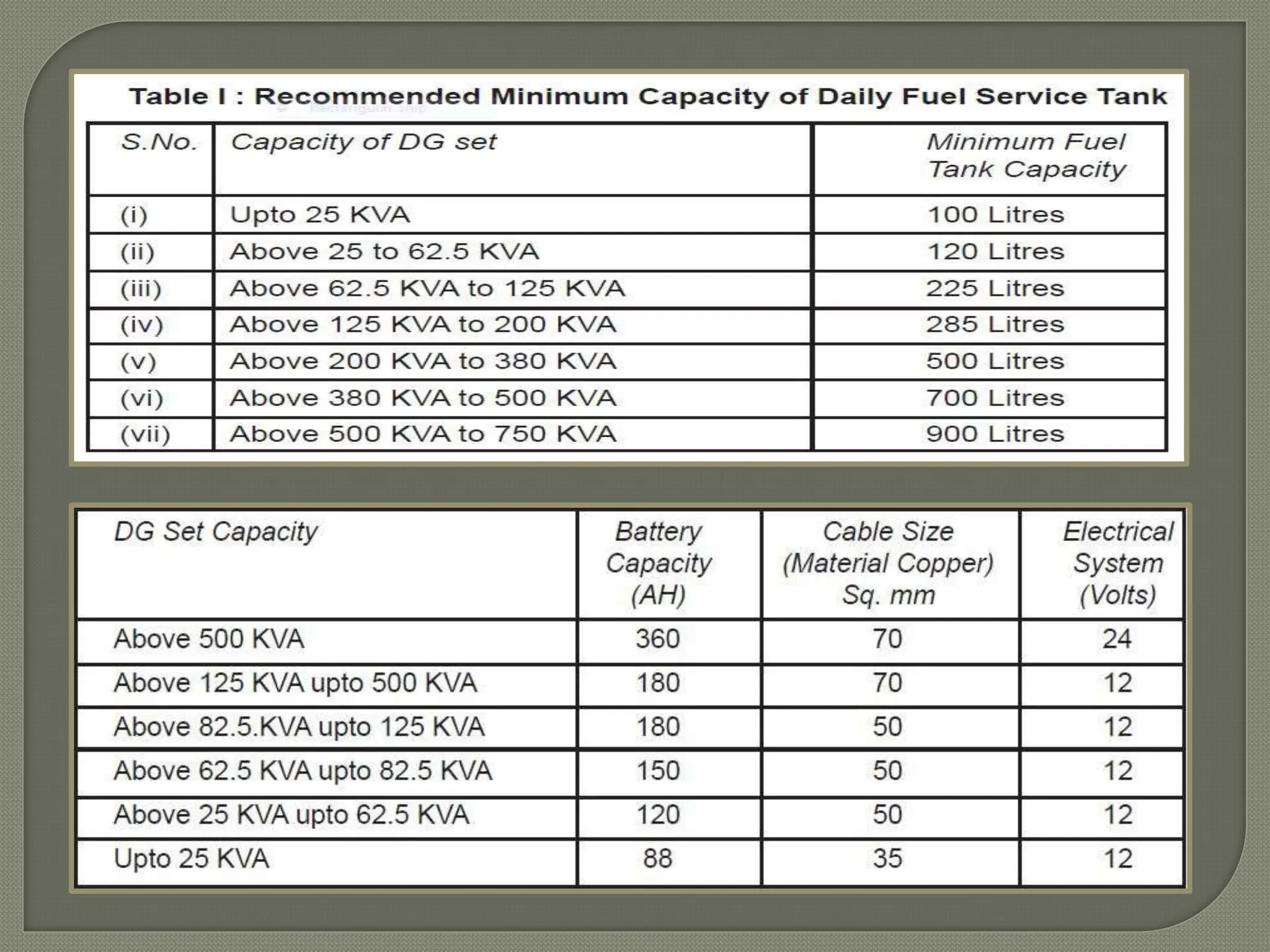
(1) Engine
(2) Alternator
(3) Fuel System
(5) Cooling and Exhaust Systems
(6) Lubrication System
(7) Battery Charger
(8) Control Panel
(9) Main Assembly / Frame
•Body is made up of aluminium cast iron.
•Silencer is attached to the system to avoid the noise of running parts.
•Aluminium and copper wire has used.
INSTALLATION
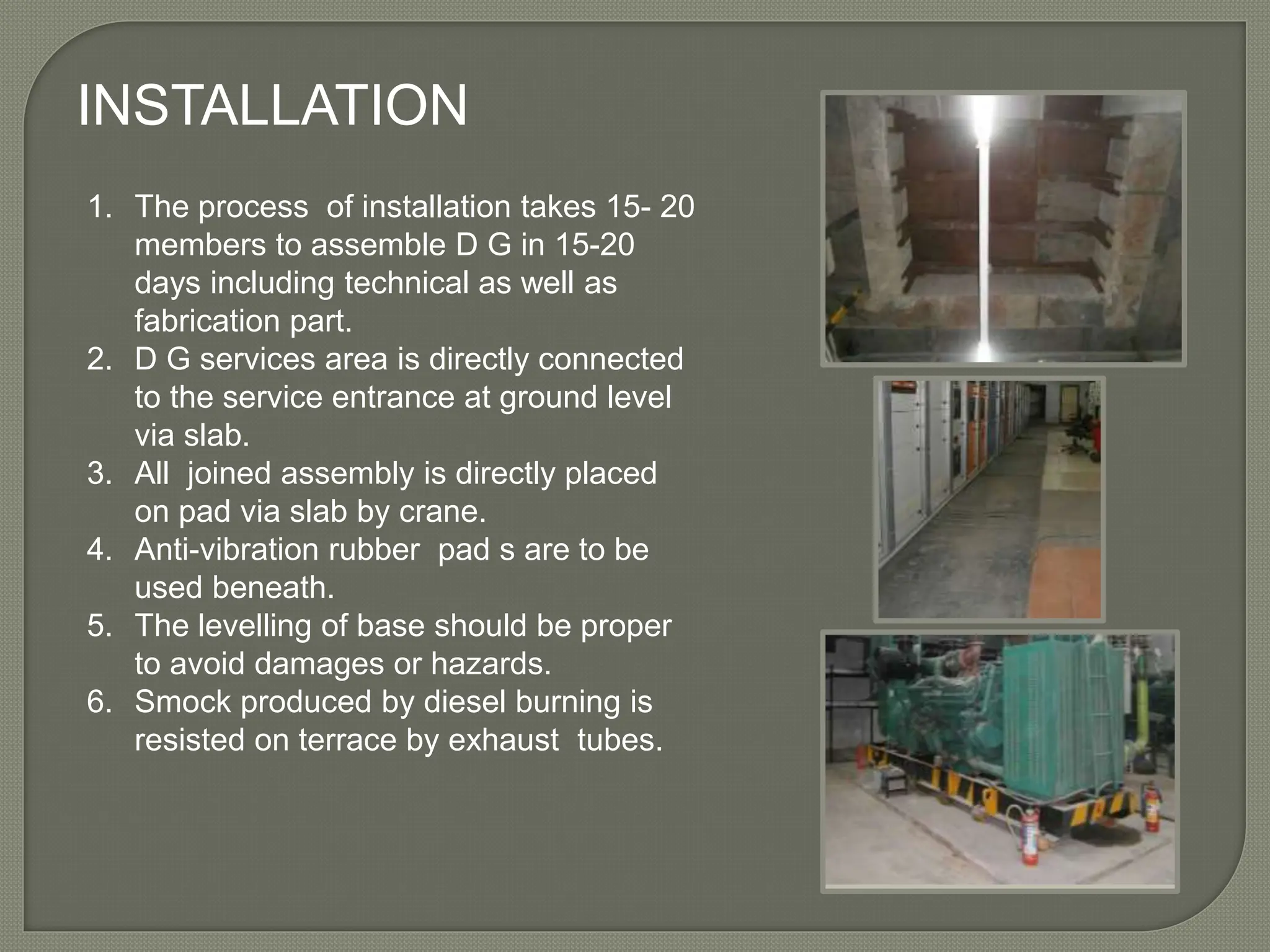
1. The process of installation takes 15- 20
members to assemble D G in 15-20
days including technical as well as
fabrication part.
2. D G services area is directly connected
to the service entrance at ground level
via slab.
3. All joined assembly is directly placed
on pad via slab by crane.
4. Anti-vibration rubber pad s are to be
used beneath.
5. The levelling of base should be proper
to avoid damages or hazards.
6. Smock produced by diesel burning is
resisted on terrace by exhaust tubes.
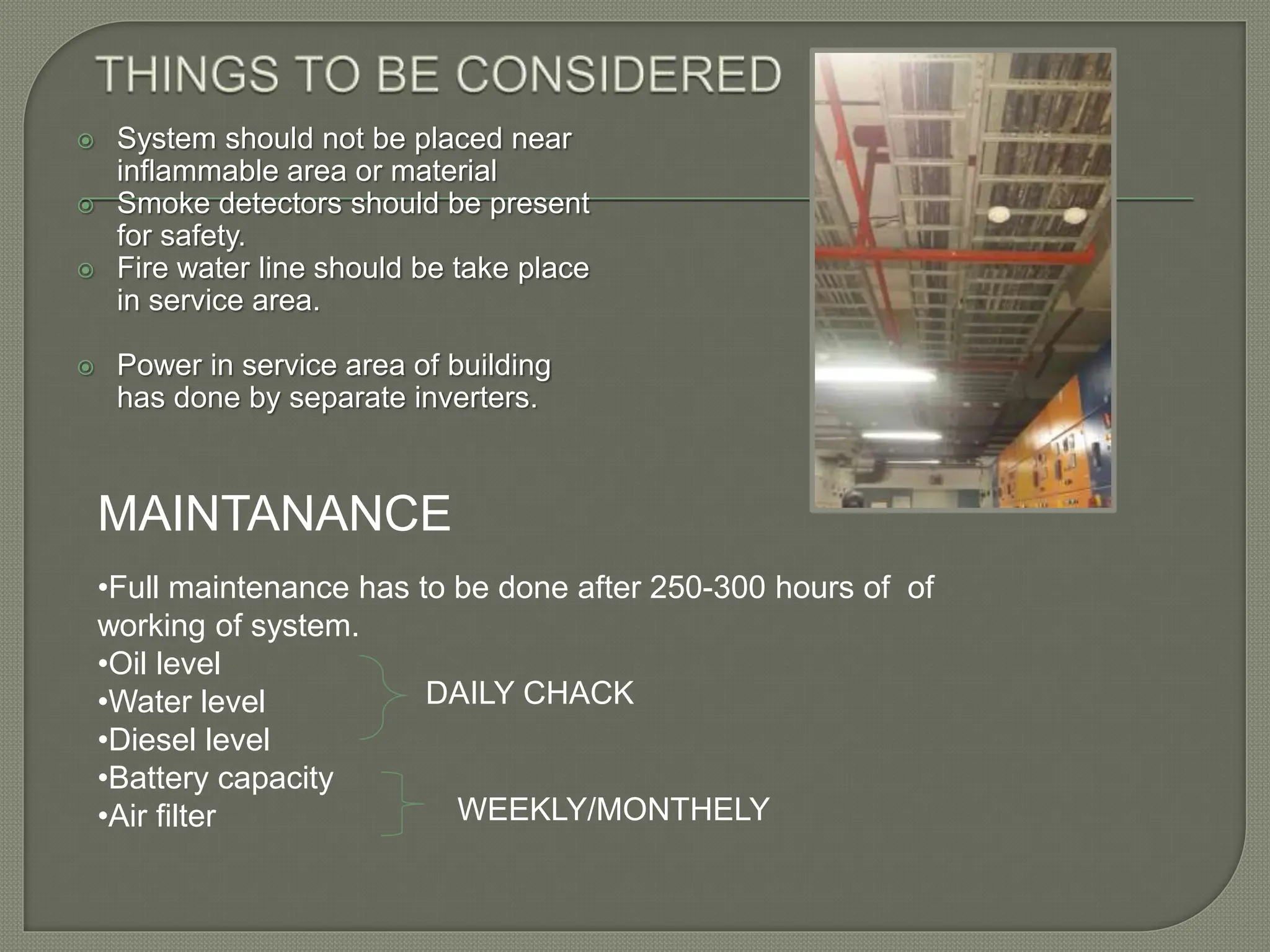
 System should not be placed near
inflammable area or material
 Smoke detectors should be present
for safety.
 Fire water line should be take place
in service area.
 Power in service area of building
has done by separate inverters.
MAINTANANCE
•Full maintenance has to be done after 250-300 hours of of
working of system.
•Oil level
•Water level
•Diesel level
•Battery capacity
•Air filter
DAILY CHACK
WEEKLY/MONTHELY
FEATURES OF DIESEL GENERATORS
•Battery is provided in a tray inside the enclosure
•Doors have high quality gaskets to avoid leakage of sound
•Fuel level is indicated with the help of fuel gauge meter
•Sound proof and weather proof enclosure.
•To make the system vibration free, mounting is done on anti-vibration pads mounted on
base frame.
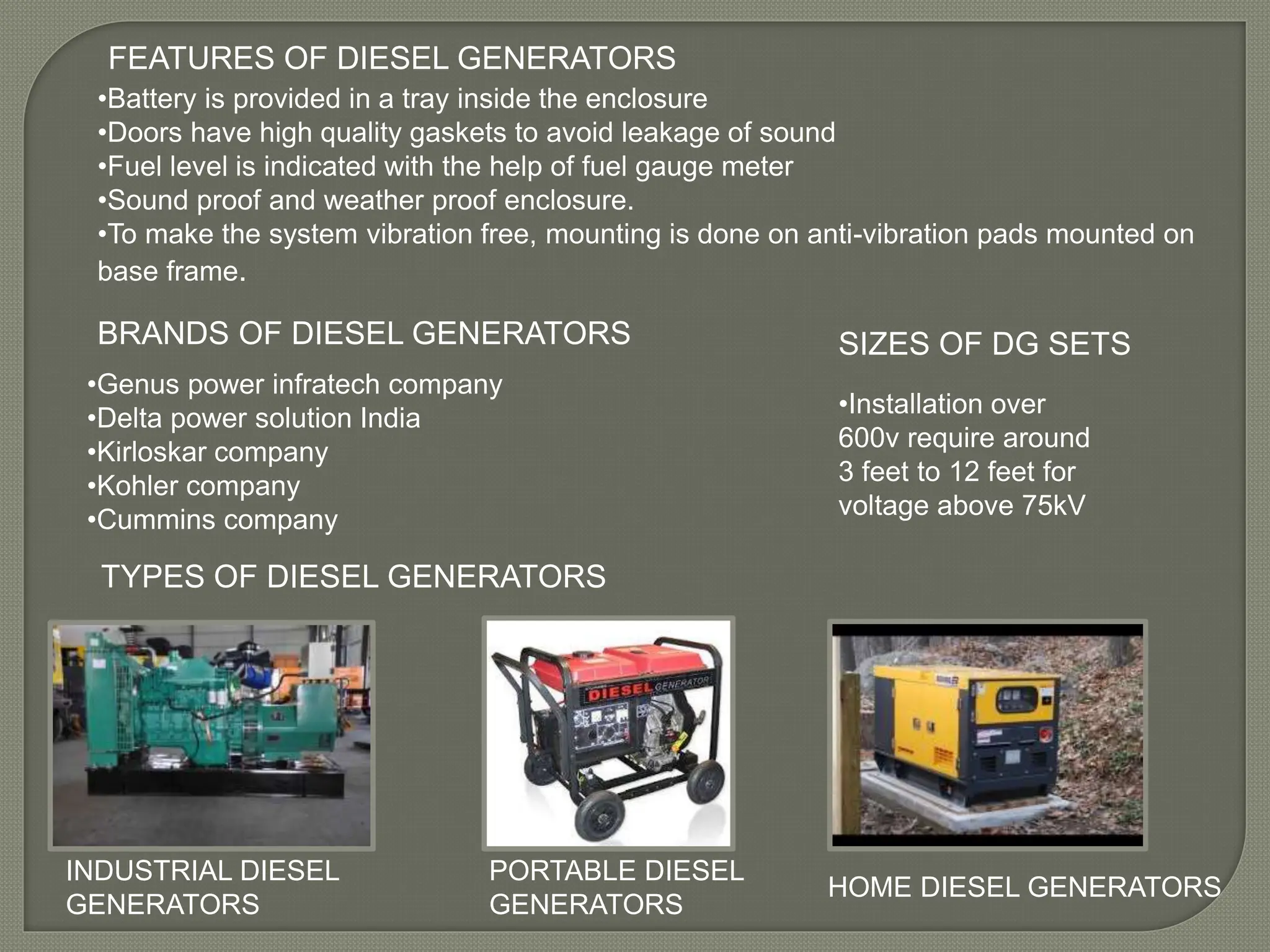
TYPES OF DIESEL GENERATORS
INDUSTRIAL DIESEL
GENERATORS
PORTABLE DIESEL
GENERATORS
HOME DIESEL GENERATORS
BRANDS OF DIESEL GENERATORS
•Genus power infratech company
•Delta power solution India
•Kirloskar company
•Kohler company
•Cummins company
SIZES OF DG SETS
•Installation over
600v require around
3 feet to 12 feet for
voltage above 75kV
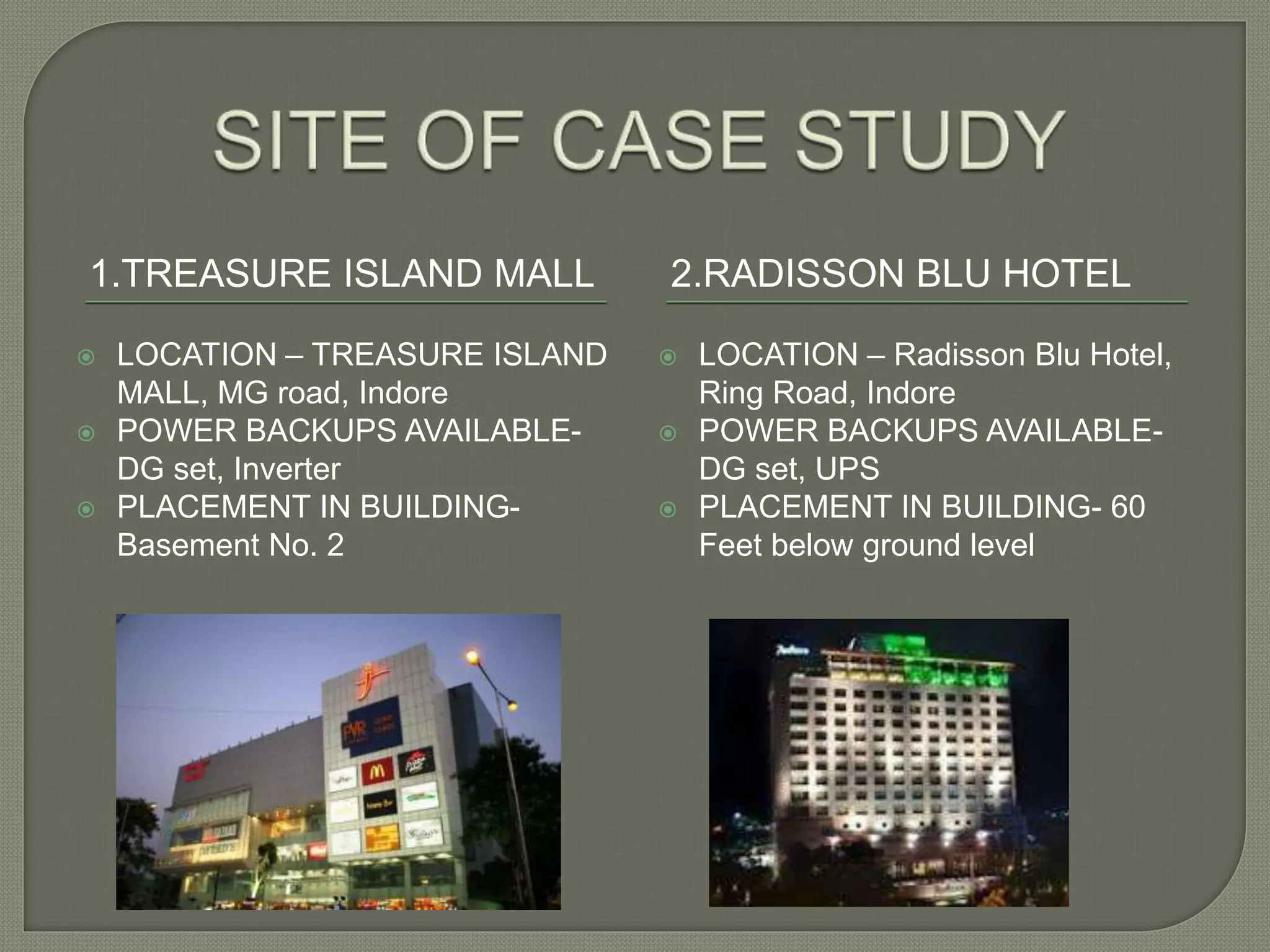
1.TREASURE ISLAND MALL 2.RADISSON BLU HOTEL
 LOCATION – TREASURE ISLAND
MALL, MG road, Indore
 POWER BACKUPS AVAILABLE-
DG set, Inverter
 PLACEMENT IN BUILDING-
Basement No. 2
 LOCATION – Radisson Blu Hotel,
Ring Road, Indore
 POWER BACKUPS AVAILABLE-
DG set, UPS
 PLACEMENT IN BUILDING- 60
Feet below ground level
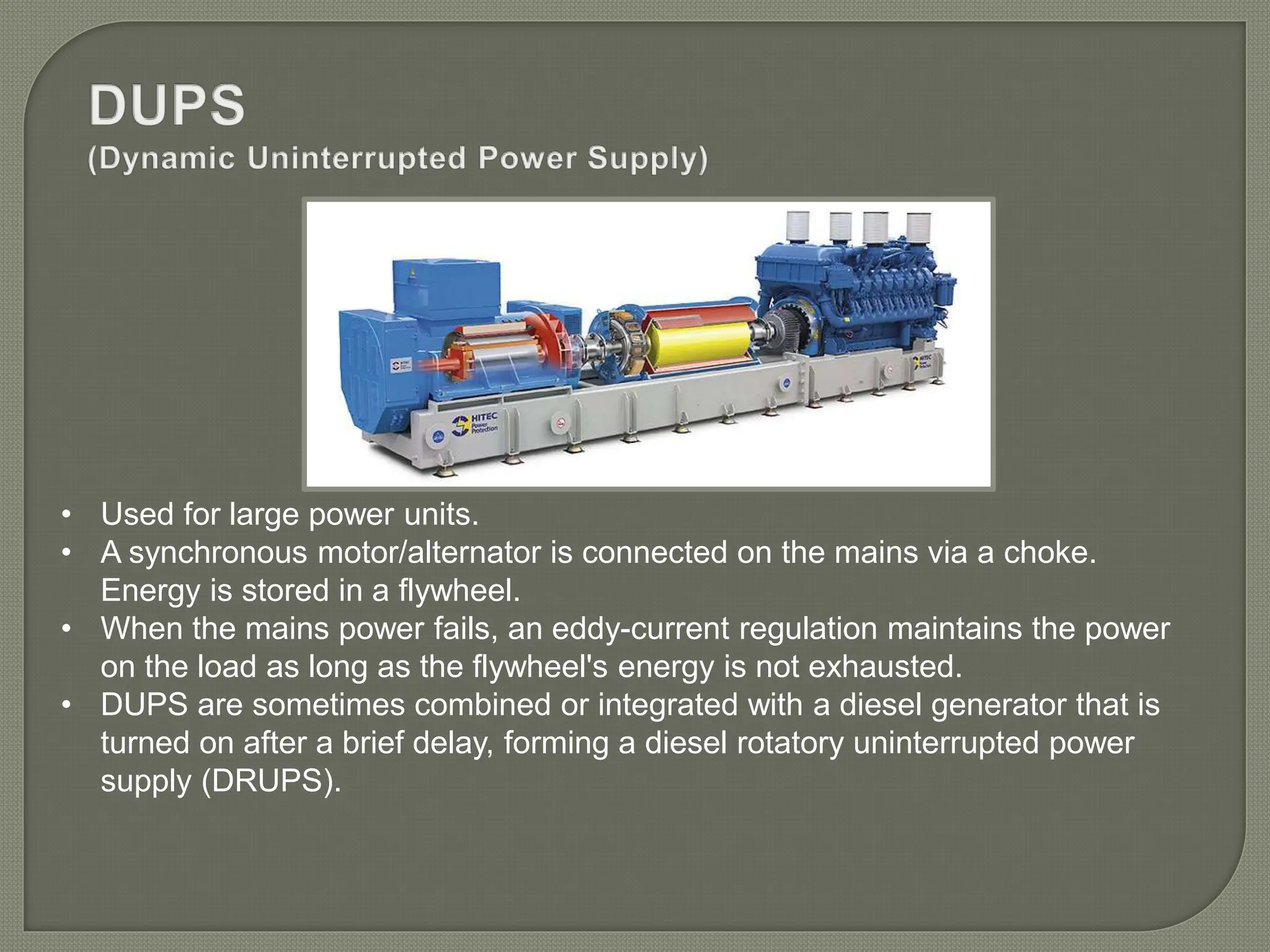
• Used for large power units.
• A synchronous motor/alternator is connected on the mains via a choke.
Energy is stored in a flywheel.
• When the mains power fails, an eddy-current regulation maintains the power
on the load as long as the flywheel's energy is not exhausted.
• DUPS are sometimes combined or integrated with a diesel generator that is
turned on after a brief delay, forming a diesel rotatory uninterrupted power
supply (DRUPS).
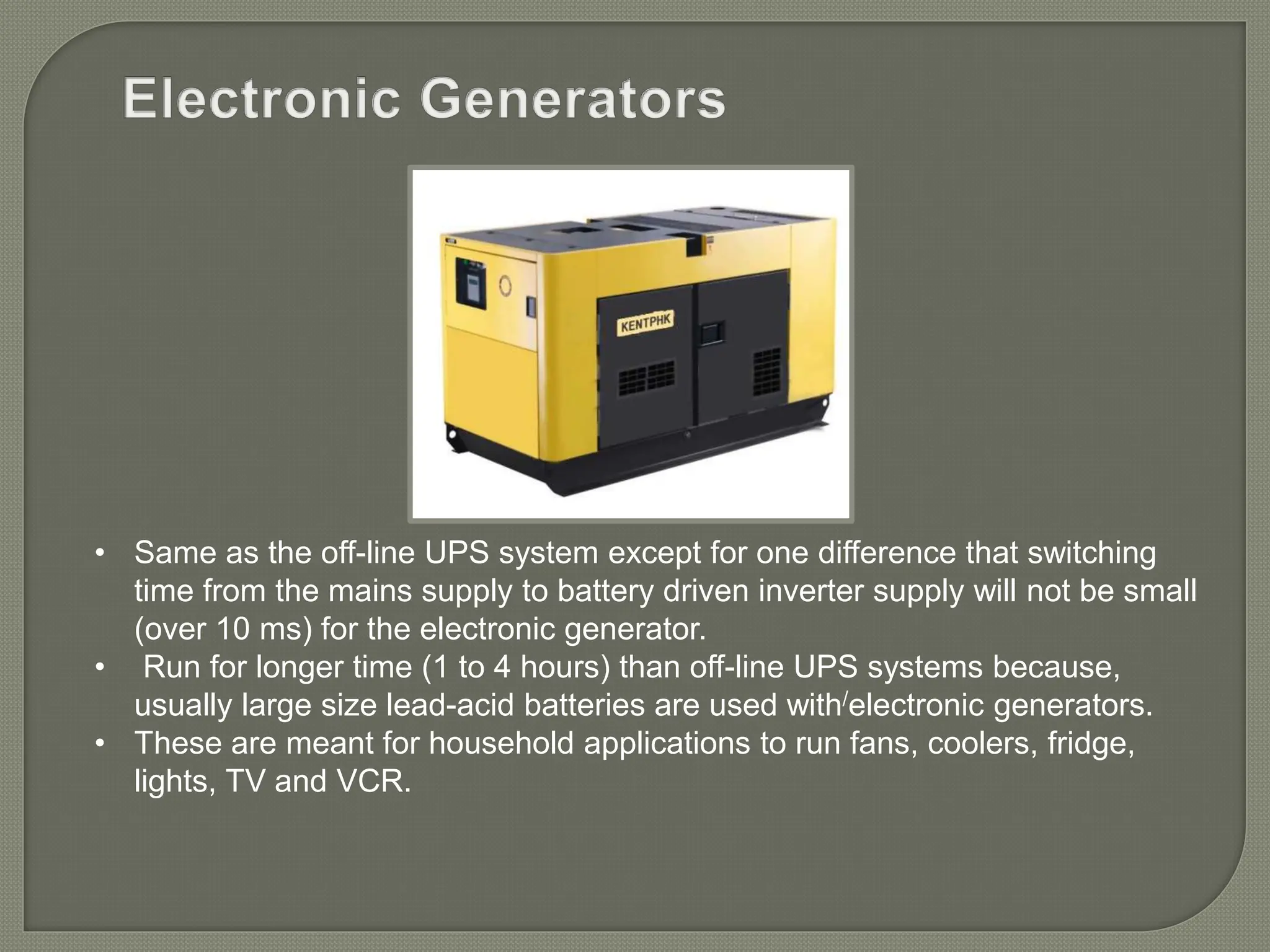
• Same as the off-line UPS system except for one difference that switching
time from the mains supply to battery driven inverter supply will not be small
(over 10 ms) for the electronic generator.
• Run for longer time (1 to 4 hours) than off-line UPS systems because,
usually large size lead-acid batteries are used with/electronic generators.
• These are meant for household applications to run fans, coolers, fridge,
lights, TV and VCR.
Power backup notes and PPT inverter s.pdf

Power backup notes and PPT inverter s.pdf

  • 1.
  • 2.
     Electricity generatoror bank of batteries that can provide adequate power to operate critically important equipment or keep them working until commercial power is restored  This buffer against loss of power prevents inconvenient or dangerous stoppage of critical process .  Once the cycle is finished , the equipment can be safely powered down with minimal danger or damage Uses •Commonly in computer system •Manufacturing equipment • Hospital • Power station •Telephony •Aircraft emergency batteries. FLOW CHART
  • 3.
    What is aU P S? • Also known as battery/flywheel backup. • An electrical apparatus that provides emergency power to a load when the input power source, typically mains power, fails. • A UPS differs from an auxiliary or emergency power supply or standby generator in that it will provide near- instantaneous protection from input power interruptions, by supplying energy stored in batteries, super-capacitors, or flywheels. • The on-battery runtime of most ups is relatively short (only a few minutes) but sufficient to start a standby power source or properly shut down the protected equipment.
  • 4.
    Uses In computers, datacentres, telecommunication equipment or other electrical equipment where an unexpected power disruption could cause injuries, fatalities, serious business disruption or data loss. ADVANTAGES 1. Maintenance Of Power 2. Continuity Of Operation 3. Surge Protection 1. High Start Up Cost 2. Maintenance Cost 3. Energy Use Power Range A single computer without a video monitor of `around 200VA rating to large units powering entire data centres or buildings. DISADVANTAGES
  • 5.
    In a standby("off-line") system the load is powered directly by the input power and the backup power circuitry is only invoked when the utility power fails. Most UPS below 1 kVA are of the line-interactive or standby variety which are usually less expensive. Offline U P S The three general categories of modern UPS systems are on- line or standby. Types of UPS
  • 6.
    Offline UPS: • Inthe case of Off-Line UPS, the inverter is off when the mains power is on and the output voltage is derived directly from the mains. The inverter turns on only when the mains supply fails. Its switching time is less than 5 ms. • These UPS are generally used with PCs or computers or other appliances where a small duration (5 ms or less) interruption in power supply can be tolerated. • Usually, sealed batteries or lead-acid batteries are used. • The running time of these supplies is also low (about 10 to 30 minutes).
  • 7.
    • An on-lineUPS uses a "double conversion" method of accepting AC input, rectifying to DC for through the rechargeable battery (or battery strings), then inverting back to 120 V/230 V AC for powering the protected equipment. Online U P S
  • 8.
    Online UPS: • Incase of On-line UPS, the battery operated inverter works continuously whether the mains supply is present or not. • When the mains supply fails, the UPS supplies power only until the batteries get discharged. However, once the mains power resumes, the batteries will get charged again. • The switching times of these supplies is considered to be zero. Usually sealed maintenance free batteries (lead-acid) are used • The running time of the inverter is low (approximately 10 to 30 minutes).
  • 9.
    Parts of aOnline UPS CONTROL PANEL CEILING JOINERY POWER SWITCH connected to BATTERIES BATTERIES connected to UPS UPS of lesser power
  • 10.
    Leading brands ofa UPS i. APC ii. Numeric iii. Luminous iv. Su-kam v. Genus vi. Microtek vii. Delta power solutions SITE OBSERVATIONS (Radisson Blu) • COMPANY- AROS (Installed by PCI Limited) • 6 Nos. of UPS of powers 100, 250 and 300 KVA Installed • Major areas in a Hotel that require UPS backup I. Kitchen II. Floors III. Accounts IV. Services • Special Care- The temperature of the room where the UPS are kept should not be more than 19-20ºC or else UPS shuts down due to excessive heat. • Small batteries are used so that in case of minor damage in single battery it can be fixed separately
  • 12.
    INTRODUCTION An inverter isan electrical circuit capable of turning DC power into AC power, while at the same time regulating the voltage, current, and frequency of the signal.  Inverters are used at residential, commercial and industrial buildings Uses : To operate all kinds of devices electric lights, kitchen appliances, microwaves, power tools, TVs, radios, computers etc. MICROTEK, SU-KAM, VIDEOCON, LUMINOUS ARISE CYBERPOWER, CROMPTON GREAVES, DELTA. BRANDS OF INVERTERS
  • 13.
    Types of inverter: Modified Sine Wave Inverters This type of home inverter obtains power from a battery of 12 volts and must be recharged using a generator or a solar panel. Appliances like microwave ovens, light bulbs, etc. can be run using these types of inverter.  True Sine Wave Inverters This is one of the better types of inverters as they provide better power as compared to the modified sine wave inverters for homes. These types of home inverter are also run using a battery of a larger capacity. They are best inverters employed for the power sensitive appliances like refrigerators, televisions, air conditioners, washing machines,  Solar Inverters Solar inverters are among the type of inverters for home that are energy efficient as they do not require a separate source for generating power. The solar energy is collected during the daytime and used at time of need after being converted into electrical energy. Types of solar inverters : Stand-alone inverters, Battery back-up inverters, Grid tie inverters.
  • 14.
    When the ACmains power supply is available. When the AC mains supply is available, the AC mains sensor senses it and the supply goes to the Relay and battery charging section of the inverter.AC main sensor activates a relay and this relay will directly pass the AC mains supply to the output socket. When the AC mains power supply is not available. When the AC mains power supply is not available, an oscillator circuit inside the inverter produces a 50Hz MOS drive signal. This MOS drive signal will be amplified by the driver section and sent to the output section. Automation in an Inverter. Inverter contains various circuits to automatically sense and tackle various situations that may occur when the inverter is running or in standby. This automaton section looks after conditions such as overload, over heat, low battery, over charge etc WORKING OF INVERTERS
  • 15.
    WORKING OF INVERTERS Maintainance: •Always required well ventilated area for inverter installation. •Checking the water level of battery in every two months. •Always keep the surface and sides of battery clean and dust free. •Keep the battery terminals corrosion free and rust free. • Vents around battery should be dust free and open. Blocked vents lead to hydrogen gas accumulation ,which may lead to bursting of battery. •From safety point of view, installation of the inverter should be at safe places in home which is out of the reach of children or a less used area. But at the same time that area should be airy and properly ventilated.
  • 17.
    DIESEL GENERATING SETS WHATIS A DG SET ? •A Diesel Generator (DG) is a combination of diesel engine with electrical generator to generate electricity. It extracts chemical energy from diesel and converts its in electrical energy ADVANTAGES OF DG SETS Low fuel consumption. High efficiency. Easy access to serviceable parts. Compact, sleek, and manual operating system. Maintenance is easy. DISADVANTAGES OF DG SETS •It produces higher smoke. •It takes more time for installation. •Heavy and large body parts. •It is expensive.
  • 18.
    (1) Engine (2) Alternator (3)Fuel System (5) Cooling and Exhaust Systems (6) Lubrication System (7) Battery Charger (8) Control Panel (9) Main Assembly / Frame •Body is made up of aluminium cast iron. •Silencer is attached to the system to avoid the noise of running parts. •Aluminium and copper wire has used.
  • 19.
    INSTALLATION 1. The processof installation takes 15- 20 members to assemble D G in 15-20 days including technical as well as fabrication part. 2. D G services area is directly connected to the service entrance at ground level via slab. 3. All joined assembly is directly placed on pad via slab by crane. 4. Anti-vibration rubber pad s are to be used beneath. 5. The levelling of base should be proper to avoid damages or hazards. 6. Smock produced by diesel burning is resisted on terrace by exhaust tubes.
  • 20.
     System shouldnot be placed near inflammable area or material  Smoke detectors should be present for safety.  Fire water line should be take place in service area.  Power in service area of building has done by separate inverters. MAINTANANCE •Full maintenance has to be done after 250-300 hours of of working of system. •Oil level •Water level •Diesel level •Battery capacity •Air filter DAILY CHACK WEEKLY/MONTHELY
  • 21.
    FEATURES OF DIESELGENERATORS •Battery is provided in a tray inside the enclosure •Doors have high quality gaskets to avoid leakage of sound •Fuel level is indicated with the help of fuel gauge meter •Sound proof and weather proof enclosure. •To make the system vibration free, mounting is done on anti-vibration pads mounted on base frame. TYPES OF DIESEL GENERATORS INDUSTRIAL DIESEL GENERATORS PORTABLE DIESEL GENERATORS HOME DIESEL GENERATORS BRANDS OF DIESEL GENERATORS •Genus power infratech company •Delta power solution India •Kirloskar company •Kohler company •Cummins company SIZES OF DG SETS •Installation over 600v require around 3 feet to 12 feet for voltage above 75kV
  • 23.
    1.TREASURE ISLAND MALL2.RADISSON BLU HOTEL  LOCATION – TREASURE ISLAND MALL, MG road, Indore  POWER BACKUPS AVAILABLE- DG set, Inverter  PLACEMENT IN BUILDING- Basement No. 2  LOCATION – Radisson Blu Hotel, Ring Road, Indore  POWER BACKUPS AVAILABLE- DG set, UPS  PLACEMENT IN BUILDING- 60 Feet below ground level
  • 25.
    • Used forlarge power units. • A synchronous motor/alternator is connected on the mains via a choke. Energy is stored in a flywheel. • When the mains power fails, an eddy-current regulation maintains the power on the load as long as the flywheel's energy is not exhausted. • DUPS are sometimes combined or integrated with a diesel generator that is turned on after a brief delay, forming a diesel rotatory uninterrupted power supply (DRUPS).
  • 26.
    • Same asthe off-line UPS system except for one difference that switching time from the mains supply to battery driven inverter supply will not be small (over 10 ms) for the electronic generator. • Run for longer time (1 to 4 hours) than off-line UPS systems because, usually large size lead-acid batteries are used with/electronic generators. • These are meant for household applications to run fans, coolers, fridge, lights, TV and VCR.