Poverty &
Welfare
Reform

The challenge on
Sheffield’s Doorstep
You insult your Maker when you exploit the powerless;
when you are kind to the poor, you honour God
Proverbs, 14:31

If the present order is taken for granted or assumed to
be sacrosanct, charity from the more to the less fortunate
would seem virtuous and commendable; to those for
whom the order itself is suspect or worse, such charity is
blood-money. Why should some be in the position to
dispense and others to need that kind of charity?
Archbishop William Temple, from Christianity and Social Order
Some basic facts
•
•
•

•

•

UK is 7th wealthiest, but 3rd most unequal country
Markets are useful, but they don’t reduce inequality or
remove poverty, only we can choose to do that
Poorest on benefits gets £56.80 pw, less than £3,000
per year, median earner c. £20,000, highest paid civil
servant £200,000
Inequality is associated with a range of expensive
social problems, including poor mental health, life
expectancy and violence that harm everyone
Sheffield ranks 38 out of 326 places in the UK in a
measure of your risk of being in poverty
So, what is welfare reform?
Child Benefit freeze

Abolition of Sure Start Maternity for second children

Changes to CPI indexation of benefits

Reductions in support for carers

Replacing DLA with PIP

Child Benefit clawback from higher rate taxpayers

Time-limiting of contributory ESA

Transfer of Social Fund to local government

Council Tax Benefit: 10% reduction and localisation

Changes for JSA lone parents

Housing Benefit: Under-occupation

Household Benefit cap

Abolition of the Independent Living Fund

Continued use of ATOS or others

Universal Credit

Reductions in ‘Access to Work’ funding

Closure of Remploy services

Abolition of the Child Trust Fund

Tax credit reductions

Abolition of the Health in Pregnancy Grant

Abolition of the Child Trust Fund

Abolition of the ESA youth rules

Housing Benefit: Non-dependant deductions

Reductions in Supporting People funding
Biggest cuts in poorest places
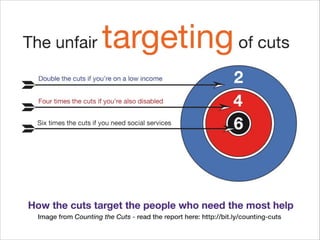
Cuts target poorest & disabled people
The impact is only just beginning
At the end of December 2013 there were 4120 council tenants
affected by Under-occupancy. Of those approximately 85% were
assessed as having 1 bedroom too many, losing an average of £10.21
pw; and approximately 15% were assessed as having 2 or more
bedrooms too many, losing an average of £19.77 	

Of the 4120 tenants affected by Under-occupancy, at the end of
December 2013: 241 (6%) had not made any payment towards the
Under- occupancy cut in their benefit. This figure compares to 10%
of tenants who had paid nothing towards the Under-occupancy cut in
their benefit at the end of October 2013. 1874 (45%) had paid in full the
amount of the Under-occupancy cut in their benefit. However, of those
tenants who had paid in full, 649 have received a Discretionary
Housing Payment (DHP) which has paid some or all of their Underoccupancy charge. Therefore 1225 tenants (30% of all tenants affected
by the ‘bedroom tax’) have paid the shortfall in full without receiving a
DHP. This figure has increased from 18% at the end of October 2013.
2005 (49%) had paid something but not all. At the end of October
2013 this figure was 55%.
Since April 2013, 336 tenants have been awarded a rehousing priority
to move to a smaller property. Of the tenants awarded a priority 262
tenants have stated this is due to the impact of welfare reforms. 87
tenants have had agreement to move, despite them having rent arrears
that would normally have stopped them from being rehoused. So far
153 council housing tenants have downsized already since April.
There are approximately a further 2,000 tenants in Sheffield affected by
Under-occupancy who are living in other social housing.
In addition public spending is being cut
Without systems of collective security - welfare - human
life descends into fear, terror, revolution and war.
Current crisis was not caused by excessive public
spending, nor by welfare nor by disabled people. It
was caused by over-lending (and private borrowing).
Public expenditure has changed little
The real cost of benefits (net of taxes) is minimal
Our debt crisis was fed by a housing bubble
To protect homeowners the government slashed
the cost of borrowing.
Government is now subsidising the mortgages of
homeowners at a cost of over £34 billion per year.
The poorest 10% of families pay the highest share
of their income in taxes - about 45%.
There are only a tiny number of people who do not work for
years - the vast majority of people go out and look for work.
Benefit fraud is dwarfed by fraud by
taxpayers and fraud by government itself.
Benefit fraud is only 6% of tax fraud, yet it is
covered by the news 600% more.

The “Benefit Thieves” campaign was established
by the previous Labour Government.
‘Welfare reform’ is code for a redistribution of
resources away from the poorest and towards
the better off.
!

In the competition for political power, politicians
are taking care to ensure that they target
benefits on swing voters: home owners, families
with two employed parents, middle-income
earners.
!

The median voter is far more important than any
other. The median voter determines who wins
elections. We live in a medianocracy.
The use of stigma, shame and
scapegoating is distracting us
from the real issues.
Our problems were not created by disabled people or by people
in poverty - they were created by the powerful and the wealthy

Pruitt Igoe Urban Housing Project: 1952-1968
The current system is a complex net of taxes and benefits
that nobody understands but which leaves people fearful.
The UK is the second most centralised welfare
state in the world (after New Zealand)
We do not need to treat services as professionally defined
gifts - we should have real entitlements
We fell asleep. We forgot that they don’t take care of
us, we take care of each other. We forgot that it’s the
rich who need the poor, not the poor who need the
rich. We forgot that politicians work for us, we don’t
work for them. We forgot that government doesn’t
innovate, people do. We forgot that government
doesn’t create wealth, people do. We forgot that
government doesn’t know best, people do. We forgot
about citizenship, we forgot about families, we forgot
about community. We confused good with big. We
confused achievement with wealth. We confused
love with control. We forgot that the welfare state was
made by us, that it belongs to us and it needs to
work for us. It’s time to wake up.
We need a new settlement - a constitutional approach
which protects our rights and shifts power to citizens.
Elements of a better system might include:

•
•
•
•
•

Human rights at heart of
system
Minimum universal
securities as rights
A fair and integrated taxbenefit system
Individual freedom for all
Families and communities
respected and supported.
When I give food to the poor, they call me a saint. When I ask why
they are poor, they call me a communist - Helder Camara
Britain is the world’s seventh largest economy and yet people are going hungry.
Half a million people have visited foodbanks in the UK since last Easter and 5,500
people were admitted to hospital in the UK for malnutrition last year.
One in five mothers report regularly skipping meals to better feed their children, and
even more families are just one unexpected bill away from waking up with empty
cupboards.
We often hear talk of hard choices. Surely few can be harder than that faced by the
tens of thousands of older people who must “heat or eat” each winter, harder than
those faced by families whose wages have stayed flat while food prices have gone up
30% in just five years.
Yet beyond even this we must, as a society, face up to the fact that over half of people
using foodbanks have been put in that situation by cut backs to and failures in the
benefit system, whether it be payment delays or punitive sanctions.
On March 5th Lent will begin. The Christian tradition has long been at this time to fast,
and by doing so draw closer to our neighbour and closer to God.
On March 5th we will begin a time of fasting while half a million regularly go hungry in
Britain. We urge those of all faith and none, people of good conscience, to join with us.
There is an acute moral imperative to act. Hundreds of thousands of people are doing
so already, as they set up and support foodbanks across the UK. But this is a national
crisis, and one we must rise to.
We call on government to do its part: acting to investigate food markets that are failing,
to make sure that work pays, and to ensure that the welfare system provides a robust
last line of defence against hunger.
Join us at www.endhungerfast.co.uk.
The Church may not have all the answers...
!

!
!
!
!
!
!
!

but it can ask the right questions.
For more information:
!

Web: www.centreforwelfarereform.org
!

Twitter: @CforWR and @simonjduffy
!

Blog: www.simonduffy.info
!

Facebook: centreforwelfarereform
!

Campaign: www.campaignforafairsociety.org

© Simon Duffy. Rights Reserved. Full copyright details at www.centreforwelfarereform.org

Poverty & Welfare reform

  • 1.
    Poverty & Welfare Reform The challengeon Sheffield’s Doorstep
  • 2.
    You insult yourMaker when you exploit the powerless; when you are kind to the poor, you honour God Proverbs, 14:31 If the present order is taken for granted or assumed to be sacrosanct, charity from the more to the less fortunate would seem virtuous and commendable; to those for whom the order itself is suspect or worse, such charity is blood-money. Why should some be in the position to dispense and others to need that kind of charity? Archbishop William Temple, from Christianity and Social Order
  • 3.
    Some basic facts • • • • • UKis 7th wealthiest, but 3rd most unequal country Markets are useful, but they don’t reduce inequality or remove poverty, only we can choose to do that Poorest on benefits gets £56.80 pw, less than £3,000 per year, median earner c. £20,000, highest paid civil servant £200,000 Inequality is associated with a range of expensive social problems, including poor mental health, life expectancy and violence that harm everyone Sheffield ranks 38 out of 326 places in the UK in a measure of your risk of being in poverty
  • 4.
    So, what iswelfare reform? Child Benefit freeze Abolition of Sure Start Maternity for second children Changes to CPI indexation of benefits Reductions in support for carers Replacing DLA with PIP Child Benefit clawback from higher rate taxpayers Time-limiting of contributory ESA Transfer of Social Fund to local government Council Tax Benefit: 10% reduction and localisation Changes for JSA lone parents Housing Benefit: Under-occupation Household Benefit cap Abolition of the Independent Living Fund Continued use of ATOS or others Universal Credit Reductions in ‘Access to Work’ funding Closure of Remploy services Abolition of the Child Trust Fund Tax credit reductions Abolition of the Health in Pregnancy Grant Abolition of the Child Trust Fund Abolition of the ESA youth rules Housing Benefit: Non-dependant deductions Reductions in Supporting People funding
  • 5.
    Biggest cuts inpoorest places
  • 6.
    Cuts target poorest& disabled people
  • 7.
    The impact isonly just beginning At the end of December 2013 there were 4120 council tenants affected by Under-occupancy. Of those approximately 85% were assessed as having 1 bedroom too many, losing an average of £10.21 pw; and approximately 15% were assessed as having 2 or more bedrooms too many, losing an average of £19.77 Of the 4120 tenants affected by Under-occupancy, at the end of December 2013: 241 (6%) had not made any payment towards the Under- occupancy cut in their benefit. This figure compares to 10% of tenants who had paid nothing towards the Under-occupancy cut in their benefit at the end of October 2013. 1874 (45%) had paid in full the amount of the Under-occupancy cut in their benefit. However, of those tenants who had paid in full, 649 have received a Discretionary Housing Payment (DHP) which has paid some or all of their Underoccupancy charge. Therefore 1225 tenants (30% of all tenants affected by the ‘bedroom tax’) have paid the shortfall in full without receiving a DHP. This figure has increased from 18% at the end of October 2013. 2005 (49%) had paid something but not all. At the end of October 2013 this figure was 55%. Since April 2013, 336 tenants have been awarded a rehousing priority to move to a smaller property. Of the tenants awarded a priority 262 tenants have stated this is due to the impact of welfare reforms. 87 tenants have had agreement to move, despite them having rent arrears that would normally have stopped them from being rehoused. So far 153 council housing tenants have downsized already since April. There are approximately a further 2,000 tenants in Sheffield affected by Under-occupancy who are living in other social housing.
  • 8.
    In addition publicspending is being cut
  • 16.
    Without systems ofcollective security - welfare - human life descends into fear, terror, revolution and war.
  • 17.
    Current crisis wasnot caused by excessive public spending, nor by welfare nor by disabled people. It was caused by over-lending (and private borrowing).
  • 18.
    Public expenditure haschanged little
  • 19.
    The real costof benefits (net of taxes) is minimal
  • 20.
    Our debt crisiswas fed by a housing bubble
  • 21.
    To protect homeownersthe government slashed the cost of borrowing.
  • 22.
    Government is nowsubsidising the mortgages of homeowners at a cost of over £34 billion per year.
  • 23.
    The poorest 10%of families pay the highest share of their income in taxes - about 45%.
  • 25.
    There are onlya tiny number of people who do not work for years - the vast majority of people go out and look for work.
  • 26.
    Benefit fraud isdwarfed by fraud by taxpayers and fraud by government itself.
  • 27.
    Benefit fraud isonly 6% of tax fraud, yet it is covered by the news 600% more. The “Benefit Thieves” campaign was established by the previous Labour Government.
  • 28.
    ‘Welfare reform’ iscode for a redistribution of resources away from the poorest and towards the better off. ! In the competition for political power, politicians are taking care to ensure that they target benefits on swing voters: home owners, families with two employed parents, middle-income earners. ! The median voter is far more important than any other. The median voter determines who wins elections. We live in a medianocracy.
  • 29.
    The use ofstigma, shame and scapegoating is distracting us from the real issues.
  • 30.
    Our problems werenot created by disabled people or by people in poverty - they were created by the powerful and the wealthy Pruitt Igoe Urban Housing Project: 1952-1968
  • 32.
    The current systemis a complex net of taxes and benefits that nobody understands but which leaves people fearful.
  • 33.
    The UK isthe second most centralised welfare state in the world (after New Zealand)
  • 34.
    We do notneed to treat services as professionally defined gifts - we should have real entitlements
  • 35.
    We fell asleep.We forgot that they don’t take care of us, we take care of each other. We forgot that it’s the rich who need the poor, not the poor who need the rich. We forgot that politicians work for us, we don’t work for them. We forgot that government doesn’t innovate, people do. We forgot that government doesn’t create wealth, people do. We forgot that government doesn’t know best, people do. We forgot about citizenship, we forgot about families, we forgot about community. We confused good with big. We confused achievement with wealth. We confused love with control. We forgot that the welfare state was made by us, that it belongs to us and it needs to work for us. It’s time to wake up.
  • 36.
    We need anew settlement - a constitutional approach which protects our rights and shifts power to citizens.
  • 37.
    Elements of abetter system might include: • • • • • Human rights at heart of system Minimum universal securities as rights A fair and integrated taxbenefit system Individual freedom for all Families and communities respected and supported.
  • 38.
    When I givefood to the poor, they call me a saint. When I ask why they are poor, they call me a communist - Helder Camara
  • 40.
    Britain is theworld’s seventh largest economy and yet people are going hungry. Half a million people have visited foodbanks in the UK since last Easter and 5,500 people were admitted to hospital in the UK for malnutrition last year. One in five mothers report regularly skipping meals to better feed their children, and even more families are just one unexpected bill away from waking up with empty cupboards. We often hear talk of hard choices. Surely few can be harder than that faced by the tens of thousands of older people who must “heat or eat” each winter, harder than those faced by families whose wages have stayed flat while food prices have gone up 30% in just five years. Yet beyond even this we must, as a society, face up to the fact that over half of people using foodbanks have been put in that situation by cut backs to and failures in the benefit system, whether it be payment delays or punitive sanctions. On March 5th Lent will begin. The Christian tradition has long been at this time to fast, and by doing so draw closer to our neighbour and closer to God. On March 5th we will begin a time of fasting while half a million regularly go hungry in Britain. We urge those of all faith and none, people of good conscience, to join with us. There is an acute moral imperative to act. Hundreds of thousands of people are doing so already, as they set up and support foodbanks across the UK. But this is a national crisis, and one we must rise to. We call on government to do its part: acting to investigate food markets that are failing, to make sure that work pays, and to ensure that the welfare system provides a robust last line of defence against hunger. Join us at www.endhungerfast.co.uk.
  • 41.
    The Church maynot have all the answers... ! ! ! ! ! ! ! ! but it can ask the right questions.
  • 42.
    For more information: ! Web:www.centreforwelfarereform.org ! Twitter: @CforWR and @simonjduffy ! Blog: www.simonduffy.info ! Facebook: centreforwelfarereform ! Campaign: www.campaignforafairsociety.org © Simon Duffy. Rights Reserved. Full copyright details at www.centreforwelfarereform.org