1
Every Which Way We Can
A literacy and social inclusion position paper
Viv Bird and Rodie Akerman
2
‘Every which way we can’ –
A Literacy and Social Inclusion Position Paper
Contents
Introduction ............................................................................................................................... 4
Definitions and scope of this paper.................................................................................... 5
1. The current policy context ................................................................................................... 7
2. A literacy vision................................................................................................................... 13
3. Implications for policy ....................................................................................................... 16
4. Literacy links with social exclusion, health, offending and community participation
.................................................................................................................................................... 19
5. Learning literacy skills ....................................................................................................... 21
5.1 Learning theory............................................................................................................. 22
5.2 Formal and informal learning..................................................................................... 22
5.3 Implications of learning theory on literacy learning ............................................... 23
6. Influences on literacy learners........................................................................................... 25
7. Successful literacy approaches among those at risk ...................................................... 28
7.1 Promoting early language and reading skills........................................................... 29
a) Engaging individuals and building relationships ................................................. 30
b) Meeting needs and interests ..................................................................................... 31
c) Providing book experiences ...................................................................................... 33
d) Working in partnership............................................................................................. 34
Summary .......................................................................................................................... 34
7.2 Building parents’ skills................................................................................................. 36
a) Engaging parents and building relationships ........................................................ 36
b) Meeting needs and interests ..................................................................................... 40
c) Providing book and reading experiences................................................................ 42
d) Working in partnership............................................................................................. 43
Summary .......................................................................................................................... 43
7.3 Out-of-school-hours support....................................................................................... 45
a) Engaging children and building relationships....................................................... 45
b) Meeting needs and interests ..................................................................................... 46
c) Providing book and reading experiences................................................................ 49
d) Working in partnership............................................................................................. 51
Summary .......................................................................................................................... 51
7.4. Motivating disaffected young people ....................................................................... 53
a) Engaging individuals and building relationships ................................................. 54
b) Meeting need and interests....................................................................................... 55
c) Providing book and reading experiences................................................................ 57
3
d) Working in partnership and with intermediaries ................................................. 58
Summary .......................................................................................................................... 59
7.5. Improving the skills of adults at risk ........................................................................ 61
a) Engaging adults and building relationships .......................................................... 63
b) Meeting needs and interests ..................................................................................... 63
c) Providing book and reading experiences................................................................ 66
d) Working in partnership and with intermediaries ................................................. 68
Summary .......................................................................................................................... 72
7.6 Model for building parental skills.............................................................................. 73
8. Conclusions.......................................................................................................................... 75
Acknowledgments.................................................................................................................. 78
Appendix 1 Background to the project................................................................................ 79
Appendix 2 Use of services by disadvantaged people...................................................... 81
4
Introduction
According to a recent study by the Centre for Analysis of Social Exclusion (CASE) at
the London School of Economics1, poverty and social exclusion have been taken very
seriously by this Government, resulting in high-profile targets, new policies and
funding streams. Social exclusion was recognised to consist of multi-faceted and inter-
linked problems, with the cycle of disadvantage more clearly understood than ever
before. Tackling educational standards, and literacy in particular, was an important
dimension to the strategy to address social exclusion. Two reasons lie behind the
thinking.
First was the aim to make Britain a more equal society and ‘close the gap’ by
addressing issues that included area and neighbourhood deprivation, and educational
attainment. Second, socio-economic factors also led to pressures for reform. The
changing nature of the workplace and the increased complexity of traditional jobs,
had led to an increase in demand for those with good literacy skills. Successive
surveys commissioned by the Basic Skills Agency, however, had identified worrying
levels of adult basic skills needs. The Moser report2 subsequently provided the
framework for the Skills for Life national strategy for adult literacy and numeracy that
was launched in 2001. Both these documents recognised the need to focus attention on
groups at risk of social exclusion, those living in disadvantaged communities and
those not attracted to more traditional learning programmes.
Policymakers look not just at the ‘stock’ – those adults most at risk of exclusion
because of their poor literacy – but also at the ‘flow’ of young people entering and
going through the school system. There are concerns for the numbers leaving school
without sufficient ‘good’ GCSEs to access further education, training or work
opportunities. There is greater recognition too of the need to support the role of
families, especially those most in need.
This paper is for those concerned with the relationship between poor literacy skills
and social exclusion, including policymakers, education professionals and service
providers. It includes the evidence after two years of a three-year Basic Skills Agency
National Support Project delivered by the National Literacy Trust, and follows an
earlier discussion paper, Literacy and Social Inclusion: the Policy Challenge3.
1 Joseph Rowntree Foundation (2005) Policies towards poverty, inequality and exclusion since 1997, York:
Joseph Rowntree Foundation. Taken from the book by J. Hills and K. Stewart (eds.) (2004) New Labour,
poverty, inequality and exclusion, Bristol: The Policy Press.
2 Department for Education and Employment (1999) A fresh start: Improving literacy and numeracy. The
report of the working group chaired by Sir Claus Moser, London: Department for Education and
Employment.
3 V. Bird (2004) Literacy and Social Inclusion: the Policy Challenge, London: National Literacy Trust.
5
The purpose of this paper is to review the evidence gathered and to provide a
resource for those concerned with issues in this field. The evidence was developed
from a dialogue with literacy practitioners working with those who were already – or
were at risk of becoming – socially excluded because of their poor literacy, and also
with those professionals across a range of policy areas who saw poor literacy skills as
a significant factor in their own service delivery. Published research findings and
official reports were also included in the evidence base.
The focus of the paper is on home and community literacy, rather than classroom
practice, with five key areas:
• Promoting early language and reading skills
• Building parents’ skills
• Out-of-school-hours literacy support
• Motivating disaffected young people
• Improving the skills of adults at risk
The paper begins by discussing some of the challenges in the current policy climate in
relation to literacy and social inclusion (section 1). It goes on to propose ‘the literacy
vision’, outlining the ‘perfect literacy system’ which would best support at-risk
literacy learners (section 2). The implications for policy are then considered (section 3).
Section 4 summarises the research evidence on the links between literacy and social
exclusion while section 5 looks at literacy learning and, in particular, the role of
informal learning.
Section 6 identifies the influences on literacy learners, and the key role of partnerships.
Section 7 identifies the key factors, and the underpinning research evidence, for
successful literacy practice across the five key areas described above. Illustrative case
studies are provided.
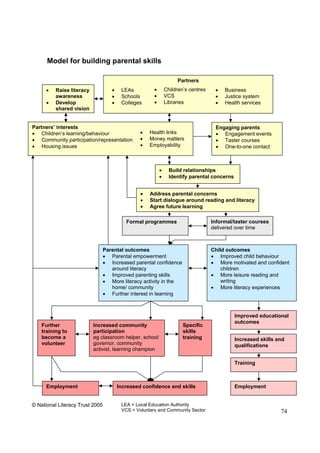
A model for building parental skills, which shows the outcomes for parents and
children, and the impact on schools, communities and employment, is provided on
page 73.
Definitions and scope of this paper
• Social inclusion
The term social inclusion is defined depending on the different perspectives of
particular groups or analysts. According to the Government’s Social Exclusion Unit,
6
social exclusion results when people or communities face a combination of problems
including unemployment, discrimination, poor skills, low incomes, poor housing,
high crime, bad health and family breakdown4. Others see it as a lack of participation
in everyday life, whether education, employment, community life or citizenship5.
Another view focuses on one particular indicator, the ‘headline’ indicator of low
income6. In this paper, social inclusion refers to a combination of the first and second
definitions, recognising that these problems exist and need to be addressed for
reasons of social justice and community cohesion.
• Definition of ‘at risk’
The term ‘at risk’ is used in the paper as a shorthand for those who are at risk of social
exclusion, and who also have poor or underdeveloped literacy or language skills.
These include high-risk groups such as children permanently excluded or ‘missing’
from school, or those in care, Travellers and Gypsies, the homeless, prisoners, asylum
seekers and problematic drug users. The term also includes other groups at risk at
some stage of their lives, for example, those leaving school without any qualifications,
young people not in education or training, long-term unemployed adults (parents and
those without children), and those from some ethnic minority groups where cultural
or language differences may lead to exclusion. Those with multiple challenges in
terms of education, employment, housing or health7 are also part of the at-risk group.
• Special educational needs
The paper does not cover children with special educational needs or adults with
learning difficulties. These are fields explored in much greater depth by specialist
organisations such as the British Dyslexia Association, RNID, the National Deaf
Children’s Society and, where adults are concerned, by the National Research and
Development Centre for adult literacy and numeracy. While the findings of this paper
may find common ground in terms of the social inclusion dimension, there will be
additional factors pertinent to particular learning difficulties that cannot be fully
explored here.
• Skills for Life definition
Where adults at risk are concerned, those with ‘poor literacy’ can be interpreted as the
Skills for Life definition of ‘adults with literacy, numeracy or language needs’.
4 Social Exclusion Unit (2004) Breaking the Cycle: Taking stock of progress and priorities for the future,
London: Office of the Deputy Prime Minister.
5 S. Parsons and J. Bynner (2002) Basic Skills and Social Exclusion, London: The Basic Skills Agency.
6 G. Palmer, J. North, J. Carr and P. Kenway (2003) Monitoring poverty and social exclusion 2003, York:
Joseph Rowntree Foundation.
7 Social Exclusion Unit (2004).
7
1. The current policy context
Literacy is one facet of social policy; all policymakers need to consider whether public
policy meets equity or social justice objectives, and whether it encourages efficiency in
public service delivery.
Addressing poverty and breaking the cycle of disadvantage are two key approaches to
tackling social exclusion. While the number of children brought up in poverty has
been cut by 25%, according to the Joseph Rowntree Foundation, poverty among
childless adults of working age has increased. In addition, many of those with the
greatest and most complex needs have benefited least from the drive to tackle social
exclusion, including those with few skills. According to the Social Exclusion Unit, the
most disadvantaged people do not use services, including education and benefits, as
much as others do, or gain from them as much when they do use them8. This has led
to a shift in thinking so that there will be less focus on ‘hard-to-reach’ groups, and
more emphasis on developing services that are ‘easy to use’9.
A key question for policymakers therefore is: does the current policy climate support
the literacy skills development of those most at risk, with resulting benefits for service
delivery?
Improving the general standard of literacy teaching of pupils, students and adult
learners will, of course, benefit those most at risk of social exclusion. While there have
been some improvements in the performance of average and above-average children,
until recently this was not so for the most deprived10. With increased spending on
education since 1999, the latest evidence shows that progress in schools in the most
disadvantaged local authority areas has been faster than elsewhere11. Nevertheless,
the CASE study highlights tensions between improvements for all and closing the
gap12.
Poverty of circumstances, and aspirations, puts some individuals at a disadvantage
from an early age. Research has shown that children suffer from the social exclusion of
their parents; the social and psychological effects start very early on in a child’s life
8 Social Exclusion Unit (2004).
9 This point is explored further in Appendix 2.
10 J. Sparkes and H. Glennister (2002) Preventing social exclusion: education’s contribution, in J. Hills, J.
Le Grand and D. Pichaud (eds.) Understanding Social Exclusion, Oxford: Oxford University Press.
11 Social Exclusion Unit (2004).
12 J. Hills and K. Stewart (eds.) (2004) New Labour, poverty, inequality and exclusion, Bristol: The Policy
Press.
8
and contribute to their own identity. The difference in achievement can be seen in
children as young as 22 months, and the gap gets wider the older they get13.
Government priorities are to achieve better outcomes for children, parents and
communities through a range of policies designed to address social exclusion such as
Sure Start, Neighbourhood Renewal including New Deal for Communities, and
Excellence in Cities. Improving the life chances of children at risk is the focus of Every
Child Matters14, and its legislative framework, the Children Act. Literacy is recognised
as the cornerstone of raising educational standards for children, initially through the
National Literacy Strategy and now through the Primary and Key Stage 3 National
Strategies.
The point was made during the National Literacy Trust’s consultation process last
year15 that schools have access to catch-up programmes for underachieving children,
with targeted support for underperforming schools. Guidance, including a video, has
been developed by the Primary National Strategy and sent to primary schools on the
most effective ways of working with parents. But schools need to find out about and
build on reading and writing activities children engage in at home; Ofsted found that
primary schools seldom use the broader range of materials pupils use at home as a
starting point to further their reading in schools and improve their motivation16.
Ofsted also found that primary schools that were successful in developing parental
support for reading focused on specific initiatives that involved parents actively in
reading with their children. General parental involvement was not enough17. The
evidence on extended schools is that while particular activities offered by them had
beneficial, if limited scale, impacts, the activities tended to attract the less alienated
children and adults. Case studies showed that relatively few initiatives aimed to
engage parents in a dialogue about their child’s education18.
The challenge for local authorities as they move towards greater integration of
services for children, families and schools, is one of aligning their services and
developing good communication between teams. It should be noted that making it
someone’s role to coordinate literacy support can make a difference. There is evidence
that the Skills for Families consultant role was crucial to the success of this national
13 L. Feinstein (1999) Pre-school educational inequality? British children in the 1970 cohort, London: Centre
for Economic Performance, University College.
14 Department for Education and Skills (2003) Every Child Matters, London: The Stationery Office.
15A consultation period followed publication of the Trust discussion paper by Bird (2004).
16 Ofsted (2004) Reading for purpose and pleasure: An evaluation of the teaching of reading in primary schools,
London: Ofsted.
17 Ibid.
18 C. Cummings, A. Dyson and L. Todd, with the Education Policy and Evaluation Unit, University of
Brighton (2004) Evaluation of the Extended Schools Pathfinder Projects, Newcastle upon Tyne: University of
Newcastle upon Tyne/London: Department for Education and Skills.
9
pilot programme at local level19, by providing the link – internally within local
education authorities, and externally with schools and Learning and Skills Councils.
But there is no guarantee these posts will continue once funding runs out in March
2005, and who will promote the need for a family learning coordinator in authorities
not involved in the pilot programme?
The Government acknowledges the need for more joined-up services20. Opportunities
for greater coordination should be provided via the proposed Children’s Centres and
Children’s Trusts, and the stated priority for more extended support (‘educare’)
through all-day schools and more family learning. However, providing support for at-
risk parents needs to go further than the provision of materials and videos, and more
opportunities for childcare. If budgets are tight, what guarantee is there that family
learning programmes will be a priority? Family learning, with links to more formal
family literacy programmes and skills learning, needs to be part of the core offer to at -
risk parents.
The aspiration for Every Child Matters21 is not only to protect children and improve
their care, but to go beyond and improve the life chances of children at risk with
implications for parenting, fostering, young people’s activities and youth justice. The
new Directors of Children’s Services in local authorities will be charged with
delivering the five outcomes for children: being healthy; staying safe; enjoying and
achieving; making a positive contribution; and economic well-being. This vision for
children’s services offers the opportunity to develop a locally-driven strategy to
ensure home literacy support for the most vulnerable children and their families.
Some library authorities are doing pioneering work bringing books into children’s
homes, but there is no focus on home literacy support in the national guidance. It is
still early days and many authorities are still in the process of working out new local
structures and partnerships. New regional change agents within government offices
in the regions will be charged with supporting the process at local level; they could be
influential in getting home literacy support on the Every Child Matters map.
Connexions – which faces an uncertain future – found considerable challenges in
partnership working, highlighted in a recent Joseph Rowntree report22. Yet, evaluation
by the Department for Education and Skills (DfES)23 showed that it was making a
positive impact with young people at risk. Given the multiple risks in young people’s
19 Skills for Families (2004) Skills for Families 2003-4 Summary Report. Retrieved February 2005 from
www.skillsforfamilies.org.
20 Department for Education and Skills (2004) Five Year Strategy for Children and Learners. Putting people
at the heart of public services, London: The Stationery Office. Hereafter referred to as Five Year Strategy.
21 Department for Education and Skills (2003) Every Child Matters.
22 B. Coles, L. Britton and L. Hicks (2004) Inter-agency work and the Connexions service, York: Joseph
Rowntree Foundation.
23 L. Hoggarth and D. I. Smith (2004) Understanding the impact of Connexions on Young People at Risk,
London: Department for Education and Skills.
10
lives, the authors stress that a holistic non-stigmatising approach was most effective
and single-stranded interventions had less impact. This raises questions for whoever –
in the future – takes responsibility for at-risk young people, about how basic skills
work is approached with this disaffected, extremely challenging group.
The Skills for Life national strategy for improving adult literacy and numeracy is part
of the national Skills Strategy to increase the numbers of young people and adults
with adequate skills. It is recognised24 that help with adult basic skills needs to be
delivered in ways that suit learners’ circumstances, such as in the workplace and in
communities. However, consultation responses to the Trust discussion paper25
showed there were concerns about how basic skills work with at-risk young people
and adults in communities, and especially in rural areas, is both supported and
funded. Many rural or coastal environments, while scenic to the casual observer, often
mask huge failings in housing, infrastructure, transport and other local services,
which add to the difficulties for people to take up learning opportunities.
The point was also made that work to develop trusting relationships and build
confidence, an important factor in social inclusion work and highlighted in this paper,
is not necessarily best carried out by highly trained professional literacy tutors. This is
a controversial issue. While having professional knowledge is clearly important, this
should not be at the risk of rejecting those with the personal qualities to develop
relationships with disadvantaged adults. At a time when there is still a shortage of
basic skills tutors in some areas, decisions may have to be made at local level to
employ those without the full qualifications, with the proviso that they will receive
support, and access to professional training.
Other barriers that inhibit the long-term engagement of at-risk adults in learning
mentioned during the consultations included: short-term projects; pilots that end
without lessons being learned and successful activity mainstreamed; and a pre-
occupation with immediate targets. Another point that needs to be mentioned is the
ambivalence and, occasionally, underlying hostility of some potentially influential
sectors and institutions towards the Skills for Life agenda. For example, a
preoccupation with basic skills targets, at the expense of other education and training
opportunities for prisoners, has been highlighted as a matter of concern by the
National Institute of Adult Continuing Education (NIACE)26, and the Forum on
Prisoner Education.
24 Department for Education and Skills (2004) Five Year Strategy.
25 Bird (2004).
26 T. Udin (2004) Learning’s not a crime; education and training for offenders and ex-offenders in the
community, Leicester: National Institute for Adult Continuing Education.
11
Launched in 2001, Skills for Life is a relatively young strategy. The National Audit
Office27 acknowledged that the low level of basic skills was a big problem, which
could only be addressed through action over the long term. In responding to the Trust
consultation, the Skills for Life Strategy Unit recognised that there were “issues and
challenges facing all of us seeking to eliminate social exclusion and meet the needs of
all children, young people and adults.” In response to the issues surrounding funding,
its availability and the need for it to be available flexibly, the point was made that
while this was essentially the province of the Learning and Skills Council, social
exclusion was the result of many factors, and not all of them could be addressed by
education policies or by the education budget itself.
In its response to the consultation, the Neighbourhood Renewal Unit recognised that
improving basic skills was fundamental to the neighbourhood renewal agenda, and
acknowledged that the principle of allocating neighbourhood renewal funding to
community literacy approaches, including outreach/development work, was a good
idea. It noted that to do so would mean learning providers engaging with Local
Strategic Partnerships at local level.
Public libraries operate at the heart of local communities, providing access to book
collections, internet access (through the People’s Network) and other learning
resources. Government policy 28 states that library services should promote social
inclusion and this is taking effect, though perhaps not uniformly. A recent report29
shows that many cultural institutions have interpreted their role as being to widen
access for socially excluded groups rather than to reach out to impact them. It also
suggests that the museums, libraries and archives sector has a role to play in
overcoming social isolation (both for groups and individuals), promoting intercultural
understanding and providing safe places for meetings. Around 75% of library
authorities believe they should support adult basic skills activity30. The ‘national
offers’ being developed by the Department for Culture, Media and Sport, via
Framework for the Future, should help to ‘level up’ library services.
Addressing worklessness by helping at-risk adults with multiple challenges will not
be solved easily, and indeed must be looked at in the context of individuals’ lives, the
effect on their benefits and pensions, and with regard to local employment
opportunities, as well as the personal, health and social situation they are in. There is a
danger that front-line workers in employment services will take a simplistic view of
27 Comptroller and Auditor General, National Audit Office (2004) Skills for Life: Improving adult literacy
and numeracy, London: The Stationery Office.
28 See www.inspiringlearningforall.gov.uk.
29 K. Oakley for Burns Owens Partnership (2004) New Directions in Social Policy: Developing the Evidence
Base for Museums, Libraries and Archives in England (Interim Report), London: Museums, Libraries and
Archives Council.
30 A. Barzey (2003) Mapping the Territory, London: National Literacy Trust.
12
the issues, referring at-risk adults on to learning providers without understanding the
real (and perceived) barriers they face.
The final point concerns targets and how we measure progress, since general targets
make it easy to ignore the more challenging learners of all ages. A focus on broad
targets may therefore mask a lack of progress by those most at risk. A target for the
engagement and support of at-risk learners needs to be introduced. We also need to
track those with most to gain from learning, taking into account the need to measure
small steps of progress, such as increased confidence, regular attendance at learning
provision, and engagement in literacy activities as well as using summative tests.
Where adult literacy learners are concerned, will the Learning and Skills Councils take
responsibility for developing a unique learner code that will make it easier to measure
progress over time, especially where learners have experienced different types of
provision and support?
Some challenges – and opportunities – for policy have been identified. Before the
implications for policy are considered, let us look at – in an ideal world – what a
‘perfect literacy system’ for those at risk would look like.
13
2. A literacy vision
When looking at complex problems and working through long-term solutions, it is
important to think strategically and consider what our vision might be, before taking
action. In considering the vision, the following points should be taken into account: is
the vision feasible, what might our own role be in making this vision a reality, and
who do we need to persuade for the current situation, as we know it, to change for the
better? A re-designed system should be delivering the following:
• All parents talk to their babies and very young children, appreciating that their
noises and babbles are ways of communicating with those around. They are not
embarrassed to encourage their children’s chatter in public, or at home, but use
opportunities to explain the world they see and hear around them. They sing
nursery rhymes and songs they are familiar with.
• All mums, dads and carers understand the value and importance of books and
reading with their very young children, an activity they enjoy together on a
daily basis because they understand the power of the book to excite, inform
and sooth their developing children. Owning books and visiting the library are
valued because they know that an enjoyment of books and reading provides
the foundations of later learning and school achievement. Children’s early
marks on paper, and drawings, are encouraged and recognised as the first
stages of writing. All parents know how they can access informal family
learning opportunities in local venues where they feel comfortable, starting
while their children are very young and continuing as long as they need it.
• At-risk children are encouraged by adults from an early age – at home,
nursery, school and in the neighbourhood – to speak with confidence, to listen
to other points of view and to sustain a conversation. With daily opportunities
to enjoy stories and nursery rhymes, they have favourite books and tapes. As
emergent readers and writers at school, they are confident they will get
encouragement, help and recognition of their successes, from the adults in their
lives.
• Primary schools are skilled at early identification of at-risk children who
struggle to acquire literacy skills. They provide additional literacy support by
trained staff, and encouragement for leisure reading through reading mentors;
these may be older children, parents or community volunteers. They are active
in building relationships with at-risk parents and carers, promoting library
membership and ways they can give their children literacy support at home.
Where children have a combination of literacy, emotional and behavioural
14
needs, appropriate coordinated help is provided; where their parents also have
literacy needs and other pressing issues, they are included as part of a family
support package.
• Teachers, playgroup and nursery workers, library staff and learning
assistants understand the importance of encouraging at-risk children to read
for pleasure. These professionals are proactive in facilitating informal, hands-
on family learning experiences to develop literacy confidence in at-risk parents
and children and know how to identify parents with literacy needs. They can
guide parents to places where they can get advice and more formal help with
their skills development. They appreciate that some parents may need a lot of
encouragement to access this help.
• Family learning staff know how to identify where parents have a literacy need,
and how to support them into appropriate family literacy programmes run by
family literacy professionals who are knowledgeable about children’s literacy
development as well as adult literacy teaching methods.
• At-risk young people are identified by schools at secondary transfer by a
trained member of staff. A personal support plan to improve their language
and literacy skills is in place, shared and regularly reviewed with parents and
carers. Intensive help is provided in curriculum time, using new technology
and other motivational approaches but with a clear skills focus. Trained
business/community mentors, or peer reading partners, provide out-of-school-
hours support to build up reading confidence and a focus on learning.
• Secondary schools prioritise literacy and language skills development, finding
new ways of helping at-risk young people who fail to acquire good literacy
skills. They understand this might mean setting up partnerships with sports
clubs, the youth service and through the arts, to develop a young person’s
confidence and a ‘can do’ attitude, building in specific literacy and
communication skills outcomes. Success is celebrated and used as an
opportunity to link future skills learning to academic, vocational and personal
goals. Learning assistants are trained to identify literacy needs and support
young people’s literacy progress.
• At-risk adults can get help with literacy through venues local to them – this
may be at the local library, faith or community group, arts, sports or
community centre – where they can access informal learning opportunities,
help to tackle issues that are important in their lives, as well as support to
improve their literacy skills.
15
• Colleges and other learning providers organise their provision to provide a
variety of entry points for at-risk adults, recognising the value of working in
partnership with agencies with a different professional expertise and
community organisations that have a special relationship with at-risk
individuals. They fund training to raise awareness of literacy issues, and
support skills training for employees and volunteers in partner organisations
where a need has been identified.
• Cultural agencies recognise their unique role in supporting literacy learning
for those at risk. Family-friendly libraries and museums work in partnership to
support family learning activities, including support for Bookstart, study
support and fun approaches to learning for at-risk children and young people.
They also make it possible for at-risk adults to access their resources by having
clearly signposted, easy read collections, with staff trained to identify literacy
needs and to provide learning support where appropriate.
• Youth, and voluntary and community organisations are willing, and
knowledgeable about how to help at-risk young people and adults develop
their literacy confidence and enjoyment. They look for informal opportunities
to promote their users’ self-confidence and practical literacy skills, helping
them to progress in their formal learning.
• Employers and job-related organisations not directly involved in formal
learning provision appreciate that they have a crucial role to play as
intermediaries in the learning process, and support ‘literacy champions’ to
promote a learning culture in their organisations. They encourage employees,
volunteers and service users with low skills to get involved in literacy-related
activities and skills improvement, with the understanding that it can take time
to build confidence and a ‘can-do’ attitude to learning.
• Central and local government acknowledge the vital contribution that homes
and communities play in the Government’s priorities around education and
social exclusion. They provide direction and support for the development of a
home and community literacy strategy at local level, with specific long-term
targets, so that those most at risk from their poor literacy are specifically
included as part of mainstream service delivery.
16
3. Implications for policy
If this vision is to become a reality, policymakers, service providers and funders need
to take account of the following factors:
Recognising that literacy is not just a classroom issue
Strengthening the literacy capacity of homes and communities will benefit school
outcomes. There should be universal family learning opportunities to promote home
literacy support for children at risk and their parents and carers. Children’s Centres,
extended schools and those responsible for implementing Every Child Matters31
should prioritise a home literacy support function, in partnership with public
libraries. Links should be made, where appropriate, to the Foundation Stage, Primary
and Key Stage 3 National Strategies, and Skills for Life.
Fostering local leadership
Leadership is needed at local level to drive the vision described above to establish
literacy support systems for at-risk homes and communities. High-level political and
professional leadership is needed to set up the local infrastructure, harness strategic
support for inter-agency partnerships and to appoint a person to make the vision a
reality. That person provides a different leadership role, defined by facilitation,
collaboration and coordination, both developing the local vision and interpreting
partners’ needs. The role involves facilitating the links between formal and informal
learning, and translating the vision into positive action by securing funding for on-
the-ground project work and promotion.
Supporting literacy partnerships
For effective partnerships, different perceptions of partners need to be articulated and
solutions worked through. The time it takes to develop good relationships with
partners and with disaffected learners, which is part of the learning process, is
normally underestimated. Where insufficient time (or funding) is provided, issues
may remain unresolved and minor partners (but perhaps important ones in terms of
their influence with those most at risk) are more likely to withdraw, thus reducing the
potential impact on the literacy learner. There will be resistance by some potential
partners who may not be willing to support the literacy skills agenda, either for the
reasons given above, or because they need to be convinced that in doing so they will
meet the immediate needs of their service users. They may also need reassurance that
this work will be recognised as intrinsic to their professional responsibilities.
31 Department for Education and Skills (2003) Every Child Matters.
17
Recognising high-quality literacy teachers
Across the board, supporting at-risk young people and adults to improve their
literacy skills requires targeted use of the best teachers available who can motivate,
personalise learning and provide opportunities for students to achieve the important
small steps to success. This will have implications for target-based policies.
Continuing structural issues in delivering high teaching standards, identified by
Government inspections, include teacher quality and the stock of trained adult basic
skills teachers. These factors impact on the ability of institutions working with at-risk
children, young people and adults to deliver high-quality teaching and learning.
Valuing and training intermediaries
Breaking down barriers to learning may be helped by enlisting the support of trusted
intermediaries, for example, reading or learning mentors, family learning tutors,
librarians, neighbourhood agents, community, and front-line workers. Intermediaries
will need specific literacy awareness training to help them play their role more
effectively. Some low-paid intermediaries or volunteers may have inadequate skills
levels themselves and, in some cases, basic skills needs. In these cases, advice and
support will be needed to help them improve their own skills too.
Taking a wider view of literacy skills learning
For at-risk young people and adults, consideration should be given to providing a
social environment for talking about issues relevant to them as part of the overall
learning package and, in the process, developing their oral communication skills and
self-confidence. It means developing a ‘negotiated’ curriculum to give people some
control over how and what they learn. Initially there may not be a literacy dimension,
but teachers need to know how to build in a literacy skills focus over time, being
explicit about an individual’s literacy achievements and promoting a dialogue about
what he or she wants to achieve next. This has implications for shared priorities (see
below).
Providing funding for community-focused literacy learning
Skills for Life, Learning and Skills Councils, health, regeneration and social exclusion
agencies need to recognise, and properly fund, a community-focused approach to
family learning and to provision geared to improve the literacy skills of at-risk young
people and adults. This means core funding to develop partnerships, activities to
engage learners – with an allowance for risk-taking to reach new audiences – and
meeting additional costs for childcare, transport, incentives and rewards to celebrate
progress.
There is a need to look beyond short-term projects and focus on empowering
individuals at risk, building self-efficacy, motivation to learn, and the resilience to
continue, despite the odds. Funding agencies also need to recognise that at-risk
18
learners may drop in and out of provision because of their complicated lives;
providers who support at-risk learners should get sufficient funding to help them ride
the attendance see-saw including, where necessary, one-to-one literacy support.
Making targets work for those at risk
Targets provide a clear focus, and public accountability, but their presence – or
absence – may result in unintended consequences. Attainment targets promote
focused literacy teaching but too great a concentration on learning outcomes may put
off some individuals with complex problems. Schools have attendance targets; adult
literacy providers should also have participation targets to focus support for at-risk
adults. There should also be incentives for colleges to develop partnerships with local
agencies and the voluntary and community sector to help recruit, and retain, at-risk
adults in learning. Developing shared priorities and targets across services should
highlight the link between poor literacy and improved service delivery. Local
Strategic Partnerships and Learning and Skills Councils should be addressing this
together.
Developing a better evidence base
Tracking systems need to be in place to record the progress of at-risk learners over the
longer term so that we better understand the positive and negative experiences that
have helped, and hindered, their literacy progress. This would also persuade funders
that an investment in at-risk groups of learners will bring social and economic benefits
in the long-term.
The following sections will consider the evidence base that has led to the above
conclusions.
19
4. Literacy links with social exclusion, health, offending and
community participation
The research evidence that links education, and in particular literacy, to social
exclusion is summarised below:
• There is clear research evidence that educational failure is strongly associated
with the process of social exclusion. There is a causal relationship, but it can be
reversed. Education, and the outcomes measured by educational attainment in
the form of qualifications and test scores during compulsory schooling, is the
most frequent and most effective predictor of adult outcomes, and of social
exclusion32.
• There is also strong evidence that having poor basic skills impacts on adult
outcomes, especially for individuals at high risk of social exclusion from other
factors33. At age 16, over half of boys with poor reading skills think school is a
waste of time and nearly four in five want to leave school as soon as possible.
Poor reading is predictive of adult social exclusion; additional risk factors in
childhood include social class, parents’ education and living in overcrowded
housing. An additional risk factor is having parents with little interest in their
child’s education or who are unsure about, or do not want their child to pursue,
education or training post-16.
• There is a statistically significant connection between repeated offending and
poor basic skills34.
• There are significant differences in health-related practices and mental health
between those with poor basic skills and those with good basic skills35. It
should be noted, however, that while poor literacy does not cause ill health, it
does restrict access to information for ‘good’ health-related practices.
• Men and women with poor basic skills at risk of social exclusion are less likely
to feel satisfied with their lot, or to feel in control of their lives, compared with
32 J. Sparkes and H. Glennister (2002) Preventing social exclusion: education’s contribution. In J. Hills, J.
Le Grand and D. Pichaud (eds.) Understanding Social Exclusion, Oxford: Oxford University Press.
33 Parsons and Bynner (2002).
34 S. Parsons (2002) Basic Skills and Crime: Findings from a study of adults born in 1958 and 1970, London:
the Basic Skills Agency. However, Michael Rice found little evidence that prisoners are less literate than
their counterparts in the general population. M. Rice (1998) The Prison Reading Survey: a report to HM
Prison Service Planning Group, Cambridge: Institute of Criminology, University of Cambridge.
35 J. Bynner and S. Parsons (1997) It doesn’t get any better: the impact of poor basic skills on the lives of 37 year
olds, London: The Basic Skills Agency.
20
those with good reading skills. They are also less likely to be involved with
community groups36.
Additional Points
• The research literature suggests that a lack of ‘capabilities’ leads individuals to
become socially excluded. These capabilities relate to cognitive development
and educational success, but also extend to health and social participation.
These are gained – or not – over time, and are important to the achievement of
adult identity, especially adult employability37.
• The role of families is critical in the development of children’s capabilities38.
Income (or lack of it), parental education, health (physical and mental) and
well-being are strongly influential. Other important factors include parenting
style and whether parents do education-type activities outside school, for
example, reading with their children.
• Acquiring capabilities is not restricted to childhood, although the primary
phase is a key period when these exclusion processes can be reversed39.
• The concept of ‘lifelong learning’40 recognises that the potential for learning,
and therefore increasing capabilities, continues throughout adult life.
• Adults with basic skills needs are not homogeneous, and transitions can be
eased by supportive personal or work relationships41.
In summary, there is a proven link between being a poor reader and later social
exclusion. However, there are protective factors, including the behaviours and
attitudes of parents and families, and supportive personal or work relationships.
36 Ibid.
37 J. Bynner (2003) Risks and Outcomes of Social Exclusion: Insights from longitudinal data, London: Institute
of Education.
38 L. Feinstein, K. Duckworth and R. Sabates (2004) A model of the inter-generational effects of parental
education, London: Department for Education and Skills.
39 J. Bynner (2001) Risks and Protective Factors in Social Exclusion. Children and Society, vol. 15, pp. 285-
301.
40 F. Coffield (2001) What progress are we making with lifelong learning? The evidence from Research,
Newcastle upon Tyne: University of Newcastle upon Tyne/London: Department for Education and
Skills.
41 M. Cieslik and D. Simpson (in preparation) The Role of Basic Skills in Transitions to Adulthood,
Middlesbrough: School of Social Sciences and Law, University of Teesside.
21
5. Learning literacy skills
Introduction
The traditional UNESCO definition of literacy is “the ability to read and write, with
understanding, a short simple sentence about one’s everyday life”. This is currently
being re-examined; literacy will no longer be presented as a single concept, but rather
as ‘literacies’, in recognition that there are different types and levels of literacy.
Learning literacy skills depends on governments to provide literacy education but
also, “On individuals’ family and the socio-cultural context and their attitude to
printed matter.”42 In other words, homes and communities are influential in the
acquisition of literacy skills.
Families provide the foundations for early literacy among very young children.
Language – that is speaking, listening, comprehension and vocabulary – is learned
mostly through interaction with the environment and with adults. Parents do this
through conversation, encouraging imaginative play, and by reading stories, singing
nursery rhymes and encouraging book ownership. There are well-developed
frameworks for early years practitioners to help young children acquire these skills43.
In England, the teaching of literacy has been hotly contested in recent years, though a
‘mixed methods’ approach is now seen through the daily literacy hour44. The debate
has had implications for how adult literacy is conceived. One influential theory45
suggests that literacy needs to be seen as more than a set of skills; what people do
with their basic skills, with whom, when and why, are important factors in adult
literacy teaching and therefore adult learners’ needs and interests are paramount. In
an international review of approaches to adult literacy learning, Street (2004)
concludes that teaching and learning cannot be separated and therefore underpinning
approaches to literacy are theories of learning46.
42 EFA Global Monitoring Report Team (2002) Education for All Global Monitoring Report 2002: Education
for All – is the world on track?, Paris: United Nations Educational, Scientific and Cultural Organization.
Retrieved February 2005 from www.unesco.org/education/efa.
43 Qualifications and Curriculum Authority (2000) Curriculum guidance for the foundation stage, London:
Department for Education and Skills/Qualifications and Curriculum Authority; and Sure
Start/Manchester Metropolitan University (2002) Birth to three matters: a framework to support children in
their earliest years, London: Department for Education and Skills.
44 The ‘searchlight’ model described by the National Literacy Strategy Framework for teaching advocates
the use of a range of strategies to get at the meaning of a text; however, phonics is taught explicitly and
directly away from the text, with opportunities to apply phonic knowledge to real text. Department for
Education and Skills (2001) The National Literacy Strategy: Framework for teaching, London: Department
for Education and Skills.
45 D. Barton and M. Hamilton (1999) Situated Literacies: reading and writing in context, London: Routledge.
46 B. Street (2004) Understanding and Defining Literacy: Scoping paper for EFA Global Monitoring Report 2006
(unpublished).
22
5.1 Learning theory
Numerous studies have investigated the role of motivation; the motivation to read is
particularly important since the amount children read for enjoyment is a major
contributor to their reading achievement47. Indeed, a major international study48
showed that reading enjoyment is more important for children’s success than their
family’s socio-economic status. However, the PIRLS study reported that despite their
overall skill in reading, English primary children tended to be less keen to read and
less confident about their ability to read than children in many other countries49.
While motivation to learn is therefore clearly important, also relevant in the context of
social inclusion is what encourages persistence of behaviour50 in the light of problems
encountered, and whether there is an expectation of success51. Changing the deeply-
held negative attitudes and beliefs individuals may have about themselves as learners
presents a huge challenge52. When difficulties arise, learners need to believe that their
own efforts will make a difference to what they can achieve. The issue of formal and
informal learning processes, relevant to the above challenges, is an area that has
attracted a lot of interest in recent years.
5.2 Formal and informal learning
Theories around adults’ and young people’s learning have focused on learning as a
process. Rogers53 identified two different approaches; acquisition learning, which goes
on all the time and relates to everyday life, and formalised learning, which involves a
consciousness of learning to enhance what is actually learned.
47 C. Clark (forthcoming 2005) Reading motivation and reading for pleasure, London: National Literacy
Trust.
48 Organisation for Economic Co-operation and Development (2003) Reading for Change: Performance and
engagement across countries: Results from PISA, Paris: Organisation for Economic Co-operation and
Development.
49 L. Twist, M. Sainsbury, A. Woodthorpe and C. Whetton (2003) Reading All Over the World: PIRLS
National Report for England, Slough: National Foundation for Educational Research.
50 W. Huitt (2001) Motivation to learn: An overview. Educational Psychology Interactive, Valdosta, GA:
Valdosta State University. Retrieved December 2004 from
http://chiron.valdosta.edu/whuitt/col/motivation/motivate.html.
51 V. Vroom (1964) Work and motivation, New York: Wiley.
52 L. Festinger (1957) A theory of cognitive dissonance, Evanston, IL: Row, Peterson.
53 A. Rogers (2003) What is the difference? A new critique of adult learning and teaching, Leicester: National
Institute for Adult Continuing Education.
23
These terms have been further described as formal learning, non-formal learning and
informal learning54. Formal learning is usually provided by an education institution,
and has structured learning objectives, leading to a certification. Non-formal learning
is still structured, but can be adapted to suit individual circumstances. Informal
learning is unorganised, can be moulded by the needs of participants who can join
and leave whenever they want to. These categories can overlap. It has been suggested
that the boundaries or relationships between informal, non-formal and formal
learning can only be understood within various contexts.
Studies by NIACE show that informal learning in the community is a trigger for
change and development55. A 2004 review on non-formal learning56 suggests that it is
the blending of formal and informal approaches that is significant, not their
separation. One of the areas examined was youth mentoring. Longitudinal studies on
the transitions to adulthood of at-risk adolescents in poor communities revealed that
informal mentors, sought out by the young people themselves from among their own
families and communities, appear to be a key protective factor for successful
transitions. This is sometimes called natural mentoring. Detached youth work was
seen as informal mentoring since the aim was to develop relationships with young
people, giving them the power to choose whether to engage, and to define their own
needs. More recently, there has been a move to more formalised youth mentoring
schemes to re-engage young people in education, employment and training, for
example, through Excellence in Cities learning mentors, called engagement
mentoring. The study concluded that there are few, if any, learning situations where
either formal or informal elements are not present, and therefore it may be more
fruitful to look for ways in which they inter-relate.
5.3 Implications of learning theory on literacy learning
The central focus of the major national strategies to improve children’s literacy and
adults’ basic skills is the teaching framework. These frameworks have undoubtedly
contributed to more focused and skilled literacy teaching. However, where
disadvantaged young people and adults are concerned, more attention needs to be
given to how they learn (especially the learning resistant), their motivation and
54 A. Rogers (2004) Looking again at non-formal and informal education – towards a new paradigm. The
encyclopaedia of informal education. Retrieved February 2005 from
www.infed.org/biblio/non_formal_paradigm.htm.
55 V. McGivney (1999) Informal learning in the community: a trigger for change and development, Leicester:
National Institute for Adult Continuing Education.
56 H. Colley, P. Hodkinson and J. Malcolm (2002) Non-formal learning: mapping the
conceptual terrain, a consultation report, Leeds: Lifelong Learning Institute, University of Leeds.
24
disposition to do so, and the necessary conditions that promote persistence for the
achievement of their learning goals.
An understanding of the learning process will also help those who are not
professional educators – parents and carers, other family members, local and national
agencies – to see the value of their own role in helping those most in need to become
enthusiastic learners. Educators should consider too how they might harness the
support of the home and the wider community to address barriers to literacy learning.
The systems of influence on literacy learners are described in the next section.
25
6. Influences on literacy learners
There are many systems of influence on literacy learners of all ages, some of which are
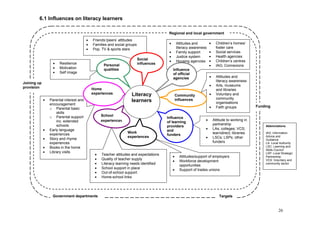
illustrated in the diagram (6.1) overleaf. These influences may be positive or negative,
either increasing confidence or instilling, or perhaps reinforcing, negative attitudes to
learning. The key influences are shown with their different component parts, which
may also link to more than one key influence. The strength of any one influence will
vary according to the learner’s circumstances and will depend too on the age of the
literacy learner. For example, young people may be more influenced by their peers
rather than their parents (though not necessarily so). Friends, or a mother and toddler
drop-in centre, may be more influential among young parents than the school. It is
suggested that the potential influence of learning institutions to support those most at
risk, is greater where there is an understanding, and the capacity, to work in
partnership with parents, outside agencies and voluntary and community groups.
The importance of social networks to motivate and maintain interest in learning is a
recurring theme in the findings of the Literacy and Social Inclusion Project. The
personal qualities and resilience of the individual, formed to a great extent by early
childhood experiences, will impact on that individual’s motivation and determination
to learn, whatever the odds. Feinstein and Bynner57 argue that ‘capitals’ (assets or
resources) are influenced by personal attributes (‘capabilities’); children form their
own capabilities as they develop, and these are highly dependent on the capital
passed on by their parents. ‘Identity capital’ means a person’s concept of themselves
while ‘human capital’ includes their qualifications, knowledge and skills. ‘Social
capital’ includes an individual’s support structures in terms of friendships, social
networks and civic participation. An individual’s health, and family factors, are also
influential.
The capitals/capabilities theory is a helpful analysis tool for explaining why social
networks can contribute to the learning dispositions of individuals with low
confidence and skills, and weak social capital. Creating opportunities for people from
different communities to connect, meet and discuss issues and concerns has long been
recognised by Government as a way of promoting social cohesion and race equality58.
Educational and social interventions aimed at addressing social exclusion may lead to
changes in individual self-concept, increased well-being and more developed social
networks. However, for those with poor literacy, providing a literacy skills dimension
to the intervention, it is suggested, will add further value by increasing their
57 L. Feinstein and J. Bynner (2003) The benefits of assets in childhood as protection against adult social
exclusion: the relative effects of financial, human, social and psychological assets (unpublished), London:
Bedford Group for Lifecourse and Statistical Studies, Institute of Education.
58 Local Government Association (2002) Guidance on community cohesion, London: LGA Publications.
26
Targets
• Parental interest and
encouragement
o Parental basic
skills
o Parental support
inc. extended
schools
• Early language
experiences
• Story and rhyme
experiences
• Books in the home
• Library visits
• Teacher attitudes and expectations
• Quality of teacher supply
• Literacy learning needs identified
• School support in place
• Out-of-school support
• Home-school links
• Resilience
• Motivation
• Self image
• Friends’/peers’ attitudes
• Families and social groups
• Pop, TV & sports stars
• Attitudes and
literacy awareness
• Family support
• Justice system
• Housing agencies
• Attitudes and
literacy awareness
• Arts, museums
and libraries
• Voluntary and
community
organisations
• Faith groups
• Attitude to working in
partnership
• LAs; colleges; VCS;
learndirect; libraries
• LSCs; LSPs; other
funders
• Attitudes/support of employers
• Workforce development
opportunities
• Support of trades unions
Home
experiences
Regional and local government
Joining up
provision
Funding
Abbreviations
IAG: Information,
Advice and
Guidance
LA: Local Authority
LSC: Learning and
Skills Council
LSP: Local Strategic
Partnership
VCS: Voluntary and
community sector
• Children’s homes/
foster care
• Social services
• Health agencies
• Children’s centres
• IAG; Connexions
Community
influences
Influence
of learning
providers
and
funders
Work
experiences
School
experiences
Personal
qualities
Social
influences
Influence
of official
agencies
Literacy
learners
Government departments
6.1 Influences on literacy learners
27
human capital. For literacy interventions to be effective among at-risk individuals,
consideration needs to be given to other, in some cases critical, factors, such as
strengthening learners’ self-esteem and their social networks, as well as improving
their skills and qualifications.
28
7. Successful literacy approaches among those at risk
Introduction
The evidence presented so far has highlighted the importance of motivation and the
need to change an individual’s perception of himself or herself as a learner, a process
that can be supported by personal, work or social networks. This section provides the
evidence for successful home and community approaches that engage, motivate and
improve the literacy and language skills of those of all ages at risk. In an age focused
on targets and quantification, numbers of qualifications achieved provide a
recognised and tangible measurement of ‘success’. Indeed, qualifications may play an
important motivating role, provide public recognition of attaining a national standard
and a ‘good value’ measure in relation to public expenditure. However, it is also
important to understand the very important ‘soft’ indicators of progress that measure
milestones along the way: reduced disaffection, enhanced self-esteem and confidence,
increased motivation, and greater engagement in literacy activity in the long term for
individuals and their families.
The evidence is examined in relation to the five areas of investigation in the Literacy
and Social Inclusion Project:
• Promoting early language and reading skills
• Building parents’ skills
• Out-of-school-hours literacy support
• Motivating disaffected young people
• Improving the skills of adults at risk
Each section reviews the research evidence, practitioner feedback from our 2003 and
2004 consultations and data received via project activity forms. Illustrative case
studies are provided which demonstrate different approaches to partnerships, use of
funding streams, types of activities, and outcomes. More than 80 practice examples
across the five areas of investigation can be seen at
www.literacytrust.org.uk/socialinclusion.
The evidence is presented through four thematic sections:
a) Engaging individuals and building relationships
b) Meeting needs and interests
c) Providing book and reading experiences
d) Working in partnership and using intermediaries
Inevitably there is some overlap between the themes.
29
7.1 Promoting early language and reading skills
Introduction
There is strong evidence from the United States that pre-school language and literacy
experiences are strong predictors of early language and literacy growth, and that the
strongest predictor of children’s early literacy development is the support for literacy
in the home59.
This is backed up by the Effective Provision of Pre-School Education (EPPE) study in
England, a long-term research project looking at the impact of pre-school education60.
It has confirmed that disadvantaged children, in particular, benefit significantly from
good quality pre-school experiences. It also confirmed the importance for all children
of a high-quality home learning environment: that is, where parents are actively
engaged in activities with children and encouraging their intellectual and social
development. Such an environment could be viewed as a ‘protective’ factor in
reducing incidence of special educational needs. In terms of child outcomes, such
practices are more important than parents’ social class and their levels of education.
We can infer that positive support to help parents who are less confident and
knowledgeable about how to help their young children acquire early language and
reading skills will contribute to improved child outcomes at school. This is the reason
the National Literacy Trust runs the Talk To Your Baby campaign to encourage
parents and carers to talk more to children from birth to three61.
There is other evidence that confirms the need to encourage and support at-risk
parents to talk and listen to their children. Research62 carried out by the Thomas
Coram Research Unit at the University of London to evaluate the Wilstaar early
identification test showed that at-risk infants did not have noisier home environments,
or spend more time exposed to television. Rather than an excess of noise, there was a
dearth of social interaction.
59 K. Roach and C. Snow (2000) What predicts 4th grade reading comprehension? In C. Snow (chair),
Predicting 4th grade reading comprehension in a low-income population: The critical importance of social
precursors from home and school during early childhood, New Orleans, Louisiana: symposium conducted at
the annual meeting of the American Educational Research Association.
60 K. Sylva, E. Melhuish, P. Sammons, I. Siraj-Blatchford and B. Taggart (2004) Effective provision of pre-
school education (EPPE) project: Final Report, London: Department for Education and Skills.
61 See www.talktoyourbaby.org.uk.
62 I. St James-Roberts (2004) Evaluation of the Wilstaar scheme. Literacy Today, no. 40, pp. 18-19.
30
a) Engaging individuals and building relationships
Importance of home visits
Research shows that home visiting, reinforcing positive behaviours, can be a very
effective mechanism for offering support to parents in the familiar surroundings of
their own home. This has been proven to be an effective approach for families at risk.
A DfES review, using evidence from the United States, showed there were measurable
reductions in offending among participating children compared with similar children
whose families did not receive home and educational support63. Home visiting and
modelling are built into UK research-led early intervention programmes such as the
REAL programme and the ORIM64 framework, and PEEP (see page 30), providing
support for early language and literacy activities and encouraging parents to step
outside the home and join in local group activities. Several visits may be needed
before this is achieved.
Building parental confidence
Sure Start has been run through local programmes in the most deprived regions of the
country and aims to achieve better outcomes for children, parents and communities
63 C. Sutton, D. Utting and D. Farrington (eds.) (2004) Support from the Start: Working with young children
and their families to reduce the risks of crime and anti-social behaviour, London: Department for Education
and Skills.
64 The ORIM framework was developed by Sheffield University’s REAL Project. ORIM stands for
Opportunities for learning, showing Recognition of the child’s activities, Interaction with the child on
literacy activities, and providing a Model of a literacy user. See
www.shef.ac.uk/education/research/RTPHannandNut.shtml.
Case study: Thurrock Community Mothers
The Thurrock Community Mothers Skilled for Health Project enables
isolated and vulnerable parents of young children to access learning
provision, or one-to-one basic skills support in their own homes. Health
visitors, nursery and school nurses, community development workers, and
community mother and breast-feeding supporter volunteers receive basic
skills awareness training and make referrals. Community mothers train as
tutors who provide informal, health-focused learning support in the home,
sometimes using laptop computers. Innovative cartoon materials have been
used to open up discussion with parents about basic skills needs. Once
parents have gained sufficient confidence, they are encouraged to
access mainstream learning provision. The project operates in partnership
with Thurrock Adult Community College, is run by Thurrock Primary Care
NHS Trust (PCT), and is funded by the PCT, Sure Start and the European
Social Fund.
Information provided by project
31
by improving children’s health, education and emotional development, and
supporting parents in their role and in developing their employment aspirations.
Children's early language development is promoted heavily by Sure Start65. There are
early indications that mothers in Sure Start local programmes are more likely to treat
their children in a warm and accepting manner, which is consistent with the Sure Start
principles that it is first necessary to influence parenting and family behaviour66.
b) Meeting needs and interests
Modelling good early communication
Actually showing parents (modelling) ways of communicating with their children is
more effective than simply providing information, and is the basis for successful early
years practice. Parents – mothers and fathers – would benefit from knowing how to
tell their children nursery rhymes and stories, including those that reflect their own
cultural and social history. Getting parents and very young children to make books
together is also valuable. Sure Start has pioneered a number of approaches that
emphasise the importance of partnerships with parents, including Communicating
Matters, which provides training and materials for those working with young
children aged from three to five. It is important to build on what parents already do at
home and encourage them to do more. Some parents find it difficult to articulate their
views with confidence outside their immediate circle of friends and family.
65 Sure Start/Manchester Metropolitan University (2002).
66 Sure Start (2004) Towards understanding Sure Start local programmes: Summary of findings from the
national evaluation, London: Department for Education and Skills.
“After I went home [from hospital] and spoke, my baby turned towards me.
I felt really important and loved, special.”
Mother taking part in a study aiming to establish good parent-baby communication
S. Bemrose and L. Lynch (2004) A bump start. Speech and Language Therapy in Practice,
Autumn 2004, pp. 10-11.
Case study: PEEP
The Peers Early Education Partnership (PEEP) runs weekly group sessions
in areas of disadvantage for families with very young children. Session
leaders model different ways of sharing books with children, songs and
rhymes are taught, and the contribution of everyday talk to children’s
development is emphasised. Evaluation showed that children in the PEEP
group made significantly greater progress in their learning than those in the
comparison group, in the areas of vocabulary, language comprehension,
understanding about books and print, and number concepts. In addition, the
PEEP children had higher self-esteem in their feelings about their cognitive
and physical competence.
M. Evangelou and K. Sylva (2003) The Effects of the Peers Early Education Partnership
(PEEP) on Children's Developmental Progress, London: Department for Education and
Skills.
32
An intervention project, Talking Time, trained nursery staff in the language skills to
be targeted and how to run specific activities providing opportunities for language
development. Evaluation showed that following the intervention, participating
children improved in both their verbal and non-verbal abilities by more than would
have been expected in the course of normal development, and more than a control
group of children67. The research identified a need for staff training in oral language
development and support, for concrete guidance and the need for these principles to
be extended into Reception and key stage 1.
Building parental confidence through new media
Connecting learning to what is already known and experienced is recognised as good
practice by teachers. What we do know is that very young children are familiar with,
and become literate across, a range of media that may include moving images and
texts in a variety of forms. This includes television, film and computer games and
children respond to these sources by talking, role-playing, dancing and singing. Their
parents are generally happy to encourage and join in with this play, perhaps because
they feel comfortable with television narratives, more so perhaps than traditional
picture books found in nurseries68. This may be a good ‘way in’ to talking to less
confident parents about language and literacy.
Providing a link to literacy learning
A small-scale evaluation of a Skills for Families project69, part of a Skills for Life
regional development programme that tested new models for delivering family
literacy and wider family learning, found that ICT had great potential in attracting
new learners and providing access to other facilities in the community (for example,
libraries, museums and learning centres). The project also offered strong learning
outcomes, in terms of both the parents’ own learning and their ability to support their
children.
67 J. Dockrell, M. Stuart and D. King (2004) Talking Time: supporting effective practice in preschool provision,
London: Institute of Education.
68 J. Marsh (forthcoming 2005) Digikids: young children, popular culture and media. In N. Yelland (ed.)
Contemporary Issues in Early Childhood, Buckingham: Open University Press.
69 K. Pahl (2004) Making Space for Learning, Sheffield: University of Sheffield/London: South Norwood
CET Centre.
“I was in town the other day just talking to him in his pushchair while we
walked along. Everyone was looking at me funny but I don’t care … it
makes a difference to him. I might sing this week; see what they think of
that.”
Parent after attending a Language and Play project
CRG Research Ltd (2004) Evaluation of the Language and Play Programme: Final Report,
London: The Basic Skills Agency.
33
c) Providing book experiences
Book ownership
Bookstart is a national book giving scheme for babies. At the child’s nine-month
health check, parents are given a Bookstart pack by the health visitor, which includes
a free board book for their baby, reading advice and recommendations from
Booktrust, as well as information on how to join the library and, in many cases, an
invitation to join. Informal library events, such as rhyme time or story time, can also
be offered. The scheme has been evaluated through longitudinal, but small-scale
studies. The final stage of the evaluation compared the key stage 1 performance of
Birmingham pupils who had been given Bookstart packs at nine months with that of a
matched control group. While the sample size was small, the Bookstart children
performed significantly better, showing that their earlier advantage when starting
school remained as their primary education continues70. Earlier studies showed that
Bookstart families credit the programme with encouraging them to read to their baby
more and feeling more confident about how to do so.
Qualitative research evidence highlighted the important role of library and nursery
staff in modelling how to share books with children, and the confidence and
communication skills this brought to parents and other members of the family71.
Where Bookstart activities are linked to multi-agency approaches to reach those
parents who are socially isolated, through initiatives such as Sure Start, there are
greater opportunities to build relationships of trust between staff and less confident
parents. In July 2004, the Chancellor announced the extension of the Bookstart scheme
to provide free books at nine months, 18 months and age three for every child.
70 B. Wade and M. Moore (2000) A Sure Start with Books. Early Years, vol. 20, no. 2, pp. 39-46.
71 M. Moore and B. Wade (2003) Bookstart – a qualitative evaluation. Educational Review, vol. 55, no. 1,
pp. 3-13.
Case study: The Sunshine Library, Wakefield
The Sure Start-funded Sunshine Library was purpose-built to support early
language development and book enjoyment among families living in a
deprived community. It was developed by Sure Start, the library service and
Lupset Community Centre Association, with some funding from the
Coalfield Regeneration Trust. A nursery is next door, and children visiting
the library are encouraged to talk and listen through features in the nursery
garden such as ‘listening’ flowers with holes to speak through. The library
holds short courses run by the Workers’ Educational Association offering
family craft activities and storytelling, and upstairs is an adult training
centre. A Bookstart Plus coordinator visits families at home and encourages
them to go along to the library with her, while another Bookstart worker
runs book and literacy sessions with parents. With a ‘satellite’ library at the
Asian Women’s Centre, Asian mothers are encouraged to use the library and
34
Shared Beginnings® is a programme that helps parents to take an active role in
developing their children’s early language and literacy through conversation, play,
making and using books, and using local community resources. A small-scale
evaluation72 found evidence that the programme was helping children and their
parents to engage with books and language activities, and also fostering parents’
interest in further learning. A visit to the library is built into the programme to
encourage parents to use this local resource. Funding from the Chartered Institute of
Housing, and partnership with housing providers, has led to courses being set up on
housing estates in areas of deprivation. Parents in Newport reported that a Shared
Beginnings course there had led to increased enjoyment in their child’s development
and increased confidence in setting routines, for example, combining nursery rhymes
with teeth brushing. The course also had the benefit of introducing participants from
the same community to one another.
d) Working in partnership
This section has highlighted several examples of partnership working to promote
early language and reading approaches. These partners are early years practitioners,
library services, family learning and basic skills professionals, the voluntary and
community sector, and health and housing organisations.
Summary
The strongest predictor of children’s early literacy development is support for literacy
in the home. Home visiting provides an opportunity to get to know at-risk parents
and offer some first-step help around early language and literacy in the context of
their own environment. Actually showing at-risk parents (modelling) ways of
communicating with their children is more effective than simply providing
information, building on what parents are already doing at home and encouraging
them to do more. They can then be encouraged to step outside the home and join in
local group activities, although this may take time. As very young children and
parents will be very familiar with many television programmes and characters,
72 P. Hannon and K. Hirst (2002) Report of an evaluation of Shared Beginnings® (unpublished). This
programme was originally developed by Reading Is Fundamental, Inc© and adapted by Reading Is
Fundamental, UK in collaboration with the Newcastle Literacy Trust.
enjoy books with their children in their home language or in English, even if
their English is limited. The librarian and a Bookstart Plus worker have
received basic skills training and are able to provide support for parents’
literacy and help them make the step in to local learning provision.
Information provided by project
35
popular culture may be a good way in to talking about language and literacy. There is
some evidence that giving very young children books – with opportunities for them
and their parents to join the library and take part in literacy-related activities – has a
positive effect on their performance on starting school.
36
7.2 Building parents’ skills
Introduction
Parental support for language and reading in the early years needs to continue as
children grow. Consideration should also be given to how parents’ own literacy
learning needs can be supported. A model for building parental skills is provided on
page 73, illustrating the process of developing partnerships, the engagement of
parents in literacy skills learning, the outcomes for parents and children, and the
resulting benefits for schools, communities and employers.
A recent research review on the influences on pupil achievement highlighted the
importance of at-home parenting as a significant factor, greater even than social class
or parents’ level of education. Good at-home parenting means talking through how
children are doing at school, introducing them to the library, encouraging high
aspirations and encouraging them to continue in education after compulsory school is
finished73.
Parental attitudes to reading are important; research suggests that children who know
adults who read for pleasure are more likely to take it for granted that reading is a
valuable and worthwhile activity74. Also, children whose home experiences promote
the view that reading is a source of entertainment are likely to become intrinsically
motivated to read75.
A recent review on family learning76 proposes that all families should have access to
local facilities for formal and informal learning, linked coherently to wider services
and learning provision.
a) Engaging parents and building relationships
There is evidence about ‘what works’ to change at-risk parents’ behaviour around
parenting. This includes demonstrating or modelling new approaches with
opportunities for parents to try out and get feedback; recognising that family
73 C. Desforges with A. Abouchaar (2003) The impact of parental involvement, parental support and family
education on pupil achievement and adjustment: a literature review, London: Department for Education and
Skills.
74 L. Baker, D. Scher and K. Mackler (1997) Home and family influences on motivations for reading.
Educational Psychologist, vol. 32, no. 2, pp. 69-82.
75 Clark (forthcoming 2005).
76 M. Lochrie (2004) Family learning: building all our futures, Leicester: National Institute for Adult
Continuing Education.
37
relationships play a part; and programmes that include sanctions for negative
behaviour and strategies for positive behaviour through play and praise. Sutton and
colleagues77 quote evidence on US Head Start programmes, set up to help
communities meet the needs of disadvantaged pre-school children. They identify
success factors such as providing transport, meals, childcare and accessible locations;
encouraging every parent’s participation by advertising it as a universal programme;
and targeting and encouraging high-risk families through home visits, including visits
by parents who have previously participated. A collaborative model is adopted that
assumes that course leaders and parents both have expertise, and that encourages
parents to help each other and develop support networks outside the group, including
from other family members78. The same principles can be applied in engaging families
at risk to support their children’s developing literacy skills, but learning needs to be
fun79.
Crafts, arts and drama
An evaluation80 of one of the Skills for Families programmes found that activities that
focused on creativity and oracy, and supported home-school links, were particularly
helpful in supporting parents with little or no experience of formal learning. Parents
thought of the sessions as a non-threatening environment and talked about what they
brought to courses, such as books made at home. Practitioners’ experiences suggest
that arts activities may also bring benefits in terms of building parents’ confidence as
they see what they can create. Encouraging parents to take part in activities with their
children helps develop speaking and listening skills.
77 Sutton et al (2004).
78 C. Webster-Stratton (1998) Parent training with low income families: promoting parental engagement
through a collaborative approach. In J. Lutzker (ed.) Handbook of Child Abuse Research and Treatment,
New York, NY: Plenum Press.
79 Evaluation of the Derbyshire community literacy initiative Read On – Write Away!, which makes a
large contribution to regeneration and social inclusion programmes in the region, found its ethos was
perceived as ‘fun’ and ‘jolly’, a deliberate strategy in targeting those who have had bad prior
experiences of learning: P. Davies with V. Bird, M. Hamilton, P. Hannon and C. Taylor (2002) Read On –
Write Away! An evaluation report, Matlock: Read On – Write Away!.
80 K. Pahl (2004) All these little umbrellas under one giant canopy: An evaluation of Family Literacy, Language
and Numeracy in Read On – Write Away!, Matlock: Read On – Write Away!.
Case Study: Inspire Aspire
Inspire Aspire was a project to extend the creative family learning work of
the Partnership Education Service (PES), part of Rochdale LEA. It enabled 10
women of Asian heritage to develop new artistic and literacy skills through
a residential week based at the Fundació Pilar i Joan Miró art and education
centre in Mallorca. Before the trip the group attended 10 weeks of classes
where they learnt to use the internet for research, which together with the
diaries and reports they wrote improved their use of English. Once in
Mallorca they used sketch pads and cameras to record the natural beauty
38
Drama was the underpinning approach of the Fathers Inside and Family Man courses
run in prisons by the charity Safe Ground, and was regarded by participants as
valuable because it was accessible to all, regardless of literacy level, and was an
effective communication tool81. Tutors in the pilot project described drama as a
‘refreshing’ alternative approach and a powerful medium for teaching family
relationship skills. Evaluation suggested that the courses may impact positively on
offending behaviour, as prisoners were encouraged to consider how their actions
affected others. The team-based approach was also seen as a positive feature, and the
final presentation as a valuable experience that uplifted both teachers and
participants.
Reaching fathers
Most family learning programmes involve mothers, yet fathers play a key role in their
children’s achievement. Analysis of National Child Development Study data82
showed that father involvement at age seven and mother involvement at age seven
significantly and independently predict higher educational achievement by age 20
and this applies to both girls and boys. An involved father is defined as one who
reads to his child, takes outings with his child, is interested in his child’s education
and takes a role equal to the mother’s in managing his child. There is little empirical
evidence on the effect of fathers’ involvement on children’s literacy outcomes directly,
81 K. Halsey, M. Ashworth and J. Harland (2002) Made for Prisoners by Prisoners – an Evaluation of the Safe
Ground Family Relationships and Parenting Programme, York: National Foundation for Educational
Research.
82 E. Flouri and A. Buchanan (2001) Father involvement and outcomes in adolescence and adulthood, Oxford:
Department of Social Policy and Social Work, University of Oxford.
and signs of Islamic influence on architecture, and then worked together,
with the support of a community artist, to use their work to produce silk
screen prints, which were later exhibited at a Rochdale gallery. Following
the trip two of the women became parent governors – a role to which none
of the group had previously aspired, seven took up new courses and four
gained jobs; some have also joined the management group of a new
Community Arts Learning Centre. Staff assess that these outcomes are due
to increased confidence and self-esteem, which has also benefited their
children. The women contributed to the cost of the trip, subsidised by
various grants and support.
N. Jackson and A. Cunningham (2004) Inspire Aspire. Basic Skills, Winter 2004, pp. 14-16.
“I really enjoyed working in a group, helping each other … all different,
sharing opinions, talking about what we were doing. We were doing art!”
Participant
39
with very little quantitative evidence of the extent to which fathers engage with their
children in literacy-related activities83.
Research has highlighted the relative absence of men in family learning programmes
and, when they do join, they are likely to drop out of school-based daytime
programmes where mothers are in the majority84.
Barriers to fathers’ involvement in Sure Start programmes include operating at times
that clash with work hours, traditional attitudes towards childcare and
responsibilities, and fathers’ lack of awareness of the programme. Fathers were more
likely to get involved where there was a strategy to involve them and the presence of
dedicated staff members, including male staff, to encourage fathers’ involvement85.
To conclude, involving fathers – or any significant male carer – in literacy activities
may provide important role models for at-risk boys and there are examples of where
fathers have been successfully engaged in family learning programmes. However,
providers need to consider how father-friendly their organisations are. Fathers need to
be specifically targeted, taking account of the barriers identified above, if they are to
benefit from family learning events and programmes.
83 R. Ortiz (2000) The many faces of learning to read: The role of fathers in helping their children to
develop early literacy skills. Multicultural Perspectives, vol. 2, pp. 10-17.
84 R. Goldman (2004) Fathers’ involvement in family learning programmes. Adult Learning and Skills, no.
4, pp. 17-19. Based on forthcoming research for the National Family and Parenting Institute – see
www.nfpi.org.
85 N. Lloyd, M. O'Brien and C. Lewis (2003) Fathers in Sure Start, London: Department for Education
and Skills.
Case study: Bolton Literacy Trust and dads
The Bolton Literacy Trust is a charity working with others to raise literacy
and numeracy standards and engage new learners in innovative ways.
Through a project called ‘Catching the Learning Buzz’, funded by the
Learning and Skills Council, it has provided sports equipment for a Somali
centre with the aim of engaging dads and teenagers. It has also set up an
internet café, which aims to attract families and has several grandfathers
coming along to learn IT skills and send emails to relatives. With the charity
Saturday Fathers, another café is being set up in an access centre for dads
and children who see each other only at weekends, so that the dads can help
their children with homework and improve their own IT skills. There will
also be a ‘Care to Read’ resource area equipped with comfortable seating
and books, including books especially chosen to appeal to reluctant male
readers.
Information provided by project
40
b) Meeting needs and interests
Having fun through family learning
If parents and children enjoy the learning process, and have the satisfaction of
participating in activities that interest them, they are more likely to feel positive about
the process. Finding out what kinds of activities are right for participants is crucial –
for some people football would be ‘fun’, for others, sewing might be. The interests of
children are powerful incentives to engage parents with literacy needs in learning86.
Encouragement and helping parents to feel confident in the activity are also important
factors to consider. Parents with low levels of confidence, or with the greatest learning
needs, are more likely to take part in practical activities that do not involve any
reading or writing, for example, Storysacks (see page 41), crafts or gardening projects.
Family learning may contribute to social relationships and the development of
friendships87. It also offers opportunities for achieving a number of cross-cutting
policy objectives including improving child development, extended schools and
raising school standards88.
A literacy focus to parenting programmes
A parenting support programme that has clear literacy aims and focus can have
positive literacy outcomes for both children and parents.
A study has looked at how the PEEP programme supported parents as adult
learners89. The study found that there were benefits for parents who participated in a
PEEP group for five or more sessions, which included support through the ‘Learning
Bridge’ initiative, offering links to opportunities in education and employment.
Parents reported that the social support offered by PEEP was an important factor in
their decision to extend their employment-related skills and to enhance their
parenting techniques. They also showed significantly greater awareness of their
child’s literacy development and of ways to foster it, such as through modelling
techniques and looking for words and texts in their daily lives. More parents who
participated in PEEP went on to take basic skills courses than the control group.
86 GFA Consulting on behalf of the Department for Education and Employment (1999) Learning elements
of the Single Regeneration Budget, London: Department for Education and Employment.
87 J. Eldred and J. Haggart (2002) The Generation Game, Leicester: National Institute for Adult Continuing
Education.
88 Lochrie (2004).
89 K. Sylva, M. Evangelou, R. Taylor, A. Rothwell and G. Brooks (2004) Enabling Parents: The Role of
PEEP in Supporting Parents as Adult Learners, Oxford: University of Oxford.
“… if I turn out to be clever enough”
“… if everything goes to plan and it rarely ever does in my life”
Learners talking about their hopes of reaching their goals
P. Davies (2002) Read On – Write Away! The Greenhill Study, Matlock: Read On – Write
Away!.
41
When front-line staff receive literacy awareness training, they become more confident
in their ability to support parents with poor literacy. An external evaluation of the
Step in to Learning programme90, which trained nearly 2,000 members of staff from
neighbourhood nurseries, found that 95% felt they were better able to identify parents
and carers with literacy and language needs and 80% reported that they referred them
to literacy provision. Parents were also willing to ask nursery staff for help around
these issues, with 92% saying they would feel happy to do so.
Family literacy interventions
Most family literacy practitioners aim to impart short-term skills, but also long-term
changes in families, relating, for example, to support for children’s school education,
improvements of adults’ basic skills, employability and attitudes to lifelong learning91.
The Basic Skills Agency (the Adult Basic Skills Unit at the time) instituted family
literacy demonstration programmes and subsequently developed other programmes
such as Early Start and Keeping Up with the Children.
Evaluation of the family literacy demonstration programmes by the National
Foundation for Educational Research92 reported positive changes in attitudes and
literacy practices on the part of participating parents, which were maintained when
they were re-interviewed three and six months after their courses and, for some of
them, two and a half to three years later. These programmes were located in areas of
multiple deprivation targeting parents with very low literacy skills. The follow-up
research showed that family literacy children were holding their own, and their
educational prospects were better than they would have been without the
programme.
One of the strongest findings that emerged from this study was the huge boost to
parents’ confidence as a result of the courses; this was also a key factor in the process
of achieving quantitative gains, for both parents and children. Some parents would
not have stayed without the peer cooperation that they discovered; they found that
the feeling of “we’re all in it together” was helpful. It was also noted that programmes
avoided over-concentration on reading, and genuinely focused also on talking and
writing. The coordinators emphasised the value to parents of being able to move
straight from a separate session where they learnt an activity to do with their children,
to a joint session where they could try it out, and, if appropriate, have the parent’s role
90 National Institute for Adult Continuing Education (2004) External Evaluation of the Step in to
Learning Neighbourhood Nursery Training and Development project. Retrieved February 2005 from
www.stepintolearning.org/Default.aspx?Cobra=SqSRWECZdQ4MfP98x5UV112A and
www.niace.org.uk/Research/BasicSkills/Projects/NNurseries.htm.
91 P. Hannon and V. Bird (2004) Family Literacy in England: Theory, Practice, Research and Policy. In B.
Wasik (ed.) Handbook of family literacy, Mahwah, NJ: Lawrence Erlbaum Associates.
92 G. Brooks, T. Gorman, J. Harman, D. Hutchison and A. Wilkin (1996) Family Literacy Works: The NFER
Evaluation of the Basic Skills Agency's Demonstration Programmes, London: The Basic Skills Agency.
42
modelled by a teacher. This immediate practice gave rise to an evident delight in the
parents at being able to help their children.
There is strong evidence from outside the UK that the Pause, Prompt and Praise
programme can be very effective at supporting parents with their children’s literacy93.
In this simple approach, parents are taught to help children who may have fallen
behind with their reading by helping them decode text by looking for clues and
praising their success in a way that particularly relates to their reading behaviour. A
small-scale intervention study funded by the Department of Health – Spokes
(Supporting Parents on Kids’ Education) – showed that a combined literacy and
behaviour support programme was welcomed by parents and teachers. The parenting
support focused on positive play, and planned ignoring of unwanted behaviour.
Information and knowledge was provided, using the Pause, Prompt and Praise
approach, to help parents become more confident in supporting their children’s
literacy development in the home94.
c) Providing book and reading experiences
Storysacks
Running a Storysacks event can engage at-risk parents, through the practical
experience and fun of making Storysack props, and the sack itself, and in the process
introducing parents to the pleasure of book-related activities with their children. A
Storysack is a cloth bag containing a book and supporting materials, such as soft toys
93 T. Glenn (1995) Pause, Prompt and Praise: Reading Tutoring Procedures for Home and School
Partnership. In S. Wolfendale and K. Topping (eds.) Family Involvement in Literacy, London: Cassell.
94 C. Crook (2001) Parental support. Literacy Today, no. 29, p. 21.
Case study: Share
The Share programme was developed by the Community Education
Development Centre (now ContinYou) for parents and their school-age
children to practise their literacy skills together. It can be used up to key
stage 3. It has been adapted by the Bolton Literacy Trust for use with
younger children in a number of primary schools and Sure Start centres in
Bolton. Sessions are based around a fun learning activity that parents can
use or adapt with their children at home, such as making activity books,
matching and sorting activities, letter, number, colour and shape
recognition. Parents keep a folder of activities which can go towards
accreditation for an Open College Playwork certificate. A Share Plus
parenting skills programme also exists, and the Bolton Literacy Trust has
trained other voluntary organisations such as NCH and YMCA to run these
courses.
Information provided by the Bolton Literacy Trust
43
of the book’s main characters, props and scenery. Even if a parent’s reading skills are
limited, these props can be used with children to bring a book to life. The Storysack
may also contain a non-fiction book on the same theme, an audio-tape of the story or a
language-based game. A short guide suggests questions for parents to ask and other
ways to extend the reading activity.
d) Working in partnership
Early years organisations and primary schools are important partners in the process of
building parents’ literacy skills while providing, at the same time, appropriate
support to their needs as parents. However, the evidence on supporting parents when
their children get to secondary school is less conclusive. Evidence from practitioners
suggests that IT courses and courses on money management can be successful ‘hooks’
to involve parents at the secondary phase. There are early signs, from the work of
Reading Is Fundamental, UK, that transition from the primary to secondary school is a
fruitful time to remind parents of the need to encourage children’s leisure reading.
Community arts, sports clubs and centres, museums, art galleries and libraries can all
provide additional interest and focus to literacy activities with parents. The role of
professionals from these organisations, and other intermediaries, is explored further
in the adults section (page 60).
Summary
Good at-home parenting is a significant factor in pupil achievement. Primary schools
that were successful in developing parental support for reading focused on specific
initiatives that involved parents actively reading with their children. Engaging at-risk
parents with low literacy skills and confidence, through arts, crafts or drama activities
provides a link to later learning; group work provides opportunities to develop
relationships and build individual support networks. Parents will then be more likely
to sign up for more formal literacy programmes. A parenting programme that has
clear literacy aims and focus, delivered by trained family literacy tutors, is more likely
to have positive literacy outcomes for children and parents. Introducing at-risk
parents and children to the local library encourages them to see libraries as friendly
places that provide free access to books, and other resources. Getting fathers involved
in doing literacy activities may provide important role models for at-risk boys.
"There were not many books at home when I was a kid, but we’ve got lots of
books in the house now."
Parent after taking part in Read On – Write Away! project
P. Davies (2002) Read On – Write Away! The Greenhill Study, Matlock: Read On – Write
Away!.
44
However, a deliberate strategy is needed to involve fathers in family learning
programmes – taking account of their needs and interest – since family learning
mostly attracts mothers.
45
7.3 Out-of-school-hours support
Introduction
The US Harvard Home-School Study has interviewed children since the age of three
(they are now 16) and showed that the greatest predictor of their literacy development
was support for literacy in the home; the areas of greatest impact were sharing books,
extended talk at mealtimes and opportunities to chat beyond the here and now95.
Material poverty means fewer learning resources like reference books and computers
in the home. Schools in disadvantaged areas therefore need to consider the added
importance of libraries and study support provision like homework clubs in bridging
this gap96.
a) Engaging children and building relationships
Buddy readers and others can provide important role models to engage children in
reading and literacy activities (see page 49). At-risk children sometimes need ‘safe
spaces’ before they can focus on learning. Consideration should be given to how this
can be provided, along with adults prepared to listen to children’s concerns (real or
imaginary) to help break down emotional barriers to learning.
95 Roach and Snow (2000).
96 R. Lupton (2004) Schools in Disadvantaged Areas: Recognising Context and Raising Quality, London:
Centre for Analysis of Social Exclusion, London School of Economics and Political Science.
Case Study: A Quiet Place
A Quiet Place is a room in a school set aside for children under stress, to
develop their emotional literacy and prevent the risk of exclusion and
unacceptable behaviour. The room might contain soft furnishings, tent-like
areas, water and sand; it forms part of an holistic programme including
storytelling, art and music workshops. Children are given one-to-one
attention and taught how to manage their stress, improving their confidence
and communication skills and making them better able to settle in class. The
University of Liverpool has evaluated A Quiet Place and shown that it has
had a positive impact on behaviour. Funding comes from various sources.
Information provided by project
46
b) Meeting needs and interests
Linking literacy learning to popular culture
Children (and adults) use literacy in different ways in their daily lives. Drawing
exclusively on book-related literacy runs the risk of excluding children who are not
familiar or comfortable with books. Oral communication, emails, drawing, drama and
other art forms can play important roles in supporting literacy97. Children with poor
speaking and listening skills need as many opportunities as possible, outside and
within the classroom, to improve these skills. New written forms of communication
reflect speech more closely, for example, email and text messaging, which can provide
a useful way in to learning other forms of written expression. Similarly, reading and
writing can be more meaningful to children when linked to their everyday
experiences in the home, and popular culture can be a good starting point. Building
on their interest in and knowledge of, for example, television programmes, videos or
computer games, can help develop children’s language skills as they talk about the
plot or describe popular characters. This can motivate children to write outside school.
It is important to take account of pupils’ wider cultural knowledge and experiences,
including their home culture, to support and extend their school-based literacy work.
Evaluation of Ultralab’s Notschool.net, which functions as an online community for
teenagers who, for a variety of reasons, are out of school for a long time, showed that
using the new technology and the support of ‘mentors’ (teachers) and ‘buddies’
(university students), the literacy skills of the young people improved. Most of them
had very low levels of literacy when they joined the project, but they made “clear
learning gains”, mapped through their use of ‘stickies’ (the virtual sticky notes that
enabled the young people to communicate with mentors and with each other) and in
the accreditation they achieved.
This issue around new technology will be explored further in 7.4.
97 G. Merchant (2003) Email me your thoughts: Digital communication and narrative writing. Reading,
Literacy and Language, vol. 37, no. 3, pp. 104-110.
“With the recipe, there were a couple of boys who wouldn’t normally have a
go at writing. If I’d have asked [child] to come and write, he wouldn’t have
done it. It’s because it had the Teletubbies on top.”
Nursery headteacher talking about an activity in which children made Tubby custard and
then wrote down ‘recipes’ on special paper
J. Marsh (2000) Teletubby Tales: popular culture in the early years language and literacy
curriculum. Contemporary Issues in Early Childhood, vol. 1, no. 2, pp. 119-133.
47
Involving the arts
Our own review and consultation process highlighted the importance of museums,
libraries and archives in offering important contextualised learning opportunities to
pupils in need. Encouraging a sensory and emotional response to artefacts can, in
some cases, break down personal barriers to engagement at many levels, including
skills learning.
A US review found support for the role of arts learning in assisting the development
of critical academic skills, including basic and advanced literacy and numeracy98. An
evaluation of the National Theatre’s drama work in primary schools99 found that
drama promotes children’s enjoyment in educational processes, and, aside from
learning about drama as an art form, children also gained in self-confidence.
Compared with a matched sample, National Theatre children learned to speak more
clearly and listen more attentively, although there were no differences in their reading
and writing test scores. There is appreciation therefore, though little hard research
evidence, that the arts and cultural agencies provide different sorts of experiences that
can motivate children and young people to learn. One researcher has specifically
examined the role of the arts in relation to literacy learning of children and young
people. According to Shirley Brice Heath, education and literacy researchers are
98 R. Deasy (ed.) (2002) Critical links: learning in the arts and student academic and social development,
Washington: Arts Education Partnership.
99 H. Turner, B. Mayall and R. Dickinson (2004) Children engaging with drama: an evaluation of the National
Theatre’s drama work in primary schools 2002- 2004, London: Social Science Research Unit, Institute of
Education.
Case study: Polly’s Story
The Ragged School Museum in east London has developed this project to
support the language skills of children in Reception and key stage 1 through
storytelling. Children talk about the objects they can see in a reconstructed
kitchen of 100 years ago, and compare them with their modern equivalents,
making links from the setting to their own lives. They join in with rhymes
and actions to accompany the story of Polly, a girl who might have lived in
the house, ask questions and act out household tasks. The museum also has
a loan box for schools, with replica and real museum artefacts, ‘feely bags’ of
objects for the children to identify by touch and a tape of rhymes. Since most
local children do not speak English at home, the project helps them to learn
new vocabulary in a way that captures their imaginations: one class is still
talking about their visit and writing stories based on it two years later. Initial
funding through the Department for Education and Skills and the London
Museums Agency (now ALM London) allowed for supply teaching cover,
meaning that the museum could work with teachers for a whole day at a
time to develop the project – a reason that staff give for its success.
Information provided by project
48
understandably focused on reading and writing through intentional instruction and
learning, and few know about the studies on language acquisition or cognitive science
reports on memory. She believes we should focus on where the arts and literacy meet:
in other words, drawing in collaboration with writing, creative writing for production
or to complement visual arts, and dramatic renderings of children’s literature and
young adult publications100.
Literacy and sport
Sport and sporting heroes, who talk enthusiastically about books and the importance
of learning, can motivate children to want to practise their literacy skills. The NFER
evaluation of Playing for Success101 showed that participation in the scheme improved
the reading comprehension scores of underachieving young people at secondary
school age, boys and girls equally. Key success factors were the football or sports club
setting, which motivated pupils to become involved, the use of computers and the
internet, opportunities for choice of study and to develop independent study skills –
and the chance to improve their sports skills too.
100 S. Brice Heath (2004) Learning language and strategic thinking through the arts. Reading Research
Quarterly, vol. 39, pp. 338-342.
101 C. Sharp, J. Blackmore, L. Kendall, K. Greene, W. Keys, A. Maccauley, I. Schagen and T. Yeshanew
(2003) Playing for Success: An Evaluation of the Fourth Year, London: Department for Education and
Skills/Slough: National Foundation for Educational Research.
Case study: Premier League Reading Stars
Premier League Reading Stars (PLRS) is one of the programmes established
by the National Literacy Trust’s Reading The Game initiative. Each Premier
League club partners with at least one local library, which establishes family
reading groups. A group of 10 local key stage 2 children meet regularly,
along with a parent or carer, to discuss the favourite reads of professional
footballers. Each club has nominated a Reading Champion, who in turn
nominates a favourite book; a list is then compiled of 10 adults’ books and 10
children’s books, which are delivered along with some librarian-
recommended reads to each library. Each club provides plenty of incentives,
including free match tickets, stadium tours, and ideally a chance to meet the
Reading Champion. Internal evaluation indicates that children and adults
want to read more as a result of participating in the programme. PLRS is a
partnership between the Trust, the Premier League and the Football
Foundation, with support from Arts Council England.
Information provided by project
49
c) Providing book and reading experiences
Choosing, borrowing and owning books
Where there are few books in the home, it is important to provide opportunities for
children to choose, borrow and own books. Research for a 2002 working group on
library provision for children and young people102 revealed a need for children and
young people to have access to a wide range of appropriate books, guidance for
choosing books, opportunities to talk to peers about reading experiences and the
support of an interested adult and reading role models. Electronic and interactive
storybooks can be motivators to read for young children in general, and for non-
motivated readers and ESOL children in particular103.
Promotional events or competitions can motivate children to read more. Evidence
from the Summer Reading Challenge – an annual event to encourage reading and
library usage among children – indicated that four in five participating children
believed their reading had improved as a result, 63% read a book about people with
different lives from them and 40% had found a new favourite book.
102 Chartered Institute of Library and Information Professionals (2002) Start with the child: Report of the
CILIP Working Group on library provision for children and young people, London: Chartered Institute of
Library and Information Professionals.
103 R. Andrews, A. Burn, J. Leach, T. Locke, G. Low and C. Torgerson (2002) A systematic review of the
impact of networked ICT on 5-16 year olds’ literacy in English (EPPI-Centre Review, version 1.1). In
Research Evidence in Education Library, London: EPPI-Centre, Social Science Research Unit, Institute of
Education.
Case study: Reading Is Fundamental, UK in women’s refuges
Reading Is Fundamental, UK (RIF), an initiative of the National Literacy
Trust, has been working in partnership with women’s refuges since 1997. In
one project, Perthshire Women’s Aid was able to provide 15 children and
young people, aged from five months to 16 years, with their own choice of
books and audiotapes. The refuge reported that older children and teenagers
were enthusiastic about choosing books that reflected their personalities. The
project enabled the young people to get to know one another by swapping
books, as well as providing all the children with an opportunity to find
pleasure and escape through reading.
Information provided by RIF, UK
“As for Karim [age 10] he began reading quicker and at school his teacher
noticed his writing got amazingly better. As for my elder boy as he saw his
little brother reading so much, he wanted to take part in it. And when I had
someone to share my opinion about the books I read, that made me read
more.”
Participating parent, Premier League Reading Stars
50
Where a child does not receive home support, is perceived to be at risk or is the
responsibility of the corporate parent (i.e. a professional within a local authority)
consideration needs to be given to how that child will get these enriching book
experiences and additional reading support. Every Child Matters104 provides a policy
framework for a more joined-up approach to provide better support for looked-after
children. This should mean partnership with the public library service.
Buddy reading schemes
A review by Brooks105 on what works for children with literacy difficulties found
there were successful in-class interventions as well as those beyond the classroom,
including family literacy programmes and using trained volunteers. It also reported
on some earlier studies of initiatives that combined support for reading with different
approaches to boost self-esteem, with some success, and concluded that work on self-
esteem with reading would seem to have definite potential.
Training older students to support younger pupils’ reading is a well-used in-school
strategy. FASTLANE, Kirklees, is a language, literacy and numeracy project that
tackles exclusion by building links between home, school and communities in areas of
disadvantage. Evaluation of its Book Buddies strand106 found that a significant
104 Department for Education and Skills (2003) Every Child Matters.
105 G. Brooks (2002) What Works for Children with Literacy Difficulties? The Effectiveness of Intervention
Schemes, London: Department for Education and Skills.
106 C. Herrick and A. Ali (2002) FASTLANE Evaluation Final Report, Huddersfield: University of
Huddersfield.
Case study: NE1 4 Reading (that’s ‘Anyone for Reading’ in txt spk)
NE1 4 Reading encourages young people in care homes to enjoy reading for
fun. It is funded by Lancashire County Council social services, in
partnership with the library service, the Education of Looked after Children
Team and the Youth and Community Team, and has included awareness-
raising training for both librarians and social workers. Each care home is
given a book collection and receives regular visits from a young people’s
librarian who brings along books and magazines from local libraries,
including books suitable for teenagers with low levels of literacy.
Workshops with performance poets have also been held and proved
particularly popular, with participants expressing themselves through
creative writing and visiting a studio to record their own poetry. All of the
homes have reported an increase in reading activity since the project started,
library membership has gone up, and some homes have started a reading
hour each day for staff and young people alike.
Information provided by project
51
proportion of underachieving children involved in this school-based scheme (Years 1,
2 and 7) showed a substantial improvement in reading age over a three-month period.
A sample of 25 of the Buddies (who were in Years 8 and 10) showed a similar
improvement. Interviews with project and school staff indicated that there were social
and emotional benefits for the Buddies too.
The Read On – Write Away! (ROWA!) Buddy Reading scheme in Derbyshire, in
partnership with the county’s social services department, trains care leavers and
young people who are out of school to work (usually but not exclusively in schools)
with a younger partner who is having some reading difficulties. Internal evaluation107
found that over 30% of the young people trained as Buddies stayed with ROWA! to
undertake further literacy-related activities. Over 80 young people were involved in
the first two years of the project, of whom 53 gained nationally recognised
accreditation, including OCN qualifications in Buddy Reading and Storysacks.
ROWA! reported that with good support, many Buddies were committed, reliable and
skilful in helping children who were struggling with their reading, and that the
benefits to both groups were considerable; the scheme has become central to the local
authority’s work in supporting the needs of care leavers. The scheme has also
developed strands for young offenders and for employees, where the express purpose
is to improve the basic skills of adults and young people as they help others.
d) Working in partnership
Providing book and reading experiences is key during the primary phase when a
child is not getting, for whatever reason, home literacy support. Again, libraries, arts
and sports organisations are useful partners, while reading buddies can be found in
other parents and grandparents, learning assistants, caretakers, retired people and
members of the business community.
Summary
Material poverty means fewer learning resources like books and computers in the
home. Schools and libraries in disadvantaged areas need to consider how they can
provide study support like homework clubs to bridge the gap. For children not
familiar or comfortable with books, or those with under-developed oral language
skills, popular culture and new forms of communication, such as text messaging, may
be a good starting point to develop their language and literacy skills. The arts and
drama help develop confidence in speaking and listening, and providing different
107 Read On – Write Away! (2000) The Buddy Reading Project '2 Years On', Matlock: Read On – Write
Away!.
52
learning experiences may motivate many at-risk children and young people to learn.
Similarly, out-of-school learning at sports clubs motivates children and young people
to improve their literacy skills. Some at-risk children who have experienced trauma
may need ‘safe spaces’ before they can focus on learning, and schools should consider
how this might be provided.
Where there are few books in the home, children need opportunities to choose,
borrow and own books. At-risk children can benefit from trained reading volunteers,
whether these are older pupils, parents or members of the community. These ‘reading
buddies’ also benefit from the experience. For this reason, consideration should be
given to encouraging older at-risk pupils or students to become buddies in order to
improve their self-esteem and confidence.
53
7.4. Motivating disaffected young people
Much of the ‘what works’ evidence to support children’s literacy will also be true for
young people. However, young people with poor literacy skills are much more likely
to be disengaged from learning. There are three types of young people disengaged
from learning: those who are ‘out of touch’ who have practically lost contact with
school; those who are ‘in touch’ but disaffected, including truants; and finally, there
are low achievers, many of whom will be capable of achieving more if their interest
and enthusiasm are roused108.
The aims and aspirations of disadvantaged young people are known to be very
similar to those of all young people, although they do shift with maturity, and include
having a family, an interesting job, and sufficient money to support their lifestyle.
However, according to a study by the Prince’s Trust, while 41% of the disadvantaged
felt they were held back by a lack of qualifications, for many, there was a lack of
understanding as to how they would achieve their aims in life109.
There is a developing evidence base around community approaches to support
disaffected and disengaged young people through the Neighbourhood Support Fund
(NSF) and the Young Adult Learners Partnership (YALP). Of the young people who
have attended NSF projects, 68% have moved back into education, training or work.
Many young people have benefited from improvements in self-confidence, self-esteem
and the development of new skills, including literacy and numeracy. Evaluation
showed there is a clear and continuing demand for the services its projects provide for
young people whose needs are not being met by the education service110.
For those in the criminal justice system, there is some evidence that youth disorder
and juvenile offending can be tackled through community-based after-school
recreation programmes, education projects and intensive supervision and after-care of
juvenile offenders. These include schemes to improve literacy and numeracy for those
with very low skills111. One-to-one support in institutions may help to meet individual
needs.
108 H. Steedman and S. Stoney (2004) Disengagement 14-16: Context and Evidence, London: Centre for
Economic Performance, London School of Economics and Political Science.
109 A. Calder and R. Cope (2003) Breaking Barriers? Reaching the Hardest to Reach, London: The Prince’s
Trust.
110 S. Golden, T. Spielhofer, D. Sims and L. O’Donnell (2004) Supporting the Hardest-to-Reach Young
People: The Contribution of the Neighbourhood Support Fund, London: Department for Education and Skills.
111 Neighbourhood Renewal Unit (2002) What works?: Reviewing the evidence base for neighbourhood
renewal, London: Office of the Deputy Prime Minister.
54
a) Engaging individuals and building relationships
Informal learning approaches
Evaluation of the NSF programme, drawing on a range of sources of evidence,
showed that young people respond positively to delivery of literacy and numeracy
provision that is informal and unlike school, but is rather a preparation for gaining
qualifications or employment112. Other success factors were also identified: involving
young people in the running of the project; the relationship between the young people
and skilled and caring project staff who made the young people feel respected and
listened to; and a structured but flexible approach to programme activities. Measuring
the distance young people travelled was a challenge; generally it was done by creating
a file of work and staff observations. Progress was less marked for young people who
presented more serious personal problems, for example, drug dependency or
homelessness.
Focus on employment-related skills
Young offenders and disaffected young people with poor literacy and numeracy
valued training when it was perceived as preparation for employment, and where
they were treated as adults, for example, by being able to make a cup of tea or have
the radio playing. Qualifications directly related to practical activities and which
112 Golden et al (2004).
Case study: One to one
One to One is a scheme at HMYOI Huntercombe through which volunteer
tutors help juvenile offenders with their literacy, language and numeracy,
with the aim of giving boys the skills and confidence to access learning
opportunities. Volunteers are trained in working in a secure environment as
well as in helping students with their reading and writing. One to One uses
a phonic programme that staff have found to work well for inexperienced
learners, those with learning difficulties and those whose first language is
not English. Students may be referred to the scheme from various areas of
the prison – for example, they may need help with catering vocabulary if
they work in the kitchens. The support students receive is tailored to their
individual needs and interests, and volunteers work closely with the scheme
coordinators to move their students’ skills on within a short time. Prison
staff have noticed improved confidence and self-esteem in participants,
along with a better ability to cope with prison life; they see improving a
prisoner’s literacy skills as part of a wider picture. The scheme is funded by
the prison itself.
Information provided by project
55
could be applied to obtaining employment were highly valued, for example, studying
to take the driving test113.
b) Meeting need and interests
Engaging young people in literacy learning
YALP is a joint initiative between NIACE and the National Youth Agency that
researches and develops effective approaches to learning among young adults aged 16
to 25. Recent research114 has looked specifically at how to engage and improve
participation of young adults with low skills and not in education, employment or
training – a key priority of the Skills for Life strategy. It found that most projects were
located within community settings working across the spectrum of formal and
informal approaches to learning. Hooks into learning included building on learners’
interests using a wide range of materials, for example, newsletters, video projects,
information about budgeting and poetry, with specific literacy, language or numeracy
teaching embedded or built into delivery, rather than bolted on.
The project identified some issues. Young people are aware that learning can be a
passport to employment, but are less willing to do the work involved, particularly
portfolio work. Accreditation needs to be carefully considered because while it
motivates some young people, for others it represents a barrier. The development of
speaking and listening skills seems to be largely overlooked, although many
practitioners referred to improving communication skills as a soft outcome for their
work. Also, there was strong feeling that practitioners initially trained as youth
workers are the ‘right’ people to work with young adults, but there was a reluctance
among youth workers to take up basic skills training, as they saw youth work and
teaching as two distinct vocations.
113 J. Hurry, L. Brazier, K. Snapes and A. Wilson (2004) Improving the literacy and numeracy of young
offenders and disaffected young people: the first 18 months of the study, London: Institute of Education.
114 B. McNeil and L. Smith (2004) Success factors in informal learning: Young adults’ experiences of literacy,
language and numeracy, Progress Report, London: National Research and Development Centre for adult
literacy and numeracy.
"We do activities such as football. This involves diet, health, timekeeping,
communication, taking instructions from a coach, literacy – doing a match
report and a magazine."
Project worker, Neighbourhood Support Fund
S. Golden, T. Spielhofer, D. Sims and L. O’Donnell (2004) Supporting the Hardest-to-Reach
Young People: The Contribution of the Neighbourhood Support Fund, London: Department for
Education and Skills.
56
Hurry and colleagues115 recommend that basic skills teaching and materials match
learners’ interests and their own objectives and make them feel more positive about
learning. It is important to recognise differences in levels of ability and learning style.
Staff training is vital, as even high-quality materials such as those from Skills for Life
and the PLUS programme are not always used as intended. Embedding basic skills in
a practical and/or vocational context will tend to be more appealing than a formal
curriculum.
Working with new technology
Using popular culture and media have already been highlighted as possible
motivators for children’s learning. M-learning is a three-year European research and
development project that is investigating the potential role of mobile devices to
engage young adults (aged 16 to 24 years) in learning activities and change their
attitudes to learning. Research reviews as part of this project identified the
overwhelming use of the mobile phone among young adults (ownership of 90%
among 15 to 19-year-olds, and 81% of 20 to 24-year-olds in the UK). While it has been
suggested that the use of text messaging may inhibit the learning of correct spelling,
many young people who would not normally pick up a pen and write messages are
enthusiastic texters, and there are suggestions that the verbal skills of some usually
reticent boys are improving as they chat on their mobile phones. Playing games is a
popular mobile phone activity. A survey of 746 young mobile phone users across the
UK identified that almost half (49%) of respondents expressed an interest in using
phone-based games to improve their spelling and reading, especially among 16 to 19-
year-olds116. It is not known how many of these have basic skills needs.
115 Hurry et al (2004).
116 J. Attewell and C. Savill-Smith (eds.) (2004) Learning with mobile devices: a book of papers, London:
Learning and Skills Development Agency.
Case study: The PLUS programme
PLUS is the Youth Justice Board’s strategy to target those within the Youth
Justice System who have poor literacy and numeracy skills, re-engage them
in education and enable them to break the cycle of re-offending by giving
them the skills they need for the future. PLUS aims to provide a flexible
approach to learning and a range of materials, including a computer-based
initial assessment tool, traditional worksheets for individual or group study,
interactive CDRoms based around mobile phone technology and buying a
scooter, and a wide range of ‘enrichment materials’ focusing on projects to
engage the interest of learners. These have included building a pond and
forming a virtual band. PLUS also provides training and resources for
teachers, including a guide to accreditation that demonstrates how PLUS
resources map across to mainstream accreditation routes.
Information provided by project
57
c) Providing book and reading experiences
Evidence from the OECD Programme for International Student Assessment shows
that social background is a powerful factor influencing performance, but that poor
performance does not automatically follow; 15-year-old students, whose parents have
the lowest occupational status but who read regularly and feel positive about it, are
better readers than students with home advantages and weaker reading engagement.
The library service has an important role in providing out-of-school experiences
around books, access to the internet and homework support. A 2002 report117 revealed
that while libraries generally make good provision for very young children and up to
the end of key stage 1, there is less library activity specifically targeted at young
people. Young people in care can experience problems with joining a library if there is
no one adult willing to take long-term responsibility for their library membership.
Library policy now recognises the need to make the process of joining a library easier.
There are examples of libraries working in partnership to engage young people with
libraries and books through the YouthBOOX initiative; libraries have been willing
partners in the Positive Activities for Young People (PAYP) out-of-school programme
but there is no evaluation evidence.
117 Chartered Institute of Library and Information Professionals (2002).
“Finding ways to engage students in reading may be one of the most
effective ways to leverage social change.”
Organisation for Economic Cooperation and Development (2002) Reading for Change:
Performance and engagement across countries, Paris: Organisation for Economic Cooperation
and Development.
Case study: YouthBOOX
YouthBOOX is a partnership between library services and the youth service
that brings socially excluded young people into contact with books and
libraries. Evaluation (based on views provided by those working on the
eight projects) identified successful ‘hooks’ that engaged young people in
reading. These were the quality of relationships young people had with
project workers and within the group; having books as part of the furniture
in youth work settings; including magazines and non-fiction and, for some,
graphic novels and websites; and involving the young people themselves in
selecting the books. Peer recommendation was also a factor. A key part of
the project was joint training, to raise understanding of the different
professional skills of librarians and youth workers.
58
d) Working in partnership and with intermediaries
Working with the voluntary and community sector
Good practice identified in the NSF118 showed that a critical success factor in engaging
young people not in education, employment or training was the involvement of the
voluntary and community sector. The fact that the 650 voluntary organisations
delivering the programme were well established in their neighbourhoods meant they
were able to convince young people to join up. Projects ‘hooked’ young people into
informal but challenging learning through activities that already interested them –
popular culture, music, sport, computers, motorbikes.
118 B. Davies and J. Docking (2004) Transforming lives: Re-engaging young people through community-based
projects. NSF good practice, London: Department for Education and Skills.
YouthBOOX Moving On built on these projects and targeted 12 to 16-year-
olds with literacy problems, to improve their reading in an informal,
supportive atmosphere. The shortage of suitable and attractive books at the
right level was problematic, although ‘small’ books, poetry and non-fiction
around relationships, music and health were successful hooks. The lack of
basic skills awareness and assessment knowledge in open-access youth
club/library venues made it more difficult for workers to assess young
people’s literacy needs. The difficulties of brokering partnerships with basic
skills providers were connected with a shortage of basic skills tutors; when
they were available, they felt ill-equipped to work with challenging young
people. The age of the young people made it difficult to secure proper
support as they were too young for adult provision, while there was a lack
of funds to ‘buy in’ basic skills support for the project.
R. Hunter (2000) YouthBOOX. Literacy Today, no. 25, p. 15, and The Reading Agency
(2004) Final Report of the YouthBOOX Moving On programme 2003–4, The National Youth
Agency/The Reading Agency/The Paul Hamlyn Foundation. Retrieved February 2005
from www.readingagency.org.uk/html/download_details.cfm?e=24.
Case study: Tackling Skills
Tackling Skills, run through the Foyer Federation, the BBC and football
clubs, aims to help young people develop their literacy and communication
skills by using sport to inspire and motivate them. Participants are people
aged 16 to 25 who have not responded to formal education and are residents
of Foyers (and therefore in housing need) or are referred by the Prince’s
Trust. BBC Sport reporters act as mentors to them, and over two months aim
to build their confidence as they are trained at their local BBC studios in the
skills needed to become a working journalist. Participants are also allocated
a Foyer education worker and member of the local football club staff, who
59
Using intermediaries including mentors
A number of studies show that intermediaries, known and respected by at-risk young
people, can play an influencing role in helping them to engage with literacy learning.
These may be unofficial or official mentors, youth workers, librarians or others
working in voluntary or community organisations. Where these mentors have
received some literacy awareness training, and they are connected to specific learning
institutions, their influence is likely to be greater. There is no research evidence that
substantiates this point, but studies on adults with poor literacy skills suggest this is
likely to be the case.
Two cross-departmental programmes that aim to reduce youth offending are the
Youth Inclusion Programme and PAYP. Providing sports, arts and creative activities
through PAYP encourages and supports young people to return to education and
training. Early findings from an evaluation119 confirmed that the success of
educational activities undertaken as part of PAYP depended on the ability of key
workers and providers to engage young people. Key workers – for example, youth
and social workers – played a particularly significant role, ensuring that places on the
scheme were filled by those most at risk, and developing trusting relationships with
the young people.
Summary
Informal approaches work best to re-engage disaffected young people in literacy
learning. Programmes need to involve young people in the running of the project, and
develop relationships between the young people and skilled and caring staff, within a
119 CRG for the Department for Education and Skills (2004) An Evaluation of Positive Activities for Young
People: Briefing Paper July 2004. Retrieved February 2005 from
www.connexions.gov.uk/partnerships/documents/PAYP-InterimEvaluationReportJuly2004.doc.
provide additional support. They work through a course booklet that can
count towards a formal qualification, and get to interview a football player,
manager or member of coaching staff – researching, recording and editing
the interview to make it ready for broadcast. The young people also
accompany journalists to interviews, press conferences and a match, where
they write a match report for the BBC Sport website. Some have gone on to
work experience at the BBC or have taken football coaching badges; staff
believe that Tackling Skills gives the young people the “injection” of
confidence and energy that they need, while developing their written and
oral communication skills. The programme is funded through the Football
Foundation, the BBC and various smaller grants.
Information provided by project
60
structured and flexible approach. Employment-related skills, and qualifications
directly related to practical activities which could help young people get jobs, were
highly valued. Literacy should be built into activities that build on learners’ interests
using a wide range of materials, for example, newsletters, video projects, information
about budgeting, new technology or poetry. Some libraries have worked in
partnership with youth services to help disaffected young people engage with
libraries and books. The voluntary and community sector also provides access to at-
risk young people, who do not see them as ‘authority’ figures. Literacy awareness
training would help trusted intermediaries, including key workers, to be more
confident in their ability to identify a young person’s literacy needs and how he or she
might be best encouraged to learn.
61
7.5. Improving the skills of adults at risk
The 2003 Skills for Life Survey found that very few adults regarded their reading,
writing or maths skills as below average, even among those with the lowest level of
ability120. Persuading adults with below average literacy skills that they could enjoy
and benefit from learning is therefore a considerable challenge. Most qualifications
that counted towards the July 2004 target121 were gained by adults who were happy to
study at a further education college. Since more than half of these qualifications were
gained by 16 to 18-year-olds, larger numbers of older adults with low skills need to be
encouraged into learning122.
The Moser report called for diverse provision including community provision to reach
out to individuals and groups not attracted to more traditional programmes123.
A framework for working with adults in a community-focused way to improve their
literacy skills, one which is particularly suitable for attracting at-risk groups of
learners, has been provided by an NRDC research study124. The researchers
investigated community-focused provision and concluded that it was a robust
concept. It can best be understood in relation to three main issues: vision,
development and delivery.
• The concept of ‘vision’ captures a distinctive, strategic way of thinking about
local provision that means going to people where they are, valuing them and
120 J. Williams with S. Clemens, K Oleinikova and K. Tarvin of BMRB Social Research for the
Department for Education and Skills (2003) The Skills for Life survey: A national needs and impact survey of
literacy, numeracy and ICT skills, London: Department for Education and Skills.
121 The 2004 target was for 750,000 to gain qualifications. This was achieved.
122 Comptroller and Auditor General, National Audit Office (2004).
123 Department for Education and Employment (1999) A fresh start: Improving literacy and numeracy.
124 P. Hannon, K. Pahl, V. Bird, C. Taylor and C. Birch (2003) Community-focused provision in adult
literacy, numeracy and language: an exploratory study, London: National Research and Development
Centre for adult literacy and numeracy.
“Whether we are talking about young people or adults, we’ve got to come
back to what people want, rather than what we think they need. That’s a
critical aspect of getting them engaged – perhaps then we will see more
people reach the Level 2 standard in an area which will enrich their life,
either socially or economically. Engaging people is the main issue and has a
bearing on Government targets, but the funding often doesn’t cover it – the
actual provision of the literacy and numeracy is what attracts funding. The
issue of engagement for work-related skills is also key, particularly for
men.”
Avril McIntyre, Chief Executive, LifeLine Community Projects
62
what they want to learn; a vision shared by both managers and tutors working
at community level.
• Development, in practical terms, means having staff whose job involves going
beyond the organisation, networking with community groups and
organisations, talking to people who might be interested in learning, putting on
taster courses that reflect their interests, and ensuring that provision continues
to meet their interests but also challenges learners to move on.
• Delivery can be understood further in terms of a holistic view of learning;
concern about learning situations; quality; and achievement and progression.
• A fourth issue, sustained funding, emerged as absolutely critical for a
community-focused approach to be successful.
Case study: Read On – Write Away! (ROWA!)
ROWA! is an innovative community-focused literacy partnership, operating
in Derbyshire and the ex-Coalfields area of north Nottinghamshire. It works
with local partners to improve literacy levels, especially for those of all ages
most disadvantaged by their literacy skills. In this way, it contributes to
economic regeneration by improving the skills of the current and future
workforce. ROWA! has developed a community literacy strategy based on a
‘cradle to grave’ approach, targeting areas of high social need. Schools are
included in its strategy, while emphasising the family as a vehicle for
learning. There is an emphasis on learning as a ‘fun activity’ and celebration
of achievement at all levels. Core funding comes from Derbyshire Local
Education Authority, Derby City Council and Derbyshire Learning and
Skills Council.
Information provided by project
“ROWA! has been effective in forming partnerships with and heightened
literacy awareness among agencies and community organisations that are
not involved in education. These partners now see themselves as part of a
community literacy strategy.”
P. Davies with V. Bird, M. Hamilton, P. Hannon and C. Taylor (2002) Read On – Write Away!
Evaluation Report, Matlock: Read on – Write Away!.
63
a) Engaging adults and building relationships
Building social networks
A NIACE survey showed that friendships are important in any form of adult
learning125. The NRDC Adult Learners’ Lives study suggested that all relationships
matter in learning, not just the relationship between learners and teacher, but also the
social networks established with other learners126. For adults with additional
challenges, these relationships of trust provide much-needed support. For adult
teachers, this may mean having to respond to learners’ pressing needs before, or
sometimes concurrently with, tasks around improving their literacy. This requires
inter-personal skills beyond professional teaching skills as well as knowledge about
referral systems. For those seeking asylum, there needs to be more interagency
response to support their social and learning needs127.
b) Meeting needs and interests
Talking about experiences
Research128 has highlighted the significance of adult learners being able to talk about
experiences: to find the language to describe them or to tell their painful stories; and
the language used to cope with children and accessing services, including health and
childcare. For ESOL learners in particular, “talk is work”, and group approaches are
most effective since they can help develop friendships which are an important way of
learning English and developing personal support systems129.
125 National Institute for Adult Continuing Education (2003) Evaluation of LSC funded family programmes,
Leicester: National Institute for Adult Continuing Education.
126 D. Barton, R. Ivanic, Y. Appleby, R. Hodge and K. Tusting (2004) Adult Learners' Lives project: setting
the scene, London: National Research and Development Centre for adult literacy and numeracy.
127 Ibid.
128 Ibid.
129 C. Roberts, M. Baynham, P. Shrubshall, D. Barton, P. Chopra, M. Cooke, R. Hodge, K. Pitt, P.
Schellekens, C. Wallace and S. Whitfield (2004) English for Speakers of Other Languages (ESOL) – case
studies of provision, learners' needs and resources, London: National Research and Development Centre for
adult literacy and numeracy.
Case study: LifeLine Community Projects
LifeLine Community Projects ran ESOL classes at a health centre, combined
with post-natal support. A health visitor was present and the course covered
useful English for new mothers, including information on accessing local
services. Staff built a trusting relationship with one learner, who they
discovered to be in urgent housing need. They were then able to accompany
her to social services to help resolve the problem.
Information provided by project
64
Subjects that are potentially painful can be brought into the classroom through
activities in which students have control over their contributions and the opportunity
to voice what is important to them. Students in the group from which the above quote
came were given disposable cameras and encouraged to talk about the photographs
they took to illustrate their lives and experiences.
Writing as a motivator
While reading and writing are closely interconnected, there is some evidence that
writing is a greater motivator than reading, and that adults are more likely to need
help with their writing than with their reading130. Engaging in writing is closely
linked to the development of oral communication skills, and the mastery of spelling
and writing is important to learners. The review findings also suggest that having
real-life materials and communication may be significant factors in attracting and
retaining students in learning.
130 S. Kelly, L. Soundranayagam and S. Grief (2004) Teaching and learning writing: a review of research and
practice, London: National Research and Development Centre for adult literacy and numeracy.
Case study: Inside Voices
This project took the form of eight workshops, in which young offenders
produced written work inspired by objects from loan boxes brought in by
staff from Reading Museum. The workshops incorporated the history of the
objects, participants’ perceptions of them, and the writing of short pieces of
prose or poetry, led by a professional poet. The young men’s confidence was
built by initially writing poems as a group: everyone, including the
facilitator, contributed one line to the poem. The objects that worked best
were ones related to topics the participants had not studied at school, such
as Egyptian and Native American items, smoking objects and those
connected with natural history. A book of their poems was produced, and a
copy given to all participants. The young men appreciated the fact that they
"Everybody is traumatised in some way or another. They have all left their
families and communities. It’s very difficult for us and very different from
teaching people of South Asian heritage who live here in strong family and
community networks … many topics are taboo … like family and anything
to do with leisure and shopping cause it’s all linked to spending money
which they haven’t got …"
ESOL teacher
R. Hodge and K. Pitt with D. Barton (2004) Working Paper No 4 “This is not enough for one’s
life”: Perceptions of living and learning English in Blackburn by students seeking asylum and
refugee status, Lancaster: Lancaster Literacy Research Centre, Lancaster University.
65
Short, practical courses
For those in work, small amounts of learning, or informal learning through everyday
experiences, may be more attractive than qualifications131, which are not necessarily a
motivating factor for those already in work. Practical courses such as first aid or food
handling, which are of obvious benefit to both employer and employee, can be a good
way of engaging learners without stigma and for learning providers to form
partnerships with employees. They are also a way of attracting those out of work.
Role of new technology
Ufi research132 showed that 92% of learners with literacy and numeracy needs found
ICT motivating to learn. While two-thirds felt that ICT helped them to learn, in
particular helping their concentration, just under half felt that the role of a tutor was
important to their learning experience.
131 M. Hughes and L. Doyle (2004) Learning without lessons, London: Learning and Skills Development
Agency. This was a small study of small and medium-sized employers.
132 From the Ufi response to the Trust discussion paper by Bird (2004).
Case study: Ore Valley Resident Service Organisation (RSO)
As a social enterprise, Ore Valley was the first operational RSO in the UK. It
trained long-term unemployed people on a deprived housing estate to carry
out improvements to flats and communal areas on the estate. As a result,
eight people from the Environmental Improvements and Decorating Teams
took up NVQs at a local college, one of whom won Decorating Student of
the Year. In addition, 60 tenants have so far participated in a ‘Changing
Rooms’ course (DIY with embedded basic skills), of whom six have gone on
to do other college courses and two have won private decorating contracts.
L. Richardson (2004) Case Study Report: Ore Valley Resident Service Organisation
(working paper, part of The Role of Community Involvement in Improving Services in
Deprived Areas: A Research Project for the Neighbourhood Renewal Unit, ODPM),
London: LSE Housing, Centre for the Analysis of Social Exclusion, London School of
Economics and Political Science / SQW Ltd.
Case study: Severn Vale Housing and learndirect
Severn Vale Housing in Gloucestershire has opened a learndirect centre on a
deprived estate, to provide community support and give residents a chance
to develop their skills. The centre is located in an old post office, which was
transformed with funding from the Gloucestershire Learning and Skills
Council (LSC), and is managed by Tilad, a training provider. As the centre is
were trusted to hold the artefacts, and that their work was put into the loan
boxes to inspire school children and others with their own writing.
D. Kendall and J. McAlpine-Black for SEMLAC (2004) Project Hero Toolkit, Winchester:
SEMLAC. Retrieved February 2005 from www.semlac.org.uk/projecthero_toolkit.html.
66
Money management
Having help in sorting out problems around money management or debt can attract
adults with poor skills into learning provision. The Basic Skills Agency has developed
taster courses and materials that combine financial literacy with basic skills support.
Evaluation by the National Foundation for Educational Research on the early
community pilots identified some of the challenges involved in helping socially
excluded adults improve their financial literacy and basic skills, and the importance of
having a flexible approach tailored to meet individual needs133.
Interest in health
Very little is known about the difficulties people with poor basic skills experience
when dealing with the healthcare system and the particular skills that could help
them improve their health literacy. The best evidence comes from ContinYou (then the
Community Education Development Centre) which developed effective approaches
through its Literacy Links to Health programme134. Recommendations include basic
skills awareness training for all health staff so they know how to support clients with
poor literacy, by referring them to local provision and by offering comfortable, non-
threatening venues for courses. Health is an area that interests people greatly, perhaps
for obvious reasons. A research study carried out in the US showed that health, as a
content and a skill area, was valued highly by adult literacy practitioners because it
motivated and interested learners135.
c) Providing book and reading experiences
Integrated approaches using different art forms and basic skills were developed
through the Adult and Community Learning Fund (ACLF) (1999-2003). This showed
that, in community settings, a range of creative activities have often been successful in
133 S. McMeeking, R. Smith, A. Lines, L. Dartnall and S. Schagen (2002) Evaluation of the community
development programme in financial literacy and basic skills, Slough: National Foundation for Educational
Research.
134 H. Durbin and S. Summer (2001) Literacy links to health, Coventry: Community Education
Development Centre (now ContinYou).
135 A literature review carried out as part of the Adult Learners Lives study – see Barton et al (2004).
new, its outcomes are not yet known, although staff say that there has been a
great deal of community interest, aided by its position near to shops and bus
stops. Plans for the future include homework clubs for children and ‘Silver
Surfer’ days for older people.
Information provided by Ufi Ltd
67
engaging new learners who would not naturally take up discrete basic skills provision
at college136.
The Quick Reads project, funded by the Learning and Skills Council, involved basic
skills learners, basic skills coordinators from Essex County Council adult education
service and Essex library staff in developing a permanent library stock for less
confident readers. Evaluation137 showed that learners enjoyed the experience of
finding accessible, interesting books, which led to them reading more, and to making
more adventurous choices. With encouragement from tutors, many of those
interviewed reported they had a read a book for the first time in years, and the whole
experience had been beneficial in terms of increasing both reading and social
confidence. The Ask Chris website provided opportunities for learners to write their
own book reviews. This work was built upon in the Vital Link, a national
development project, run in partnership by The Reading Agency, the National
Literacy Trust and funded by the Museums, Libraries and Archives Council. The Vital
Link promotes the use of libraries and books as a way of motivating and improving
the reading skills of basic skills learners (see page 67).
136 The Basic Skills Agency (2004) Engaging new learners in basic skills through arts, crafts and creative media
London: The Basic Skills Agency.
137 B. Train (2003) Quick Reads, reader development and basic skills: An Evaluation Report, Sheffield:
Department of Information Studies, University of Sheffield.
Case study: The Mobile Library Traveller Project, Essex
The library service in Essex and the Essex Travellers Education Service are
bringing books to families living on Traveller sites in the county. Mobile
libraries make weekly stops at a number of sites and also at primary schools
with a high proportion of Traveller pupils. Preparation for this project
included cultural awareness training for librarians and careful selection of
stock, to cover subjects known to be of interest to the Traveller community –
for example, non-fiction books on animal keeping. Older adults, who may
have low levels of literacy skills, particularly enjoy looking at well-
illustrated Traveller heritage books and discussing the photographs, some of
which contain extended family members. Many of the children are very
enthusiastic, eagerly waiting for the van to arrive each week, and anecdotal
evidence suggests that some children are helping their parents learn to read.
Future plans include the provision of IT for Traveller families. The work is
coordinated by a project manager funded by the Children’s Fund Essex, and
other partners include the Gypsy Services Team and Sure Start.
Information retrieved February 2005 from
www.cilip.org.uk/aboutcilip/medalsandawards/LibrariesChangeLives/lclawinrep04.htm.
68
d) Working in partnership and with intermediaries
Voluntary and community organisations
Voluntary and community organisations are essential partners in getting hard-to-
reach people into learning, but there are barriers in getting them effectively
involved138. The voluntary and community sector can make a significant contribution
to improving basic skills among groups of ‘hard-to-reach’ adult learners139. The ACLF
evaluation – based on the reports and statistics returned from the 318 ACLF projects
managed by the Basic Skills Agency – indicated that the Agency’s organised training
and support made a significant difference to the capacity of the sector to do effective
literacy, numeracy and language work. This included basic skills awareness raising
sessions for all front-line staff and, in some cases, with their partner organisations.
Where capacity building was effective, it contributed to the organisation’s ability to
sustain the work after the end of the ACLF project funding. However, the report
identified that there were few incentives for mainstream providers to work in
partnership with the voluntary sector to deliver basic skills, and that funding and
policy drivers are needed if this situation is to change.
Working with libraries, museums and archives
The vast majority of libraries, museums and archives believe they should support
basic skills activity140. A survey carried out by the Vital Link programme in February
2004 found that 99% of library authorities felt this area of work was very or fairly
important, and 87% had partnerships in place to support people with low literacy
levels. 71% said that their staff had received some kind of basic skills awareness or
stock development training141.
138 Comptroller and Auditor General, National Audit Office (2004).
139 M. Sampson, B. Somani, R. Zwart and S. Siddiq (2004) Adult and Community Learning Fund, 1998 -
2004: Final report – Basic Skills Agency strand, London: The Basic Skills Agency.
140 Barzey (2003).
141 From the Vital Link’s response to the Trust discussion paper by Bird (2004).
“I would say that empowerment is the key to motivation. It is [our]
experience that if we empower people through building their confidence and
give them the ability to think that there is a point to improving their skills
… then the desire to improve their skills will follow … I think it is worth
commenting that the VCS [voluntary and community sector] (with its
fingers in many pies – including those projects not directly concerned with
training/employment or skills) is well placed to build relationships with
people … [our] neighbourhood warden team have a vital role in building
relationships with local communities and they could promote skills that
would empower people…”
Laura Moynahan, Chief Executive of Netherthorpe and Upperthorpe Community Alliance,
in response to NLT discussion paper, V. Bird (2004) Literacy and Social Inclusion: the Policy
Challenge, London: National Literacy Trust.
69
The Museums, Libraries and Archives Council conducted three ‘Need To Read’ adult
basic skills projects in London, the North East and the North West, jointly funded by
the DfES and the Department for Media, Culture and Sport. Research into the London
Need to Read project142, using qualitative and quantitative methods, provided some
evidence that libraries have recruited and re-engaged adult learners, especially from
London’s hard-to-reach communities, with a higher than average proportion from
black and ethnic minority communities, broadly in line with London’s population.
Key success factors included the informal learning environment, the quality of the
tutors and the one-to-one relationship. 55% of learners had not been involved in any
formal adult learning before enrolling on a course at a library. The research
highlighted that while there was clear commitment from the sector, much of the
provision is due to short-term funding which is not sustainable in the long term.
Business involvement
Many at-risk adults will be in employment. This raises the issue of the vital role
employers could play in improving the skills of their employees. There are a number
of factors which may determine the effectiveness of basic skills programmes in the
workplace, including conducting a learning needs analysis; considering basic skills as
a part of the firm’s overall training and development programme; provision which is
free to the worker and is offered in working time; and clear support for the
programme from senior management143.
A research digest by the National Literacy Trust found that the benefits to employers
investing in basic skills training can include increased productivity, fewer errors, safer
workplaces, longer job tenure and less staff turnover, as well as enhanced consumer
satisfaction144. The positive effect on staff turnover was the particular conclusion of
the Ananiadou review, which also found that employers who have sponsored basic
skills training are generally positive about the experience145.
142 D. Brockhurst and I. Dodds (for Archives, Libraries and Museums London) (2004) Londoners Need To
Read, London: ALM London.
143 J. Payne (2003) Basic skills in the workplace: a research review, London: Learning and Skills Development
Agency.
144 C. Clark (2004) Business Involvement in Literacy – an overview, London: National Literacy Trust.
Retrieved February 2005 from www.literacytrust.org.uk/About/businessdinner.html.
145 K. Ananiadou, A. Jenkins and A. Wolf (2003) The benefits to employers of raising workforce basic skills
levels: a review of the literature, London: National Research and Development Centre for adult literacy
and numeracy.
“I think you get more confident as you go along. When I first came here I
was really unconfident and then slowly I relaxed as I took more courses and
that’s when I started to think about qualifications. “
Learner in library
D. Brockhurst and I. Dodds (for Archives, Libraries and Museums London) (2004) Londoners
Need To Read, London: ALM London.
70
Business can contribute in many ways to support literacy improvement in
communities. Support can come in different forms, through sponsoring literacy
events; supporting employees as reading mentors or e-pals (email pen pals); or
running employment training for vulnerable groups that includes a literacy or
communication dimension. In the workplace, employers can play an important role to
encourage their less-skilled employees to take up learning opportunities to improve
the skills they need for work, prepare them for change or long-term restructuring. One
example is Virgin Trains which has set up learning centres in some of its stations
where employees and their families can undertake basic skills courses with
confidentiality.
A LSDA research study, despite little research literature on the specific subject of
brokerage, identified different forms of learning brokerage and effective strategies for
engaging non-traditional adult learners, to tackle skills needs and to improve social
inclusion and equity146. The essence of brokerage is to mediate between learners and
institutions and it can be found in the community, at work, within an educational
institution or in the voluntary sector. Though the term was not widely recognised, it
should not be seen as the job of one individual, but rather as a process through
networks or a chain of individuals.
146 Institute for Access Studies (2004) Learning brokerage: Building bridges between learners and providers,
London: Learning and Skills Research Centre, Learning and Skills Development Agency.
Case study: KPMG
The financial services company KPMG runs a volunteering scheme for its
employees, in which they spend half an hour a week for 10 weeks helping a
primary school child with their reading or numeracy skills. Every employee
has access to three and a half hours of company time per month to
undertake this kind of voluntary work. According to Mike Rake, company
chairman, “Volunteering … gives the employees involved a sense of
achievement and opens the door to a whole new set of skills.” For the child it
can mean the opportunity to communicate with a neutral and supportive
adult, and the provision of a working role model and insight into the world
of work that may otherwise be absent from the child’s life.
KPMG also supports a ‘Ready for Work’ course for homeless people,
involving two days of pre-employment training, a two-week work
placement and the support of coaches and volunteers from the company.
This represents a partnership between the corporate, voluntary and
statutory sectors. The training includes communication skills such as active
listening, self-presentation and an interview situation. In 2002-2004, 145
people gained employment through the programme; 400 employees
participate in KPMG’s volunteering schemes each year.
Information provided by KPMG
71
Cieslik and Simpson147 identified different types of intermediaries who could support
young people and adults with basic skills needs: those who were ‘basic skills’ aware
(for example, literacy tutors); agencies which were more neutral (for example, trades
unions, youth workers); and family members or friends. The researchers concluded
that those who focused only on ‘basic skills problems’ – rather than considering the
complexity of issues people with basic skills needs face – found developing bridges
more problematic.
The Link Up project148 explored ways of recruiting Skills for Life supporters,
pioneering the development of the Level 2 Adult Support qualification. Evaluation
showed that the quality of the training was good; 6,000 volunteers were recruited,
primarily in deprived areas, providing many volunteers without a Level 2
qualification with the opportunity to take the national literacy test149. Despite this
success, the short-term nature of the project and the focus of the programme on
training targets, meant that it was often not sufficiently embedded in partner
organisations and networks, or local plans for building Skills for Life capacity and
infrastructure, to achieve sustained outcomes. The research concludes that a
‘champion’ for Link Up activity is needed. The DfES-funded Frontline Workers
Project is continuing to develop knowledge in this field in 12 locations, with a greater
emphasis on building further on established networks.
The trades unions play an important intermediary role in the workplace. The Union
Learning Fund has so far trained over 6,500 Union Learning Reps and engaged 36,000
learners, with basic skills being the main type of learning activity. Securing release
from work to attend learning remains a challenge for some, however150. In an in-depth
study of a single workplace where workers were students on an adult literacy
programme151, some tensions too were identified. However, the programme did help
develop students’ confidence and enhance their critical, analytical and problem-
solving skills, with significant benefits to individuals, their employer and the trade
union.
147 Cieslik and Simpson (in preparation).
148 The Link Up Project, jointly funded by the Department for Education and Skills and the Home
Office’s Active Communities Unit, was managed by the Basic Skills Agency.
149 J. Cutter, M. Clements, C. Laxton, K. Marwood and M. Rix (York Consulting Ltd) (2004) Link Up
Evaluation: Final Report, London: Department for Education and Skills.
150 York Consulting on behalf of the Department for Education and Skills (2002) Evaluation of the Union
Learning Fund in Year 4, London: Department for Education and Skills.
151 J. Ward (2004) Voices from the workface: perspectives from a local authority workplace literacy programme,
University of Sheffield School of Education Doctor of Education Programme.
72
Summary
Key to the process of engaging at-risk adults in learning is providing enjoyable
learning experiences – in local venues where people feel comfortable – that encourage
discussion around relevant issues, and building relationships, both between learner
and teacher and between learners themselves. Further participation in learning, even
though participants may not see themselves as ‘learners’ at this stage, is more likely
through informal approaches, with minimum assessment of learning need so that they
are not put off152. Providing participants with a choice of what to do next (a ‘menu’ of
activities), using learning materials that are interesting and relevant, encourages a
sense of ‘ownership’ and commitment to attend. Practitioners can build in literacy
tasks to more practical activities where appropriate, be explicit about them and offer
support where necessary. Recognising achievements, and celebrating success, builds
confidence over time and an interest in more focused learning opportunities. For
some, this will lead to the desire to acquire qualifications.
By allowing adult tutors to take a wider view of ‘literacy support’, rather than isolated
skills learning, it is possible to help at-risk adults to develop the appropriate language
and communication skills to deal more effectively with the issues they face. Once
literacy is identified as one way of dealing with life’s stressful situations, engagement
in the learning process deepens – along with the thirst for more skills. In these
circumstances, a one-to-one approach may be needed.
A research-led framework has been developed for working with adults in a
community-focused way, which particularly suits the complex needs of at-risk adults.
Partners and intermediaries are key; business and the voluntary and community
sector provide access to and additional support for at-risk groups, while libraries and
museums offer different and interesting learning experiences and, in the case of
libraries, books and other resources.
152 P. Lavender, J. Derrick and B. Brooks (2004) ‘Testing, Testing…’ 123: Assessment in adult literacy,
language and numeracy: A NIACE policy discussion paper, Leicester: National Institute for Adult
Continuing Education.
73
7.6 Model for building parental skills
A model for building parental skills is provided overleaf. It builds on two conceptual
frameworks, first, the community-focused approach to improving adult basic skills,
developed by the University of Sheffield (see page 60), and second, the model of the
inter-generational effects of parental education, proposed by Feinstein and colleagues
from the Centre for Research on the Wider Benefits of Learning (see footnote 38). The
model for building parental skills illustrates the benefits of a community-focused
approach that takes a wide view of engagement in literacy learning, including
partnerships with other organisations. In this case, positive outcomes for both parent
and child are shown, but the model could be applied equally to children, young
people and adults who are not parents. The wider impacts for schools, communities
and employment are indicated too.
74
Model for building parental skills
• Build relationships
• Identify parental concerns
• Address parental concerns
• Start dialogue around reading and literacy
• Agree future learning
Partners
• Children’s centres
• VCS
• Libraries
• LEAs
• Schools
• Colleges
• Business
• Justice system
• Health services
Engaging parents
• Engagement events
• Taster courses
• One-to-one contact
Partners’ interests
• Children’s learning/behaviour
• Community participation/representation
• Housing issues
• Health links
• Money matters
• Employability
Child outcomes
• Improved child behaviour
• More motivated and confident
children
• More leisure reading and
writing
• More literacy experiences
Parental outcomes
• Parental empowerment
• Increased parental confidence
around literacy
• Improved parenting skills
• More literacy activity in the
home/ community
• Further interest in learning
Formal programmes Informal/taster courses
delivered over time
Improved educational
outcomes
Increased skills and
qualifications
Training
Specific
skills
training
Increased community
participation
eg classroom helper, school
governor, community
activist, learning champion
Further
training to
become a
volunteer
Increased confidence and skillsEmployment Employment
• Raise literacy
awareness
• Develop
shared vision
© National Literacy Trust 2005 LEA = Local Education Authority
VCS = Voluntary and Community Sector
75
8. Conclusions
The acquisition of good literacy skills is not just a schools or even just an education
issue. We need to look for ‘every which way we can’ to motivate and guide at-risk
children, young people and adults, helping them to see good literacy skills as an
important and attainable goal. We urgently need to find ways to build an individual’s
‘capabilities’ from an early age, and support families to develop early language skills
in their young children and engage them in literacy-related activities. For those
children, young people and adults outside a family structure, we need to find other
ways to influence and help them develop competent literacy skills.
This process takes time. It requires good teachers, and trained intermediaries, to help
break down barriers to literacy learning through listening to what at-risk individuals
want out of life. It requires exciting and real-life learning experiences that help these
individuals take the first small steps towards the achievement of their goals. However,
there are major gaps, funding barriers, and a shortage of teachers with the necessary
personal qualities to motivate and help those with multiple challenges. This makes it
extremely difficult for individual schools and adult learning providers to make a
sustained difference with those most at risk, outside of a locally developed strategic
framework.
Some policymakers and service providers still need to be persuaded to see literacy as
an inter-generational issue that cuts across, and brings benefits to, a wide range of
policy areas; to see literacy as lifelong learning and wider than basic skills, and more
than just an early years issue. The Government accepts the need to do more to support
families most in need, and much good work has been pioneered in Sure Start.
Childcare is becoming increasingly important, and rightly so, but there are concerns
around providing quality learning environments that pay sufficient attention to
children’s early communication skills. In addition, there is concern that providing
childcare may, in the future, be at the expense of extending family learning provision.
For parents, this would shut down important pathways into literacy and wider skills
learning.
A cross-cutting family and community-focused literacy policy would open up
opportunities for partnership working and provide much-needed support for
mainstream service delivery. A few local authorities have had the vision to take this
route, such as Derbyshire, Birmingham, Newcastle and Bolton, and some examples of
their innovative partnership work are highlighted in this paper. Their top-level vision
has been translated into on-the-ground partnerships with other service areas, business
and the voluntary and community sector, with funding for a coordinator to drive
activity and seek further funding sources. These partners have seen the benefits of
being part of a community literacy strategy.
76
National government should recognise such innovation and create the policy climate
for more authorities to do likewise. The implementation of Every Child Matters
should include a specific reference to consider the language and literacy skills of
children at risk, and how best to support families with their children’s literacy
development. This would include opportunities to enjoy books and reading; the
public library service could offer support.
Every extended school should develop a home and community literacy strand, with
public libraries as central partners. The strand would include opportunities for
parents to engage with their children’s learning, including family learning activities,
and would address concerns that at-risk children and parents are not benefiting as
much as they could from extended schools’ initiatives.
The Skills for Life Strategy Unit, Learning and Skills Councils, Local Strategic
Partnerships and the Neighbourhood Renewal Unit should work with local
authorities to promote coherence in policy, and a clear funding route, for a
community-focused literacy strategy in order to support schools and adult learning
providers in their work with at-risk groups, including parents. Resulting policies
would recognise that many at-risk learners are not ready or able to take national
qualifications, for many different reasons, and need to learn in different ways, and at
their own pace. However, their engagement in learning will, in the long term, lead to
personal, social and economic benefits.
Such a strategy will only work if there is a national effort to develop and embed the
Skills for Life teaching and learning infrastructure and, crucially, more Government
funding to extend the quantity and quality of the basic skills teaching force. An
increase in the supply of trained and experienced basic skills teachers will mean there
is greater capacity to deliver quality provision. This will mean a better deal for all
adults with basic skills needs, including the most disadvantaged with complex needs
and problems, such as those in the criminal justice system.
In addition, a developing infrastructure of community-focused basic skills tutors, with
appropriate funding and local vision, would provide on-the-ground support for cross-
cutting priorities around community participation and cohesion, giving at-risk adults
not only the skills, but also ‘a voice’ and therefore a stake in their communities. It
would provide a much-needed link into the learning agenda for neighbourhood
renewal, tenant and wider community engagement initiatives.
Finally, a key question was raised for policymakers at the beginning of this paper:
does the current policy climate support the literacy skills development of those most
at risk, with resulting benefits for service delivery? The answer is no. While targets
can be effective tools, they can result in unintended consequences. We need to look at
how targets might be refined, or developed further, to ensure that they work
77
productively and realistically for those most at risk. In this way, the needs of such
individuals will be brought into the mainstream, and activity to support them will be
funded at a realistic level and not be dependent on short-term project funding.
The CASE study referred to earlier recognised there has been movement on some key
poverty and social exclusion indicators. However, it concluded: “There is still a long
way to go to reach an unambiguous picture of success, and sustained effort will be
needed to make further progress.”153 If we address the issues raised in this paper, we
will be closer to achieving our long-term goals of improved literacy skills, community
participation and sustained employability for those of all ages most at risk.
153Hills and Stewart (2005).
78
Acknowledgments
We are extremely grateful to Christina Clark, Neil McClelland and Julia Strong from
the National Literacy Trust for their helpful comments and suggestions in the
preparation of this paper. We are also grateful to Greg Brooks, John Bynner and Liz
Richardson for their helpful comments at draft report stage.
We would like to thank the Basic Skills Agency for funding the Literacy and Social
Inclusion Project. The Agency was instrumental in developing the early evidence base
around basic skills and social exclusion, working with Professor John Bynner at the
Centre for Longitudinal Studies at the Institute of Education, and using cohort study
data from the 1958 National Child Development Study and the 1970 British Cohort
Study.
We would also like to acknowledge the contribution of the Centre for the Analysis of
Social Exclusion at the London School of Economics and of the Centre for Research on
the Wider Benefits of Learning at the Institute of Education. The work of all three
research centres has greatly helped our understanding of the links between learning,
class and social exclusion. The National Research and Development Centre for adult
literacy and numeracy (NRDC), established in 2002 by the Adult Basic Skills Strategy
Unit (now the Skills for Life Strategy Unit) within the DfES, is looking at the
relationship between economic development, social inclusion and basic skills through
a number of research studies using a range of methods. NRDC has already published
a number of reports, and reports in progress, to which reference has been made in this
paper.
Viv Bird, Project Director, Literacy and Social Inclusion
Rodie Akerman, Policy Analyst – Social Inclusion
National Literacy Trust
79
Appendix 1 Background to the project
The Literacy and Social Inclusion Project is a three-year Basic Skills Agency National
Support Project delivered by the National Literacy Trust. It started in November 2002.
The broad aims of the project are to:
1. Explore the key indicators of changed literacy practices and improved skills in
the context of social inclusion
2. Identify ‘what works’ for those with few skills and educational experiences and
attitudes that put them, or their children, at risk
3. Provide evidence about the step changes necessary to achieve outcomes at a
personal level
Project Milestones
• A regional consultation process, carried out in June and July 2003 via
Government Offices in the Regions, involved a large number of policy and
practice areas operating across the age spectrum, including Sure Start,
Children’s Fund, Connexions, Jobcentre Plus, prison and probation services,
further education colleges, learndirect, local education authorities, schools and
the voluntary and community sector. A separate consultation event was held
in Wales in February 2004, in partnership with the Basic Skills Agency, which
is responsible for overseeing the implementation of the National Strategy for
Basic Skills in Wales.
• A website was launched in July 2003 providing information and analysis on
policy, research and practice concerning home and community literacy
practices across the five key themes:
o Promoting early language and reading skills
o Building parents’ skills
o Out-of-school-hours literacy support
o Motivating disaffected young people
o Improving the skills of adults at risk
• A discussion paper, Literacy and Social Inclusion: the Policy Challenge, was
published in April 2004.
• A seminar at 11 Downing Street in May 2004, organised by the Smith Institute,
provided a lively debate of the issues raised in the paper with people from
across the spectrum of education, business and the housing sector.
80
• A second consultation period took place during summer 2004 to encourage
responses to the discussion paper from policymakers, practitioners and the
academic community.
• Responses to:
1. The Green Paper Every Child Matters (2003) – Department for Education and
Skills
2. Investing in Skills: Taking Forward the Skills Strategy: An LSC consultation on
Reforming the Funding and Planning Arrangements for First Steps, Personal and
Community Development Learning for Adults (2004) – The Learning and Skills
Council
For more information on the project visit www.literacytrust.org.uk/socialinclusion
81
Appendix 2 Use of services by disadvantaged people
The most disadvantaged people tend not to use services, including education and
benefits, as much as others do, or gain as much from them when they do. This is true
for people of all ages: parents with very young children, school-age children, young
people and adults. For example, attendance in schools with disadvantaged catchment
areas tends to be lower than schools in better-off neighbourhoods.
Evidence from the New Deal employment programmes shows that people with the
most disadvantages have been least likely to participate, or to get jobs as a result.
There is broad recognition that there are groups of people who “consistently emerge
with poorer outcomes and for whom many services struggle to adapt their
provision.”154 There are three broad, overlapping groups who seem to miss out:
people with physical or mental health problems; those from some ethnic minority
groups, including asylum seekers and refugees; and those who lack skills or
qualifications, both formal qualifications and broader basic and life skills155.
Such groups have sometimes been called ‘hard to reach’. This is a contentious term
and it might be fairer for the services themselves to be called hard to reach156. There
are many reasons for this. People may not be aware that the services exist at all, or are
meant for them; for example, the services may not have publicised themselves
adequately; people may not have been able to read relevant publicity due to poor
skills, may not have a telephone to enquire, or to be able to afford transport to get to
them. They may come from a family or community where there is no tradition of
accessing such services, or may be prevented from accessing them due to hectic family
lives and childcare commitments, clashes of appointments with other services, or
simply more pressing worries (for example, debt, children who truant or are excluded
from school). They may have additional factors that make it difficult for them to
access services, such as not being able to speak English well, being an asylum seeker
or a Traveller, being homeless or having a drug or alcohol addiction.
154 Social Exclusion Unit (2004).
155 Ibid.
156 The Social Exclusion Unit has proposed there should be less focus on ‘hard to reach’ groups and
more emphasis on developing services that are ‘easy to use’. Social Exclusion Unit (2004) The impact of
government policy on social exclusion among children 0-13 and their families, London: Office of the Deputy
Prime Minister.

Every_which_way

  • 1.
    1 Every Which WayWe Can A literacy and social inclusion position paper Viv Bird and Rodie Akerman
  • 2.
    2 ‘Every which waywe can’ – A Literacy and Social Inclusion Position Paper Contents Introduction ............................................................................................................................... 4 Definitions and scope of this paper.................................................................................... 5 1. The current policy context ................................................................................................... 7 2. A literacy vision................................................................................................................... 13 3. Implications for policy ....................................................................................................... 16 4. Literacy links with social exclusion, health, offending and community participation .................................................................................................................................................... 19 5. Learning literacy skills ....................................................................................................... 21 5.1 Learning theory............................................................................................................. 22 5.2 Formal and informal learning..................................................................................... 22 5.3 Implications of learning theory on literacy learning ............................................... 23 6. Influences on literacy learners........................................................................................... 25 7. Successful literacy approaches among those at risk ...................................................... 28 7.1 Promoting early language and reading skills........................................................... 29 a) Engaging individuals and building relationships ................................................. 30 b) Meeting needs and interests ..................................................................................... 31 c) Providing book experiences ...................................................................................... 33 d) Working in partnership............................................................................................. 34 Summary .......................................................................................................................... 34 7.2 Building parents’ skills................................................................................................. 36 a) Engaging parents and building relationships ........................................................ 36 b) Meeting needs and interests ..................................................................................... 40 c) Providing book and reading experiences................................................................ 42 d) Working in partnership............................................................................................. 43 Summary .......................................................................................................................... 43 7.3 Out-of-school-hours support....................................................................................... 45 a) Engaging children and building relationships....................................................... 45 b) Meeting needs and interests ..................................................................................... 46 c) Providing book and reading experiences................................................................ 49 d) Working in partnership............................................................................................. 51 Summary .......................................................................................................................... 51 7.4. Motivating disaffected young people ....................................................................... 53 a) Engaging individuals and building relationships ................................................. 54 b) Meeting need and interests....................................................................................... 55 c) Providing book and reading experiences................................................................ 57
  • 3.
    3 d) Working inpartnership and with intermediaries ................................................. 58 Summary .......................................................................................................................... 59 7.5. Improving the skills of adults at risk ........................................................................ 61 a) Engaging adults and building relationships .......................................................... 63 b) Meeting needs and interests ..................................................................................... 63 c) Providing book and reading experiences................................................................ 66 d) Working in partnership and with intermediaries ................................................. 68 Summary .......................................................................................................................... 72 7.6 Model for building parental skills.............................................................................. 73 8. Conclusions.......................................................................................................................... 75 Acknowledgments.................................................................................................................. 78 Appendix 1 Background to the project................................................................................ 79 Appendix 2 Use of services by disadvantaged people...................................................... 81
  • 4.
    4 Introduction According to arecent study by the Centre for Analysis of Social Exclusion (CASE) at the London School of Economics1, poverty and social exclusion have been taken very seriously by this Government, resulting in high-profile targets, new policies and funding streams. Social exclusion was recognised to consist of multi-faceted and inter- linked problems, with the cycle of disadvantage more clearly understood than ever before. Tackling educational standards, and literacy in particular, was an important dimension to the strategy to address social exclusion. Two reasons lie behind the thinking. First was the aim to make Britain a more equal society and ‘close the gap’ by addressing issues that included area and neighbourhood deprivation, and educational attainment. Second, socio-economic factors also led to pressures for reform. The changing nature of the workplace and the increased complexity of traditional jobs, had led to an increase in demand for those with good literacy skills. Successive surveys commissioned by the Basic Skills Agency, however, had identified worrying levels of adult basic skills needs. The Moser report2 subsequently provided the framework for the Skills for Life national strategy for adult literacy and numeracy that was launched in 2001. Both these documents recognised the need to focus attention on groups at risk of social exclusion, those living in disadvantaged communities and those not attracted to more traditional learning programmes. Policymakers look not just at the ‘stock’ – those adults most at risk of exclusion because of their poor literacy – but also at the ‘flow’ of young people entering and going through the school system. There are concerns for the numbers leaving school without sufficient ‘good’ GCSEs to access further education, training or work opportunities. There is greater recognition too of the need to support the role of families, especially those most in need. This paper is for those concerned with the relationship between poor literacy skills and social exclusion, including policymakers, education professionals and service providers. It includes the evidence after two years of a three-year Basic Skills Agency National Support Project delivered by the National Literacy Trust, and follows an earlier discussion paper, Literacy and Social Inclusion: the Policy Challenge3. 1 Joseph Rowntree Foundation (2005) Policies towards poverty, inequality and exclusion since 1997, York: Joseph Rowntree Foundation. Taken from the book by J. Hills and K. Stewart (eds.) (2004) New Labour, poverty, inequality and exclusion, Bristol: The Policy Press. 2 Department for Education and Employment (1999) A fresh start: Improving literacy and numeracy. The report of the working group chaired by Sir Claus Moser, London: Department for Education and Employment. 3 V. Bird (2004) Literacy and Social Inclusion: the Policy Challenge, London: National Literacy Trust.
  • 5.
    5 The purpose ofthis paper is to review the evidence gathered and to provide a resource for those concerned with issues in this field. The evidence was developed from a dialogue with literacy practitioners working with those who were already – or were at risk of becoming – socially excluded because of their poor literacy, and also with those professionals across a range of policy areas who saw poor literacy skills as a significant factor in their own service delivery. Published research findings and official reports were also included in the evidence base. The focus of the paper is on home and community literacy, rather than classroom practice, with five key areas: • Promoting early language and reading skills • Building parents’ skills • Out-of-school-hours literacy support • Motivating disaffected young people • Improving the skills of adults at risk The paper begins by discussing some of the challenges in the current policy climate in relation to literacy and social inclusion (section 1). It goes on to propose ‘the literacy vision’, outlining the ‘perfect literacy system’ which would best support at-risk literacy learners (section 2). The implications for policy are then considered (section 3). Section 4 summarises the research evidence on the links between literacy and social exclusion while section 5 looks at literacy learning and, in particular, the role of informal learning. Section 6 identifies the influences on literacy learners, and the key role of partnerships. Section 7 identifies the key factors, and the underpinning research evidence, for successful literacy practice across the five key areas described above. Illustrative case studies are provided. A model for building parental skills, which shows the outcomes for parents and children, and the impact on schools, communities and employment, is provided on page 73. Definitions and scope of this paper • Social inclusion The term social inclusion is defined depending on the different perspectives of particular groups or analysts. According to the Government’s Social Exclusion Unit,
  • 6.
    6 social exclusion resultswhen people or communities face a combination of problems including unemployment, discrimination, poor skills, low incomes, poor housing, high crime, bad health and family breakdown4. Others see it as a lack of participation in everyday life, whether education, employment, community life or citizenship5. Another view focuses on one particular indicator, the ‘headline’ indicator of low income6. In this paper, social inclusion refers to a combination of the first and second definitions, recognising that these problems exist and need to be addressed for reasons of social justice and community cohesion. • Definition of ‘at risk’ The term ‘at risk’ is used in the paper as a shorthand for those who are at risk of social exclusion, and who also have poor or underdeveloped literacy or language skills. These include high-risk groups such as children permanently excluded or ‘missing’ from school, or those in care, Travellers and Gypsies, the homeless, prisoners, asylum seekers and problematic drug users. The term also includes other groups at risk at some stage of their lives, for example, those leaving school without any qualifications, young people not in education or training, long-term unemployed adults (parents and those without children), and those from some ethnic minority groups where cultural or language differences may lead to exclusion. Those with multiple challenges in terms of education, employment, housing or health7 are also part of the at-risk group. • Special educational needs The paper does not cover children with special educational needs or adults with learning difficulties. These are fields explored in much greater depth by specialist organisations such as the British Dyslexia Association, RNID, the National Deaf Children’s Society and, where adults are concerned, by the National Research and Development Centre for adult literacy and numeracy. While the findings of this paper may find common ground in terms of the social inclusion dimension, there will be additional factors pertinent to particular learning difficulties that cannot be fully explored here. • Skills for Life definition Where adults at risk are concerned, those with ‘poor literacy’ can be interpreted as the Skills for Life definition of ‘adults with literacy, numeracy or language needs’. 4 Social Exclusion Unit (2004) Breaking the Cycle: Taking stock of progress and priorities for the future, London: Office of the Deputy Prime Minister. 5 S. Parsons and J. Bynner (2002) Basic Skills and Social Exclusion, London: The Basic Skills Agency. 6 G. Palmer, J. North, J. Carr and P. Kenway (2003) Monitoring poverty and social exclusion 2003, York: Joseph Rowntree Foundation. 7 Social Exclusion Unit (2004).
  • 7.
    7 1. The currentpolicy context Literacy is one facet of social policy; all policymakers need to consider whether public policy meets equity or social justice objectives, and whether it encourages efficiency in public service delivery. Addressing poverty and breaking the cycle of disadvantage are two key approaches to tackling social exclusion. While the number of children brought up in poverty has been cut by 25%, according to the Joseph Rowntree Foundation, poverty among childless adults of working age has increased. In addition, many of those with the greatest and most complex needs have benefited least from the drive to tackle social exclusion, including those with few skills. According to the Social Exclusion Unit, the most disadvantaged people do not use services, including education and benefits, as much as others do, or gain from them as much when they do use them8. This has led to a shift in thinking so that there will be less focus on ‘hard-to-reach’ groups, and more emphasis on developing services that are ‘easy to use’9. A key question for policymakers therefore is: does the current policy climate support the literacy skills development of those most at risk, with resulting benefits for service delivery? Improving the general standard of literacy teaching of pupils, students and adult learners will, of course, benefit those most at risk of social exclusion. While there have been some improvements in the performance of average and above-average children, until recently this was not so for the most deprived10. With increased spending on education since 1999, the latest evidence shows that progress in schools in the most disadvantaged local authority areas has been faster than elsewhere11. Nevertheless, the CASE study highlights tensions between improvements for all and closing the gap12. Poverty of circumstances, and aspirations, puts some individuals at a disadvantage from an early age. Research has shown that children suffer from the social exclusion of their parents; the social and psychological effects start very early on in a child’s life 8 Social Exclusion Unit (2004). 9 This point is explored further in Appendix 2. 10 J. Sparkes and H. Glennister (2002) Preventing social exclusion: education’s contribution, in J. Hills, J. Le Grand and D. Pichaud (eds.) Understanding Social Exclusion, Oxford: Oxford University Press. 11 Social Exclusion Unit (2004). 12 J. Hills and K. Stewart (eds.) (2004) New Labour, poverty, inequality and exclusion, Bristol: The Policy Press.
  • 8.
    8 and contribute totheir own identity. The difference in achievement can be seen in children as young as 22 months, and the gap gets wider the older they get13. Government priorities are to achieve better outcomes for children, parents and communities through a range of policies designed to address social exclusion such as Sure Start, Neighbourhood Renewal including New Deal for Communities, and Excellence in Cities. Improving the life chances of children at risk is the focus of Every Child Matters14, and its legislative framework, the Children Act. Literacy is recognised as the cornerstone of raising educational standards for children, initially through the National Literacy Strategy and now through the Primary and Key Stage 3 National Strategies. The point was made during the National Literacy Trust’s consultation process last year15 that schools have access to catch-up programmes for underachieving children, with targeted support for underperforming schools. Guidance, including a video, has been developed by the Primary National Strategy and sent to primary schools on the most effective ways of working with parents. But schools need to find out about and build on reading and writing activities children engage in at home; Ofsted found that primary schools seldom use the broader range of materials pupils use at home as a starting point to further their reading in schools and improve their motivation16. Ofsted also found that primary schools that were successful in developing parental support for reading focused on specific initiatives that involved parents actively in reading with their children. General parental involvement was not enough17. The evidence on extended schools is that while particular activities offered by them had beneficial, if limited scale, impacts, the activities tended to attract the less alienated children and adults. Case studies showed that relatively few initiatives aimed to engage parents in a dialogue about their child’s education18. The challenge for local authorities as they move towards greater integration of services for children, families and schools, is one of aligning their services and developing good communication between teams. It should be noted that making it someone’s role to coordinate literacy support can make a difference. There is evidence that the Skills for Families consultant role was crucial to the success of this national 13 L. Feinstein (1999) Pre-school educational inequality? British children in the 1970 cohort, London: Centre for Economic Performance, University College. 14 Department for Education and Skills (2003) Every Child Matters, London: The Stationery Office. 15A consultation period followed publication of the Trust discussion paper by Bird (2004). 16 Ofsted (2004) Reading for purpose and pleasure: An evaluation of the teaching of reading in primary schools, London: Ofsted. 17 Ibid. 18 C. Cummings, A. Dyson and L. Todd, with the Education Policy and Evaluation Unit, University of Brighton (2004) Evaluation of the Extended Schools Pathfinder Projects, Newcastle upon Tyne: University of Newcastle upon Tyne/London: Department for Education and Skills.
  • 9.
    9 pilot programme atlocal level19, by providing the link – internally within local education authorities, and externally with schools and Learning and Skills Councils. But there is no guarantee these posts will continue once funding runs out in March 2005, and who will promote the need for a family learning coordinator in authorities not involved in the pilot programme? The Government acknowledges the need for more joined-up services20. Opportunities for greater coordination should be provided via the proposed Children’s Centres and Children’s Trusts, and the stated priority for more extended support (‘educare’) through all-day schools and more family learning. However, providing support for at- risk parents needs to go further than the provision of materials and videos, and more opportunities for childcare. If budgets are tight, what guarantee is there that family learning programmes will be a priority? Family learning, with links to more formal family literacy programmes and skills learning, needs to be part of the core offer to at - risk parents. The aspiration for Every Child Matters21 is not only to protect children and improve their care, but to go beyond and improve the life chances of children at risk with implications for parenting, fostering, young people’s activities and youth justice. The new Directors of Children’s Services in local authorities will be charged with delivering the five outcomes for children: being healthy; staying safe; enjoying and achieving; making a positive contribution; and economic well-being. This vision for children’s services offers the opportunity to develop a locally-driven strategy to ensure home literacy support for the most vulnerable children and their families. Some library authorities are doing pioneering work bringing books into children’s homes, but there is no focus on home literacy support in the national guidance. It is still early days and many authorities are still in the process of working out new local structures and partnerships. New regional change agents within government offices in the regions will be charged with supporting the process at local level; they could be influential in getting home literacy support on the Every Child Matters map. Connexions – which faces an uncertain future – found considerable challenges in partnership working, highlighted in a recent Joseph Rowntree report22. Yet, evaluation by the Department for Education and Skills (DfES)23 showed that it was making a positive impact with young people at risk. Given the multiple risks in young people’s 19 Skills for Families (2004) Skills for Families 2003-4 Summary Report. Retrieved February 2005 from www.skillsforfamilies.org. 20 Department for Education and Skills (2004) Five Year Strategy for Children and Learners. Putting people at the heart of public services, London: The Stationery Office. Hereafter referred to as Five Year Strategy. 21 Department for Education and Skills (2003) Every Child Matters. 22 B. Coles, L. Britton and L. Hicks (2004) Inter-agency work and the Connexions service, York: Joseph Rowntree Foundation. 23 L. Hoggarth and D. I. Smith (2004) Understanding the impact of Connexions on Young People at Risk, London: Department for Education and Skills.
  • 10.
    10 lives, the authorsstress that a holistic non-stigmatising approach was most effective and single-stranded interventions had less impact. This raises questions for whoever – in the future – takes responsibility for at-risk young people, about how basic skills work is approached with this disaffected, extremely challenging group. The Skills for Life national strategy for improving adult literacy and numeracy is part of the national Skills Strategy to increase the numbers of young people and adults with adequate skills. It is recognised24 that help with adult basic skills needs to be delivered in ways that suit learners’ circumstances, such as in the workplace and in communities. However, consultation responses to the Trust discussion paper25 showed there were concerns about how basic skills work with at-risk young people and adults in communities, and especially in rural areas, is both supported and funded. Many rural or coastal environments, while scenic to the casual observer, often mask huge failings in housing, infrastructure, transport and other local services, which add to the difficulties for people to take up learning opportunities. The point was also made that work to develop trusting relationships and build confidence, an important factor in social inclusion work and highlighted in this paper, is not necessarily best carried out by highly trained professional literacy tutors. This is a controversial issue. While having professional knowledge is clearly important, this should not be at the risk of rejecting those with the personal qualities to develop relationships with disadvantaged adults. At a time when there is still a shortage of basic skills tutors in some areas, decisions may have to be made at local level to employ those without the full qualifications, with the proviso that they will receive support, and access to professional training. Other barriers that inhibit the long-term engagement of at-risk adults in learning mentioned during the consultations included: short-term projects; pilots that end without lessons being learned and successful activity mainstreamed; and a pre- occupation with immediate targets. Another point that needs to be mentioned is the ambivalence and, occasionally, underlying hostility of some potentially influential sectors and institutions towards the Skills for Life agenda. For example, a preoccupation with basic skills targets, at the expense of other education and training opportunities for prisoners, has been highlighted as a matter of concern by the National Institute of Adult Continuing Education (NIACE)26, and the Forum on Prisoner Education. 24 Department for Education and Skills (2004) Five Year Strategy. 25 Bird (2004). 26 T. Udin (2004) Learning’s not a crime; education and training for offenders and ex-offenders in the community, Leicester: National Institute for Adult Continuing Education.
  • 11.
    11 Launched in 2001,Skills for Life is a relatively young strategy. The National Audit Office27 acknowledged that the low level of basic skills was a big problem, which could only be addressed through action over the long term. In responding to the Trust consultation, the Skills for Life Strategy Unit recognised that there were “issues and challenges facing all of us seeking to eliminate social exclusion and meet the needs of all children, young people and adults.” In response to the issues surrounding funding, its availability and the need for it to be available flexibly, the point was made that while this was essentially the province of the Learning and Skills Council, social exclusion was the result of many factors, and not all of them could be addressed by education policies or by the education budget itself. In its response to the consultation, the Neighbourhood Renewal Unit recognised that improving basic skills was fundamental to the neighbourhood renewal agenda, and acknowledged that the principle of allocating neighbourhood renewal funding to community literacy approaches, including outreach/development work, was a good idea. It noted that to do so would mean learning providers engaging with Local Strategic Partnerships at local level. Public libraries operate at the heart of local communities, providing access to book collections, internet access (through the People’s Network) and other learning resources. Government policy 28 states that library services should promote social inclusion and this is taking effect, though perhaps not uniformly. A recent report29 shows that many cultural institutions have interpreted their role as being to widen access for socially excluded groups rather than to reach out to impact them. It also suggests that the museums, libraries and archives sector has a role to play in overcoming social isolation (both for groups and individuals), promoting intercultural understanding and providing safe places for meetings. Around 75% of library authorities believe they should support adult basic skills activity30. The ‘national offers’ being developed by the Department for Culture, Media and Sport, via Framework for the Future, should help to ‘level up’ library services. Addressing worklessness by helping at-risk adults with multiple challenges will not be solved easily, and indeed must be looked at in the context of individuals’ lives, the effect on their benefits and pensions, and with regard to local employment opportunities, as well as the personal, health and social situation they are in. There is a danger that front-line workers in employment services will take a simplistic view of 27 Comptroller and Auditor General, National Audit Office (2004) Skills for Life: Improving adult literacy and numeracy, London: The Stationery Office. 28 See www.inspiringlearningforall.gov.uk. 29 K. Oakley for Burns Owens Partnership (2004) New Directions in Social Policy: Developing the Evidence Base for Museums, Libraries and Archives in England (Interim Report), London: Museums, Libraries and Archives Council. 30 A. Barzey (2003) Mapping the Territory, London: National Literacy Trust.
  • 12.
    12 the issues, referringat-risk adults on to learning providers without understanding the real (and perceived) barriers they face. The final point concerns targets and how we measure progress, since general targets make it easy to ignore the more challenging learners of all ages. A focus on broad targets may therefore mask a lack of progress by those most at risk. A target for the engagement and support of at-risk learners needs to be introduced. We also need to track those with most to gain from learning, taking into account the need to measure small steps of progress, such as increased confidence, regular attendance at learning provision, and engagement in literacy activities as well as using summative tests. Where adult literacy learners are concerned, will the Learning and Skills Councils take responsibility for developing a unique learner code that will make it easier to measure progress over time, especially where learners have experienced different types of provision and support? Some challenges – and opportunities – for policy have been identified. Before the implications for policy are considered, let us look at – in an ideal world – what a ‘perfect literacy system’ for those at risk would look like.
  • 13.
    13 2. A literacyvision When looking at complex problems and working through long-term solutions, it is important to think strategically and consider what our vision might be, before taking action. In considering the vision, the following points should be taken into account: is the vision feasible, what might our own role be in making this vision a reality, and who do we need to persuade for the current situation, as we know it, to change for the better? A re-designed system should be delivering the following: • All parents talk to their babies and very young children, appreciating that their noises and babbles are ways of communicating with those around. They are not embarrassed to encourage their children’s chatter in public, or at home, but use opportunities to explain the world they see and hear around them. They sing nursery rhymes and songs they are familiar with. • All mums, dads and carers understand the value and importance of books and reading with their very young children, an activity they enjoy together on a daily basis because they understand the power of the book to excite, inform and sooth their developing children. Owning books and visiting the library are valued because they know that an enjoyment of books and reading provides the foundations of later learning and school achievement. Children’s early marks on paper, and drawings, are encouraged and recognised as the first stages of writing. All parents know how they can access informal family learning opportunities in local venues where they feel comfortable, starting while their children are very young and continuing as long as they need it. • At-risk children are encouraged by adults from an early age – at home, nursery, school and in the neighbourhood – to speak with confidence, to listen to other points of view and to sustain a conversation. With daily opportunities to enjoy stories and nursery rhymes, they have favourite books and tapes. As emergent readers and writers at school, they are confident they will get encouragement, help and recognition of their successes, from the adults in their lives. • Primary schools are skilled at early identification of at-risk children who struggle to acquire literacy skills. They provide additional literacy support by trained staff, and encouragement for leisure reading through reading mentors; these may be older children, parents or community volunteers. They are active in building relationships with at-risk parents and carers, promoting library membership and ways they can give their children literacy support at home. Where children have a combination of literacy, emotional and behavioural
  • 14.
    14 needs, appropriate coordinatedhelp is provided; where their parents also have literacy needs and other pressing issues, they are included as part of a family support package. • Teachers, playgroup and nursery workers, library staff and learning assistants understand the importance of encouraging at-risk children to read for pleasure. These professionals are proactive in facilitating informal, hands- on family learning experiences to develop literacy confidence in at-risk parents and children and know how to identify parents with literacy needs. They can guide parents to places where they can get advice and more formal help with their skills development. They appreciate that some parents may need a lot of encouragement to access this help. • Family learning staff know how to identify where parents have a literacy need, and how to support them into appropriate family literacy programmes run by family literacy professionals who are knowledgeable about children’s literacy development as well as adult literacy teaching methods. • At-risk young people are identified by schools at secondary transfer by a trained member of staff. A personal support plan to improve their language and literacy skills is in place, shared and regularly reviewed with parents and carers. Intensive help is provided in curriculum time, using new technology and other motivational approaches but with a clear skills focus. Trained business/community mentors, or peer reading partners, provide out-of-school- hours support to build up reading confidence and a focus on learning. • Secondary schools prioritise literacy and language skills development, finding new ways of helping at-risk young people who fail to acquire good literacy skills. They understand this might mean setting up partnerships with sports clubs, the youth service and through the arts, to develop a young person’s confidence and a ‘can do’ attitude, building in specific literacy and communication skills outcomes. Success is celebrated and used as an opportunity to link future skills learning to academic, vocational and personal goals. Learning assistants are trained to identify literacy needs and support young people’s literacy progress. • At-risk adults can get help with literacy through venues local to them – this may be at the local library, faith or community group, arts, sports or community centre – where they can access informal learning opportunities, help to tackle issues that are important in their lives, as well as support to improve their literacy skills.
  • 15.
    15 • Colleges andother learning providers organise their provision to provide a variety of entry points for at-risk adults, recognising the value of working in partnership with agencies with a different professional expertise and community organisations that have a special relationship with at-risk individuals. They fund training to raise awareness of literacy issues, and support skills training for employees and volunteers in partner organisations where a need has been identified. • Cultural agencies recognise their unique role in supporting literacy learning for those at risk. Family-friendly libraries and museums work in partnership to support family learning activities, including support for Bookstart, study support and fun approaches to learning for at-risk children and young people. They also make it possible for at-risk adults to access their resources by having clearly signposted, easy read collections, with staff trained to identify literacy needs and to provide learning support where appropriate. • Youth, and voluntary and community organisations are willing, and knowledgeable about how to help at-risk young people and adults develop their literacy confidence and enjoyment. They look for informal opportunities to promote their users’ self-confidence and practical literacy skills, helping them to progress in their formal learning. • Employers and job-related organisations not directly involved in formal learning provision appreciate that they have a crucial role to play as intermediaries in the learning process, and support ‘literacy champions’ to promote a learning culture in their organisations. They encourage employees, volunteers and service users with low skills to get involved in literacy-related activities and skills improvement, with the understanding that it can take time to build confidence and a ‘can-do’ attitude to learning. • Central and local government acknowledge the vital contribution that homes and communities play in the Government’s priorities around education and social exclusion. They provide direction and support for the development of a home and community literacy strategy at local level, with specific long-term targets, so that those most at risk from their poor literacy are specifically included as part of mainstream service delivery.
  • 16.
    16 3. Implications forpolicy If this vision is to become a reality, policymakers, service providers and funders need to take account of the following factors: Recognising that literacy is not just a classroom issue Strengthening the literacy capacity of homes and communities will benefit school outcomes. There should be universal family learning opportunities to promote home literacy support for children at risk and their parents and carers. Children’s Centres, extended schools and those responsible for implementing Every Child Matters31 should prioritise a home literacy support function, in partnership with public libraries. Links should be made, where appropriate, to the Foundation Stage, Primary and Key Stage 3 National Strategies, and Skills for Life. Fostering local leadership Leadership is needed at local level to drive the vision described above to establish literacy support systems for at-risk homes and communities. High-level political and professional leadership is needed to set up the local infrastructure, harness strategic support for inter-agency partnerships and to appoint a person to make the vision a reality. That person provides a different leadership role, defined by facilitation, collaboration and coordination, both developing the local vision and interpreting partners’ needs. The role involves facilitating the links between formal and informal learning, and translating the vision into positive action by securing funding for on- the-ground project work and promotion. Supporting literacy partnerships For effective partnerships, different perceptions of partners need to be articulated and solutions worked through. The time it takes to develop good relationships with partners and with disaffected learners, which is part of the learning process, is normally underestimated. Where insufficient time (or funding) is provided, issues may remain unresolved and minor partners (but perhaps important ones in terms of their influence with those most at risk) are more likely to withdraw, thus reducing the potential impact on the literacy learner. There will be resistance by some potential partners who may not be willing to support the literacy skills agenda, either for the reasons given above, or because they need to be convinced that in doing so they will meet the immediate needs of their service users. They may also need reassurance that this work will be recognised as intrinsic to their professional responsibilities. 31 Department for Education and Skills (2003) Every Child Matters.
  • 17.
    17 Recognising high-quality literacyteachers Across the board, supporting at-risk young people and adults to improve their literacy skills requires targeted use of the best teachers available who can motivate, personalise learning and provide opportunities for students to achieve the important small steps to success. This will have implications for target-based policies. Continuing structural issues in delivering high teaching standards, identified by Government inspections, include teacher quality and the stock of trained adult basic skills teachers. These factors impact on the ability of institutions working with at-risk children, young people and adults to deliver high-quality teaching and learning. Valuing and training intermediaries Breaking down barriers to learning may be helped by enlisting the support of trusted intermediaries, for example, reading or learning mentors, family learning tutors, librarians, neighbourhood agents, community, and front-line workers. Intermediaries will need specific literacy awareness training to help them play their role more effectively. Some low-paid intermediaries or volunteers may have inadequate skills levels themselves and, in some cases, basic skills needs. In these cases, advice and support will be needed to help them improve their own skills too. Taking a wider view of literacy skills learning For at-risk young people and adults, consideration should be given to providing a social environment for talking about issues relevant to them as part of the overall learning package and, in the process, developing their oral communication skills and self-confidence. It means developing a ‘negotiated’ curriculum to give people some control over how and what they learn. Initially there may not be a literacy dimension, but teachers need to know how to build in a literacy skills focus over time, being explicit about an individual’s literacy achievements and promoting a dialogue about what he or she wants to achieve next. This has implications for shared priorities (see below). Providing funding for community-focused literacy learning Skills for Life, Learning and Skills Councils, health, regeneration and social exclusion agencies need to recognise, and properly fund, a community-focused approach to family learning and to provision geared to improve the literacy skills of at-risk young people and adults. This means core funding to develop partnerships, activities to engage learners – with an allowance for risk-taking to reach new audiences – and meeting additional costs for childcare, transport, incentives and rewards to celebrate progress. There is a need to look beyond short-term projects and focus on empowering individuals at risk, building self-efficacy, motivation to learn, and the resilience to continue, despite the odds. Funding agencies also need to recognise that at-risk
  • 18.
    18 learners may dropin and out of provision because of their complicated lives; providers who support at-risk learners should get sufficient funding to help them ride the attendance see-saw including, where necessary, one-to-one literacy support. Making targets work for those at risk Targets provide a clear focus, and public accountability, but their presence – or absence – may result in unintended consequences. Attainment targets promote focused literacy teaching but too great a concentration on learning outcomes may put off some individuals with complex problems. Schools have attendance targets; adult literacy providers should also have participation targets to focus support for at-risk adults. There should also be incentives for colleges to develop partnerships with local agencies and the voluntary and community sector to help recruit, and retain, at-risk adults in learning. Developing shared priorities and targets across services should highlight the link between poor literacy and improved service delivery. Local Strategic Partnerships and Learning and Skills Councils should be addressing this together. Developing a better evidence base Tracking systems need to be in place to record the progress of at-risk learners over the longer term so that we better understand the positive and negative experiences that have helped, and hindered, their literacy progress. This would also persuade funders that an investment in at-risk groups of learners will bring social and economic benefits in the long-term. The following sections will consider the evidence base that has led to the above conclusions.
  • 19.
    19 4. Literacy linkswith social exclusion, health, offending and community participation The research evidence that links education, and in particular literacy, to social exclusion is summarised below: • There is clear research evidence that educational failure is strongly associated with the process of social exclusion. There is a causal relationship, but it can be reversed. Education, and the outcomes measured by educational attainment in the form of qualifications and test scores during compulsory schooling, is the most frequent and most effective predictor of adult outcomes, and of social exclusion32. • There is also strong evidence that having poor basic skills impacts on adult outcomes, especially for individuals at high risk of social exclusion from other factors33. At age 16, over half of boys with poor reading skills think school is a waste of time and nearly four in five want to leave school as soon as possible. Poor reading is predictive of adult social exclusion; additional risk factors in childhood include social class, parents’ education and living in overcrowded housing. An additional risk factor is having parents with little interest in their child’s education or who are unsure about, or do not want their child to pursue, education or training post-16. • There is a statistically significant connection between repeated offending and poor basic skills34. • There are significant differences in health-related practices and mental health between those with poor basic skills and those with good basic skills35. It should be noted, however, that while poor literacy does not cause ill health, it does restrict access to information for ‘good’ health-related practices. • Men and women with poor basic skills at risk of social exclusion are less likely to feel satisfied with their lot, or to feel in control of their lives, compared with 32 J. Sparkes and H. Glennister (2002) Preventing social exclusion: education’s contribution. In J. Hills, J. Le Grand and D. Pichaud (eds.) Understanding Social Exclusion, Oxford: Oxford University Press. 33 Parsons and Bynner (2002). 34 S. Parsons (2002) Basic Skills and Crime: Findings from a study of adults born in 1958 and 1970, London: the Basic Skills Agency. However, Michael Rice found little evidence that prisoners are less literate than their counterparts in the general population. M. Rice (1998) The Prison Reading Survey: a report to HM Prison Service Planning Group, Cambridge: Institute of Criminology, University of Cambridge. 35 J. Bynner and S. Parsons (1997) It doesn’t get any better: the impact of poor basic skills on the lives of 37 year olds, London: The Basic Skills Agency.
  • 20.
    20 those with goodreading skills. They are also less likely to be involved with community groups36. Additional Points • The research literature suggests that a lack of ‘capabilities’ leads individuals to become socially excluded. These capabilities relate to cognitive development and educational success, but also extend to health and social participation. These are gained – or not – over time, and are important to the achievement of adult identity, especially adult employability37. • The role of families is critical in the development of children’s capabilities38. Income (or lack of it), parental education, health (physical and mental) and well-being are strongly influential. Other important factors include parenting style and whether parents do education-type activities outside school, for example, reading with their children. • Acquiring capabilities is not restricted to childhood, although the primary phase is a key period when these exclusion processes can be reversed39. • The concept of ‘lifelong learning’40 recognises that the potential for learning, and therefore increasing capabilities, continues throughout adult life. • Adults with basic skills needs are not homogeneous, and transitions can be eased by supportive personal or work relationships41. In summary, there is a proven link between being a poor reader and later social exclusion. However, there are protective factors, including the behaviours and attitudes of parents and families, and supportive personal or work relationships. 36 Ibid. 37 J. Bynner (2003) Risks and Outcomes of Social Exclusion: Insights from longitudinal data, London: Institute of Education. 38 L. Feinstein, K. Duckworth and R. Sabates (2004) A model of the inter-generational effects of parental education, London: Department for Education and Skills. 39 J. Bynner (2001) Risks and Protective Factors in Social Exclusion. Children and Society, vol. 15, pp. 285- 301. 40 F. Coffield (2001) What progress are we making with lifelong learning? The evidence from Research, Newcastle upon Tyne: University of Newcastle upon Tyne/London: Department for Education and Skills. 41 M. Cieslik and D. Simpson (in preparation) The Role of Basic Skills in Transitions to Adulthood, Middlesbrough: School of Social Sciences and Law, University of Teesside.
  • 21.
    21 5. Learning literacyskills Introduction The traditional UNESCO definition of literacy is “the ability to read and write, with understanding, a short simple sentence about one’s everyday life”. This is currently being re-examined; literacy will no longer be presented as a single concept, but rather as ‘literacies’, in recognition that there are different types and levels of literacy. Learning literacy skills depends on governments to provide literacy education but also, “On individuals’ family and the socio-cultural context and their attitude to printed matter.”42 In other words, homes and communities are influential in the acquisition of literacy skills. Families provide the foundations for early literacy among very young children. Language – that is speaking, listening, comprehension and vocabulary – is learned mostly through interaction with the environment and with adults. Parents do this through conversation, encouraging imaginative play, and by reading stories, singing nursery rhymes and encouraging book ownership. There are well-developed frameworks for early years practitioners to help young children acquire these skills43. In England, the teaching of literacy has been hotly contested in recent years, though a ‘mixed methods’ approach is now seen through the daily literacy hour44. The debate has had implications for how adult literacy is conceived. One influential theory45 suggests that literacy needs to be seen as more than a set of skills; what people do with their basic skills, with whom, when and why, are important factors in adult literacy teaching and therefore adult learners’ needs and interests are paramount. In an international review of approaches to adult literacy learning, Street (2004) concludes that teaching and learning cannot be separated and therefore underpinning approaches to literacy are theories of learning46. 42 EFA Global Monitoring Report Team (2002) Education for All Global Monitoring Report 2002: Education for All – is the world on track?, Paris: United Nations Educational, Scientific and Cultural Organization. Retrieved February 2005 from www.unesco.org/education/efa. 43 Qualifications and Curriculum Authority (2000) Curriculum guidance for the foundation stage, London: Department for Education and Skills/Qualifications and Curriculum Authority; and Sure Start/Manchester Metropolitan University (2002) Birth to three matters: a framework to support children in their earliest years, London: Department for Education and Skills. 44 The ‘searchlight’ model described by the National Literacy Strategy Framework for teaching advocates the use of a range of strategies to get at the meaning of a text; however, phonics is taught explicitly and directly away from the text, with opportunities to apply phonic knowledge to real text. Department for Education and Skills (2001) The National Literacy Strategy: Framework for teaching, London: Department for Education and Skills. 45 D. Barton and M. Hamilton (1999) Situated Literacies: reading and writing in context, London: Routledge. 46 B. Street (2004) Understanding and Defining Literacy: Scoping paper for EFA Global Monitoring Report 2006 (unpublished).
  • 22.
    22 5.1 Learning theory Numerousstudies have investigated the role of motivation; the motivation to read is particularly important since the amount children read for enjoyment is a major contributor to their reading achievement47. Indeed, a major international study48 showed that reading enjoyment is more important for children’s success than their family’s socio-economic status. However, the PIRLS study reported that despite their overall skill in reading, English primary children tended to be less keen to read and less confident about their ability to read than children in many other countries49. While motivation to learn is therefore clearly important, also relevant in the context of social inclusion is what encourages persistence of behaviour50 in the light of problems encountered, and whether there is an expectation of success51. Changing the deeply- held negative attitudes and beliefs individuals may have about themselves as learners presents a huge challenge52. When difficulties arise, learners need to believe that their own efforts will make a difference to what they can achieve. The issue of formal and informal learning processes, relevant to the above challenges, is an area that has attracted a lot of interest in recent years. 5.2 Formal and informal learning Theories around adults’ and young people’s learning have focused on learning as a process. Rogers53 identified two different approaches; acquisition learning, which goes on all the time and relates to everyday life, and formalised learning, which involves a consciousness of learning to enhance what is actually learned. 47 C. Clark (forthcoming 2005) Reading motivation and reading for pleasure, London: National Literacy Trust. 48 Organisation for Economic Co-operation and Development (2003) Reading for Change: Performance and engagement across countries: Results from PISA, Paris: Organisation for Economic Co-operation and Development. 49 L. Twist, M. Sainsbury, A. Woodthorpe and C. Whetton (2003) Reading All Over the World: PIRLS National Report for England, Slough: National Foundation for Educational Research. 50 W. Huitt (2001) Motivation to learn: An overview. Educational Psychology Interactive, Valdosta, GA: Valdosta State University. Retrieved December 2004 from http://chiron.valdosta.edu/whuitt/col/motivation/motivate.html. 51 V. Vroom (1964) Work and motivation, New York: Wiley. 52 L. Festinger (1957) A theory of cognitive dissonance, Evanston, IL: Row, Peterson. 53 A. Rogers (2003) What is the difference? A new critique of adult learning and teaching, Leicester: National Institute for Adult Continuing Education.
  • 23.
    23 These terms havebeen further described as formal learning, non-formal learning and informal learning54. Formal learning is usually provided by an education institution, and has structured learning objectives, leading to a certification. Non-formal learning is still structured, but can be adapted to suit individual circumstances. Informal learning is unorganised, can be moulded by the needs of participants who can join and leave whenever they want to. These categories can overlap. It has been suggested that the boundaries or relationships between informal, non-formal and formal learning can only be understood within various contexts. Studies by NIACE show that informal learning in the community is a trigger for change and development55. A 2004 review on non-formal learning56 suggests that it is the blending of formal and informal approaches that is significant, not their separation. One of the areas examined was youth mentoring. Longitudinal studies on the transitions to adulthood of at-risk adolescents in poor communities revealed that informal mentors, sought out by the young people themselves from among their own families and communities, appear to be a key protective factor for successful transitions. This is sometimes called natural mentoring. Detached youth work was seen as informal mentoring since the aim was to develop relationships with young people, giving them the power to choose whether to engage, and to define their own needs. More recently, there has been a move to more formalised youth mentoring schemes to re-engage young people in education, employment and training, for example, through Excellence in Cities learning mentors, called engagement mentoring. The study concluded that there are few, if any, learning situations where either formal or informal elements are not present, and therefore it may be more fruitful to look for ways in which they inter-relate. 5.3 Implications of learning theory on literacy learning The central focus of the major national strategies to improve children’s literacy and adults’ basic skills is the teaching framework. These frameworks have undoubtedly contributed to more focused and skilled literacy teaching. However, where disadvantaged young people and adults are concerned, more attention needs to be given to how they learn (especially the learning resistant), their motivation and 54 A. Rogers (2004) Looking again at non-formal and informal education – towards a new paradigm. The encyclopaedia of informal education. Retrieved February 2005 from www.infed.org/biblio/non_formal_paradigm.htm. 55 V. McGivney (1999) Informal learning in the community: a trigger for change and development, Leicester: National Institute for Adult Continuing Education. 56 H. Colley, P. Hodkinson and J. Malcolm (2002) Non-formal learning: mapping the conceptual terrain, a consultation report, Leeds: Lifelong Learning Institute, University of Leeds.
  • 24.
    24 disposition to doso, and the necessary conditions that promote persistence for the achievement of their learning goals. An understanding of the learning process will also help those who are not professional educators – parents and carers, other family members, local and national agencies – to see the value of their own role in helping those most in need to become enthusiastic learners. Educators should consider too how they might harness the support of the home and the wider community to address barriers to literacy learning. The systems of influence on literacy learners are described in the next section.
  • 25.
    25 6. Influences onliteracy learners There are many systems of influence on literacy learners of all ages, some of which are illustrated in the diagram (6.1) overleaf. These influences may be positive or negative, either increasing confidence or instilling, or perhaps reinforcing, negative attitudes to learning. The key influences are shown with their different component parts, which may also link to more than one key influence. The strength of any one influence will vary according to the learner’s circumstances and will depend too on the age of the literacy learner. For example, young people may be more influenced by their peers rather than their parents (though not necessarily so). Friends, or a mother and toddler drop-in centre, may be more influential among young parents than the school. It is suggested that the potential influence of learning institutions to support those most at risk, is greater where there is an understanding, and the capacity, to work in partnership with parents, outside agencies and voluntary and community groups. The importance of social networks to motivate and maintain interest in learning is a recurring theme in the findings of the Literacy and Social Inclusion Project. The personal qualities and resilience of the individual, formed to a great extent by early childhood experiences, will impact on that individual’s motivation and determination to learn, whatever the odds. Feinstein and Bynner57 argue that ‘capitals’ (assets or resources) are influenced by personal attributes (‘capabilities’); children form their own capabilities as they develop, and these are highly dependent on the capital passed on by their parents. ‘Identity capital’ means a person’s concept of themselves while ‘human capital’ includes their qualifications, knowledge and skills. ‘Social capital’ includes an individual’s support structures in terms of friendships, social networks and civic participation. An individual’s health, and family factors, are also influential. The capitals/capabilities theory is a helpful analysis tool for explaining why social networks can contribute to the learning dispositions of individuals with low confidence and skills, and weak social capital. Creating opportunities for people from different communities to connect, meet and discuss issues and concerns has long been recognised by Government as a way of promoting social cohesion and race equality58. Educational and social interventions aimed at addressing social exclusion may lead to changes in individual self-concept, increased well-being and more developed social networks. However, for those with poor literacy, providing a literacy skills dimension to the intervention, it is suggested, will add further value by increasing their 57 L. Feinstein and J. Bynner (2003) The benefits of assets in childhood as protection against adult social exclusion: the relative effects of financial, human, social and psychological assets (unpublished), London: Bedford Group for Lifecourse and Statistical Studies, Institute of Education. 58 Local Government Association (2002) Guidance on community cohesion, London: LGA Publications.
  • 26.
    26 Targets • Parental interestand encouragement o Parental basic skills o Parental support inc. extended schools • Early language experiences • Story and rhyme experiences • Books in the home • Library visits • Teacher attitudes and expectations • Quality of teacher supply • Literacy learning needs identified • School support in place • Out-of-school support • Home-school links • Resilience • Motivation • Self image • Friends’/peers’ attitudes • Families and social groups • Pop, TV & sports stars • Attitudes and literacy awareness • Family support • Justice system • Housing agencies • Attitudes and literacy awareness • Arts, museums and libraries • Voluntary and community organisations • Faith groups • Attitude to working in partnership • LAs; colleges; VCS; learndirect; libraries • LSCs; LSPs; other funders • Attitudes/support of employers • Workforce development opportunities • Support of trades unions Home experiences Regional and local government Joining up provision Funding Abbreviations IAG: Information, Advice and Guidance LA: Local Authority LSC: Learning and Skills Council LSP: Local Strategic Partnership VCS: Voluntary and community sector • Children’s homes/ foster care • Social services • Health agencies • Children’s centres • IAG; Connexions Community influences Influence of learning providers and funders Work experiences School experiences Personal qualities Social influences Influence of official agencies Literacy learners Government departments 6.1 Influences on literacy learners
  • 27.
    27 human capital. Forliteracy interventions to be effective among at-risk individuals, consideration needs to be given to other, in some cases critical, factors, such as strengthening learners’ self-esteem and their social networks, as well as improving their skills and qualifications.
  • 28.
    28 7. Successful literacyapproaches among those at risk Introduction The evidence presented so far has highlighted the importance of motivation and the need to change an individual’s perception of himself or herself as a learner, a process that can be supported by personal, work or social networks. This section provides the evidence for successful home and community approaches that engage, motivate and improve the literacy and language skills of those of all ages at risk. In an age focused on targets and quantification, numbers of qualifications achieved provide a recognised and tangible measurement of ‘success’. Indeed, qualifications may play an important motivating role, provide public recognition of attaining a national standard and a ‘good value’ measure in relation to public expenditure. However, it is also important to understand the very important ‘soft’ indicators of progress that measure milestones along the way: reduced disaffection, enhanced self-esteem and confidence, increased motivation, and greater engagement in literacy activity in the long term for individuals and their families. The evidence is examined in relation to the five areas of investigation in the Literacy and Social Inclusion Project: • Promoting early language and reading skills • Building parents’ skills • Out-of-school-hours literacy support • Motivating disaffected young people • Improving the skills of adults at risk Each section reviews the research evidence, practitioner feedback from our 2003 and 2004 consultations and data received via project activity forms. Illustrative case studies are provided which demonstrate different approaches to partnerships, use of funding streams, types of activities, and outcomes. More than 80 practice examples across the five areas of investigation can be seen at www.literacytrust.org.uk/socialinclusion. The evidence is presented through four thematic sections: a) Engaging individuals and building relationships b) Meeting needs and interests c) Providing book and reading experiences d) Working in partnership and using intermediaries Inevitably there is some overlap between the themes.
  • 29.
    29 7.1 Promoting earlylanguage and reading skills Introduction There is strong evidence from the United States that pre-school language and literacy experiences are strong predictors of early language and literacy growth, and that the strongest predictor of children’s early literacy development is the support for literacy in the home59. This is backed up by the Effective Provision of Pre-School Education (EPPE) study in England, a long-term research project looking at the impact of pre-school education60. It has confirmed that disadvantaged children, in particular, benefit significantly from good quality pre-school experiences. It also confirmed the importance for all children of a high-quality home learning environment: that is, where parents are actively engaged in activities with children and encouraging their intellectual and social development. Such an environment could be viewed as a ‘protective’ factor in reducing incidence of special educational needs. In terms of child outcomes, such practices are more important than parents’ social class and their levels of education. We can infer that positive support to help parents who are less confident and knowledgeable about how to help their young children acquire early language and reading skills will contribute to improved child outcomes at school. This is the reason the National Literacy Trust runs the Talk To Your Baby campaign to encourage parents and carers to talk more to children from birth to three61. There is other evidence that confirms the need to encourage and support at-risk parents to talk and listen to their children. Research62 carried out by the Thomas Coram Research Unit at the University of London to evaluate the Wilstaar early identification test showed that at-risk infants did not have noisier home environments, or spend more time exposed to television. Rather than an excess of noise, there was a dearth of social interaction. 59 K. Roach and C. Snow (2000) What predicts 4th grade reading comprehension? In C. Snow (chair), Predicting 4th grade reading comprehension in a low-income population: The critical importance of social precursors from home and school during early childhood, New Orleans, Louisiana: symposium conducted at the annual meeting of the American Educational Research Association. 60 K. Sylva, E. Melhuish, P. Sammons, I. Siraj-Blatchford and B. Taggart (2004) Effective provision of pre- school education (EPPE) project: Final Report, London: Department for Education and Skills. 61 See www.talktoyourbaby.org.uk. 62 I. St James-Roberts (2004) Evaluation of the Wilstaar scheme. Literacy Today, no. 40, pp. 18-19.
  • 30.
    30 a) Engaging individualsand building relationships Importance of home visits Research shows that home visiting, reinforcing positive behaviours, can be a very effective mechanism for offering support to parents in the familiar surroundings of their own home. This has been proven to be an effective approach for families at risk. A DfES review, using evidence from the United States, showed there were measurable reductions in offending among participating children compared with similar children whose families did not receive home and educational support63. Home visiting and modelling are built into UK research-led early intervention programmes such as the REAL programme and the ORIM64 framework, and PEEP (see page 30), providing support for early language and literacy activities and encouraging parents to step outside the home and join in local group activities. Several visits may be needed before this is achieved. Building parental confidence Sure Start has been run through local programmes in the most deprived regions of the country and aims to achieve better outcomes for children, parents and communities 63 C. Sutton, D. Utting and D. Farrington (eds.) (2004) Support from the Start: Working with young children and their families to reduce the risks of crime and anti-social behaviour, London: Department for Education and Skills. 64 The ORIM framework was developed by Sheffield University’s REAL Project. ORIM stands for Opportunities for learning, showing Recognition of the child’s activities, Interaction with the child on literacy activities, and providing a Model of a literacy user. See www.shef.ac.uk/education/research/RTPHannandNut.shtml. Case study: Thurrock Community Mothers The Thurrock Community Mothers Skilled for Health Project enables isolated and vulnerable parents of young children to access learning provision, or one-to-one basic skills support in their own homes. Health visitors, nursery and school nurses, community development workers, and community mother and breast-feeding supporter volunteers receive basic skills awareness training and make referrals. Community mothers train as tutors who provide informal, health-focused learning support in the home, sometimes using laptop computers. Innovative cartoon materials have been used to open up discussion with parents about basic skills needs. Once parents have gained sufficient confidence, they are encouraged to access mainstream learning provision. The project operates in partnership with Thurrock Adult Community College, is run by Thurrock Primary Care NHS Trust (PCT), and is funded by the PCT, Sure Start and the European Social Fund. Information provided by project
  • 31.
    31 by improving children’shealth, education and emotional development, and supporting parents in their role and in developing their employment aspirations. Children's early language development is promoted heavily by Sure Start65. There are early indications that mothers in Sure Start local programmes are more likely to treat their children in a warm and accepting manner, which is consistent with the Sure Start principles that it is first necessary to influence parenting and family behaviour66. b) Meeting needs and interests Modelling good early communication Actually showing parents (modelling) ways of communicating with their children is more effective than simply providing information, and is the basis for successful early years practice. Parents – mothers and fathers – would benefit from knowing how to tell their children nursery rhymes and stories, including those that reflect their own cultural and social history. Getting parents and very young children to make books together is also valuable. Sure Start has pioneered a number of approaches that emphasise the importance of partnerships with parents, including Communicating Matters, which provides training and materials for those working with young children aged from three to five. It is important to build on what parents already do at home and encourage them to do more. Some parents find it difficult to articulate their views with confidence outside their immediate circle of friends and family. 65 Sure Start/Manchester Metropolitan University (2002). 66 Sure Start (2004) Towards understanding Sure Start local programmes: Summary of findings from the national evaluation, London: Department for Education and Skills. “After I went home [from hospital] and spoke, my baby turned towards me. I felt really important and loved, special.” Mother taking part in a study aiming to establish good parent-baby communication S. Bemrose and L. Lynch (2004) A bump start. Speech and Language Therapy in Practice, Autumn 2004, pp. 10-11. Case study: PEEP The Peers Early Education Partnership (PEEP) runs weekly group sessions in areas of disadvantage for families with very young children. Session leaders model different ways of sharing books with children, songs and rhymes are taught, and the contribution of everyday talk to children’s development is emphasised. Evaluation showed that children in the PEEP group made significantly greater progress in their learning than those in the comparison group, in the areas of vocabulary, language comprehension, understanding about books and print, and number concepts. In addition, the PEEP children had higher self-esteem in their feelings about their cognitive and physical competence. M. Evangelou and K. Sylva (2003) The Effects of the Peers Early Education Partnership (PEEP) on Children's Developmental Progress, London: Department for Education and Skills.
  • 32.
    32 An intervention project,Talking Time, trained nursery staff in the language skills to be targeted and how to run specific activities providing opportunities for language development. Evaluation showed that following the intervention, participating children improved in both their verbal and non-verbal abilities by more than would have been expected in the course of normal development, and more than a control group of children67. The research identified a need for staff training in oral language development and support, for concrete guidance and the need for these principles to be extended into Reception and key stage 1. Building parental confidence through new media Connecting learning to what is already known and experienced is recognised as good practice by teachers. What we do know is that very young children are familiar with, and become literate across, a range of media that may include moving images and texts in a variety of forms. This includes television, film and computer games and children respond to these sources by talking, role-playing, dancing and singing. Their parents are generally happy to encourage and join in with this play, perhaps because they feel comfortable with television narratives, more so perhaps than traditional picture books found in nurseries68. This may be a good ‘way in’ to talking to less confident parents about language and literacy. Providing a link to literacy learning A small-scale evaluation of a Skills for Families project69, part of a Skills for Life regional development programme that tested new models for delivering family literacy and wider family learning, found that ICT had great potential in attracting new learners and providing access to other facilities in the community (for example, libraries, museums and learning centres). The project also offered strong learning outcomes, in terms of both the parents’ own learning and their ability to support their children. 67 J. Dockrell, M. Stuart and D. King (2004) Talking Time: supporting effective practice in preschool provision, London: Institute of Education. 68 J. Marsh (forthcoming 2005) Digikids: young children, popular culture and media. In N. Yelland (ed.) Contemporary Issues in Early Childhood, Buckingham: Open University Press. 69 K. Pahl (2004) Making Space for Learning, Sheffield: University of Sheffield/London: South Norwood CET Centre. “I was in town the other day just talking to him in his pushchair while we walked along. Everyone was looking at me funny but I don’t care … it makes a difference to him. I might sing this week; see what they think of that.” Parent after attending a Language and Play project CRG Research Ltd (2004) Evaluation of the Language and Play Programme: Final Report, London: The Basic Skills Agency.
  • 33.
    33 c) Providing bookexperiences Book ownership Bookstart is a national book giving scheme for babies. At the child’s nine-month health check, parents are given a Bookstart pack by the health visitor, which includes a free board book for their baby, reading advice and recommendations from Booktrust, as well as information on how to join the library and, in many cases, an invitation to join. Informal library events, such as rhyme time or story time, can also be offered. The scheme has been evaluated through longitudinal, but small-scale studies. The final stage of the evaluation compared the key stage 1 performance of Birmingham pupils who had been given Bookstart packs at nine months with that of a matched control group. While the sample size was small, the Bookstart children performed significantly better, showing that their earlier advantage when starting school remained as their primary education continues70. Earlier studies showed that Bookstart families credit the programme with encouraging them to read to their baby more and feeling more confident about how to do so. Qualitative research evidence highlighted the important role of library and nursery staff in modelling how to share books with children, and the confidence and communication skills this brought to parents and other members of the family71. Where Bookstart activities are linked to multi-agency approaches to reach those parents who are socially isolated, through initiatives such as Sure Start, there are greater opportunities to build relationships of trust between staff and less confident parents. In July 2004, the Chancellor announced the extension of the Bookstart scheme to provide free books at nine months, 18 months and age three for every child. 70 B. Wade and M. Moore (2000) A Sure Start with Books. Early Years, vol. 20, no. 2, pp. 39-46. 71 M. Moore and B. Wade (2003) Bookstart – a qualitative evaluation. Educational Review, vol. 55, no. 1, pp. 3-13. Case study: The Sunshine Library, Wakefield The Sure Start-funded Sunshine Library was purpose-built to support early language development and book enjoyment among families living in a deprived community. It was developed by Sure Start, the library service and Lupset Community Centre Association, with some funding from the Coalfield Regeneration Trust. A nursery is next door, and children visiting the library are encouraged to talk and listen through features in the nursery garden such as ‘listening’ flowers with holes to speak through. The library holds short courses run by the Workers’ Educational Association offering family craft activities and storytelling, and upstairs is an adult training centre. A Bookstart Plus coordinator visits families at home and encourages them to go along to the library with her, while another Bookstart worker runs book and literacy sessions with parents. With a ‘satellite’ library at the Asian Women’s Centre, Asian mothers are encouraged to use the library and
  • 34.
    34 Shared Beginnings® isa programme that helps parents to take an active role in developing their children’s early language and literacy through conversation, play, making and using books, and using local community resources. A small-scale evaluation72 found evidence that the programme was helping children and their parents to engage with books and language activities, and also fostering parents’ interest in further learning. A visit to the library is built into the programme to encourage parents to use this local resource. Funding from the Chartered Institute of Housing, and partnership with housing providers, has led to courses being set up on housing estates in areas of deprivation. Parents in Newport reported that a Shared Beginnings course there had led to increased enjoyment in their child’s development and increased confidence in setting routines, for example, combining nursery rhymes with teeth brushing. The course also had the benefit of introducing participants from the same community to one another. d) Working in partnership This section has highlighted several examples of partnership working to promote early language and reading approaches. These partners are early years practitioners, library services, family learning and basic skills professionals, the voluntary and community sector, and health and housing organisations. Summary The strongest predictor of children’s early literacy development is support for literacy in the home. Home visiting provides an opportunity to get to know at-risk parents and offer some first-step help around early language and literacy in the context of their own environment. Actually showing at-risk parents (modelling) ways of communicating with their children is more effective than simply providing information, building on what parents are already doing at home and encouraging them to do more. They can then be encouraged to step outside the home and join in local group activities, although this may take time. As very young children and parents will be very familiar with many television programmes and characters, 72 P. Hannon and K. Hirst (2002) Report of an evaluation of Shared Beginnings® (unpublished). This programme was originally developed by Reading Is Fundamental, Inc© and adapted by Reading Is Fundamental, UK in collaboration with the Newcastle Literacy Trust. enjoy books with their children in their home language or in English, even if their English is limited. The librarian and a Bookstart Plus worker have received basic skills training and are able to provide support for parents’ literacy and help them make the step in to local learning provision. Information provided by project
  • 35.
    35 popular culture maybe a good way in to talking about language and literacy. There is some evidence that giving very young children books – with opportunities for them and their parents to join the library and take part in literacy-related activities – has a positive effect on their performance on starting school.
  • 36.
    36 7.2 Building parents’skills Introduction Parental support for language and reading in the early years needs to continue as children grow. Consideration should also be given to how parents’ own literacy learning needs can be supported. A model for building parental skills is provided on page 73, illustrating the process of developing partnerships, the engagement of parents in literacy skills learning, the outcomes for parents and children, and the resulting benefits for schools, communities and employers. A recent research review on the influences on pupil achievement highlighted the importance of at-home parenting as a significant factor, greater even than social class or parents’ level of education. Good at-home parenting means talking through how children are doing at school, introducing them to the library, encouraging high aspirations and encouraging them to continue in education after compulsory school is finished73. Parental attitudes to reading are important; research suggests that children who know adults who read for pleasure are more likely to take it for granted that reading is a valuable and worthwhile activity74. Also, children whose home experiences promote the view that reading is a source of entertainment are likely to become intrinsically motivated to read75. A recent review on family learning76 proposes that all families should have access to local facilities for formal and informal learning, linked coherently to wider services and learning provision. a) Engaging parents and building relationships There is evidence about ‘what works’ to change at-risk parents’ behaviour around parenting. This includes demonstrating or modelling new approaches with opportunities for parents to try out and get feedback; recognising that family 73 C. Desforges with A. Abouchaar (2003) The impact of parental involvement, parental support and family education on pupil achievement and adjustment: a literature review, London: Department for Education and Skills. 74 L. Baker, D. Scher and K. Mackler (1997) Home and family influences on motivations for reading. Educational Psychologist, vol. 32, no. 2, pp. 69-82. 75 Clark (forthcoming 2005). 76 M. Lochrie (2004) Family learning: building all our futures, Leicester: National Institute for Adult Continuing Education.
  • 37.
    37 relationships play apart; and programmes that include sanctions for negative behaviour and strategies for positive behaviour through play and praise. Sutton and colleagues77 quote evidence on US Head Start programmes, set up to help communities meet the needs of disadvantaged pre-school children. They identify success factors such as providing transport, meals, childcare and accessible locations; encouraging every parent’s participation by advertising it as a universal programme; and targeting and encouraging high-risk families through home visits, including visits by parents who have previously participated. A collaborative model is adopted that assumes that course leaders and parents both have expertise, and that encourages parents to help each other and develop support networks outside the group, including from other family members78. The same principles can be applied in engaging families at risk to support their children’s developing literacy skills, but learning needs to be fun79. Crafts, arts and drama An evaluation80 of one of the Skills for Families programmes found that activities that focused on creativity and oracy, and supported home-school links, were particularly helpful in supporting parents with little or no experience of formal learning. Parents thought of the sessions as a non-threatening environment and talked about what they brought to courses, such as books made at home. Practitioners’ experiences suggest that arts activities may also bring benefits in terms of building parents’ confidence as they see what they can create. Encouraging parents to take part in activities with their children helps develop speaking and listening skills. 77 Sutton et al (2004). 78 C. Webster-Stratton (1998) Parent training with low income families: promoting parental engagement through a collaborative approach. In J. Lutzker (ed.) Handbook of Child Abuse Research and Treatment, New York, NY: Plenum Press. 79 Evaluation of the Derbyshire community literacy initiative Read On – Write Away!, which makes a large contribution to regeneration and social inclusion programmes in the region, found its ethos was perceived as ‘fun’ and ‘jolly’, a deliberate strategy in targeting those who have had bad prior experiences of learning: P. Davies with V. Bird, M. Hamilton, P. Hannon and C. Taylor (2002) Read On – Write Away! An evaluation report, Matlock: Read On – Write Away!. 80 K. Pahl (2004) All these little umbrellas under one giant canopy: An evaluation of Family Literacy, Language and Numeracy in Read On – Write Away!, Matlock: Read On – Write Away!. Case Study: Inspire Aspire Inspire Aspire was a project to extend the creative family learning work of the Partnership Education Service (PES), part of Rochdale LEA. It enabled 10 women of Asian heritage to develop new artistic and literacy skills through a residential week based at the Fundació Pilar i Joan Miró art and education centre in Mallorca. Before the trip the group attended 10 weeks of classes where they learnt to use the internet for research, which together with the diaries and reports they wrote improved their use of English. Once in Mallorca they used sketch pads and cameras to record the natural beauty
  • 38.
    38 Drama was theunderpinning approach of the Fathers Inside and Family Man courses run in prisons by the charity Safe Ground, and was regarded by participants as valuable because it was accessible to all, regardless of literacy level, and was an effective communication tool81. Tutors in the pilot project described drama as a ‘refreshing’ alternative approach and a powerful medium for teaching family relationship skills. Evaluation suggested that the courses may impact positively on offending behaviour, as prisoners were encouraged to consider how their actions affected others. The team-based approach was also seen as a positive feature, and the final presentation as a valuable experience that uplifted both teachers and participants. Reaching fathers Most family learning programmes involve mothers, yet fathers play a key role in their children’s achievement. Analysis of National Child Development Study data82 showed that father involvement at age seven and mother involvement at age seven significantly and independently predict higher educational achievement by age 20 and this applies to both girls and boys. An involved father is defined as one who reads to his child, takes outings with his child, is interested in his child’s education and takes a role equal to the mother’s in managing his child. There is little empirical evidence on the effect of fathers’ involvement on children’s literacy outcomes directly, 81 K. Halsey, M. Ashworth and J. Harland (2002) Made for Prisoners by Prisoners – an Evaluation of the Safe Ground Family Relationships and Parenting Programme, York: National Foundation for Educational Research. 82 E. Flouri and A. Buchanan (2001) Father involvement and outcomes in adolescence and adulthood, Oxford: Department of Social Policy and Social Work, University of Oxford. and signs of Islamic influence on architecture, and then worked together, with the support of a community artist, to use their work to produce silk screen prints, which were later exhibited at a Rochdale gallery. Following the trip two of the women became parent governors – a role to which none of the group had previously aspired, seven took up new courses and four gained jobs; some have also joined the management group of a new Community Arts Learning Centre. Staff assess that these outcomes are due to increased confidence and self-esteem, which has also benefited their children. The women contributed to the cost of the trip, subsidised by various grants and support. N. Jackson and A. Cunningham (2004) Inspire Aspire. Basic Skills, Winter 2004, pp. 14-16. “I really enjoyed working in a group, helping each other … all different, sharing opinions, talking about what we were doing. We were doing art!” Participant
  • 39.
    39 with very littlequantitative evidence of the extent to which fathers engage with their children in literacy-related activities83. Research has highlighted the relative absence of men in family learning programmes and, when they do join, they are likely to drop out of school-based daytime programmes where mothers are in the majority84. Barriers to fathers’ involvement in Sure Start programmes include operating at times that clash with work hours, traditional attitudes towards childcare and responsibilities, and fathers’ lack of awareness of the programme. Fathers were more likely to get involved where there was a strategy to involve them and the presence of dedicated staff members, including male staff, to encourage fathers’ involvement85. To conclude, involving fathers – or any significant male carer – in literacy activities may provide important role models for at-risk boys and there are examples of where fathers have been successfully engaged in family learning programmes. However, providers need to consider how father-friendly their organisations are. Fathers need to be specifically targeted, taking account of the barriers identified above, if they are to benefit from family learning events and programmes. 83 R. Ortiz (2000) The many faces of learning to read: The role of fathers in helping their children to develop early literacy skills. Multicultural Perspectives, vol. 2, pp. 10-17. 84 R. Goldman (2004) Fathers’ involvement in family learning programmes. Adult Learning and Skills, no. 4, pp. 17-19. Based on forthcoming research for the National Family and Parenting Institute – see www.nfpi.org. 85 N. Lloyd, M. O'Brien and C. Lewis (2003) Fathers in Sure Start, London: Department for Education and Skills. Case study: Bolton Literacy Trust and dads The Bolton Literacy Trust is a charity working with others to raise literacy and numeracy standards and engage new learners in innovative ways. Through a project called ‘Catching the Learning Buzz’, funded by the Learning and Skills Council, it has provided sports equipment for a Somali centre with the aim of engaging dads and teenagers. It has also set up an internet café, which aims to attract families and has several grandfathers coming along to learn IT skills and send emails to relatives. With the charity Saturday Fathers, another café is being set up in an access centre for dads and children who see each other only at weekends, so that the dads can help their children with homework and improve their own IT skills. There will also be a ‘Care to Read’ resource area equipped with comfortable seating and books, including books especially chosen to appeal to reluctant male readers. Information provided by project
  • 40.
    40 b) Meeting needsand interests Having fun through family learning If parents and children enjoy the learning process, and have the satisfaction of participating in activities that interest them, they are more likely to feel positive about the process. Finding out what kinds of activities are right for participants is crucial – for some people football would be ‘fun’, for others, sewing might be. The interests of children are powerful incentives to engage parents with literacy needs in learning86. Encouragement and helping parents to feel confident in the activity are also important factors to consider. Parents with low levels of confidence, or with the greatest learning needs, are more likely to take part in practical activities that do not involve any reading or writing, for example, Storysacks (see page 41), crafts or gardening projects. Family learning may contribute to social relationships and the development of friendships87. It also offers opportunities for achieving a number of cross-cutting policy objectives including improving child development, extended schools and raising school standards88. A literacy focus to parenting programmes A parenting support programme that has clear literacy aims and focus can have positive literacy outcomes for both children and parents. A study has looked at how the PEEP programme supported parents as adult learners89. The study found that there were benefits for parents who participated in a PEEP group for five or more sessions, which included support through the ‘Learning Bridge’ initiative, offering links to opportunities in education and employment. Parents reported that the social support offered by PEEP was an important factor in their decision to extend their employment-related skills and to enhance their parenting techniques. They also showed significantly greater awareness of their child’s literacy development and of ways to foster it, such as through modelling techniques and looking for words and texts in their daily lives. More parents who participated in PEEP went on to take basic skills courses than the control group. 86 GFA Consulting on behalf of the Department for Education and Employment (1999) Learning elements of the Single Regeneration Budget, London: Department for Education and Employment. 87 J. Eldred and J. Haggart (2002) The Generation Game, Leicester: National Institute for Adult Continuing Education. 88 Lochrie (2004). 89 K. Sylva, M. Evangelou, R. Taylor, A. Rothwell and G. Brooks (2004) Enabling Parents: The Role of PEEP in Supporting Parents as Adult Learners, Oxford: University of Oxford. “… if I turn out to be clever enough” “… if everything goes to plan and it rarely ever does in my life” Learners talking about their hopes of reaching their goals P. Davies (2002) Read On – Write Away! The Greenhill Study, Matlock: Read On – Write Away!.
  • 41.
    41 When front-line staffreceive literacy awareness training, they become more confident in their ability to support parents with poor literacy. An external evaluation of the Step in to Learning programme90, which trained nearly 2,000 members of staff from neighbourhood nurseries, found that 95% felt they were better able to identify parents and carers with literacy and language needs and 80% reported that they referred them to literacy provision. Parents were also willing to ask nursery staff for help around these issues, with 92% saying they would feel happy to do so. Family literacy interventions Most family literacy practitioners aim to impart short-term skills, but also long-term changes in families, relating, for example, to support for children’s school education, improvements of adults’ basic skills, employability and attitudes to lifelong learning91. The Basic Skills Agency (the Adult Basic Skills Unit at the time) instituted family literacy demonstration programmes and subsequently developed other programmes such as Early Start and Keeping Up with the Children. Evaluation of the family literacy demonstration programmes by the National Foundation for Educational Research92 reported positive changes in attitudes and literacy practices on the part of participating parents, which were maintained when they were re-interviewed three and six months after their courses and, for some of them, two and a half to three years later. These programmes were located in areas of multiple deprivation targeting parents with very low literacy skills. The follow-up research showed that family literacy children were holding their own, and their educational prospects were better than they would have been without the programme. One of the strongest findings that emerged from this study was the huge boost to parents’ confidence as a result of the courses; this was also a key factor in the process of achieving quantitative gains, for both parents and children. Some parents would not have stayed without the peer cooperation that they discovered; they found that the feeling of “we’re all in it together” was helpful. It was also noted that programmes avoided over-concentration on reading, and genuinely focused also on talking and writing. The coordinators emphasised the value to parents of being able to move straight from a separate session where they learnt an activity to do with their children, to a joint session where they could try it out, and, if appropriate, have the parent’s role 90 National Institute for Adult Continuing Education (2004) External Evaluation of the Step in to Learning Neighbourhood Nursery Training and Development project. Retrieved February 2005 from www.stepintolearning.org/Default.aspx?Cobra=SqSRWECZdQ4MfP98x5UV112A and www.niace.org.uk/Research/BasicSkills/Projects/NNurseries.htm. 91 P. Hannon and V. Bird (2004) Family Literacy in England: Theory, Practice, Research and Policy. In B. Wasik (ed.) Handbook of family literacy, Mahwah, NJ: Lawrence Erlbaum Associates. 92 G. Brooks, T. Gorman, J. Harman, D. Hutchison and A. Wilkin (1996) Family Literacy Works: The NFER Evaluation of the Basic Skills Agency's Demonstration Programmes, London: The Basic Skills Agency.
  • 42.
    42 modelled by ateacher. This immediate practice gave rise to an evident delight in the parents at being able to help their children. There is strong evidence from outside the UK that the Pause, Prompt and Praise programme can be very effective at supporting parents with their children’s literacy93. In this simple approach, parents are taught to help children who may have fallen behind with their reading by helping them decode text by looking for clues and praising their success in a way that particularly relates to their reading behaviour. A small-scale intervention study funded by the Department of Health – Spokes (Supporting Parents on Kids’ Education) – showed that a combined literacy and behaviour support programme was welcomed by parents and teachers. The parenting support focused on positive play, and planned ignoring of unwanted behaviour. Information and knowledge was provided, using the Pause, Prompt and Praise approach, to help parents become more confident in supporting their children’s literacy development in the home94. c) Providing book and reading experiences Storysacks Running a Storysacks event can engage at-risk parents, through the practical experience and fun of making Storysack props, and the sack itself, and in the process introducing parents to the pleasure of book-related activities with their children. A Storysack is a cloth bag containing a book and supporting materials, such as soft toys 93 T. Glenn (1995) Pause, Prompt and Praise: Reading Tutoring Procedures for Home and School Partnership. In S. Wolfendale and K. Topping (eds.) Family Involvement in Literacy, London: Cassell. 94 C. Crook (2001) Parental support. Literacy Today, no. 29, p. 21. Case study: Share The Share programme was developed by the Community Education Development Centre (now ContinYou) for parents and their school-age children to practise their literacy skills together. It can be used up to key stage 3. It has been adapted by the Bolton Literacy Trust for use with younger children in a number of primary schools and Sure Start centres in Bolton. Sessions are based around a fun learning activity that parents can use or adapt with their children at home, such as making activity books, matching and sorting activities, letter, number, colour and shape recognition. Parents keep a folder of activities which can go towards accreditation for an Open College Playwork certificate. A Share Plus parenting skills programme also exists, and the Bolton Literacy Trust has trained other voluntary organisations such as NCH and YMCA to run these courses. Information provided by the Bolton Literacy Trust
  • 43.
    43 of the book’smain characters, props and scenery. Even if a parent’s reading skills are limited, these props can be used with children to bring a book to life. The Storysack may also contain a non-fiction book on the same theme, an audio-tape of the story or a language-based game. A short guide suggests questions for parents to ask and other ways to extend the reading activity. d) Working in partnership Early years organisations and primary schools are important partners in the process of building parents’ literacy skills while providing, at the same time, appropriate support to their needs as parents. However, the evidence on supporting parents when their children get to secondary school is less conclusive. Evidence from practitioners suggests that IT courses and courses on money management can be successful ‘hooks’ to involve parents at the secondary phase. There are early signs, from the work of Reading Is Fundamental, UK, that transition from the primary to secondary school is a fruitful time to remind parents of the need to encourage children’s leisure reading. Community arts, sports clubs and centres, museums, art galleries and libraries can all provide additional interest and focus to literacy activities with parents. The role of professionals from these organisations, and other intermediaries, is explored further in the adults section (page 60). Summary Good at-home parenting is a significant factor in pupil achievement. Primary schools that were successful in developing parental support for reading focused on specific initiatives that involved parents actively reading with their children. Engaging at-risk parents with low literacy skills and confidence, through arts, crafts or drama activities provides a link to later learning; group work provides opportunities to develop relationships and build individual support networks. Parents will then be more likely to sign up for more formal literacy programmes. A parenting programme that has clear literacy aims and focus, delivered by trained family literacy tutors, is more likely to have positive literacy outcomes for children and parents. Introducing at-risk parents and children to the local library encourages them to see libraries as friendly places that provide free access to books, and other resources. Getting fathers involved in doing literacy activities may provide important role models for at-risk boys. "There were not many books at home when I was a kid, but we’ve got lots of books in the house now." Parent after taking part in Read On – Write Away! project P. Davies (2002) Read On – Write Away! The Greenhill Study, Matlock: Read On – Write Away!.
  • 44.
    44 However, a deliberatestrategy is needed to involve fathers in family learning programmes – taking account of their needs and interest – since family learning mostly attracts mothers.
  • 45.
    45 7.3 Out-of-school-hours support Introduction TheUS Harvard Home-School Study has interviewed children since the age of three (they are now 16) and showed that the greatest predictor of their literacy development was support for literacy in the home; the areas of greatest impact were sharing books, extended talk at mealtimes and opportunities to chat beyond the here and now95. Material poverty means fewer learning resources like reference books and computers in the home. Schools in disadvantaged areas therefore need to consider the added importance of libraries and study support provision like homework clubs in bridging this gap96. a) Engaging children and building relationships Buddy readers and others can provide important role models to engage children in reading and literacy activities (see page 49). At-risk children sometimes need ‘safe spaces’ before they can focus on learning. Consideration should be given to how this can be provided, along with adults prepared to listen to children’s concerns (real or imaginary) to help break down emotional barriers to learning. 95 Roach and Snow (2000). 96 R. Lupton (2004) Schools in Disadvantaged Areas: Recognising Context and Raising Quality, London: Centre for Analysis of Social Exclusion, London School of Economics and Political Science. Case Study: A Quiet Place A Quiet Place is a room in a school set aside for children under stress, to develop their emotional literacy and prevent the risk of exclusion and unacceptable behaviour. The room might contain soft furnishings, tent-like areas, water and sand; it forms part of an holistic programme including storytelling, art and music workshops. Children are given one-to-one attention and taught how to manage their stress, improving their confidence and communication skills and making them better able to settle in class. The University of Liverpool has evaluated A Quiet Place and shown that it has had a positive impact on behaviour. Funding comes from various sources. Information provided by project
  • 46.
    46 b) Meeting needsand interests Linking literacy learning to popular culture Children (and adults) use literacy in different ways in their daily lives. Drawing exclusively on book-related literacy runs the risk of excluding children who are not familiar or comfortable with books. Oral communication, emails, drawing, drama and other art forms can play important roles in supporting literacy97. Children with poor speaking and listening skills need as many opportunities as possible, outside and within the classroom, to improve these skills. New written forms of communication reflect speech more closely, for example, email and text messaging, which can provide a useful way in to learning other forms of written expression. Similarly, reading and writing can be more meaningful to children when linked to their everyday experiences in the home, and popular culture can be a good starting point. Building on their interest in and knowledge of, for example, television programmes, videos or computer games, can help develop children’s language skills as they talk about the plot or describe popular characters. This can motivate children to write outside school. It is important to take account of pupils’ wider cultural knowledge and experiences, including their home culture, to support and extend their school-based literacy work. Evaluation of Ultralab’s Notschool.net, which functions as an online community for teenagers who, for a variety of reasons, are out of school for a long time, showed that using the new technology and the support of ‘mentors’ (teachers) and ‘buddies’ (university students), the literacy skills of the young people improved. Most of them had very low levels of literacy when they joined the project, but they made “clear learning gains”, mapped through their use of ‘stickies’ (the virtual sticky notes that enabled the young people to communicate with mentors and with each other) and in the accreditation they achieved. This issue around new technology will be explored further in 7.4. 97 G. Merchant (2003) Email me your thoughts: Digital communication and narrative writing. Reading, Literacy and Language, vol. 37, no. 3, pp. 104-110. “With the recipe, there were a couple of boys who wouldn’t normally have a go at writing. If I’d have asked [child] to come and write, he wouldn’t have done it. It’s because it had the Teletubbies on top.” Nursery headteacher talking about an activity in which children made Tubby custard and then wrote down ‘recipes’ on special paper J. Marsh (2000) Teletubby Tales: popular culture in the early years language and literacy curriculum. Contemporary Issues in Early Childhood, vol. 1, no. 2, pp. 119-133.
  • 47.
    47 Involving the arts Ourown review and consultation process highlighted the importance of museums, libraries and archives in offering important contextualised learning opportunities to pupils in need. Encouraging a sensory and emotional response to artefacts can, in some cases, break down personal barriers to engagement at many levels, including skills learning. A US review found support for the role of arts learning in assisting the development of critical academic skills, including basic and advanced literacy and numeracy98. An evaluation of the National Theatre’s drama work in primary schools99 found that drama promotes children’s enjoyment in educational processes, and, aside from learning about drama as an art form, children also gained in self-confidence. Compared with a matched sample, National Theatre children learned to speak more clearly and listen more attentively, although there were no differences in their reading and writing test scores. There is appreciation therefore, though little hard research evidence, that the arts and cultural agencies provide different sorts of experiences that can motivate children and young people to learn. One researcher has specifically examined the role of the arts in relation to literacy learning of children and young people. According to Shirley Brice Heath, education and literacy researchers are 98 R. Deasy (ed.) (2002) Critical links: learning in the arts and student academic and social development, Washington: Arts Education Partnership. 99 H. Turner, B. Mayall and R. Dickinson (2004) Children engaging with drama: an evaluation of the National Theatre’s drama work in primary schools 2002- 2004, London: Social Science Research Unit, Institute of Education. Case study: Polly’s Story The Ragged School Museum in east London has developed this project to support the language skills of children in Reception and key stage 1 through storytelling. Children talk about the objects they can see in a reconstructed kitchen of 100 years ago, and compare them with their modern equivalents, making links from the setting to their own lives. They join in with rhymes and actions to accompany the story of Polly, a girl who might have lived in the house, ask questions and act out household tasks. The museum also has a loan box for schools, with replica and real museum artefacts, ‘feely bags’ of objects for the children to identify by touch and a tape of rhymes. Since most local children do not speak English at home, the project helps them to learn new vocabulary in a way that captures their imaginations: one class is still talking about their visit and writing stories based on it two years later. Initial funding through the Department for Education and Skills and the London Museums Agency (now ALM London) allowed for supply teaching cover, meaning that the museum could work with teachers for a whole day at a time to develop the project – a reason that staff give for its success. Information provided by project
  • 48.
    48 understandably focused onreading and writing through intentional instruction and learning, and few know about the studies on language acquisition or cognitive science reports on memory. She believes we should focus on where the arts and literacy meet: in other words, drawing in collaboration with writing, creative writing for production or to complement visual arts, and dramatic renderings of children’s literature and young adult publications100. Literacy and sport Sport and sporting heroes, who talk enthusiastically about books and the importance of learning, can motivate children to want to practise their literacy skills. The NFER evaluation of Playing for Success101 showed that participation in the scheme improved the reading comprehension scores of underachieving young people at secondary school age, boys and girls equally. Key success factors were the football or sports club setting, which motivated pupils to become involved, the use of computers and the internet, opportunities for choice of study and to develop independent study skills – and the chance to improve their sports skills too. 100 S. Brice Heath (2004) Learning language and strategic thinking through the arts. Reading Research Quarterly, vol. 39, pp. 338-342. 101 C. Sharp, J. Blackmore, L. Kendall, K. Greene, W. Keys, A. Maccauley, I. Schagen and T. Yeshanew (2003) Playing for Success: An Evaluation of the Fourth Year, London: Department for Education and Skills/Slough: National Foundation for Educational Research. Case study: Premier League Reading Stars Premier League Reading Stars (PLRS) is one of the programmes established by the National Literacy Trust’s Reading The Game initiative. Each Premier League club partners with at least one local library, which establishes family reading groups. A group of 10 local key stage 2 children meet regularly, along with a parent or carer, to discuss the favourite reads of professional footballers. Each club has nominated a Reading Champion, who in turn nominates a favourite book; a list is then compiled of 10 adults’ books and 10 children’s books, which are delivered along with some librarian- recommended reads to each library. Each club provides plenty of incentives, including free match tickets, stadium tours, and ideally a chance to meet the Reading Champion. Internal evaluation indicates that children and adults want to read more as a result of participating in the programme. PLRS is a partnership between the Trust, the Premier League and the Football Foundation, with support from Arts Council England. Information provided by project
  • 49.
    49 c) Providing bookand reading experiences Choosing, borrowing and owning books Where there are few books in the home, it is important to provide opportunities for children to choose, borrow and own books. Research for a 2002 working group on library provision for children and young people102 revealed a need for children and young people to have access to a wide range of appropriate books, guidance for choosing books, opportunities to talk to peers about reading experiences and the support of an interested adult and reading role models. Electronic and interactive storybooks can be motivators to read for young children in general, and for non- motivated readers and ESOL children in particular103. Promotional events or competitions can motivate children to read more. Evidence from the Summer Reading Challenge – an annual event to encourage reading and library usage among children – indicated that four in five participating children believed their reading had improved as a result, 63% read a book about people with different lives from them and 40% had found a new favourite book. 102 Chartered Institute of Library and Information Professionals (2002) Start with the child: Report of the CILIP Working Group on library provision for children and young people, London: Chartered Institute of Library and Information Professionals. 103 R. Andrews, A. Burn, J. Leach, T. Locke, G. Low and C. Torgerson (2002) A systematic review of the impact of networked ICT on 5-16 year olds’ literacy in English (EPPI-Centre Review, version 1.1). In Research Evidence in Education Library, London: EPPI-Centre, Social Science Research Unit, Institute of Education. Case study: Reading Is Fundamental, UK in women’s refuges Reading Is Fundamental, UK (RIF), an initiative of the National Literacy Trust, has been working in partnership with women’s refuges since 1997. In one project, Perthshire Women’s Aid was able to provide 15 children and young people, aged from five months to 16 years, with their own choice of books and audiotapes. The refuge reported that older children and teenagers were enthusiastic about choosing books that reflected their personalities. The project enabled the young people to get to know one another by swapping books, as well as providing all the children with an opportunity to find pleasure and escape through reading. Information provided by RIF, UK “As for Karim [age 10] he began reading quicker and at school his teacher noticed his writing got amazingly better. As for my elder boy as he saw his little brother reading so much, he wanted to take part in it. And when I had someone to share my opinion about the books I read, that made me read more.” Participating parent, Premier League Reading Stars
  • 50.
    50 Where a childdoes not receive home support, is perceived to be at risk or is the responsibility of the corporate parent (i.e. a professional within a local authority) consideration needs to be given to how that child will get these enriching book experiences and additional reading support. Every Child Matters104 provides a policy framework for a more joined-up approach to provide better support for looked-after children. This should mean partnership with the public library service. Buddy reading schemes A review by Brooks105 on what works for children with literacy difficulties found there were successful in-class interventions as well as those beyond the classroom, including family literacy programmes and using trained volunteers. It also reported on some earlier studies of initiatives that combined support for reading with different approaches to boost self-esteem, with some success, and concluded that work on self- esteem with reading would seem to have definite potential. Training older students to support younger pupils’ reading is a well-used in-school strategy. FASTLANE, Kirklees, is a language, literacy and numeracy project that tackles exclusion by building links between home, school and communities in areas of disadvantage. Evaluation of its Book Buddies strand106 found that a significant 104 Department for Education and Skills (2003) Every Child Matters. 105 G. Brooks (2002) What Works for Children with Literacy Difficulties? The Effectiveness of Intervention Schemes, London: Department for Education and Skills. 106 C. Herrick and A. Ali (2002) FASTLANE Evaluation Final Report, Huddersfield: University of Huddersfield. Case study: NE1 4 Reading (that’s ‘Anyone for Reading’ in txt spk) NE1 4 Reading encourages young people in care homes to enjoy reading for fun. It is funded by Lancashire County Council social services, in partnership with the library service, the Education of Looked after Children Team and the Youth and Community Team, and has included awareness- raising training for both librarians and social workers. Each care home is given a book collection and receives regular visits from a young people’s librarian who brings along books and magazines from local libraries, including books suitable for teenagers with low levels of literacy. Workshops with performance poets have also been held and proved particularly popular, with participants expressing themselves through creative writing and visiting a studio to record their own poetry. All of the homes have reported an increase in reading activity since the project started, library membership has gone up, and some homes have started a reading hour each day for staff and young people alike. Information provided by project
  • 51.
    51 proportion of underachievingchildren involved in this school-based scheme (Years 1, 2 and 7) showed a substantial improvement in reading age over a three-month period. A sample of 25 of the Buddies (who were in Years 8 and 10) showed a similar improvement. Interviews with project and school staff indicated that there were social and emotional benefits for the Buddies too. The Read On – Write Away! (ROWA!) Buddy Reading scheme in Derbyshire, in partnership with the county’s social services department, trains care leavers and young people who are out of school to work (usually but not exclusively in schools) with a younger partner who is having some reading difficulties. Internal evaluation107 found that over 30% of the young people trained as Buddies stayed with ROWA! to undertake further literacy-related activities. Over 80 young people were involved in the first two years of the project, of whom 53 gained nationally recognised accreditation, including OCN qualifications in Buddy Reading and Storysacks. ROWA! reported that with good support, many Buddies were committed, reliable and skilful in helping children who were struggling with their reading, and that the benefits to both groups were considerable; the scheme has become central to the local authority’s work in supporting the needs of care leavers. The scheme has also developed strands for young offenders and for employees, where the express purpose is to improve the basic skills of adults and young people as they help others. d) Working in partnership Providing book and reading experiences is key during the primary phase when a child is not getting, for whatever reason, home literacy support. Again, libraries, arts and sports organisations are useful partners, while reading buddies can be found in other parents and grandparents, learning assistants, caretakers, retired people and members of the business community. Summary Material poverty means fewer learning resources like books and computers in the home. Schools and libraries in disadvantaged areas need to consider how they can provide study support like homework clubs to bridge the gap. For children not familiar or comfortable with books, or those with under-developed oral language skills, popular culture and new forms of communication, such as text messaging, may be a good starting point to develop their language and literacy skills. The arts and drama help develop confidence in speaking and listening, and providing different 107 Read On – Write Away! (2000) The Buddy Reading Project '2 Years On', Matlock: Read On – Write Away!.
  • 52.
    52 learning experiences maymotivate many at-risk children and young people to learn. Similarly, out-of-school learning at sports clubs motivates children and young people to improve their literacy skills. Some at-risk children who have experienced trauma may need ‘safe spaces’ before they can focus on learning, and schools should consider how this might be provided. Where there are few books in the home, children need opportunities to choose, borrow and own books. At-risk children can benefit from trained reading volunteers, whether these are older pupils, parents or members of the community. These ‘reading buddies’ also benefit from the experience. For this reason, consideration should be given to encouraging older at-risk pupils or students to become buddies in order to improve their self-esteem and confidence.
  • 53.
    53 7.4. Motivating disaffectedyoung people Much of the ‘what works’ evidence to support children’s literacy will also be true for young people. However, young people with poor literacy skills are much more likely to be disengaged from learning. There are three types of young people disengaged from learning: those who are ‘out of touch’ who have practically lost contact with school; those who are ‘in touch’ but disaffected, including truants; and finally, there are low achievers, many of whom will be capable of achieving more if their interest and enthusiasm are roused108. The aims and aspirations of disadvantaged young people are known to be very similar to those of all young people, although they do shift with maturity, and include having a family, an interesting job, and sufficient money to support their lifestyle. However, according to a study by the Prince’s Trust, while 41% of the disadvantaged felt they were held back by a lack of qualifications, for many, there was a lack of understanding as to how they would achieve their aims in life109. There is a developing evidence base around community approaches to support disaffected and disengaged young people through the Neighbourhood Support Fund (NSF) and the Young Adult Learners Partnership (YALP). Of the young people who have attended NSF projects, 68% have moved back into education, training or work. Many young people have benefited from improvements in self-confidence, self-esteem and the development of new skills, including literacy and numeracy. Evaluation showed there is a clear and continuing demand for the services its projects provide for young people whose needs are not being met by the education service110. For those in the criminal justice system, there is some evidence that youth disorder and juvenile offending can be tackled through community-based after-school recreation programmes, education projects and intensive supervision and after-care of juvenile offenders. These include schemes to improve literacy and numeracy for those with very low skills111. One-to-one support in institutions may help to meet individual needs. 108 H. Steedman and S. Stoney (2004) Disengagement 14-16: Context and Evidence, London: Centre for Economic Performance, London School of Economics and Political Science. 109 A. Calder and R. Cope (2003) Breaking Barriers? Reaching the Hardest to Reach, London: The Prince’s Trust. 110 S. Golden, T. Spielhofer, D. Sims and L. O’Donnell (2004) Supporting the Hardest-to-Reach Young People: The Contribution of the Neighbourhood Support Fund, London: Department for Education and Skills. 111 Neighbourhood Renewal Unit (2002) What works?: Reviewing the evidence base for neighbourhood renewal, London: Office of the Deputy Prime Minister.
  • 54.
    54 a) Engaging individualsand building relationships Informal learning approaches Evaluation of the NSF programme, drawing on a range of sources of evidence, showed that young people respond positively to delivery of literacy and numeracy provision that is informal and unlike school, but is rather a preparation for gaining qualifications or employment112. Other success factors were also identified: involving young people in the running of the project; the relationship between the young people and skilled and caring project staff who made the young people feel respected and listened to; and a structured but flexible approach to programme activities. Measuring the distance young people travelled was a challenge; generally it was done by creating a file of work and staff observations. Progress was less marked for young people who presented more serious personal problems, for example, drug dependency or homelessness. Focus on employment-related skills Young offenders and disaffected young people with poor literacy and numeracy valued training when it was perceived as preparation for employment, and where they were treated as adults, for example, by being able to make a cup of tea or have the radio playing. Qualifications directly related to practical activities and which 112 Golden et al (2004). Case study: One to one One to One is a scheme at HMYOI Huntercombe through which volunteer tutors help juvenile offenders with their literacy, language and numeracy, with the aim of giving boys the skills and confidence to access learning opportunities. Volunteers are trained in working in a secure environment as well as in helping students with their reading and writing. One to One uses a phonic programme that staff have found to work well for inexperienced learners, those with learning difficulties and those whose first language is not English. Students may be referred to the scheme from various areas of the prison – for example, they may need help with catering vocabulary if they work in the kitchens. The support students receive is tailored to their individual needs and interests, and volunteers work closely with the scheme coordinators to move their students’ skills on within a short time. Prison staff have noticed improved confidence and self-esteem in participants, along with a better ability to cope with prison life; they see improving a prisoner’s literacy skills as part of a wider picture. The scheme is funded by the prison itself. Information provided by project
  • 55.
    55 could be appliedto obtaining employment were highly valued, for example, studying to take the driving test113. b) Meeting need and interests Engaging young people in literacy learning YALP is a joint initiative between NIACE and the National Youth Agency that researches and develops effective approaches to learning among young adults aged 16 to 25. Recent research114 has looked specifically at how to engage and improve participation of young adults with low skills and not in education, employment or training – a key priority of the Skills for Life strategy. It found that most projects were located within community settings working across the spectrum of formal and informal approaches to learning. Hooks into learning included building on learners’ interests using a wide range of materials, for example, newsletters, video projects, information about budgeting and poetry, with specific literacy, language or numeracy teaching embedded or built into delivery, rather than bolted on. The project identified some issues. Young people are aware that learning can be a passport to employment, but are less willing to do the work involved, particularly portfolio work. Accreditation needs to be carefully considered because while it motivates some young people, for others it represents a barrier. The development of speaking and listening skills seems to be largely overlooked, although many practitioners referred to improving communication skills as a soft outcome for their work. Also, there was strong feeling that practitioners initially trained as youth workers are the ‘right’ people to work with young adults, but there was a reluctance among youth workers to take up basic skills training, as they saw youth work and teaching as two distinct vocations. 113 J. Hurry, L. Brazier, K. Snapes and A. Wilson (2004) Improving the literacy and numeracy of young offenders and disaffected young people: the first 18 months of the study, London: Institute of Education. 114 B. McNeil and L. Smith (2004) Success factors in informal learning: Young adults’ experiences of literacy, language and numeracy, Progress Report, London: National Research and Development Centre for adult literacy and numeracy. "We do activities such as football. This involves diet, health, timekeeping, communication, taking instructions from a coach, literacy – doing a match report and a magazine." Project worker, Neighbourhood Support Fund S. Golden, T. Spielhofer, D. Sims and L. O’Donnell (2004) Supporting the Hardest-to-Reach Young People: The Contribution of the Neighbourhood Support Fund, London: Department for Education and Skills.
  • 56.
    56 Hurry and colleagues115recommend that basic skills teaching and materials match learners’ interests and their own objectives and make them feel more positive about learning. It is important to recognise differences in levels of ability and learning style. Staff training is vital, as even high-quality materials such as those from Skills for Life and the PLUS programme are not always used as intended. Embedding basic skills in a practical and/or vocational context will tend to be more appealing than a formal curriculum. Working with new technology Using popular culture and media have already been highlighted as possible motivators for children’s learning. M-learning is a three-year European research and development project that is investigating the potential role of mobile devices to engage young adults (aged 16 to 24 years) in learning activities and change their attitudes to learning. Research reviews as part of this project identified the overwhelming use of the mobile phone among young adults (ownership of 90% among 15 to 19-year-olds, and 81% of 20 to 24-year-olds in the UK). While it has been suggested that the use of text messaging may inhibit the learning of correct spelling, many young people who would not normally pick up a pen and write messages are enthusiastic texters, and there are suggestions that the verbal skills of some usually reticent boys are improving as they chat on their mobile phones. Playing games is a popular mobile phone activity. A survey of 746 young mobile phone users across the UK identified that almost half (49%) of respondents expressed an interest in using phone-based games to improve their spelling and reading, especially among 16 to 19- year-olds116. It is not known how many of these have basic skills needs. 115 Hurry et al (2004). 116 J. Attewell and C. Savill-Smith (eds.) (2004) Learning with mobile devices: a book of papers, London: Learning and Skills Development Agency. Case study: The PLUS programme PLUS is the Youth Justice Board’s strategy to target those within the Youth Justice System who have poor literacy and numeracy skills, re-engage them in education and enable them to break the cycle of re-offending by giving them the skills they need for the future. PLUS aims to provide a flexible approach to learning and a range of materials, including a computer-based initial assessment tool, traditional worksheets for individual or group study, interactive CDRoms based around mobile phone technology and buying a scooter, and a wide range of ‘enrichment materials’ focusing on projects to engage the interest of learners. These have included building a pond and forming a virtual band. PLUS also provides training and resources for teachers, including a guide to accreditation that demonstrates how PLUS resources map across to mainstream accreditation routes. Information provided by project
  • 57.
    57 c) Providing bookand reading experiences Evidence from the OECD Programme for International Student Assessment shows that social background is a powerful factor influencing performance, but that poor performance does not automatically follow; 15-year-old students, whose parents have the lowest occupational status but who read regularly and feel positive about it, are better readers than students with home advantages and weaker reading engagement. The library service has an important role in providing out-of-school experiences around books, access to the internet and homework support. A 2002 report117 revealed that while libraries generally make good provision for very young children and up to the end of key stage 1, there is less library activity specifically targeted at young people. Young people in care can experience problems with joining a library if there is no one adult willing to take long-term responsibility for their library membership. Library policy now recognises the need to make the process of joining a library easier. There are examples of libraries working in partnership to engage young people with libraries and books through the YouthBOOX initiative; libraries have been willing partners in the Positive Activities for Young People (PAYP) out-of-school programme but there is no evaluation evidence. 117 Chartered Institute of Library and Information Professionals (2002). “Finding ways to engage students in reading may be one of the most effective ways to leverage social change.” Organisation for Economic Cooperation and Development (2002) Reading for Change: Performance and engagement across countries, Paris: Organisation for Economic Cooperation and Development. Case study: YouthBOOX YouthBOOX is a partnership between library services and the youth service that brings socially excluded young people into contact with books and libraries. Evaluation (based on views provided by those working on the eight projects) identified successful ‘hooks’ that engaged young people in reading. These were the quality of relationships young people had with project workers and within the group; having books as part of the furniture in youth work settings; including magazines and non-fiction and, for some, graphic novels and websites; and involving the young people themselves in selecting the books. Peer recommendation was also a factor. A key part of the project was joint training, to raise understanding of the different professional skills of librarians and youth workers.
  • 58.
    58 d) Working inpartnership and with intermediaries Working with the voluntary and community sector Good practice identified in the NSF118 showed that a critical success factor in engaging young people not in education, employment or training was the involvement of the voluntary and community sector. The fact that the 650 voluntary organisations delivering the programme were well established in their neighbourhoods meant they were able to convince young people to join up. Projects ‘hooked’ young people into informal but challenging learning through activities that already interested them – popular culture, music, sport, computers, motorbikes. 118 B. Davies and J. Docking (2004) Transforming lives: Re-engaging young people through community-based projects. NSF good practice, London: Department for Education and Skills. YouthBOOX Moving On built on these projects and targeted 12 to 16-year- olds with literacy problems, to improve their reading in an informal, supportive atmosphere. The shortage of suitable and attractive books at the right level was problematic, although ‘small’ books, poetry and non-fiction around relationships, music and health were successful hooks. The lack of basic skills awareness and assessment knowledge in open-access youth club/library venues made it more difficult for workers to assess young people’s literacy needs. The difficulties of brokering partnerships with basic skills providers were connected with a shortage of basic skills tutors; when they were available, they felt ill-equipped to work with challenging young people. The age of the young people made it difficult to secure proper support as they were too young for adult provision, while there was a lack of funds to ‘buy in’ basic skills support for the project. R. Hunter (2000) YouthBOOX. Literacy Today, no. 25, p. 15, and The Reading Agency (2004) Final Report of the YouthBOOX Moving On programme 2003–4, The National Youth Agency/The Reading Agency/The Paul Hamlyn Foundation. Retrieved February 2005 from www.readingagency.org.uk/html/download_details.cfm?e=24. Case study: Tackling Skills Tackling Skills, run through the Foyer Federation, the BBC and football clubs, aims to help young people develop their literacy and communication skills by using sport to inspire and motivate them. Participants are people aged 16 to 25 who have not responded to formal education and are residents of Foyers (and therefore in housing need) or are referred by the Prince’s Trust. BBC Sport reporters act as mentors to them, and over two months aim to build their confidence as they are trained at their local BBC studios in the skills needed to become a working journalist. Participants are also allocated a Foyer education worker and member of the local football club staff, who
  • 59.
    59 Using intermediaries includingmentors A number of studies show that intermediaries, known and respected by at-risk young people, can play an influencing role in helping them to engage with literacy learning. These may be unofficial or official mentors, youth workers, librarians or others working in voluntary or community organisations. Where these mentors have received some literacy awareness training, and they are connected to specific learning institutions, their influence is likely to be greater. There is no research evidence that substantiates this point, but studies on adults with poor literacy skills suggest this is likely to be the case. Two cross-departmental programmes that aim to reduce youth offending are the Youth Inclusion Programme and PAYP. Providing sports, arts and creative activities through PAYP encourages and supports young people to return to education and training. Early findings from an evaluation119 confirmed that the success of educational activities undertaken as part of PAYP depended on the ability of key workers and providers to engage young people. Key workers – for example, youth and social workers – played a particularly significant role, ensuring that places on the scheme were filled by those most at risk, and developing trusting relationships with the young people. Summary Informal approaches work best to re-engage disaffected young people in literacy learning. Programmes need to involve young people in the running of the project, and develop relationships between the young people and skilled and caring staff, within a 119 CRG for the Department for Education and Skills (2004) An Evaluation of Positive Activities for Young People: Briefing Paper July 2004. Retrieved February 2005 from www.connexions.gov.uk/partnerships/documents/PAYP-InterimEvaluationReportJuly2004.doc. provide additional support. They work through a course booklet that can count towards a formal qualification, and get to interview a football player, manager or member of coaching staff – researching, recording and editing the interview to make it ready for broadcast. The young people also accompany journalists to interviews, press conferences and a match, where they write a match report for the BBC Sport website. Some have gone on to work experience at the BBC or have taken football coaching badges; staff believe that Tackling Skills gives the young people the “injection” of confidence and energy that they need, while developing their written and oral communication skills. The programme is funded through the Football Foundation, the BBC and various smaller grants. Information provided by project
  • 60.
    60 structured and flexibleapproach. Employment-related skills, and qualifications directly related to practical activities which could help young people get jobs, were highly valued. Literacy should be built into activities that build on learners’ interests using a wide range of materials, for example, newsletters, video projects, information about budgeting, new technology or poetry. Some libraries have worked in partnership with youth services to help disaffected young people engage with libraries and books. The voluntary and community sector also provides access to at- risk young people, who do not see them as ‘authority’ figures. Literacy awareness training would help trusted intermediaries, including key workers, to be more confident in their ability to identify a young person’s literacy needs and how he or she might be best encouraged to learn.
  • 61.
    61 7.5. Improving theskills of adults at risk The 2003 Skills for Life Survey found that very few adults regarded their reading, writing or maths skills as below average, even among those with the lowest level of ability120. Persuading adults with below average literacy skills that they could enjoy and benefit from learning is therefore a considerable challenge. Most qualifications that counted towards the July 2004 target121 were gained by adults who were happy to study at a further education college. Since more than half of these qualifications were gained by 16 to 18-year-olds, larger numbers of older adults with low skills need to be encouraged into learning122. The Moser report called for diverse provision including community provision to reach out to individuals and groups not attracted to more traditional programmes123. A framework for working with adults in a community-focused way to improve their literacy skills, one which is particularly suitable for attracting at-risk groups of learners, has been provided by an NRDC research study124. The researchers investigated community-focused provision and concluded that it was a robust concept. It can best be understood in relation to three main issues: vision, development and delivery. • The concept of ‘vision’ captures a distinctive, strategic way of thinking about local provision that means going to people where they are, valuing them and 120 J. Williams with S. Clemens, K Oleinikova and K. Tarvin of BMRB Social Research for the Department for Education and Skills (2003) The Skills for Life survey: A national needs and impact survey of literacy, numeracy and ICT skills, London: Department for Education and Skills. 121 The 2004 target was for 750,000 to gain qualifications. This was achieved. 122 Comptroller and Auditor General, National Audit Office (2004). 123 Department for Education and Employment (1999) A fresh start: Improving literacy and numeracy. 124 P. Hannon, K. Pahl, V. Bird, C. Taylor and C. Birch (2003) Community-focused provision in adult literacy, numeracy and language: an exploratory study, London: National Research and Development Centre for adult literacy and numeracy. “Whether we are talking about young people or adults, we’ve got to come back to what people want, rather than what we think they need. That’s a critical aspect of getting them engaged – perhaps then we will see more people reach the Level 2 standard in an area which will enrich their life, either socially or economically. Engaging people is the main issue and has a bearing on Government targets, but the funding often doesn’t cover it – the actual provision of the literacy and numeracy is what attracts funding. The issue of engagement for work-related skills is also key, particularly for men.” Avril McIntyre, Chief Executive, LifeLine Community Projects
  • 62.
    62 what they wantto learn; a vision shared by both managers and tutors working at community level. • Development, in practical terms, means having staff whose job involves going beyond the organisation, networking with community groups and organisations, talking to people who might be interested in learning, putting on taster courses that reflect their interests, and ensuring that provision continues to meet their interests but also challenges learners to move on. • Delivery can be understood further in terms of a holistic view of learning; concern about learning situations; quality; and achievement and progression. • A fourth issue, sustained funding, emerged as absolutely critical for a community-focused approach to be successful. Case study: Read On – Write Away! (ROWA!) ROWA! is an innovative community-focused literacy partnership, operating in Derbyshire and the ex-Coalfields area of north Nottinghamshire. It works with local partners to improve literacy levels, especially for those of all ages most disadvantaged by their literacy skills. In this way, it contributes to economic regeneration by improving the skills of the current and future workforce. ROWA! has developed a community literacy strategy based on a ‘cradle to grave’ approach, targeting areas of high social need. Schools are included in its strategy, while emphasising the family as a vehicle for learning. There is an emphasis on learning as a ‘fun activity’ and celebration of achievement at all levels. Core funding comes from Derbyshire Local Education Authority, Derby City Council and Derbyshire Learning and Skills Council. Information provided by project “ROWA! has been effective in forming partnerships with and heightened literacy awareness among agencies and community organisations that are not involved in education. These partners now see themselves as part of a community literacy strategy.” P. Davies with V. Bird, M. Hamilton, P. Hannon and C. Taylor (2002) Read On – Write Away! Evaluation Report, Matlock: Read on – Write Away!.
  • 63.
    63 a) Engaging adultsand building relationships Building social networks A NIACE survey showed that friendships are important in any form of adult learning125. The NRDC Adult Learners’ Lives study suggested that all relationships matter in learning, not just the relationship between learners and teacher, but also the social networks established with other learners126. For adults with additional challenges, these relationships of trust provide much-needed support. For adult teachers, this may mean having to respond to learners’ pressing needs before, or sometimes concurrently with, tasks around improving their literacy. This requires inter-personal skills beyond professional teaching skills as well as knowledge about referral systems. For those seeking asylum, there needs to be more interagency response to support their social and learning needs127. b) Meeting needs and interests Talking about experiences Research128 has highlighted the significance of adult learners being able to talk about experiences: to find the language to describe them or to tell their painful stories; and the language used to cope with children and accessing services, including health and childcare. For ESOL learners in particular, “talk is work”, and group approaches are most effective since they can help develop friendships which are an important way of learning English and developing personal support systems129. 125 National Institute for Adult Continuing Education (2003) Evaluation of LSC funded family programmes, Leicester: National Institute for Adult Continuing Education. 126 D. Barton, R. Ivanic, Y. Appleby, R. Hodge and K. Tusting (2004) Adult Learners' Lives project: setting the scene, London: National Research and Development Centre for adult literacy and numeracy. 127 Ibid. 128 Ibid. 129 C. Roberts, M. Baynham, P. Shrubshall, D. Barton, P. Chopra, M. Cooke, R. Hodge, K. Pitt, P. Schellekens, C. Wallace and S. Whitfield (2004) English for Speakers of Other Languages (ESOL) – case studies of provision, learners' needs and resources, London: National Research and Development Centre for adult literacy and numeracy. Case study: LifeLine Community Projects LifeLine Community Projects ran ESOL classes at a health centre, combined with post-natal support. A health visitor was present and the course covered useful English for new mothers, including information on accessing local services. Staff built a trusting relationship with one learner, who they discovered to be in urgent housing need. They were then able to accompany her to social services to help resolve the problem. Information provided by project
  • 64.
    64 Subjects that arepotentially painful can be brought into the classroom through activities in which students have control over their contributions and the opportunity to voice what is important to them. Students in the group from which the above quote came were given disposable cameras and encouraged to talk about the photographs they took to illustrate their lives and experiences. Writing as a motivator While reading and writing are closely interconnected, there is some evidence that writing is a greater motivator than reading, and that adults are more likely to need help with their writing than with their reading130. Engaging in writing is closely linked to the development of oral communication skills, and the mastery of spelling and writing is important to learners. The review findings also suggest that having real-life materials and communication may be significant factors in attracting and retaining students in learning. 130 S. Kelly, L. Soundranayagam and S. Grief (2004) Teaching and learning writing: a review of research and practice, London: National Research and Development Centre for adult literacy and numeracy. Case study: Inside Voices This project took the form of eight workshops, in which young offenders produced written work inspired by objects from loan boxes brought in by staff from Reading Museum. The workshops incorporated the history of the objects, participants’ perceptions of them, and the writing of short pieces of prose or poetry, led by a professional poet. The young men’s confidence was built by initially writing poems as a group: everyone, including the facilitator, contributed one line to the poem. The objects that worked best were ones related to topics the participants had not studied at school, such as Egyptian and Native American items, smoking objects and those connected with natural history. A book of their poems was produced, and a copy given to all participants. The young men appreciated the fact that they "Everybody is traumatised in some way or another. They have all left their families and communities. It’s very difficult for us and very different from teaching people of South Asian heritage who live here in strong family and community networks … many topics are taboo … like family and anything to do with leisure and shopping cause it’s all linked to spending money which they haven’t got …" ESOL teacher R. Hodge and K. Pitt with D. Barton (2004) Working Paper No 4 “This is not enough for one’s life”: Perceptions of living and learning English in Blackburn by students seeking asylum and refugee status, Lancaster: Lancaster Literacy Research Centre, Lancaster University.
  • 65.
    65 Short, practical courses Forthose in work, small amounts of learning, or informal learning through everyday experiences, may be more attractive than qualifications131, which are not necessarily a motivating factor for those already in work. Practical courses such as first aid or food handling, which are of obvious benefit to both employer and employee, can be a good way of engaging learners without stigma and for learning providers to form partnerships with employees. They are also a way of attracting those out of work. Role of new technology Ufi research132 showed that 92% of learners with literacy and numeracy needs found ICT motivating to learn. While two-thirds felt that ICT helped them to learn, in particular helping their concentration, just under half felt that the role of a tutor was important to their learning experience. 131 M. Hughes and L. Doyle (2004) Learning without lessons, London: Learning and Skills Development Agency. This was a small study of small and medium-sized employers. 132 From the Ufi response to the Trust discussion paper by Bird (2004). Case study: Ore Valley Resident Service Organisation (RSO) As a social enterprise, Ore Valley was the first operational RSO in the UK. It trained long-term unemployed people on a deprived housing estate to carry out improvements to flats and communal areas on the estate. As a result, eight people from the Environmental Improvements and Decorating Teams took up NVQs at a local college, one of whom won Decorating Student of the Year. In addition, 60 tenants have so far participated in a ‘Changing Rooms’ course (DIY with embedded basic skills), of whom six have gone on to do other college courses and two have won private decorating contracts. L. Richardson (2004) Case Study Report: Ore Valley Resident Service Organisation (working paper, part of The Role of Community Involvement in Improving Services in Deprived Areas: A Research Project for the Neighbourhood Renewal Unit, ODPM), London: LSE Housing, Centre for the Analysis of Social Exclusion, London School of Economics and Political Science / SQW Ltd. Case study: Severn Vale Housing and learndirect Severn Vale Housing in Gloucestershire has opened a learndirect centre on a deprived estate, to provide community support and give residents a chance to develop their skills. The centre is located in an old post office, which was transformed with funding from the Gloucestershire Learning and Skills Council (LSC), and is managed by Tilad, a training provider. As the centre is were trusted to hold the artefacts, and that their work was put into the loan boxes to inspire school children and others with their own writing. D. Kendall and J. McAlpine-Black for SEMLAC (2004) Project Hero Toolkit, Winchester: SEMLAC. Retrieved February 2005 from www.semlac.org.uk/projecthero_toolkit.html.
  • 66.
    66 Money management Having helpin sorting out problems around money management or debt can attract adults with poor skills into learning provision. The Basic Skills Agency has developed taster courses and materials that combine financial literacy with basic skills support. Evaluation by the National Foundation for Educational Research on the early community pilots identified some of the challenges involved in helping socially excluded adults improve their financial literacy and basic skills, and the importance of having a flexible approach tailored to meet individual needs133. Interest in health Very little is known about the difficulties people with poor basic skills experience when dealing with the healthcare system and the particular skills that could help them improve their health literacy. The best evidence comes from ContinYou (then the Community Education Development Centre) which developed effective approaches through its Literacy Links to Health programme134. Recommendations include basic skills awareness training for all health staff so they know how to support clients with poor literacy, by referring them to local provision and by offering comfortable, non- threatening venues for courses. Health is an area that interests people greatly, perhaps for obvious reasons. A research study carried out in the US showed that health, as a content and a skill area, was valued highly by adult literacy practitioners because it motivated and interested learners135. c) Providing book and reading experiences Integrated approaches using different art forms and basic skills were developed through the Adult and Community Learning Fund (ACLF) (1999-2003). This showed that, in community settings, a range of creative activities have often been successful in 133 S. McMeeking, R. Smith, A. Lines, L. Dartnall and S. Schagen (2002) Evaluation of the community development programme in financial literacy and basic skills, Slough: National Foundation for Educational Research. 134 H. Durbin and S. Summer (2001) Literacy links to health, Coventry: Community Education Development Centre (now ContinYou). 135 A literature review carried out as part of the Adult Learners Lives study – see Barton et al (2004). new, its outcomes are not yet known, although staff say that there has been a great deal of community interest, aided by its position near to shops and bus stops. Plans for the future include homework clubs for children and ‘Silver Surfer’ days for older people. Information provided by Ufi Ltd
  • 67.
    67 engaging new learnerswho would not naturally take up discrete basic skills provision at college136. The Quick Reads project, funded by the Learning and Skills Council, involved basic skills learners, basic skills coordinators from Essex County Council adult education service and Essex library staff in developing a permanent library stock for less confident readers. Evaluation137 showed that learners enjoyed the experience of finding accessible, interesting books, which led to them reading more, and to making more adventurous choices. With encouragement from tutors, many of those interviewed reported they had a read a book for the first time in years, and the whole experience had been beneficial in terms of increasing both reading and social confidence. The Ask Chris website provided opportunities for learners to write their own book reviews. This work was built upon in the Vital Link, a national development project, run in partnership by The Reading Agency, the National Literacy Trust and funded by the Museums, Libraries and Archives Council. The Vital Link promotes the use of libraries and books as a way of motivating and improving the reading skills of basic skills learners (see page 67). 136 The Basic Skills Agency (2004) Engaging new learners in basic skills through arts, crafts and creative media London: The Basic Skills Agency. 137 B. Train (2003) Quick Reads, reader development and basic skills: An Evaluation Report, Sheffield: Department of Information Studies, University of Sheffield. Case study: The Mobile Library Traveller Project, Essex The library service in Essex and the Essex Travellers Education Service are bringing books to families living on Traveller sites in the county. Mobile libraries make weekly stops at a number of sites and also at primary schools with a high proportion of Traveller pupils. Preparation for this project included cultural awareness training for librarians and careful selection of stock, to cover subjects known to be of interest to the Traveller community – for example, non-fiction books on animal keeping. Older adults, who may have low levels of literacy skills, particularly enjoy looking at well- illustrated Traveller heritage books and discussing the photographs, some of which contain extended family members. Many of the children are very enthusiastic, eagerly waiting for the van to arrive each week, and anecdotal evidence suggests that some children are helping their parents learn to read. Future plans include the provision of IT for Traveller families. The work is coordinated by a project manager funded by the Children’s Fund Essex, and other partners include the Gypsy Services Team and Sure Start. Information retrieved February 2005 from www.cilip.org.uk/aboutcilip/medalsandawards/LibrariesChangeLives/lclawinrep04.htm.
  • 68.
    68 d) Working inpartnership and with intermediaries Voluntary and community organisations Voluntary and community organisations are essential partners in getting hard-to- reach people into learning, but there are barriers in getting them effectively involved138. The voluntary and community sector can make a significant contribution to improving basic skills among groups of ‘hard-to-reach’ adult learners139. The ACLF evaluation – based on the reports and statistics returned from the 318 ACLF projects managed by the Basic Skills Agency – indicated that the Agency’s organised training and support made a significant difference to the capacity of the sector to do effective literacy, numeracy and language work. This included basic skills awareness raising sessions for all front-line staff and, in some cases, with their partner organisations. Where capacity building was effective, it contributed to the organisation’s ability to sustain the work after the end of the ACLF project funding. However, the report identified that there were few incentives for mainstream providers to work in partnership with the voluntary sector to deliver basic skills, and that funding and policy drivers are needed if this situation is to change. Working with libraries, museums and archives The vast majority of libraries, museums and archives believe they should support basic skills activity140. A survey carried out by the Vital Link programme in February 2004 found that 99% of library authorities felt this area of work was very or fairly important, and 87% had partnerships in place to support people with low literacy levels. 71% said that their staff had received some kind of basic skills awareness or stock development training141. 138 Comptroller and Auditor General, National Audit Office (2004). 139 M. Sampson, B. Somani, R. Zwart and S. Siddiq (2004) Adult and Community Learning Fund, 1998 - 2004: Final report – Basic Skills Agency strand, London: The Basic Skills Agency. 140 Barzey (2003). 141 From the Vital Link’s response to the Trust discussion paper by Bird (2004). “I would say that empowerment is the key to motivation. It is [our] experience that if we empower people through building their confidence and give them the ability to think that there is a point to improving their skills … then the desire to improve their skills will follow … I think it is worth commenting that the VCS [voluntary and community sector] (with its fingers in many pies – including those projects not directly concerned with training/employment or skills) is well placed to build relationships with people … [our] neighbourhood warden team have a vital role in building relationships with local communities and they could promote skills that would empower people…” Laura Moynahan, Chief Executive of Netherthorpe and Upperthorpe Community Alliance, in response to NLT discussion paper, V. Bird (2004) Literacy and Social Inclusion: the Policy Challenge, London: National Literacy Trust.
  • 69.
    69 The Museums, Librariesand Archives Council conducted three ‘Need To Read’ adult basic skills projects in London, the North East and the North West, jointly funded by the DfES and the Department for Media, Culture and Sport. Research into the London Need to Read project142, using qualitative and quantitative methods, provided some evidence that libraries have recruited and re-engaged adult learners, especially from London’s hard-to-reach communities, with a higher than average proportion from black and ethnic minority communities, broadly in line with London’s population. Key success factors included the informal learning environment, the quality of the tutors and the one-to-one relationship. 55% of learners had not been involved in any formal adult learning before enrolling on a course at a library. The research highlighted that while there was clear commitment from the sector, much of the provision is due to short-term funding which is not sustainable in the long term. Business involvement Many at-risk adults will be in employment. This raises the issue of the vital role employers could play in improving the skills of their employees. There are a number of factors which may determine the effectiveness of basic skills programmes in the workplace, including conducting a learning needs analysis; considering basic skills as a part of the firm’s overall training and development programme; provision which is free to the worker and is offered in working time; and clear support for the programme from senior management143. A research digest by the National Literacy Trust found that the benefits to employers investing in basic skills training can include increased productivity, fewer errors, safer workplaces, longer job tenure and less staff turnover, as well as enhanced consumer satisfaction144. The positive effect on staff turnover was the particular conclusion of the Ananiadou review, which also found that employers who have sponsored basic skills training are generally positive about the experience145. 142 D. Brockhurst and I. Dodds (for Archives, Libraries and Museums London) (2004) Londoners Need To Read, London: ALM London. 143 J. Payne (2003) Basic skills in the workplace: a research review, London: Learning and Skills Development Agency. 144 C. Clark (2004) Business Involvement in Literacy – an overview, London: National Literacy Trust. Retrieved February 2005 from www.literacytrust.org.uk/About/businessdinner.html. 145 K. Ananiadou, A. Jenkins and A. Wolf (2003) The benefits to employers of raising workforce basic skills levels: a review of the literature, London: National Research and Development Centre for adult literacy and numeracy. “I think you get more confident as you go along. When I first came here I was really unconfident and then slowly I relaxed as I took more courses and that’s when I started to think about qualifications. “ Learner in library D. Brockhurst and I. Dodds (for Archives, Libraries and Museums London) (2004) Londoners Need To Read, London: ALM London.
  • 70.
    70 Business can contributein many ways to support literacy improvement in communities. Support can come in different forms, through sponsoring literacy events; supporting employees as reading mentors or e-pals (email pen pals); or running employment training for vulnerable groups that includes a literacy or communication dimension. In the workplace, employers can play an important role to encourage their less-skilled employees to take up learning opportunities to improve the skills they need for work, prepare them for change or long-term restructuring. One example is Virgin Trains which has set up learning centres in some of its stations where employees and their families can undertake basic skills courses with confidentiality. A LSDA research study, despite little research literature on the specific subject of brokerage, identified different forms of learning brokerage and effective strategies for engaging non-traditional adult learners, to tackle skills needs and to improve social inclusion and equity146. The essence of brokerage is to mediate between learners and institutions and it can be found in the community, at work, within an educational institution or in the voluntary sector. Though the term was not widely recognised, it should not be seen as the job of one individual, but rather as a process through networks or a chain of individuals. 146 Institute for Access Studies (2004) Learning brokerage: Building bridges between learners and providers, London: Learning and Skills Research Centre, Learning and Skills Development Agency. Case study: KPMG The financial services company KPMG runs a volunteering scheme for its employees, in which they spend half an hour a week for 10 weeks helping a primary school child with their reading or numeracy skills. Every employee has access to three and a half hours of company time per month to undertake this kind of voluntary work. According to Mike Rake, company chairman, “Volunteering … gives the employees involved a sense of achievement and opens the door to a whole new set of skills.” For the child it can mean the opportunity to communicate with a neutral and supportive adult, and the provision of a working role model and insight into the world of work that may otherwise be absent from the child’s life. KPMG also supports a ‘Ready for Work’ course for homeless people, involving two days of pre-employment training, a two-week work placement and the support of coaches and volunteers from the company. This represents a partnership between the corporate, voluntary and statutory sectors. The training includes communication skills such as active listening, self-presentation and an interview situation. In 2002-2004, 145 people gained employment through the programme; 400 employees participate in KPMG’s volunteering schemes each year. Information provided by KPMG
  • 71.
    71 Cieslik and Simpson147identified different types of intermediaries who could support young people and adults with basic skills needs: those who were ‘basic skills’ aware (for example, literacy tutors); agencies which were more neutral (for example, trades unions, youth workers); and family members or friends. The researchers concluded that those who focused only on ‘basic skills problems’ – rather than considering the complexity of issues people with basic skills needs face – found developing bridges more problematic. The Link Up project148 explored ways of recruiting Skills for Life supporters, pioneering the development of the Level 2 Adult Support qualification. Evaluation showed that the quality of the training was good; 6,000 volunteers were recruited, primarily in deprived areas, providing many volunteers without a Level 2 qualification with the opportunity to take the national literacy test149. Despite this success, the short-term nature of the project and the focus of the programme on training targets, meant that it was often not sufficiently embedded in partner organisations and networks, or local plans for building Skills for Life capacity and infrastructure, to achieve sustained outcomes. The research concludes that a ‘champion’ for Link Up activity is needed. The DfES-funded Frontline Workers Project is continuing to develop knowledge in this field in 12 locations, with a greater emphasis on building further on established networks. The trades unions play an important intermediary role in the workplace. The Union Learning Fund has so far trained over 6,500 Union Learning Reps and engaged 36,000 learners, with basic skills being the main type of learning activity. Securing release from work to attend learning remains a challenge for some, however150. In an in-depth study of a single workplace where workers were students on an adult literacy programme151, some tensions too were identified. However, the programme did help develop students’ confidence and enhance their critical, analytical and problem- solving skills, with significant benefits to individuals, their employer and the trade union. 147 Cieslik and Simpson (in preparation). 148 The Link Up Project, jointly funded by the Department for Education and Skills and the Home Office’s Active Communities Unit, was managed by the Basic Skills Agency. 149 J. Cutter, M. Clements, C. Laxton, K. Marwood and M. Rix (York Consulting Ltd) (2004) Link Up Evaluation: Final Report, London: Department for Education and Skills. 150 York Consulting on behalf of the Department for Education and Skills (2002) Evaluation of the Union Learning Fund in Year 4, London: Department for Education and Skills. 151 J. Ward (2004) Voices from the workface: perspectives from a local authority workplace literacy programme, University of Sheffield School of Education Doctor of Education Programme.
  • 72.
    72 Summary Key to theprocess of engaging at-risk adults in learning is providing enjoyable learning experiences – in local venues where people feel comfortable – that encourage discussion around relevant issues, and building relationships, both between learner and teacher and between learners themselves. Further participation in learning, even though participants may not see themselves as ‘learners’ at this stage, is more likely through informal approaches, with minimum assessment of learning need so that they are not put off152. Providing participants with a choice of what to do next (a ‘menu’ of activities), using learning materials that are interesting and relevant, encourages a sense of ‘ownership’ and commitment to attend. Practitioners can build in literacy tasks to more practical activities where appropriate, be explicit about them and offer support where necessary. Recognising achievements, and celebrating success, builds confidence over time and an interest in more focused learning opportunities. For some, this will lead to the desire to acquire qualifications. By allowing adult tutors to take a wider view of ‘literacy support’, rather than isolated skills learning, it is possible to help at-risk adults to develop the appropriate language and communication skills to deal more effectively with the issues they face. Once literacy is identified as one way of dealing with life’s stressful situations, engagement in the learning process deepens – along with the thirst for more skills. In these circumstances, a one-to-one approach may be needed. A research-led framework has been developed for working with adults in a community-focused way, which particularly suits the complex needs of at-risk adults. Partners and intermediaries are key; business and the voluntary and community sector provide access to and additional support for at-risk groups, while libraries and museums offer different and interesting learning experiences and, in the case of libraries, books and other resources. 152 P. Lavender, J. Derrick and B. Brooks (2004) ‘Testing, Testing…’ 123: Assessment in adult literacy, language and numeracy: A NIACE policy discussion paper, Leicester: National Institute for Adult Continuing Education.
  • 73.
    73 7.6 Model forbuilding parental skills A model for building parental skills is provided overleaf. It builds on two conceptual frameworks, first, the community-focused approach to improving adult basic skills, developed by the University of Sheffield (see page 60), and second, the model of the inter-generational effects of parental education, proposed by Feinstein and colleagues from the Centre for Research on the Wider Benefits of Learning (see footnote 38). The model for building parental skills illustrates the benefits of a community-focused approach that takes a wide view of engagement in literacy learning, including partnerships with other organisations. In this case, positive outcomes for both parent and child are shown, but the model could be applied equally to children, young people and adults who are not parents. The wider impacts for schools, communities and employment are indicated too.
  • 74.
    74 Model for buildingparental skills • Build relationships • Identify parental concerns • Address parental concerns • Start dialogue around reading and literacy • Agree future learning Partners • Children’s centres • VCS • Libraries • LEAs • Schools • Colleges • Business • Justice system • Health services Engaging parents • Engagement events • Taster courses • One-to-one contact Partners’ interests • Children’s learning/behaviour • Community participation/representation • Housing issues • Health links • Money matters • Employability Child outcomes • Improved child behaviour • More motivated and confident children • More leisure reading and writing • More literacy experiences Parental outcomes • Parental empowerment • Increased parental confidence around literacy • Improved parenting skills • More literacy activity in the home/ community • Further interest in learning Formal programmes Informal/taster courses delivered over time Improved educational outcomes Increased skills and qualifications Training Specific skills training Increased community participation eg classroom helper, school governor, community activist, learning champion Further training to become a volunteer Increased confidence and skillsEmployment Employment • Raise literacy awareness • Develop shared vision © National Literacy Trust 2005 LEA = Local Education Authority VCS = Voluntary and Community Sector
  • 75.
    75 8. Conclusions The acquisitionof good literacy skills is not just a schools or even just an education issue. We need to look for ‘every which way we can’ to motivate and guide at-risk children, young people and adults, helping them to see good literacy skills as an important and attainable goal. We urgently need to find ways to build an individual’s ‘capabilities’ from an early age, and support families to develop early language skills in their young children and engage them in literacy-related activities. For those children, young people and adults outside a family structure, we need to find other ways to influence and help them develop competent literacy skills. This process takes time. It requires good teachers, and trained intermediaries, to help break down barriers to literacy learning through listening to what at-risk individuals want out of life. It requires exciting and real-life learning experiences that help these individuals take the first small steps towards the achievement of their goals. However, there are major gaps, funding barriers, and a shortage of teachers with the necessary personal qualities to motivate and help those with multiple challenges. This makes it extremely difficult for individual schools and adult learning providers to make a sustained difference with those most at risk, outside of a locally developed strategic framework. Some policymakers and service providers still need to be persuaded to see literacy as an inter-generational issue that cuts across, and brings benefits to, a wide range of policy areas; to see literacy as lifelong learning and wider than basic skills, and more than just an early years issue. The Government accepts the need to do more to support families most in need, and much good work has been pioneered in Sure Start. Childcare is becoming increasingly important, and rightly so, but there are concerns around providing quality learning environments that pay sufficient attention to children’s early communication skills. In addition, there is concern that providing childcare may, in the future, be at the expense of extending family learning provision. For parents, this would shut down important pathways into literacy and wider skills learning. A cross-cutting family and community-focused literacy policy would open up opportunities for partnership working and provide much-needed support for mainstream service delivery. A few local authorities have had the vision to take this route, such as Derbyshire, Birmingham, Newcastle and Bolton, and some examples of their innovative partnership work are highlighted in this paper. Their top-level vision has been translated into on-the-ground partnerships with other service areas, business and the voluntary and community sector, with funding for a coordinator to drive activity and seek further funding sources. These partners have seen the benefits of being part of a community literacy strategy.
  • 76.
    76 National government shouldrecognise such innovation and create the policy climate for more authorities to do likewise. The implementation of Every Child Matters should include a specific reference to consider the language and literacy skills of children at risk, and how best to support families with their children’s literacy development. This would include opportunities to enjoy books and reading; the public library service could offer support. Every extended school should develop a home and community literacy strand, with public libraries as central partners. The strand would include opportunities for parents to engage with their children’s learning, including family learning activities, and would address concerns that at-risk children and parents are not benefiting as much as they could from extended schools’ initiatives. The Skills for Life Strategy Unit, Learning and Skills Councils, Local Strategic Partnerships and the Neighbourhood Renewal Unit should work with local authorities to promote coherence in policy, and a clear funding route, for a community-focused literacy strategy in order to support schools and adult learning providers in their work with at-risk groups, including parents. Resulting policies would recognise that many at-risk learners are not ready or able to take national qualifications, for many different reasons, and need to learn in different ways, and at their own pace. However, their engagement in learning will, in the long term, lead to personal, social and economic benefits. Such a strategy will only work if there is a national effort to develop and embed the Skills for Life teaching and learning infrastructure and, crucially, more Government funding to extend the quantity and quality of the basic skills teaching force. An increase in the supply of trained and experienced basic skills teachers will mean there is greater capacity to deliver quality provision. This will mean a better deal for all adults with basic skills needs, including the most disadvantaged with complex needs and problems, such as those in the criminal justice system. In addition, a developing infrastructure of community-focused basic skills tutors, with appropriate funding and local vision, would provide on-the-ground support for cross- cutting priorities around community participation and cohesion, giving at-risk adults not only the skills, but also ‘a voice’ and therefore a stake in their communities. It would provide a much-needed link into the learning agenda for neighbourhood renewal, tenant and wider community engagement initiatives. Finally, a key question was raised for policymakers at the beginning of this paper: does the current policy climate support the literacy skills development of those most at risk, with resulting benefits for service delivery? The answer is no. While targets can be effective tools, they can result in unintended consequences. We need to look at how targets might be refined, or developed further, to ensure that they work
  • 77.
    77 productively and realisticallyfor those most at risk. In this way, the needs of such individuals will be brought into the mainstream, and activity to support them will be funded at a realistic level and not be dependent on short-term project funding. The CASE study referred to earlier recognised there has been movement on some key poverty and social exclusion indicators. However, it concluded: “There is still a long way to go to reach an unambiguous picture of success, and sustained effort will be needed to make further progress.”153 If we address the issues raised in this paper, we will be closer to achieving our long-term goals of improved literacy skills, community participation and sustained employability for those of all ages most at risk. 153Hills and Stewart (2005).
  • 78.
    78 Acknowledgments We are extremelygrateful to Christina Clark, Neil McClelland and Julia Strong from the National Literacy Trust for their helpful comments and suggestions in the preparation of this paper. We are also grateful to Greg Brooks, John Bynner and Liz Richardson for their helpful comments at draft report stage. We would like to thank the Basic Skills Agency for funding the Literacy and Social Inclusion Project. The Agency was instrumental in developing the early evidence base around basic skills and social exclusion, working with Professor John Bynner at the Centre for Longitudinal Studies at the Institute of Education, and using cohort study data from the 1958 National Child Development Study and the 1970 British Cohort Study. We would also like to acknowledge the contribution of the Centre for the Analysis of Social Exclusion at the London School of Economics and of the Centre for Research on the Wider Benefits of Learning at the Institute of Education. The work of all three research centres has greatly helped our understanding of the links between learning, class and social exclusion. The National Research and Development Centre for adult literacy and numeracy (NRDC), established in 2002 by the Adult Basic Skills Strategy Unit (now the Skills for Life Strategy Unit) within the DfES, is looking at the relationship between economic development, social inclusion and basic skills through a number of research studies using a range of methods. NRDC has already published a number of reports, and reports in progress, to which reference has been made in this paper. Viv Bird, Project Director, Literacy and Social Inclusion Rodie Akerman, Policy Analyst – Social Inclusion National Literacy Trust
  • 79.
    79 Appendix 1 Backgroundto the project The Literacy and Social Inclusion Project is a three-year Basic Skills Agency National Support Project delivered by the National Literacy Trust. It started in November 2002. The broad aims of the project are to: 1. Explore the key indicators of changed literacy practices and improved skills in the context of social inclusion 2. Identify ‘what works’ for those with few skills and educational experiences and attitudes that put them, or their children, at risk 3. Provide evidence about the step changes necessary to achieve outcomes at a personal level Project Milestones • A regional consultation process, carried out in June and July 2003 via Government Offices in the Regions, involved a large number of policy and practice areas operating across the age spectrum, including Sure Start, Children’s Fund, Connexions, Jobcentre Plus, prison and probation services, further education colleges, learndirect, local education authorities, schools and the voluntary and community sector. A separate consultation event was held in Wales in February 2004, in partnership with the Basic Skills Agency, which is responsible for overseeing the implementation of the National Strategy for Basic Skills in Wales. • A website was launched in July 2003 providing information and analysis on policy, research and practice concerning home and community literacy practices across the five key themes: o Promoting early language and reading skills o Building parents’ skills o Out-of-school-hours literacy support o Motivating disaffected young people o Improving the skills of adults at risk • A discussion paper, Literacy and Social Inclusion: the Policy Challenge, was published in April 2004. • A seminar at 11 Downing Street in May 2004, organised by the Smith Institute, provided a lively debate of the issues raised in the paper with people from across the spectrum of education, business and the housing sector.
  • 80.
    80 • A secondconsultation period took place during summer 2004 to encourage responses to the discussion paper from policymakers, practitioners and the academic community. • Responses to: 1. The Green Paper Every Child Matters (2003) – Department for Education and Skills 2. Investing in Skills: Taking Forward the Skills Strategy: An LSC consultation on Reforming the Funding and Planning Arrangements for First Steps, Personal and Community Development Learning for Adults (2004) – The Learning and Skills Council For more information on the project visit www.literacytrust.org.uk/socialinclusion
  • 81.
    81 Appendix 2 Useof services by disadvantaged people The most disadvantaged people tend not to use services, including education and benefits, as much as others do, or gain as much from them when they do. This is true for people of all ages: parents with very young children, school-age children, young people and adults. For example, attendance in schools with disadvantaged catchment areas tends to be lower than schools in better-off neighbourhoods. Evidence from the New Deal employment programmes shows that people with the most disadvantages have been least likely to participate, or to get jobs as a result. There is broad recognition that there are groups of people who “consistently emerge with poorer outcomes and for whom many services struggle to adapt their provision.”154 There are three broad, overlapping groups who seem to miss out: people with physical or mental health problems; those from some ethnic minority groups, including asylum seekers and refugees; and those who lack skills or qualifications, both formal qualifications and broader basic and life skills155. Such groups have sometimes been called ‘hard to reach’. This is a contentious term and it might be fairer for the services themselves to be called hard to reach156. There are many reasons for this. People may not be aware that the services exist at all, or are meant for them; for example, the services may not have publicised themselves adequately; people may not have been able to read relevant publicity due to poor skills, may not have a telephone to enquire, or to be able to afford transport to get to them. They may come from a family or community where there is no tradition of accessing such services, or may be prevented from accessing them due to hectic family lives and childcare commitments, clashes of appointments with other services, or simply more pressing worries (for example, debt, children who truant or are excluded from school). They may have additional factors that make it difficult for them to access services, such as not being able to speak English well, being an asylum seeker or a Traveller, being homeless or having a drug or alcohol addiction. 154 Social Exclusion Unit (2004). 155 Ibid. 156 The Social Exclusion Unit has proposed there should be less focus on ‘hard to reach’ groups and more emphasis on developing services that are ‘easy to use’. Social Exclusion Unit (2004) The impact of government policy on social exclusion among children 0-13 and their families, London: Office of the Deputy Prime Minister.