PÖyry point of view - OCTOBER 2014 
Is the end 
in sight for 
renewable 
subsidies?
Wholesale grid parity 
of solar and wind 
Rapidly falling costs of wind and solar mean that these technologies 
could soon be competitive against conventional coal or gas power 
stations, potentially ushering in a new era of unsubsidised renewables. 
In this Point of View, we examine when that might happen, and what 
the implications could be. 
What is ‘grid parity’? 
Grid parity occurs when an emerging 
technology such as wind or solar can produce 
electricity at the same levelised cost as buying 
power from the grid. This has long been 
regarded as the ‘holy grail’ of the renewables 
industry, as when grid parity is reached, market 
forces (rather than subsidies) would drive large 
scale deployment. 
However, given that different consumers 
pay different prices for electricity, there are 
different definitions of grid parity, depending on 
what price is compared: 
• Retail grid parity occurs when the levelised 
cost of wind or solar falls below the retail 
price of electricity (for example, the price at 
which a typical household buys electricity). 
Since the retail price includes transmission 
2 | PÖYRY POINT OF VIEW 
and distribution costs, retail margins, as well 
as taxes and often renewables subsidies, the 
price paid is high and reaching grid parity is 
hence easier. 
• Wholesale grid parity occurs when wind or 
solar becomes competitive with wholesale 
price and hence with large-scale power 
generation – such as gas, coal or nuclear 
power stations. Since the wholesale price is 
much lower than the retail price, this requires 
the cost of renewables to fall further. 
Although retail grid parity will be reached 
sooner than wholesale parity (and in some 
countries has already been reached) many of 
the advantages may be short-lived as they stem 
from the way in which the fixed costs of the 
system (such as the cost of the grid) are shared. 
For example, a move to charging grid fees for 
consumers based on peak consumption (per 
kW) rather than on energy (per kWh) would 
quickly remove much of the advantage that 
solar gains. Equally, a move to charging based 
on time of day rather than average monthly 
or quarterly prices may quickly erode many 
benefits of selling surplus electricity back to 
the grid. 
For this reason we focus this article on 
wholesale grid parity, as the point when solar 
or wind can compete with conventional power 
stations is likely to be transformative. 
Where might grid parity happen first? 
Grid parity of renewables technologies is 
geography specific as: 
• available wind and solar resources differ 
significantly across different locations; 
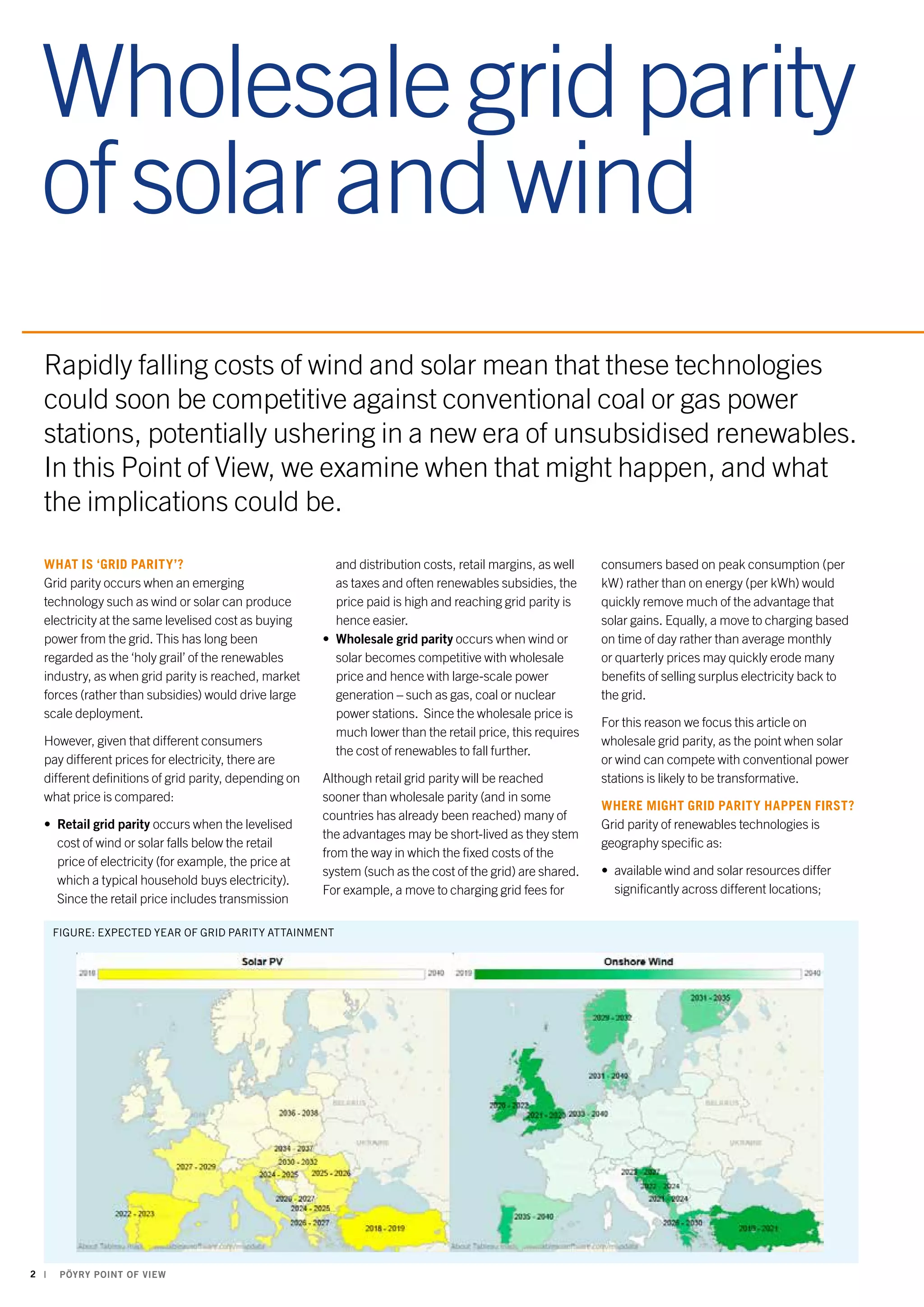
FIGURE: EXPECTED YEAR OF GRID PARITY ATTAINMENT
“A system where wind and solar 
become competitive with 
wholesale market prices will mark 
a massive shift in the evolution of 
these technologies.” 
PÖYRY POINT OF VIEW | 3 
• installation and operating costs of wind and 
solar vary from location to location; and 
• electricity prices vary by country or region 
depending on relevant generation mix, fuel 
and carbon prices, and short-run marginal 
cost of marginal generators in the system. 
In Europe, there is much more sun in the south, 
and wind in the north, so we would expect 
these to be the dominant factors driving grid 
parity. However, the cost of electricity is also 
crucial, as whether a country has a system 
dominated by hydro (leading to low prices) or 
gas (currently leading to high prices) is vital. 
Thus a country with high electricity costs and 
excellent solar or wind resource is likely to be 
first for large-scale deployment of solar or wind 
without subsidies. 
When might grid parity be reached? 
We have conducted a detailed analysis to 
assess when wind and solar will reach grid 
parity across Europe by applying our state-of-the- 
art electricity market model BID3. BID3 
is the leading European electricity market 
simulation software1 for modelling the dispatch 
of all generation on the European network. 
Country specific wind and solar output profiles 
based on wind speed data of a 20x20 km 
grid and solar radiation data of a 30x30 km 
grid were applied. A pragmatic learning rate 
of these renewable technologies was also 
considered. Furthermore, our analysis is 
centred on wholesale electricity prices based 
on Pöyry analysis. 
Solar PV achieves wholesale grid parity ahead 
of onshore wind, while offshore wind and 
solar CSP would not reach grid parity during 
the analysis period spanning 2014 – 2040. 
Assuming falling capital costs, countries in 
Southern Europe will first attain grid parity for 
solar PV, primarily due to high solar irradiance. 
Spain would achieve solar PV parity as early 
as 2021 followed by Portugal (2022) and Italy 
(2025 to 2032 depending on specific region). 
5% higher capex for solar PV would delay the 
grid parity by one to three years as represented 
by the upper value of the grid parity range in 
the figure. 
Onshore wind is expected to achieve wholesale 
grid parity in a very limited number of countries 
before 2030. In case of relatively lower 
onshore wind capex, Ireland will achieve grid 
parity in 2020 followed by Great Britain in 
2021 primarily due to high achievable onshore 
wind load factors in these countries. A 10% 
higher onshore wind capex would delay the 
grid parity by two to four years as represented 
by the upper value of the grid parity range in 
the figure. 
In Turkey, grid parity is gained for solar PV 
(2018) and onshore wind (2019) ahead of 
any other European country due to higher 
wholesale electricity prices in the country. 
Note that uncertainties involving cost (capex 
and opex) of renewable technologies and fuel 
(coal, oil and gas) as well as carbon prices can 
accelerate or delay the time when grid parity is 
expected to be reached. 
Implications of reaching grid parity 
Reaching grid parity for a given renewable 
technology means that it can now compete 
with other conventional technologies, mainly 
coal and gas-fired power stations, without 
subsidies. This could lead to accelerated 
deployment of such a technology provided 
there are no investment, supply chain, policy or 
regulatory constraints. 
Based on our analysis, we have found that on 
achieving grid parity an additional 220GW of 
solar PV mostly in Southern Europe and 40GW 
onshore wind across Europe can be built in the 
absence of above mentioned constraints. 
So what prevents even higher deployment of 
renewables? One of the main factors is that 
of revenue cannibalisation: as the share of 
renewables rapidly grows in a system, it puts 
a downward pressure on wholesale electricity 
prices. In particular, large amounts of solar PV 
can depress prices during the midday peak so 
that they fall below night-time prices. 
In the most extreme scenarios, the wholesale 
price drops to zero during the day – the 
strongest possible signal that no further solar is 
required on the system. 
While the above factors lead to lowering the 
wholesale electricity prices, large penetration 
of wind and solar can also result in curtailment 
of surplus wind and solar energy when the sum 
of intermittent generation and other must-run 
generation in the system at a given time 
exceeds concurrent demand. Consequently 
the achievable load factors of wind and solar 
will reduce associated with loss of revenues. 
Such situations are more likely to occur in 
systems with very limited energy storage 
facilities. 
At high penetration of renewables due to the 
combined effect of falling wholesale electricity 
prices and reduced (achievable) load factor 
of wind and solar, a threshold level of these 
technologies will be reached beyond which 
further addition of wind and solar capacity will 
not allow adequate revenues to self-sustain. 
Closing comment 
A system where wind and solar become 
competitive with wholesale market prices will 
mark a massive shift in the evolution of these 
technologies. We would expect to see large-scale 
deployment (unhindered by changes 
in regulation or government whim), with solar 
mainly in southern Europe and onshore wind in 
Northern Europe. 
Although factors such as planning permission 
and public acceptance may reduce 
deployment, the ultimate cap on deployment 
levels would be the capture price effect – by 
building more wind or solar, they reduce prices 
and hence become uneconomic. 
Ultimately, the goal of wholesale grid-parity of 
renewables remains a long way off, and unless 
there is a further shift in capital or deployment 
costs, most large-scale renewables deployment 
in the next 20 years will remain subsidised. 
1 BID3 simulates all 8760 hours per year, with multiple 
historical weather patterns, generating hourly 
wholesale prices for each country for each future 
modelled year, and dispatch patterns and revenues for 
plants in Europe. Further information: 
www.poyry.com/bid3
Photos: colourbox.com 
Pöyry Management Consulting 
AUSTRALIA 
Melbourne 
Phone: +61 3 9252 2700 
AUSTRIA 
Vienna 
Phone: +43 1 6411 800 
BRAZIL 
Curitiba 
Phone: +55 41 3252 7665 
São Paulo 
Phone: +55 11 5187 5555 
CHINA 
Shanghai 
Phone: +86 21 6115 9660 
FINLAND 
Helsinki 
Phone: +358 10 3311 
FRANCE 
Paris 
Phone: +33 156 88 2710 
GERMANY 
Düsseldorf 
Phone: +49 211 175 2380 
Munich 
Phone: +49 89 954771 62 
INDONESIA 
Jakarta 
Phone: +62 21 527 5552 
ITALY 
Milan 
Phone: +39 02 3659 6900 
NEW ZEALAND 
Auckland 
Phone: +64 9 918 1100 
www.poyry.com 
NORWAY 
Oslo 
Phone: +47 4540 5000 
RUSSIA 
Moscow 
Phone: +7 495 937 5257 
SINGAPORE 
Phone: +65 6733 3331 
SPAIN 
Madrid 
Phone: +34 615 457 290 
SWEDEN 
Stockholm 
Phone: +46 8 528 01200 
SWITZERLAND 
Zurich 
Phone: +41 44 288 9090 
THAILAND 
Bangkok 
Phone: +66 2 657 1000 
UNITED ARAB EMIRATES 
Dubai 
Phone: +971 4 6069 500 
UNITED KINGDOM 
London 
Phone: +44 207 932 8200 
Oxford 
Phone: +44 1865 722 660 
USA 
Atlanta 
Phone: +1 404 585 2117 
New York 
Phone: +1 646 651 1547 
Pöyry is an international consulting and engineering company. We serve 
clients globally across the energy and industrial sectors and locally in 
our core markets. We deliver strategic advisory and engineering 
services, underpinned by strong project implementation capability and 
expertise. Our focus sectors are power generation, transmission & 
distribution, forest industry, chemicals & biorefining, mining & metals, 
transportation and water. Pöyry has an extensive local office network 
employing about 6,000 experts. 
About the 
Pöyry Point of 
View 
Staying on top of your game means keeping up with the 
latest thinking, trends and developments. We know that this 
can sometimes be tough as the pace of change continues... 
At Pöyry, we encourage our global network of experts to 
actively contribute to the debate - generating fresh insight 
and challenging the status quo. The Pöyry Point of View is 
our practical, accessible and issues-based approach to 
sharing our latest thinking. 
We invite you to take a look – please let us know your 
thoughts. 
Disclaimer 
Pöyry reserves all rights to this publication. No part of this 
publication may be reproduced or used in any form without the prior 
written consent of Pöyry. This publication is partly based on 
information that is not within Pöyry’s control. Pöyry does not make 
any representation or warranty, expressed or implied, as to the 
accuracy or completeness of the information contained in this 
publication. Pöyry expressly disclaims any and all liability arising out 
of or relating to the use of this publication. 
This publication may contain projections which are based on 
assumptions subjected to uncertainties and contingencies. 
Because of the subjective judgments and inherent uncertainties of 
projections, and because events frequently do not occur as 
expected, there can be no assurance that the projections contained 
herein will be realized and actual results may be different from 
projected results. Hence the projections supplied are not to be 
regarded as firm predictions of the future, but rather as illustrations 
of what might happen. 
Join the debate 
R 
www.linkedin.com/ 
company/Poyry 
@PoyryPlc 
#PoyryPOV 
www.youtube.com/ 
PoyryPlc 
www.facebook.com/ 
PoyryPlc 
PN 0019 2014/10 V1

Pov renewable subsidies_pn0019_v1_web

  • 1.
    PÖyry point ofview - OCTOBER 2014 Is the end in sight for renewable subsidies?
  • 2.
    Wholesale grid parity of solar and wind Rapidly falling costs of wind and solar mean that these technologies could soon be competitive against conventional coal or gas power stations, potentially ushering in a new era of unsubsidised renewables. In this Point of View, we examine when that might happen, and what the implications could be. What is ‘grid parity’? Grid parity occurs when an emerging technology such as wind or solar can produce electricity at the same levelised cost as buying power from the grid. This has long been regarded as the ‘holy grail’ of the renewables industry, as when grid parity is reached, market forces (rather than subsidies) would drive large scale deployment. However, given that different consumers pay different prices for electricity, there are different definitions of grid parity, depending on what price is compared: • Retail grid parity occurs when the levelised cost of wind or solar falls below the retail price of electricity (for example, the price at which a typical household buys electricity). Since the retail price includes transmission 2 | PÖYRY POINT OF VIEW and distribution costs, retail margins, as well as taxes and often renewables subsidies, the price paid is high and reaching grid parity is hence easier. • Wholesale grid parity occurs when wind or solar becomes competitive with wholesale price and hence with large-scale power generation – such as gas, coal or nuclear power stations. Since the wholesale price is much lower than the retail price, this requires the cost of renewables to fall further. Although retail grid parity will be reached sooner than wholesale parity (and in some countries has already been reached) many of the advantages may be short-lived as they stem from the way in which the fixed costs of the system (such as the cost of the grid) are shared. For example, a move to charging grid fees for consumers based on peak consumption (per kW) rather than on energy (per kWh) would quickly remove much of the advantage that solar gains. Equally, a move to charging based on time of day rather than average monthly or quarterly prices may quickly erode many benefits of selling surplus electricity back to the grid. For this reason we focus this article on wholesale grid parity, as the point when solar or wind can compete with conventional power stations is likely to be transformative. Where might grid parity happen first? Grid parity of renewables technologies is geography specific as: • available wind and solar resources differ significantly across different locations; FIGURE: EXPECTED YEAR OF GRID PARITY ATTAINMENT
  • 3.
    “A system wherewind and solar become competitive with wholesale market prices will mark a massive shift in the evolution of these technologies.” PÖYRY POINT OF VIEW | 3 • installation and operating costs of wind and solar vary from location to location; and • electricity prices vary by country or region depending on relevant generation mix, fuel and carbon prices, and short-run marginal cost of marginal generators in the system. In Europe, there is much more sun in the south, and wind in the north, so we would expect these to be the dominant factors driving grid parity. However, the cost of electricity is also crucial, as whether a country has a system dominated by hydro (leading to low prices) or gas (currently leading to high prices) is vital. Thus a country with high electricity costs and excellent solar or wind resource is likely to be first for large-scale deployment of solar or wind without subsidies. When might grid parity be reached? We have conducted a detailed analysis to assess when wind and solar will reach grid parity across Europe by applying our state-of-the- art electricity market model BID3. BID3 is the leading European electricity market simulation software1 for modelling the dispatch of all generation on the European network. Country specific wind and solar output profiles based on wind speed data of a 20x20 km grid and solar radiation data of a 30x30 km grid were applied. A pragmatic learning rate of these renewable technologies was also considered. Furthermore, our analysis is centred on wholesale electricity prices based on Pöyry analysis. Solar PV achieves wholesale grid parity ahead of onshore wind, while offshore wind and solar CSP would not reach grid parity during the analysis period spanning 2014 – 2040. Assuming falling capital costs, countries in Southern Europe will first attain grid parity for solar PV, primarily due to high solar irradiance. Spain would achieve solar PV parity as early as 2021 followed by Portugal (2022) and Italy (2025 to 2032 depending on specific region). 5% higher capex for solar PV would delay the grid parity by one to three years as represented by the upper value of the grid parity range in the figure. Onshore wind is expected to achieve wholesale grid parity in a very limited number of countries before 2030. In case of relatively lower onshore wind capex, Ireland will achieve grid parity in 2020 followed by Great Britain in 2021 primarily due to high achievable onshore wind load factors in these countries. A 10% higher onshore wind capex would delay the grid parity by two to four years as represented by the upper value of the grid parity range in the figure. In Turkey, grid parity is gained for solar PV (2018) and onshore wind (2019) ahead of any other European country due to higher wholesale electricity prices in the country. Note that uncertainties involving cost (capex and opex) of renewable technologies and fuel (coal, oil and gas) as well as carbon prices can accelerate or delay the time when grid parity is expected to be reached. Implications of reaching grid parity Reaching grid parity for a given renewable technology means that it can now compete with other conventional technologies, mainly coal and gas-fired power stations, without subsidies. This could lead to accelerated deployment of such a technology provided there are no investment, supply chain, policy or regulatory constraints. Based on our analysis, we have found that on achieving grid parity an additional 220GW of solar PV mostly in Southern Europe and 40GW onshore wind across Europe can be built in the absence of above mentioned constraints. So what prevents even higher deployment of renewables? One of the main factors is that of revenue cannibalisation: as the share of renewables rapidly grows in a system, it puts a downward pressure on wholesale electricity prices. In particular, large amounts of solar PV can depress prices during the midday peak so that they fall below night-time prices. In the most extreme scenarios, the wholesale price drops to zero during the day – the strongest possible signal that no further solar is required on the system. While the above factors lead to lowering the wholesale electricity prices, large penetration of wind and solar can also result in curtailment of surplus wind and solar energy when the sum of intermittent generation and other must-run generation in the system at a given time exceeds concurrent demand. Consequently the achievable load factors of wind and solar will reduce associated with loss of revenues. Such situations are more likely to occur in systems with very limited energy storage facilities. At high penetration of renewables due to the combined effect of falling wholesale electricity prices and reduced (achievable) load factor of wind and solar, a threshold level of these technologies will be reached beyond which further addition of wind and solar capacity will not allow adequate revenues to self-sustain. Closing comment A system where wind and solar become competitive with wholesale market prices will mark a massive shift in the evolution of these technologies. We would expect to see large-scale deployment (unhindered by changes in regulation or government whim), with solar mainly in southern Europe and onshore wind in Northern Europe. Although factors such as planning permission and public acceptance may reduce deployment, the ultimate cap on deployment levels would be the capture price effect – by building more wind or solar, they reduce prices and hence become uneconomic. Ultimately, the goal of wholesale grid-parity of renewables remains a long way off, and unless there is a further shift in capital or deployment costs, most large-scale renewables deployment in the next 20 years will remain subsidised. 1 BID3 simulates all 8760 hours per year, with multiple historical weather patterns, generating hourly wholesale prices for each country for each future modelled year, and dispatch patterns and revenues for plants in Europe. Further information: www.poyry.com/bid3
  • 4.
    Photos: colourbox.com PöyryManagement Consulting AUSTRALIA Melbourne Phone: +61 3 9252 2700 AUSTRIA Vienna Phone: +43 1 6411 800 BRAZIL Curitiba Phone: +55 41 3252 7665 São Paulo Phone: +55 11 5187 5555 CHINA Shanghai Phone: +86 21 6115 9660 FINLAND Helsinki Phone: +358 10 3311 FRANCE Paris Phone: +33 156 88 2710 GERMANY Düsseldorf Phone: +49 211 175 2380 Munich Phone: +49 89 954771 62 INDONESIA Jakarta Phone: +62 21 527 5552 ITALY Milan Phone: +39 02 3659 6900 NEW ZEALAND Auckland Phone: +64 9 918 1100 www.poyry.com NORWAY Oslo Phone: +47 4540 5000 RUSSIA Moscow Phone: +7 495 937 5257 SINGAPORE Phone: +65 6733 3331 SPAIN Madrid Phone: +34 615 457 290 SWEDEN Stockholm Phone: +46 8 528 01200 SWITZERLAND Zurich Phone: +41 44 288 9090 THAILAND Bangkok Phone: +66 2 657 1000 UNITED ARAB EMIRATES Dubai Phone: +971 4 6069 500 UNITED KINGDOM London Phone: +44 207 932 8200 Oxford Phone: +44 1865 722 660 USA Atlanta Phone: +1 404 585 2117 New York Phone: +1 646 651 1547 Pöyry is an international consulting and engineering company. We serve clients globally across the energy and industrial sectors and locally in our core markets. We deliver strategic advisory and engineering services, underpinned by strong project implementation capability and expertise. Our focus sectors are power generation, transmission & distribution, forest industry, chemicals & biorefining, mining & metals, transportation and water. Pöyry has an extensive local office network employing about 6,000 experts. About the Pöyry Point of View Staying on top of your game means keeping up with the latest thinking, trends and developments. We know that this can sometimes be tough as the pace of change continues... At Pöyry, we encourage our global network of experts to actively contribute to the debate - generating fresh insight and challenging the status quo. The Pöyry Point of View is our practical, accessible and issues-based approach to sharing our latest thinking. We invite you to take a look – please let us know your thoughts. Disclaimer Pöyry reserves all rights to this publication. No part of this publication may be reproduced or used in any form without the prior written consent of Pöyry. This publication is partly based on information that is not within Pöyry’s control. Pöyry does not make any representation or warranty, expressed or implied, as to the accuracy or completeness of the information contained in this publication. Pöyry expressly disclaims any and all liability arising out of or relating to the use of this publication. This publication may contain projections which are based on assumptions subjected to uncertainties and contingencies. Because of the subjective judgments and inherent uncertainties of projections, and because events frequently do not occur as expected, there can be no assurance that the projections contained herein will be realized and actual results may be different from projected results. Hence the projections supplied are not to be regarded as firm predictions of the future, but rather as illustrations of what might happen. Join the debate R www.linkedin.com/ company/Poyry @PoyryPlc #PoyryPOV www.youtube.com/ PoyryPlc www.facebook.com/ PoyryPlc PN 0019 2014/10 V1