Max Mongelli
Clinical Associate Professor
Western Clinical School
University of Sydney
Nepean Hospital
Post-Partum Hemorrhage:
Management and
Complications
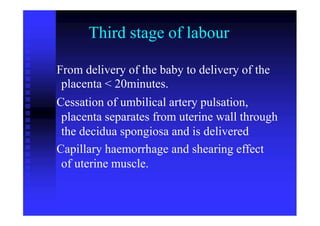
Third stage of labour
From delivery of the baby to delivery of the
placenta < 20minutes.
Cessation of umbilical artery pulsation,
placenta separates from uterine wall through
the decidua spongiosa and is delivered
Capillary haemorrhage and shearing effect
of uterine muscle.
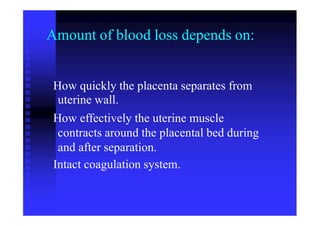
Amount of blood loss depends on:
How quickly the placenta separates from
uterine wall.
How effectively the uterine muscle
contracts around the placental bed during
and after separation.
Intact coagulation system.
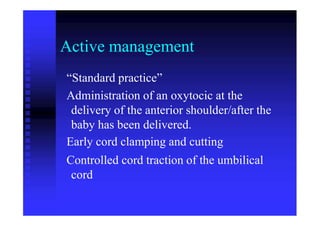
Active management
“Standard practice”
Administration of an oxytocic at the
delivery of the anterior shoulder/after the
baby has been delivered.
Early cord clamping and cutting
Controlled cord traction of the umbilical
cord
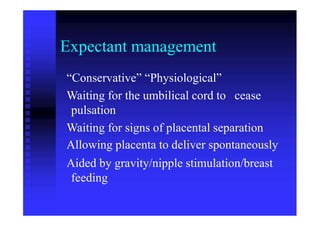
Expectant management
“Conservative” “Physiological”
Waiting for the umbilical cord to
pulsation
cease
Waiting for signs of placental separation
Allowing placenta to deliver spontaneously
Aided by gravity/nipple stimulation/breast
feeding
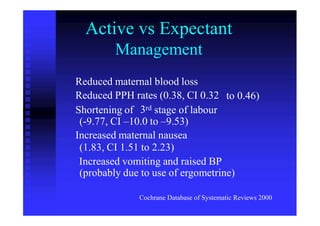
Active vs Expectant
Management
Reduced maternal blood loss
Reduced PPH rates (0.38, CI 0.32 to 0.46)
3rdShortening of stage of labour
(-9.77, CI –10.0 to –9.53)
Increased maternal nausea
(1.83, CI 1.51 to 2.23)
Increased vomiting and raised BP
(probably due to use of ergometrine)
Cochrane Database of Systematic Reviews 2000
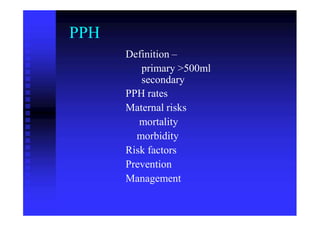
PPH
Definition –
primary >500ml
secondary
PPH rates
Maternal risks
mortality
morbidity
Risk factors
Prevention
Management
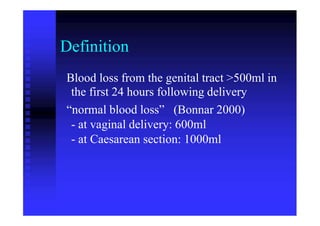
Definition
Blood loss from the genital tract >500ml in
the first 24 hours following delivery
“normal blood loss” (Bonnar 2000)
- at vaginal delivery: 600ml
- at Caesarean section: 1000ml
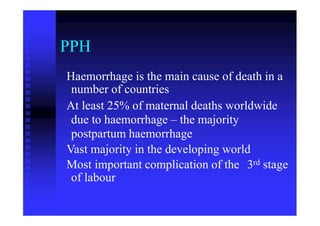
PPH
Haemorrhage is the main cause of death in a
number of countries
At least 25% of maternal deaths worldwide
due to haemorrhage – the majority
postpartum haemorrhage
Vast majority in the developing world
3rdMost important complication of the
of labour
stage
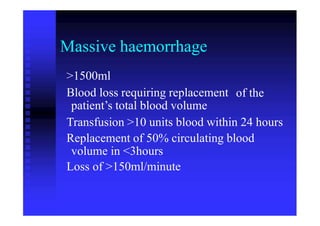
Massive haemorrhage
>1500ml
Blood loss requiring replacement
patient’s total blood volume
of the
Transfusion >10 units blood within 24 hours
Replacement of 50% circulating blood
volume in <3hours
Loss of >150ml/minute
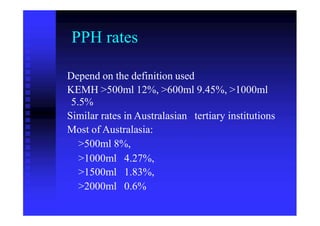
PPH rates
Depend on the definition used
KEMH >500ml 12%, >600ml 9.45%, >1000ml
5.5%
Similar rates in Australasian
Most of Australasia:
>500ml 8%,
tertiary institutions
>1000ml
>1500ml
>2000ml
4.27%,
1.83%,
0.6%
Maternal risks
Mortality
Triennial reports from UK 1985-96 show no
significant reduction in the number of deaths
haemorrhage (30 each triennia)
Majority due to substandard care
DELAY in - correction of hypovolaemia,
- diagnosis and treatment of defective
coagulation
- surgical control of bleeding
“TOO LITTLE TOO LATE”
from
Mortality
Developing countries PPH 125,000 deaths/yr
28% of maternal deaths
Risk 1 in 1000
Australia 1 in 100,000 deliveries die of PPH
Life threatening haemorrhage 1 in 1000 deliveries
Risk increases with increasing maternal age
especially >35 years
Morbidity
Coagulopathy (DIC)
Fluid overload/Pulmonary
Left ventricular failure
edema
Morbidity
Injury to ureter and bladder
intervention
Sheehans syndrome
from surgical
permanent hypopituitarism caused by
avascular necrosis of the anterior
pituitary gland,
failure of lactation, amenorrhoea,
hypothyroidism and adrenocortical
insufficiency
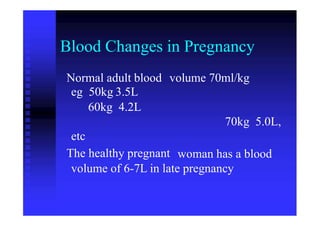
Blood Changes in Pregnancy
Normal adult blood
eg 50kg 3.5L
volume 70ml/kg
60kg 4.2L
70kg 5.0L,
etc
The healthy pregnant woman has a blood
volume of 6-7L in late pregnancy
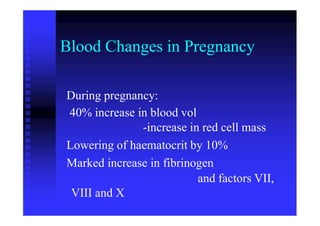
Blood Changes in Pregnancy
During pregnancy:
40% increase in blood vol
-increase in red cell mass
Lowering of haematocrit by 10%
Marked increase in fibrinogen
and factors VII,
VIII and X
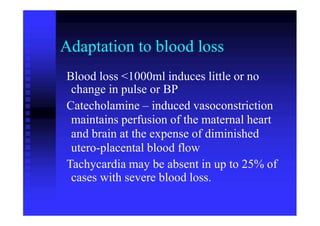
Adaptation to blood loss
Blood loss <1000ml induces little or no
change in pulse or BP
Catecholamine – induced vasoconstriction
maintains perfusion of the maternal heart
and brain at the expense of diminished
utero-placental blood flow
Tachycardia may be absent in up to 25% of
cases with severe blood loss.
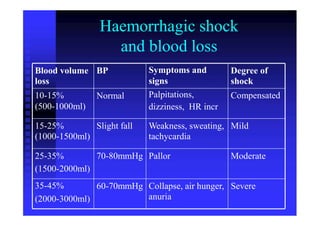
Haemorrhagic shock
and blood loss
Symptoms and
signs
Palpitations,
Blood volume
loss
10-15%
(500-1000ml)
BP Degree of
shock
CompensatedNormal
dizziness, HR incr
15-25%
(1000-1500ml)
Slight fall Weakness, sweating,
tachycardia
Mild
25-35%
(1500-2000ml)
35-45%
(2000-3000ml)
70-80mmHg Pallor Moderate
60-70mmHg Collapse, air hunger,
anuria
Severe
Disseminated Intravascular Coagulation
Depletion of fibrinogen, coagulation
circulating platelets
Haemostatic failure
Microvascular bleeding
Increased blood loss
Unlikely if platelet count is normal
factors and
Risk Factors for PPH (1)
Placenta praevia, especially
accreta/percreta/increta
Previous history of PPH
Previous history of retained
if associated with
placenta, Ashermans
syndrome, endometrial ablation
Hypertensive disorders
Manual removal of retained placenta
Refusal of blood transfusion
Risk Factors for PPH (2)
Maternal obesity
Large baby
APH/abruption
Multiple pregnancy
Previous PPH (recurrence rate 8-10%)
Operative delivery – Emergency CS
substantially increases the risk
Risk Factors for PPH (3)
Anaemia
Induction/augmentation
Instrumental delivery
of labour
(1st 2ndProlonged labour or stage)
Grand multiparity (>5)
Bleeding disorder (eg Von Willebrandt’s)
Use of anti-epileptic medications
Prevention of PPH:
Antenatal period
Identification and correction of anemia
pregnancy
in
Detection
Detection
Care plan
of sub-clinical bleeding disorders
of placenta accreta/percreta
for management of third stage if
risk factors detected
Prevention of PPH (2)
Oxytocic policy
Venous access, G+H, active management of
third stage, oxytocin infusion in those
identified as at risk
Senior obstetrician/anaesthetist at placenta
praevia CS
+/-gynae oncologist at placenta accreta CS
Management of PPH
Call for help
Resuscitate
Restore circulating blood volume
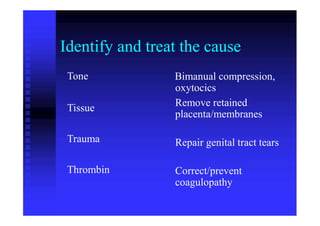
Identify and treat the cause
Resuscitation
Massage fundus
Venous access, 16 gauge cannula,
Tilt head down, O2 by face mask
Bloods:FBC, Coags, X-match
IDC
Monitoring
x2
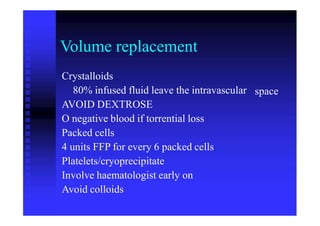
Volume replacement
Crystalloids
80% infused fluid leave the intravascular
AVOID DEXTROSE
O negative blood if torrential loss
Packed cells
4 units FFP for every 6 packed cells
Platelets/cryoprecipitate
Involve haematologist early on
Avoid colloids
space
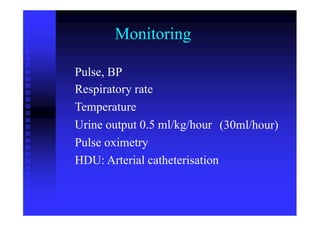
Monitoring
Pulse, BP
Respiratory rate
Temperature
Urine output 0.5 ml/kg/hour
Pulse oximetry
(30ml/hour)
HDU: Arterial catheterisation
Identify
Tone
and treat the cause
Bimanual compression,
oxytocics
Remove retained
placenta/membranes
Tissue
Trauma Repair genital tract tears
Thrombin Correct/prevent
coagulopathy
Uterine atony
Most common cause of PPH
Oxytocin infusion (as per local
Ergometrine IM
protocol)
Rectal misoprostol (up to 800mcg)
Rectal PGE2 (20 mg)
Intra-myometrial PG F2 alpha (250 mcg)
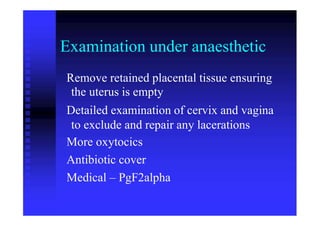
Examination under anaesthetic
Remove retained placental tissue ensuring
the uterus is empty
Detailed examination of cervix and vagina
to exclude and repair any lacerations
More oxytocics
Antibiotic cover
Medical – PgF2alpha
Case Scenario
You are the SR/consultant called to theatre.
Junior registar has a patient who has lost
1500ml has done EUA, given oxytocics
including PgF2alpha and the patient is
continuing to bleed.
What are you going to do?
Continued bleeding
Uterine tamponade
Foley catheter
Double balloon catheter
Uterine packing
Sengstaken-Blakemore tube
Consider calling gynae oncologist
Consider arterial embolisation – interventional
radiologist
Laparotomy
Uterine haemostatic suture
B Lynch suture
Modified B Lynch
Arterial ligation
Bilateral internal artery ligation
Bilateral uterine/ovarian artery
ligation
Hysterectomy
Total
Subtotal
Technique
70mm round bodied No.2 CCG
3cm from the right lower edge and 3cm
from the right lateral border of the incision
Thread through into the uterine cavity and
emerge the needle 3cm above the incision
Pass the CCG over the fundus 3-4cm from
the right cornual border
Technique
Feed CCG posteriorly and vertically.
Enter uterine cavity posteriorly at same site
as superior anterior entry point
Pull CCG under moderate tension, assistant
applies manual compression
Pass suture horizontally to emerge on
posterior wall at the same level but on the
left posterior side of the uterus
Technique
Suture knot using two or three throws whilst
assistant maintains bimanual compression
Close the lower transverse incision in the
uterus
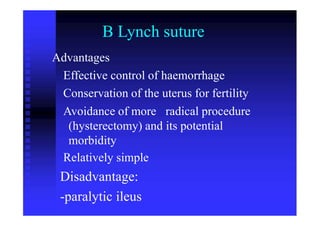
B Lynch suture
Advantages
Effective control of haemorrhage
Conservation of the uterus for fertility
Avoidance of more
(hysterectomy) and
morbidity
Relatively simple
Disadvantage:
-paralytic ileus
radical procedure
its potential
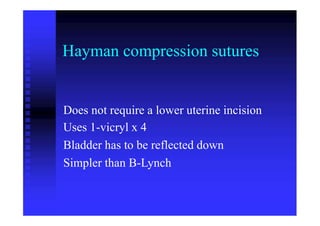
Hayman compression sutures
Does not require a lower uterine incision
Uses 1-vicryl x 4
Bladder has to be reflected down
Simpler than B-Lynch
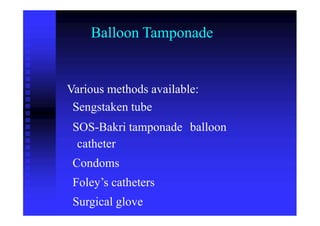
Balloon Tamponade
Various methods available:
Sengstaken tube
SOS-Bakri tamponade
catheter
Condoms
Foley’s catheters
Surgical glove
balloon
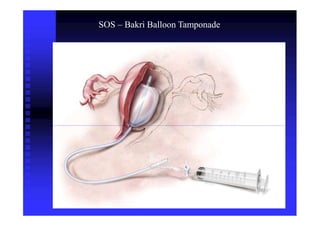
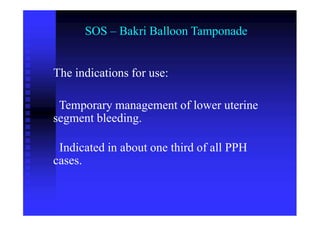
SOS – Bakri Balloon Tamponade
The indications for use:
Temporary management of lower uterine
segment bleeding.
Indicated in about one third of all PPH
cases.
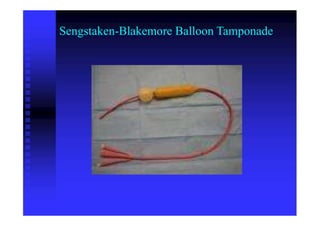
Sengstaken-Blakemore Balloon Tamponade
Esophageal balloon inflated to 250 ml with
normal saline
Prophylactic antibiotics
Prevented major surgery in more than 70%
of cases
May help reduce bleeding if transfer is
required.
Balloon Tamponade with Condoms
The idea was first introduced by Professor Sayeba Akhter
(Dhaka, Bangladesh) to save the life of a woman who had
severe jaundice with intractable PPH.
Condom is inflated with isotonic saline of 250 – 500 ml
(sometime >500 ml – 1 L)
When the bleeding is reduced considerably, further
inflation is stopped. then outer end of the catheter is
folded and fixed to the thigh.
To keep the inflated balloon within the uterus, the post
vagina is packed with sterile pack
Uterine Artery Ligation -
“O’ Leary Stitch”
Requires downward bladder reflection
risk of ureteric injury.
to reduce
Bilateral ligation effective in 90% of cases
High ligature may be required.
Low risk of long-term complications
Interventional Radiology
Percutaneous transcatheter embolisation
Must be performed before uterine artery
ligation
Performed under fluoroscopic guidance
Gelfoam is the preferred agent
Angiographic occlusion balloon catheters
Success rate 95-97%
Useful for vulvovaginal hematomas
Interventional Radiology:
Disadvantages
There may be a significant delay before
personnel and equipment are in place
Not widely available
Contraindicated if coagulopathy is present
Minimal data on subsequent pregnancy
outcomes
Interventional Radiology:
Complications
Procedure related morbidity
Post-embolisation fever
Buttock ischemia
Vascular perforation
Infection
of 6%
Case scenario
You are a GP obstetrician delivering a low
risk woman in a country hospital.
You are delivering the placenta and note
that her BP has suddenly fallen to 80/40,
pulse
What
What
40. She is bleeding profusely
do you do?
is your differential diagnosis?
Concealed PPH
If hypovolaemic……..and no overt
consider
Broad ligament haematoma
bleeding
Ischiorectal fossa haemorrhage/haematoma
Paravaginal haematoma
Intra abdominal bleeding
Previous uterine scar – uterine rupture
Rupture of vascular aneurysms
Liver/spleen rupture
Conclusions
Relevance of PPH worldwide
Increasing incidence of PPH
Prophylaxis
Don’t forget the basics
Good luck!

Postpartum Hemorrhage

  • 1.
    Max Mongelli Clinical AssociateProfessor Western Clinical School University of Sydney Nepean Hospital Post-Partum Hemorrhage: Management and Complications
  • 2.
    Third stage oflabour From delivery of the baby to delivery of the placenta < 20minutes. Cessation of umbilical artery pulsation, placenta separates from uterine wall through the decidua spongiosa and is delivered Capillary haemorrhage and shearing effect of uterine muscle.
  • 3.
    Amount of bloodloss depends on: How quickly the placenta separates from uterine wall. How effectively the uterine muscle contracts around the placental bed during and after separation. Intact coagulation system.
  • 4.
    Active management “Standard practice” Administrationof an oxytocic at the delivery of the anterior shoulder/after the baby has been delivered. Early cord clamping and cutting Controlled cord traction of the umbilical cord
  • 5.
    Expectant management “Conservative” “Physiological” Waitingfor the umbilical cord to pulsation cease Waiting for signs of placental separation Allowing placenta to deliver spontaneously Aided by gravity/nipple stimulation/breast feeding
  • 6.
    Active vs Expectant Management Reducedmaternal blood loss Reduced PPH rates (0.38, CI 0.32 to 0.46) 3rdShortening of stage of labour (-9.77, CI –10.0 to –9.53) Increased maternal nausea (1.83, CI 1.51 to 2.23) Increased vomiting and raised BP (probably due to use of ergometrine) Cochrane Database of Systematic Reviews 2000
  • 7.
    PPH Definition – primary >500ml secondary PPHrates Maternal risks mortality morbidity Risk factors Prevention Management
  • 8.
    Definition Blood loss fromthe genital tract >500ml in the first 24 hours following delivery “normal blood loss” (Bonnar 2000) - at vaginal delivery: 600ml - at Caesarean section: 1000ml
  • 9.
    PPH Haemorrhage is themain cause of death in a number of countries At least 25% of maternal deaths worldwide due to haemorrhage – the majority postpartum haemorrhage Vast majority in the developing world 3rdMost important complication of the of labour stage
  • 10.
    Massive haemorrhage >1500ml Blood lossrequiring replacement patient’s total blood volume of the Transfusion >10 units blood within 24 hours Replacement of 50% circulating blood volume in <3hours Loss of >150ml/minute
  • 11.
    PPH rates Depend onthe definition used KEMH >500ml 12%, >600ml 9.45%, >1000ml 5.5% Similar rates in Australasian Most of Australasia: >500ml 8%, tertiary institutions >1000ml >1500ml >2000ml 4.27%, 1.83%, 0.6%
  • 12.
    Maternal risks Mortality Triennial reportsfrom UK 1985-96 show no significant reduction in the number of deaths haemorrhage (30 each triennia) Majority due to substandard care DELAY in - correction of hypovolaemia, - diagnosis and treatment of defective coagulation - surgical control of bleeding “TOO LITTLE TOO LATE” from
  • 13.
    Mortality Developing countries PPH125,000 deaths/yr 28% of maternal deaths Risk 1 in 1000 Australia 1 in 100,000 deliveries die of PPH Life threatening haemorrhage 1 in 1000 deliveries Risk increases with increasing maternal age especially >35 years
  • 14.
  • 15.
    Morbidity Injury to ureterand bladder intervention Sheehans syndrome from surgical permanent hypopituitarism caused by avascular necrosis of the anterior pituitary gland, failure of lactation, amenorrhoea, hypothyroidism and adrenocortical insufficiency
  • 16.
    Blood Changes inPregnancy Normal adult blood eg 50kg 3.5L volume 70ml/kg 60kg 4.2L 70kg 5.0L, etc The healthy pregnant woman has a blood volume of 6-7L in late pregnancy
  • 17.
    Blood Changes inPregnancy During pregnancy: 40% increase in blood vol -increase in red cell mass Lowering of haematocrit by 10% Marked increase in fibrinogen and factors VII, VIII and X
  • 18.
    Adaptation to bloodloss Blood loss <1000ml induces little or no change in pulse or BP Catecholamine – induced vasoconstriction maintains perfusion of the maternal heart and brain at the expense of diminished utero-placental blood flow Tachycardia may be absent in up to 25% of cases with severe blood loss.
  • 19.
    Haemorrhagic shock and bloodloss Symptoms and signs Palpitations, Blood volume loss 10-15% (500-1000ml) BP Degree of shock CompensatedNormal dizziness, HR incr 15-25% (1000-1500ml) Slight fall Weakness, sweating, tachycardia Mild 25-35% (1500-2000ml) 35-45% (2000-3000ml) 70-80mmHg Pallor Moderate 60-70mmHg Collapse, air hunger, anuria Severe
  • 20.
    Disseminated Intravascular Coagulation Depletionof fibrinogen, coagulation circulating platelets Haemostatic failure Microvascular bleeding Increased blood loss Unlikely if platelet count is normal factors and
  • 21.
    Risk Factors forPPH (1) Placenta praevia, especially accreta/percreta/increta Previous history of PPH Previous history of retained if associated with placenta, Ashermans syndrome, endometrial ablation Hypertensive disorders Manual removal of retained placenta Refusal of blood transfusion
  • 22.
    Risk Factors forPPH (2) Maternal obesity Large baby APH/abruption Multiple pregnancy Previous PPH (recurrence rate 8-10%) Operative delivery – Emergency CS substantially increases the risk
  • 23.
    Risk Factors forPPH (3) Anaemia Induction/augmentation Instrumental delivery of labour (1st 2ndProlonged labour or stage) Grand multiparity (>5) Bleeding disorder (eg Von Willebrandt’s) Use of anti-epileptic medications
  • 24.
    Prevention of PPH: Antenatalperiod Identification and correction of anemia pregnancy in Detection Detection Care plan of sub-clinical bleeding disorders of placenta accreta/percreta for management of third stage if risk factors detected
  • 25.
    Prevention of PPH(2) Oxytocic policy Venous access, G+H, active management of third stage, oxytocin infusion in those identified as at risk Senior obstetrician/anaesthetist at placenta praevia CS +/-gynae oncologist at placenta accreta CS
  • 26.
    Management of PPH Callfor help Resuscitate Restore circulating blood volume Identify and treat the cause
  • 27.
    Resuscitation Massage fundus Venous access,16 gauge cannula, Tilt head down, O2 by face mask Bloods:FBC, Coags, X-match IDC Monitoring x2
  • 28.
    Volume replacement Crystalloids 80% infusedfluid leave the intravascular AVOID DEXTROSE O negative blood if torrential loss Packed cells 4 units FFP for every 6 packed cells Platelets/cryoprecipitate Involve haematologist early on Avoid colloids space
  • 29.
    Monitoring Pulse, BP Respiratory rate Temperature Urineoutput 0.5 ml/kg/hour Pulse oximetry (30ml/hour) HDU: Arterial catheterisation
  • 30.
    Identify Tone and treat thecause Bimanual compression, oxytocics Remove retained placenta/membranes Tissue Trauma Repair genital tract tears Thrombin Correct/prevent coagulopathy
  • 31.
    Uterine atony Most commoncause of PPH Oxytocin infusion (as per local Ergometrine IM protocol) Rectal misoprostol (up to 800mcg) Rectal PGE2 (20 mg) Intra-myometrial PG F2 alpha (250 mcg)
  • 32.
    Examination under anaesthetic Removeretained placental tissue ensuring the uterus is empty Detailed examination of cervix and vagina to exclude and repair any lacerations More oxytocics Antibiotic cover Medical – PgF2alpha
  • 33.
    Case Scenario You arethe SR/consultant called to theatre. Junior registar has a patient who has lost 1500ml has done EUA, given oxytocics including PgF2alpha and the patient is continuing to bleed. What are you going to do?
  • 34.
    Continued bleeding Uterine tamponade Foleycatheter Double balloon catheter Uterine packing Sengstaken-Blakemore tube Consider calling gynae oncologist Consider arterial embolisation – interventional radiologist
  • 35.
    Laparotomy Uterine haemostatic suture BLynch suture Modified B Lynch Arterial ligation Bilateral internal artery ligation Bilateral uterine/ovarian artery ligation Hysterectomy Total Subtotal
  • 36.
    Technique 70mm round bodiedNo.2 CCG 3cm from the right lower edge and 3cm from the right lateral border of the incision Thread through into the uterine cavity and emerge the needle 3cm above the incision Pass the CCG over the fundus 3-4cm from the right cornual border
  • 37.
    Technique Feed CCG posteriorlyand vertically. Enter uterine cavity posteriorly at same site as superior anterior entry point Pull CCG under moderate tension, assistant applies manual compression Pass suture horizontally to emerge on posterior wall at the same level but on the left posterior side of the uterus
  • 38.
    Technique Suture knot usingtwo or three throws whilst assistant maintains bimanual compression Close the lower transverse incision in the uterus
  • 39.
    B Lynch suture Advantages Effectivecontrol of haemorrhage Conservation of the uterus for fertility Avoidance of more (hysterectomy) and morbidity Relatively simple Disadvantage: -paralytic ileus radical procedure its potential
  • 40.
    Hayman compression sutures Doesnot require a lower uterine incision Uses 1-vicryl x 4 Bladder has to be reflected down Simpler than B-Lynch
  • 41.
    Balloon Tamponade Various methodsavailable: Sengstaken tube SOS-Bakri tamponade catheter Condoms Foley’s catheters Surgical glove balloon
  • 42.
    SOS – BakriBalloon Tamponade
  • 43.
    SOS – BakriBalloon Tamponade The indications for use: Temporary management of lower uterine segment bleeding. Indicated in about one third of all PPH cases.
  • 44.
  • 45.
    Sengstaken-Blakemore Balloon Tamponade Esophagealballoon inflated to 250 ml with normal saline Prophylactic antibiotics Prevented major surgery in more than 70% of cases May help reduce bleeding if transfer is required.
  • 46.
    Balloon Tamponade withCondoms The idea was first introduced by Professor Sayeba Akhter (Dhaka, Bangladesh) to save the life of a woman who had severe jaundice with intractable PPH. Condom is inflated with isotonic saline of 250 – 500 ml (sometime >500 ml – 1 L) When the bleeding is reduced considerably, further inflation is stopped. then outer end of the catheter is folded and fixed to the thigh. To keep the inflated balloon within the uterus, the post vagina is packed with sterile pack
  • 47.
    Uterine Artery Ligation- “O’ Leary Stitch” Requires downward bladder reflection risk of ureteric injury. to reduce Bilateral ligation effective in 90% of cases High ligature may be required. Low risk of long-term complications
  • 48.
    Interventional Radiology Percutaneous transcatheterembolisation Must be performed before uterine artery ligation Performed under fluoroscopic guidance Gelfoam is the preferred agent Angiographic occlusion balloon catheters Success rate 95-97% Useful for vulvovaginal hematomas
  • 49.
    Interventional Radiology: Disadvantages There maybe a significant delay before personnel and equipment are in place Not widely available Contraindicated if coagulopathy is present Minimal data on subsequent pregnancy outcomes
  • 50.
    Interventional Radiology: Complications Procedure relatedmorbidity Post-embolisation fever Buttock ischemia Vascular perforation Infection of 6%
  • 51.
    Case scenario You area GP obstetrician delivering a low risk woman in a country hospital. You are delivering the placenta and note that her BP has suddenly fallen to 80/40, pulse What What 40. She is bleeding profusely do you do? is your differential diagnosis?
  • 52.
    Concealed PPH If hypovolaemic……..andno overt consider Broad ligament haematoma bleeding Ischiorectal fossa haemorrhage/haematoma Paravaginal haematoma Intra abdominal bleeding Previous uterine scar – uterine rupture Rupture of vascular aneurysms Liver/spleen rupture
  • 53.
    Conclusions Relevance of PPHworldwide Increasing incidence of PPH Prophylaxis Don’t forget the basics Good luck!