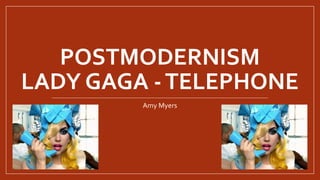
POSTMODERNISM 
LADY GAGA -TELEPHONE 
Amy Myers
HYPERREALITY 
• “Baudrillard claims that our current society has replaced all reality and meaning wit symbols 
and signs and that human experience is of a simulation of reality.” 
• “he believes we cannot separate the image from reality” 
• Applying to lady gaga: 
• She has a stage name she has created for her image, rarely referred to as Stefani Germanotta. 
• She keeps her personal life and her superstar status separate this gives her the ability to 
control her image, and get away with different things for example the meat dress. 
• “I have mastered the art of fame”. She has kept her hyper-real version of herself with the 
outrageous fashion, she is able to keep the public and press attention away from her personal 
life.
INTERTEXTUAL REFERENCING 
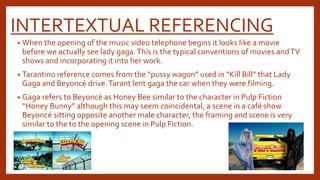
• When the opening of the music video telephone begins it looks like a movie 
before we actually see lady gaga. This is the typical conventions of movies and TV 
shows and incorporating it into her work. 
• Tarantino reference comes from the “pussy wagon” used in “Kill Bill” that Lady 
Gaga and Beyoncé drive. Tarant lent gaga the car when they were filming. 
• Gaga refers to Beyoncé as Honey Bee similar to the character in Pulp Fiction 
“Honey Bunny” although this may seem coincidental, a scene in a café show 
Beyoncé sitting opposite another male character, the framing and scene is very 
similar to the to the opening scene in Pulp Fiction.
BRICOLAGE 
• Warhol's exploration of mass consumer culture and advertising through 
his Campbell's soup studies. Gaga and akerlund challenge the gender 
stereotype of the perfect housewife portrayed in 1950s pop culture 
• Gaga plays the stereotypical 50s housewife in the scene but she uses 
bricolage to create a new meaning to show how she felt about the 50s 
house if by adding poison to the food she makes and it ends up killing 
everyone.

Postmodernism lady gaga

  • 1.
    POSTMODERNISM LADY GAGA-TELEPHONE Amy Myers
  • 2.
    HYPERREALITY • “Baudrillardclaims that our current society has replaced all reality and meaning wit symbols and signs and that human experience is of a simulation of reality.” • “he believes we cannot separate the image from reality” • Applying to lady gaga: • She has a stage name she has created for her image, rarely referred to as Stefani Germanotta. • She keeps her personal life and her superstar status separate this gives her the ability to control her image, and get away with different things for example the meat dress. • “I have mastered the art of fame”. She has kept her hyper-real version of herself with the outrageous fashion, she is able to keep the public and press attention away from her personal life.
  • 3.
    INTERTEXTUAL REFERENCING •When the opening of the music video telephone begins it looks like a movie before we actually see lady gaga. This is the typical conventions of movies and TV shows and incorporating it into her work. • Tarantino reference comes from the “pussy wagon” used in “Kill Bill” that Lady Gaga and Beyoncé drive. Tarant lent gaga the car when they were filming. • Gaga refers to Beyoncé as Honey Bee similar to the character in Pulp Fiction “Honey Bunny” although this may seem coincidental, a scene in a café show Beyoncé sitting opposite another male character, the framing and scene is very similar to the to the opening scene in Pulp Fiction.
  • 4.
    BRICOLAGE • Warhol'sexploration of mass consumer culture and advertising through his Campbell's soup studies. Gaga and akerlund challenge the gender stereotype of the perfect housewife portrayed in 1950s pop culture • Gaga plays the stereotypical 50s housewife in the scene but she uses bricolage to create a new meaning to show how she felt about the 50s house if by adding poison to the food she makes and it ends up killing everyone.