POST MODERNISM 
RESEARCH
POSTMODERNISM 
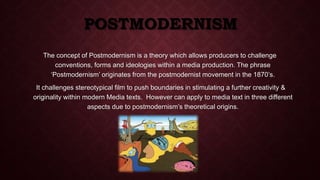
The concept of Postmodernism is a theory which allows producers to challenge 
conventions, forms and ideologies within a media production. The phrase 
‘Postmodernism’ originates from the postmodernist movement in the 1870’s. 
It challenges stereotypical film to push boundaries in stimulating a further creativity & 
originality within modern Media texts. However can apply to media text in three different 
aspects due to postmodernism’s theoretical origins.
POSTMODERNISM THEORIES 
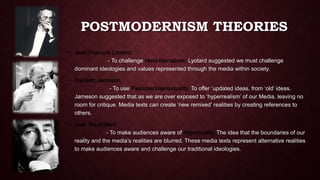
• Jean-Francois Lyotard. 
- To challenge Meta-Narratives. Lyotard suggested we must challenge 
dominant ideologies and values represented through the media within society. 
• Frederic Jameson. 
- To use Pastiche/Intertextuality. To offer ‘updated ideas, from ‘old’ ideas. 
Jameson suggested that as we are over exposed to ‘hyperrealism’ of our Media, leaving no 
room for critique. Media texts can create ‘new remixed’ realities by creating references to 
others. 
• Jean Baudrillard 
- To make audiences aware of Hyperreality. The idea that the boundaries of our 
reality and the media’s realities are blurred. These media texts represent alternative realities 
to make audiences aware and challenge our traditional ideologies.
CHALLENGING META-NARRATIVES 
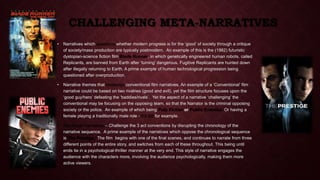
• Narratives which questions whether modern progress is for the ‘good’ of society through a critique 
of society/mass production are typically postmodern. An example of this is the (1982) futuristic 
dystopian-science fiction film Blade Runner, in which genetically engineered human robots, called 
Replicants, are banned from Earth after ‘turning’ dangerous. Fugitive Replicants are hunted down 
after illegally returning to Earth. A prime example of human technological progression being 
questioned after overproduction. 
• Narrative themes that challenge conventional film narratives. An example of a ‘Conventional’ film 
narrative could be based on two rivalries (good and evil), yet the film structure focuses upon the 
‘good guy/hero’ defeating the ‘baddies/rivals’. Yet the aspect of a narrative ‘challenging’ the 
conventional may be focusing on the opposing team, so that the Narrator is the criminal opposing 
society or the police. An example of which being Pulp Fiction or Public Enemies. Or having a 
female playing a traditionally male role - Kill Bill for example. 
• Non linear Narratives – Challenge the 3 act conventions by disrupting the chronology of the 
narrative sequence. A prime example of the narratives which oppose the chronological sequence 
is The Prestige. The film begins with one of the final scenes, and continues to narrate from three 
different points of the entire story, and switches from each of these throughout. This being until 
ends tie in a psychological-thriller manner at the very end. This style of narrative engages the 
audience with the characters more, involving the audience psychologically, making them more 
active viewers.
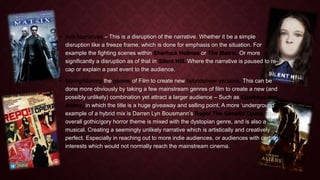
• Anti-Narratives – This is a disruption of the narrative. Whether it be a simple 
disruption like a freeze frame, which is done for emphasis on the situation. For 
example the fighting scenes within Sherlock Holmes or The Matrix. Or more 
significantly a disruption as of that in Silent Hill. Where the narrative is paused to re-cap 
or explain a past event to the audience. 
• Mixing/blurring the genres of Film to create new hybrids/new versions. This can be 
done more obviously by taking a few mainstream genres of film to create a new (and 
possibly unlikely) combination yet attract a larger audience – Such as Cowboys and 
Aliens, in which the title is a huge giveaway and selling point. A more ‘underground’ 
example of a hybrid mix is Darren Lyn Bousmann’s Repo! The Genetic Opera. The 
overall gothic/gory horror theme is mixed with the dystopian genre, and is also a 
musical. Creating a seemingly unlikely narrative which is artistically and creatively 
perfect. Especially in reaching out to more indie audiences, or audiences with certain 
interests which would not normally reach the mainstream cinema.
INTERTEXTUALITY 
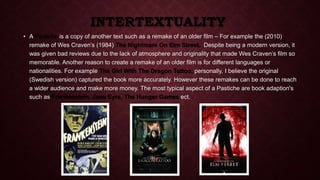
• A Pastiche is a copy of another text such as a remake of an older film – For example the (2010) 
remake of Wes Craven’s (1984) The Nightmare On Elm Street. Despite being a modern version, it 
was given bad reviews due to the lack of atmosphere and originality that made Wes Craven’s film so 
memorable. Another reason to create a remake of an older film is for different languages or 
nationalities. For example The Girl With The Dragon Tattoo, personally, I believe the original 
(Swedish version) captured the book more accurately. However these remakes can be done to reach 
a wider audience and make more money. The most typical aspect of a Pastiche are book adaption's 
such as Frankenstein, Jane Eyre, The Hunger Games ect.
• A Bricolage ‘steals’ significant or not so significant images or objects from different styles. Usually 
within the high art style to create new meanings. 
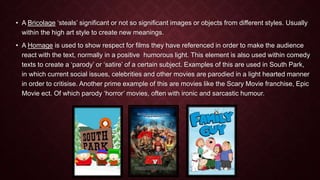
• A Homage is used to show respect for films they have referenced in order to make the audience 
react with the text, normally in a positive humorous light. This element is also used within comedy 
texts to create a ‘parody’ or ‘satire’ of a certain subject. Examples of this are used in South Park, 
in which current social issues, celebrities and other movies are parodied in a light hearted manner 
in order to critisise. Another prime example of this are movies like the Scary Movie franchise, Epic 
Movie ect. Of which parody ‘horror’ movies, often with ironic and sarcastic humour.
HYPER-REALITY 
The definition of a hyperreality is to create an artificial world or style which is opposing to reality. 
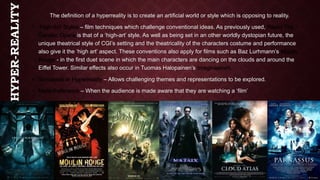
• ‘High-Art’ Styles – film techniques which challenge conventional ideas. As previously used, Repo! The 
Genetic Opera is that of a ‘high-art’ style. As well as being set in an other worldly dystopian future, the 
unique theatrical style of CGI’s setting and the theatricality of the characters costume and performance 
also give it the ‘high art’ aspect. These conventions also apply for films such as Baz Lurhmann’s Moulin 
Rouge - in the first duet scene in which the main characters are dancing on the clouds and around the 
Eiffel Tower. Similar effects also occur in Tuomas Halopainen’s Imaginaerum. 
• Simulacra or Hyperreality – Allows challenging themes and representations to be explored. 
• Meta-Reference – When the audience is made aware that they are watching a ‘film’
GENRE 
DEFINITIONS 
The French word ‘Genre’ means ‘type’ or ‘kind’. Yet within the Media it allows certain media product to be 
categorised according to their similarities in order for the producer to meet or challenge the audiences 
expectations. 
• The mainstream ‘Rigid’ genre categories, which cover a wide range of movies for commercial purposes, 
are seemingly and overly simplified so as to attract a mass audience due to Cinematic selling purposes 
of the mainstream blockbuster Hollywood movies. (Such as; Horror, Comedy, Romance, Fantasy). 
• Not so much opposing this, however broadening the genre categories are the Flexible definitions. 
Created to reach a more independent or alternative audience. Although these may also be as big as the 
mainstream Hollywood movies, cinematically viewed. The genre categories are seemingly more ‘in 
depth’ and explorative with a more specifically defined title in order to appeal to niche audiences (For 
example Dystopian-Steampunk-Horror).
GENRE THEORIES 
RIGID DEFINITIONS 
‘Genre’ within the entertainment context, was originally used by Aristotle within Greek theatre. This was in order to establish a particular 
‘quality control’ over types of play, in which deviation was discouraged. 
A further example for which is much later linguist (of the 19th Century) Charles Sanders Pierce. He looked at fixed meanings or Iconic Signs 
within a text, Genre therefore follows strict guidelines or conventions in order to clearly establish what an audience is expecting to see. 
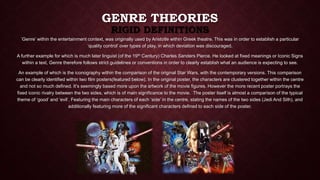
An example of which is the iconography within the comparison of the original Star Wars, with the contemporary versions. This comparison 
can be clearly identified within two film posters(featured below). In the original poster, the characters are clustered together within the centre 
and not so much defined. It’s seemingly based more upon the artwork of the movie figures. However the more recent poster portrays the 
fixed iconic rivalry between the two sides, which is of main significance to the movie. The poster itself is almost a comparison of the typical 
theme of ‘good’ and ‘evil’. Featuring the main characters of each ‘side’ in the centre, stating the names of the two sides (Jedi And Sith), and 
additionally featuring more of the significant characters defined to each side of the poster.
GENRE THEORIES 
FLEXIBLE DEFINITIONS 
Two Europeans critics of Hollywood, Adorno and Horkheimer, stated that mass production of film create a repetitive 
‘standardisation’ of conventions. These of which being dominated by one ideology – The American Dream for example. 
Nick Lacey suggests that genre is a negotiation between the Audience and Producers. A Producers ideology of a Genre attracting 
a particular Audience, may differ when released. The same applies when this audience views the particular text, who may 
categorise it under a certain or multiple genre categories. Therefore genre has evolved by establishing ‘sub genres’, ‘mixed 
genres’ or ‘hybrids’. Tis Postmodern theory allows producers to challenge genre conventions within a text by mixing or using a 
range of generic conventions as Hybrid genres. 
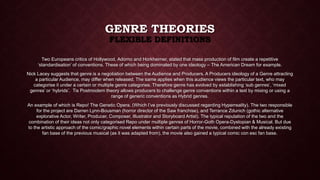
An example of which is Repo! The Genetic Opera. (Which I’ve previously discussed regarding Hyperreality). The two responsible 
for the project are Darren Lynn-Bousman (horror director of the Saw franchise), and Terrance Zdunich (gothic alternative 
explorative Actor, Writer, Producer, Composer, Illustrator and Storyboard Artist). The typical reputation of the two and the 
combination of their ideas not only categorised Repo under multiple genres of Horror-Goth Opera-Dystopian & Musical. But due 
to the artistic approach of the comic/graphic novel elements within certain parts of the movie, combined with the already existing 
fan base of the previous musical (as it was adapted from), the movie also gained a typical comic con esc fan base.
DYSTOPIAN GENRE 
The word Dystopia is an opposition to Utopia. So the general theme of Dystopian Worlds within the genre 
is descriptive of an unpleasant or frightening, and typically set in a totalitarian future or an 
environmentally degraded theme. 
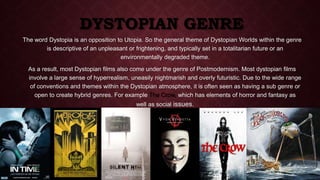
As a result, most Dystopian films also come under the genre of Postmodernism. Most dystopian films 
involve a large sense of hyperrealism, uneasily nightmarish and overly futuristic. Due to the wide range 
of conventions and themes within the Dystopian atmosphere, it is often seen as having a sub genre or 
open to create hybrid genres. For example The Crow, which has elements of horror and fantasy as 
well as social issues.
DYSTOPIAN CONVENTIONS 
(POSSIBLE NARRATIVES) 
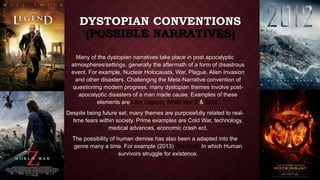
Many of the dystopian narratives take place in post apocalyptic 
atmospheres/settings, generally the aftermath of a form of disastrous 
event. For example, Nuclear Holocausts, War, Plague, Alien Invasion 
and other disasters. Challenging the Meta-Narrative convention of 
questioning modern progress, many dystopian themes involve post-apocalyptic 
disasters of a man made cause. Examples of these 
elements are I Am Legend, World War Z & 2012. 
Despite being future set, many themes are purposefully related to real-time 
fears within society. Prime examples are Cold War, technology, 
medical advances, economic crash ect. 
The possibility of human demise has also been a adapted into the 
genre many a time. For example (2013) The Host. In which Human 
survivors struggle for existence.
DYSTOPIAN FILM EXAMPLES. 
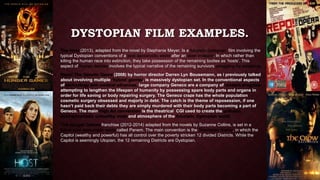
• The Host (2013), adapted from the novel by Stephanie Meyer. Is a futuristic dystopian film involving the 
typical Dystopian conventions of a post apocalyptic world after an alien invasion. In which rather than 
killing the human race into extinction, they take possession of the remaining bodies as ‘hosts’. This 
aspect of human demise involves the typical narrative of the remaining survivors struggling for existence. 
• Repo! The Genetic Opera (2008) by horror director Darren Lyn Bousemann, as i previously talked 
about involving multiple ‘hybrid’ genres, is massively dystopian set. In the conventional aspects 
of technology and medical advances, large company Geneco are a company of modern progress 
attempting to lengthen the lifespan of humanity by possessing spare body parts and organs in 
order for life saving or body repairing surgery. The Geneco craze has the whole population 
cosmetic surgery obsessed and majorly in debt. The catch is the theme of reposession, if one 
hasn’t paid back their debts they are simply murdered with their body parts becoming a part of 
Geneco. The main High Art convention is the theatrical CGI used to create the polluted, 
environmentally unhealthy state and atmosphere of the futuristic Dystopian world. 
• The Hunger Games franchise (2012-2014) adapted from the novels by Suzanne Collins, is set in a 
future post apocalyptic world called Panem. The main convention is the Totalitarian theme, in which the 
Capitol (wealthy and powerful) has all control over the poverty stricken 12 divided Districts. While the 
Capitol is seemingly Utopian, the 12 remaining Districts are Dystopian.

Post modernism2

  • 1.
  • 2.
    POSTMODERNISM The conceptof Postmodernism is a theory which allows producers to challenge conventions, forms and ideologies within a media production. The phrase ‘Postmodernism’ originates from the postmodernist movement in the 1870’s. It challenges stereotypical film to push boundaries in stimulating a further creativity & originality within modern Media texts. However can apply to media text in three different aspects due to postmodernism’s theoretical origins.
  • 3.
    POSTMODERNISM THEORIES •Jean-Francois Lyotard. - To challenge Meta-Narratives. Lyotard suggested we must challenge dominant ideologies and values represented through the media within society. • Frederic Jameson. - To use Pastiche/Intertextuality. To offer ‘updated ideas, from ‘old’ ideas. Jameson suggested that as we are over exposed to ‘hyperrealism’ of our Media, leaving no room for critique. Media texts can create ‘new remixed’ realities by creating references to others. • Jean Baudrillard - To make audiences aware of Hyperreality. The idea that the boundaries of our reality and the media’s realities are blurred. These media texts represent alternative realities to make audiences aware and challenge our traditional ideologies.
  • 4.
    CHALLENGING META-NARRATIVES •Narratives which questions whether modern progress is for the ‘good’ of society through a critique of society/mass production are typically postmodern. An example of this is the (1982) futuristic dystopian-science fiction film Blade Runner, in which genetically engineered human robots, called Replicants, are banned from Earth after ‘turning’ dangerous. Fugitive Replicants are hunted down after illegally returning to Earth. A prime example of human technological progression being questioned after overproduction. • Narrative themes that challenge conventional film narratives. An example of a ‘Conventional’ film narrative could be based on two rivalries (good and evil), yet the film structure focuses upon the ‘good guy/hero’ defeating the ‘baddies/rivals’. Yet the aspect of a narrative ‘challenging’ the conventional may be focusing on the opposing team, so that the Narrator is the criminal opposing society or the police. An example of which being Pulp Fiction or Public Enemies. Or having a female playing a traditionally male role - Kill Bill for example. • Non linear Narratives – Challenge the 3 act conventions by disrupting the chronology of the narrative sequence. A prime example of the narratives which oppose the chronological sequence is The Prestige. The film begins with one of the final scenes, and continues to narrate from three different points of the entire story, and switches from each of these throughout. This being until ends tie in a psychological-thriller manner at the very end. This style of narrative engages the audience with the characters more, involving the audience psychologically, making them more active viewers.
  • 5.
    • Anti-Narratives –This is a disruption of the narrative. Whether it be a simple disruption like a freeze frame, which is done for emphasis on the situation. For example the fighting scenes within Sherlock Holmes or The Matrix. Or more significantly a disruption as of that in Silent Hill. Where the narrative is paused to re-cap or explain a past event to the audience. • Mixing/blurring the genres of Film to create new hybrids/new versions. This can be done more obviously by taking a few mainstream genres of film to create a new (and possibly unlikely) combination yet attract a larger audience – Such as Cowboys and Aliens, in which the title is a huge giveaway and selling point. A more ‘underground’ example of a hybrid mix is Darren Lyn Bousmann’s Repo! The Genetic Opera. The overall gothic/gory horror theme is mixed with the dystopian genre, and is also a musical. Creating a seemingly unlikely narrative which is artistically and creatively perfect. Especially in reaching out to more indie audiences, or audiences with certain interests which would not normally reach the mainstream cinema.
  • 6.
    INTERTEXTUALITY • APastiche is a copy of another text such as a remake of an older film – For example the (2010) remake of Wes Craven’s (1984) The Nightmare On Elm Street. Despite being a modern version, it was given bad reviews due to the lack of atmosphere and originality that made Wes Craven’s film so memorable. Another reason to create a remake of an older film is for different languages or nationalities. For example The Girl With The Dragon Tattoo, personally, I believe the original (Swedish version) captured the book more accurately. However these remakes can be done to reach a wider audience and make more money. The most typical aspect of a Pastiche are book adaption's such as Frankenstein, Jane Eyre, The Hunger Games ect.
  • 7.
    • A Bricolage‘steals’ significant or not so significant images or objects from different styles. Usually within the high art style to create new meanings. • A Homage is used to show respect for films they have referenced in order to make the audience react with the text, normally in a positive humorous light. This element is also used within comedy texts to create a ‘parody’ or ‘satire’ of a certain subject. Examples of this are used in South Park, in which current social issues, celebrities and other movies are parodied in a light hearted manner in order to critisise. Another prime example of this are movies like the Scary Movie franchise, Epic Movie ect. Of which parody ‘horror’ movies, often with ironic and sarcastic humour.
  • 8.
    HYPER-REALITY The definitionof a hyperreality is to create an artificial world or style which is opposing to reality. • ‘High-Art’ Styles – film techniques which challenge conventional ideas. As previously used, Repo! The Genetic Opera is that of a ‘high-art’ style. As well as being set in an other worldly dystopian future, the unique theatrical style of CGI’s setting and the theatricality of the characters costume and performance also give it the ‘high art’ aspect. These conventions also apply for films such as Baz Lurhmann’s Moulin Rouge - in the first duet scene in which the main characters are dancing on the clouds and around the Eiffel Tower. Similar effects also occur in Tuomas Halopainen’s Imaginaerum. • Simulacra or Hyperreality – Allows challenging themes and representations to be explored. • Meta-Reference – When the audience is made aware that they are watching a ‘film’
  • 9.
    GENRE DEFINITIONS TheFrench word ‘Genre’ means ‘type’ or ‘kind’. Yet within the Media it allows certain media product to be categorised according to their similarities in order for the producer to meet or challenge the audiences expectations. • The mainstream ‘Rigid’ genre categories, which cover a wide range of movies for commercial purposes, are seemingly and overly simplified so as to attract a mass audience due to Cinematic selling purposes of the mainstream blockbuster Hollywood movies. (Such as; Horror, Comedy, Romance, Fantasy). • Not so much opposing this, however broadening the genre categories are the Flexible definitions. Created to reach a more independent or alternative audience. Although these may also be as big as the mainstream Hollywood movies, cinematically viewed. The genre categories are seemingly more ‘in depth’ and explorative with a more specifically defined title in order to appeal to niche audiences (For example Dystopian-Steampunk-Horror).
  • 10.
    GENRE THEORIES RIGIDDEFINITIONS ‘Genre’ within the entertainment context, was originally used by Aristotle within Greek theatre. This was in order to establish a particular ‘quality control’ over types of play, in which deviation was discouraged. A further example for which is much later linguist (of the 19th Century) Charles Sanders Pierce. He looked at fixed meanings or Iconic Signs within a text, Genre therefore follows strict guidelines or conventions in order to clearly establish what an audience is expecting to see. An example of which is the iconography within the comparison of the original Star Wars, with the contemporary versions. This comparison can be clearly identified within two film posters(featured below). In the original poster, the characters are clustered together within the centre and not so much defined. It’s seemingly based more upon the artwork of the movie figures. However the more recent poster portrays the fixed iconic rivalry between the two sides, which is of main significance to the movie. The poster itself is almost a comparison of the typical theme of ‘good’ and ‘evil’. Featuring the main characters of each ‘side’ in the centre, stating the names of the two sides (Jedi And Sith), and additionally featuring more of the significant characters defined to each side of the poster.
  • 11.
    GENRE THEORIES FLEXIBLEDEFINITIONS Two Europeans critics of Hollywood, Adorno and Horkheimer, stated that mass production of film create a repetitive ‘standardisation’ of conventions. These of which being dominated by one ideology – The American Dream for example. Nick Lacey suggests that genre is a negotiation between the Audience and Producers. A Producers ideology of a Genre attracting a particular Audience, may differ when released. The same applies when this audience views the particular text, who may categorise it under a certain or multiple genre categories. Therefore genre has evolved by establishing ‘sub genres’, ‘mixed genres’ or ‘hybrids’. Tis Postmodern theory allows producers to challenge genre conventions within a text by mixing or using a range of generic conventions as Hybrid genres. An example of which is Repo! The Genetic Opera. (Which I’ve previously discussed regarding Hyperreality). The two responsible for the project are Darren Lynn-Bousman (horror director of the Saw franchise), and Terrance Zdunich (gothic alternative explorative Actor, Writer, Producer, Composer, Illustrator and Storyboard Artist). The typical reputation of the two and the combination of their ideas not only categorised Repo under multiple genres of Horror-Goth Opera-Dystopian & Musical. But due to the artistic approach of the comic/graphic novel elements within certain parts of the movie, combined with the already existing fan base of the previous musical (as it was adapted from), the movie also gained a typical comic con esc fan base.
  • 12.
    DYSTOPIAN GENRE Theword Dystopia is an opposition to Utopia. So the general theme of Dystopian Worlds within the genre is descriptive of an unpleasant or frightening, and typically set in a totalitarian future or an environmentally degraded theme. As a result, most Dystopian films also come under the genre of Postmodernism. Most dystopian films involve a large sense of hyperrealism, uneasily nightmarish and overly futuristic. Due to the wide range of conventions and themes within the Dystopian atmosphere, it is often seen as having a sub genre or open to create hybrid genres. For example The Crow, which has elements of horror and fantasy as well as social issues.
  • 13.
    DYSTOPIAN CONVENTIONS (POSSIBLENARRATIVES) Many of the dystopian narratives take place in post apocalyptic atmospheres/settings, generally the aftermath of a form of disastrous event. For example, Nuclear Holocausts, War, Plague, Alien Invasion and other disasters. Challenging the Meta-Narrative convention of questioning modern progress, many dystopian themes involve post-apocalyptic disasters of a man made cause. Examples of these elements are I Am Legend, World War Z & 2012. Despite being future set, many themes are purposefully related to real-time fears within society. Prime examples are Cold War, technology, medical advances, economic crash ect. The possibility of human demise has also been a adapted into the genre many a time. For example (2013) The Host. In which Human survivors struggle for existence.
  • 14.
    DYSTOPIAN FILM EXAMPLES. • The Host (2013), adapted from the novel by Stephanie Meyer. Is a futuristic dystopian film involving the typical Dystopian conventions of a post apocalyptic world after an alien invasion. In which rather than killing the human race into extinction, they take possession of the remaining bodies as ‘hosts’. This aspect of human demise involves the typical narrative of the remaining survivors struggling for existence. • Repo! The Genetic Opera (2008) by horror director Darren Lyn Bousemann, as i previously talked about involving multiple ‘hybrid’ genres, is massively dystopian set. In the conventional aspects of technology and medical advances, large company Geneco are a company of modern progress attempting to lengthen the lifespan of humanity by possessing spare body parts and organs in order for life saving or body repairing surgery. The Geneco craze has the whole population cosmetic surgery obsessed and majorly in debt. The catch is the theme of reposession, if one hasn’t paid back their debts they are simply murdered with their body parts becoming a part of Geneco. The main High Art convention is the theatrical CGI used to create the polluted, environmentally unhealthy state and atmosphere of the futuristic Dystopian world. • The Hunger Games franchise (2012-2014) adapted from the novels by Suzanne Collins, is set in a future post apocalyptic world called Panem. The main convention is the Totalitarian theme, in which the Capitol (wealthy and powerful) has all control over the poverty stricken 12 divided Districts. While the Capitol is seemingly Utopian, the 12 remaining Districts are Dystopian.