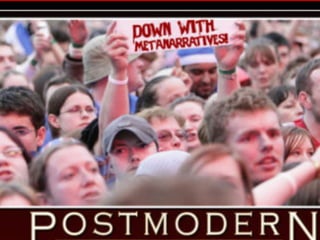
Post-­‐modernism	
  defini.on	
  
“Post-­‐modernism,	
  in	
  Western	
  philosophy,	
  is	
  a	
  
late	
  20th-­‐century	
  movement	
  
characterized	
  by	
  broad	
  skep.cism,	
  subjec.vism,	
  
or	
  rela.vism;	
  a	
  general	
  suspicion	
  
of	
  reason;	
  and	
  an	
  acute	
  sensi.vity	
  to	
  the	
  role	
  of	
  
ideology	
  in	
  asser.ng	
  and	
  
maintaining	
  poli.cal	
  and	
  economic	
  power”.	
  
	
  Encyclopedia	
  Britannica	
  
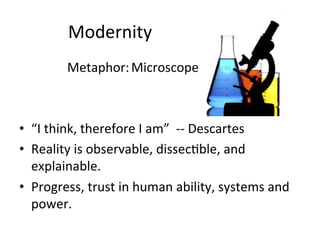
Modernity	


  Metaphor:	
  Microscope	


•  “I	
  think,	
  therefore	
  I	
  am”	
  	
  -­‐-­‐	
  Descartes	
  
•  Reality	
  is	
  observable,	
  dissec.ble,	
  and	
  
explainable.	
  
•  Progress,	
  trust	
  in	
  human	
  ability,	
  systems	
  and	
  
power.	


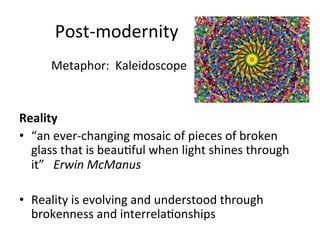
Post-­‐modernity	


  Metaphor: 	
  Kaleidoscope	


Reality	
  
•  “an	
  ever-­‐changing	
  mosaic	
  of	
  pieces	
  of	
  broken	
  
glass	
  that	
  is	
  beau.ful	
  when	
  light	
  shines	
  through	
  
it”	
  	
  	
  Erwin	
  McManus	
  
•  Reality	
  is	
  evolving	
  and	
  understood	
  through	
  
brokenness	
  and	
  interrela.onships	


Shaping	
  the	
  postmodern	
  mindset	
  
•  Separation	
  between time and place
(no	
  rhythm)	
  
	
  globaliza7on,	
  24	
  x7,	
  internet.	


•  Social disembedding (no	
  roots)	


  worldwide	
  financial	
  and	
  other	
  systems	
  (no	
  local	
  
influence	
  /	
  context).	
  
•  Re-ordering of knowledge and social
relationships (	
  no	
  tradi.ons)	
  
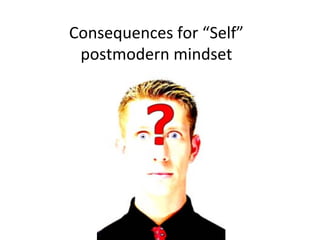
Consequences	
  for	
  “Self”	
  
postmodern	
  mindset	
  
“Self”	
  and	
  postmodern	
  mindset	
  
1.  Identity	
  is	
  a	
  reflec.on	
  project,	
  for	
  which	
  
the	
  individual	
  him/her	
  self	
  carries	
  the	
  full	
  
responsibility	
  	
  
2.  ‘Self’ is	
  seen	
  as	
  a	
  narra.ve	
  (	
  you	
  are	
  the	
  
author	
  of	
  your	
  own	
  life)	
  
3.  Reflection	
  is	
  constant	
  and	
  prominent	
  (the	
  
ever	
  con.nuing	
  stream	
  of	
  the	
  same	
  
reflec.ve	
  ques.ons)	
  
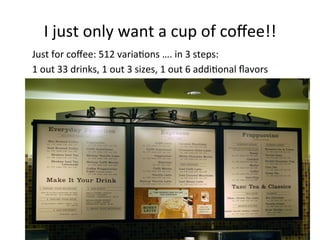
I	
  just	
  only	
  want	
  a	
  cup	
  of	
  coffee!!	
  
Just	
  for	
  coffee:	
  512	
  varia.ons	
  ….	
  in	
  3	
  steps:	
  	
  
1	
  out	
  33	
  drinks,	
  1	
  out	
  3	
  sizes,	
  1	
  out	
  6	
  addi.onal	
  flavors	
  
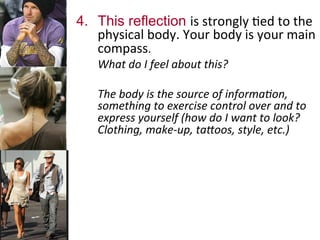
4.  This reflection is	
  strongly	
  .ed	
  to	
  the	
  
physical	
  body.	
  Your	
  body	
  is	
  your	
  main	
  
compass.	


  What	
  do	
  I	
  feel	
  about	
  this?	


  The	
  body	
  is	
  the	
  source	
  of	
  informa7on,	
  
something	
  to	
  exercise	
  control	
  over	
  and	
  to	
  
express	
  yourself	
  (how	
  do	
  I	
  want	
  to	
  look?	
  
Clothing,	
  make-­‐up,	
  taNoos,	
  style,	
  etc.)	


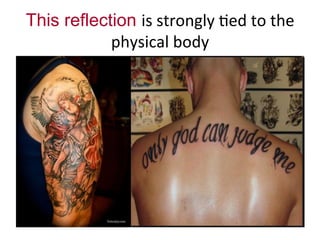
This reflection is	
  strongly	
  .ed	
  to	
  the	
  
physical	
  body	
  
“Self”	
  and	
  the	
  postmodern	
  mindset	
  
5.  Identity formation	
  is	
  only	
  based	
  on	
  internal	
  
reflec.ons	
  (it’s	
  not	
  tested	
  against	
  an	
  external	
  
norm).	
  
•  There	
  is	
  no	
  master	
  story	
  to	
  direc7on	
  and	
  value	
  to	
  
iden7ty	
  forma7on	
  	
  
•  Life	
  has	
  no	
  higher	
  purpose-­‐then	
  self	
  forma7on	
  
•  There	
  are	
  no	
  social	
  role	
  models	
  to	
  follow	
  
Post	
  modern	
  characteris.cs	
  
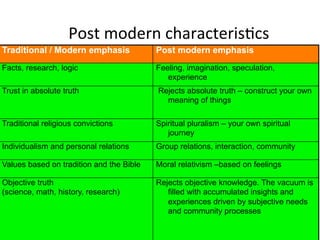
Traditional / Modern emphasis Post modern emphasis
Facts, research, logic Feeling, imagination, speculation,
experience
Trust in absolute truth Rejects absolute truth – construct your own
meaning of things
Traditional religious convictions Spiritual pluralism – your own spiritual
journey
Individualism and personal relations Group relations, interaction, community
Values based on tradition and the Bible Moral relativism –based on feelings
Objective truth
(science, math, history, research)
Rejects objective knowledge. The vacuum is
filled with accumulated insights and
experiences driven by subjective needs
and community processes
Post	
  modern	
  characteris.cs	
  2	
  
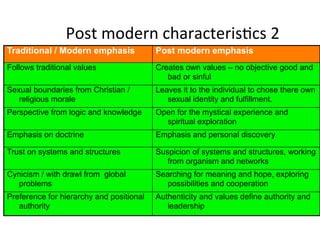
Traditional / Modern emphasis Post modern emphasis
Follows traditional values Creates own values – no objective good and
bad or sinful
Sexual boundaries from Christian /
religious morale
Leaves it to the individual to chose there own
sexual identity and fulfillment.
Perspective from logic and knowledge Open for the mystical experience and
spiritual exploration
Emphasis on doctrine Emphasis and personal discovery
Trust on systems and structures Suspicion of systems and structures, working
from organism and networks
Cynicism / with drawl from global
problems
Searching for meaning and hope, exploring
possibilities and cooperation
Preference for hierarchy and positional
authority
Authenticity and values define authority and
leadership
Barrières	
  
Barrières	


•  Rejec.on	
  of	
  the	
  rigid	
  a`tude	
  towards	
  differences	
  
•  Rejec.on	
  of	
  the	
  absolute	
  truth	
  à	
  subjec.vity,	
  local,	
  
personal	
  and	
  contextual	
  truth	
  
•  Inclusive	
  thinking	
  and	
  tolerance	
  
•  Informa.on	
  outside	
  the	
  own	
  experience	
  is	
  viewed	
  as	
  
NOISE	
  –	
  desire	
  for	
  relevance	
  
•  Rejec.on	
  of	
  nega.vity,	
  judgementalism,	
  and	
  legalism	
  
•  Allergy	
  for	
  power	
  play	
  of	
  religion	
  and	
  poli.cs	
  
•  Not	
  quickly	
  commifed	
  to	
  tasks	
  or	
  posi.ons	
  
Opportuni.es	
  and	
  Bridges	
  
•  Sensi.vity	
  for	
  spirituality	
  
•  Experimental	
  spirituality,	
  i.s.o.	
  words	
  
•  Open	
  for	
  mystery	
  and	
  	
  parables	
  
•  Personal	
  spirituality	
  and	
  discipleship	
  	
  
•  Pragma.sm,	
  what	
  is	
  relevant	
  for	
  me	
  
•  Social	
  needs	
  /	
  searching	
  for	
  meaning	
  
•  Personal	
  needs:	
  emo.onal	
  /	
  spiritual	
  brokenness	
  
•  Longing	
  for	
  shalom	
  and	
  	
  jus.ce	
  
•  Desire	
  to	
  break	
  out	
  from	
  old	
  ways	
  and	
  forms,	
  searching	
  
for	
  new	
  ways	
  
•  Search	
  for	
  spiritual	
  mentors	
  /	
  coaches	
  
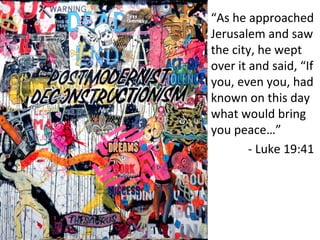
“As	
  he	
  approached	
  
Jerusalem	
  and	
  saw	
  
the	
  city,	
  he	
  wept	
  
over	
  it	
  and	
  said,	
  “If	
  
you,	
  even	
  you,	
  had	
  
known	
  on	
  this	
  day	
  
what	
  would	
  bring	
  
you	
  peace…” 	


  -­‐	
  Luke	
  19:41	
  
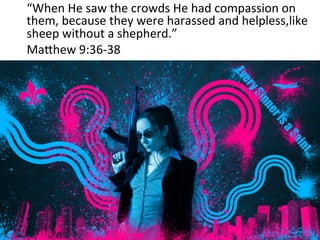
“When	
  He	
  saw	
  the	
  crowds	
  He	
  had	
  compassion	
  on	
  
them,	
  because	
  they	
  were	
  harassed	
  and	
  helpless,like	
  
sheep	
  without	
  a	
  shepherd.”	
  
Mafhew	
  9:36-­‐38	


Postmodern presentation fmi gms from Piet Brinksma

  • 2.
    Post-­‐modernism  defini.on   “Post-­‐modernism,  in  Western  philosophy,  is  a   late  20th-­‐century  movement   characterized  by  broad  skep.cism,  subjec.vism,   or  rela.vism;  a  general  suspicion   of  reason;  and  an  acute  sensi.vity  to  the  role  of   ideology  in  asser.ng  and   maintaining  poli.cal  and  economic  power”.    Encyclopedia  Britannica  
  • 3.
    Modernity        Metaphor:  Microscope       •  “I  think,  therefore  I  am”    -­‐-­‐  Descartes   •  Reality  is  observable,  dissec.ble,  and   explainable.   •  Progress,  trust  in  human  ability,  systems  and   power.    
  • 4.
    Post-­‐modernity      Metaphor:  Kaleidoscope       Reality   •  “an  ever-­‐changing  mosaic  of  pieces  of  broken   glass  that  is  beau.ful  when  light  shines  through   it”      Erwin  McManus   •  Reality  is  evolving  and  understood  through   brokenness  and  interrela.onships    
  • 6.
    Shaping  the  postmodern  mindset   •  Separation  between time and place (no  rhythm)    globaliza7on,  24  x7,  internet.     •  Social disembedding (no  roots)        worldwide  financial  and  other  systems  (no  local   influence  /  context).   •  Re-ordering of knowledge and social relationships (  no  tradi.ons)  
  • 7.
    Consequences  for  “Self”   postmodern  mindset  
  • 8.
    “Self”  and  postmodern  mindset   1.  Identity  is  a  reflec.on  project,  for  which   the  individual  him/her  self  carries  the  full   responsibility     2.  ‘Self’ is  seen  as  a  narra.ve  (  you  are  the   author  of  your  own  life)   3.  Reflection  is  constant  and  prominent  (the   ever  con.nuing  stream  of  the  same   reflec.ve  ques.ons)  
  • 9.
    I  just  only  want  a  cup  of  coffee!!   Just  for  coffee:  512  varia.ons  ….  in  3  steps:     1  out  33  drinks,  1  out  3  sizes,  1  out  6  addi.onal  flavors  
  • 10.
    4.  This reflectionis  strongly  .ed  to  the   physical  body.  Your  body  is  your  main   compass.      What  do  I  feel  about  this?        The  body  is  the  source  of  informa7on,   something  to  exercise  control  over  and  to   express  yourself  (how  do  I  want  to  look?   Clothing,  make-­‐up,  taNoos,  style,  etc.)      
  • 11.
    This reflection is  strongly  .ed  to  the   physical  body  
  • 12.
    “Self”  and  the  postmodern  mindset   5.  Identity formation  is  only  based  on  internal   reflec.ons  (it’s  not  tested  against  an  external   norm).   •  There  is  no  master  story  to  direc7on  and  value  to   iden7ty  forma7on     •  Life  has  no  higher  purpose-­‐then  self  forma7on   •  There  are  no  social  role  models  to  follow  
  • 13.
    Post  modern  characteris.cs   Traditional / Modern emphasis Post modern emphasis Facts, research, logic Feeling, imagination, speculation, experience Trust in absolute truth Rejects absolute truth – construct your own meaning of things Traditional religious convictions Spiritual pluralism – your own spiritual journey Individualism and personal relations Group relations, interaction, community Values based on tradition and the Bible Moral relativism –based on feelings Objective truth (science, math, history, research) Rejects objective knowledge. The vacuum is filled with accumulated insights and experiences driven by subjective needs and community processes
  • 14.
    Post  modern  characteris.cs  2   Traditional / Modern emphasis Post modern emphasis Follows traditional values Creates own values – no objective good and bad or sinful Sexual boundaries from Christian / religious morale Leaves it to the individual to chose there own sexual identity and fulfillment. Perspective from logic and knowledge Open for the mystical experience and spiritual exploration Emphasis on doctrine Emphasis and personal discovery Trust on systems and structures Suspicion of systems and structures, working from organism and networks Cynicism / with drawl from global problems Searching for meaning and hope, exploring possibilities and cooperation Preference for hierarchy and positional authority Authenticity and values define authority and leadership
  • 15.
  • 16.
    Barrières       •  Rejec.on  of  the  rigid  a`tude  towards  differences   •  Rejec.on  of  the  absolute  truth  à  subjec.vity,  local,   personal  and  contextual  truth   •  Inclusive  thinking  and  tolerance   •  Informa.on  outside  the  own  experience  is  viewed  as   NOISE  –  desire  for  relevance   •  Rejec.on  of  nega.vity,  judgementalism,  and  legalism   •  Allergy  for  power  play  of  religion  and  poli.cs   •  Not  quickly  commifed  to  tasks  or  posi.ons  
  • 17.
    Opportuni.es  and  Bridges   •  Sensi.vity  for  spirituality   •  Experimental  spirituality,  i.s.o.  words   •  Open  for  mystery  and    parables   •  Personal  spirituality  and  discipleship     •  Pragma.sm,  what  is  relevant  for  me   •  Social  needs  /  searching  for  meaning   •  Personal  needs:  emo.onal  /  spiritual  brokenness   •  Longing  for  shalom  and    jus.ce   •  Desire  to  break  out  from  old  ways  and  forms,  searching   for  new  ways   •  Search  for  spiritual  mentors  /  coaches  
  • 18.
    “As  he  approached   Jerusalem  and  saw   the  city,  he  wept   over  it  and  said,  “If   you,  even  you,  had   known  on  this  day   what  would  bring   you  peace…”                      -­‐  Luke  19:41  
  • 19.
    “When  He  saw  the  crowds  He  had  compassion  on   them,  because  they  were  harassed  and  helpless,like   sheep  without  a  shepherd.”   Mafhew  9:36-­‐38