Local Density of States Measurements using
STM/STS Techniques
Chintalagiri Shashank
Supervisor : Dr. Deshdeep Sahdev
Acknowledgements
I am grateful to Prof. Deshdeep Sahdev for his guidance and the
opportunity to work with him on this project. I would also like to thank
Prof. Anjan Kumar Gupta for sharing his experience with STS, and Mr.
Joshua Mathew of Quazar Technologies Pvt. Ltd. for his assistance in
making the necessary changes to their nanoRev Air STM.
HOPGScan Image Retrace Image
Processed Image
Gold
LargeareascanSmallareascanConductanceMap
Scan Image Retrace Image
Bi2Te3Scan Image (Processsd) Retrace Image (Processed)
Lock­in Amplifier SchematicIntroduction
Scanning Tunnelling Spectroscopy (STS) is a technique
used to characterise electronic distribution as a function
of energy at the surface of conducting and semi­
conducting samples with the help of an STM. It can be
used to measure the local density of states at various
points on the surface and generate conductance maps
of the surface. Band gaps can also be measured using
this technique. It can be shown that the local density of
states is well represented by the tunnelling conductance
dI/dV, where I is the tunnelling current and V the bias
voltage.
The focus of this project is to demonstrate STS by
measuring the local density of states of three samples,
namely Gold (Au), Highly ordered pyrolytic graphite
(HOPG), and Bismuth Telluride.
Experimental Setup
The experimental setup is centred on the nanoREV Air
STM. In addition to the STM, a lock­in amplifier (LIA) is
used to measure tunnelling conductance directly. The
data presented here was taken using a commercially
available EG&G 5209 lock­in amplifier. In addition, a
lock­in amplifier based on the AD630 balanced
demodulator is being designed in parallel (schematic in
figure), and will be used to acquire the same data.
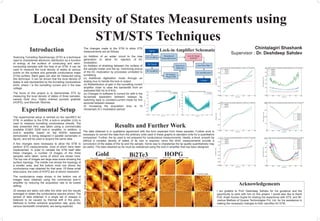
A few changes were necessary to allow the STM to
perform STS measurements, most of which have been
implemented. In order to validate the STM itself after
these changes, a number of images of the three
samples were taken, some of which are shown here.
The top row of images are large area scans showing the
surface topology. The middle row shows the topology of
a smaller area, and the bottom most row shows the
conductance map obtained for that area. Of these small
area scans, the ones of HOPG are of atomic resolution.
The conductance maps shown in the bottom row of
images were obtained using the commercial lock­in
amplifier by reducing the acquisition rate to its lowest
setting.
30 sweeps are taken one after the other and the results
averaged to obtain the conductance spectra shown. The
spread of data obtained in a single set of sweeps is
believed to be caused by thermal drift in the piezo.
Methods to further enhance acquisition rate, given the
various bandwidth constraints, are being explored.
The changes made to the STM to allow STS
measurements are as follows:
(a) Addition of an adder circuit to the bias
generation to allow for injection of AC
modulation.
(b) Addition of shielding between the surface of
the sample holder and the tip, minimizing pickup
of the AC modulation by processes unrelated to
tunnelliing.
(c) Additional digitization mode through an
analog mux to handle the lock­in output.
(d) Redistribution of gain in the tunnelling current
amplifier chain to raise the bandwidth from an
estimated 800 Hz to 8 KHz.
(e) Changes to software to correct for drift in the
tip­sample separation between sweeps by
switching back to constant­current mode for five
seconds between sweeps.
(f) Increasing the acquisition time to 10
ms/sample (5 x modulation period)
.
Results and Further Work
The data obtained is in qualitative agreement with the form expected from these samples. Further work is
necessary to convert the data from the arbitrary units used in these graphs to standard units for a quantitative
comparison. Further, the tip used is not prepared for conductance measurements. Ideally, a blunt, smooth tip
without a complex density of states of its own is required, since the dI/dV measurements provide a
convolution of the states of the tip and the sample. Some way to charaterise the tip quality quantitatively may
be useful. The data obtained so far must be reobtained using the lock­in amplifier that has been designed.

Poster : STM/STS Techniques

  • 1.
    Local Density ofStates Measurements using STM/STS Techniques Chintalagiri Shashank Supervisor : Dr. Deshdeep Sahdev Acknowledgements I am grateful to Prof. Deshdeep Sahdev for his guidance and the opportunity to work with him on this project. I would also like to thank Prof. Anjan Kumar Gupta for sharing his experience with STS, and Mr. Joshua Mathew of Quazar Technologies Pvt. Ltd. for his assistance in making the necessary changes to their nanoRev Air STM. HOPGScan Image Retrace Image Processed Image Gold LargeareascanSmallareascanConductanceMap Scan Image Retrace Image Bi2Te3Scan Image (Processsd) Retrace Image (Processed) Lock­in Amplifier SchematicIntroduction Scanning Tunnelling Spectroscopy (STS) is a technique used to characterise electronic distribution as a function of energy at the surface of conducting and semi­ conducting samples with the help of an STM. It can be used to measure the local density of states at various points on the surface and generate conductance maps of the surface. Band gaps can also be measured using this technique. It can be shown that the local density of states is well represented by the tunnelling conductance dI/dV, where I is the tunnelling current and V the bias voltage. The focus of this project is to demonstrate STS by measuring the local density of states of three samples, namely Gold (Au), Highly ordered pyrolytic graphite (HOPG), and Bismuth Telluride. Experimental Setup The experimental setup is centred on the nanoREV Air STM. In addition to the STM, a lock­in amplifier (LIA) is used to measure tunnelling conductance directly. The data presented here was taken using a commercially available EG&G 5209 lock­in amplifier. In addition, a lock­in amplifier based on the AD630 balanced demodulator is being designed in parallel (schematic in figure), and will be used to acquire the same data. A few changes were necessary to allow the STM to perform STS measurements, most of which have been implemented. In order to validate the STM itself after these changes, a number of images of the three samples were taken, some of which are shown here. The top row of images are large area scans showing the surface topology. The middle row shows the topology of a smaller area, and the bottom most row shows the conductance map obtained for that area. Of these small area scans, the ones of HOPG are of atomic resolution. The conductance maps shown in the bottom row of images were obtained using the commercial lock­in amplifier by reducing the acquisition rate to its lowest setting. 30 sweeps are taken one after the other and the results averaged to obtain the conductance spectra shown. The spread of data obtained in a single set of sweeps is believed to be caused by thermal drift in the piezo. Methods to further enhance acquisition rate, given the various bandwidth constraints, are being explored. The changes made to the STM to allow STS measurements are as follows: (a) Addition of an adder circuit to the bias generation to allow for injection of AC modulation. (b) Addition of shielding between the surface of the sample holder and the tip, minimizing pickup of the AC modulation by processes unrelated to tunnelliing. (c) Additional digitization mode through an analog mux to handle the lock­in output. (d) Redistribution of gain in the tunnelling current amplifier chain to raise the bandwidth from an estimated 800 Hz to 8 KHz. (e) Changes to software to correct for drift in the tip­sample separation between sweeps by switching back to constant­current mode for five seconds between sweeps. (f) Increasing the acquisition time to 10 ms/sample (5 x modulation period) . Results and Further Work The data obtained is in qualitative agreement with the form expected from these samples. Further work is necessary to convert the data from the arbitrary units used in these graphs to standard units for a quantitative comparison. Further, the tip used is not prepared for conductance measurements. Ideally, a blunt, smooth tip without a complex density of states of its own is required, since the dI/dV measurements provide a convolution of the states of the tip and the sample. Some way to charaterise the tip quality quantitatively may be useful. The data obtained so far must be reobtained using the lock­in amplifier that has been designed.