GLI INDICATORI PER LA STIMA DELLA VULNERABILITÀ ALLA LAND DEGRADATION DA FATTORI ANTROPICI: STRUMENTI PER UNA EFFICACE PIANIFICAZIONE TERRITORIALE IMBRENDA  V. 1,2 , D’EMILIO M. 2 , LANFREDI M. 2 , RAGOSTA M. 1 , SIMONIELLO T. 2 1  Università degli Studi della Basilicata, Dipartimento di Ingegneria e Fisica dell'Ambiente (DIFA) 2 Istituto di Metodologie per l’Analisi Ambientale (IMAA-CNR)
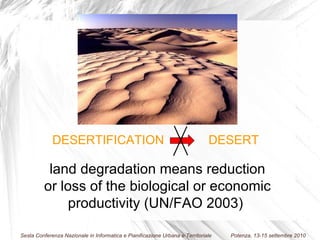
land degradation means reduction or loss of the biological or economic productivity (UN/FAO 2003)  DESERTIFICATION DESERT
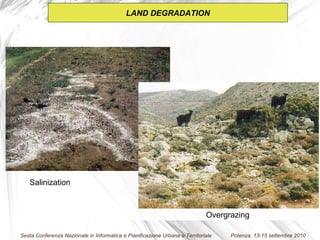
LAND DEGRADATION Salinization Overgrazing
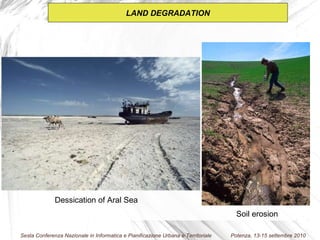
Dessication of Aral Sea Soil erosion LAND DEGRADATION
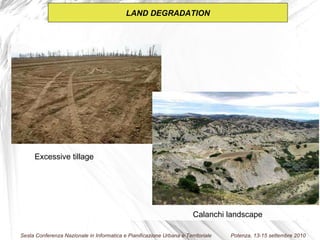
Excessive tillage Calanchi landscape LAND DEGRADATION
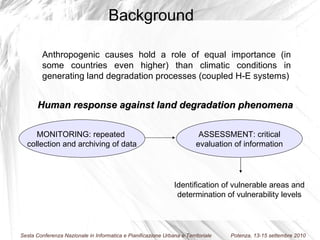
Anthropogenic causes hold a role of equal importance (in some countries even higher) than climatic conditions in generating land degradation processes (coupled H-E systems) MONITORING: repeated  collection and archiving of data ASSESSMENT: critical evaluation of information  Human response against land degradation phenomena Identification of vulnerable areas and determination of vulnerability levels Background
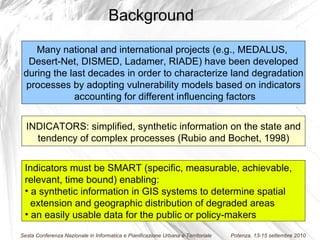
Indicators must be SMART (specific, measurable, achievable,  relevant, time bound) enabling: a synthetic information in GIS systems to determine spatial  extension and geographic distribution of degraded areas an easily usable data for the public or policy-makers INDICATORS: simplified, synthetic information on the state and tendency of complex processes (Rubio and Bochet, 1998) M any national and international projects (e.g., MEDALUS,  Desert-Net, DISMED, Ladamer, RIADE) have been developed during the last decades in order to characterize land degradation  processes by adopting vulnerability models based on indicators accounting for different influencing factors Background
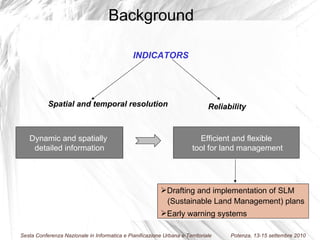
INDICATORS Spatial and temporal resolution Reliability Dynamic and spatially  detailed information Efficient and flexible tool for land management Drafting and implementation of SLM  (Sustainable Land Management) plans Early warning systems Background
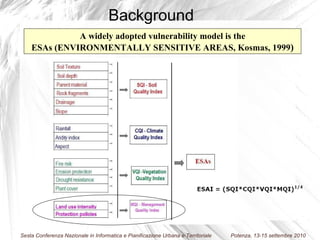
A widely adopted vulnerability model is the ESAs ( ENVIRONMENTALLY SENSITIVE AREAS, Kosmas, 1999 ) Background
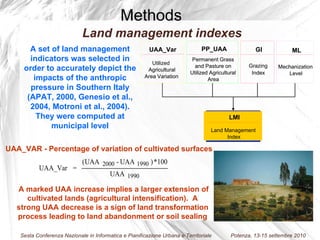
Land management indexes UAA_VAR - Percentage of variation of cultivated surfaces Methods A set of land management indicators was selected in order to accurately depict the impacts of the anthropic pressure in Southern Italy (APAT, 2000, Genesio et al., 2004, Motroni et al., 2004). They were computed at municipal level A marked UAA increase implies a larger extension of cultivated lands (agricultural intensification).  A strong UAA decrease is a sign of land transformation process leading to land abandonment or soil sealing LMI Land Management  Index ML Mechanization Level GI Grazing  Index PP_UAA Permanent Grass and Pasture on  Utilized Agricultural Area UAA_Var Utilized Agricultural Area  Variation LMI Land Management  Index ML Mechanization Level GI Grazing  Index PP_UAA Permanent Grass and Pasture on  Utilized Agricultural Area UAA_Var Agricultural Area  Variation
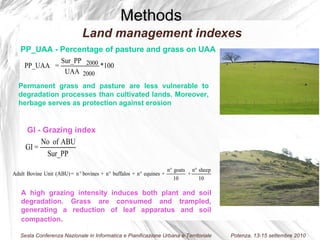
Permanent grass and pasture are less vulnerable to degradation processes than cultivated lands. Moreover, herbage serves as protection against erosion A high grazing intensity induces both plant and soil degradation. Grass are consumed and trampled, generating a reduction of leaf apparatus and soil compaction .  Methods PP_UAA -  Percentage of pasture and grass on UAA GI - Grazing index Land management indexes
The MLI considers that persistent mechanical interventions strongly alter soil chemical-physical properties since repeated passes causes a stratum of compacted soil having a low permeability (ploughsole formation). It limits the  root expansion and water penetration, and in the worse situation creates asphyxiation conditions that bring on vegetation cover degradation and reduction in crop production Non compacted soil Compacted soil Methods MLI - Level of agricultural mechanization [Duiker, 2004]
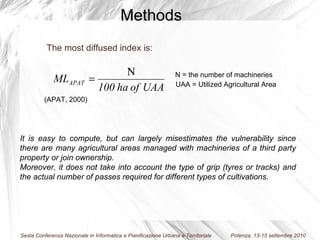
The most diffused index is: (APAT, 2000) N = the number of machineries UAA = Utilized Agricultural Area It is easy to compute, but can largely misestimates the vulnerability since there are many agricultural areas managed with machineries of a third party property or join ownership. Moreover, it does not take into account the type of grip (tyres or tracks) and the actual number of passes required for different types of cultivations . Methods
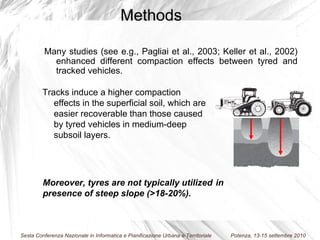
Tracks induce a higher compaction effects in the superficial soil, which are easier recoverable than those caused by tyred vehicles in medium-deep subsoil layers. Many studies (see e.g., Pagliai et al., 2003; Keller et al., 2002) enhanced different compaction effects between tyred and tracked vehicles.   Methods Moreover, tyres are not typically utilized  in presence of steep slope (>18-20%).
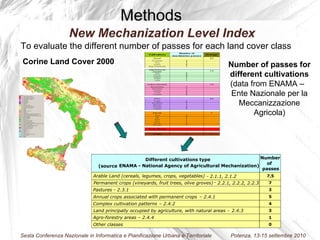
Corine Land Cover 2000 Number of passes for different cultivations (data from ENAMA –  Ente Nazionale per la Meccanizzazione Agricola) To evaluate the different number of passes for each land cover class Methods New Mechanization Level Index 0 Other classes 3 Land principally occupied by agriculture, with significant areas of natural vegetation 4 Complex cultivation patterns Annual crops associated with permanent crops 3 Pastures - 2.3.1 7 Permanent crops (rice fields, vineyards, fruit trees and berry p lantations, olive groves) 7,5 Arable Land (cereals, legumes, crops, vegetables) Number  of passes Different cultivations type (source  - ENAMA National Agency of Agricultural Mechanization) 0 Other classes 3 Land principally occupied by agriculture, with significant areas of natural vegetation Complex cultivation patterns Annual crops associated with permanent crops 7 Permanent crops (rice fields, vineyards, fruit trees and berry p lantations, olive groves) Arable Land (cereals, legumes, crops, vegetables) Number  of passes Different cultivations type (source  - ENAMA National Agency of Agricultural Mechanization) 0 Other classes 1 3 Land principally occupied by agriculture, with significant areas of natural vegetation 4 5 3 7 Permanent crops (vineyards, fruit trees, olive groves) 7,5 Number  of passes Different cultivations type (source  - ENAMA National Agency of Agricultural Mechanization) 0 Other classes 1 3 Land principally occupied by agriculture, with natural areas - 2.4.3 4 – 2.4.2 5 – 2.4.1 3 7 7,5 Number  of passes Different cultivations type (source  ENAMA - National Agency of Agricultural Mechanization) - 2.1.1, 2.1.2 - 2.2.1, 2.2.2, 2.2.3 Agro-forestry areas – 2.4.4
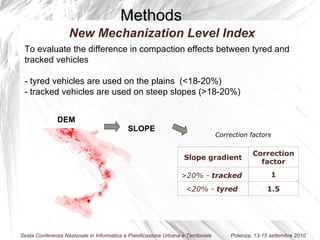
To evaluate the difference in compaction effects between tyred and tracked vehicles  - tyred vehicles are used on the plains  (<18-20%) - tracked vehicles are used on steep slopes (>18-20%) DEM SLOPE Correction factors Methods New Mechanization Level Index Slope gradient Correction factor >20%   -   tracked   1 <20%   -   tyred  1.5
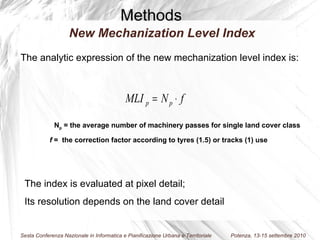
N p  =  the average number of machinery passes for single land cover class f  =  the correction factor according to tyres (1.5) or tracks (1) use The analytic expression of the new mechanization level index is: The index is evaluated at pixel detail;  Its resolution depends on the land cover detail Methods New Mechanization Level Index
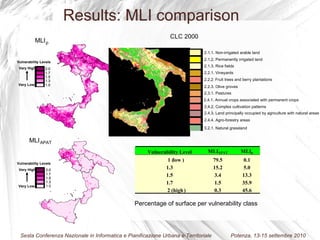
2.0 1.7 1.5 1.3 1.0 2.0 1.7 1.5 1.3 1.0 MLI p CLC 2000 MLI APAT 2.1.1. Non-irrigated arable land 2.1.2. Permanently irrigated land 2.1.3. Rice fields 2.2.1. Vineyards 2.2.2 .  Fruit trees and berry plantations 2.2.3. Olive groves 2.3.1. Pastures 2.4.1. Annual crops associated with permanent crops 2.4.2. Complex cultivation patterns  2.4.3. Land principally occupied by agriculture with natural areas 2.4.4. Agro-forestry areas  3.2.1. Natural grassland Percentage of surface per vulnerability class Results: MLI comparison 2.0 1.7 1.5 1.3 1.0 2.0 1.7 1.5 1.3 2.0 1.7 1.5 1.3 Vulner ability Level MLI APAT MLI p 1 ( low  ) 79.5 0.1 1.3 15.2 5.0 1.5 3.4 13.3 1.7 1.5 35.9 2  ( high ) 0.3 45.6 Very Low Very High Vulnerability Levels Very Low Very High Vulnerability Levels
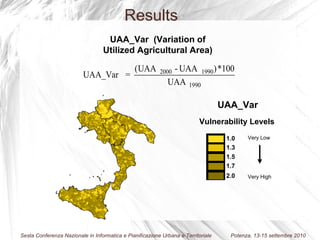
UAA_Var  (Variation of  Utilized Agricultural Area)   UAA_Var Vulnerability Levels 1.0 1.3 1.5 1.7 2.0 Very Low Very High Results
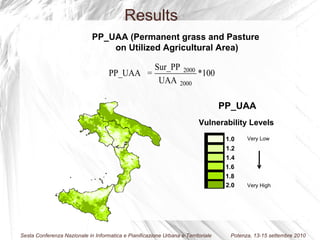
PP_UAA (Permanent grass and Pasture  on Utilized Agricultural Area) 1.0 1.2 1.4 1.6 1.8 2.0 Very Low Very High PP_UAA Vulnerability Levels Results
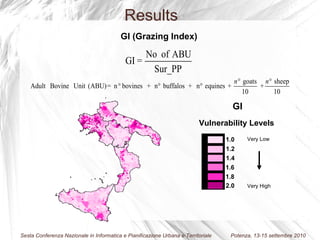
GI (Grazing Index) GI  Vulnerability Levels Very Low Very High 1.0 1.2 1.4 1.6 1.8 2.0 Results
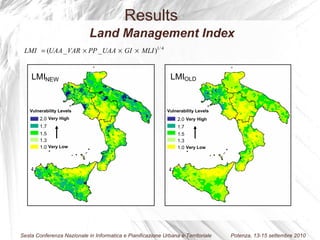
Land Management Index Results LMI OLD 1.0 2.0 1.3 1.5 1.7 Very Low Very   High Vulnerability Levels LMI NEW 1.0 2.0 1.3 1.5 1.7 Very Low Very   High Vulnerability Levels
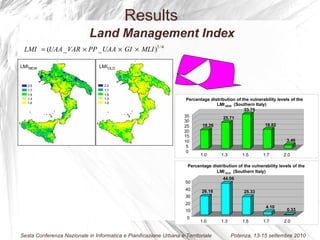
Land Management Index Results Percentage distribution of the vulnerability levels of the LMI NEW (Southern Italy) Percentage distribution of the vulnerability levels of the LMI OLD (Southern Italy) 18.26 25.71 33.75 18.82 3.46 0 5 10 15 20 25 30 35 1.0 1.3 1.5 1.7 2.0 26.18 44.06 25.33 4.10 0.33 0 10 20 30 40 50 1.0 1.3 1.5 1.7 2.0 LMI NEW 1.0 2.0 1.3 1.5 1.7 1.0 2.0 1.3 1.5 1.7 LMI OLD 1.0 2.0 1.3 1.5 1.7 1.0 2.0 1.3 1.5 1.7
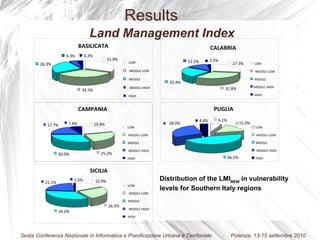
Distribution of the LMI NEW  in vulnerability levels for Southern Italy regions  BASILICATA 3.3% 4.3% 26.3% 34.3% 31.9% LOW MIDDLE-LOW MIDDLE MIDDLE-HIGH HIGH CALABRIA 2.2% 12.2% 25.4% 32.8% 27.3% LOW MIDDLE-LOW MIDDLE MIDDLE-HIGH HIGH CAMPANIA 7.4% 17.7% 30.0% 25.2% 19.8% LOW MIDDLE-LOW MIDDLE MIDDLE-HIGH HIGH SICILIA 15.9% 26.5% 34.0% 22.1% 1.5% LOW MIDDLE-LOW MIDDLE MIDDLE-HIGH HIGH PUGLIA 6.1% 15.0% 46.5% 4.4% 28.0% Land Management Index Results LOW MIDDLE-LOW MIDDLE MIDDLE-HIGH HIGH
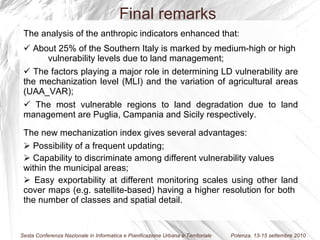
The analysis of the anthropic indicators enhanced that: About 25% of the Southern Italy is marked by medium-high or high  vulnerability levels due to land management; The factors playing a major role in determining LD vulnerability are the mechanization level (MLI) and the variation of agricultural areas (UAA_VAR); The most vulnerable regions to land degradation due to land management are Puglia, Campania and Sicily respectively. The new mechanization index gives several advantages: Possibility of a frequent updating; Capability to discriminate among different vulnerability values within the municipal areas; Easy exportability at different monitoring scales using other land cover maps (e.g. satellite-based) having a higher resolution for both  the number of classes and spatial detail. Final remarks
Thank you for attention Contact: imbrenda@imaa.cnr.it
 
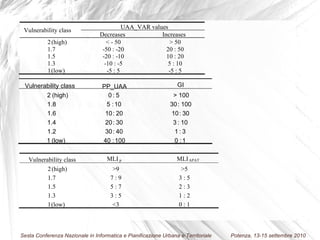
UAA_VAR values Vulnerability class Decreases Increases 2 (high) <  - 50 > 50 1.7 - 50  : - 20 20 : 50 1.5 - 20  : - 10 10 : 20 1.3 - 10  : - 5 5 : 10 1 (low) - 5 : 5 - 5 : 5 Vulnerability class MLI p MLI APAT  2 (high) >9 >5 1.7 7  : 9 3  : 5 1.5 5  : 7 2  : 3 1.3 3  : 5 1  : 2 1 (low) <3 0  : 1 Vulnerability class PP_UAA AA GI 2 (high) 0  : 5 > 100 1.8 5 : 10 30  : 100 1.6 10  : 20 10  : 30 1.4 20  : 30 3  : 10 1.2 30  : 40 1  : 3 1 (low) 40 : 100 0 : 1
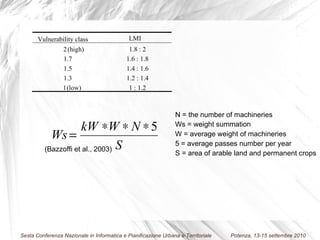
(Bazzoffi et al., 2003) N = the number of machineries Ws = weight summation W = average weight of machineries  5 = average passes number per year S = area of arable land and permanent crops Vulnerability class LMI 2 (high) 1.8 : 2 1.7 1.6  : 1.8 1.5 1.4 : 1.6 1.3 1.2 :  1.4 1 (low) 1 :  1.2

Gli indicatori per la stima della vulnerabilità alla land degradation da fattori antropici: strumenti per una efficace pianificazione territoriale, di Vito Imbrenda , Maria Grazia D’Emilio , Maria Lanfredi , Maria Ragosta , Tiziana Simoniello

  • 1.
    GLI INDICATORI PERLA STIMA DELLA VULNERABILITÀ ALLA LAND DEGRADATION DA FATTORI ANTROPICI: STRUMENTI PER UNA EFFICACE PIANIFICAZIONE TERRITORIALE IMBRENDA V. 1,2 , D’EMILIO M. 2 , LANFREDI M. 2 , RAGOSTA M. 1 , SIMONIELLO T. 2 1 Università degli Studi della Basilicata, Dipartimento di Ingegneria e Fisica dell'Ambiente (DIFA) 2 Istituto di Metodologie per l’Analisi Ambientale (IMAA-CNR)
  • 2.
    land degradation meansreduction or loss of the biological or economic productivity (UN/FAO 2003) DESERTIFICATION DESERT
  • 3.
  • 4.
    Dessication of AralSea Soil erosion LAND DEGRADATION
  • 5.
    Excessive tillage Calanchilandscape LAND DEGRADATION
  • 6.
    Anthropogenic causes holda role of equal importance (in some countries even higher) than climatic conditions in generating land degradation processes (coupled H-E systems) MONITORING: repeated collection and archiving of data ASSESSMENT: critical evaluation of information Human response against land degradation phenomena Identification of vulnerable areas and determination of vulnerability levels Background
  • 7.
    Indicators must beSMART (specific, measurable, achievable, relevant, time bound) enabling: a synthetic information in GIS systems to determine spatial extension and geographic distribution of degraded areas an easily usable data for the public or policy-makers INDICATORS: simplified, synthetic information on the state and tendency of complex processes (Rubio and Bochet, 1998) M any national and international projects (e.g., MEDALUS, Desert-Net, DISMED, Ladamer, RIADE) have been developed during the last decades in order to characterize land degradation processes by adopting vulnerability models based on indicators accounting for different influencing factors Background
  • 8.
    INDICATORS Spatial andtemporal resolution Reliability Dynamic and spatially detailed information Efficient and flexible tool for land management Drafting and implementation of SLM (Sustainable Land Management) plans Early warning systems Background
  • 9.
    A widely adoptedvulnerability model is the ESAs ( ENVIRONMENTALLY SENSITIVE AREAS, Kosmas, 1999 ) Background
  • 10.
    Land management indexesUAA_VAR - Percentage of variation of cultivated surfaces Methods A set of land management indicators was selected in order to accurately depict the impacts of the anthropic pressure in Southern Italy (APAT, 2000, Genesio et al., 2004, Motroni et al., 2004). They were computed at municipal level A marked UAA increase implies a larger extension of cultivated lands (agricultural intensification). A strong UAA decrease is a sign of land transformation process leading to land abandonment or soil sealing LMI Land Management Index ML Mechanization Level GI Grazing Index PP_UAA Permanent Grass and Pasture on Utilized Agricultural Area UAA_Var Utilized Agricultural Area Variation LMI Land Management Index ML Mechanization Level GI Grazing Index PP_UAA Permanent Grass and Pasture on Utilized Agricultural Area UAA_Var Agricultural Area Variation
  • 11.
    Permanent grass andpasture are less vulnerable to degradation processes than cultivated lands. Moreover, herbage serves as protection against erosion A high grazing intensity induces both plant and soil degradation. Grass are consumed and trampled, generating a reduction of leaf apparatus and soil compaction . Methods PP_UAA - Percentage of pasture and grass on UAA GI - Grazing index Land management indexes
  • 12.
    The MLI considersthat persistent mechanical interventions strongly alter soil chemical-physical properties since repeated passes causes a stratum of compacted soil having a low permeability (ploughsole formation). It limits the root expansion and water penetration, and in the worse situation creates asphyxiation conditions that bring on vegetation cover degradation and reduction in crop production Non compacted soil Compacted soil Methods MLI - Level of agricultural mechanization [Duiker, 2004]
  • 13.
    The most diffusedindex is: (APAT, 2000) N = the number of machineries UAA = Utilized Agricultural Area It is easy to compute, but can largely misestimates the vulnerability since there are many agricultural areas managed with machineries of a third party property or join ownership. Moreover, it does not take into account the type of grip (tyres or tracks) and the actual number of passes required for different types of cultivations . Methods
  • 14.
    Tracks induce ahigher compaction effects in the superficial soil, which are easier recoverable than those caused by tyred vehicles in medium-deep subsoil layers. Many studies (see e.g., Pagliai et al., 2003; Keller et al., 2002) enhanced different compaction effects between tyred and tracked vehicles. Methods Moreover, tyres are not typically utilized in presence of steep slope (>18-20%).
  • 15.
    Corine Land Cover2000 Number of passes for different cultivations (data from ENAMA – Ente Nazionale per la Meccanizzazione Agricola) To evaluate the different number of passes for each land cover class Methods New Mechanization Level Index 0 Other classes 3 Land principally occupied by agriculture, with significant areas of natural vegetation 4 Complex cultivation patterns Annual crops associated with permanent crops 3 Pastures - 2.3.1 7 Permanent crops (rice fields, vineyards, fruit trees and berry p lantations, olive groves) 7,5 Arable Land (cereals, legumes, crops, vegetables) Number of passes Different cultivations type (source - ENAMA National Agency of Agricultural Mechanization) 0 Other classes 3 Land principally occupied by agriculture, with significant areas of natural vegetation Complex cultivation patterns Annual crops associated with permanent crops 7 Permanent crops (rice fields, vineyards, fruit trees and berry p lantations, olive groves) Arable Land (cereals, legumes, crops, vegetables) Number of passes Different cultivations type (source - ENAMA National Agency of Agricultural Mechanization) 0 Other classes 1 3 Land principally occupied by agriculture, with significant areas of natural vegetation 4 5 3 7 Permanent crops (vineyards, fruit trees, olive groves) 7,5 Number of passes Different cultivations type (source - ENAMA National Agency of Agricultural Mechanization) 0 Other classes 1 3 Land principally occupied by agriculture, with natural areas - 2.4.3 4 – 2.4.2 5 – 2.4.1 3 7 7,5 Number of passes Different cultivations type (source ENAMA - National Agency of Agricultural Mechanization) - 2.1.1, 2.1.2 - 2.2.1, 2.2.2, 2.2.3 Agro-forestry areas – 2.4.4
  • 16.
    To evaluate thedifference in compaction effects between tyred and tracked vehicles - tyred vehicles are used on the plains (<18-20%) - tracked vehicles are used on steep slopes (>18-20%) DEM SLOPE Correction factors Methods New Mechanization Level Index Slope gradient Correction factor >20% - tracked 1 <20% - tyred 1.5
  • 17.
    N p = the average number of machinery passes for single land cover class f = the correction factor according to tyres (1.5) or tracks (1) use The analytic expression of the new mechanization level index is: The index is evaluated at pixel detail; Its resolution depends on the land cover detail Methods New Mechanization Level Index
  • 18.
    2.0 1.7 1.51.3 1.0 2.0 1.7 1.5 1.3 1.0 MLI p CLC 2000 MLI APAT 2.1.1. Non-irrigated arable land 2.1.2. Permanently irrigated land 2.1.3. Rice fields 2.2.1. Vineyards 2.2.2 . Fruit trees and berry plantations 2.2.3. Olive groves 2.3.1. Pastures 2.4.1. Annual crops associated with permanent crops 2.4.2. Complex cultivation patterns 2.4.3. Land principally occupied by agriculture with natural areas 2.4.4. Agro-forestry areas 3.2.1. Natural grassland Percentage of surface per vulnerability class Results: MLI comparison 2.0 1.7 1.5 1.3 1.0 2.0 1.7 1.5 1.3 2.0 1.7 1.5 1.3 Vulner ability Level MLI APAT MLI p 1 ( low ) 79.5 0.1 1.3 15.2 5.0 1.5 3.4 13.3 1.7 1.5 35.9 2 ( high ) 0.3 45.6 Very Low Very High Vulnerability Levels Very Low Very High Vulnerability Levels
  • 19.
    UAA_Var (Variationof Utilized Agricultural Area) UAA_Var Vulnerability Levels 1.0 1.3 1.5 1.7 2.0 Very Low Very High Results
  • 20.
    PP_UAA (Permanent grassand Pasture on Utilized Agricultural Area) 1.0 1.2 1.4 1.6 1.8 2.0 Very Low Very High PP_UAA Vulnerability Levels Results
  • 21.
    GI (Grazing Index)GI Vulnerability Levels Very Low Very High 1.0 1.2 1.4 1.6 1.8 2.0 Results
  • 22.
    Land Management IndexResults LMI OLD 1.0 2.0 1.3 1.5 1.7 Very Low Very High Vulnerability Levels LMI NEW 1.0 2.0 1.3 1.5 1.7 Very Low Very High Vulnerability Levels
  • 23.
    Land Management IndexResults Percentage distribution of the vulnerability levels of the LMI NEW (Southern Italy) Percentage distribution of the vulnerability levels of the LMI OLD (Southern Italy) 18.26 25.71 33.75 18.82 3.46 0 5 10 15 20 25 30 35 1.0 1.3 1.5 1.7 2.0 26.18 44.06 25.33 4.10 0.33 0 10 20 30 40 50 1.0 1.3 1.5 1.7 2.0 LMI NEW 1.0 2.0 1.3 1.5 1.7 1.0 2.0 1.3 1.5 1.7 LMI OLD 1.0 2.0 1.3 1.5 1.7 1.0 2.0 1.3 1.5 1.7
  • 24.
    Distribution of theLMI NEW in vulnerability levels for Southern Italy regions BASILICATA 3.3% 4.3% 26.3% 34.3% 31.9% LOW MIDDLE-LOW MIDDLE MIDDLE-HIGH HIGH CALABRIA 2.2% 12.2% 25.4% 32.8% 27.3% LOW MIDDLE-LOW MIDDLE MIDDLE-HIGH HIGH CAMPANIA 7.4% 17.7% 30.0% 25.2% 19.8% LOW MIDDLE-LOW MIDDLE MIDDLE-HIGH HIGH SICILIA 15.9% 26.5% 34.0% 22.1% 1.5% LOW MIDDLE-LOW MIDDLE MIDDLE-HIGH HIGH PUGLIA 6.1% 15.0% 46.5% 4.4% 28.0% Land Management Index Results LOW MIDDLE-LOW MIDDLE MIDDLE-HIGH HIGH
  • 25.
    The analysis ofthe anthropic indicators enhanced that: About 25% of the Southern Italy is marked by medium-high or high vulnerability levels due to land management; The factors playing a major role in determining LD vulnerability are the mechanization level (MLI) and the variation of agricultural areas (UAA_VAR); The most vulnerable regions to land degradation due to land management are Puglia, Campania and Sicily respectively. The new mechanization index gives several advantages: Possibility of a frequent updating; Capability to discriminate among different vulnerability values within the municipal areas; Easy exportability at different monitoring scales using other land cover maps (e.g. satellite-based) having a higher resolution for both the number of classes and spatial detail. Final remarks
  • 26.
    Thank you forattention Contact: imbrenda@imaa.cnr.it
  • 27.
  • 28.
    UAA_VAR values Vulnerabilityclass Decreases Increases 2 (high) < - 50 > 50 1.7 - 50 : - 20 20 : 50 1.5 - 20 : - 10 10 : 20 1.3 - 10 : - 5 5 : 10 1 (low) - 5 : 5 - 5 : 5 Vulnerability class MLI p MLI APAT 2 (high) >9 >5 1.7 7 : 9 3 : 5 1.5 5 : 7 2 : 3 1.3 3 : 5 1 : 2 1 (low) <3 0 : 1 Vulnerability class PP_UAA AA GI 2 (high) 0 : 5 > 100 1.8 5 : 10 30 : 100 1.6 10 : 20 10 : 30 1.4 20 : 30 3 : 10 1.2 30 : 40 1 : 3 1 (low) 40 : 100 0 : 1
  • 29.
    (Bazzoffi et al.,2003) N = the number of machineries Ws = weight summation W = average weight of machineries 5 = average passes number per year S = area of arable land and permanent crops Vulnerability class LMI 2 (high) 1.8 : 2 1.7 1.6 : 1.8 1.5 1.4 : 1.6 1.3 1.2 : 1.4 1 (low) 1 : 1.2

Editor's Notes

  • #2 rrrrrrrrrrrrrrrrrrrrrrrrr
  • #3 rrrrrrrrrrrrrrrrrrrrrrrrr
  • #4 rrrrrrrrrrrrrrrrrrrrrrrrr
  • #5 rrrrrrrrrrrrrrrrrrrrrrrrr
  • #7 rrrrrrrrrrrrrrrrrrrrrrrrr
  • #10 rrrrrrrrrrrrrrrrrrrrrrrrr
  • #16 rrrrrrrrrrrrrrrrrrrrrrrrr
  • #17 rrrrrrrrrrrrrrrrrrrrrrrrr ICEDS - Integrated CEOS European Data Server ICEDS was inspired in particular by the Committee on Earth Observing Satellites (CEOS) CEOS Landsat and SRTM Project (CLASP) proposal