Highland Creek Treatment Plant Biosolids Management
Schedule B Class Environmental Assessment 1
WELCOME
Public Information Centre No.2
Highland Creek Treatment Plant Biosolids Management
Schedule B Class Environmental Assessment
Royal Canadian Legion, 45 Lawson Road
Thursday, April 9th, 2015
6:00 p.m. – 9:00 p.m.
Highland Creek Treatment Plant Biosolids Management
Schedule B Class Environmental Assessment
Why are we holding this Public Information Centre?
To inform you about:
 Why the City is doing this study
 The study steps and schedule
 The long list of biosolids management
alternatives considered
 The short list of feasible biosolids
management alternatives that will be
evaluated in greater detail
 The proposed approach to evaluating the
short-listed biosolids management
alternatives to select the best one for the
HCTP
We want your input because:
 Minimizing impacts to the community is a
primary goal of this project
 Understanding what is important to you helps
the City to select the best biosolids
management alternative for the HCTP
2
Please complete a Comment Sheet and leave it here today, or
return it to the City by Thursday, April 30, 2015.
Highland Creek Treatment Plant Biosolids Management
Schedule B Class Environmental Assessment
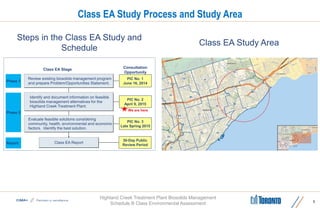
Class EA Study Process and Study Area
3
Steps in the Class EA Study and
Schedule
Class EA Study Area
Highland Creek Treatment Plant Biosolids Management
Schedule B Class Environmental Assessment
Highland Creek
Wastewater Treatment
Plant and Current
Biosolids Management
Program
Highland Creek Treatment Plant Biosolids Management
Schedule B Class Environmental Assessment
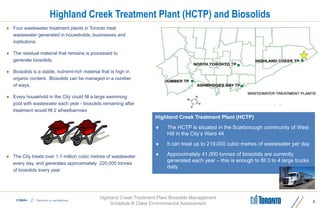
Highland Creek Treatment Plant (HCTP) and Biosolids
 Four wastewater treatment plants in Toronto treat
wastewater generated in households, businesses and
institutions
 The residual material that remains is processed to
generate biosolids.
 Biosolids is a stable, nutrient-rich material that is high in
organic content. Biosolids can be managed in a number
of ways.
 Every household in the City could fill a large swimming
pool with wastewater each year - biosolids remaining after
treatment would fill 2 wheelbarrows
 The City treats over 1.1 million cubic metres of wastewater
every day, and generates approximately 220,000 tonnes
of biosolids every year
5
Highland Creek Treatment Plant (HCTP)
 The HCTP is situated in the Scarborough community of West
Hill in the City’s Ward 44
 It can treat up to 219,000 cubic metres of wastewater per day
 Approximately 41,000 tonnes of biosolids are currently
generated each year – this is enough to fill 3 to 4 large trucks
daily
Highland Creek Treatment Plant Biosolids Management
Schedule B Class Environmental Assessment
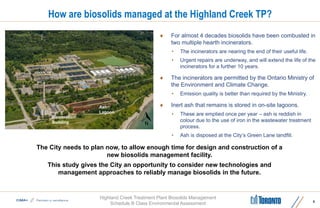
How are biosolids managed at the Highland Creek TP?
 For almost 4 decades biosolids have been combusted in
two multiple hearth incinerators.
• The incinerators are nearing the end of their useful life.
• Urgent repairs are underway, and will extend the life of the
incinerators for a further 10 years.
 The incinerators are permitted by the Ontario Ministry of
the Environment and Climate Change.
• Emission quality is better than required by the Ministry.
 Inert ash that remains is stored in on-site lagoons.
• These are emptied once per year – ash is reddish in
colour due to the use of iron in the wastewater treatment
process.
• Ash is disposed at the City’s Green Lane landfill.
6
Incineration
Building
Ash
Lagoon
The City needs to plan now, to allow enough time for design and construction of a
new biosolids management facility.
This study gives the City an opportunity to consider new technologies and
management approaches to reliably manage biosolids in the future.
Highland Creek Treatment Plant Biosolids Management
Schedule B Class Environmental Assessment
Biosolids Management
Alternatives and
Evaluation Methodology
Highland Creek Treatment Plant Biosolids Management
Schedule B Class Environmental Assessment
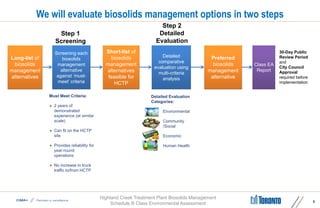
Detailed Evaluation
Categories:
 Environmental
 Community
/Social
 Economic
 Human Health
We will evaluate biosolids management options in two steps
Short-list of
biosolids
management
alternatives
feasible for
HCTP
Class EA
Report
Long-list of
biosolids
management
alternatives
Screening each
biosolids
management
alternative
against ‘must-
meet’ criteria
Detailed
comparative
evaluation using
multi-criteria
analysis
Preferred
biosolids
management
alternative
30-Day Public
Review Period
and
City Council
Approval
required before
implementation
8
Must Meet Criteria:
 2 years of
demonstrated
experience (at similar
scale)
 Can fit on the HCTP
site
 Provides reliability for
year-round
operations
 No increase in truck
traffic to/from HCTP
Step 1
Screening
Step 2
Detailed
Evaluation
Highland Creek Treatment Plant Biosolids Management
Schedule B Class Environmental Assessment
On-Site Thermal Destruction
On-Site Processing to Produce
Fertilizer and Off-Site Distribution
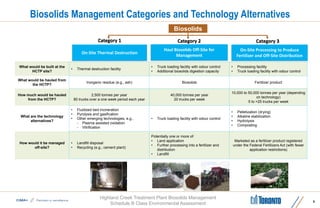
What would be built at the
HCTP site?
• Thermal destruction facility
• Truck loading facility with odour control
• Additional biosolids digestion capacity
• Processing facility
• Truck loading facility with odour control
What would be hauled from
the HCTP?
Inorganic residue (e.g., ash) Biosolids Fertilizer product
How much would be hauled
from the HCTP?
2,500 tonnes per year
80 trucks over a one week period each year
40,000 tonnes per year
20 trucks per week
10,000 to 50,000 tonnes per year (depending
on technology)
5 to >25 trucks per week
What are the technology
alternatives?
• Fluidized bed incineration
• Pyrolysis and gasification
• Other emerging technologies, e.g.,
 Plasma assisted oxidation
 Vitrification
• Truck loading facility with odour control
• Pelletization (drying)
• Alkaline stabilization
• Hydrolysis
• Composting
How would it be managed
off-site?
• Landfill disposal
• Recycling (e.g., cement plant)
Potentially one or more of:
• Land application
• Further processing into a fertilizer and
distribution
• Landfill
Marketed as a fertilizer product registered
under the Federal Fertilizers Act (with fewer
application restrictions)
Biosolids Management Categories and Technology Alternatives
9
Biosolids
Category 1
Haul Biosolids Off-Site for
Management
Category 2 Category 3
Highland Creek Treatment Plant Biosolids Management
Schedule B Class Environmental Assessment
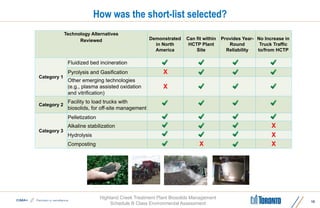
How was the short-list selected?
10
Technology Alternatives
Reviewed Demonstrated
in North
America
Can fit within
HCTP Plant
Site
Provides Year-
Round
Reliability
No Increase in
Truck Traffic
to/from HCTP
Category 1
Fluidized bed incineration
Pyrolysis and Gasification X
Other emerging technologies
(e.g., plasma assisted oxidation
and vitrification)
X
Category 2
Facility to load trucks with
biosolids, for off-site management
Category 3
Pelletization
Alkaline stabilization X
Hydrolysis X
Composting X X
Highland Creek Treatment Plant Biosolids Management
Schedule B Class Environmental Assessment
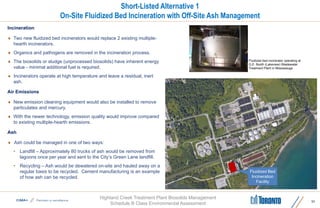
Short-Listed Alternative 1
On-Site Fluidized Bed Incineration with Off-Site Ash Management
Incineration
 Two new fluidized bed incinerators would replace 2 existing multiple-
hearth incinerators.
 Organics and pathogens are removed in the incineration process.
 The biosolids or sludge (unprocessed biosolids) have inherent energy
value - minimal additional fuel is required.
 Incinerators operate at high temperature and leave a residual, inert
ash.
Air Emissions
 New emission cleaning equipment would also be installed to remove
particulates and mercury.
 With the newer technology, emission quality would improve compared
to existing multiple-hearth emissions.
Ash
 Ash could be managed in one of two ways:
• Landfill – Approximately 80 trucks of ash would be removed from
lagoons once per year and sent to the City’s Green Lane landfill.
• Recycling – Ash would be dewatered on-site and hauled away on a
regular basis to be recycled. Cement manufacturing is an example
of how ash can be recycled.
11
Fluidized bed incinerator operating at
G.E. Booth (Lakeview) Wastewater
Treatment Plant in Mississauga
Fluidized Bed
Incineration
Facility
Highland Creek Treatment Plant Biosolids Management
Schedule B Class Environmental Assessment
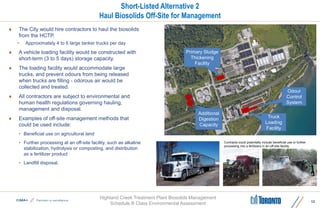
Short-Listed Alternative 2
Haul Biosolids Off-Site for Management
 The City would hire contractors to haul the biosolids
from the HCTP.
• Approximately 4 to 6 large tanker trucks per day
 A vehicle loading facility would be constructed with
short-term (3 to 5 days) storage capacity.
 The loading facility would accommodate large
trucks, and prevent odours from being released
when trucks are filling - odorous air would be
collected and treated.
 All contractors are subject to environmental and
human health regulations governing hauling,
management and disposal.
 Examples of off-site management methods that
could be used include:
• Beneficial use on agricultural land
• Further processing at an off-site facility, such as alkaline
stabilization, hydrolysis or composting, and distribution
as a fertilizer product
• Landfill disposal.
12
Contracts could potentially include beneficial use or further
processing into a fertilizers in an off-site facility.
Truck
Loading
Facility
Odour
Control
System
Primary Sludge
Thickening
Facility
Additional
Digestion
Capacity
Highland Creek Treatment Plant Biosolids Management
Schedule B Class Environmental Assessment
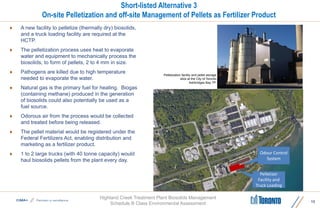
Short-listed Alternative 3
On-site Pelletization and off-site Management of Pellets as Fertilizer Product
 A new facility to pelletize (thermally dry) biosolids,
and a truck loading facility are required at the
HCTP.
 The pelletization process uses heat to evaporate
water and equipment to mechanically process the
biosolids, to form of pellets, 2 to 4 mm in size.
 Pathogens are killed due to high temperature
needed to evaporate the water.
 Natural gas is the primary fuel for heating. Biogas
(containing methane) produced in the generation
of biosolids could also potentially be used as a
fuel source.
 Odorous air from the process would be collected
and treated before being released.
 The pellet material would be registered under the
Federal Fertilizers Act, enabling distribution and
marketing as a fertilizer product.
 1 to 2 large trucks (with 40 tonne capacity) would
haul biosolids pellets from the plant every day.
13
Pelletizer
Facility and
Truck Loading
Odour Control
System
Pelletization facility and pellet storage
silos at the City of Toronto
Ashbridges Bay TP.
Highland Creek Treatment Plant Biosolids Management
Schedule B Class Environmental Assessment
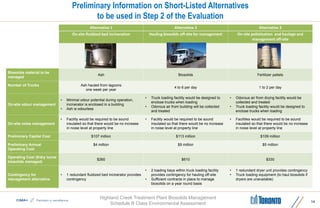
Preliminary Information on Short-Listed Alternatives
to be used in Step 2 of the Evaluation
Alternative 1 Alternative 2 Alternative 3
On-site fluidized bed incineration Hauling biosolids off-site for management On-site pelletization and haulage and
management off-site
Biosolids material to be
managed
Ash Biosolids Fertilizer pellets
Number of Trucks Ash hauled from lagoons
one week per year
4 to 6 per day 1 to 2 per day
On-site odour management
• Minimal odour potential during operation,
incinerator is enclosed in a building
• Ash is odourless
• Truck loading facility would be designed to
enclose trucks when loading
• Odorous air from building will be collected
and treated
• Odorous air from drying facility would be
collected and treated
• Truck loading facility would be designed to
enclose trucks when loading
On-site noise management
• Facility would be required to be sound
insulated so that there would be no increase
in noise level at property line
• Facility would be required to be sound
insulated so that there would be no increase
in noise level at property line
• Facilities would be required to be sound
insulated so that there would be no increase
in noise level at property line
Preliminary Capital Cost $107 million $113 million $109 million
Preliminary Annual
Operating Cost
$4 million $9 million $5 million
Operating Cost ($/dry tonne
biosolids managed)
$260 $610 $330
Contingency for
management alternative
• 1 redundant fluidized bed incinerator provides
contingency
• 2 loading bays within truck loading facility
provides contingency for hauling off-site
• Sufficient contracts in place to manage
biosolids on a year round basis
• 1 redundant dryer unit provides contingency
• Truck loading equipment (to haul biosolids if
dryers are unavailable)
14
Highland Creek Treatment Plant Biosolids Management
Schedule B Class Environmental Assessment
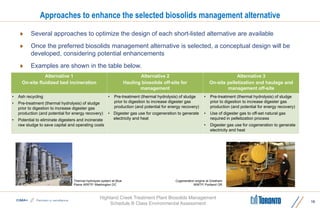
Approaches to enhance the selected biosolids management alternative
Alternative 1
On-site fluidized bed incineration
Alternative 2
Hauling biosolids off-site for
management
Alternative 3
On-site pelletization and haulage and
management off-site
• Ash recycling
• Pre-treatment (thermal hydrolysis) of sludge
prior to digestion to increase digester gas
production (and potential for energy recovery)
• Potential to eliminate digesters and incinerate
raw sludge to save capital and operating costs
• Pre-treatment (thermal hydrolysis) of sludge
prior to digestion to increase digester gas
production (and potential for energy recovery)
• Digester gas use for cogeneration to generate
electricity and heat
• Pre-treatment (thermal hydrolysis) of sludge
prior to digestion to increase digester gas
production (and potential for energy recovery)
• Use of digester gas to off-set natural gas
required in pelletization process
• Digester gas use for cogeneration to generate
electricity and heat
15
 Several approaches to optimize the design of each short-listed alternative are available
 Once the preferred biosolids management alternative is selected, a conceptual design will be
developed, considering potential enhancements
 Examples are shown in the table below.
Thermal hydrolysis system at Blue
Plains WWTP, Washington DC
Cogeneration engine at Gresham
WWTP, Portland OR
Highland Creek Treatment Plant Biosolids Management
Schedule B Class Environmental Assessment
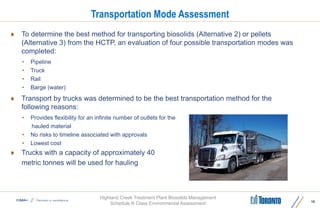
 To determine the best method for transporting biosolids (Alternative 2) or pellets
(Alternative 3) from the HCTP, an evaluation of four possible transportation modes was
completed:
• Pipeline
• Truck
• Rail
• Barge (water)
 Transport by trucks was determined to be the best transportation method for the
following reasons:
• Provides flexibility for an infinite number of outlets for the
hauled material
• No risks to timeline associated with approvals
• Lowest cost
 Trucks with a capacity of approximately 40
metric tonnes will be used for hauling
Transportation Mode Assessment
16
Highland Creek Treatment Plant Biosolids Management
Schedule B Class Environmental Assessment
Transportation Route Assessment
17
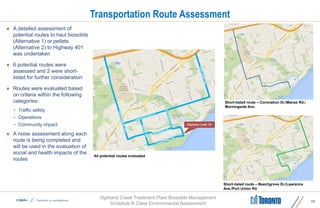
 A detailed assessment of
potential routes to haul biosolids
(Alternative 1) or pellets
(Alternative 2) to Highway 401
was undertaken
 6 potential routes were
assessed and 2 were short-
listed for further consideration
 Routes were evaluated based
on criteria within the following
categories:
• Traffic safety
• Operations
• Community impact
 A noise assessment along each
route is being completed and
will be used in the evaluation of
social and health impacts of the
routes
All potential routes evaluated
Short-listed route – Coronation Dr./Manse Rd./
Morningside Ave.
Short-listed route – Beechgrove Dr./Lawrence
Ave./Port Union Rd.
Highland Creek Treatment Plant Biosolids Management
Schedule B Class Environmental Assessment
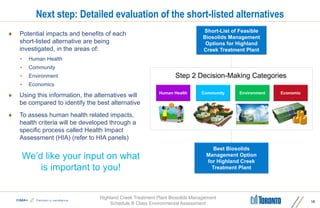
Next step: Detailed evaluation of the short-listed alternatives
 Potential impacts and benefits of each
short-listed alternative are being
investigated, in the areas of:
• Human Health
• Community
• Environment
• Economics
 Using this information, the alternatives will
be compared to identify the best alternative
 To assess human health related impacts,
health criteria will be developed through a
specific process called Health Impact
Assessment (HIA) (refer to HIA panels)
We’d like your input on what
is important to you!
18
EnvironmentCommunityHuman Health Economic
Best Biosolids
Management Option
for Highland Creek
Treatment Plant
Short-List of Feasible
Biosolids Management
Options for Highland
Creek Treatment Plant
Step 2 Decision-Making Categories
Highland Creek Treatment Plant Biosolids Management
Schedule B Class Environmental Assessment
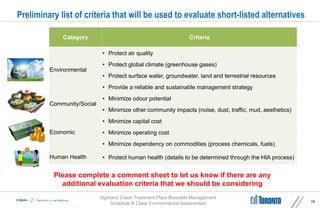
Preliminary list of criteria that will be used to evaluate short-listed alternatives
19
Please complete a comment sheet to let us know if there are any
additional evaluation criteria that we should be considering
Category Criteria
Environmental
• Protect air quality
• Protect global climate (greenhouse gases)
• Protect surface water, groundwater, land and terrestrial resources
• Provide a reliable and sustainable management strategy
Community/Social
• Minimize odour potential
• Minimize other community impacts (noise, dust, traffic, mud, aesthetics)
Economic
• Minimize capital cost
• Minimize operating cost
• Minimize dependency on commodities (process chemicals, fuels)
Human Health • Protect human health (details to be determined through the HIA process)
Highland Creek Treatment Plant Biosolids Management
Schedule B Class Environmental Assessment
Health Impact
Assessment
Highland Creek Treatment Plant Biosolids Management
Schedule B Class Environmental Assessment
Health Impact Assessment
 A Health Impact Assessment (HIA) is a procedure used to
identify how a specific project could potentially affect
health
 For this study, the HIA will use the following key sources of
information to evaluate health impacts from biosolids
management alternatives:
• Cumulative Air Emissions Assessment
• Human Health Risk Assessment – which will evaluate the
potential for health impacts from emissions
• Noise assessment
• Odour assessment
• Traffic assessment
• Other health related impacts, as identified through a HIA
Stakeholders Group that represents the community, City and
subject experts
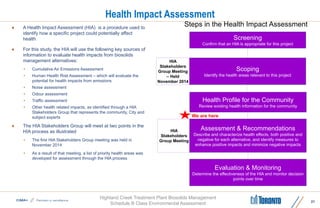
 The HIA Stakeholders Group will meet at two points in the
HIA process as illustrated
• The first HIA Stakeholders Group meeting was held in
November 2014
• As a result of that meeting, a list of priority health areas was
developed for assessment through the HIA process
21
Screening
Confirm that an HIA is appropriate for this project
Scoping
Identify the health areas relevant to this project
Health Profile for the Community
Review existing health information for the community
Assessment & Recommendations
Describe and characterize health effects, both positive and
negative for each alternative, and identify measures to
enhance positive impacts and minimize negative impacts
Evaluation & Monitoring
Determine the effectiveness of the HIA and monitor decision
points over time
HIA
Stakeholders
Group Meeting
HIA
Stakeholders
Group Meeting
– Held
November 2014
Steps in the Health Impact Assessment
We are here
Highland Creek Treatment Plant Biosolids Management
Schedule B Class Environmental Assessment
Health Impact Assessment
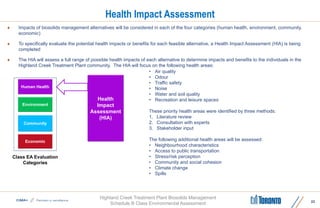
 Impacts of biosolids management alternatives will be considered in each of the four categories (human health, environment, community,
economic)
 To specifically evaluate the potential health impacts or benefits for each feasible alternative, a Health Impact Assessment (HIA) is being
completed
 The HIA will assess a full range of possible health impacts of each alternative to determine impacts and benefits to the individuals in the
Highland Creek Treatment Plant community. The HIA will focus on the following health areas:
22
Health
Impact
Assessment
(HIA)
Environment
Community
Human Health
Economic
Class EA Evaluation
Categories
• Air quality
• Odour
• Traffic safety
• Noise
• Water and soil quality
• Recreation and leisure spaces
These priority health areas were identified by three methods:
1. Literature review
2. Consultation with experts
3. Stakeholder input
The following additional health areas will be assessed:
• Neighbourhood characteristics
• Access to public transportation
• Stress/risk perception
• Community and social cohesion
• Climate change
• Spills
Highland Creek Treatment Plant Biosolids Management
Schedule B Class Environmental Assessment
Cumulative Air
Emissions
Assessment
and
Human Health Risk
Assessment
Highland Creek Treatment Plant Biosolids Management
Schedule B Class Environmental Assessment
Cumulative Air Emissions Assessment
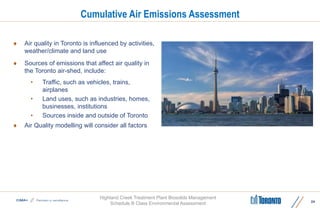
 Air quality in Toronto is influenced by activities,
weather/climate and land use
 Sources of emissions that affect air quality in
the Toronto air-shed, include:
• Traffic, such as vehicles, trains,
airplanes
• Land uses, such as industries, homes,
businesses, institutions
• Sources inside and outside of Toronto
 Air Quality modelling will consider all factors
24
Highland Creek Treatment Plant Biosolids Management
Schedule B Class Environmental Assessment
Cumulative Air Emissions Assessment
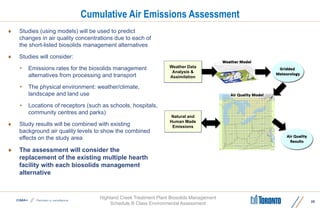
 Studies (using models) will be used to predict
changes in air quality concentrations due to each of
the short-listed biosolids management alternatives
 Studies will consider:
• Emissions rates for the biosolids management
alternatives from processing and transport
• The physical environment: weather/climate,
landscape and land use
• Locations of receptors (such as schools, hospitals,
community centres and parks)
 Study results will be combined with existing
background air quality levels to show the combined
effects on the study area
 The assessment will consider the
replacement of the existing multiple hearth
facility with each biosolids management
alternative
25
Weather Data
Analysis &
Assimilation
Natural and
Human Made
Emissions
Highland Creek Treatment Plant Biosolids Management
Schedule B Class Environmental Assessment
Human Health Risk Assessment (HHRA)
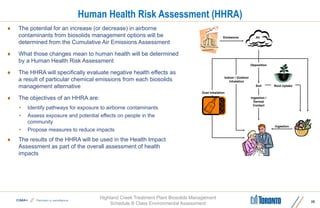
 The potential for an increase (or decrease) in airborne
contaminants from biosolids management options will be
determined from the Cumulative Air Emissions Assessment
 What those changes mean to human health will be determined
by a Human Health Risk Assessment
 The HHRA will specifically evaluate negative health effects as
a result of particular chemical emissions from each biosolids
management alternative
 The objectives of an HHRA are:
• Identify pathways for exposure to airborne contaminants
• Assess exposure and potential effects on people in the
community
• Propose measures to reduce impacts
 The results of the HHRA will be used in the Health Impact
Assessment as part of the overall assessment of health
impacts
26
Emissions Air
Soil Root Uptake
Ingestion /
Dermal
Contact
Ingestion
Dust Inhalation
Ingestion of Breast
Milk (Infant)
Deposition
Indoor / Outdoor
Inhalation
Highland Creek Treatment Plant Biosolids Management
Schedule B Class Environmental Assessment
What are we doing moving forward?
 Please complete a Comment Sheet and leave it here today, or
return it to the City by Thursday, April 30, 2015
 Information you provided tonight will feed into the Step 2
detailed evaluation of short-listed biosolids management
alternatives
 A third public information centre will be held in late spring
2015 to present the results of the Health Impact Assessment,
Human Health Risk Assessment, and evaluation of biosolids
management alternatives
27
For more information about this project, or to view the Public Information Centre displays
online, please visit the project website:
http://www.toronto.ca/hctpbiosolidsea

Poster boards pic no 2 final

  • 1.
    Highland Creek TreatmentPlant Biosolids Management Schedule B Class Environmental Assessment 1 WELCOME Public Information Centre No.2 Highland Creek Treatment Plant Biosolids Management Schedule B Class Environmental Assessment Royal Canadian Legion, 45 Lawson Road Thursday, April 9th, 2015 6:00 p.m. – 9:00 p.m.
  • 2.
    Highland Creek TreatmentPlant Biosolids Management Schedule B Class Environmental Assessment Why are we holding this Public Information Centre? To inform you about:  Why the City is doing this study  The study steps and schedule  The long list of biosolids management alternatives considered  The short list of feasible biosolids management alternatives that will be evaluated in greater detail  The proposed approach to evaluating the short-listed biosolids management alternatives to select the best one for the HCTP We want your input because:  Minimizing impacts to the community is a primary goal of this project  Understanding what is important to you helps the City to select the best biosolids management alternative for the HCTP 2 Please complete a Comment Sheet and leave it here today, or return it to the City by Thursday, April 30, 2015.
  • 3.
    Highland Creek TreatmentPlant Biosolids Management Schedule B Class Environmental Assessment Class EA Study Process and Study Area 3 Steps in the Class EA Study and Schedule Class EA Study Area
  • 4.
    Highland Creek TreatmentPlant Biosolids Management Schedule B Class Environmental Assessment Highland Creek Wastewater Treatment Plant and Current Biosolids Management Program
  • 5.
    Highland Creek TreatmentPlant Biosolids Management Schedule B Class Environmental Assessment Highland Creek Treatment Plant (HCTP) and Biosolids  Four wastewater treatment plants in Toronto treat wastewater generated in households, businesses and institutions  The residual material that remains is processed to generate biosolids.  Biosolids is a stable, nutrient-rich material that is high in organic content. Biosolids can be managed in a number of ways.  Every household in the City could fill a large swimming pool with wastewater each year - biosolids remaining after treatment would fill 2 wheelbarrows  The City treats over 1.1 million cubic metres of wastewater every day, and generates approximately 220,000 tonnes of biosolids every year 5 Highland Creek Treatment Plant (HCTP)  The HCTP is situated in the Scarborough community of West Hill in the City’s Ward 44  It can treat up to 219,000 cubic metres of wastewater per day  Approximately 41,000 tonnes of biosolids are currently generated each year – this is enough to fill 3 to 4 large trucks daily
  • 6.
    Highland Creek TreatmentPlant Biosolids Management Schedule B Class Environmental Assessment How are biosolids managed at the Highland Creek TP?  For almost 4 decades biosolids have been combusted in two multiple hearth incinerators. • The incinerators are nearing the end of their useful life. • Urgent repairs are underway, and will extend the life of the incinerators for a further 10 years.  The incinerators are permitted by the Ontario Ministry of the Environment and Climate Change. • Emission quality is better than required by the Ministry.  Inert ash that remains is stored in on-site lagoons. • These are emptied once per year – ash is reddish in colour due to the use of iron in the wastewater treatment process. • Ash is disposed at the City’s Green Lane landfill. 6 Incineration Building Ash Lagoon The City needs to plan now, to allow enough time for design and construction of a new biosolids management facility. This study gives the City an opportunity to consider new technologies and management approaches to reliably manage biosolids in the future.
  • 7.
    Highland Creek TreatmentPlant Biosolids Management Schedule B Class Environmental Assessment Biosolids Management Alternatives and Evaluation Methodology
  • 8.
    Highland Creek TreatmentPlant Biosolids Management Schedule B Class Environmental Assessment Detailed Evaluation Categories:  Environmental  Community /Social  Economic  Human Health We will evaluate biosolids management options in two steps Short-list of biosolids management alternatives feasible for HCTP Class EA Report Long-list of biosolids management alternatives Screening each biosolids management alternative against ‘must- meet’ criteria Detailed comparative evaluation using multi-criteria analysis Preferred biosolids management alternative 30-Day Public Review Period and City Council Approval required before implementation 8 Must Meet Criteria:  2 years of demonstrated experience (at similar scale)  Can fit on the HCTP site  Provides reliability for year-round operations  No increase in truck traffic to/from HCTP Step 1 Screening Step 2 Detailed Evaluation
  • 9.
    Highland Creek TreatmentPlant Biosolids Management Schedule B Class Environmental Assessment On-Site Thermal Destruction On-Site Processing to Produce Fertilizer and Off-Site Distribution What would be built at the HCTP site? • Thermal destruction facility • Truck loading facility with odour control • Additional biosolids digestion capacity • Processing facility • Truck loading facility with odour control What would be hauled from the HCTP? Inorganic residue (e.g., ash) Biosolids Fertilizer product How much would be hauled from the HCTP? 2,500 tonnes per year 80 trucks over a one week period each year 40,000 tonnes per year 20 trucks per week 10,000 to 50,000 tonnes per year (depending on technology) 5 to >25 trucks per week What are the technology alternatives? • Fluidized bed incineration • Pyrolysis and gasification • Other emerging technologies, e.g.,  Plasma assisted oxidation  Vitrification • Truck loading facility with odour control • Pelletization (drying) • Alkaline stabilization • Hydrolysis • Composting How would it be managed off-site? • Landfill disposal • Recycling (e.g., cement plant) Potentially one or more of: • Land application • Further processing into a fertilizer and distribution • Landfill Marketed as a fertilizer product registered under the Federal Fertilizers Act (with fewer application restrictions) Biosolids Management Categories and Technology Alternatives 9 Biosolids Category 1 Haul Biosolids Off-Site for Management Category 2 Category 3
  • 10.
    Highland Creek TreatmentPlant Biosolids Management Schedule B Class Environmental Assessment How was the short-list selected? 10 Technology Alternatives Reviewed Demonstrated in North America Can fit within HCTP Plant Site Provides Year- Round Reliability No Increase in Truck Traffic to/from HCTP Category 1 Fluidized bed incineration Pyrolysis and Gasification X Other emerging technologies (e.g., plasma assisted oxidation and vitrification) X Category 2 Facility to load trucks with biosolids, for off-site management Category 3 Pelletization Alkaline stabilization X Hydrolysis X Composting X X
  • 11.
    Highland Creek TreatmentPlant Biosolids Management Schedule B Class Environmental Assessment Short-Listed Alternative 1 On-Site Fluidized Bed Incineration with Off-Site Ash Management Incineration  Two new fluidized bed incinerators would replace 2 existing multiple- hearth incinerators.  Organics and pathogens are removed in the incineration process.  The biosolids or sludge (unprocessed biosolids) have inherent energy value - minimal additional fuel is required.  Incinerators operate at high temperature and leave a residual, inert ash. Air Emissions  New emission cleaning equipment would also be installed to remove particulates and mercury.  With the newer technology, emission quality would improve compared to existing multiple-hearth emissions. Ash  Ash could be managed in one of two ways: • Landfill – Approximately 80 trucks of ash would be removed from lagoons once per year and sent to the City’s Green Lane landfill. • Recycling – Ash would be dewatered on-site and hauled away on a regular basis to be recycled. Cement manufacturing is an example of how ash can be recycled. 11 Fluidized bed incinerator operating at G.E. Booth (Lakeview) Wastewater Treatment Plant in Mississauga Fluidized Bed Incineration Facility
  • 12.
    Highland Creek TreatmentPlant Biosolids Management Schedule B Class Environmental Assessment Short-Listed Alternative 2 Haul Biosolids Off-Site for Management  The City would hire contractors to haul the biosolids from the HCTP. • Approximately 4 to 6 large tanker trucks per day  A vehicle loading facility would be constructed with short-term (3 to 5 days) storage capacity.  The loading facility would accommodate large trucks, and prevent odours from being released when trucks are filling - odorous air would be collected and treated.  All contractors are subject to environmental and human health regulations governing hauling, management and disposal.  Examples of off-site management methods that could be used include: • Beneficial use on agricultural land • Further processing at an off-site facility, such as alkaline stabilization, hydrolysis or composting, and distribution as a fertilizer product • Landfill disposal. 12 Contracts could potentially include beneficial use or further processing into a fertilizers in an off-site facility. Truck Loading Facility Odour Control System Primary Sludge Thickening Facility Additional Digestion Capacity
  • 13.
    Highland Creek TreatmentPlant Biosolids Management Schedule B Class Environmental Assessment Short-listed Alternative 3 On-site Pelletization and off-site Management of Pellets as Fertilizer Product  A new facility to pelletize (thermally dry) biosolids, and a truck loading facility are required at the HCTP.  The pelletization process uses heat to evaporate water and equipment to mechanically process the biosolids, to form of pellets, 2 to 4 mm in size.  Pathogens are killed due to high temperature needed to evaporate the water.  Natural gas is the primary fuel for heating. Biogas (containing methane) produced in the generation of biosolids could also potentially be used as a fuel source.  Odorous air from the process would be collected and treated before being released.  The pellet material would be registered under the Federal Fertilizers Act, enabling distribution and marketing as a fertilizer product.  1 to 2 large trucks (with 40 tonne capacity) would haul biosolids pellets from the plant every day. 13 Pelletizer Facility and Truck Loading Odour Control System Pelletization facility and pellet storage silos at the City of Toronto Ashbridges Bay TP.
  • 14.
    Highland Creek TreatmentPlant Biosolids Management Schedule B Class Environmental Assessment Preliminary Information on Short-Listed Alternatives to be used in Step 2 of the Evaluation Alternative 1 Alternative 2 Alternative 3 On-site fluidized bed incineration Hauling biosolids off-site for management On-site pelletization and haulage and management off-site Biosolids material to be managed Ash Biosolids Fertilizer pellets Number of Trucks Ash hauled from lagoons one week per year 4 to 6 per day 1 to 2 per day On-site odour management • Minimal odour potential during operation, incinerator is enclosed in a building • Ash is odourless • Truck loading facility would be designed to enclose trucks when loading • Odorous air from building will be collected and treated • Odorous air from drying facility would be collected and treated • Truck loading facility would be designed to enclose trucks when loading On-site noise management • Facility would be required to be sound insulated so that there would be no increase in noise level at property line • Facility would be required to be sound insulated so that there would be no increase in noise level at property line • Facilities would be required to be sound insulated so that there would be no increase in noise level at property line Preliminary Capital Cost $107 million $113 million $109 million Preliminary Annual Operating Cost $4 million $9 million $5 million Operating Cost ($/dry tonne biosolids managed) $260 $610 $330 Contingency for management alternative • 1 redundant fluidized bed incinerator provides contingency • 2 loading bays within truck loading facility provides contingency for hauling off-site • Sufficient contracts in place to manage biosolids on a year round basis • 1 redundant dryer unit provides contingency • Truck loading equipment (to haul biosolids if dryers are unavailable) 14
  • 15.
    Highland Creek TreatmentPlant Biosolids Management Schedule B Class Environmental Assessment Approaches to enhance the selected biosolids management alternative Alternative 1 On-site fluidized bed incineration Alternative 2 Hauling biosolids off-site for management Alternative 3 On-site pelletization and haulage and management off-site • Ash recycling • Pre-treatment (thermal hydrolysis) of sludge prior to digestion to increase digester gas production (and potential for energy recovery) • Potential to eliminate digesters and incinerate raw sludge to save capital and operating costs • Pre-treatment (thermal hydrolysis) of sludge prior to digestion to increase digester gas production (and potential for energy recovery) • Digester gas use for cogeneration to generate electricity and heat • Pre-treatment (thermal hydrolysis) of sludge prior to digestion to increase digester gas production (and potential for energy recovery) • Use of digester gas to off-set natural gas required in pelletization process • Digester gas use for cogeneration to generate electricity and heat 15  Several approaches to optimize the design of each short-listed alternative are available  Once the preferred biosolids management alternative is selected, a conceptual design will be developed, considering potential enhancements  Examples are shown in the table below. Thermal hydrolysis system at Blue Plains WWTP, Washington DC Cogeneration engine at Gresham WWTP, Portland OR
  • 16.
    Highland Creek TreatmentPlant Biosolids Management Schedule B Class Environmental Assessment  To determine the best method for transporting biosolids (Alternative 2) or pellets (Alternative 3) from the HCTP, an evaluation of four possible transportation modes was completed: • Pipeline • Truck • Rail • Barge (water)  Transport by trucks was determined to be the best transportation method for the following reasons: • Provides flexibility for an infinite number of outlets for the hauled material • No risks to timeline associated with approvals • Lowest cost  Trucks with a capacity of approximately 40 metric tonnes will be used for hauling Transportation Mode Assessment 16
  • 17.
    Highland Creek TreatmentPlant Biosolids Management Schedule B Class Environmental Assessment Transportation Route Assessment 17  A detailed assessment of potential routes to haul biosolids (Alternative 1) or pellets (Alternative 2) to Highway 401 was undertaken  6 potential routes were assessed and 2 were short- listed for further consideration  Routes were evaluated based on criteria within the following categories: • Traffic safety • Operations • Community impact  A noise assessment along each route is being completed and will be used in the evaluation of social and health impacts of the routes All potential routes evaluated Short-listed route – Coronation Dr./Manse Rd./ Morningside Ave. Short-listed route – Beechgrove Dr./Lawrence Ave./Port Union Rd.
  • 18.
    Highland Creek TreatmentPlant Biosolids Management Schedule B Class Environmental Assessment Next step: Detailed evaluation of the short-listed alternatives  Potential impacts and benefits of each short-listed alternative are being investigated, in the areas of: • Human Health • Community • Environment • Economics  Using this information, the alternatives will be compared to identify the best alternative  To assess human health related impacts, health criteria will be developed through a specific process called Health Impact Assessment (HIA) (refer to HIA panels) We’d like your input on what is important to you! 18 EnvironmentCommunityHuman Health Economic Best Biosolids Management Option for Highland Creek Treatment Plant Short-List of Feasible Biosolids Management Options for Highland Creek Treatment Plant Step 2 Decision-Making Categories
  • 19.
    Highland Creek TreatmentPlant Biosolids Management Schedule B Class Environmental Assessment Preliminary list of criteria that will be used to evaluate short-listed alternatives 19 Please complete a comment sheet to let us know if there are any additional evaluation criteria that we should be considering Category Criteria Environmental • Protect air quality • Protect global climate (greenhouse gases) • Protect surface water, groundwater, land and terrestrial resources • Provide a reliable and sustainable management strategy Community/Social • Minimize odour potential • Minimize other community impacts (noise, dust, traffic, mud, aesthetics) Economic • Minimize capital cost • Minimize operating cost • Minimize dependency on commodities (process chemicals, fuels) Human Health • Protect human health (details to be determined through the HIA process)
  • 20.
    Highland Creek TreatmentPlant Biosolids Management Schedule B Class Environmental Assessment Health Impact Assessment
  • 21.
    Highland Creek TreatmentPlant Biosolids Management Schedule B Class Environmental Assessment Health Impact Assessment  A Health Impact Assessment (HIA) is a procedure used to identify how a specific project could potentially affect health  For this study, the HIA will use the following key sources of information to evaluate health impacts from biosolids management alternatives: • Cumulative Air Emissions Assessment • Human Health Risk Assessment – which will evaluate the potential for health impacts from emissions • Noise assessment • Odour assessment • Traffic assessment • Other health related impacts, as identified through a HIA Stakeholders Group that represents the community, City and subject experts  The HIA Stakeholders Group will meet at two points in the HIA process as illustrated • The first HIA Stakeholders Group meeting was held in November 2014 • As a result of that meeting, a list of priority health areas was developed for assessment through the HIA process 21 Screening Confirm that an HIA is appropriate for this project Scoping Identify the health areas relevant to this project Health Profile for the Community Review existing health information for the community Assessment & Recommendations Describe and characterize health effects, both positive and negative for each alternative, and identify measures to enhance positive impacts and minimize negative impacts Evaluation & Monitoring Determine the effectiveness of the HIA and monitor decision points over time HIA Stakeholders Group Meeting HIA Stakeholders Group Meeting – Held November 2014 Steps in the Health Impact Assessment We are here
  • 22.
    Highland Creek TreatmentPlant Biosolids Management Schedule B Class Environmental Assessment Health Impact Assessment  Impacts of biosolids management alternatives will be considered in each of the four categories (human health, environment, community, economic)  To specifically evaluate the potential health impacts or benefits for each feasible alternative, a Health Impact Assessment (HIA) is being completed  The HIA will assess a full range of possible health impacts of each alternative to determine impacts and benefits to the individuals in the Highland Creek Treatment Plant community. The HIA will focus on the following health areas: 22 Health Impact Assessment (HIA) Environment Community Human Health Economic Class EA Evaluation Categories • Air quality • Odour • Traffic safety • Noise • Water and soil quality • Recreation and leisure spaces These priority health areas were identified by three methods: 1. Literature review 2. Consultation with experts 3. Stakeholder input The following additional health areas will be assessed: • Neighbourhood characteristics • Access to public transportation • Stress/risk perception • Community and social cohesion • Climate change • Spills
  • 23.
    Highland Creek TreatmentPlant Biosolids Management Schedule B Class Environmental Assessment Cumulative Air Emissions Assessment and Human Health Risk Assessment
  • 24.
    Highland Creek TreatmentPlant Biosolids Management Schedule B Class Environmental Assessment Cumulative Air Emissions Assessment  Air quality in Toronto is influenced by activities, weather/climate and land use  Sources of emissions that affect air quality in the Toronto air-shed, include: • Traffic, such as vehicles, trains, airplanes • Land uses, such as industries, homes, businesses, institutions • Sources inside and outside of Toronto  Air Quality modelling will consider all factors 24
  • 25.
    Highland Creek TreatmentPlant Biosolids Management Schedule B Class Environmental Assessment Cumulative Air Emissions Assessment  Studies (using models) will be used to predict changes in air quality concentrations due to each of the short-listed biosolids management alternatives  Studies will consider: • Emissions rates for the biosolids management alternatives from processing and transport • The physical environment: weather/climate, landscape and land use • Locations of receptors (such as schools, hospitals, community centres and parks)  Study results will be combined with existing background air quality levels to show the combined effects on the study area  The assessment will consider the replacement of the existing multiple hearth facility with each biosolids management alternative 25 Weather Data Analysis & Assimilation Natural and Human Made Emissions
  • 26.
    Highland Creek TreatmentPlant Biosolids Management Schedule B Class Environmental Assessment Human Health Risk Assessment (HHRA)  The potential for an increase (or decrease) in airborne contaminants from biosolids management options will be determined from the Cumulative Air Emissions Assessment  What those changes mean to human health will be determined by a Human Health Risk Assessment  The HHRA will specifically evaluate negative health effects as a result of particular chemical emissions from each biosolids management alternative  The objectives of an HHRA are: • Identify pathways for exposure to airborne contaminants • Assess exposure and potential effects on people in the community • Propose measures to reduce impacts  The results of the HHRA will be used in the Health Impact Assessment as part of the overall assessment of health impacts 26 Emissions Air Soil Root Uptake Ingestion / Dermal Contact Ingestion Dust Inhalation Ingestion of Breast Milk (Infant) Deposition Indoor / Outdoor Inhalation
  • 27.
    Highland Creek TreatmentPlant Biosolids Management Schedule B Class Environmental Assessment What are we doing moving forward?  Please complete a Comment Sheet and leave it here today, or return it to the City by Thursday, April 30, 2015  Information you provided tonight will feed into the Step 2 detailed evaluation of short-listed biosolids management alternatives  A third public information centre will be held in late spring 2015 to present the results of the Health Impact Assessment, Human Health Risk Assessment, and evaluation of biosolids management alternatives 27 For more information about this project, or to view the Public Information Centre displays online, please visit the project website: http://www.toronto.ca/hctpbiosolidsea