Visit https://testbankbell.com todownload the full version and
explore more testbank or solutions manual
Disaster Recovery 2nd Phillips Solution Manual
_____ Click the link below to download _____
http://testbankbell.com/product/disaster-recovery-2nd-
phillips-solution-manual/
Explore and download more testbank or solutions manual at testbankbell.com
2.
Here are somerecommended products that we believe you will be
interested in. You can click the link to download.
Test Bank for Strategic Staffing, 2nd Edition: Jean
Phillips
http://testbankbell.com/product/test-bank-for-strategic-staffing-2nd-
edition-jean-phillips/
Solution Manual for Fundamentals of Financial Accounting
5th Canadian by Phillips
http://testbankbell.com/product/solution-manual-for-fundamentals-of-
financial-accounting-5th-canadian-by-phillips/
Solution Manual for M: Information Systems, 4th Edition,
Paige Baltzan Amy Phillips
http://testbankbell.com/product/solution-manual-for-m-information-
systems-4th-edition-paige-baltzan-amy-phillips/
Core Concepts of Accounting Information Systems Simkin
13th Edition Test Bank
http://testbankbell.com/product/core-concepts-of-accounting-
information-systems-simkin-13th-edition-test-bank/
3.
Test Bank forManaging and Using Information Systems: A
Strategic Approach, 5th Edition Keri E. Pearlson, Carol S.
Saunders
http://testbankbell.com/product/test-bank-for-managing-and-using-
information-systems-a-strategic-approach-5th-edition-keri-e-pearlson-
carol-s-saunders/
Test bank for Fundamentals of Corporate Finance 3rd
Edition by Parrino
http://testbankbell.com/product/test-bank-for-fundamentals-of-
corporate-finance-3rd-edition-by-parrino/
Test Bank for Small Business Management: Entrepreneurship
and Beyond 6th Edition Timothy S. Hatten
http://testbankbell.com/product/test-bank-for-small-business-
management-entrepreneurship-and-beyond-6th-edition-timothy-s-hatten/
Test Bank for Human Development, 10th Edition : Crandell
http://testbankbell.com/product/test-bank-for-human-development-10th-
edition-crandell/
Test Bank for HDEV 5th Edition by Rathus
http://testbankbell.com/product/test-bank-for-hdev-5th-edition-by-
rathus/
4.
Chemistry Chang 10thEdition Test Bank
http://testbankbell.com/product/chemistry-chang-10th-edition-test-
bank/
5.
Disaster Recovery 2ndPhillips
Full chapter at: https://testbankbell.com/product/disaster-recovery-2nd-phillips-solution-manual/
Chapter Two
Theory
6.
Learning Objectives
• Providean overview of the major conceptual and theoretical
perspectives used in disaster recovery research.
• Apply concepts and theories to understand how disaster recovery
could be approached.
• Use concepts and theories to identify potential barriers to recovery.
• Demonstrate an understanding of key principles to promote a
sustainable recovery.
7.
Key Terms
• DisasterResilience
• Dominant Paradigm
• Economic Vitality
• Emergent Norm Theory
• Environmental Quality
• Equity
• Feminist Theory
• Holistic Recovery
• Mitigation
• Non-structural Mitigation
• Structural Mitigation
• Participatory Recovery
• Quality of life
• Resilience
• Socio-political Ecology Theory
• Sustainability
• Systems Theory
• Vulnerability Theory
8.
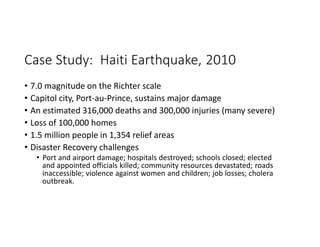
Case Study: HaitiEarthquake, 2010
• 7.0 magnitude on the Richter scale
• Capitol city, Port-au-Prince, sustains major damage
• An estimated 316,000 deaths and 300,000 injuries (many severe)
• Loss of 100,000 homes
• 1.5 million people in 1,354 relief areas
• Disaster Recovery challenges
• Port and airport damage; hospitals destroyed; schools closed; elected
and appointed officials killed; community resources devastated; roads
inaccessible; violence against women and children; job losses; cholera
outbreak.
9.
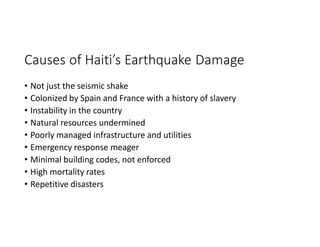
Causes of Haiti’sEarthquake Damage
• Not just the seismic shake
• Colonized by Spain and France with a history of slavery
• Instability in the country
• Natural resources undermined
• Poorly managed infrastructure and utilities
• Emergency response meager
• Minimal building codes, not enforced
• High mortality rates
• Repetitive disasters
10.
Why Theory?
• Toprovide insights
• To increase explanation
• “multi- and interdisciplinary approaches are needed to understand
and effectively deal with the complex problems of our day” in
disasters and humanitarian crises (McEntire 2007, p. 3)
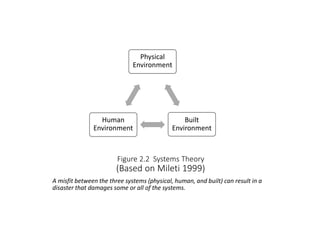
Systems Theory
• Physicalsystems – include the weather, such as when an ice storm
creates a state of emergency
• Built environment – includes ports, roads, bridges, which can be
affected by physical systems like a flood that covers a road
• Human systems – when physical systems affect people and the places
where they live
• A disaster occurs when there is a misfit between these systems such
as allowing people to build near a river that floods annually.
13.
Vulnerability Theory (VT)
•In contrast to the dominant system where the physical system
“causes” the disaster and the cause is engineered, like a levee used to
prevent flooding.
• VT focuses on the human systems
• Disasters are not equal opportunity events, some people are affected
more than others like low income families or countries
• VT also says that we overlook the resources and resilience capacities of
those most at risk, and often fail to include them like not inviting people
with disabilities to the recovery planning table
14.
Socio-political Ecology Theory
•Looks at interactions within human social systems
• People trying to re-establish normalcy after a disaster usually
compete for resources, often with disparate outcomes
• After an earthquake in Pakistan, men were more likely to obtain
resources than women
• Pre-disaster inequalities usually worsen the competition
• Winners and losers appear in the competitive process
• After a disaster, small businesses with fewer resources are more likely to
fail than larger businesses with more resources
15.
Liberal Feminism andDisaster Recovery
• Identify the practical needs of women and children throughout the
disaster event and how institutional arrangements can adapt to their
needs: child care, domestic violence, employment, housing access.
• Recruit and retain women staff in disaster recovery organizations,
with particular attention paid to involving women from disaster-
vulnerable populations and locations.
• Train and educate disaster recovery staff and volunteers in working
with women of various educational, income, age and disability levels.
• Target women-owned businesses and female-dominated nonprofits in
business recovery and economic development programs.
16.
Multiracial Feminist Theoryand Disaster Recovery
• Involve organizations that empower women of color to participate in
the recovery planning and implementation processes and pay them
for their contributions.
• Build social networks between women’s groups involving women of
color in recovery activities including funding initiatives and programs
that pay for and/or reimburse staff and volunteer labor.
• Facilitate the active participation of women from underrepresented
groups in disaster recovery planning.
• Target women leaders from diverse cultural groups for leadership
positions in recovery staff and voluntary organizations.
17.
Feminist Political Ecologyand Disaster Recovery
• Involve women environmental leaders in planning mitigation activities
for the full range of recovery needs in housing, environment,
infrastructure, and businesses.
• Increase networking between disaster organizations and women
involved in environmental justice and sustainable development
organizations.
• Integrate women involved in local health and safety issues, including
technological disasters and hazardous materials, for long-term
research on the effects of these substances for women and children.
18.
Feminist Development Theory
•Recovery projects may have gendered impacts and provide more
opportunities for men than for women.
• Traditional development programs, and those that influence recovery
times, may strengthen gender stratification.
• Woman-centric recovery schemes should be created, especially those
that tap into women’s economic talents.
• Within highly gender-segregated societies, woman-only recovery
centers and workplaces may need to be created.
19.
Emergent norm theory
•Because few places plan for recovery, it is often an ad hoc, emergent
process
• Emergence is newly appearing behavior or activities, like a recovery
group that advocates for children
• Disasters tend to disable bureaucratic structures
• Flexible, innovative approaches usually cover unmet needs or those
that are not met by existing structures
20.
Sustainable recovery –6 principles
• consensus-building through participatory processes
• People get a say in how a community is rebuilt
• insuring for quality of life
• People decide what makes their community a great place to live
• economic vitality
• A variety of businesses can return
• Social and intergenerational equity
• Everyone has a chance to return
• environmental quality
• Promoting the environment to be healthy over time and for future generations
• mitigating to insure disaster resilience
• Reducing the effects of future disasters
his experience couldsuppose that I am one of the many. If he did, it
would be his fault--not mine."
The little clock struck four.
"An hour more, my friend--an hour more. And then--well, I do
hope you'll come before the hour's out, for your sake, as well as
mine. I wonder if, in this little matter, I've been counting my
chickens before they're hatched. I, of all women, should have known
better. And, with such a hand faced on the board, one might be
excused for supposing that it would take the pool. A straight flush
cannot be beaten."
She laughed again, this time not quite so lightly.
"It reminds me of some of the games which I have seen played.
You can't show a hand to beat a straight, but you can fight to save
the pool. I wonder if he means fighting. If he does, it'll be against all
the odds. He has neither gun nor bow. When I start shooting, he's
bound to drop. Sure."
The merriment passed from her face, the laughter from her eyes--
an expression of anxiety came into them instead; a look which
suggested hunger, a something which made her, all at once, seem
actually old.
"Perhaps he takes it that a victory, on these lines, may mean
more than a defeat. And he counts on that. It would, too. It would
mean farewell--a long farewell, an actual farewell--to another of my
dreams. And the brightest of them all. But I don't care. It would
mean death to him. Death! And such a death! And, after all, it would
only mean a stumble to me. From the practice I have had, I have
become so used to stumbles that surely one other wouldn't count."
She began moving about the room restlessly, touching here a
table, there a chair, to the window, and back again, as if a spirit
possessed her which made her not know what it was she wanted to
23.
be at. Sheapproached a corner of the room, as if she were about to
take refuge in it, like some naughty child. As she went, clenching her
fists, as if she were pressing her finger-nails into her palms, she
gave a little cry.
"Oh, I'd give--I'd give, what wouldn't I give?--if he'd come into
the room, now--without keeping me waiting any longer, now!--and
speak to me as I would have him speak! Why doesn't he come? He
has everything to gain, he has nothing to lose!"
She swept right round, with a swish of her skirts, in a sort of
frenzy, echoing her own question as she swung out her arms in front
of her.
"Why doesn't he come?"
Even as the words were on her lips, at the hall door there came a
knocking. She went red and white, despite the aids of beauty! She
caught at a chair, as if desirous of having something to lean against.
"Thank God!"
Then, as if conscious of the incongruity of such words upon her
lips, she put her hands up to her face.
"Oh, I'm so glad he's come!"
Some one outside had hold of the handle of the door. She
uncovered her face. She touched her hair. She touched the bosom of
her dress. She dropped into the chair by which she was standing. In
an instant she was the picture of composure.
The door opened to admit Mr. Haines.
His appearance was a shock to Mrs. Carruth. She looked
negligently round, as if indifferent who the new-comer might be, and
then--she stared.
24.
"You!"
There was somethingin the lady's intonation which was very far
from being complimentary. She stood up, quivering with
disappointment and with rage.
"I thought I gave instructions that this afternoon I was not at
home to visitors."
Mr. Haines did not seem to be at all nonplussed.
"That's what the young lady who opened the door told me. I said
I would wait until you were. I will."
Mr. Haines sat down--with every appearance of having come to
stay. Mrs. Carruth looked at the clock, then at her watch, then at the
gentleman upon the chair. The gentleman in question, with his head
thrown back, was staring at the ceiling, as if quite unconscious of
her neighbourhood. It seemed to be as much as the lady could do to
retain her self-control.
"I am sure, Mr. Haines, that you cannot wish to be rude. I have
an appointment this afternoon which I regret will prevent my having
the pleasure of receiving you."
"I'm going to have my say. I'll say it afterwards, or I'll say it now.
It's all the same to me."
"What do you mean by you're going to have your say?"
"If you're ready, I'll let it out. But don't mind me. Don't let me
spoil your appointment. Keep anything you've got to keep."
Mrs. Carruth seemed to be at a loss to know what to do. Her
looks were eloquent witnesses as to what she would have done if
she could. But, apparently, she did not see her way to do it. She
temporised.
25.
"If there isanything of importance, Mr. Haines, which you wished
to say to me, perhaps you will be so good as to say it as briefly as
you can, now. Possibly it will not detain you, at the utmost, more
than a quarter of an hour."
"Possibly it will not. I rather reckon you'll have a word to say in
that. It won't all be for me." Mr. Haines brought his eyes down to the
level of the lady's face. He spread out his hands upon his knees. He
looked at her very straight. "What I have to say may be said in
about two words. It's just this--I've found my girl."
Mrs. Carruth did not display any great amount of interest, but she
did seem to be surprised.
"Indeed! I am glad to hear it. I hope that she is well."
"She is well. She's better than many of us ever will be. She's at
rest."
"At rest? How?"
"As it was told to me. She is dead."
"Dead! Mr. Haines?"
"Yes, murdered. As I saw it in the vision, so it is."
Mrs. Carruth looked at Mr. Haines as if she felt that he had a
somewhat singular method of imparting information--especially of
such a peculiar kind.
"If what you say is correct, you have such a queer way of putting
things. I never can quite make you out. I need not tell you how
sorry I am."
"You have cause for sorrow. The grief is about half yours."
"Half mine? What do you mean?"
26.
"I have lovedyou, true and faithful, since the first time I set eyes
on you. Before ever Daniel did."
The sudden change of subject seemed, not unnaturally, to take
the lady aback.
"What nonsense are you talking? What did you mean by saying
the grief's half mine?"
"I'm coming to it, in time. I want to put to you this question. Will
you have me, now, just as I am?"
"I will not; neither now or ever. How many more times am I to tell
you that? Jack Haines, I do believe you're more than half insane."
"I may be. So'll you be before I'm through." Raising the big
forefinger of his right hand, he wagged it at her solemnly. "There's
some one come between us. Yes. That aristocrat."
"Aristocrat? What do you mean?"
"You know what I mean. Yes. The blood-stained Townsend. I
knew he was stained with blood when first I saw him inside this
room. But I did not know with whose blood he was stained, or I
would have called him to his account right there and then. I did not
know he was stained with the blood of my girl."
"Jack!"
The name came from her with an unconscious recurrence to the
days which were gone.
"Yes. This is the man who has stolen what ought by rights to have
been mine--the slayer of my girl."
"It's not true! You coward! You know you lie!"
"I do not lie."
27.
"You do lie!What proof have you?"
"Enough and to spare--for him, for me, and for you."
"Out with it, then. Let's hear what some of it's like."
Mrs. Carruth was standing by the little centre table. Rising from
his chair, Mr. Haines went and stood at the other side of it. Resting
his hands on the edges, he leaned over it towards her.
"Have you heard of the Three Bridges tragedy?"
She looked at him just once. In that one look she saw something,
on his face or in his eyes, which, to use an expressive idiom, seemed
to take the stiffening all out of her. She dropped into a chair as if he
had knocked her into it. She caught at the arms. Her complexion
assumed a curious tinge of yellow. There was a moment's pause.
Then, from between her rigid lips, there came one word.
"Yes."
"The woman who was killed was Loo--my Loo."
She shuddered, as if attacked by sudden ague.
"It's a lie!"
"It's not a lie. It's gospel truth. And Townsend killed her."
Her rejoinder, under ordinary circumstances, might have struck
him as an odd one.
"You can't prove it."
"I can prove it. And the police can prove it, too."
Half rising from her chair, she turned to him, every muscle in her
body seemed to be quivering with excitement.
28.
"The police? Dothey know it?"
"They do. To-morrow the whole world will know it. They've laid
hold of the wrong man. They've found it out just before it's a bit too
late. They hope to have hold of your friend Townsend soon. They're
hoping wrong. His first reckoning will be with me. When that is
through, neither he nor I will care who has what's left. Since I have
loved you, true and faithful, all these years, I calculated I would
come and ask you if, when all is done, you'd give me my reward. We
might make a happy ending of it, you and me together, over on the
other side. But if you won't, you won't. So I'm through. I've only one
word left--good-bye."
He held out his hand to her. So far as she was concerned, it went
unheeded. Indeed, it would seem, from the eager question which
she asked, that most of what he had been saying had gone
unheeded too.
"Are you sure the police are after him? Are you sure?"
He looked at her from under the shadow of his bushy,
overhanging eyebrows, in silence, for a moment. Then he said, more
in sorrow than in anger--
"So your last thought is of him? Well, I'm sorry!"
Without anymore elaborate leave-taking than was comprised in
these few words. Mr. Haines went from the room and from the
house.
Mrs. Carruth seemed scarcely conscious of the fact of his
departure. All her faculties and all her thoughts seemed far away.
Indeed, it was only after a lapse of some seconds that, looking
about her, with a start, she appeared to recognise that she was
alone. Getting up, she began to pace feverishly about the room, as if
only rapid movement could enable her to control the fires which
were mounting in her blood.
29.
"I wonder ifit's true! I wonder if it is! Perhaps that explains why it
is he hasn't come. I may have been misjudging him. Perhaps he
can't come. Suppose he is arrested. Perhaps he doesn't know what it
is the police have discovered. He's nearly certain not to know. Who's
to tell him? I will go and tell him! This instant! Now! I will warn him
against the police and against Jack Haines. I will save him yet, yet.
He shall owe it all to me."
With her hands she brushed her hair from her brow--the hair
which she had so carefully arranged.
"After all I have longed for, after all I have lived through, I do
believe that for him I should esteem the world well lost."
She ran upstairs--literally ran. She put on a coat and hat in a
space of time which, for shortness, considering that a pretty woman
was concerned, was simply marvellous. And having put them on, she
ran down the stairs. She hurried through the hall. She opened the
hall door.
And as she did so something or some one bounded up the steps--
rather than mounted them in an ordinary fashion. There was a flash
of something in the air. Mrs. Carruth was borne backwards.
A second afterwards she was lying half on her face, with the
lifeblood streaming from her on to the floor.
THE LAST MEETINGOF THE CLUB.
Horseferry Road. A hazy though a cloudless night. A house, the
windows of which showed no lights. Up two flights of stairs.
The rendezvous of that agreeable social institution, the Murder
Club.
The Club was to hold a session. The gentleman who, if he was
not the actual source of inspiration, was, at any rate, the founder,
the promoter, the organiser, the backbone of the Club, was making
ready for the members coming. A man about the middle height,
somewhat slightly built, in evening dress, with an orchid in his
buttonhole--Mr. Cecil Pendarvon. Mr. Pendarvon was not bad-looking.
He had a long, fair beard, which he had a trick of pulling with both
his hands. His eyes were certainly not ugly, but to the close observer
they conveyed an odd impression. As one watched them, one began
to wonder if they were the man's real eyes which one saw, or if the
real eyes were behind them. Perhaps one had this feeling of wonder,
because, although there always was the light of laughter in Mr.
Pendarvon's eyes, their real expression was one of such cold,
passionless, unrelenting cruelty.
For some reason Mr. Pendarvon seemed ill at ease. One hand was
resting on the large oval table which occupied the greater portion of
the room, with the other he tugged at his beard, while he stared at
a manuscript volume, bound in a beautiful scarlet binding, which lay
open in front of him. A cackling sound was emitted from his throat,
which was, possibly, intended for a chuckle.
32.
"His signature! Hissign manual! An elegant example, too! With
his own hand--tied tight. If I remember rightly, he did say something
about his practically committing suicide by affixing his signature to
such a declaration. How often is truth spoken in a jest. What fools
men are!"
His statement--which was very far from being an original
statement--of the folly of humanity, seemed to afford him a large
amount of satisfaction. He combed his beard with the fingers of both
his hands. He kept on chuckling to himself as if he had given
utterance to one of the best jokes that ever was heard.
"What's that?"
It was queer to notice how, in an instant, all signs of amusement
fled. He gripped the rim of the massive table, as if seeking its
support. He cast a stealthy glance about him. He stood and listened,
seeming to hold his breath to enable him to do it better. The man's
real self peeped from his eyes. His whole bearing suggested fear.
There was a perfect silence for some moments. Then he drew a
long breath.
"It's nothing." He began again to tug at his beard, as if
mechanically. "What a little upsets a man if he is in the mood." He
glanced at his watch, seeming, as he did so, to make a mental
calculation. "It's time that some of them were here." He paused, the
remainder of his speech apparently referring to some other theme.
"I hope that one can rely upon them sometimes--that one may take
it that the guardians of law and order do not always blunder. I
suppose that we are shadowed. I suppose, too, that they will make
no movement until they have received ocular demonstration of the
fact that all of them are here. What's that?"
Again there was a sudden, startling change in Mr. Pendarvon's
outward bearing. Obviously his every faculty was strained in the act
of listening. So far as an ordinary observer would have been able to
33.
judge there didnot appear to be a sound. Yet it is not improbable
that something had made itself audible to Mr. Pendarvon's unusually
keen sense of hearing, because presently a slight click was heard, as
it seemed, within the wall itself upon his right.
"Number one!"
Mr. Pendarvon's state of tension seemed to slightly decrease. The
wall upon his right was panelled from floor to ceiling. One of the
panels Mr. Pendarvon slipped aside, and, in doing so, revealed a dial-
plate of peculiar construction, which apparently had some
connection with electricity. On it was a prominent figure 2. Beneath
it a needle made three separate strokes. A large 1 appeared. Then
three more separate strokes. Then another prominent 2. On the
appearance of the second 2, on Mr. Pendarvon's touching an ivory
button, the whole thing performed a complete revolution, and a
sound as of a gong was heard.
While the gong still continued to vibrate, a voice was heard
outside the door exclaiming "Reginald!"
The announcement of the name seemed to precipitate Mr.
Pendarvon back into his former condition of uneasiness.
"The man himself," he muttered. Then, by way of an
afterthought, with a smile which by no means suggested mirth, "I
wonder if they saw him come."
He seemed to hesitate, then, with an effort, to pull himself
together.
"The honourable member should not be kept waiting."
As he made this observation to himself, with another mirthless
grin, he pressed a second button, which was on the other side of the
dial. Immediately the door without swung open.
34.
In another momentMr. Reginald Townsend appeared upon the
threshold of the door.
"A trifle slow to-night, Pendarvon--eh?"
Mr. Pendarvon admitted the soft impeachment.
"I'm afraid that this time, perhaps, I am. You've caught me
napping. I was just putting the things in order when you came."
"Putting the things in order! I see. The things want putting in
order, Pendarvon--eh?"
"There is a certain amount of work which has to be done, which,
of course, by virtue of my office"--this with a sneer which, perhaps,
the speaker found it impossible to suppress--"I have to do."
"By virtue of your office; yes." Mr. Pendarvon looked up at Mr.
Townsend, only, as it were, by accident and for a moment; then his
glance went back again. "It would be a fine night if it were not for
the mist which is in the air. One now and then can get peeps at the
stars beyond. But this mist gives me a chill."
"It's warm enough in here."
"Oh, yes, it's sufficiently warm in here."
In each man's manner there was something which was distinctly
out of the ordinary, and the strangest part of it was that, though
each was, as a rule, as keen an observer as one might easily meet,
neither seemed to realise that there was anything unusual in the
bearing of the other. Mr. Pendarvon was restless, fidgety, fussy,
continually on the watch for something to happen, not in the room,
but out of it. He was like a person who has an appointment of the
first importance, and who is devoured with anxiety lest the individual
with whom he has the appointment should fail to keep it. Mr.
Townsend's mood, on the other hand, seemed almost
35.
transcendental. His physicalbeauty, uncommon both in type and in
degree, seemed to-night to have positively increased. It was almost
startling. He seemed, too, to have increased in height. He bore
himself with an unconscious grace which displayed his splendid
figure to singular advantage. His head was thrown a little back from
his shoulders, and in his eyes and in the whole expression of his face
there was something which suggested rapturous calm. One felt that,
whatever happened, this man's mind would be at ease. He recalled
the soldier who, having volunteered for a forlorn hope, advances to
meet death, and worse than death, with a smile.
It is probably when our soldiers have been in just that mood that
they have done the deeds which have seemed to the world to be
miracles of valour. It is when one cares for nothing that, sometimes,
one can do anything.
Each of these men, however, seemed to be so preoccupied in his
affairs that he noticed nothing uncommon in the other. Mr.
Pendarvon fidgeted about the room. He set the chairs straight, the
decanters on the table. He occupied himself with a dozen trifling
things which scarcely seemed to stand in need of his attention. Mr.
Townsend stood in front of the huge, old-fashioned fireplace paying
no sort of heed to the other's fussiness, seeming indeed to be in a
condition of mind which, psychologically, approximated to a waking
dream.
Although he took no notice of the fit of fidgets with which Mr.
Pendarvon seemed to be afflicted, his very calmness caused that
gentleman to seem still more ill at ease. More than once he seemed
to be on the point of saying something and then to stop short as if
for want of being able to find something appropriate to say.
At last he did hit upon a sufficiently apposite remark.
"They're late to-night."
36.
The sound ofhis voice seemed to rouse Mr. Townsend to the fact
of Mr. Pendarvon's presence.
"They are a little late to-night, Pendarvon." He looked at his
watch. "Indeed! Is it possible that they may have neglected to make
a note of the occasion?"
Mr. Pendarvon laughed--again not merrily.
"I don't think there is much fear of that. They're sure to come, if
only for their own safety's sake." Again the cheerless grin. "Possibly
they're trying to get their spirits up by putting the spirits down upon
the way. Hark! there's some one coming now."
There was a silence as the two men listened, with their eyes upon
the dial-plate which Mr. Pendarvon had left exposed. It repeated the
performance with which it had announced Mr. Townsend's arrival.
"You have good ears, Pendarvon. I heard nothing."
Mr. Pendarvon admitted that it was so.
"I have good ears."
He spoke with a dryness which seemed to be unnecessarily
significant. He sounded the gong. There was a voice without.
"Henry!"
"Dear Mr. Shepherd. You may let him in."
The door swung open. There entered a tall man, with long grey
hair, clad in the attire of a superior mechanic. He had a silent face--
the face of a man who can be silent in very many tongues--and the
eyes of a man who sees visions. He vouchsafed no sort of greeting,
but at once sat down on one of the chairs which stood around the
table.
37.
Mr. Townsend lookedat him as one looks at an object which one
finds an interesting study.
"I trust, Mr. Shepherd, that you may have fortune in drawing the
lot to-night."
Mr. Shepherd opened his lips, which hitherto he had kept
hermetically closed. He spoke with a nasal twang which suggested a
certain type of prayer-meeting.
"Not to-night: my hour is not yet."
"Indeed! May I ask when your hour is likely to be?"
"I seek not to inquire."
The hint which Mr. Shepherd intended to convey was
unmistakable. Mr. Pendarvon laughed. Mr. Townsend stared. Before
the latter could speak again the dial-plate repeated its previous
performances. This time two voices answered to the summons of the
gong.
The door opened to admit Mr. Teddy Hibbard and his inseparable
friend, Mr. Eugene Silvester.
They were both of them boys, rather than men, and were
obviously members of that class which, in a more advanced stage of
social organisation, will probably, during its salad days, be detained
in some kindly institution, the inmates of which will be gently, yet
firmly, persuaded to do themselves as little injury as they
conveniently can. They grow out of it, some of these young men, in
time. But one had only to look at this particular two to see that, with
them, that time was scarcely yet.
The bell, being started, was kept rolling. One after the other the
members of the Club came in. A heterogeneous gathering they
38.
were. One wonderedwhat some of them did in such a galley. They
seemed to be so oddly out of place.
At last, with two exceptions, all the members were assembled.
One of the exceptions was Lord Archibald Beaupré. His absence was
the cause, not only of comment, but, as time went on, and still he
did not come, of obvious uneasiness to some of those who had
arrived. Tell-tale looks came on their faces. They eyed each other, as
it were, askance. They not only inquired of one another why it was
he did not come, but they made the same inquiry of themselves with
still more emphasis. The appearance of indifference with which, at
first, they had treated the absent member's tardiness became less
and less convincing. It was he who last had drawn the lot. It was he
who had to do something for the Honour of the Club.
What was it which had detained him?
Mr. Pendarvon, who, plainly, was not the least uneasy of those
who were present in the room, addressed an inquiry to Mr.
Townsend.
"You are Beaupré's fidus achates, Townsend. When did you see
him last?"
Mr. Townsend had evidently shown an indifference to the fact of
Lord Archibald Beaupré's non-arrival which evidently in his case was
not assumed. He looked at Mr. Pendarvon a moment before he
answered, and when he did answer his manner, although completely
courteous, was hardly genial.
"For information of Lord Archibald Beaupré I must refer you--to
Lord Archibald Beaupré."
Mr. Pendarvon seemed to relish neither the look with which he
had been favoured nor the answer. Indeed, Mr. Townsend's manner,
even more than his answer, seemed to increase the general feeling
of uneasiness which was beginning to dominate the room.
39.
Suddenly there wasthe sound of a click. With a rapidity which, in
its way, was comic, all eyes were fixed upon the dial-plate. Its
mechanism had been set in motion. The familiar movements
followed.
"There he is!" exclaimed a voice.
Mr. Silvester added, with a show of hilarity which was slightly
forced, "Better late than never!"
Mr. Pendarvon sounded the gong, seemingly in a state of fevered
agitation.
"Stephen!" exclaimed a voice.
A blank look came on some of the faces.
"It isn't Beaupré; it's Kendrick!"
Colonel Kendrick was the other member who had not yet put in
an appearance. His absence had gone almost unnoticed. He had to
do nothing for the Honour of the Club--as yet.
Colonel Kendrick came into the room. He was a thickset, soldierly-
looking man, with a slight grey moustache and a pair of bold,
unflinching eyes. He bowed as he came in, speaking in that short,
crisp, staccato tone of voice which is apt to mark the man who has
been accustomed to command.
"Gentlemen, I have to apologise to you for my delay." He turned
to Mr. Townsend. "I have to inform you, Mr. Townsend, that Mr.
Pendarvon has set the police upon your track."
MR. TOWNSEND REACHESHOME.
The members, for the most part, stared at the Colonel. Then they
stared at one another. They did not seem to understand. Mr.
Townsend looked at the Colonel, then at Mr. Pendarvon. Mr.
Pendarvon, with twitching lips and dilated eyes, was leaning, as if for
support, against the dial-plate.
"Pendarvon, I am waiting for you to contradict what Kendrick has
said."
Mr. Pendarvon was making an effort to control his faculty of
speech.
"It's false."
Mr. Townsend turned to the Colonel.
"You hear what he says?"
The Colonel pointed at Mr. Pendarvon.
"And you see how he says it." They did see. The disclosure of his
treachery, being premature, had taken Mr. Pendarvon unawares. It
had, unfortunately, caused him to lose his nerve. He stood crouching
against the wall, trembling, like a cur, in terror of what might be to
come.
The man's guilt was self-confessed. They perceived that it was so
with a stupefaction which made them dumb.
Colonel Kendrick went on.
42.
"I have acousin at Scotland Yard. He has just now told me that,
this morning, they received information of the existence of an
organisation called the Murder Club. They had been told that the
individual who was actually responsible for the Three Bridges
Tragedy was a member of the Club. His name was Reginald
Townsend. I asked who was their informant. I was told that it was a
man named Cecil Pendarvon. So, gentlemen, the person who is
responsible for the position in which we find ourselves is the one
who has given us away."
One or two of the members made a half-unconscious movement
forward. Mr. Pendarvon seemed to endeavour to huddle himself
closer to the dial-plate.
"My cousin informed me that the club was to meet tonight, and
that a coup was to be made while the members were in actual
assembly. I have hurried straight from my cousin here. I have some
acquaintance with the personnel of Scotland Yard. As I approached
these premises I recognised one or two individuals whom I knew by
sight. Mr. Townsend, the police are at the door waiting to receive the
signal to effect your capture."
Of all those present Mr. Townsend seemed the least affected by
the Colonel's communication. It was the humorous side of the
situation which seemed to strike him first.
"It is the unexpected happens, my dear Kendrick. I do believe
that all the wisdom of the world is contained in that one phrase. The
blow has come from the quarter from which I least expected it. Mr.
Pendarvon, I presume that you are acquainted with the rule which
you yourself framed, and which lays down the measure which is to
be meted out to traitors."
Mr. Townsend moved towards Mr. Pendarvon. Snatching a revolver
from his pocket, Mr. Pendarvon pointed it in the face of the man he
had betrayed. In an instant Colonel Kendrick had struck it from his
43.
hand. One barrelwas discharged harmlessly as it fell. Immediately a
dozen weapons were in a dozen hands. Mr. Townsend retained his
appearance of perfect ease. Standing in front of Mr. Pendarvon, he
regarded that gentleman with courteous contempt which caused
him, literally, to seem to wither.
"Well done!"
The tranquil scorn of Mr. Townsend's tone seemed to affect Mr.
Pendarvon as if it had been vitriol. He writhed.
"You--you hound!" he spluttered.
Mr. Townsend merely repeated his former commendation, which
the other received as if it had been a scorpion's lash.
"Well done!"
There was a click. Mr. Pendarvon's body was obscuring the dial-
plate. With scant ceremony, the Colonel thrust him aside. The dial
had made a new departure. It displayed the figure 3.
The Colonel spoke.
"I fancy we may take it that that is the signal which Mr.
Pendarvon has arranged with his policemen friends. It is they who
have given it, being now outside the door. I imagine, gentlemen,
that, so far as we are concerned, we have but little to fear. Be so
good, some one, as to tear that book and to burn it."
The Colonel pointed to the manuscript book in the beautiful
crimson cover. Some one snatched it up. In a moment it was in
pieces and the pieces were in flames. Mr. Pendarvon made a
movement as if he would have done something to check the
destruction of so important a witness. The Colonel checked him with
a word.
44.
"Stand still!" AndMr. Pendarvon was still. The Colonel turned to
Mr. Townsend. "It is you who have most to fear. Can you suggest
how you may be able to effect your escape?"
"Unless Mr. Pendarvon has romanced, he has not only provided
the trap, but also the means of escape from the trap which he has
baited--unless, I say, he has romanced. We shall see. Good-bye,
Pendarvon."
With a gesture of careless insolence, with his open palm, Mr.
Townsend struck Mr. Pendarvon lightly across the face. That was too
much even for Mr. Pendarvon. He sprang at Mr. Townsend. Mr.
Townsend knocked him down. Being down, he seemed to deem it
wiser, on the whole, to stay there.
A voice was heard without--a peremptory voice, an official voice.
"Open this door immediately, or we shall break it down!"
Mr. Townsend gave a mocking rejoinder.
"Break it down; by all means, break it down!" He went to the
fireplace; he stood within it. He turned to the assembled company.
"We shall meet again--at Philippi!"
He grasped the first two stanchions and was immediately out of
sight.
"Count twelve," he told himself as he climbed. "This is the twelfth.
Put out your hand to the right, and you will feel a bolt. This does
feel like a bolt, and a door. After all, Pendarvon, you're not such a
liar as you might have been."
Scrambling through the door which he had thrust open, Mr.
Townsend found himself standing on what was evidently thereof. It
was flat just there. In front of him was a high brick wall, which
served as a base for a stack of chimneys.
45.
Welcome to ourwebsite – the ideal destination for book lovers and
knowledge seekers. With a mission to inspire endlessly, we offer a
vast collection of books, ranging from classic literary works to
specialized publications, self-development books, and children's
literature. Each book is a new journey of discovery, expanding
knowledge and enriching the soul of the reade
Our website is not just a platform for buying books, but a bridge
connecting readers to the timeless values of culture and wisdom. With
an elegant, user-friendly interface and an intelligent search system,
we are committed to providing a quick and convenient shopping
experience. Additionally, our special promotions and home delivery
services ensure that you save time and fully enjoy the joy of reading.
Let us accompany you on the journey of exploring knowledge and
personal growth!
testbankbell.com