Disaster Recovery 2nd Phillips Solution Manual
download
http://testbankbell.com/product/disaster-recovery-2nd-phillips-
solution-manual/
Download more testbank from https://testbankbell.com
We believe these products will be a great fit for you. Click
the link to download now, or visit testbankbell.com
to discover even more!
Test Bank for Strategic Staffing, 2nd Edition: Jean
Phillips
https://testbankbell.com/product/test-bank-for-strategic-
staffing-2nd-edition-jean-phillips/
Solution Manual for Fundamentals of Financial
Accounting 5th Canadian by Phillips
https://testbankbell.com/product/solution-manual-for-
fundamentals-of-financial-accounting-5th-canadian-by-phillips/
Solution Manual for M: Information Systems, 4th
Edition, Paige Baltzan Amy Phillips
https://testbankbell.com/product/solution-manual-for-m-
information-systems-4th-edition-paige-baltzan-amy-phillips/
Solution Manual for Managerial Accounting, 4th Edition,
Stacey Whitecotton, Robert Libby, Fred Phillips
https://testbankbell.com/product/solution-manual-for-managerial-
accounting-4th-edition-stacey-whitecotton-robert-libby-fred-
phillips/
Solution Manual for Business Driven Information
Systems, 6th Edition, Paige Baltzan, Amy Phillips
https://testbankbell.com/product/solution-manual-for-business-
driven-information-systems-6th-edition-paige-baltzan-amy-
phillips/
Fundamentals of Financial Accounting 5th Edition
Phillips Solutions Manual
https://testbankbell.com/product/fundamentals-of-financial-
accounting-5th-edition-phillips-solutions-manual/
Digital Control System Analysis and Design 4th Edition
Phillips Solutions Manual
https://testbankbell.com/product/digital-control-system-analysis-
and-design-4th-edition-phillips-solutions-manual/
Strategic Staffing 3rd Edition Phillips Test Bank
https://testbankbell.com/product/strategic-staffing-3rd-edition-
phillips-test-bank/
Solution Manual for Organizational Behavior: Managing
People and Organizations, 13th Edition, Ricky W.
Griffin Jean M. Phillips Stanley M. Gully
https://testbankbell.com/product/solution-manual-for-
organizational-behavior-managing-people-and-organizations-13th-
edition-ricky-w-griffin-jean-m-phillips-stanley-m-gully/
Disaster Recovery 2nd Phillips
Full chapter at: https://testbankbell.com/product/disaster-recovery-2nd-phillips-solution-manual/
Chapter Two
Theory
Learning Objectives
• Provide an overview of the major conceptual and theoretical
perspectives used in disaster recovery research.
• Apply concepts and theories to understand how disaster recovery
could be approached.
• Use concepts and theories to identify potential barriers to recovery.
• Demonstrate an understanding of key principles to promote a
sustainable recovery.
Key Terms
• Disaster Resilience
• Dominant Paradigm
• Economic Vitality
• Emergent Norm Theory
• Environmental Quality
• Equity
• Feminist Theory
• Holistic Recovery
• Mitigation
• Non-structural Mitigation
• Structural Mitigation
• Participatory Recovery
• Quality of life
• Resilience
• Socio-political Ecology Theory
• Sustainability
• Systems Theory
• Vulnerability Theory
Case Study: Haiti Earthquake, 2010
• 7.0 magnitude on the Richter scale
• Capitol city, Port-au-Prince, sustains major damage
• An estimated 316,000 deaths and 300,000 injuries (many severe)
• Loss of 100,000 homes
• 1.5 million people in 1,354 relief areas
• Disaster Recovery challenges
• Port and airport damage; hospitals destroyed; schools closed; elected
and appointed officials killed; community resources devastated; roads
inaccessible; violence against women and children; job losses; cholera
outbreak.
Causes of Haiti’s Earthquake Damage
• Not just the seismic shake
• Colonized by Spain and France with a history of slavery
• Instability in the country
• Natural resources undermined
• Poorly managed infrastructure and utilities
• Emergency response meager
• Minimal building codes, not enforced
• High mortality rates
• Repetitive disasters
Why Theory?
• To provide insights
• To increase explanation
• “multi- and interdisciplinary approaches are needed to understand
and effectively deal with the complex problems of our day” in
disasters and humanitarian crises (McEntire 2007, p. 3)
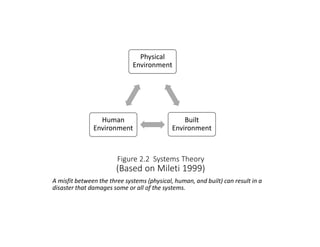
Physical
Environment
Human
Environment
Built
Environment
Figure 2.2 Systems Theory
(Based on Mileti 1999)
A misfit between the three systems (physical, human, and built) can result in a
disaster that damages some or all of the systems.
Systems Theory
• Physical systems – include the weather, such as when an ice storm
creates a state of emergency
• Built environment – includes ports, roads, bridges, which can be
affected by physical systems like a flood that covers a road
• Human systems – when physical systems affect people and the places
where they live
• A disaster occurs when there is a misfit between these systems such
as allowing people to build near a river that floods annually.
Vulnerability Theory (VT)
• In contrast to the dominant system where the physical system
“causes” the disaster and the cause is engineered, like a levee used to
prevent flooding.
• VT focuses on the human systems
• Disasters are not equal opportunity events, some people are affected
more than others like low income families or countries
• VT also says that we overlook the resources and resilience capacities of
those most at risk, and often fail to include them like not inviting people
with disabilities to the recovery planning table
Socio-political Ecology Theory
• Looks at interactions within human social systems
• People trying to re-establish normalcy after a disaster usually
compete for resources, often with disparate outcomes
• After an earthquake in Pakistan, men were more likely to obtain
resources than women
• Pre-disaster inequalities usually worsen the competition
• Winners and losers appear in the competitive process
• After a disaster, small businesses with fewer resources are more likely to
fail than larger businesses with more resources
Liberal Feminism and Disaster Recovery
• Identify the practical needs of women and children throughout the
disaster event and how institutional arrangements can adapt to their
needs: child care, domestic violence, employment, housing access.
• Recruit and retain women staff in disaster recovery organizations,
with particular attention paid to involving women from disaster-
vulnerable populations and locations.
• Train and educate disaster recovery staff and volunteers in working
with women of various educational, income, age and disability levels.
• Target women-owned businesses and female-dominated nonprofits in
business recovery and economic development programs.
Multiracial Feminist Theory and Disaster Recovery
• Involve organizations that empower women of color to participate in
the recovery planning and implementation processes and pay them
for their contributions.
• Build social networks between women’s groups involving women of
color in recovery activities including funding initiatives and programs
that pay for and/or reimburse staff and volunteer labor.
• Facilitate the active participation of women from underrepresented
groups in disaster recovery planning.
• Target women leaders from diverse cultural groups for leadership
positions in recovery staff and voluntary organizations.
Feminist Political Ecology and Disaster Recovery
• Involve women environmental leaders in planning mitigation activities
for the full range of recovery needs in housing, environment,
infrastructure, and businesses.
• Increase networking between disaster organizations and women
involved in environmental justice and sustainable development
organizations.
• Integrate women involved in local health and safety issues, including
technological disasters and hazardous materials, for long-term
research on the effects of these substances for women and children.
Feminist Development Theory
• Recovery projects may have gendered impacts and provide more
opportunities for men than for women.
• Traditional development programs, and those that influence recovery
times, may strengthen gender stratification.
• Woman-centric recovery schemes should be created, especially those
that tap into women’s economic talents.
• Within highly gender-segregated societies, woman-only recovery
centers and workplaces may need to be created.
Emergent norm theory
• Because few places plan for recovery, it is often an ad hoc, emergent
process
• Emergence is newly appearing behavior or activities, like a recovery
group that advocates for children
• Disasters tend to disable bureaucratic structures
• Flexible, innovative approaches usually cover unmet needs or those
that are not met by existing structures
Sustainable recovery – 6 principles
• consensus-building through participatory processes
• People get a say in how a community is rebuilt
• insuring for quality of life
• People decide what makes their community a great place to live
• economic vitality
• A variety of businesses can return
• Social and intergenerational equity
• Everyone has a chance to return
• environmental quality
• Promoting the environment to be healthy over time and for future generations
• mitigating to insure disaster resilience
• Reducing the effects of future disasters
Another Random Document on
Scribd Without Any Related Topics
CHAPTER XVII
A WOODLAND WONDERLAND
What we saw was a circular chamber formed of tree-trunks at the
sides and roofed with masses of green leaves. The central trees had
been cleared away by some means, for a large mahogany stump
was used for a table and its beautifully polished surface proclaimed
that it had been a live tree when sawed through. Also there were
several seats formed from stumps in various parts of the room, and
one or two benches and a couch had been manufactured very
cleverly from polished mahogany wood.
But these were by no means the chief wonder of the place. The
walls were thickly covered with climbing vines, which reached in
graceful festoons to the overhanging central boughs; but these were
all the creation of man rather than of nature, for they were formed
from virgin gold.
Also the ornaments scattered about the place, the mountings of
the furniture, swinging lamps and tabourettes, all were of gold, and
never have I beheld the equal of their exquisite workmanship or
unique designing. The tracery of every leaf of the golden bower
imitated accurately nature itself, the veins and stems being so
perfect as to cause one to marvel. Not only had a vast amount of
pure gold been used in this work, but years must have been
consumed in its execution.
“Oh, Tcharn!” cried Ilalah, in a shocked tone, as soon as she had
recovered from the wonder of her first look; “you have broken the
law!”
“It is true,” answered the arrow-maker, calmly.
“Why did you do it?” she asked.
“The yellow metal is very beautiful,” said he, looking upon the
golden bower with loving eyes; “and it is soft, and easy to work into
many pretty forms. Years ago, when I began to gather the metal for
my arrows and spears, I found in our mountains much of the
forbidden gold, and it cried out to me to take it and love it, and I
could not resist. So I brought it here, where no white man could
ever see it and where not even your father was likely to come and
charge me with my crime. My princess, you and your friends are the
first to know my secret, and it is safe in your care because you are
yourself breaking the law and defying the king.”
“In what way?” asked Ilalah.
“In seeking the pebbles that are denied our people, and in
befriending the whites who have been condemned by us for
centuries.”
She was silent for a moment. Then she said, bravely:
“Tcharn, such laws are unjust. I will break them because they are
my father’s laws and not my own. When I come to rule my people I
will make other laws that are more reasonable—and then I will
forgive you for your gold-work.”
“Oh, Ilalah!” exclaimed Moit; “how can you rule these Indians
when you have promised to come with me, and be my queen?”
She drew her hand across her eyes as if bewildered, and then
smiled sweetly into her lover’s face.
“How easy it is to forget,” she said, “when one has always been
accustomed to a certain life. I will go with you, and I will never rule
my people.”
“You are wrong, my princess,” declared the dwarf, eagerly. “What
to you is the white man’s land? You will rule us indeed, and that in a
brief space of time!”
“No, my friend,” she said, “the house that moves will carry me
away with my white chief, and in a new land I will help him to rule
his own people.”
The arrow-maker looked at her with a dreamy, prophetic
expression upon his wizened features.
“Man knows little,” said he, “but the Serpent of Wisdom knows
much. In my forest the serpent dwells, and it has told me secrets of
the days to come. Soon you will be the Queen of the Techlas, and
the White Chief will be but your slave. I see you ruling wisely and
with justice, as you have promised, but still upholding the traditions
of your race. You will never leave the San Blas country, my Ilalah.”
She laughed, brightly.
“Are you then a seer, my cousin?” she asked.
The dwarf started, as if suddenly awakened, and his eyes lost
their speculative gaze.
“Sometimes the vision comes to me,” he said; “how or why I know
not. But always I see truly.”
Duncan Moit did not understand this dialogue, which had been
conducted in the native tongue. He had been examining, with the
appreciation of a skilled workman, the beautiful creations of the
Indian goldsmith. But now our uneasy looks and the significant
glances of Nux and Bryonia attracted his attention, and he turned to
ask an explanation.
The princess evaded the subject, saying lightly that the dwarf had
been trying to excuse himself for breaking the law and employing
the forbidden gold in his decorations. I turned to Tcharn and again
demanded:
“Show us the pebbles.”
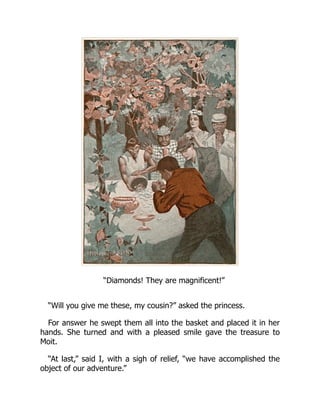
At once he drew a basket woven of rushes from beneath a bench
and turned out its contents on the top of the great table. A heap of
stones was disclosed, the appearance of which at first disappointed
me. They were of many shapes and sizes and had surfaces
resembling ground glass. In the semi gloom of the bower and amid
the shining gold tracery of its ornamentation the “pebbles” seemed
uninteresting enough.
But Moit pounced upon the treasure with exclamations of wonder,
examining them eagerly. Either the German or the arrow-maker had
chipped some of them in places, and then the clear, sparkling
brilliancy of the diamonds was fully demonstrated.
“They are magnificent!” cried the inventor. “I have never seen
gems so pure in color or of such remarkable size and perfect form.”
I compared them mentally with the stones I had found in the roll
of bark taken from the dead man’s pocket, and decided that these
were indeed in no way inferior.
The dwarf opened a golden cabinet and brought us three more
diamonds. These had been cut into facets and polished, and were
amazingly brilliant. I am sure Tcharn had never seen the usual
method of diamond-cutting, and perhaps knew nothing of the
esteem in which civilized nations held these superb pebbles of pure
carbon; so it is remarkable that he had intuitively found the only
means of exhibiting the full beauty of the stones.
“Diamonds! They are magnificent!”
“Will you give me these, my cousin?” asked the princess.
For answer he swept them all into the basket and placed it in her
hands. She turned and with a pleased smile gave the treasure to
Moit.
“At last,” said I, with a sigh of relief, “we have accomplished the
object of our adventure.”
“At last,” said Duncan, “I have enough money to patent my
inventions and to give the machine to the world in all its perfection!”
“But we mus’ get out o’ here, Mars’ Sam,” observed Bry, gravely.
“That is true,” I replied. “And I hope now that we have no further
reason for staying that we shall have little difficulty in passing the
lines of our enemies.”
We confided to the arrow-maker a portion of our adventures, and
told him how Nalig-Nad had seemed determined to destroy us.
When the relation was finished I asked:
“Will you advise us how we can best regain our ship without
meeting the king’s warriors?”
He considered the matter with great earnestness. Then he
enquired:
“Will your machine run safely in the waters of the ocean?”
I repeated the question to Moit.
“Yes,” he answered, “if the water is not too rough.”
“Then it will be best for you to go east until you come to the coast
of the Atlantic,” said Tcharn. “The tribes of the south-east will not
oppose you if the Princess Ilalah and I are with you. When you get
to the ocean you may travel in the water to your river, and so reach
your ship.”
This advice was so good that we at once adopted the suggestion.
The arrow-maker now clapped his hands, and to our surprise
three tall natives entered the bower and bowed to him. He ordered
them to bring refreshments, and they at once turned and
disappeared.
“Who are these men?” I asked.
“They are my assistants, who help me to forge the arrows and the
spears,” he replied. “The king always allows me three men, and their
tongues are cut out so that they cannot tell to others the secrets of
my art.”
That explained why he was able to devote so much time to the
execution of his gold-work.
The servants shortly returned bearing golden dishes of exquisite
shapes, on the polished surfaces of which familiar scenes in the lives
of the San Blas were cleverly engraved.
We were given fresh milk, a kind of hominy boiled and spiced,
slices of cold mutton and several sorts of fruits, including cocoanut
meats.
Sitting around the splendid table, which would have conferred
distinction upon a king’s palace, we made a hasty but satisfying meal
and then prepared to return to the automobile.
I think the little arrow-maker was as eager to ride in the wonderful
machine as to guide us on our way; but we were very glad to have
him with us, and he sat quietly absorbed by the side of Duncan Moit
and watched the inventor direct the course of his automobile over
the difficult pathway between the trees.
We reached level ground without accident and then, turning to the
left, increased our speed and travelled rapidly over the now familiar
plains in the direction of the sea.
We followed the edge of the forest as well as we could, for here in
the uplands the numerous streams were less difficult to cross; but
soon after we had passed beyond the point of our first excursion in
this direction we came upon a good sized river sweeping out from
the wood, which Tcharn told us flowed into the Atlantic further
toward the north. There were dangerous rapids in it, however, so we
decided it would be safer to continue on to the coast than to trust
ourselves to this treacherous current.
And now we soon began to pass the cocoanut groves, while
groups of natives paused to stare at us wonderingly. But we made
no halt, for the plains were smooth and easy to travel upon and the
less we had to do with the natives the better we were off.
A mile inland from the ocean the dwarf told us were many
villages. We decided to rush past these quickly to avoid being
stopped, and Tcharn agreed that it would be wise. Explanations
would be sure to delay us, even if these tribes had not already been
warned by messengers from Nalig-Nad to capture us if we came
their way. So when we reached the villages we shot by them like a
flash, and the sensation we created was laughable.
Men, women and children—even the dogs—rushed from the path
of the dreadful flying monster in a panic of fear, and we heard their
screams and wild cries long after the houses had been left far
behind. These tribes may be just as brave as the ones farther north,
but their natures are not so stolid and self-possessed.
The ocean came into view suddenly, and we found the banks so
high above the beach that we were obliged to turn north until we
reached a small river, the water of which was deep enough to float
us out to sea.
Here we bade farewell, with much regret, to our arrow-maker, and
Duncan generously presented him with such wrenches and other
tools as could be spared from his outfit. These presents gave the
dwarf much delight, and for my part I was so grateful for his
assistance that I gave him my silver watch, and showed him how to
tell the time of day by following the movements of its hands. He
understood it very quickly and I knew that he would obtain much
pleasure from its possession.
It was little enough, indeed, for the transfer of the diamonds,
which were worth a fortune; but the gems were valueless to him,
even had he been able to own them without the risk of forfeiting his
life.
We left the arrow-maker earnestly watching us from the bank as
we paddled swiftly down the stream; but soon our attention was
directed to other matters and we forgot him.
When we reached the ocean we headed out boldly, but the long
waves rolled pretty high for us, we soon found. It was not at all a
rough sea, yet Moit was forced to acknowledge that his invention
was not intended for ocean travel. After we had tossed about for a
time we went ashore, finding to our joy that the beach was broad
and sandy, and the tide was out.
This was the best luck that could possibly have happened to us,
and we sped along the sands at a fine rate of speed, resolved to
make the most of our opportunities.
Just before we reached the northern forest, however, we found
that king Nalig-Nad had been thoughtful enough to anticipate the
possibility of our coming this way and had sent a large force to
oppose us. They were crowded thickly upon the beach and we were
given the choice of meeting them or driving into the ocean again.
I rather favored the latter course, but Duncan’s face was set and
stern, and I saw that he was intent on running them down.
He increased our rate of speed until we were fairly flying, and a
moment more we bumped into the solid ranks of the Indians and
sent them tumbling in every direction—not so much on account of
the machine’s weight as its velocity.
Those who were not knocked over made haste to get out of our
way, and in a few seconds they were all behind us and we could
slacken our terrible pace with safety.
We had passed the mouths of several streams on our way, and
circled some remarkably broad and pretty bays, so now we began to
look for the river in which our wrecked ship was stranded. One
broad inlet we paddled up for a way, but it led straight into the
wood; so we backed out again, and the next time were more
successful; for soon we were able to discern the Gladys H. lying on
her side, and knew we were near our journey’s end.
Ilalah told us that small ships sometimes came to this river to
trade with her people for skins and tortoise-shell; but none had been
there for several months.
At first I thought that our wreck was entirely deserted, but after a
time Uncle Naboth’s pudgy form appeared at the stern, waving his
red handkerchief in frantic greeting; a moment later our sailors
flocked to his side, and then a lusty cheer of welcome saluted our
grateful ears.
CHAPTER XVIII
THE PRINCESS DISAPPEARS
We were given a joyful welcome by our comrades aboard the
wreck, you may be sure. Ned was there, a smile mantling his rugged
face as the auto came alongside and he assisted us to make fast and
mount to the slanting deck of the ship.
Uncle Naboth’s eyes were big and staring as our dainty Indian
princess came aboard; but I could see that he was pleased with her
beauty and modest demeanor.
No questions were asked us until we were all comfortably stowed
on deck and the automobile had been hoisted over the side by the
willing sailors and set in its old position. They were glad enough to
see us safely returned without bothering us with questioning; but I
knew of their eagerness to hear of our adventures and so took an
early opportunity to remark:
“Well, Uncle Naboth and Ned, we’ve got the diamonds.”
“Sure?”
“Sure enough.”
I brought the basket and allowed them to inspect the treasure,
which they did with wonder and a sort of awe, for they had little to
say.
“How much is the bunch worth?” asked my uncle, trying to be
indifferent.
“Why, we are all quite ignorant of their value,” I replied; “but Moit
and I both think we have secured a snug fortune for each one of us
four who are interested in the division. We couldn’t have done
anything at all without the automobile, though, so I am going to
give Duncan a part of my share.”
“I won’t take it,” declared Moit. “We made a fair and square
bargain, to share alike, and I mean to live up to it.”
“But you need the money more than we do,” I protested, “for
you’ve got to build a factory to manufacture your machines and also
to make a home for Ilalah. She is a prize we don’t share in, but we’d
like to contribute to her happiness, so I shall suggest to Ned and
Uncle Naboth that you take a half of all the diamonds and we will
divide the other half.”
“Agreed!” cried my uncle and Ned, both together, and although
Duncan objected in a rather pig-headed way I declared that we had
fully made up our minds and he had nothing to say about the
matter.
Then we told out story, rather briefly at first, for it would take
some time to give our friends all the details of our adventures. Uncle
was very proud of the way Bryonia and Nux had behaved, and told
them so in his outspoken fashion. The honest fellows could have
desired no higher reward.
After this Ned told me of his trip. On reaching the ocean he had
rigged a mast and sail on the long boat and before a brisk breeze
had soon reached Manzanillo Bay and arrived at Colon harbor within
a half day.
Colon is a primitive town built upon a low coral island, but being
the Atlantic terminal of the great canal it possessed an office of the
Central and South American Telegraph Company, so that Ned was
able to send a cable message by way of Galveston to Mr. Harlan.
He got an answer the next day, saying that the Carmenia, one of
the Company’s ships, was due at Cristobal in a few days, and further
instructions as to the disposition of the wrecked cargo would be
cabled me on her arrival. Cristobal was a port adjoining Colon, and I
remembered to have heard that the Carmenia was soon to come
home from the Pacific with a light cargo; so I judged it would be Mr.
Harlan’s intention to have her take our structural steel on board and
carry it on to San Pedro.
All we could do now was to wait, and instead of waiting in
unhealthy Colon Ned wisely decided to return to the wreck and
report to me.
They had begun to worry over us and to fear the Indians had
murdered us, so it was a great relief to them when we came back
safe and successful from our perilous adventure.
Uncle Naboth admired Ilalah more and more as he came to know
her, and he told Duncan with great seriousness that she was worth
more than all the diamonds in the world, to which absurd
proposition the inventor gravely agreed. But indeed we were all fond
of the charming girl and vied with one another to do her honor. Even
stolid Ned Britton rowed across to the marshes in the afternoon and
returned with a gorgeous bouquet of wild flowers to place in the
Indian maid’s cabin—formerly his own cabin, but gladly resigned for
her use.
Ilalah accepted all the attentions showered upon her with simple,
unaffected delight, and confided to us that she had altered entirely
her old judgment of the whites and now liked them very much.
“They must be my people, after this,” she said, with a sad smile,
“because I have left the Techlas forever.”
At dinner Bryonia outdid himself as a chef and provided for the
menu every delicacy the ship afforded. Ilalah ate little, but enjoyed
the strange foods and unusual cooking. After dinner we sat on the
deck in the splendid moonlight and recited at length our adventures,
until the hour grew late.
When I went to bed I carried the diamonds to my locker, putting
them carefully away where no one could get at them until we left
the wreck and the time came to make the division. The ship was
very safe for the present. Until another severe gale occurred to bring
the waves up the river there was no danger of her going to pieces,
as she held firmly to her mud bank, weighted on her open planks
with the great mass of steel in the hold. Her bottom was like a crate,
but her upper works seemed as firm and substantial as ever.
Ilalah’s cabin was on the starboard side, but in spite of the ship’s
listing her window was four or five feet above the surface of the
river. She bade us a sweet good-night in her pretty broken English,
and an hour later everyone on board was enjoying peaceful
slumbers and I, for my part, was dreaming of the fortune we had so
unexpectedly secured.
Suddenly a cry aroused me. I sat up and listened but could hear
no further sound. Absolute silence reigned throughout the ship. Yet
the cry still rang in my ears, and the recollection of it unnerved me.
While I hesitated a knock came to my door, and I got up and
lighted a candle.
Moit was standing outside in the saloon. His face was white but as
undecided in expression as my own.
“Did you hear anything, Sam?” he asked.
“Yes.”
“Was it a cry for help?”
“That, or a woman’s scream, Duncan.”
“Come with me,” he said, and I followed him to the door of Ilalah’s
cabin.
Two or three loud knockings failed to arouse any response. I
turned the handle, found the door unlocked, and threw it open.
The room was empty.
I turned my flickering candle in every direction, lighting up the
smallest cranny, as if the girl could be hidden in a rat-hole. The
window stood wide open, and the cool night breeze came through it.
I turned toward Duncan, who stood in the middle of the room
staring at the floor. As my gaze followed his I saw several of the blue
beads Ilalah had worn scattered over the carpet.
“It is Nalig-Nad,” he muttered. “The San Blas have stolen my
princess!”
“What’s up, boys?” asked Uncle Naboth. He was standing in the
doorway clad in a suit of pajamas that were striped like a convict’s,
only in more gorgeous colors.
“The Indians have stolen Ilalah and carried her away,” I answered.
I am afraid Uncle Naboth swore. He is a mild mannered old
gentleman, but having taken a strong liking for the beautiful girl he
perhaps could find no other way, on the impulse of the moment, to
express his feelings.
“Well,” he remarked, after we had looked blankly into one
another’s faces for a time, “we must get her back again, that’s all.”
“Of course, sir,” agreed Duncan, rousing himself. “We will go at
once.”
“What time is it?” I asked.
“Three o’clock,” answered my uncle, promptly.
“Then let us wait until morning,” I advised. “The Indians already
have a good start of us and there would be no chance to overtake
them before they regain the king’s village. We must be cautious and
lay our plans carefully if we hope to succeed.”
“Perhaps you are right,” returned Duncan, wearily. “But I swear to
you, Sam, that I will find Ilalah and bring her back with me, or
perish in the attempt.”
I smiled at his theatric manner, but Uncle Naboth said seriously:
“I don’t blame you a bit, sir. That girl is worth a heap o’ trouble,
and you can count on me to help you to the last gasp.”
“Well, well,” said I, impatiently, “let us get dressed and go on deck
to talk it over.” I well knew there would be no more sleep for us that
night, and although I was not in love with the lost princess I was as
eager to effect her rescue as Moit himself.
“But I must warn you, gentlemen,” I continued, “that you have to
deal with the wiliest and fiercest savage in existence, and if we
venture into his dominions again the chances of our ever coming out
alive are mighty slim.”
“All right, Sam,” retorted Uncle Naboth, cheerfully; “we’ve got to
take those chances, my lad, so what’s the use of grumbling?”
“If you’re afraid, Sam—” began Moit, stiffly.
“Oh, get out!” was my peevish reply. “I may be afraid, and small
wonder if I am; but you know very well I’ll go with you. So get your
togs on, both of you, and I’ll meet you on deck.”
CHAPTER XIX
WE ATTEMPT A RESCUE
The entire ship’s company was aroused by this time, and it
amused me to find that every man jack, down to the commonest
sailor, was tremendously indignant and most properly incensed
because Nalig-Nad had dared to steal his own daughter—the
successor to his throne—from the white men with whom she had
fled.
Ned Britton’s plan was to arm our entire company “to the teeth”
and march in solid ranks through the forest until we came to the
king’s village, which he figured lay about opposite the point where
our ship had stranded. Once at the village we could surprise the
place, capture Ilalah, and bear her in triumph back to the wreck.
There were several objections to Ned’s optimistic plan. In the first
place we did not know the forest, and the Indians did. They could
hide behind the trees and pick us off with their arrows before we
could use our fire-arms; or they might ambush us, and annihilate
our band. Moreover, we were not sure Ilalah had been taken directly
to the king’s village. They might have hidden her somewhere else.
“It’s another case of automobile, Mr. Moit,” declared Uncle Naboth.
“If we’re a-goin’ to get that girl you’ll have to use the convertible, as
sure as fate.”
“There is no doubt of that,” returned the inventor, promptly. “I
have determined to start as soon as it is daylight.”
“What is your idea, Duncan?” I asked.

Disaster Recovery 2nd Phillips Solution Manual

  • 1.
    Disaster Recovery 2ndPhillips Solution Manual download http://testbankbell.com/product/disaster-recovery-2nd-phillips- solution-manual/ Download more testbank from https://testbankbell.com
  • 2.
    We believe theseproducts will be a great fit for you. Click the link to download now, or visit testbankbell.com to discover even more! Test Bank for Strategic Staffing, 2nd Edition: Jean Phillips https://testbankbell.com/product/test-bank-for-strategic- staffing-2nd-edition-jean-phillips/ Solution Manual for Fundamentals of Financial Accounting 5th Canadian by Phillips https://testbankbell.com/product/solution-manual-for- fundamentals-of-financial-accounting-5th-canadian-by-phillips/ Solution Manual for M: Information Systems, 4th Edition, Paige Baltzan Amy Phillips https://testbankbell.com/product/solution-manual-for-m- information-systems-4th-edition-paige-baltzan-amy-phillips/ Solution Manual for Managerial Accounting, 4th Edition, Stacey Whitecotton, Robert Libby, Fred Phillips https://testbankbell.com/product/solution-manual-for-managerial- accounting-4th-edition-stacey-whitecotton-robert-libby-fred- phillips/
  • 3.
    Solution Manual forBusiness Driven Information Systems, 6th Edition, Paige Baltzan, Amy Phillips https://testbankbell.com/product/solution-manual-for-business- driven-information-systems-6th-edition-paige-baltzan-amy- phillips/ Fundamentals of Financial Accounting 5th Edition Phillips Solutions Manual https://testbankbell.com/product/fundamentals-of-financial- accounting-5th-edition-phillips-solutions-manual/ Digital Control System Analysis and Design 4th Edition Phillips Solutions Manual https://testbankbell.com/product/digital-control-system-analysis- and-design-4th-edition-phillips-solutions-manual/ Strategic Staffing 3rd Edition Phillips Test Bank https://testbankbell.com/product/strategic-staffing-3rd-edition- phillips-test-bank/ Solution Manual for Organizational Behavior: Managing People and Organizations, 13th Edition, Ricky W. Griffin Jean M. Phillips Stanley M. Gully https://testbankbell.com/product/solution-manual-for- organizational-behavior-managing-people-and-organizations-13th- edition-ricky-w-griffin-jean-m-phillips-stanley-m-gully/
  • 4.
    Disaster Recovery 2ndPhillips Full chapter at: https://testbankbell.com/product/disaster-recovery-2nd-phillips-solution-manual/ Chapter Two Theory
  • 5.
    Learning Objectives • Providean overview of the major conceptual and theoretical perspectives used in disaster recovery research. • Apply concepts and theories to understand how disaster recovery could be approached. • Use concepts and theories to identify potential barriers to recovery. • Demonstrate an understanding of key principles to promote a sustainable recovery.
  • 6.
    Key Terms • DisasterResilience • Dominant Paradigm • Economic Vitality • Emergent Norm Theory • Environmental Quality • Equity • Feminist Theory • Holistic Recovery • Mitigation • Non-structural Mitigation • Structural Mitigation • Participatory Recovery • Quality of life • Resilience • Socio-political Ecology Theory • Sustainability • Systems Theory • Vulnerability Theory
  • 7.
    Case Study: HaitiEarthquake, 2010 • 7.0 magnitude on the Richter scale • Capitol city, Port-au-Prince, sustains major damage • An estimated 316,000 deaths and 300,000 injuries (many severe) • Loss of 100,000 homes • 1.5 million people in 1,354 relief areas • Disaster Recovery challenges • Port and airport damage; hospitals destroyed; schools closed; elected and appointed officials killed; community resources devastated; roads inaccessible; violence against women and children; job losses; cholera outbreak.
  • 8.
    Causes of Haiti’sEarthquake Damage • Not just the seismic shake • Colonized by Spain and France with a history of slavery • Instability in the country • Natural resources undermined • Poorly managed infrastructure and utilities • Emergency response meager • Minimal building codes, not enforced • High mortality rates • Repetitive disasters
  • 9.
    Why Theory? • Toprovide insights • To increase explanation • “multi- and interdisciplinary approaches are needed to understand and effectively deal with the complex problems of our day” in disasters and humanitarian crises (McEntire 2007, p. 3)
  • 10.
    Physical Environment Human Environment Built Environment Figure 2.2 SystemsTheory (Based on Mileti 1999) A misfit between the three systems (physical, human, and built) can result in a disaster that damages some or all of the systems.
  • 11.
    Systems Theory • Physicalsystems – include the weather, such as when an ice storm creates a state of emergency • Built environment – includes ports, roads, bridges, which can be affected by physical systems like a flood that covers a road • Human systems – when physical systems affect people and the places where they live • A disaster occurs when there is a misfit between these systems such as allowing people to build near a river that floods annually.
  • 12.
    Vulnerability Theory (VT) •In contrast to the dominant system where the physical system “causes” the disaster and the cause is engineered, like a levee used to prevent flooding. • VT focuses on the human systems • Disasters are not equal opportunity events, some people are affected more than others like low income families or countries • VT also says that we overlook the resources and resilience capacities of those most at risk, and often fail to include them like not inviting people with disabilities to the recovery planning table
  • 13.
    Socio-political Ecology Theory •Looks at interactions within human social systems • People trying to re-establish normalcy after a disaster usually compete for resources, often with disparate outcomes • After an earthquake in Pakistan, men were more likely to obtain resources than women • Pre-disaster inequalities usually worsen the competition • Winners and losers appear in the competitive process • After a disaster, small businesses with fewer resources are more likely to fail than larger businesses with more resources
  • 14.
    Liberal Feminism andDisaster Recovery • Identify the practical needs of women and children throughout the disaster event and how institutional arrangements can adapt to their needs: child care, domestic violence, employment, housing access. • Recruit and retain women staff in disaster recovery organizations, with particular attention paid to involving women from disaster- vulnerable populations and locations. • Train and educate disaster recovery staff and volunteers in working with women of various educational, income, age and disability levels. • Target women-owned businesses and female-dominated nonprofits in business recovery and economic development programs.
  • 15.
    Multiracial Feminist Theoryand Disaster Recovery • Involve organizations that empower women of color to participate in the recovery planning and implementation processes and pay them for their contributions. • Build social networks between women’s groups involving women of color in recovery activities including funding initiatives and programs that pay for and/or reimburse staff and volunteer labor. • Facilitate the active participation of women from underrepresented groups in disaster recovery planning. • Target women leaders from diverse cultural groups for leadership positions in recovery staff and voluntary organizations.
  • 16.
    Feminist Political Ecologyand Disaster Recovery • Involve women environmental leaders in planning mitigation activities for the full range of recovery needs in housing, environment, infrastructure, and businesses. • Increase networking between disaster organizations and women involved in environmental justice and sustainable development organizations. • Integrate women involved in local health and safety issues, including technological disasters and hazardous materials, for long-term research on the effects of these substances for women and children.
  • 17.
    Feminist Development Theory •Recovery projects may have gendered impacts and provide more opportunities for men than for women. • Traditional development programs, and those that influence recovery times, may strengthen gender stratification. • Woman-centric recovery schemes should be created, especially those that tap into women’s economic talents. • Within highly gender-segregated societies, woman-only recovery centers and workplaces may need to be created.
  • 18.
    Emergent norm theory •Because few places plan for recovery, it is often an ad hoc, emergent process • Emergence is newly appearing behavior or activities, like a recovery group that advocates for children • Disasters tend to disable bureaucratic structures • Flexible, innovative approaches usually cover unmet needs or those that are not met by existing structures
  • 19.
    Sustainable recovery –6 principles • consensus-building through participatory processes • People get a say in how a community is rebuilt • insuring for quality of life • People decide what makes their community a great place to live • economic vitality • A variety of businesses can return • Social and intergenerational equity • Everyone has a chance to return • environmental quality • Promoting the environment to be healthy over time and for future generations • mitigating to insure disaster resilience • Reducing the effects of future disasters
  • 20.
    Another Random Documenton Scribd Without Any Related Topics
  • 22.
    CHAPTER XVII A WOODLANDWONDERLAND What we saw was a circular chamber formed of tree-trunks at the sides and roofed with masses of green leaves. The central trees had been cleared away by some means, for a large mahogany stump was used for a table and its beautifully polished surface proclaimed that it had been a live tree when sawed through. Also there were several seats formed from stumps in various parts of the room, and one or two benches and a couch had been manufactured very cleverly from polished mahogany wood. But these were by no means the chief wonder of the place. The walls were thickly covered with climbing vines, which reached in graceful festoons to the overhanging central boughs; but these were all the creation of man rather than of nature, for they were formed from virgin gold. Also the ornaments scattered about the place, the mountings of the furniture, swinging lamps and tabourettes, all were of gold, and never have I beheld the equal of their exquisite workmanship or unique designing. The tracery of every leaf of the golden bower imitated accurately nature itself, the veins and stems being so perfect as to cause one to marvel. Not only had a vast amount of pure gold been used in this work, but years must have been consumed in its execution. “Oh, Tcharn!” cried Ilalah, in a shocked tone, as soon as she had recovered from the wonder of her first look; “you have broken the law!” “It is true,” answered the arrow-maker, calmly.
  • 23.
    “Why did youdo it?” she asked. “The yellow metal is very beautiful,” said he, looking upon the golden bower with loving eyes; “and it is soft, and easy to work into many pretty forms. Years ago, when I began to gather the metal for my arrows and spears, I found in our mountains much of the forbidden gold, and it cried out to me to take it and love it, and I could not resist. So I brought it here, where no white man could ever see it and where not even your father was likely to come and charge me with my crime. My princess, you and your friends are the first to know my secret, and it is safe in your care because you are yourself breaking the law and defying the king.” “In what way?” asked Ilalah. “In seeking the pebbles that are denied our people, and in befriending the whites who have been condemned by us for centuries.” She was silent for a moment. Then she said, bravely: “Tcharn, such laws are unjust. I will break them because they are my father’s laws and not my own. When I come to rule my people I will make other laws that are more reasonable—and then I will forgive you for your gold-work.” “Oh, Ilalah!” exclaimed Moit; “how can you rule these Indians when you have promised to come with me, and be my queen?” She drew her hand across her eyes as if bewildered, and then smiled sweetly into her lover’s face. “How easy it is to forget,” she said, “when one has always been accustomed to a certain life. I will go with you, and I will never rule my people.”
  • 24.
    “You are wrong,my princess,” declared the dwarf, eagerly. “What to you is the white man’s land? You will rule us indeed, and that in a brief space of time!” “No, my friend,” she said, “the house that moves will carry me away with my white chief, and in a new land I will help him to rule his own people.” The arrow-maker looked at her with a dreamy, prophetic expression upon his wizened features. “Man knows little,” said he, “but the Serpent of Wisdom knows much. In my forest the serpent dwells, and it has told me secrets of the days to come. Soon you will be the Queen of the Techlas, and the White Chief will be but your slave. I see you ruling wisely and with justice, as you have promised, but still upholding the traditions of your race. You will never leave the San Blas country, my Ilalah.” She laughed, brightly. “Are you then a seer, my cousin?” she asked. The dwarf started, as if suddenly awakened, and his eyes lost their speculative gaze. “Sometimes the vision comes to me,” he said; “how or why I know not. But always I see truly.” Duncan Moit did not understand this dialogue, which had been conducted in the native tongue. He had been examining, with the appreciation of a skilled workman, the beautiful creations of the Indian goldsmith. But now our uneasy looks and the significant glances of Nux and Bryonia attracted his attention, and he turned to ask an explanation. The princess evaded the subject, saying lightly that the dwarf had been trying to excuse himself for breaking the law and employing
  • 25.
    the forbidden goldin his decorations. I turned to Tcharn and again demanded: “Show us the pebbles.” At once he drew a basket woven of rushes from beneath a bench and turned out its contents on the top of the great table. A heap of stones was disclosed, the appearance of which at first disappointed me. They were of many shapes and sizes and had surfaces resembling ground glass. In the semi gloom of the bower and amid the shining gold tracery of its ornamentation the “pebbles” seemed uninteresting enough. But Moit pounced upon the treasure with exclamations of wonder, examining them eagerly. Either the German or the arrow-maker had chipped some of them in places, and then the clear, sparkling brilliancy of the diamonds was fully demonstrated. “They are magnificent!” cried the inventor. “I have never seen gems so pure in color or of such remarkable size and perfect form.” I compared them mentally with the stones I had found in the roll of bark taken from the dead man’s pocket, and decided that these were indeed in no way inferior. The dwarf opened a golden cabinet and brought us three more diamonds. These had been cut into facets and polished, and were amazingly brilliant. I am sure Tcharn had never seen the usual method of diamond-cutting, and perhaps knew nothing of the esteem in which civilized nations held these superb pebbles of pure carbon; so it is remarkable that he had intuitively found the only means of exhibiting the full beauty of the stones.
  • 26.
    “Diamonds! They aremagnificent!” “Will you give me these, my cousin?” asked the princess. For answer he swept them all into the basket and placed it in her hands. She turned and with a pleased smile gave the treasure to Moit. “At last,” said I, with a sigh of relief, “we have accomplished the object of our adventure.”
  • 27.
    “At last,” saidDuncan, “I have enough money to patent my inventions and to give the machine to the world in all its perfection!” “But we mus’ get out o’ here, Mars’ Sam,” observed Bry, gravely. “That is true,” I replied. “And I hope now that we have no further reason for staying that we shall have little difficulty in passing the lines of our enemies.” We confided to the arrow-maker a portion of our adventures, and told him how Nalig-Nad had seemed determined to destroy us. When the relation was finished I asked: “Will you advise us how we can best regain our ship without meeting the king’s warriors?” He considered the matter with great earnestness. Then he enquired: “Will your machine run safely in the waters of the ocean?” I repeated the question to Moit. “Yes,” he answered, “if the water is not too rough.” “Then it will be best for you to go east until you come to the coast of the Atlantic,” said Tcharn. “The tribes of the south-east will not oppose you if the Princess Ilalah and I are with you. When you get to the ocean you may travel in the water to your river, and so reach your ship.” This advice was so good that we at once adopted the suggestion. The arrow-maker now clapped his hands, and to our surprise three tall natives entered the bower and bowed to him. He ordered them to bring refreshments, and they at once turned and disappeared.
  • 28.
    “Who are thesemen?” I asked. “They are my assistants, who help me to forge the arrows and the spears,” he replied. “The king always allows me three men, and their tongues are cut out so that they cannot tell to others the secrets of my art.” That explained why he was able to devote so much time to the execution of his gold-work. The servants shortly returned bearing golden dishes of exquisite shapes, on the polished surfaces of which familiar scenes in the lives of the San Blas were cleverly engraved. We were given fresh milk, a kind of hominy boiled and spiced, slices of cold mutton and several sorts of fruits, including cocoanut meats. Sitting around the splendid table, which would have conferred distinction upon a king’s palace, we made a hasty but satisfying meal and then prepared to return to the automobile. I think the little arrow-maker was as eager to ride in the wonderful machine as to guide us on our way; but we were very glad to have him with us, and he sat quietly absorbed by the side of Duncan Moit and watched the inventor direct the course of his automobile over the difficult pathway between the trees. We reached level ground without accident and then, turning to the left, increased our speed and travelled rapidly over the now familiar plains in the direction of the sea. We followed the edge of the forest as well as we could, for here in the uplands the numerous streams were less difficult to cross; but soon after we had passed beyond the point of our first excursion in this direction we came upon a good sized river sweeping out from the wood, which Tcharn told us flowed into the Atlantic further
  • 29.
    toward the north.There were dangerous rapids in it, however, so we decided it would be safer to continue on to the coast than to trust ourselves to this treacherous current. And now we soon began to pass the cocoanut groves, while groups of natives paused to stare at us wonderingly. But we made no halt, for the plains were smooth and easy to travel upon and the less we had to do with the natives the better we were off. A mile inland from the ocean the dwarf told us were many villages. We decided to rush past these quickly to avoid being stopped, and Tcharn agreed that it would be wise. Explanations would be sure to delay us, even if these tribes had not already been warned by messengers from Nalig-Nad to capture us if we came their way. So when we reached the villages we shot by them like a flash, and the sensation we created was laughable. Men, women and children—even the dogs—rushed from the path of the dreadful flying monster in a panic of fear, and we heard their screams and wild cries long after the houses had been left far behind. These tribes may be just as brave as the ones farther north, but their natures are not so stolid and self-possessed. The ocean came into view suddenly, and we found the banks so high above the beach that we were obliged to turn north until we reached a small river, the water of which was deep enough to float us out to sea. Here we bade farewell, with much regret, to our arrow-maker, and Duncan generously presented him with such wrenches and other tools as could be spared from his outfit. These presents gave the dwarf much delight, and for my part I was so grateful for his assistance that I gave him my silver watch, and showed him how to tell the time of day by following the movements of its hands. He understood it very quickly and I knew that he would obtain much pleasure from its possession.
  • 30.
    It was littleenough, indeed, for the transfer of the diamonds, which were worth a fortune; but the gems were valueless to him, even had he been able to own them without the risk of forfeiting his life. We left the arrow-maker earnestly watching us from the bank as we paddled swiftly down the stream; but soon our attention was directed to other matters and we forgot him. When we reached the ocean we headed out boldly, but the long waves rolled pretty high for us, we soon found. It was not at all a rough sea, yet Moit was forced to acknowledge that his invention was not intended for ocean travel. After we had tossed about for a time we went ashore, finding to our joy that the beach was broad and sandy, and the tide was out. This was the best luck that could possibly have happened to us, and we sped along the sands at a fine rate of speed, resolved to make the most of our opportunities. Just before we reached the northern forest, however, we found that king Nalig-Nad had been thoughtful enough to anticipate the possibility of our coming this way and had sent a large force to oppose us. They were crowded thickly upon the beach and we were given the choice of meeting them or driving into the ocean again. I rather favored the latter course, but Duncan’s face was set and stern, and I saw that he was intent on running them down. He increased our rate of speed until we were fairly flying, and a moment more we bumped into the solid ranks of the Indians and sent them tumbling in every direction—not so much on account of the machine’s weight as its velocity. Those who were not knocked over made haste to get out of our way, and in a few seconds they were all behind us and we could slacken our terrible pace with safety.
  • 31.
    We had passedthe mouths of several streams on our way, and circled some remarkably broad and pretty bays, so now we began to look for the river in which our wrecked ship was stranded. One broad inlet we paddled up for a way, but it led straight into the wood; so we backed out again, and the next time were more successful; for soon we were able to discern the Gladys H. lying on her side, and knew we were near our journey’s end. Ilalah told us that small ships sometimes came to this river to trade with her people for skins and tortoise-shell; but none had been there for several months. At first I thought that our wreck was entirely deserted, but after a time Uncle Naboth’s pudgy form appeared at the stern, waving his red handkerchief in frantic greeting; a moment later our sailors flocked to his side, and then a lusty cheer of welcome saluted our grateful ears.
  • 33.
    CHAPTER XVIII THE PRINCESSDISAPPEARS We were given a joyful welcome by our comrades aboard the wreck, you may be sure. Ned was there, a smile mantling his rugged face as the auto came alongside and he assisted us to make fast and mount to the slanting deck of the ship. Uncle Naboth’s eyes were big and staring as our dainty Indian princess came aboard; but I could see that he was pleased with her beauty and modest demeanor. No questions were asked us until we were all comfortably stowed on deck and the automobile had been hoisted over the side by the willing sailors and set in its old position. They were glad enough to see us safely returned without bothering us with questioning; but I knew of their eagerness to hear of our adventures and so took an early opportunity to remark: “Well, Uncle Naboth and Ned, we’ve got the diamonds.” “Sure?” “Sure enough.” I brought the basket and allowed them to inspect the treasure, which they did with wonder and a sort of awe, for they had little to say. “How much is the bunch worth?” asked my uncle, trying to be indifferent.
  • 34.
    “Why, we areall quite ignorant of their value,” I replied; “but Moit and I both think we have secured a snug fortune for each one of us four who are interested in the division. We couldn’t have done anything at all without the automobile, though, so I am going to give Duncan a part of my share.” “I won’t take it,” declared Moit. “We made a fair and square bargain, to share alike, and I mean to live up to it.” “But you need the money more than we do,” I protested, “for you’ve got to build a factory to manufacture your machines and also to make a home for Ilalah. She is a prize we don’t share in, but we’d like to contribute to her happiness, so I shall suggest to Ned and Uncle Naboth that you take a half of all the diamonds and we will divide the other half.” “Agreed!” cried my uncle and Ned, both together, and although Duncan objected in a rather pig-headed way I declared that we had fully made up our minds and he had nothing to say about the matter. Then we told out story, rather briefly at first, for it would take some time to give our friends all the details of our adventures. Uncle was very proud of the way Bryonia and Nux had behaved, and told them so in his outspoken fashion. The honest fellows could have desired no higher reward. After this Ned told me of his trip. On reaching the ocean he had rigged a mast and sail on the long boat and before a brisk breeze had soon reached Manzanillo Bay and arrived at Colon harbor within a half day. Colon is a primitive town built upon a low coral island, but being the Atlantic terminal of the great canal it possessed an office of the Central and South American Telegraph Company, so that Ned was able to send a cable message by way of Galveston to Mr. Harlan.
  • 35.
    He got ananswer the next day, saying that the Carmenia, one of the Company’s ships, was due at Cristobal in a few days, and further instructions as to the disposition of the wrecked cargo would be cabled me on her arrival. Cristobal was a port adjoining Colon, and I remembered to have heard that the Carmenia was soon to come home from the Pacific with a light cargo; so I judged it would be Mr. Harlan’s intention to have her take our structural steel on board and carry it on to San Pedro. All we could do now was to wait, and instead of waiting in unhealthy Colon Ned wisely decided to return to the wreck and report to me. They had begun to worry over us and to fear the Indians had murdered us, so it was a great relief to them when we came back safe and successful from our perilous adventure. Uncle Naboth admired Ilalah more and more as he came to know her, and he told Duncan with great seriousness that she was worth more than all the diamonds in the world, to which absurd proposition the inventor gravely agreed. But indeed we were all fond of the charming girl and vied with one another to do her honor. Even stolid Ned Britton rowed across to the marshes in the afternoon and returned with a gorgeous bouquet of wild flowers to place in the Indian maid’s cabin—formerly his own cabin, but gladly resigned for her use. Ilalah accepted all the attentions showered upon her with simple, unaffected delight, and confided to us that she had altered entirely her old judgment of the whites and now liked them very much. “They must be my people, after this,” she said, with a sad smile, “because I have left the Techlas forever.” At dinner Bryonia outdid himself as a chef and provided for the menu every delicacy the ship afforded. Ilalah ate little, but enjoyed the strange foods and unusual cooking. After dinner we sat on the
  • 36.
    deck in thesplendid moonlight and recited at length our adventures, until the hour grew late. When I went to bed I carried the diamonds to my locker, putting them carefully away where no one could get at them until we left the wreck and the time came to make the division. The ship was very safe for the present. Until another severe gale occurred to bring the waves up the river there was no danger of her going to pieces, as she held firmly to her mud bank, weighted on her open planks with the great mass of steel in the hold. Her bottom was like a crate, but her upper works seemed as firm and substantial as ever. Ilalah’s cabin was on the starboard side, but in spite of the ship’s listing her window was four or five feet above the surface of the river. She bade us a sweet good-night in her pretty broken English, and an hour later everyone on board was enjoying peaceful slumbers and I, for my part, was dreaming of the fortune we had so unexpectedly secured. Suddenly a cry aroused me. I sat up and listened but could hear no further sound. Absolute silence reigned throughout the ship. Yet the cry still rang in my ears, and the recollection of it unnerved me. While I hesitated a knock came to my door, and I got up and lighted a candle. Moit was standing outside in the saloon. His face was white but as undecided in expression as my own. “Did you hear anything, Sam?” he asked. “Yes.” “Was it a cry for help?” “That, or a woman’s scream, Duncan.”
  • 37.
    “Come with me,”he said, and I followed him to the door of Ilalah’s cabin. Two or three loud knockings failed to arouse any response. I turned the handle, found the door unlocked, and threw it open. The room was empty. I turned my flickering candle in every direction, lighting up the smallest cranny, as if the girl could be hidden in a rat-hole. The window stood wide open, and the cool night breeze came through it. I turned toward Duncan, who stood in the middle of the room staring at the floor. As my gaze followed his I saw several of the blue beads Ilalah had worn scattered over the carpet. “It is Nalig-Nad,” he muttered. “The San Blas have stolen my princess!” “What’s up, boys?” asked Uncle Naboth. He was standing in the doorway clad in a suit of pajamas that were striped like a convict’s, only in more gorgeous colors. “The Indians have stolen Ilalah and carried her away,” I answered. I am afraid Uncle Naboth swore. He is a mild mannered old gentleman, but having taken a strong liking for the beautiful girl he perhaps could find no other way, on the impulse of the moment, to express his feelings. “Well,” he remarked, after we had looked blankly into one another’s faces for a time, “we must get her back again, that’s all.” “Of course, sir,” agreed Duncan, rousing himself. “We will go at once.” “What time is it?” I asked.
  • 38.
    “Three o’clock,” answeredmy uncle, promptly. “Then let us wait until morning,” I advised. “The Indians already have a good start of us and there would be no chance to overtake them before they regain the king’s village. We must be cautious and lay our plans carefully if we hope to succeed.” “Perhaps you are right,” returned Duncan, wearily. “But I swear to you, Sam, that I will find Ilalah and bring her back with me, or perish in the attempt.” I smiled at his theatric manner, but Uncle Naboth said seriously: “I don’t blame you a bit, sir. That girl is worth a heap o’ trouble, and you can count on me to help you to the last gasp.” “Well, well,” said I, impatiently, “let us get dressed and go on deck to talk it over.” I well knew there would be no more sleep for us that night, and although I was not in love with the lost princess I was as eager to effect her rescue as Moit himself. “But I must warn you, gentlemen,” I continued, “that you have to deal with the wiliest and fiercest savage in existence, and if we venture into his dominions again the chances of our ever coming out alive are mighty slim.” “All right, Sam,” retorted Uncle Naboth, cheerfully; “we’ve got to take those chances, my lad, so what’s the use of grumbling?” “If you’re afraid, Sam—” began Moit, stiffly. “Oh, get out!” was my peevish reply. “I may be afraid, and small wonder if I am; but you know very well I’ll go with you. So get your togs on, both of you, and I’ll meet you on deck.”
  • 40.
    CHAPTER XIX WE ATTEMPTA RESCUE The entire ship’s company was aroused by this time, and it amused me to find that every man jack, down to the commonest sailor, was tremendously indignant and most properly incensed because Nalig-Nad had dared to steal his own daughter—the successor to his throne—from the white men with whom she had fled. Ned Britton’s plan was to arm our entire company “to the teeth” and march in solid ranks through the forest until we came to the king’s village, which he figured lay about opposite the point where our ship had stranded. Once at the village we could surprise the place, capture Ilalah, and bear her in triumph back to the wreck. There were several objections to Ned’s optimistic plan. In the first place we did not know the forest, and the Indians did. They could hide behind the trees and pick us off with their arrows before we could use our fire-arms; or they might ambush us, and annihilate our band. Moreover, we were not sure Ilalah had been taken directly to the king’s village. They might have hidden her somewhere else. “It’s another case of automobile, Mr. Moit,” declared Uncle Naboth. “If we’re a-goin’ to get that girl you’ll have to use the convertible, as sure as fate.” “There is no doubt of that,” returned the inventor, promptly. “I have determined to start as soon as it is daylight.” “What is your idea, Duncan?” I asked.