Anesthesia for MI patient going for
CABG surgery
Dr. Vinoth Natarajan MD DNB
Consultant Cardiac Anesthesiologist
MGM Healthcare
Learning Objectives
• MI definition
• CABG in the setting of MI
• OFF pump VS ON pump
• Instruments required for OFF pump CABG
• Anesthesia considerations – OFF CABG
• A word on ERACS protocol
Myocardial Infarction- definition
• Myocardial Injury – evidence of rise in cardiac troponin levels
• Acute MI – Acute myocardial injury + atleast any 1 of the following
1) Symptoms of myocardial ischemia like chest pain, sweating
2) New ECG changes like ST elevation
3) Imaging evidence of new loss of viable myocardium or new RWMAs
4) Identification of coronary thrombus by angiography or autopsy
Types of acute MI
• Type 1 – Presence of acute atherothrombosis in coronary arteries
• Type 2 – Evidence of O2 supply/demand mismatch (narrowing)
• Type 3 – Cardiac death with symptoms and ECG changes of MI before getting
Troponin levels
• Type 4 – PCI related (stent thrombosis/restenosis)
• Type 5 – CABG related
Prior/silent MI
• Any 1 of the following
1) Abnormal Q waves with/without symptoms in the absence of nonischaemic
causes
2) Imaging evidence of loss of viable myocardium in a pattern consistent with
ischemic etiology
3) Pathological-anatomical findings of a prior MI
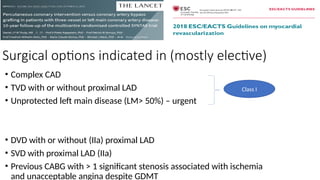
Surgical options indicated in (mostly elective)
• Complex CAD
• TVD with or without proximal LAD
• Unprotected left main disease (LM> 50%) – urgent
• DVD with or without (IIa) proximal LAD
• SVD with proximal LAD (IIa)
• Previous CABG with > 1 significant stenosis associated with ischemia
and unacceptable angina despite GDMT
Class I
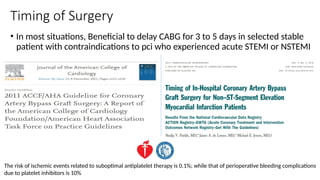
Timing of Surgery
• In most situations, Beneficial to delay CABG for 3 to 5 days in selected stable
patient with contraindications to pci who experienced acute STEMI or NSTEMI
The risk of ischemic events related to suboptimal antiplatelet therapy is 0.1%; while that of perioperative bleeding complications
due to platelet inhibitors is 10%
Emergency CABG in patient with Acute MI-
recommendations
• Failed or Difficult PCI
• Persistent ischemia or hemodynamic instability refractory to nonsurgical
therapy
• For surgical repair of postinfarction mechanical complication like Ventricular
septal rupture, Papillary muscle rupture
• In cardiogenic shock irrespective of time interval
• Life threatening arrythmias(ischemic) in patient with Left main disease or
equivalent or 3 vessel CAD
• Reasonable for Age > 75 with ST elevation irrespective of hemodynamics
Problems with Emergency CABG
• Freshly infarcted myocardium - poor tolerant of additional stress of surgery
• Medical therapy like thrombolysis or antiplatelet loading – may interfere with
the haemostasis of surgical field (Increased Transfusion rates)
• Unanticipated problems during invasive lines placement or urinary catheter
placement (injury and bleeding)
• Full stomach – aspiration risk
• Hemodynamic instability and requirement of IABP or Impella devices
CABG – two techniques
• Traditional use of Cardio-pulmonary bypass machine and then grafting
the coronary vessels with achieving cardiac arrest using cardioplegia
solution
• Modern, OFF pump Coronary vessels bypass grafting with use of
cardiac position stabilizers like Octopus and experienced cardiac
Anesthesiologist.
Which is better
Which is better
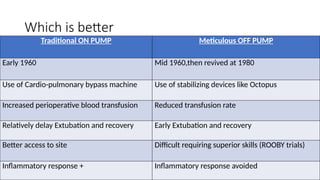
Traditional ON PUMP Meticulous OFF PUMP
Early 1960 Mid 1960,then revived at 1980
Use of Cardio-pulmonary bypass machine Use of stabilizing devices like Octopus
Increased perioperative blood transfusion Reduced transfusion rate
Relatively delay Extubation and recovery Early Extubation and recovery
Better access to site Difficult requiring superior skills (ROOBY trials)
Inflammatory response + Inflammatory response avoided
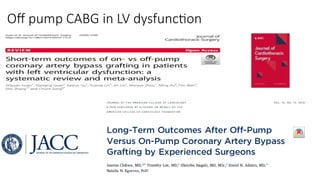
Off pump CABG in LV dysfunction
Instruments for OFF pump CABG surgery
• Tissue stabilizer (suction type to minimize the movements)– Octopus (Medtronic)
• Starfish – Heart positioners
• Mister Blower
• Stents
• Partial clamp
• Distal perfusion cannula
• Epicardial retractor - Parsonnet
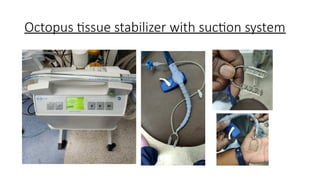
Octopus tissue stabilizer with suction system
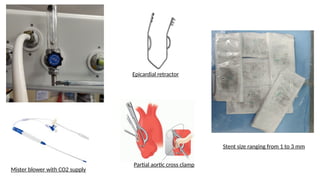
Mister blower with CO2 supply
Epicardial retractor
Partial aortic cross clamp
Stent size ranging from 1 to 3 mm
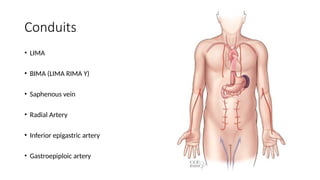
Conduits
• LIMA
• BIMA (LIMA RIMA Y)
• Saphenous vein
• Radial Artery
• Inferior epigastric artery
• Gastroepiploic artery
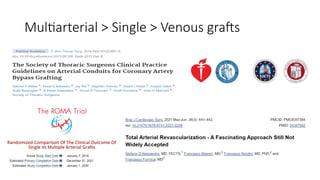
Multiarterial > Single > Venous grafts
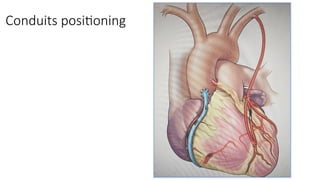
Conduits positioning
Preoperative considerations
• History taking and physical examination
• Explanation about the procedure in detail
• Blood Investigations with ECG, CXR, ECHO and Coronary Angiogram
• If needed - Myocardial viability study, B/L Carotid doppler (Age >65)
• Comorbid conditions optimization
• Drugs discontinued as per international guidelines
• NPO, informed consent and Adequate blood
• Discuss the sequence of revascularization and rationale with Surgeon
Intraoperative concerns
• ASA standard Monitoring (ECG with ST segment analysis)
• Basic ventilation monitoring (peak airway pressure, EtCO2)
• Invasive – Arterial, Central venous or Pulmonary Artery Pressure
• Temperature and Urine output
• Arterial blood gas analysis
• Bispectral Index
• Transesophageal echocardiography (essential)
Intraoperative concerns
• Induction with Fentanyl, Midazolam and Etomidate
• Muscle Relaxant – Vecuronium
• BIS around 40 with Sevoflurane and Midazolam
• Fentanyl and Vecuronium as required
• Always communicate with Surgeon and focus on surgical field
• Normalize perfusion pressure and filling pressure before each grafts
• Anticoagulation with Heparin 1-2mg/kg (ACT 250-300)
• Hemodynamics maintenance during grafting (LAD>OM>PDA)
• Maintain SBP around 100mmHg during partial clamping
• Protamine reversal (1:1) – aware of protamine reactions
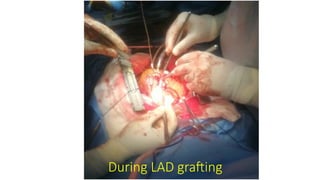
During LAD grafting
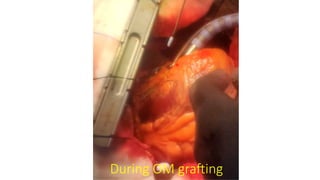
During OM grafting
Hemodynamics during grafting
• Perfusionist available and dry pump run – before
• Goal directed fluid therapy approach
• Maintain perfusion pressure and heart rate (neither high nor low)
• Liberal use of vasopressors and NTG according to the requirement
• Always visually inspect the heart and surgical field
• Determine size and ventricular contractility using TEE
• Careful ST segment analysis and any change in rhythm (Anti-arrythmics)
• If not happy, don’t progress
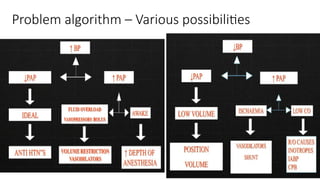
Problem algorithm – Various possibilities
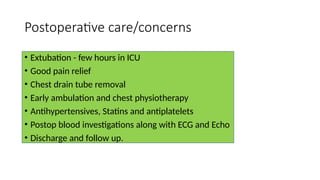
Postoperative care/concerns
• Extubation - few hours in ICU
• Good pain relief
• Chest drain tube removal
• Early ambulation and chest physiotherapy
• Antihypertensives, Statins and antiplatelets
• Postop blood investigations along with ECG and Echo
• Discharge and follow up.
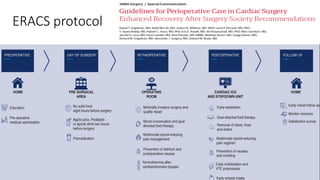
ERACS protocol
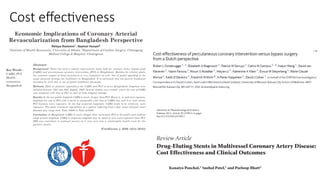
Cost effectiveness
Carry home message
• Skilled job
• Good communication skills
• Vigilant monitoring
• Cost-effective nature
Thank you once again

Anesthesia for MI patient going for surgery

  • 1.
    Anesthesia for MIpatient going for CABG surgery Dr. Vinoth Natarajan MD DNB Consultant Cardiac Anesthesiologist MGM Healthcare
  • 2.
    Learning Objectives • MIdefinition • CABG in the setting of MI • OFF pump VS ON pump • Instruments required for OFF pump CABG • Anesthesia considerations – OFF CABG • A word on ERACS protocol
  • 3.
    Myocardial Infarction- definition •Myocardial Injury – evidence of rise in cardiac troponin levels • Acute MI – Acute myocardial injury + atleast any 1 of the following 1) Symptoms of myocardial ischemia like chest pain, sweating 2) New ECG changes like ST elevation 3) Imaging evidence of new loss of viable myocardium or new RWMAs 4) Identification of coronary thrombus by angiography or autopsy
  • 4.
    Types of acuteMI • Type 1 – Presence of acute atherothrombosis in coronary arteries • Type 2 – Evidence of O2 supply/demand mismatch (narrowing) • Type 3 – Cardiac death with symptoms and ECG changes of MI before getting Troponin levels • Type 4 – PCI related (stent thrombosis/restenosis) • Type 5 – CABG related
  • 5.
    Prior/silent MI • Any1 of the following 1) Abnormal Q waves with/without symptoms in the absence of nonischaemic causes 2) Imaging evidence of loss of viable myocardium in a pattern consistent with ischemic etiology 3) Pathological-anatomical findings of a prior MI
  • 6.
    Surgical options indicatedin (mostly elective) • Complex CAD • TVD with or without proximal LAD • Unprotected left main disease (LM> 50%) – urgent • DVD with or without (IIa) proximal LAD • SVD with proximal LAD (IIa) • Previous CABG with > 1 significant stenosis associated with ischemia and unacceptable angina despite GDMT Class I
  • 7.
    Timing of Surgery •In most situations, Beneficial to delay CABG for 3 to 5 days in selected stable patient with contraindications to pci who experienced acute STEMI or NSTEMI The risk of ischemic events related to suboptimal antiplatelet therapy is 0.1%; while that of perioperative bleeding complications due to platelet inhibitors is 10%
  • 8.
    Emergency CABG inpatient with Acute MI- recommendations • Failed or Difficult PCI • Persistent ischemia or hemodynamic instability refractory to nonsurgical therapy • For surgical repair of postinfarction mechanical complication like Ventricular septal rupture, Papillary muscle rupture • In cardiogenic shock irrespective of time interval • Life threatening arrythmias(ischemic) in patient with Left main disease or equivalent or 3 vessel CAD • Reasonable for Age > 75 with ST elevation irrespective of hemodynamics
  • 9.
    Problems with EmergencyCABG • Freshly infarcted myocardium - poor tolerant of additional stress of surgery • Medical therapy like thrombolysis or antiplatelet loading – may interfere with the haemostasis of surgical field (Increased Transfusion rates) • Unanticipated problems during invasive lines placement or urinary catheter placement (injury and bleeding) • Full stomach – aspiration risk • Hemodynamic instability and requirement of IABP or Impella devices
  • 10.
    CABG – twotechniques • Traditional use of Cardio-pulmonary bypass machine and then grafting the coronary vessels with achieving cardiac arrest using cardioplegia solution • Modern, OFF pump Coronary vessels bypass grafting with use of cardiac position stabilizers like Octopus and experienced cardiac Anesthesiologist.
  • 11.
  • 12.
    Which is better TraditionalON PUMP Meticulous OFF PUMP Early 1960 Mid 1960,then revived at 1980 Use of Cardio-pulmonary bypass machine Use of stabilizing devices like Octopus Increased perioperative blood transfusion Reduced transfusion rate Relatively delay Extubation and recovery Early Extubation and recovery Better access to site Difficult requiring superior skills (ROOBY trials) Inflammatory response + Inflammatory response avoided
  • 13.
    Off pump CABGin LV dysfunction
  • 14.
    Instruments for OFFpump CABG surgery • Tissue stabilizer (suction type to minimize the movements)– Octopus (Medtronic) • Starfish – Heart positioners • Mister Blower • Stents • Partial clamp • Distal perfusion cannula • Epicardial retractor - Parsonnet
  • 15.
    Octopus tissue stabilizerwith suction system
  • 16.
    Mister blower withCO2 supply Epicardial retractor Partial aortic cross clamp Stent size ranging from 1 to 3 mm
  • 17.
    Conduits • LIMA • BIMA(LIMA RIMA Y) • Saphenous vein • Radial Artery • Inferior epigastric artery • Gastroepiploic artery
  • 18.
    Multiarterial > Single> Venous grafts
  • 19.
  • 20.
    Preoperative considerations • Historytaking and physical examination • Explanation about the procedure in detail • Blood Investigations with ECG, CXR, ECHO and Coronary Angiogram • If needed - Myocardial viability study, B/L Carotid doppler (Age >65) • Comorbid conditions optimization • Drugs discontinued as per international guidelines • NPO, informed consent and Adequate blood • Discuss the sequence of revascularization and rationale with Surgeon
  • 21.
    Intraoperative concerns • ASAstandard Monitoring (ECG with ST segment analysis) • Basic ventilation monitoring (peak airway pressure, EtCO2) • Invasive – Arterial, Central venous or Pulmonary Artery Pressure • Temperature and Urine output • Arterial blood gas analysis • Bispectral Index • Transesophageal echocardiography (essential)
  • 22.
    Intraoperative concerns • Inductionwith Fentanyl, Midazolam and Etomidate • Muscle Relaxant – Vecuronium • BIS around 40 with Sevoflurane and Midazolam • Fentanyl and Vecuronium as required • Always communicate with Surgeon and focus on surgical field • Normalize perfusion pressure and filling pressure before each grafts • Anticoagulation with Heparin 1-2mg/kg (ACT 250-300) • Hemodynamics maintenance during grafting (LAD>OM>PDA) • Maintain SBP around 100mmHg during partial clamping • Protamine reversal (1:1) – aware of protamine reactions
  • 23.
  • 24.
  • 25.
    Hemodynamics during grafting •Perfusionist available and dry pump run – before • Goal directed fluid therapy approach • Maintain perfusion pressure and heart rate (neither high nor low) • Liberal use of vasopressors and NTG according to the requirement • Always visually inspect the heart and surgical field • Determine size and ventricular contractility using TEE • Careful ST segment analysis and any change in rhythm (Anti-arrythmics) • If not happy, don’t progress
  • 26.
    Problem algorithm –Various possibilities
  • 27.
    Postoperative care/concerns • Extubation- few hours in ICU • Good pain relief • Chest drain tube removal • Early ambulation and chest physiotherapy • Antihypertensives, Statins and antiplatelets • Postop blood investigations along with ECG and Echo • Discharge and follow up.
  • 28.
  • 29.
  • 30.
    Carry home message •Skilled job • Good communication skills • Vigilant monitoring • Cost-effective nature
  • 31.

Editor's Notes

  • #1 Good morning everyone, I m vinoth natarajan. There are so many stalwartz speakers in this programme today. I m very much delighted/privilged to share my knowledge in this topic among them. Thanks to the organizing team for this wonderful opportunity. Today, I am going to tell you about the Anesthesia concerns for a MI patient going for cardiac surgery. Without any further delay, lets move to the topic
  • #2 Objectives of this section will be 1) to Define MI, when will you say it is myocardial infarction, when will you say it is myocardial injury. What is the difference?2) role of bypass surgery in the setting of MI.3) which will be the better option whether it is off pump or on pump CABG. 4) what are the specialized instruments required for performing OFF pump CABG 5) ofcourse, anesthesia concerns for OFF pump cabg and lastly, a short note on Early recovery after cardiac surgery,that is ERACS protocol
  • #3 First of all, definition. Myocardial injury is defined as the evidence of rise in cardiac troponin levels (both I and T); Whenever there is rise in their levels, then we call it as myocardial injury. When this myocardial injury is associated with atleast any 1 of the following syptoms like chest pain, new ECG changes which is not ssen in the past, echo showing the new loss of viable myocardiu or any new RWMAs and finally angio showing thrombus in any coronary vessels- then only we call it as MYOCARDIAL INFARCTION. I hope, this ll clear your mind
  • #4 Next come to the trypes of MI, type 1 ll be the presence of acute atheroma in coronary arteries, type 2 is the evidence of o2 demand supply mismatch, type 3 will be the
  • #5 Importantly, another type is prior or silent MI which will be having atleast any 1 of the following abnormal q waves I n the ecg, evidence of loss of myocardium in pattern consistent with ischemic etiology in echocardiography and finally, pathological identification after examing the infarcted heart
  • #6  According to 2018 European association of cardiothoracic surgeon’s guidelines and results from the 10 year follow-up of extended syntax trial, it is the evident that CABG is the class 1 indication in patient having complex coronary artery disease, and in patient having triple vessel disease with or without proximsl LAD lesion and unprotected left main disease ll also fall in this category. But recent SYNTAXES trial contradict the last point, many left main lesions are nowadays successfully stented without any complications in the good hands of cardiologists. So, actually speaking, there is very little space for cardiothoracic surgeons in this new era of advanced medicine. And CABG is also indicated in Double vessel disease and svd with proximal LAD involvement and in redo cases despite goal directed medical therapy
  • #7 Then next comeshere , when will you operate? Whether the surgery should be done immediately or do we have any time delay limit?,. Most of the literature mention that there ll be a lot of benefit to delay CABG for 3 to 5 days in acute MI situation,provided they should remain hemodynamically stable condition. The reason behind why are they stressing it out is “risk of ischemic events to suboptimal antiplatelt therpy is 0.1% only,while the perioperative bleeding complication due to platelet inhibiotrs is 10%. So, conclusion is better to wait for a certain period of time (roughly 5 days to wear off antiplatelet effects).
  • #8 So next comes here is, what are the situations quiring CABG should be performed as an emergency procedure. 1) when there is attempt failed or difficult PCI, 2) persistant ischemia or hemodynamic instability refracort to medical therpy, 3) should be carried ot immediately when correcting the repair of postinarction complications like VSR, PMR.4) in cardigenic shock patients and 5) patient with ongoing active lifethreatening arrythmias
  • #9 So, next – what are the problems encountered in emergency cabg setup.? As we all already know that freshly infarcted myocardium will be the poor tolerant of additional stress due to surgery. Myocardial function may worsen even after the surgery. Medical therpies may pose a threat to cardiac surgeon who is trying to achieve good hemostasis, there will be unanticipated problems like injury while putting urinary catheter or inadvertent major vessel injury while attempting to place invasive lines . There will be a risk of full stomach causing aspiration- a common problem for all emergency cases. Requorement if use mechanical assist device like IABP
  • #10 Move on to next slide, there are two options for performing CABG, one is traditional way or another is modern way
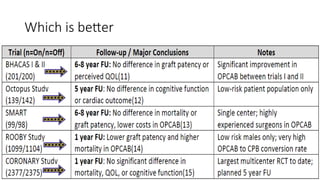
  • #11 Several studies like BHACAS I II, Octopus study, SMART, ROOBY AND coronary study mentioned that OFF pump CABG is better than ON pump CABG
  • #12 When taling about the m,ain difference between two of them, there ll be decreased blood transfusion rates,avoidance of inflammatory response due to cpb machines and possibility of early extubation and recovery. Cons inculfe the surgical access ll be good in on pump when comparing to off pump
  • #13 Well, whether off pump cabg can be suitable for LV dysfunction patient. A systematic review and meta analysis released in Journal of cardiothoracic surgery on 2020 showed short term outcomes like pulmonary complications.reexploration rate,transfusion rates were less in off pump cabg when compared to that in on pump cabg. There is also a study showing that off pump cabg can be successfully done in severe LV dysfunction patients with the liberal use of IABP and better control of hemodynamics by experienced cardiac anesthesiologist.
  • #14 Before going to discuss about hemodynamics fluctuation associated with off pump suregery, there are certain common instruments essential for performing it. 1 – tissue stabilizer popularly called as octopus-which surgeon applied over the heart to minimize the movements during grafting. Starfish is used to positionize the heart during om grafting. Next is the mister blower- the function of it is to provide the clear field by blowing the mist of air facilitating the distal anastomosis. Various sizes of shunt were used to maintain the blood flow during anastomosis. Surgeon usually make a nick in coronary vessel.insert the shunt through it and then connect the graft in that small nick portion. Others are partial clapmp, distal perfusion cannula, parsonnet epicardial retractor
  • #15 This is octopus tissue stabilizer with suction system(recommended suction pressure should be less than -450Mbar, to reduce underlying tissue damage
  • #16 This is mister blower system. You can notice CO2 supply here. CO2 is the prefable than o2 as the air emboli and combustion risk is less with co2.
  • #17 There are total of 10 vessels in our body can be used as conduits for bypass grafting.Left and right internal mammary artery, saphenous vein, radial artery, inferior epigastric and gastroepiploic artery are the grafts options available. for performing bypass surgery
  • #18 STS, ACC and also European association all recommend the use of atleast single arterial grafts while performing the surgery. There is a recent 2021 review article in Brazilian journal of cardiovascular surgery mentioning that shift to minimally invasive surgeries, technical difficulties and high chance of easy spasm are the reasons for not accepting TAR. the ongoing ROMA trial may show light on this path
  • #19 This is the picture showing graft positions and anastomosis with aorta
  • #20 Now, lets move to Anesthesia concerns for off pump cabg. Preoperative – proper history and physical examination to be done. Detailed explanation about the procedure and risk involved in it should be explained. Basic blood investigation to be done. Particulary ecg, cxr, echo and angiogram. Some centres are performinmg myocardial viability studies before the procedure,but its use is debatable. For all patient above age 65 , it is better to dob/l carotid dopller. Comorbid condition should be optimized. Pt might be on many drugs, discpntiunation should be done as per recommended guildelines. Npo, informed consent and reservation of adequate blood to be done. Most importantly, we have to discusss with sequence of grafting with surgeon before start. This ll ease our hemodynamics management.
  • #21 Should proceed the case with basic asa standard monitors. Invasive lines like arterial central and pulmonary catheter to be placed. BIS to assess the depth of anesthesia, tee is the most essential monitor and very helpful in detecting any new RWMA during grafting and for assessment of valve function during grafting
  • #22 Then, induction with fenta,midaz and etomidate, and usual vecuronium as muscle relaxant. Most important is always communicate with surgeon what step is doing and how he is doing main focus should be on surgical field. Normalize perfusion pressure and filling pressure before each grafts. Heparin to maintain act in range of 250-300.hemodynamics should be maintained stable during grafting time. OM grafting will be a challenging one where the surgeon place the heartto lie vertically. During partial clamp of aorta – bp should not be on higher side, if it is high there is chance of aortic dissection. Heparine should be reversed with protamine, usually 1:1 ratio.
  • #23 This is the intraoperative video of 65 year old gentleman who underwent cabg surgery recently in our hospital. Here, surgeon is trying to place the shunt in LAD. You can see the prupose of octopus and mister blower here clearly
  • #24 This is also a video capture during time of om grafting in the same patient. Here you can see the heart is lifted up and lying vertically.
  • #25 From this two videos, you might clearly understand how the heart is handled during the off pump cabg. So there is high chance of hemodynamics mishaps during the procedure. Mostly, it ll be related to positioning of heart and handling effect. Handling may provoke arrythmias – proper anti-arrythymic agent should be given according to the situation. Positioning may compress the heart chambers and chance of hypotension. So we have to adjust the table position accordingly and volume status of the patient. Whenever there is a requirement of phenyl ephrine bolus, it should be given. If bp is high , can go for NTG. Always assess the size and ventricular contractility with the help of TEE. If not happy in any situation, don’t progress, discuss with surgeon and relieve the compression until hemodynamics become stable.
  • #26 I m just telling you here the problem algorithm and how to solve it. There ll be two possibility. Hypotension and hypertension. if bp is high, then check PAP, if it is low (ideal situation),use anti hTN. If pap is also high, there ll be two possibilities fluid overload and pt may be awake. Another situation is low bp. Check pap, if pap is also low, may be low volume- adjust the position and can give volume. If pap is high, two chances – ischemia causing decreased LV contraction – back pressure in pulmonary vessels- HR optimization and use of NTG with phenyl ephrine boluses. Another cause id low co – first thing is rule out the causes, inotropes can be increased, if not able to maintain – can go IABp, if not maintaining after that – conversion to on pump is indicated.
  • #27 Postoperative -
  • #28 A brief note about ERACS published in 2020 January in JAMA. It s emphasising the importance of each step starting from home until discharge from the hospital to have early recovery after cardiac surgery
  • #29 Main part – cost effectiveness: one Bangladesh study concluded that multivessel cabg is cheaper than pci in long term followup and managing the compication of coronary artery disease. Even ACC AHA, also mentioned that it is less financial burden in cabg than multivessel pci in the longer run. One Indian study also confirmed the same.
  • #30 Yeah, it is skilled job,require good communication skills for an anesthesiologist. Moreover, it should be preferred more as it is very cost-effective.