Documentary Conventions
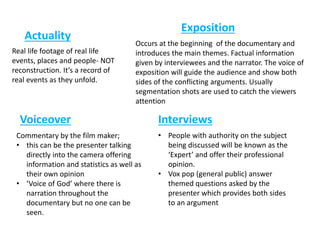
Actuality 
Real life footage of real life 
events, places and people- NOT 
reconstruction. It’s a record of 
real events as they unfold. 
Occurs at the beginning of the documentary and 
introduces the main themes. Factual information 
given by interviewees and the narrator. The voice of 
exposition will guide the audience and show both 
sides of the conflicting arguments. Usually 
segmentation shots are used to catch the viewers 
attention 
Interviews 
Voiceover 
Commentary by the film maker; 
• this can be the presenter talking 
directly into the camera offering 
information and statistics as well as 
their own opinion 
• ‘Voice of God’ where there is 
narration throughout the 
documentary but no one can be 
seen. 
Exposition 
• People with authority on the subject 
being discussed will be known as the 
‘Expert’ and offer their professional 
opinion. 
• Vox pop (general public) answer 
themed questions asked by the 
presenter which provides both sides 
to an argument
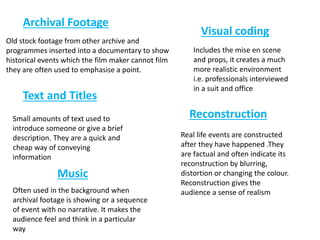
Archival Footage 
Old stock footage from other archive and 
programmes inserted into a documentary to show 
historical events which the film maker cannot film 
they are often used to emphasise a point. 
Reconstruction 
Real life events are constructed 
after they have happened .They 
are factual and often indicate its 
reconstruction by blurring, 
distortion or changing the colour. 
Reconstruction gives the 
audience a sense of realism 
Text and Titles 
Small amounts of text used to 
introduce someone or give a brief 
description. They are a quick and 
cheap way of conveying 
information 
Visual coding 
Includes the mise en scene 
and props, it creates a much 
more realistic environment 
i.e. professionals interviewed 
in a suit and office 
Music 
Often used in the background when 
archival footage is showing or a sequence 
of event with no narrative. It makes the 
audience feel and think in a particular 
way

Post 7 documentary conventions

  • 1.
  • 2.
    Actuality Real lifefootage of real life events, places and people- NOT reconstruction. It’s a record of real events as they unfold. Occurs at the beginning of the documentary and introduces the main themes. Factual information given by interviewees and the narrator. The voice of exposition will guide the audience and show both sides of the conflicting arguments. Usually segmentation shots are used to catch the viewers attention Interviews Voiceover Commentary by the film maker; • this can be the presenter talking directly into the camera offering information and statistics as well as their own opinion • ‘Voice of God’ where there is narration throughout the documentary but no one can be seen. Exposition • People with authority on the subject being discussed will be known as the ‘Expert’ and offer their professional opinion. • Vox pop (general public) answer themed questions asked by the presenter which provides both sides to an argument
  • 3.
    Archival Footage Oldstock footage from other archive and programmes inserted into a documentary to show historical events which the film maker cannot film they are often used to emphasise a point. Reconstruction Real life events are constructed after they have happened .They are factual and often indicate its reconstruction by blurring, distortion or changing the colour. Reconstruction gives the audience a sense of realism Text and Titles Small amounts of text used to introduce someone or give a brief description. They are a quick and cheap way of conveying information Visual coding Includes the mise en scene and props, it creates a much more realistic environment i.e. professionals interviewed in a suit and office Music Often used in the background when archival footage is showing or a sequence of event with no narrative. It makes the audience feel and think in a particular way