Documentaries
Codes and Conventions of
Documentaries
What is a documentary?
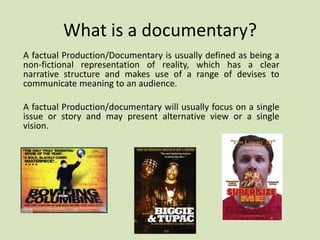
A factual Production/Documentary is usually defined as being a
non-fictional representation of reality, which has a clear
narrative structure and makes use of a range of devises to
communicate meaning to an audience.
A factual Production/documentary will usually focus on a single
issue or story and may present alternative view or a single
vision.
What are the conventions of a
documentary?
Exposition
In a documentary, the exposition occurs at the beginning and
introduces the important themes of the film. It is important
because it creates the viewer's first impression and introduces the
viewer to the content.
Dramatic segments of the documentary are specially chosen in
order to catch the viewer’s attention. These shots are specifically
positioned, such that the montage positions us to believe a certain
theme presented by the documentary and this the documentary
presents its view much more persuasively to the viewer.
Voice over
The Voice-over in a documentary is a commentary by the
filmmaker, spoken while the camera is filming, or added to
the soundtrack during the production. Through this the
filmmaker can speak directly to the viewer, offering
information, explanations and opinions.
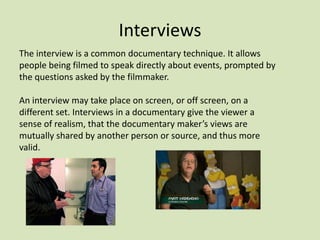
Interviews
The interview is a common documentary technique. It allows
people being filmed to speak directly about events, prompted by
the questions asked by the filmmaker.

An interview may take place on screen, or off screen, on a
different set. Interviews in a documentary give the viewer a
sense of realism, that the documentary maker’s views are
mutually shared by another person or source, and thus more
valid.
Archival footage
Archival, or stock footage, is material obtained
from a film archive and inserted into a
documentary to show historical events or to
add detail without the need for additional
filming.
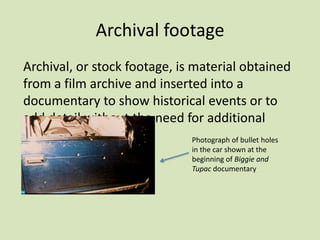
Photograph of bullet holes
in the car shown at the
beginning of Biggie and
Tupac documentary
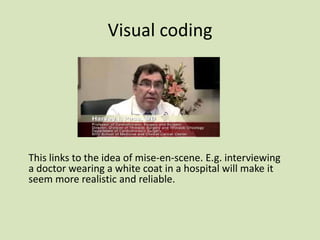
Visual coding

This links to the idea of mise-en-scene. E.g. interviewing
a doctor wearing a white coat in a hospital will make it
seem more realistic and reliable.
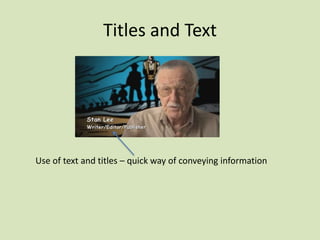
Titles and Text

Use of text and titles – quick way of conveying information
Reconstructions
Reconstructions are also often used in documentaries. They are
artificial scenes of an event which has been reconstructed and
acted out on film based on information of the event.
Reconstructions generally provide factual information, and give the
viewer a sense of realism, as if the event really happened in front
of them live.
They often indicate that the footage is not real by using techniques
such as blurring, distortion, lighting effects, changes in camera
level, and color enhancement within the footage.
Documentaries irenee

Documentaries irenee

  • 1.
  • 2.
    What is adocumentary? A factual Production/Documentary is usually defined as being a non-fictional representation of reality, which has a clear narrative structure and makes use of a range of devises to communicate meaning to an audience. A factual Production/documentary will usually focus on a single issue or story and may present alternative view or a single vision.
  • 3.
    What are theconventions of a documentary?
  • 4.
    Exposition In a documentary,the exposition occurs at the beginning and introduces the important themes of the film. It is important because it creates the viewer's first impression and introduces the viewer to the content. Dramatic segments of the documentary are specially chosen in order to catch the viewer’s attention. These shots are specifically positioned, such that the montage positions us to believe a certain theme presented by the documentary and this the documentary presents its view much more persuasively to the viewer.
  • 5.
    Voice over The Voice-overin a documentary is a commentary by the filmmaker, spoken while the camera is filming, or added to the soundtrack during the production. Through this the filmmaker can speak directly to the viewer, offering information, explanations and opinions.
  • 6.
    Interviews The interview isa common documentary technique. It allows people being filmed to speak directly about events, prompted by the questions asked by the filmmaker. An interview may take place on screen, or off screen, on a different set. Interviews in a documentary give the viewer a sense of realism, that the documentary maker’s views are mutually shared by another person or source, and thus more valid.
  • 7.
    Archival footage Archival, orstock footage, is material obtained from a film archive and inserted into a documentary to show historical events or to add detail without the need for additional filming. Photograph of bullet holes in the car shown at the beginning of Biggie and Tupac documentary
  • 8.
    Visual coding This linksto the idea of mise-en-scene. E.g. interviewing a doctor wearing a white coat in a hospital will make it seem more realistic and reliable.
  • 9.
    Titles and Text Useof text and titles – quick way of conveying information
  • 10.
    Reconstructions Reconstructions are alsooften used in documentaries. They are artificial scenes of an event which has been reconstructed and acted out on film based on information of the event. Reconstructions generally provide factual information, and give the viewer a sense of realism, as if the event really happened in front of them live. They often indicate that the footage is not real by using techniques such as blurring, distortion, lighting effects, changes in camera level, and color enhancement within the footage.