FS6 Critical Studies
Section A: The Film Text & The Spectator
              Documentary
                   What are your own
   Starter:        expectations of a
                   documentary? What
                   techniques might be
                   used by a documentary
                   filmmaker to capture the
                   ‘real’?
What are you expected to study?

  Documentary
• The study of film language in relation to the
  'real' with particular emphasis on selection
  and construction in film representation.
  Examples may be taken from both historical
  (such as 30s and 40s British Documentary)
  and contemporary examples, including
  work done on video.
  (taken from the A2 Film Studies specification)
Past Paper Questions (1):
(Note: there is no choice of questions on the exam)


•   Do we, as spectators, ask too much of
    documentary films by expecting ‘reality’ and
    ‘truth’?
•   Is it possible to identify consistent cinematic
    conventions in the documentary films you have
    studied?
•   Is there a difference between the way in which
    audiences view documentary and fiction films?
•   Do you think one method of documentary film-
    making is more likely to capture ‘the real’? Refer
    to documentaries you have studied.
Past Paper Questions (2):

(Note: there is no choice of questions on the exam)

•   Do you agree that as spectators we are more
    likely to accept at face value what we see and
    here in documentary films?
•   Is ‘objectivity’ possible in documentary
    filmmaking? Refer to documentaries you have
    studied.
•   ‘Documentaries are just as carefully structured
    and constructed as fiction films’. Discuss this
    statement with reference to documentaries you
    have studied.
•   Discuss the factors that influence the
    representation of the ‘real’ in the documentaries
    you have studied.
Use of verbal language in
             Documentaries
• Overheard Exchange: Recording of
  seemingly spontaneous dialogue between
  two or more participants engaged in
  conversation.
• Testimony: The recording of information or
  opinion by witnesses, experts or other
  participants. May involve direct address to
  the camera, or a voiceover.
• Exposition: Use of a voiceover or direct
  address to provide essential information and
  argument.
‘Modes’ of Documentary
Bill Nichols (2001)defines six modes of documentary:
• Poetic: 'reassembling fragments of the world’, eg, a montage
    of events.
• Expository or 'direct address‘: social issues presented in a
    direct form, audience acknowledged sometimes with a
    ‘voice-of-God’ narration and/or ‘talking heads’
• Observational (fly-on-the-wall): Developed with handheld
    cameras and long takes in the 1950s/60s. Audience should not
    be aware of the filmmaker; an attempt to capture reality as it
    unfolds. Observational techniques can sometimes be
    described as ‘reactive’ or ‘proactive’.
• Participatory: Film-maker interviews/interacts with participants.
• Reflexive: Aware that it is constructing its own reality.
• Performative: Represents reality in a stylised way that evokes
    the mood of fiction films to encourage audience
    engagement. May involve reconstruction of events
Representation of the ‘Real’


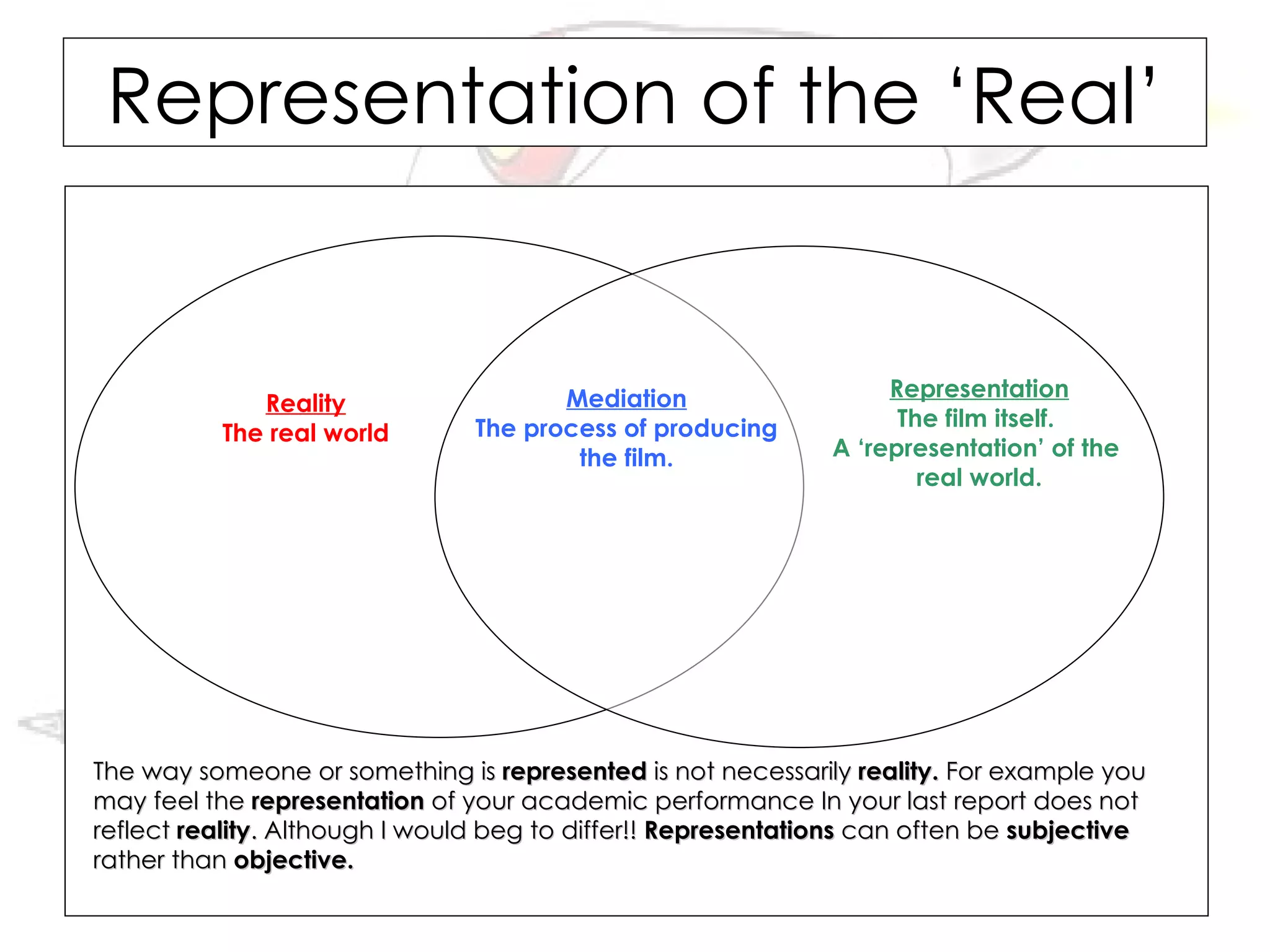
                                       Mediation                   Representation
             Reality
                                The process of producing            The film itself.
          The real world
                                        the film.             A ‘representation’ of the
                                                                      real world.


The way someone or something is represented is not necessarily reality. For example you
may feel the representation of your academic performance In your last report does not
reflect reality. Although I would beg to differ!! Representations can often be subjective
rather than objective.
Key Questions to Consider in terms of
                Representation
• What and who is being represented?
  (subject matter, participants)

• How they are being represented?
  (‘macro’ and ‘micro’ features, point of view)

• Who is representing them?
  (filmmakers and the institutions responsible for production)

• How might the audience respond to that which is being
  represented?
   (context of reception/possible audience response; preferred,
  oppositional, negotiated readings…)

Documentary Overview

  • 1.
    FS6 Critical Studies SectionA: The Film Text & The Spectator Documentary What are your own Starter: expectations of a documentary? What techniques might be used by a documentary filmmaker to capture the ‘real’?
  • 2.
    What are youexpected to study? Documentary • The study of film language in relation to the 'real' with particular emphasis on selection and construction in film representation. Examples may be taken from both historical (such as 30s and 40s British Documentary) and contemporary examples, including work done on video. (taken from the A2 Film Studies specification)
  • 3.
    Past Paper Questions(1): (Note: there is no choice of questions on the exam) • Do we, as spectators, ask too much of documentary films by expecting ‘reality’ and ‘truth’? • Is it possible to identify consistent cinematic conventions in the documentary films you have studied? • Is there a difference between the way in which audiences view documentary and fiction films? • Do you think one method of documentary film- making is more likely to capture ‘the real’? Refer to documentaries you have studied.
  • 4.
    Past Paper Questions(2): (Note: there is no choice of questions on the exam) • Do you agree that as spectators we are more likely to accept at face value what we see and here in documentary films? • Is ‘objectivity’ possible in documentary filmmaking? Refer to documentaries you have studied. • ‘Documentaries are just as carefully structured and constructed as fiction films’. Discuss this statement with reference to documentaries you have studied. • Discuss the factors that influence the representation of the ‘real’ in the documentaries you have studied.
  • 5.
    Use of verballanguage in Documentaries • Overheard Exchange: Recording of seemingly spontaneous dialogue between two or more participants engaged in conversation. • Testimony: The recording of information or opinion by witnesses, experts or other participants. May involve direct address to the camera, or a voiceover. • Exposition: Use of a voiceover or direct address to provide essential information and argument.
  • 6.
    ‘Modes’ of Documentary BillNichols (2001)defines six modes of documentary: • Poetic: 'reassembling fragments of the world’, eg, a montage of events. • Expository or 'direct address‘: social issues presented in a direct form, audience acknowledged sometimes with a ‘voice-of-God’ narration and/or ‘talking heads’ • Observational (fly-on-the-wall): Developed with handheld cameras and long takes in the 1950s/60s. Audience should not be aware of the filmmaker; an attempt to capture reality as it unfolds. Observational techniques can sometimes be described as ‘reactive’ or ‘proactive’. • Participatory: Film-maker interviews/interacts with participants. • Reflexive: Aware that it is constructing its own reality. • Performative: Represents reality in a stylised way that evokes the mood of fiction films to encourage audience engagement. May involve reconstruction of events
  • 7.
    Representation of the‘Real’ Mediation Representation Reality The process of producing The film itself. The real world the film. A ‘representation’ of the real world. The way someone or something is represented is not necessarily reality. For example you may feel the representation of your academic performance In your last report does not reflect reality. Although I would beg to differ!! Representations can often be subjective rather than objective.
  • 8.
    Key Questions toConsider in terms of Representation • What and who is being represented? (subject matter, participants) • How they are being represented? (‘macro’ and ‘micro’ features, point of view) • Who is representing them? (filmmakers and the institutions responsible for production) • How might the audience respond to that which is being represented? (context of reception/possible audience response; preferred, oppositional, negotiated readings…)