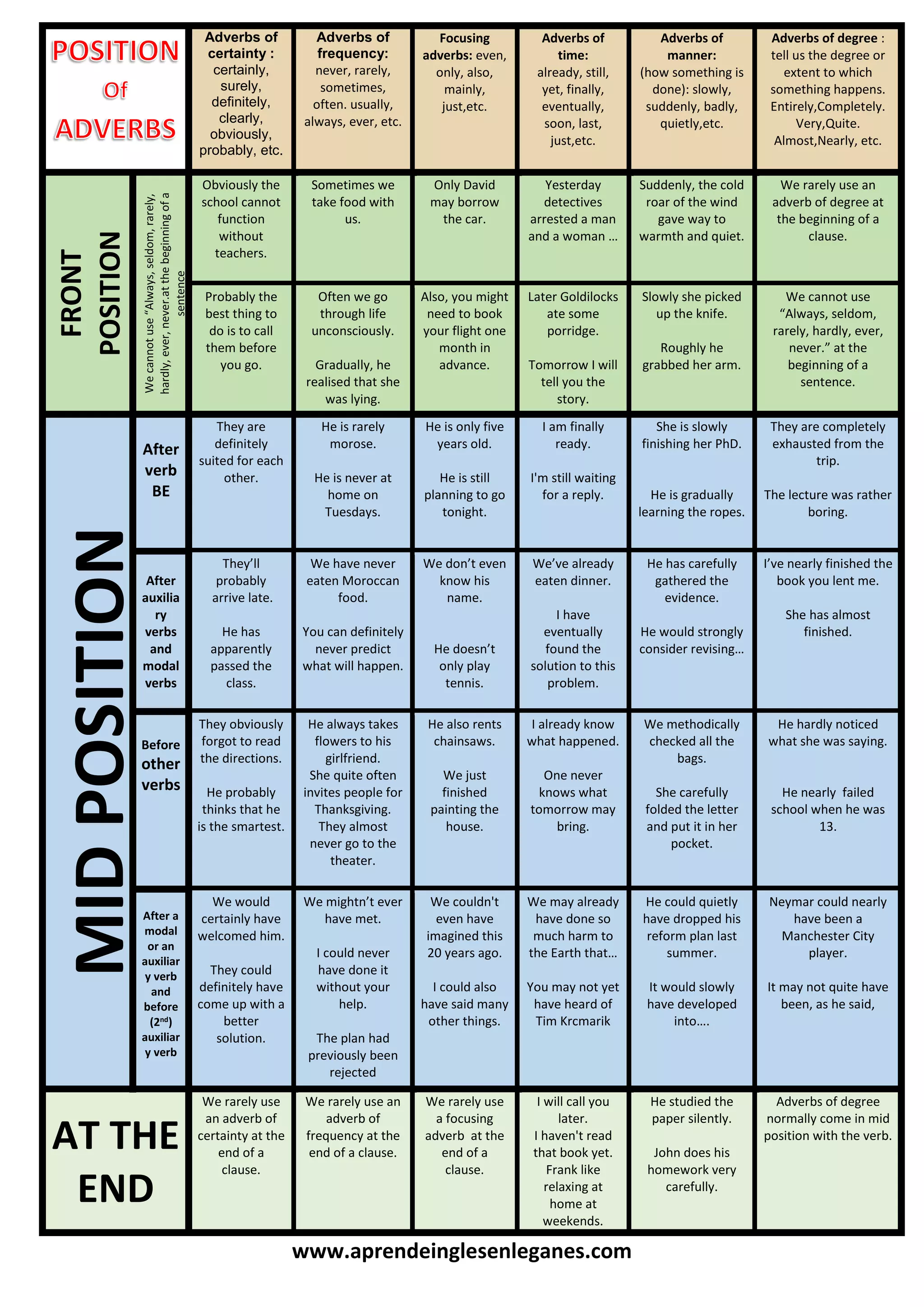
Adverbs of
certainty :
certainly,
surely,
definitely,
clearly,
obviously,
probably, etc.
Adverbs of
frequency:
never, rarely,
sometimes,
often. usually,
always, ever, etc.
Focusing
adverbs: even,
only, also,
mainly,
just,etc.
Adverbs of
time:
already, still,
yet, finally,
eventually,
soon, last,
just,etc.
Adverbs of
manner:
(how something is
done): slowly,
suddenly, badly,
quietly,etc.
Adverbs of degree :
tell us the degree or
extent to which
something happens.
Entirely,Completely.
Very,Quite.
Almost,Nearly, etc.
FRONT
POSITION
Wecannotuse“Always,seldom,rarely,
hardly,ever,never.atthebeginningofa
sentence Obviously the
school cannot
function
without
teachers.
Sometimes we
take food with
us.
Only David
may borrow
the car.
Yesterday
detectives
arrested a man
and a woman …
Suddenly, the cold
roar of the wind
gave way to
warmth and quiet.
We rarely use an
adverb of degree at
the beginning of a
clause.
Probably the
best thing to
do is to call
them before
you go.
Often we go
through life
unconsciously.
Gradually, he
realised that she
was lying.
Also, you might
need to book
your flight one
month in
advance.
Later Goldilocks
ate some
porridge.
Tomorrow I will
tell you the
story.
Slowly she picked
up the knife.
Roughly he
grabbed her arm.
We cannot use
“Always, seldom,
rarely, hardly, ever,
never.” at the
beginning of a
sentence.
MIDPOSITION
After
verb
BE
They are
definitely
suited for each
other.
He is rarely
morose.
He is never at
home on
Tuesdays.
He is only five
years old.
He is still
planning to go
tonight.
I am finally
ready.
I'm still waiting
for a reply.
She is slowly
finishing her PhD.
He is gradually
learning the ropes.
They are completely
exhausted from the
trip.
The lecture was rather
boring.
After
auxilia
ry
verbs
and
modal
verbs
They’ll
probably
arrive late.
He has
apparently
passed the
class.
We have never
eaten Moroccan
food.
You can definitely
never predict
what will happen.
We don’t even
know his
name.
He doesn’t
only play
tennis.
We’ve already
eaten dinner.
I have
eventually
found the
solution to this
problem.
He has carefully
gathered the
evidence.
He would strongly
consider revising…
I’ve nearly finished the
book you lent me.
She has almost
finished.
Before
other
verbs
They obviously
forgot to read
the directions.
He probably
thinks that he
is the smartest.
He always takes
flowers to his
girlfriend.
She quite often
invites people for
Thanksgiving.
They almost
never go to the
theater.
He also rents
chainsaws.
We just
finished
painting the
house.
I already know
what happened.
One never
knows what
tomorrow may
bring.
We methodically
checked all the
bags.
She carefully
folded the letter
and put it in her
pocket.
He hardly noticed
what she was saying.
He nearly failed
school when he was
13.
After a
modal
or an
auxiliar
y verb
and
before
(2nd)
auxiliar
y verb
We would
certainly have
welcomed him.
They could
definitely have
come up with a
better
solution.
We mightn’t ever
have met.
I could never
have done it
without your
help.
The plan had
previously been
rejected
We couldn't
even have
imagined this
20 years ago.
I could also
have said many
other things.
We may already
have done so
much harm to
the Earth that…
You may not yet
have heard of
Tim Krcmarik
He could quietly
have dropped his
reform plan last
summer.
It would slowly
have developed
into….
Neymar could nearly
have been a
Manchester City
player.
It may not quite have
been, as he said,
AT THE
END
We rarely use
an adverb of
certainty at the
end of a
clause.
We rarely use an
adverb of
frequency at the
end of a clause.
We rarely use
a focusing
adverb at the
end of a
clause.
I will call you
later.
I haven't read
that book yet.
Frank like
relaxing at
home at
weekends.
He studied the
paper silently.
John does his
homework very
carefully.
Adverbs of degree
normally come in mid
position with the verb.
www.aprendeinglesenleganes.com

Position of adverbs (table)

  • 1.
    Adverbs of certainty : certainly, surely, definitely, clearly, obviously, probably,etc. Adverbs of frequency: never, rarely, sometimes, often. usually, always, ever, etc. Focusing adverbs: even, only, also, mainly, just,etc. Adverbs of time: already, still, yet, finally, eventually, soon, last, just,etc. Adverbs of manner: (how something is done): slowly, suddenly, badly, quietly,etc. Adverbs of degree : tell us the degree or extent to which something happens. Entirely,Completely. Very,Quite. Almost,Nearly, etc. FRONT POSITION Wecannotuse“Always,seldom,rarely, hardly,ever,never.atthebeginningofa sentence Obviously the school cannot function without teachers. Sometimes we take food with us. Only David may borrow the car. Yesterday detectives arrested a man and a woman … Suddenly, the cold roar of the wind gave way to warmth and quiet. We rarely use an adverb of degree at the beginning of a clause. Probably the best thing to do is to call them before you go. Often we go through life unconsciously. Gradually, he realised that she was lying. Also, you might need to book your flight one month in advance. Later Goldilocks ate some porridge. Tomorrow I will tell you the story. Slowly she picked up the knife. Roughly he grabbed her arm. We cannot use “Always, seldom, rarely, hardly, ever, never.” at the beginning of a sentence. MIDPOSITION After verb BE They are definitely suited for each other. He is rarely morose. He is never at home on Tuesdays. He is only five years old. He is still planning to go tonight. I am finally ready. I'm still waiting for a reply. She is slowly finishing her PhD. He is gradually learning the ropes. They are completely exhausted from the trip. The lecture was rather boring. After auxilia ry verbs and modal verbs They’ll probably arrive late. He has apparently passed the class. We have never eaten Moroccan food. You can definitely never predict what will happen. We don’t even know his name. He doesn’t only play tennis. We’ve already eaten dinner. I have eventually found the solution to this problem. He has carefully gathered the evidence. He would strongly consider revising… I’ve nearly finished the book you lent me. She has almost finished. Before other verbs They obviously forgot to read the directions. He probably thinks that he is the smartest. He always takes flowers to his girlfriend. She quite often invites people for Thanksgiving. They almost never go to the theater. He also rents chainsaws. We just finished painting the house. I already know what happened. One never knows what tomorrow may bring. We methodically checked all the bags. She carefully folded the letter and put it in her pocket. He hardly noticed what she was saying. He nearly failed school when he was 13. After a modal or an auxiliar y verb and before (2nd) auxiliar y verb We would certainly have welcomed him. They could definitely have come up with a better solution. We mightn’t ever have met. I could never have done it without your help. The plan had previously been rejected We couldn't even have imagined this 20 years ago. I could also have said many other things. We may already have done so much harm to the Earth that… You may not yet have heard of Tim Krcmarik He could quietly have dropped his reform plan last summer. It would slowly have developed into…. Neymar could nearly have been a Manchester City player. It may not quite have been, as he said, AT THE END We rarely use an adverb of certainty at the end of a clause. We rarely use an adverb of frequency at the end of a clause. We rarely use a focusing adverb at the end of a clause. I will call you later. I haven't read that book yet. Frank like relaxing at home at weekends. He studied the paper silently. John does his homework very carefully. Adverbs of degree normally come in mid position with the verb. www.aprendeinglesenleganes.com