1
Close Looking Analysis: Visual ArtArtist’s Self-Portrait
AnalysisPoint Value: 80 pts possible
· 80 pts for submitting analysis of the short story to
BSP:Assignments by 11:59pm at the end of Module 3—Part 5*
*The analysis assignment will be run through TurnItIn to look
for plagiarism, so be sure to leave yourself enough time to
review your paper’s “Originality Report” and make any
necessary changes before the due-date.
Don’t forget that Tutoring services are available to you.
If you have any difficulty submitting the assignment on
Brightspace, consult the Brightspace (BSP) Help Desk
The struggle is inner: Chicano, indio, American Indian, mojado,
mexicano, immigrant Latino, Anglo in power, working class
Anglo, Black, Asian—our psyches resemble the bordertowns
and are populated by the same people. The struggle has always
been inner, and is played out in the outer terrains. Awareness
of our situation must come before inner changes, which in turn
come before changes in society. Nothing happens in the “real”
world unless it first happens in the images in our heads.
Gloria Anzaldúa, Borderlands/La Frontera: The New Mestiza
(1987)
Introduction
In this part of Module 5, we have been exploring how visual
artists and architects interact with borders in their work.
Borders inherently establish defined points of view as well as
remind us of the limitations and possibilities for transgressing
those borders or living in the “borderlands” (Anzaldúa).
Consider the images you viewed of the art, architecture, and
design found at the physical borders between nations around the
world. Could you imagine standing at these different
borderlines or in the border spaces? Which borders can you step
over? Where can you sit with someone on the other side? Where
can you see across? Which ones are completely opaque? Which
borders feel unsafe? They feel so different! How are they
designed to feel or operate this way?
Then, consider artists and architects who explore borders as
themes or principles in their work or who feel themselves to be
operating in a border space? (see Marlin-Bennett, Maya Lin)
Did any of the artists in our tours of Chicago’s public art use
their work to highlight or bump up against the borders of a wall,
a neighborhood, a community, the city?
Finally, we turn our attention to self, self-perception, and self-
representation. How would you create a portrait of yourself?
(Give it a try right now!) How do you express your internal
spirit externally? In which ways do you intentionally “present”
to the world and in which ways does the world layer an image
on to you? When does creating your own image or own story act
as resistance to a “single story” misperception? How can a self-
portrait be powerful? Consider the story behind Artemisia
Gentileschi’s Self-Portrait as the Allegory of Painting (see
Mary Gerrard) and how she used dominant iconography of the
time to render a feminist portrait. Almost every other artist you
can think of or know personally (maybe including yourself) has
created a self-portrait of some kind of another. (See the list of
275 of them below!)
This project asks you to select the self-portrait of one artist and
explore the “windows and doors” of their image through a close
analysis of the piece. How is the internal made external in their
self-image?Step 1: Select an Artist and their Self-Portrait
Spend time reviewing several of the artists on the list below;
identify those that you have read or learned about, those you
have always wanted to explore, and those who are completely
new to you. Browse around online to get more acquainted with
some of the names that pique your interest (you can start by
googling the artist name and “self-portrait”). Decide on an artist
whose work you would like to explore during this project.
Select ONE of their self-portraits (an image in which the artist
represents themselves – in painting, sculpture, or any other
medium). This self-portrait will be the object of your close
analysis for this paper.Artist OptionsThese artists are arranged
chronologically by date of birth. This is just a small sampling of
artists (if they are not on this list, it does not mean they are less
important than those here). This list only includes artists who
have created at least one self-portrait (an image in which the
artist represents themselves).
Hum 201 WW
[Semester]
[Instructor]
[Email]
1
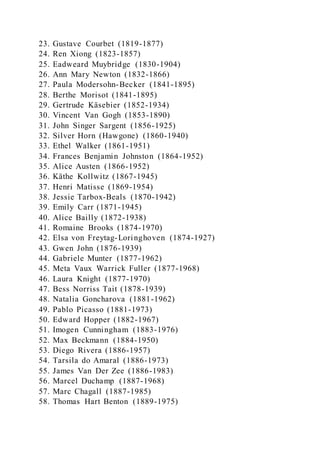
1. Leonardo da Vinci (1452-1519)
2. Albrecht Dürer (1471-1528)
3. Parmigianino (1503-1540)
4. Sofonisba Anguissola (1532-1625)
5. Lavinia Fontana (1552-1614)
6. Artemisia Gentileschi (1593-1653)
7. Diego Velázquez (1599-1660)
8. Rembrandt Van Rijn (1606-1669)
9. Juan de Pareja (1606-1670)
10. Judith Leyster (1609-1660)
11. Rosalba Carriera (1673-1757)
12. Jean Baptiste Simeon Chardin (1699-1779)
13. Joshua Reynolds (1723-1792)
14. Thomas Gainsborough (1727-1788)
15. John Singleton Copley (1738-1815)
16. Angelica Kauffman (1741-1807)
17. Henry Fuseli (1741-1825)
18. Francisco Goya (1746-1828)
19. Adélaide Labille-Guiard (1749-1803)
20. Elisabeth Vigee-Lebrun (1755-1842)
21. George Catlin (1796-1872)
22. Zacharie Vincent (1815-1886)
23. Gustave Courbet (1819-1877)
24. Ren Xiong (1823-1857)
25. Eadweard Muybridge (1830-1904)
26. Ann Mary Newton (1832-1866)
27. Paula Modersohn-Becker (1841-1895)
28. Berthe Morisot (1841-1895)
29. Gertrude Käsebier (1852-1934)
30. Vincent Van Gogh (1853-1890)
31. John Singer Sargent (1856-1925)
32. Silver Horn (Hawgone) (1860-1940)
33. Ethel Walker (1861-1951)
34. Frances Benjamin Johnston (1864-1952)
35. Alice Austen (1866-1952)
36. Käthe Kollwitz (1867-1945)
37. Henri Matisse (1869-1954)
38. Jessie Tarbox-Beals (1870-1942)
39. Emily Carr (1871-1945)
40. Alice Bailly (1872-1938)
41. Romaine Brooks (1874-1970)
42. Elsa von Freytag-Loringhoven (1874-1927)
43. Gwen John (1876-1939)
44. Gabriele Munter (1877-1962)
45. Meta Vaux Warrick Fuller (1877-1968)
46. Laura Knight (1877-1970)
47. Bess Norriss Tait (1878-1939)
48. Natalia Goncharova (1881-1962)
49. Pablo Picasso (1881-1973)
50. Edward Hopper (1882-1967)
51. Imogen Cunningham (1883-1976)
52. Max Beckmann (1884-1950)
53. Diego Rivera (1886-1957)
54. Tarsila do Amaral (1886-1973)
55. James Van Der Zee (1886-1983)
56. Marcel Duchamp (1887-1968)
57. Marc Chagall (1887-1985)
58. Thomas Hart Benton (1889-1975)
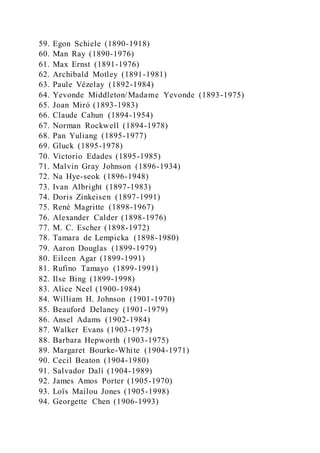
59. Egon Schiele (1890-1918)
60. Man Ray (1890-1976)
61. Max Ernst (1891-1976)
62. Archibald Motley (1891-1981)
63. Paule Vézelay (1892-1984)
64. Yevonde Middleton/Madame Yevonde (1893-1975)
65. Joan Miró (1893-1983)
66. Claude Cahun (1894-1954)
67. Norman Rockwell (1894-1978)
68. Pan Yuliang (1895-1977)
69. Gluck (1895-1978)
70. Victorio Edades (1895-1985)
71. Malvin Gray Johnson (1896-1934)
72. Na Hye-seok (1896-1948)
73. Ivan Albright (1897-1983)
74. Doris Zinkeisen (1897-1991)
75. René Magritte (1898-1967)
76. Alexander Calder (1898-1976)
77. M. C. Escher (1898-1972)
78. Tamara de Lempicka (1898-1980)
79. Aaron Douglas (1899-1979)
80. Eileen Agar (1899-1991)
81. Rufino Tamayo (1899-1991)
82. Ilse Bing (1899-1998)
83. Alice Neel (1900-1984)
84. William H. Johnson (1901-1970)
85. Beauford Delaney (1901-1979)
86. Ansel Adams (1902-1984)
87. Walker Evans (1903-1975)
88. Barbara Hepworth (1903-1975)
89. Margaret Bourke-White (1904-1971)
90. Cecil Beaton (1904-1980)
91. Salvador Dalí (1904-1989)
92. James Amos Porter (1905-1970)
93. Loïs Mailou Jones (1905-1998)
94. Georgette Chen (1906-1993)
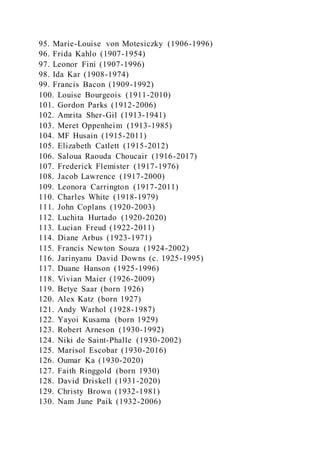
95. Marie-Louise von Motesiczky (1906-1996)
96. Frida Kahlo (1907-1954)
97. Leonor Fini (1907-1996)
98. Ida Kar (1908-1974)
99. Francis Bacon (1909-1992)
100. Louise Bourgeois (1911-2010)
101. Gordon Parks (1912-2006)
102. Amrita Sher-Gil (1913-1941)
103. Meret Oppenheim (1913-1985)
104. MF Husain (1915-2011)
105. Elizabeth Catlett (1915-2012)
106. Saloua Raouda Choucair (1916-2017)
107. Frederick Flemister (1917-1976)
108. Jacob Lawrence (1917-2000)
109. Leonora Carrington (1917-2011)
110. Charles White (1918-1979)
111. John Coplans (1920-2003)
112. Luchita Hurtado (1920-2020)
113. Lucian Freud (1922-2011)
114. Diane Arbus (1923-1971)
115. Francis Newton Souza (1924-2002)
116. Jarinyanu David Downs (c. 1925-1995)
117. Duane Hanson (1925-1996)
118. Vivian Maier (1926-2009)
119. Betye Saar (born 1926)
120. Alex Katz (born 1927)
121. Andy Warhol (1928-1987)
122. Yayoi Kusama (born 1929)
123. Robert Arneson (1930-1992)
124. Niki de Saint-Phalle (1930-2002)
125. Marisol Escobar (1930-2016)
126. Oumar Ka (1930-2020)
127. Faith Ringgold (born 1930)
128. David Driskell (1931-2020)
129. Christy Brown (1932-1981)
130. Nam June Paik (1932-2006)
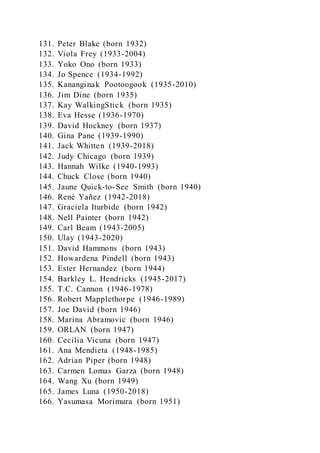
131. Peter Blake (born 1932)
132. Viola Frey (1933-2004)
133. Yoko Ono (born 1933)
134. Jo Spence (1934-1992)
135. Kananginak Pootoogook (1935-2010)
136. Jim Dine (born 1935)
137. Kay WalkingStick (born 1935)
138. Eva Hesse (1936-1970)
139. David Hockney (born 1937)
140. Gina Pane (1939-1990)
141. Jack Whitten (1939-2018)
142. Judy Chicago (born 1939)
143. Hannah Wilke (1940-1993)
144. Chuck Close (born 1940)
145. Jaune Quick-to-See Smith (born 1940)
146. René Yañez (1942-2018)
147. Graciela Iturbide (born 1942)
148. Nell Painter (born 1942)
149. Carl Beam (1943-2005)
150. Ulay (1943-2020)
151. David Hammons (born 1943)
152. Howardena Pindell (born 1943)
153. Ester Hernandez (born 1944)
154. Barkley L. Hendricks (1945-2017)
155. T.C. Cannon (1946-1978)
156. Robert Mapplethorpe (1946-1989)
157. Joe David (born 1946)
158. Marina Abramovic (born 1946)
159. ORLAN (born 1947)
160. Cecilia Vicuna (born 1947)
161. Ana Mendieta (1948-1985)
162. Adrian Piper (born 1948)
163. Carmen Lomas Garza (born 1948)
164. Wang Xu (born 1949)
165. James Luna (1950-2018)
166. Yasumasa Morimura (born 1951)
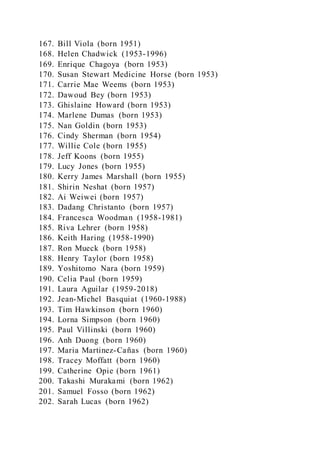
167. Bill Viola (born 1951)
168. Helen Chadwick (1953-1996)
169. Enrique Chagoya (born 1953)
170. Susan Stewart Medicine Horse (born 1953)
171. Carrie Mae Weems (born 1953)
172. Dawoud Bey (born 1953)
173. Ghislaine Howard (born 1953)
174. Marlene Dumas (born 1953)
175. Nan Goldin (born 1953)
176. Cindy Sherman (born 1954)
177. Willie Cole (born 1955)
178. Jeff Koons (born 1955)
179. Lucy Jones (born 1955)
180. Kerry James Marshall (born 1955)
181. Shirin Neshat (born 1957)
182. Ai Weiwei (born 1957)
183. Dadang Christanto (born 1957)
184. Francesca Woodman (1958-1981)
185. Riva Lehrer (born 1958)
186. Keith Haring (1958-1990)
187. Ron Mueck (born 1958)
188. Henry Taylor (born 1958)
189. Yoshitomo Nara (born 1959)
190. Celia Paul (born 1959)
191. Laura Aguilar (1959-2018)
192. Jean-Michel Basquiat (1960-1988)
193. Tim Hawkinson (born 1960)
194. Lorna Simpson (born 1960)
195. Paul Villinski (born 1960)
196. Anh Duong (born 1960)
197. Maria Martinez-Cañas (born 1960)
198. Tracey Moffatt (born 1960)
199. Catherine Opie (born 1961)
200. Takashi Murakami (born 1962)
201. Samuel Fosso (born 1962)
202. Sarah Lucas (born 1962)
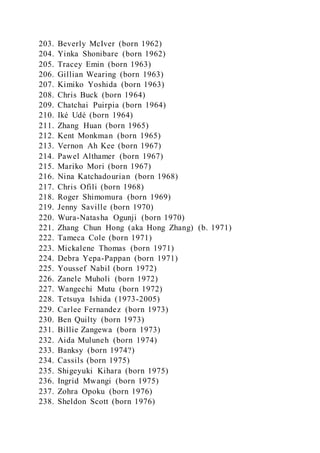
203. Beverly McIver (born 1962)
204. Yinka Shonibare (born 1962)
205. Tracey Emin (born 1963)
206. Gillian Wearing (born 1963)
207. Kimiko Yoshida (born 1963)
208. Chris Buck (born 1964)
209. Chatchai Puirpia (born 1964)
210. Iké Udé (born 1964)
211. Zhang Huan (born 1965)
212. Kent Monkman (born 1965)
213. Vernon Ah Kee (born 1967)
214. Pawel Althamer (born 1967)
215. Mariko Mori (born 1967)
216. Nina Katchadourian (born 1968)
217. Chris Ofili (born 1968)
218. Roger Shimomura (born 1969)
219. Jenny Saville (born 1970)
220. Wura-Natasha Ogunji (born 1970)
221. Zhang Chun Hong (aka Hong Zhang) (b. 1971)
222. Tameca Cole (born 1971)
223. Mickalene Thomas (born 1971)
224. Debra Yepa-Pappan (born 1971)
225. Youssef Nabil (born 1972)
226. Zanele Muholi (born 1972)
227. Wangechi Mutu (born 1972)
228. Tetsuya Ishida (1973-2005)
229. Carlee Fernandez (born 1973)
230. Ben Quilty (born 1973)
231. Billie Zangewa (born 1973)
232. Aida Muluneh (born 1974)
233. Banksy (born 1974?)
234. Cassils (born 1975)
235. Shigeyuki Kihara (born 1975)
236. Ingrid Mwangi (born 1975)
237. Zohra Opoku (born 1976)
238. Sheldon Scott (born 1976)
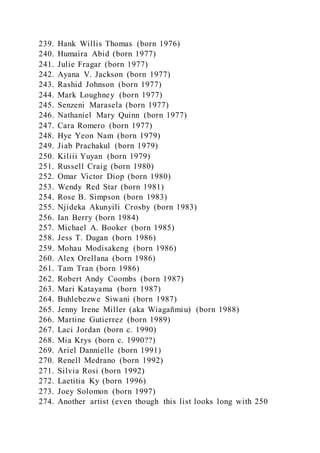
239. Hank Willis Thomas (born 1976)
240. Humaira Abid (born 1977)
241. Julie Fragar (born 1977)
242. Ayana V. Jackson (born 1977)
243. Rashid Johnson (born 1977)
244. Mark Loughney (born 1977)
245. Senzeni Marasela (born 1977)
246. Nathaniel Mary Quinn (born 1977)
247. Cara Romero (born 1977)
248. Hye Yeon Nam (born 1979)
249. Jiab Prachakul (born 1979)
250. Kiliii Yuyan (born 1979)
251. Russell Craig (born 1980)
252. Omar Victor Diop (born 1980)
253. Wendy Red Star (born 1981)
254. Rose B. Simpson (born 1983)
255. Njideka Akunyili Crosby (born 1983)
256. Ian Berry (born 1984)
257. Michael A. Booker (born 1985)
258. Jess T. Dugan (born 1986)
259. Mohau Modisakeng (born 1986)
260. Alex Orellana (born 1986)
261. Tam Tran (born 1986)
262. Robert Andy Coombs (born 1987)
263. Mari Katayama (born 1987)
264. Buhlebezwe Siwani (born 1987)
265. Jenny Irene Miller (aka Wiagañmiu) (born 1988)
266. Martine Gutierrez (born 1989)
267. Laci Jordan (born c. 1990)
268. Mia Krys (born c. 1990??)
269. Ariel Dannielle (born 1991)
270. Renell Medrano (born 1992)
271. Silvia Rosi (born 1992)
272. Laetitia Ky (born 1996)
273. Joey Solomon (born 1997)
274. Another artist (even though this list looks long with 250
artists, it’s still only scratching the surface. If you have another
artist’s work in mind, get it approved by the instructor first. It
must be a self-portrait by the artist for this assignment)
275. Yourself (If you want to analyze a self-portrait of yourself,
email the instructor to get approvalStep 2: Complete the Written
Analysis
A. Once you select an artist, identify the particular self-portrait
by them that you will analyze, and do some research to prepare
for the analysis.
Some of the artists have only created a single self-portrait;
others have created multiple self-portraits. Depending on the
artist you choose, you might need to select which one of their
self-portraits you want to research and closely analyze in your
paper, answering the five questions listed below.
If you are having trouble identifying which of your artist’s
artworks qualify as self-portraits, please email the instructor
asap for assistance. I will be happy to help.
B. Prepare your analysis to plan your paper.
You can do research into the artist and the specific self-portrait
by them that you have selected:
· Consult this HWC Library Guide on doing artist research:
· Utilize this HWC Library Guide on doing visual art analysis:
· Other reputable sources includeartsy, hyperallergic, artnet
news, museum websites, university websites, scholarly journals
like those you can access through the HWC library, or the
artist’s personal website [for contemporary artists showcasing
their own work]
· Do not rely on Pinterest or Wikipedia or other non-reputable
sources.
· Review the “Resources for Close Looking Analysis,” which
are posted in the Module 3 Part 5 tab, to familiarize your self
with some terms and techniques that will be useful for you to
incorporate into your analysis.
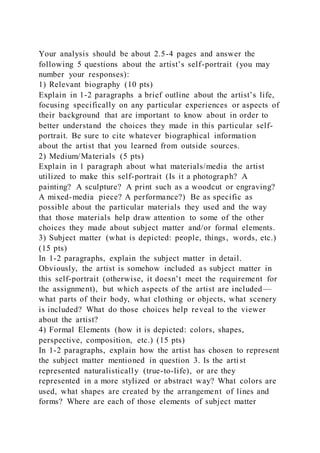
Your analysis should be about 2.5-4 pages and answer the
following 5 questions about the artist’s self-portrait (you may
number your responses):
1) Relevant biography (10 pts)
Explain in 1-2 paragraphs a brief outline about the artist’s life,
focusing specifically on any particular experiences or aspects of
their background that are important to know about in order to
better understand the choices they made in this particular self-
portrait. Be sure to cite whatever biographical information
about the artist that you learned from outside sources.
2) Medium/Materials (5 pts)
Explain in 1 paragraph about what materials/media the artist
utilized to make this self-portrait (Is it a photograph? A
painting? A sculpture? A print such as a woodcut or engraving?
A mixed-media piece? A performance?) Be as specific as
possible about the particular materials they used and the way
that those materials help draw attention to some of the other
choices they made about subject matter and/or formal elements.
3) Subject matter (what is depicted: people, things, words, etc.)
(15 pts)
In 1-2 paragraphs, explain the subject matter in detail.
Obviously, the artist is somehow included as subject matter in
this self-portrait (otherwise, it doesn’t meet the requirement for
the assignment), but which aspects of the artist are included—
what parts of their body, what clothing or objects, what scenery
is included? What do those choices help reveal to the viewer
about the artist?
4) Formal Elements (how it is depicted: colors, shapes,
perspective, composition, etc.) (15 pts)
In 1-2 paragraphs, explain how the artist has chosen to represent
the subject matter mentioned in question 3. Is the artist
represented naturalistically (true-to-life), or are they
represented in a more stylized or abstract way? What colors are
used, what shapes are created by the arrangement of lines and
forms? Where are each of those elements of subject matter
positioned in the composition? Where is the viewer positioned
relative to the subject matter? What do those choices help
reveal to the viewer about the artist?
5) Meaning/Message/Mood (15 pts)
In 2 paragraphs, explain which aspects of the self-portrait help
elicit* an emotional and/or intellectual response from the
viewer. Be sure to explain how and why those aspects work to
convey a message. How do the image’s formal elements and
subject matter work together or work in opposition to convey
the message? In other words, think of this fifth question as a
way to tie together observations from questions 1-4:
Historical and Cultural Context (values and events prevalent
during the artist’s life)
Subject Matter (what is depicted: people, things, words, etc.)
+ Formal Elements (how it is depicted: colors, shapes,
perspective, composition, etc.)Message/Meaning/Mood of the
Artwork (your interpretation based on analysis of the subject
matter and formal elements and connections to the context in
which it was made)
In your paper, explain the aspects of the artist’s identity that
they chose to highlight through their self-portrait (Their
professional identity; one or more aspect of their physical
appearance; one or more aspect of their gender, ethnic, or
religious identity; some aspect of their emotional or
psychological state; or a combination of these things) and how
their artwork fits into and/or stands out from its historical
context.6) Include a Works Cited section, plus the artwork and
caption; and organize your writing into clearly-constructed
sentences and paragraphs (20 pts) III. Other Writing Tips
Your paper should be written in the first person [using “I see”
or “it makes me think”] or in third person [using “one sees” or
“it makes the viewer think”] but avoid using second person [do
not use phrases like “you wonder” or “it makes you think”].
Use the included rubric (see pages 8-10) as a checklist to ensure
you have provided the reader with everything required.
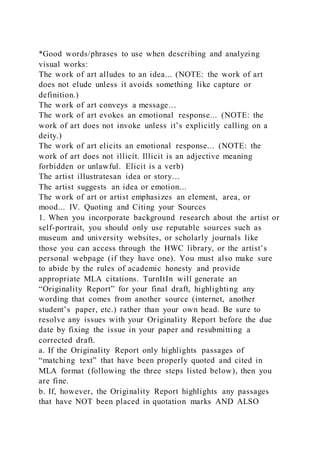
*Good words/phrases to use when describing and analyzing
visual works:
The work of art alludes to an idea... (NOTE: the work of art
does not elude unless it avoids something like capture or
definition.)
The work of art conveys a message…
The work of art evokes an emotional response... (NOTE: the
work of art does not invoke unless it’s explicitly calling on a
deity.)
The work of art elicits an emotional response... (NOTE: the
work of art does not illicit. Illicit is an adjective meaning
forbidden or unlawful. Elicit is a verb)
The artist illustratesan idea or story…
The artist suggests an idea or emotion...
The work of art or artist emphasizes an element, area, or
mood... IV. Quoting and Citing your Sources
1. When you incorporate background research about the artist or
self-portrait, you should only use reputable sources such as
museum and university websites, or scholarly journals like
those you can access through the HWC library, or the artist’s
personal webpage (if they have one). You must also make sure
to abide by the rules of academic honesty and provide
appropriate MLA citations. TurnItIn will generate an
“Originality Report” for your final draft, highlighting any
wording that comes from another source (internet, another
student’s paper, etc.) rather than your own head. Be sure to
resolve any issues with your Originality Report before the due
date by fixing the issue in your paper and resubmitting a
corrected draft.
a. If the Originality Report only highlights passages of
“matching text” that have been properly quoted and cited in
MLA format (following the three steps listed below), then you
are fine.
b. If, however, the Originality Report highlights any passages
that have NOT been placed in quotation marks AND ALSO
provided with an in-text citation and Works Cited page citation
in MLA format, then you must fix these issues and resubmit a
new draft by the due date.Three steps to properly quote and cite
your sourcesStep 1: Put all borrowed wording in quotation
marks, using proper MLA style
Formatting quotations in MLA style (Note that there are
different formatting guidelines for quoting lines of poetry and
for quoting lines of prose. Also, the length of the quotation
affects the formatting that you should follow).Step 2: Construct
in-text parenthetical citations for all borrowed ideas (whether
you’ve kept and quoted the original wording, or whether you’ve
summarized or paraphrased it in your own words), using proper
MLA style
· MLA In-text citations (basic book)
· MLA In-text citations (electronic sources)
· MLA In-text citations (artwork, movie, etc.)
Step 3: Construct a Works Cited page, using proper MLA style
MLA Works Cited page.
Close Looking Analysis: Visual ArtArtist’s Self-Portrait Rubric
(80 pts)—due on BSP:Assignments
Criterion
Exceeds Outcome
Pts
Meets Outcome
Pts
Emerging Skills
Pts
Does Not Meet Outcome
Pts
Thoroughness
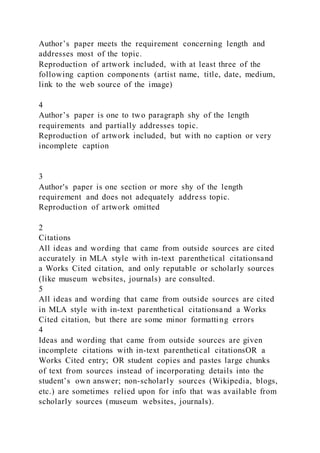
Author’s paper meets the requirements concerning length and
fully addresses topic.
Reproduction of artwork included, with complete caption (artist
name, title, date, medium, link to the web source of the image)
5
Author’s paper meets the requirement concerning length and
addresses most of the topic.
Reproduction of artwork included, with at least three of the
following caption components (artist name, title, date, medium,
link to the web source of the image)
4
Author’s paper is one to two paragraph shy of the length
requirements and partially addresses topic.
Reproduction of artwork included, but with no caption or very
incomplete caption
3
Author's paper is one section or more shy of the length
requirement and does not adequately address topic.
Reproduction of artwork omitted
2
Citations
All ideas and wording that came from outside sources are cited
accurately in MLA style with in-text parenthetical citationsand
a Works Cited citation, and only reputable or scholarly sources
(like museum websites, journals) are consulted.
5
All ideas and wording that came from outside sources are cited
in MLA style with in-text parenthetical citationsand a Works
Cited citation, but there are some minor formatting errors
4
Ideas and wording that came from outside sources are given
incomplete citations with in-text parenthetical citationsOR a
Works Cited entry; OR student copies and pastes large chunks
of text from sources instead of incorporating details into the
student’s own answer; non-scholarly sources (Wikipedia, blogs,
etc.) are sometimes relied upon for info that was available from
scholarly sources (museum websites, journals).
3
No quotations from outside sources were consulted, but
assumptions were made that should have been investigated and
cited; OR non-reputable sources (Wikipedia, blogs, etc.) are
exclusively relied upon for info that was available from
scholarly sources (like museum websites, journals).
2
Clarity/
Presentation[footnoteRef:1] [1: Consult the Purdue OWL
website for information about the writing process, academic
writing, grammar, punctuation, and mechanics.]
Exceptionally clear, mechanically sound presentation that
suffers only from rare, minor errors in sentence structure,
grammar, or punctuation. Terminology and names are used
accurately.
10
Generally clear, mechanically sound presentation that suffers
from only occasional, not persistent, grammatical errors or from
a repeated error that would not be caught by spell-check. There
is no more than one minor inaccuracy regarding terminology or
names.
9
Frequently unclear or mechanically unsound presentation that
suffers from one persistent grammatical error or a few
occasional grammatical errors. OR Misuses terminology or
names numerous times.
7
Extremely unclear or mechanically unsound presentation
demonstrating a lack of quality that does not meet expectations
for a college-level paper (i.e. 10+ fixable errors). Has not been
spell-checked. OR Frequently misuses terminology or names.
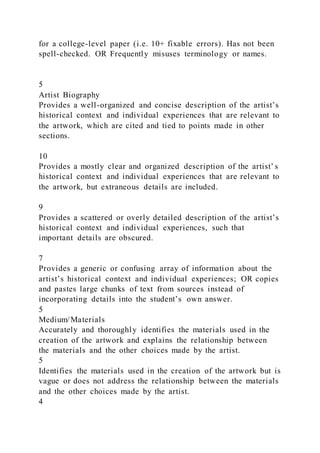
5
Artist Biography
Provides a well-organized and concise description of the artist’s
historical context and individual experiences that are relevant to
the artwork, which are cited and tied to points made in other
sections.
10
Provides a mostly clear and organized description of the artist’ s
historical context and individual experiences that are relevant to
the artwork, but extraneous details are included.
9
Provides a scattered or overly detailed description of the artist’s
historical context and individual experiences, such that
important details are obscured.
7
Provides a generic or confusing array of information about the
artist’s historical context and individual experiences; OR copies
and pastes large chunks of text from sources instead of
incorporating details into the student’s own answer.
5
Medium/Materials
Accurately and thoroughly identifies the materials used in the
creation of the artwork and explains the relationship between
the materials and the other choices made by the artist.
5
Identifies the materials used in the creation of the artwork but is
vague or does not address the relationship between the materials
and the other choices made by the artist.
4
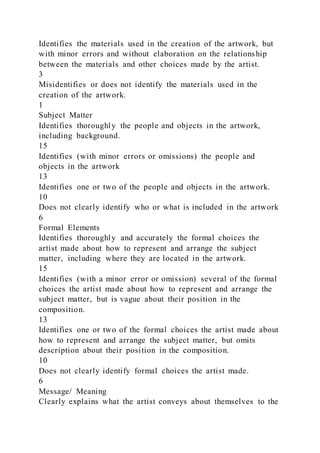
Identifies the materials used in the creation of the artwork, but
with minor errors and without elaboration on the relationship
between the materials and other choices made by the artist.
3
Misidentifies or does not identify the materials used in the
creation of the artwork.
1
Subject Matter
Identifies thoroughly the people and objects in the artwork,
including background.
15
Identifies (with minor errors or omissions) the people and
objects in the artwork
13
Identifies one or two of the people and objects in the artwork.
10
Does not clearly identify who or what is included in the artwork
6
Formal Elements
Identifies thoroughly and accurately the formal choices the
artist made about how to represent and arrange the subject
matter, including where they are located in the artwork.
15
Identifies (with a minor error or omission) several of the formal
choices the artist made about how to represent and arrange the
subject matter, but is vague about their position in the
composition.
13
Identifies one or two of the formal choices the artist made about
how to represent and arrange the subject matter, but omits
description about their position in the composition.
10
Does not clearly identify formal choices the artist made.
6
Message/ Meaning
Clearly explains what the artist conveys about themselves to the
viewer, and all aspects of that interpretation are thoroughly
supported by analysis of formal elements, subject matter, and
biography or historical context.
15
Explains several aspects of what the artist conveys about
themselves to the viewer, and most aspects of that interpretation
are supported by evidence from the subject matter, formal
elements, and biography or historical context.
13
Explains some of what the artist conveys about themselves to
the viewer, and some aspects of that interpretation are
supported by evidence from the subject matter, formal elements,
and biography or historical context.
10
Explains little about what the artist conveys about themselves;
or the interpretation is made without clear evidence from
subject matter, formal elements, and biography or historical
context.
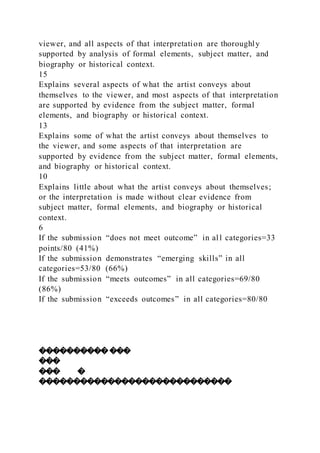
6
If the submission “does not meet outcome” in all categories=33
points/80 (41%)
If the submission demonstrates “emerging skills” in all
categories=53/80 (66%)
If the submission “meets outcomes” in all categories=69/80
(86%)
If the submission “exceeds outcomes” in all categories=80/80
�������������
���
��� �
����������������������������
��� ��������
��
�������������
!"�# $#%�&'()* +�,�- ����
�.�/012345�67893:306;<=>[email protected]>=C�<D�=E=F
G�H>DD>CC>>�G>B�F�AIJ>�KE=D�BI�BA>�@=IEDL
�GFCB�M>>N�K>OFEC>�BA>�AIJ>IMD>=�AFLDPB�Q
F<L�F�RST�U>>VW>D>�X=FD<ON�IU�YK<ID�XIEDB
Z�FDL�A<C�UFJ<GZ�GICB�FGG�IU�BA><=�QICC>CC
<IDC�<D�BA>�[>QBV�]�?=>̂�[email protected]�M<BA�
BA=>>�[email protected]�FDL�F�OFBV�_HA>Z�OIEGL�
AF̀>�K>>D�CF̀ >L�<U�BA>Z�AFL�QEB�MFB>=�ID�<B
̂
�KEB�BA>Z�L<LDPB�LI�<B
̂ _�X=FD<ON�BIGL�a[bcXP
C�d><BA�YGK>=JFDDVHA>�?=>�CBF=B>L�MA>D�BA
>�X=FD<ONCP�@=FDLCID�MFC�KE=D<[email protected]
�B=FCA�D>F=�BA>�UFJ<GZ�AIJ>V�eC�<B�@=>M�IE
B�IU�OIDB=IĜ�BA>�X=FD<ONC�OFGG>L�]ff̂�KEBBA
>�?=>�L>QF=BJ>DB�U=IJ�BA>�D>F=KZ�O<BZ�IU�[IE
BA�;EGBID�MIEGL�DIB�=>CQIDLV_g>�MFCDPB�ID�
BA><=�G<CB
̂ _�A>�CF<L�BA>�IQ>=FBI=C�BIGL�A<JV
X=FD<ON
̂ �MAI�G<̀>C�IEBC<L>�BA>�O<BZ�G<J<BĈ�F
LJ<BC�A>�[email protected]_�BI�QFZ�BA>�FDDEFG�R
ST�U>>V�HA>�OIEDBZ�LI>C�DIB�AF̀>�F�OIEDBZhM
<L>�?=>[email protected]<[email protected]>=̀<O>̂�KEB�[IE
BA�;EGBID�Ii>=C�?=>�OÌ>[email protected]>�BI�=E=FG
�=>C<L>DBC�UI=�F�U>>VX=FD<ON�CFZC�A>�BIGL�
BA>�IQ>=FBI=�A>�MIEGL�QFZ�MAFB>̀>=�<C�D>O>C
CF=Z�BI�AF̀ >�BA>�?=>�QEB�IEBVj<C�Ii>=�MFCDPB
�FOO>QB>L̂ �A>�CF<LVHA>�?=>�U>>�QIG<OZ�LFB>C
�KFON�k�I=�CI�Z>F=CV
lm�nopq�rm�sntopu�vwtxyz{|xts�}x|�{m~x���tr�����
�3�:�����������5���������
�������������
���
��� �
����������������������������
��� ��������
��
�������������
!"�# $#%�&'()* +�,�- ����
./012341�567589�035�:09:4;�56;�<:51�=:>:59�3?�@3A56
�BA=530C�:589�7�9;DE:<;�F;�3G;DH�I:56;D�56;1�7<<;
J5�:5�3D�56;1�43085C.�97:4�@3A56�BA=530�K713DL7
E:4�MD3<N;DHO6;�PD;�4;J7D5>;0589�4;<:9:30�53�=;5�
56;�63>;�2AD0�F79�.:0<D;4:2=1�:DD;9J309:2=;C.�97:4�
56;�JD;9:4;05�3?�70�7993<:75:30�D;JD;9;05:0QPD;PQ65;
D9HRSTUVVSWXSX
.YD3?;99:307=C�<7D;;D�PD;PQ65;D9�963A=40Z5�2;�?3D
<;4�53�<6;<N�7�=:95�2;?3D;�DA00:0Q�3A5�56;�433D
�53�9;;�F6:<6�63>;3F0;D9�67E;�J7:4�AJC.[7D3=4�@<6
7:52;DQ;DC�05;D075:307=�/993<:75:30�3?�B:D;�B:Q65;
D9�JD;9:4;05C�97:4�:0�7�9575;>;05H�.O6;1�Q;5�:0�56;
:D�5DA<N9�704�Q3H.B:D;PQ65;D9�4:4�;E;05A7==1�963
F�AJC�2A5�30=1�53�PQ65�56;�PD;�30�56;�0;:Q623D:
0Q�JD3J;D51C�F639;�3F0;D�674�J7:4�56;�?;;H.O6;1�JA
5�F75;D�3A5�30�56;�?;0<;�=:0;�3A5�6;D;H�O6;1�0;E;
D�97:4�0356:0Q�53�>;H�];E;D�7<N03F=;4Q;4H�O6;1�9
5334�3A5�6;D;�704�F75<6;4�:52AD0C.�MD70:<N�97:[e
mail protected]�BA=53089�>713D�97:4�5675�56;�PD;�4;J
7D5>;05�<7085�=;5�63>;3F0;D9�J71�56;�?;;�30�56;�9J
35C�2;<7A9;�56;�30=1�J;3J=;�F63�F3A=4�J71F3A=4�2;
�5639;�F639;�63>;9�7D;�30�PD;H
_̂ ̀a�bc_Td�TUcUW_efcgh�XS_ijh�_cUgWX�ijS�kUclXmi_l
f_W�̀UlfTS�Tl_hj�kfij�XSVUWhic_iUch�̀cUiShifWn�TUg
Wicoph�WSk�qUefXrst�cShicfTifUWhuvwv�xyvz{|}~�
��y�u
�������������
���
��� �
����������������������������
��� ��������
��
�������������
!"�# $#%�&'()* +�,�- ���
./012345�678�29�186�:2;21<�21�0�=/02:>/�81�729�?/8?
>/[email protected]�[email protected]�729�219A/013>�?8:[e
mail protected]�62::�7>:?�38;>/�98B>�8C�729�:89=�78B
>DEF19A/013>�29�<821<�=8�[email protected]�C8/�670=
�B81>@�F�70G�81�=7>�?8:[email protected]�:8849�:24>
D�HA=�:24>�>;>/@=721<�>:9>5�F�G2G1I=�70;>�>18A
<7DEJC=>/�=7>�K:0L>5�M8A=7�NA:=81�?8:23>�0//>9=>
G�81>�8C�./01234I9�98195�[email protected]�J::>1�./012
345�81�01�0<</0;0=>G�0990A:=�370/<>5�0338/G21<�=8
PQMRSOT5�01�UH.�9=0=281�21�Q0GA3075�[email prote
cted]:23>�=8:G�PQMR�=70=�=7>�@8A1<>/�./01234�0==
034>G�N2/>�.72>C�R0;2G�P2:G9�0=�=7>�W/>78A9>�K
>30A9>�7>�609�A?9>=�729�C0=7>/I9�78A9>�6090::86>
G�=8�KA/1DPQMRSOT�/>?8/=>G�=70=�P2:G9�609�=/>0
=>G�01G�/>:>09>GD XYZ[Z]̂_�X̀ Z]â
bc�debffgehi�jhdklmnno�pqrsh�kqol�tuom�vuoqw
mjj�odqdm�hjnujmx][�x�ŷ[[�X̀ x̀̂ �ẑ{]̂̂�|�}x[~̂_��[���̂�
�ZY�����Z]��[�a[̂�y]Z{]x�rmmjnusldx]̂[̀��]̂�}x�a[{
���Z�̀���a�ẑ�à��x]_��Z]��a_
̂ ̀��x�̂�X�â�_��[���̂��x]~̂ ̀[�a�à̂ _�������x��}̂�
x]_������[[�x���̂̂�
�������������
���
��� �
����������������������������
��� ��������
��
�������������
!"�# $#%�&'()* +�,�- $���
./0�1/.23450/15/678
97::5�;<6=/�2<53�9>57�?>5<@450/15/678ABCD�EFGB�H
IJBKL�MN�OIB�PFQRBDSIFTSIJNUV�WFQN�XNKJYJD
BL�ZV[�SFCI�]B
̂ FQLCV
�������������
���
��� �
����������������������������
��� ��������
��
�������������
!"�# $#%�&'()* +�,�- "���
./00�1232/�40560/71.40148/9 :8//056:;271.40148/9
:/0/26<1�96:/1271.40148/9 12301=/88>�8/1/38<;71.40148/9
[email protected]�@�CDBB�[email protected]�GDHADD�I
�[email protected]�MB�NOD�NPQ�RS�TPA�UBVWBD�[
email protected]@ADBFY�ZAD�[email protected][WBH�ZP]
F�NOWY�GDWF�̂@AL�TPA�_WLYD̀ a�bDFOPL�[email
protected]�ZBcDYFAd�[email protected]�NOP][email protect
ed]�Pf�[email protected][d�[email protected]]D�?cPBPXWY
F�[email protected]�Pf�jkEk�[email protected]�̂[email prote
cted]>3;44�1/38<;71.40148/[email protected]�NOD�eDYF�h]
l]Ad�̂APYYP[DA�EjmYk�NODYD�̂APYYP[DAY�iWVV�[
email protected]�gP]A�[email protected]
) �
�����
�
�������������
���
��� �
����������������������������
��� ��������
��
�������������
!"�# $#%�&'()* +�,�- #���
./012/3�456�78400159:704574;6<=>[email protected]=A?BCD
�EFGAH�IDJFH?KHL�IMK�EFGJHKN�OC>�PQ?MRS47T
124�0;4:704574;6< U4;96�4U�6S01;67:704574;6<
36S45/<6V.4S:704574;6<
<;V�S/;2W�5/2X;6Y7�Z365<:704574;6<OH>�=DMG[CK]̂G
MC�_H̀ GJH�IK�a?bGDc�MQH�de�[email protected]�eMC
FAgQ?hhHDcH�iĈF�jF?GD�PGMQ�aQGK�̂KM[[email prot
ected]�[email protected]�k?AHN�OC�IDKM?hhNaQGK�IK
�lC>�lCAHC>DHFK�=FH�kHMMGDc�IDK
̂ FHL�mCF�nop
_CcK�qrMHD�lGLH�eGcDK�Cr�IhhDHKK�s�tCCb�mCF
�aQHKH�gĥHK�IDKMH?LZ6u6;3W�81337�56v�S<�7X00
36S652:704574;6<
4;./S:704574;6<Eh?KMGJ�êFcHCD�aHhhKw�x_CGDc�aQG
K�ỳ[email protected]�CFDGDc�g?D�eD?z�j?Jb�e?ccGDc�
ebGD�{OCgFH?AK�OHHLHL|}
�������������
���
��� �
����������������������������
��� ��������
��
�������������
!"�# $#%�&'()* +�,�- ����
./012�3456/4�781�9018//:�;0<4�81�=124641241>�;0?4�@
A81BC�>5�@A0C�=1<41>051*�D
��+�E����
��
������
�����F�������
����-����
�� ��
�������
�G�
���� ���������
����H�����
�
������I���������
�J����
�������� ���������
�K5L4�9L5M�N.7�N4OC
PQR�PSTU�V�PSTU3411C:/<8108�>441�?8>8//:�CA5>�O
A0/4�C0>>01W�O0>A�W0L/?L0412�X:�/8B4PQR�PSTU�
V�YZ[S
�������������
���
��� �
����������������������������
��� ��������
��
�������������
!"�# $#%�&'()* +�,�- .���
/0123�456�789:6;/<�=9>62�[email protected]�42�@52A�:?
4?B�32B9C6�@522498D�2:�EB?C7�F?8�98�G59B?>6B35
9?HIJ�HKLM�N�MOPQR22798D�:21�?�86A�[email prote
cted]�[email protected]�?16�[email protected]@[email protect
ed]�?8>�F664�V0V�DW9>[email protected][PKM]JPXNMQ
PHMPYK
̂
L_̀_I[a�b�L_MKcKK̀ NMQPHMPYK
̂ d2A�eWC5�[email prote
cted]�f�g6A�h22:�[email protected]�i8�[email protected]�0
6?>�k9F3B6�T19C7�T5?4�[email protected]�m2W�e286n�
28�fF?o28Z[_J̀KH�pPqHM�HXpM�rststNMQPHMPYK
̂
P̀YKYq̀ NMQPHMPYK
̂ uW9C768�[email protected]�[email pr
otected]�e?798D�h6v8?8C98D�[email protected]�k9F3B6�[e
mail protected]�[email protected]@9UB6�:21�[email protecte
d][email protected]�k68921�k52WB>�x6?1�[email protected]
�yz{�|94�x?4C5
�������������
���
��� �
����������������������������
��� ��������
��
�������������
!"�# $#%�&'()* +�,�- !���.
/0123�4�5612152789:9;:�<�=>[email protected]�CDE�F9:?
GHBC�9:GH>I9HJ�K9LKM9LKGB�[email protected]>9OPA
B�@P:GH>>?8GH>/0123�4�5612152789:9;:�<�=>[email pr
otected]�8;MM�:[email protected]>B�B?LLHBG�:H>I;?B�[e
mail protected];O>PGB�:HHS�G;�LHG�;IH>�[email protect
ed]/0123�4�5612152789:9;:�<�T�8K;G;L>P8KHS�[email pr
otected]�P:S�UHPLP:V�WH>HXB�JKY�T�J;:XG�QH�B9
MH:G�PQ;?G�=>[email protected]
�������������
���
��� �
����������������������������
��� ��������
��
�������������
!"�# $#%�&'()* +�,�- �����
.�/0/0�123�4156789:;
:2<4=3<1=:3=3:877893<4><19>856:3?�><;[email protected]<
�1<=�97;;�A?�>789<1:;�51B<8A:=5<1
3:�1<=537=78A9�<B�978653712317C9D3<A�95=7�A:>:@6
78=597:@�3E<5379

1Close Looking Analysis Visual ArtArtist’s Self-Portrait Analys

  • 1.
    1 Close Looking Analysis:Visual ArtArtist’s Self-Portrait AnalysisPoint Value: 80 pts possible · 80 pts for submitting analysis of the short story to BSP:Assignments by 11:59pm at the end of Module 3—Part 5* *The analysis assignment will be run through TurnItIn to look for plagiarism, so be sure to leave yourself enough time to review your paper’s “Originality Report” and make any necessary changes before the due-date. Don’t forget that Tutoring services are available to you. If you have any difficulty submitting the assignment on Brightspace, consult the Brightspace (BSP) Help Desk The struggle is inner: Chicano, indio, American Indian, mojado, mexicano, immigrant Latino, Anglo in power, working class Anglo, Black, Asian—our psyches resemble the bordertowns and are populated by the same people. The struggle has always been inner, and is played out in the outer terrains. Awareness of our situation must come before inner changes, which in turn come before changes in society. Nothing happens in the “real” world unless it first happens in the images in our heads. Gloria Anzaldúa, Borderlands/La Frontera: The New Mestiza (1987) Introduction In this part of Module 5, we have been exploring how visual artists and architects interact with borders in their work. Borders inherently establish defined points of view as well as remind us of the limitations and possibilities for transgressing those borders or living in the “borderlands” (Anzaldúa). Consider the images you viewed of the art, architecture, and design found at the physical borders between nations around the world. Could you imagine standing at these different borderlines or in the border spaces? Which borders can you step
  • 2.
    over? Where canyou sit with someone on the other side? Where can you see across? Which ones are completely opaque? Which borders feel unsafe? They feel so different! How are they designed to feel or operate this way? Then, consider artists and architects who explore borders as themes or principles in their work or who feel themselves to be operating in a border space? (see Marlin-Bennett, Maya Lin) Did any of the artists in our tours of Chicago’s public art use their work to highlight or bump up against the borders of a wall, a neighborhood, a community, the city? Finally, we turn our attention to self, self-perception, and self- representation. How would you create a portrait of yourself? (Give it a try right now!) How do you express your internal spirit externally? In which ways do you intentionally “present” to the world and in which ways does the world layer an image on to you? When does creating your own image or own story act as resistance to a “single story” misperception? How can a self- portrait be powerful? Consider the story behind Artemisia Gentileschi’s Self-Portrait as the Allegory of Painting (see Mary Gerrard) and how she used dominant iconography of the time to render a feminist portrait. Almost every other artist you can think of or know personally (maybe including yourself) has created a self-portrait of some kind of another. (See the list of 275 of them below!) This project asks you to select the self-portrait of one artist and explore the “windows and doors” of their image through a close analysis of the piece. How is the internal made external in their self-image?Step 1: Select an Artist and their Self-Portrait Spend time reviewing several of the artists on the list below; identify those that you have read or learned about, those you have always wanted to explore, and those who are completely new to you. Browse around online to get more acquainted with some of the names that pique your interest (you can start by googling the artist name and “self-portrait”). Decide on an artist whose work you would like to explore during this project. Select ONE of their self-portraits (an image in which the artist
  • 3.
    represents themselves –in painting, sculpture, or any other medium). This self-portrait will be the object of your close analysis for this paper.Artist OptionsThese artists are arranged chronologically by date of birth. This is just a small sampling of artists (if they are not on this list, it does not mean they are less important than those here). This list only includes artists who have created at least one self-portrait (an image in which the artist represents themselves). Hum 201 WW [Semester] [Instructor] [Email] 1 1. Leonardo da Vinci (1452-1519) 2. Albrecht Dürer (1471-1528) 3. Parmigianino (1503-1540) 4. Sofonisba Anguissola (1532-1625) 5. Lavinia Fontana (1552-1614) 6. Artemisia Gentileschi (1593-1653) 7. Diego Velázquez (1599-1660) 8. Rembrandt Van Rijn (1606-1669) 9. Juan de Pareja (1606-1670) 10. Judith Leyster (1609-1660) 11. Rosalba Carriera (1673-1757) 12. Jean Baptiste Simeon Chardin (1699-1779) 13. Joshua Reynolds (1723-1792) 14. Thomas Gainsborough (1727-1788) 15. John Singleton Copley (1738-1815) 16. Angelica Kauffman (1741-1807) 17. Henry Fuseli (1741-1825) 18. Francisco Goya (1746-1828) 19. Adélaide Labille-Guiard (1749-1803) 20. Elisabeth Vigee-Lebrun (1755-1842) 21. George Catlin (1796-1872) 22. Zacharie Vincent (1815-1886)
  • 4.
    23. Gustave Courbet(1819-1877) 24. Ren Xiong (1823-1857) 25. Eadweard Muybridge (1830-1904) 26. Ann Mary Newton (1832-1866) 27. Paula Modersohn-Becker (1841-1895) 28. Berthe Morisot (1841-1895) 29. Gertrude Käsebier (1852-1934) 30. Vincent Van Gogh (1853-1890) 31. John Singer Sargent (1856-1925) 32. Silver Horn (Hawgone) (1860-1940) 33. Ethel Walker (1861-1951) 34. Frances Benjamin Johnston (1864-1952) 35. Alice Austen (1866-1952) 36. Käthe Kollwitz (1867-1945) 37. Henri Matisse (1869-1954) 38. Jessie Tarbox-Beals (1870-1942) 39. Emily Carr (1871-1945) 40. Alice Bailly (1872-1938) 41. Romaine Brooks (1874-1970) 42. Elsa von Freytag-Loringhoven (1874-1927) 43. Gwen John (1876-1939) 44. Gabriele Munter (1877-1962) 45. Meta Vaux Warrick Fuller (1877-1968) 46. Laura Knight (1877-1970) 47. Bess Norriss Tait (1878-1939) 48. Natalia Goncharova (1881-1962) 49. Pablo Picasso (1881-1973) 50. Edward Hopper (1882-1967) 51. Imogen Cunningham (1883-1976) 52. Max Beckmann (1884-1950) 53. Diego Rivera (1886-1957) 54. Tarsila do Amaral (1886-1973) 55. James Van Der Zee (1886-1983) 56. Marcel Duchamp (1887-1968) 57. Marc Chagall (1887-1985) 58. Thomas Hart Benton (1889-1975)
  • 5.
    59. Egon Schiele(1890-1918) 60. Man Ray (1890-1976) 61. Max Ernst (1891-1976) 62. Archibald Motley (1891-1981) 63. Paule Vézelay (1892-1984) 64. Yevonde Middleton/Madame Yevonde (1893-1975) 65. Joan Miró (1893-1983) 66. Claude Cahun (1894-1954) 67. Norman Rockwell (1894-1978) 68. Pan Yuliang (1895-1977) 69. Gluck (1895-1978) 70. Victorio Edades (1895-1985) 71. Malvin Gray Johnson (1896-1934) 72. Na Hye-seok (1896-1948) 73. Ivan Albright (1897-1983) 74. Doris Zinkeisen (1897-1991) 75. René Magritte (1898-1967) 76. Alexander Calder (1898-1976) 77. M. C. Escher (1898-1972) 78. Tamara de Lempicka (1898-1980) 79. Aaron Douglas (1899-1979) 80. Eileen Agar (1899-1991) 81. Rufino Tamayo (1899-1991) 82. Ilse Bing (1899-1998) 83. Alice Neel (1900-1984) 84. William H. Johnson (1901-1970) 85. Beauford Delaney (1901-1979) 86. Ansel Adams (1902-1984) 87. Walker Evans (1903-1975) 88. Barbara Hepworth (1903-1975) 89. Margaret Bourke-White (1904-1971) 90. Cecil Beaton (1904-1980) 91. Salvador Dalí (1904-1989) 92. James Amos Porter (1905-1970) 93. Loïs Mailou Jones (1905-1998) 94. Georgette Chen (1906-1993)
  • 6.
    95. Marie-Louise vonMotesiczky (1906-1996) 96. Frida Kahlo (1907-1954) 97. Leonor Fini (1907-1996) 98. Ida Kar (1908-1974) 99. Francis Bacon (1909-1992) 100. Louise Bourgeois (1911-2010) 101. Gordon Parks (1912-2006) 102. Amrita Sher-Gil (1913-1941) 103. Meret Oppenheim (1913-1985) 104. MF Husain (1915-2011) 105. Elizabeth Catlett (1915-2012) 106. Saloua Raouda Choucair (1916-2017) 107. Frederick Flemister (1917-1976) 108. Jacob Lawrence (1917-2000) 109. Leonora Carrington (1917-2011) 110. Charles White (1918-1979) 111. John Coplans (1920-2003) 112. Luchita Hurtado (1920-2020) 113. Lucian Freud (1922-2011) 114. Diane Arbus (1923-1971) 115. Francis Newton Souza (1924-2002) 116. Jarinyanu David Downs (c. 1925-1995) 117. Duane Hanson (1925-1996) 118. Vivian Maier (1926-2009) 119. Betye Saar (born 1926) 120. Alex Katz (born 1927) 121. Andy Warhol (1928-1987) 122. Yayoi Kusama (born 1929) 123. Robert Arneson (1930-1992) 124. Niki de Saint-Phalle (1930-2002) 125. Marisol Escobar (1930-2016) 126. Oumar Ka (1930-2020) 127. Faith Ringgold (born 1930) 128. David Driskell (1931-2020) 129. Christy Brown (1932-1981) 130. Nam June Paik (1932-2006)
  • 7.
    131. Peter Blake(born 1932) 132. Viola Frey (1933-2004) 133. Yoko Ono (born 1933) 134. Jo Spence (1934-1992) 135. Kananginak Pootoogook (1935-2010) 136. Jim Dine (born 1935) 137. Kay WalkingStick (born 1935) 138. Eva Hesse (1936-1970) 139. David Hockney (born 1937) 140. Gina Pane (1939-1990) 141. Jack Whitten (1939-2018) 142. Judy Chicago (born 1939) 143. Hannah Wilke (1940-1993) 144. Chuck Close (born 1940) 145. Jaune Quick-to-See Smith (born 1940) 146. René Yañez (1942-2018) 147. Graciela Iturbide (born 1942) 148. Nell Painter (born 1942) 149. Carl Beam (1943-2005) 150. Ulay (1943-2020) 151. David Hammons (born 1943) 152. Howardena Pindell (born 1943) 153. Ester Hernandez (born 1944) 154. Barkley L. Hendricks (1945-2017) 155. T.C. Cannon (1946-1978) 156. Robert Mapplethorpe (1946-1989) 157. Joe David (born 1946) 158. Marina Abramovic (born 1946) 159. ORLAN (born 1947) 160. Cecilia Vicuna (born 1947) 161. Ana Mendieta (1948-1985) 162. Adrian Piper (born 1948) 163. Carmen Lomas Garza (born 1948) 164. Wang Xu (born 1949) 165. James Luna (1950-2018) 166. Yasumasa Morimura (born 1951)
  • 8.
    167. Bill Viola(born 1951) 168. Helen Chadwick (1953-1996) 169. Enrique Chagoya (born 1953) 170. Susan Stewart Medicine Horse (born 1953) 171. Carrie Mae Weems (born 1953) 172. Dawoud Bey (born 1953) 173. Ghislaine Howard (born 1953) 174. Marlene Dumas (born 1953) 175. Nan Goldin (born 1953) 176. Cindy Sherman (born 1954) 177. Willie Cole (born 1955) 178. Jeff Koons (born 1955) 179. Lucy Jones (born 1955) 180. Kerry James Marshall (born 1955) 181. Shirin Neshat (born 1957) 182. Ai Weiwei (born 1957) 183. Dadang Christanto (born 1957) 184. Francesca Woodman (1958-1981) 185. Riva Lehrer (born 1958) 186. Keith Haring (1958-1990) 187. Ron Mueck (born 1958) 188. Henry Taylor (born 1958) 189. Yoshitomo Nara (born 1959) 190. Celia Paul (born 1959) 191. Laura Aguilar (1959-2018) 192. Jean-Michel Basquiat (1960-1988) 193. Tim Hawkinson (born 1960) 194. Lorna Simpson (born 1960) 195. Paul Villinski (born 1960) 196. Anh Duong (born 1960) 197. Maria Martinez-Cañas (born 1960) 198. Tracey Moffatt (born 1960) 199. Catherine Opie (born 1961) 200. Takashi Murakami (born 1962) 201. Samuel Fosso (born 1962) 202. Sarah Lucas (born 1962)
  • 9.
    203. Beverly McIver(born 1962) 204. Yinka Shonibare (born 1962) 205. Tracey Emin (born 1963) 206. Gillian Wearing (born 1963) 207. Kimiko Yoshida (born 1963) 208. Chris Buck (born 1964) 209. Chatchai Puirpia (born 1964) 210. Iké Udé (born 1964) 211. Zhang Huan (born 1965) 212. Kent Monkman (born 1965) 213. Vernon Ah Kee (born 1967) 214. Pawel Althamer (born 1967) 215. Mariko Mori (born 1967) 216. Nina Katchadourian (born 1968) 217. Chris Ofili (born 1968) 218. Roger Shimomura (born 1969) 219. Jenny Saville (born 1970) 220. Wura-Natasha Ogunji (born 1970) 221. Zhang Chun Hong (aka Hong Zhang) (b. 1971) 222. Tameca Cole (born 1971) 223. Mickalene Thomas (born 1971) 224. Debra Yepa-Pappan (born 1971) 225. Youssef Nabil (born 1972) 226. Zanele Muholi (born 1972) 227. Wangechi Mutu (born 1972) 228. Tetsuya Ishida (1973-2005) 229. Carlee Fernandez (born 1973) 230. Ben Quilty (born 1973) 231. Billie Zangewa (born 1973) 232. Aida Muluneh (born 1974) 233. Banksy (born 1974?) 234. Cassils (born 1975) 235. Shigeyuki Kihara (born 1975) 236. Ingrid Mwangi (born 1975) 237. Zohra Opoku (born 1976) 238. Sheldon Scott (born 1976)
  • 10.
    239. Hank WillisThomas (born 1976) 240. Humaira Abid (born 1977) 241. Julie Fragar (born 1977) 242. Ayana V. Jackson (born 1977) 243. Rashid Johnson (born 1977) 244. Mark Loughney (born 1977) 245. Senzeni Marasela (born 1977) 246. Nathaniel Mary Quinn (born 1977) 247. Cara Romero (born 1977) 248. Hye Yeon Nam (born 1979) 249. Jiab Prachakul (born 1979) 250. Kiliii Yuyan (born 1979) 251. Russell Craig (born 1980) 252. Omar Victor Diop (born 1980) 253. Wendy Red Star (born 1981) 254. Rose B. Simpson (born 1983) 255. Njideka Akunyili Crosby (born 1983) 256. Ian Berry (born 1984) 257. Michael A. Booker (born 1985) 258. Jess T. Dugan (born 1986) 259. Mohau Modisakeng (born 1986) 260. Alex Orellana (born 1986) 261. Tam Tran (born 1986) 262. Robert Andy Coombs (born 1987) 263. Mari Katayama (born 1987) 264. Buhlebezwe Siwani (born 1987) 265. Jenny Irene Miller (aka Wiagañmiu) (born 1988) 266. Martine Gutierrez (born 1989) 267. Laci Jordan (born c. 1990) 268. Mia Krys (born c. 1990??) 269. Ariel Dannielle (born 1991) 270. Renell Medrano (born 1992) 271. Silvia Rosi (born 1992) 272. Laetitia Ky (born 1996) 273. Joey Solomon (born 1997) 274. Another artist (even though this list looks long with 250
  • 11.
    artists, it’s stillonly scratching the surface. If you have another artist’s work in mind, get it approved by the instructor first. It must be a self-portrait by the artist for this assignment) 275. Yourself (If you want to analyze a self-portrait of yourself, email the instructor to get approvalStep 2: Complete the Written Analysis A. Once you select an artist, identify the particular self-portrait by them that you will analyze, and do some research to prepare for the analysis. Some of the artists have only created a single self-portrait; others have created multiple self-portraits. Depending on the artist you choose, you might need to select which one of their self-portraits you want to research and closely analyze in your paper, answering the five questions listed below. If you are having trouble identifying which of your artist’s artworks qualify as self-portraits, please email the instructor asap for assistance. I will be happy to help. B. Prepare your analysis to plan your paper. You can do research into the artist and the specific self-portrait by them that you have selected: · Consult this HWC Library Guide on doing artist research: · Utilize this HWC Library Guide on doing visual art analysis: · Other reputable sources includeartsy, hyperallergic, artnet news, museum websites, university websites, scholarly journals like those you can access through the HWC library, or the artist’s personal website [for contemporary artists showcasing their own work] · Do not rely on Pinterest or Wikipedia or other non-reputable sources. · Review the “Resources for Close Looking Analysis,” which are posted in the Module 3 Part 5 tab, to familiarize your self with some terms and techniques that will be useful for you to incorporate into your analysis.
  • 12.
    Your analysis shouldbe about 2.5-4 pages and answer the following 5 questions about the artist’s self-portrait (you may number your responses): 1) Relevant biography (10 pts) Explain in 1-2 paragraphs a brief outline about the artist’s life, focusing specifically on any particular experiences or aspects of their background that are important to know about in order to better understand the choices they made in this particular self- portrait. Be sure to cite whatever biographical information about the artist that you learned from outside sources. 2) Medium/Materials (5 pts) Explain in 1 paragraph about what materials/media the artist utilized to make this self-portrait (Is it a photograph? A painting? A sculpture? A print such as a woodcut or engraving? A mixed-media piece? A performance?) Be as specific as possible about the particular materials they used and the way that those materials help draw attention to some of the other choices they made about subject matter and/or formal elements. 3) Subject matter (what is depicted: people, things, words, etc.) (15 pts) In 1-2 paragraphs, explain the subject matter in detail. Obviously, the artist is somehow included as subject matter in this self-portrait (otherwise, it doesn’t meet the requirement for the assignment), but which aspects of the artist are included— what parts of their body, what clothing or objects, what scenery is included? What do those choices help reveal to the viewer about the artist? 4) Formal Elements (how it is depicted: colors, shapes, perspective, composition, etc.) (15 pts) In 1-2 paragraphs, explain how the artist has chosen to represent the subject matter mentioned in question 3. Is the artist represented naturalistically (true-to-life), or are they represented in a more stylized or abstract way? What colors are used, what shapes are created by the arrangement of lines and forms? Where are each of those elements of subject matter
  • 13.
    positioned in thecomposition? Where is the viewer positioned relative to the subject matter? What do those choices help reveal to the viewer about the artist? 5) Meaning/Message/Mood (15 pts) In 2 paragraphs, explain which aspects of the self-portrait help elicit* an emotional and/or intellectual response from the viewer. Be sure to explain how and why those aspects work to convey a message. How do the image’s formal elements and subject matter work together or work in opposition to convey the message? In other words, think of this fifth question as a way to tie together observations from questions 1-4: Historical and Cultural Context (values and events prevalent during the artist’s life) Subject Matter (what is depicted: people, things, words, etc.) + Formal Elements (how it is depicted: colors, shapes, perspective, composition, etc.)Message/Meaning/Mood of the Artwork (your interpretation based on analysis of the subject matter and formal elements and connections to the context in which it was made) In your paper, explain the aspects of the artist’s identity that they chose to highlight through their self-portrait (Their professional identity; one or more aspect of their physical appearance; one or more aspect of their gender, ethnic, or religious identity; some aspect of their emotional or psychological state; or a combination of these things) and how their artwork fits into and/or stands out from its historical context.6) Include a Works Cited section, plus the artwork and caption; and organize your writing into clearly-constructed sentences and paragraphs (20 pts) III. Other Writing Tips Your paper should be written in the first person [using “I see” or “it makes me think”] or in third person [using “one sees” or “it makes the viewer think”] but avoid using second person [do not use phrases like “you wonder” or “it makes you think”]. Use the included rubric (see pages 8-10) as a checklist to ensure you have provided the reader with everything required.
  • 14.
    *Good words/phrases touse when describing and analyzing visual works: The work of art alludes to an idea... (NOTE: the work of art does not elude unless it avoids something like capture or definition.) The work of art conveys a message… The work of art evokes an emotional response... (NOTE: the work of art does not invoke unless it’s explicitly calling on a deity.) The work of art elicits an emotional response... (NOTE: the work of art does not illicit. Illicit is an adjective meaning forbidden or unlawful. Elicit is a verb) The artist illustratesan idea or story… The artist suggests an idea or emotion... The work of art or artist emphasizes an element, area, or mood... IV. Quoting and Citing your Sources 1. When you incorporate background research about the artist or self-portrait, you should only use reputable sources such as museum and university websites, or scholarly journals like those you can access through the HWC library, or the artist’s personal webpage (if they have one). You must also make sure to abide by the rules of academic honesty and provide appropriate MLA citations. TurnItIn will generate an “Originality Report” for your final draft, highlighting any wording that comes from another source (internet, another student’s paper, etc.) rather than your own head. Be sure to resolve any issues with your Originality Report before the due date by fixing the issue in your paper and resubmitting a corrected draft. a. If the Originality Report only highlights passages of “matching text” that have been properly quoted and cited in MLA format (following the three steps listed below), then you are fine. b. If, however, the Originality Report highlights any passages that have NOT been placed in quotation marks AND ALSO
  • 15.
    provided with anin-text citation and Works Cited page citation in MLA format, then you must fix these issues and resubmit a new draft by the due date.Three steps to properly quote and cite your sourcesStep 1: Put all borrowed wording in quotation marks, using proper MLA style Formatting quotations in MLA style (Note that there are different formatting guidelines for quoting lines of poetry and for quoting lines of prose. Also, the length of the quotation affects the formatting that you should follow).Step 2: Construct in-text parenthetical citations for all borrowed ideas (whether you’ve kept and quoted the original wording, or whether you’ve summarized or paraphrased it in your own words), using proper MLA style · MLA In-text citations (basic book) · MLA In-text citations (electronic sources) · MLA In-text citations (artwork, movie, etc.) Step 3: Construct a Works Cited page, using proper MLA style MLA Works Cited page. Close Looking Analysis: Visual ArtArtist’s Self-Portrait Rubric (80 pts)—due on BSP:Assignments Criterion Exceeds Outcome Pts Meets Outcome Pts Emerging Skills Pts Does Not Meet Outcome Pts Thoroughness Author’s paper meets the requirements concerning length and fully addresses topic. Reproduction of artwork included, with complete caption (artist name, title, date, medium, link to the web source of the image) 5
  • 16.
    Author’s paper meetsthe requirement concerning length and addresses most of the topic. Reproduction of artwork included, with at least three of the following caption components (artist name, title, date, medium, link to the web source of the image) 4 Author’s paper is one to two paragraph shy of the length requirements and partially addresses topic. Reproduction of artwork included, but with no caption or very incomplete caption 3 Author's paper is one section or more shy of the length requirement and does not adequately address topic. Reproduction of artwork omitted 2 Citations All ideas and wording that came from outside sources are cited accurately in MLA style with in-text parenthetical citationsand a Works Cited citation, and only reputable or scholarly sources (like museum websites, journals) are consulted. 5 All ideas and wording that came from outside sources are cited in MLA style with in-text parenthetical citationsand a Works Cited citation, but there are some minor formatting errors 4 Ideas and wording that came from outside sources are given incomplete citations with in-text parenthetical citationsOR a Works Cited entry; OR student copies and pastes large chunks of text from sources instead of incorporating details into the student’s own answer; non-scholarly sources (Wikipedia, blogs, etc.) are sometimes relied upon for info that was available from scholarly sources (museum websites, journals).
  • 17.
    3 No quotations fromoutside sources were consulted, but assumptions were made that should have been investigated and cited; OR non-reputable sources (Wikipedia, blogs, etc.) are exclusively relied upon for info that was available from scholarly sources (like museum websites, journals). 2 Clarity/ Presentation[footnoteRef:1] [1: Consult the Purdue OWL website for information about the writing process, academic writing, grammar, punctuation, and mechanics.] Exceptionally clear, mechanically sound presentation that suffers only from rare, minor errors in sentence structure, grammar, or punctuation. Terminology and names are used accurately. 10 Generally clear, mechanically sound presentation that suffers from only occasional, not persistent, grammatical errors or from a repeated error that would not be caught by spell-check. There is no more than one minor inaccuracy regarding terminology or names. 9 Frequently unclear or mechanically unsound presentation that suffers from one persistent grammatical error or a few occasional grammatical errors. OR Misuses terminology or names numerous times. 7 Extremely unclear or mechanically unsound presentation demonstrating a lack of quality that does not meet expectations
  • 18.
    for a college-levelpaper (i.e. 10+ fixable errors). Has not been spell-checked. OR Frequently misuses terminology or names. 5 Artist Biography Provides a well-organized and concise description of the artist’s historical context and individual experiences that are relevant to the artwork, which are cited and tied to points made in other sections. 10 Provides a mostly clear and organized description of the artist’ s historical context and individual experiences that are relevant to the artwork, but extraneous details are included. 9 Provides a scattered or overly detailed description of the artist’s historical context and individual experiences, such that important details are obscured. 7 Provides a generic or confusing array of information about the artist’s historical context and individual experiences; OR copies and pastes large chunks of text from sources instead of incorporating details into the student’s own answer. 5 Medium/Materials Accurately and thoroughly identifies the materials used in the creation of the artwork and explains the relationship between the materials and the other choices made by the artist. 5 Identifies the materials used in the creation of the artwork but is vague or does not address the relationship between the materials and the other choices made by the artist. 4
  • 19.
    Identifies the materialsused in the creation of the artwork, but with minor errors and without elaboration on the relationship between the materials and other choices made by the artist. 3 Misidentifies or does not identify the materials used in the creation of the artwork. 1 Subject Matter Identifies thoroughly the people and objects in the artwork, including background. 15 Identifies (with minor errors or omissions) the people and objects in the artwork 13 Identifies one or two of the people and objects in the artwork. 10 Does not clearly identify who or what is included in the artwork 6 Formal Elements Identifies thoroughly and accurately the formal choices the artist made about how to represent and arrange the subject matter, including where they are located in the artwork. 15 Identifies (with a minor error or omission) several of the formal choices the artist made about how to represent and arrange the subject matter, but is vague about their position in the composition. 13 Identifies one or two of the formal choices the artist made about how to represent and arrange the subject matter, but omits description about their position in the composition. 10 Does not clearly identify formal choices the artist made. 6 Message/ Meaning Clearly explains what the artist conveys about themselves to the
  • 20.
    viewer, and allaspects of that interpretation are thoroughly supported by analysis of formal elements, subject matter, and biography or historical context. 15 Explains several aspects of what the artist conveys about themselves to the viewer, and most aspects of that interpretation are supported by evidence from the subject matter, formal elements, and biography or historical context. 13 Explains some of what the artist conveys about themselves to the viewer, and some aspects of that interpretation are supported by evidence from the subject matter, formal elements, and biography or historical context. 10 Explains little about what the artist conveys about themselves; or the interpretation is made without clear evidence from subject matter, formal elements, and biography or historical context. 6 If the submission “does not meet outcome” in all categories=33 points/80 (41%) If the submission demonstrates “emerging skills” in all categories=53/80 (66%) If the submission “meets outcomes” in all categories=69/80 (86%) If the submission “exceeds outcomes” in all categories=80/80 ������������� ��� ��� � ����������������������������
  • 21.
    ��� �������� �� ������������� !"�# $#%�&'()*+�,�- ���� �.�/012345�67893:306;<=>[email protected]>=C�<D�=E=F G�H>DD>CC>>�G>B�F�AIJ>�KE=D�BI�BA>�@=IEDL �GFCB�M>>N�K>OFEC>�BA>�AIJ>IMD>=�AFLDPB�Q F<L�F�RST�U>>VW>D>�X=FD<ON�IU�YK<ID�XIEDB Z�FDL�A<C�UFJ<GZ�GICB�FGG�IU�BA><=�QICC>CC <IDC�<D�BA>�[>QBV�]�?=>̂�[email protected]�M<BA� BA=>>�[email protected]�FDL�F�OFBV�_HA>Z�OIEGL� AF̀>�K>>D�CF̀ >L�<U�BA>Z�AFL�QEB�MFB>=�ID�<B ̂ �KEB�BA>Z�L<LDPB�LI�<B ̂ _�X=FD<ON�BIGL�a[bcXP C�d><BA�YGK>=JFDDVHA>�?=>�CBF=B>L�MA>D�BA >�X=FD<ONCP�@=FDLCID�MFC�KE=D<[email protected] �B=FCA�D>F=�BA>�UFJ<GZ�AIJ>V�eC�<B�@=>M�IE B�IU�OIDB=IĜ�BA>�X=FD<ONC�OFGG>L�]ff̂�KEBBA >�?=>�L>QF=BJ>DB�U=IJ�BA>�D>F=KZ�O<BZ�IU�[IE BA�;EGBID�MIEGL�DIB�=>CQIDLV_g>�MFCDPB�ID� BA><=�G<CB ̂ _�A>�CF<L�BA>�IQ>=FBI=C�BIGL�A<JV X=FD<ON ̂ �MAI�G<̀>C�IEBC<L>�BA>�O<BZ�G<J<BĈ�F LJ<BC�A>�[email protected]_�BI�QFZ�BA>�FDDEFG�R ST�U>>V�HA>�OIEDBZ�LI>C�DIB�AF̀>�F�OIEDBZhM <L>�?=>[email protected]<[email protected]>=̀<O>̂�KEB�[IE BA�;EGBID�Ii>=C�?=>�OÌ>[email protected]>�BI�=E=FG �=>C<L>DBC�UI=�F�U>>VX=FD<ON�CFZC�A>�BIGL� BA>�IQ>=FBI=�A>�MIEGL�QFZ�MAFB>̀>=�<C�D>O>C CF=Z�BI�AF̀ >�BA>�?=>�QEB�IEBVj<C�Ii>=�MFCDPB �FOO>QB>L̂ �A>�CF<LVHA>�?=>�U>>�QIG<OZ�LFB>C �KFON�k�I=�CI�Z>F=CV lm�nopq�rm�sntopu�vwtxyz{|xts�}x|�{m~x���tr����� �3�:�����������5���������
  • 22.
    ������������� ��� ��� � ���������������������������� ��� �������� �� ������������� !"�#$#%�&'()* +�,�- ���� ./012341�567589�035�:09:4;�56;�<:51�=:>:59�3?�@3A56 �BA=530C�:589�7�9;DE:<;�F;�3G;DH�I:56;D�56;1�7<<; J5�:5�3D�56;1�43085C.�97:4�@3A56�BA=530�K713DL7 E:4�MD3<N;DHO6;�PD;�4;J7D5>;0589�4;<:9:30�53�=;5� 56;�63>;�2AD0�F79�.:0<D;4:2=1�:DD;9J309:2=;C.�97:4� 56;�JD;9:4;05�3?�70�7993<:75:30�D;JD;9;05:0QPD;PQ65; D9HRSTUVVSWXSX .YD3?;99:307=C�<7D;;D�PD;PQ65;D9�963A=40Z5�2;�?3D <;4�53�<6;<N�7�=:95�2;?3D;�DA00:0Q�3A5�56;�433D �53�9;;�F6:<6�63>;3F0;D9�67E;�J7:4�AJC.[7D3=4�@<6 7:52;DQ;DC�05;D075:307=�/993<:75:30�3?�B:D;�B:Q65; D9�JD;9:4;05C�97:4�:0�7�9575;>;05H�.O6;1�Q;5�:0�56; :D�5DA<N9�704�Q3H.B:D;PQ65;D9�4:4�;E;05A7==1�963 F�AJC�2A5�30=1�53�PQ65�56;�PD;�30�56;�0;:Q623D: 0Q�JD3J;D51C�F639;�3F0;D�674�J7:4�56;�?;;H.O6;1�JA 5�F75;D�3A5�30�56;�?;0<;�=:0;�3A5�6;D;H�O6;1�0;E; D�97:4�0356:0Q�53�>;H�];E;D�7<N03F=;4Q;4H�O6;1�9 5334�3A5�6;D;�704�F75<6;4�:52AD0C.�MD70:<N�97:[e mail protected]�BA=53089�>713D�97:4�5675�56;�PD;�4;J 7D5>;05�<7085�=;5�63>;3F0;D9�J71�56;�?;;�30�56;�9J 35C�2;<7A9;�56;�30=1�J;3J=;�F63�F3A=4�J71F3A=4�2;
  • 23.
    �5639;�F639;�63>;9�7D;�30�PD;H _̂ ̀a�bc_Td�TUcUW_efcgh�XS_ijh�_cUgWX�ijS�kUclXmi_l f_W�̀UlfTS�Tl_hj�kfij�XSVUWhic_iUch�̀cUiShifWn�TUg Wicoph�WSk�qUefXrst�cShicfTifUWhuvwv�xyvz{|}~� ��y�u ������������� ��� ��� � ���������������������������� ����������� �� ������������� !"�# $#%�&'()* +�,�- ��� ./012345�678�29�186�:2;21<�21�0�=/02:>/�81�729�?/8? >/[email protected]�[email protected]�729�219A/013>�?8:[e mail protected]�62::�7>:?�38;>/�98B>�8C�729�:89=�78B >DEF19A/013>�29�<821<�=8�[email protected]�C8/�670= �B81>@�F�70G�81�=7>�?8:[email protected]�:8849�:24> D�HA=�:24>�>;>/@=721<�>:9>5�F�G2G1I=�70;>�>18A <7DEJC=>/�=7>�K:0L>5�M8A=7�NA:=81�?8:23>�0//>9=> G�81>�8C�./01234I9�98195�[email protected]�J::>1�./012 345�81�01�0<</0;0=>G�0990A:=�370/<>5�0338/G21<�=8 PQMRSOT5�01�UH.�9=0=281�21�Q0GA3075�[email prote cted]:23>�=8:G�PQMR�=70=�=7>�@8A1<>/�./01234�0== 034>G�N2/>�.72>C�R0;2G�P2:G9�0=�=7>�W/>78A9>�K >30A9>�7>�609�A?9>=�729�C0=7>/I9�78A9>�6090::86> G�=8�KA/1DPQMRSOT�/>?8/=>G�=70=�P2:G9�609�=/>0 =>G�01G�/>:>09>GD XYZ[Z]̂_�X̀ Z]â
  • 24.
    bc�debffgehi�jhdklmnno�pqrsh�kqol�tuom�vuoqw mjj�odqdm�hjnujmx][�x�ŷ[[�X̀ x̀̂ �ẑ{]̂̂�|�}x[~̂_��[���̂� �ZY�����Z]��[�a[̂�y]Z{]x�rmmjnusldx]̂[̀��]̂�}x�a[{ ���Z�̀���a�ẑ�à��x]_��Z]��a_ ̂̀��x�̂�X�â�_��[���̂��x]~̂ ̀[�a�à̂ _�������x��}̂� x]_������[[�x���̂̂� ������������� ��� ��� � ���������������������������� ��� �������� �� ������������� !"�# $#%�&'()* +�,�- $��� ./0�1/.23450/15/678 97::5�;<6=/�2<53�9>57�?>5<@450/15/678ABCD�EFGB�H IJBKL�MN�OIB�PFQRBDSIFTSIJNUV�WFQN�XNKJYJD BL�ZV[�SFCI�]B ̂ FQLCV ������������� ��� ��� � ���������������������������� ��� �������� ��
  • 25.
    ������������� !"�# $#%�&'()* +�,�-"��� ./00�1232/�40560/71.40148/9 :8//056:;271.40148/9 :/0/26<1�96:/1271.40148/9 12301=/88>�8/1/38<;71.40148/9 [email protected]�@�CDBB�[email protected]�GDHADD�I �[email protected]�MB�NOD�NPQ�RS�TPA�UBVWBD�[ email protected]@ADBFY�ZAD�[email protected][WBH�ZP] F�NOWY�GDWF�̂@AL�TPA�_WLYD̀ a�bDFOPL�[email protected]�ZBcDYFAd�[email protected]�NOP][email protect ed]�Pf�[email protected][d�[email protected]]D�?cPBPXWY F�[email protected]�Pf�jkEk�[email protected]�̂[email prote cted]>3;44�1/38<;71.40148/[email protected]�NOD�eDYF�h] l]Ad�̂APYYP[DA�EjmYk�NODYD�̂APYYP[DAY�iWVV�[ email protected]�gP]A�[email protected] ) � ����� � ������������� ��� ��� � ���������������������������� ��� �������� �� ������������� !"�# $#%�&'()* +�,�- #��� ./012/3�456�78400159:704574;6<=>[email protected]=A?BCD �EFGAH�IDJFH?KHL�IMK�EFGJHKN�OC>�PQ?MRS47T
  • 26.
    124�0;4:704574;6< U4;96�4U�6S01;67:704574;6< 36S45/<6V.4S:704574;6< <;V�S/;2W�5/2X;6Y7�Z365<:704574;6<OH>�=DMG[CK]̂G MC�_H̀ GJH�IK�a?bGDc�MQH�de�[emailprotected]�eMC FAgQ?hhHDcH�iĈF�jF?GD�PGMQ�aQGK�̂KM[[email prot ected]�[email protected]�k?AHN�OC�IDKM?hhNaQGK�IK �lC>�lCAHC>DHFK�=FH�kHMMGDc�IDK ̂ FHL�mCF�nop _CcK�qrMHD�lGLH�eGcDK�Cr�IhhDHKK�s�tCCb�mCF �aQHKH�gĥHK�IDKMH?LZ6u6;3W�81337�56v�S<�7X00 36S652:704574;6< 4;./S:704574;6<Eh?KMGJ�êFcHCD�aHhhKw�x_CGDc�aQG K�ỳ[email protected]�CFDGDc�g?D�eD?z�j?Jb�e?ccGDc� ebGD�{OCgFH?AK�OHHLHL|} ������������� ��� ��� � ���������������������������� ��� �������� �� ������������� !"�# $#%�&'()* +�,�- ���� ./012�3456/4�781�9018//:�;0<4�81�=124641241>�;0?4�@ A81BC�>5�@A0C�=1<41>051*�D ��+�E���� �� ������ �����F������� ����-����
  • 27.
    �� �� ������� �G� ���� ��������� ����H����� � ������I��������� �J���� ����������������� �K5L4�9L5M�N.7�N4OC PQR�PSTU�V�PSTU3411C:/<8108�>441�?8>8//:�CA5>�O A0/4�C0>>01W�O0>A�W0L/?L0412�X:�/8B4PQR�PSTU� V�YZ[S ������������� ��� ��� � ���������������������������� ��� �������� �� ������������� !"�# $#%�&'()* +�,�- .��� /0123�456�789:6;/<�=9>62�[email protected]�42�@52A�:? 4?B�32B9C6�@522498D�2:�EB?C7�F?8�98�G59B?>6B35 9?HIJ�HKLM�N�MOPQR22798D�:21�?�86A�[email prote cted]�[email protected]�?16�[email protected]@[email protect ed]�?8>�F664�V0V�DW9>[email protected][PKM]JPXNMQ PHMPYK ̂ L_̀_I[a�b�L_MKcKK̀ NMQPHMPYK ̂ d2A�eWC5�[email prote
  • 28.
    cted]�f�g6A�h22:�[email protected]�i8�[email protected]�0 6?>�k9F3B6�T19C7�T5?4�[emailprotected]�m2W�e286n� 28�fF?o28Z[_J̀KH�pPqHM�HXpM�rststNMQPHMPYK ̂ P̀YKYq̀ NMQPHMPYK ̂ uW9C768�[email protected]�[email pr otected]�e?798D�h6v8?8C98D�[email protected]�k9F3B6�[e mail protected]�[email protected]@9UB6�:21�[email protecte d][email protected]�k68921�k52WB>�x6?1�[email protected] �yz{�|94�x?4C5 ������������� ��� ��� � ���������������������������� ��� �������� �� ������������� !"�# $#%�&'()* +�,�- !���. /0123�4�5612152789:9;:�<�=>[email protected]�CDE�F9:? GHBC�9:GH>I9HJ�K9LKM9LKGB�[email protected]>9OPA B�@P:GH>>?8GH>/0123�4�5612152789:9;:�<�=>[email pr otected]�8;MM�:[email protected]>B�B?LLHBG�:H>I;?B�[e mail protected];O>PGB�:HHS�G;�LHG�;IH>�[email protect ed]/0123�4�5612152789:9;:�<�T�8K;G;L>P8KHS�[email pr otected]�P:S�UHPLP:V�WH>HXB�JKY�T�J;:XG�QH�B9 MH:G�PQ;?G�=>[email protected] ������������� ��� ��� �
  • 29.
    ���������������������������� ��� �������� �� ������������� !"�# $#%�&'()*+�,�- ����� .�/0/0�123�4156789:; :2<4=3<1=:3=3:877893<4><19>856:3?�><;[email protected]< �1<=�97;;�A?�>789<1:;�51B<8A:=5<1 3:�1<=537=78A9�<B�978653712317C9D3<A�95=7�A:>:@6 78=597:@�3E<5379