A Health and Safety Guideline for Your Workplace
© Industrial Accident Prevention Association 2008. All rights reserved.
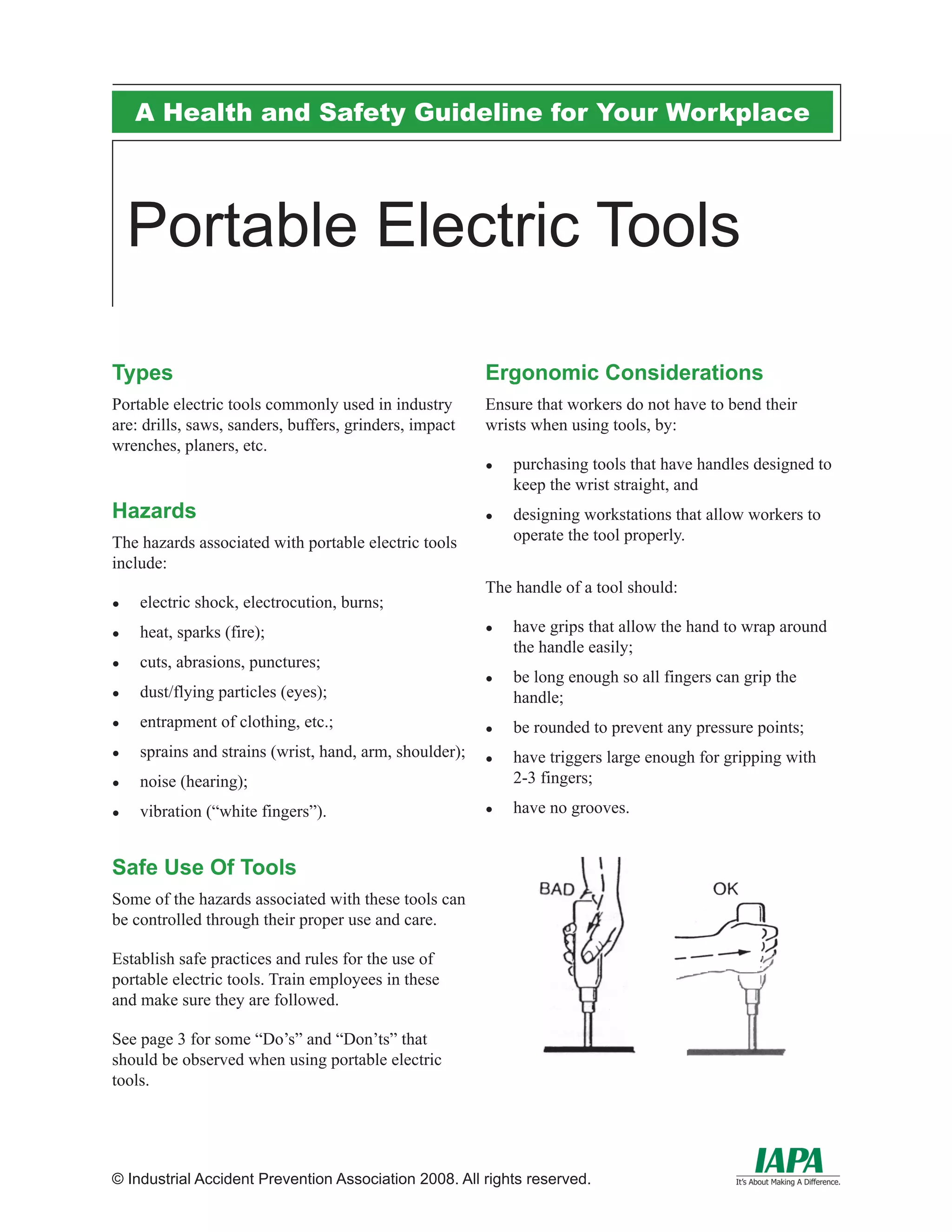
Portable Electric Tools
Types
Portable electric tools commonly used in industry
are: drills, saws, sanders, buffers, grinders, impact
wrenches, planers, etc.
Hazards
The hazards associated with portable electric tools
include:
electric shock, electrocution, burns;●●
heat, sparks (fire);●●
cuts, abrasions, punctures;●●
dust/flying particles (eyes);●●
entrapment of clothing, etc.;●●
sprains and strains (wrist, hand, arm, shoulder);●●
noise (hearing);●●
vibration (“white fingers”).●●
Safe Use Of Tools
Some of the hazards associated with these tools can
be controlled through their proper use and care.
Establish safe practices and rules for the use of
portable electric tools. Train employees in these
and make sure they are followed.
See page 3 for some “Do’s” and “Don’ts” that
should be observed when using portable electric
tools.
Ergonomic Considerations
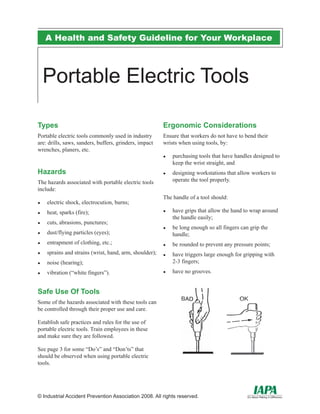
Ensure that workers do not have to bend their
wrists when using tools, by:
purchasing tools that have handles designed to●●
keep the wrist straight, and
designing workstations that allow workers to●●
operate the tool properly.
The handle of a tool should:
have grips that allow the hand to wrap around●●
the handle easily;
be long enough so all fingers can grip the●●
handle;
be rounded to prevent any pressure points;●●
have triggers large enough for gripping with●●
2-3 fingers;
have no grooves.●●
Portable Electric Tools
© Industrial Accident Prevention Association 2008. All rights reserved.
2
Provide lightweight tools that can be easily
supported by one hand, or provide tools with two
handles to permit better handling.
If the tool weighs more than 0.5 kg (1 lb), support
it with a counter balanced harness.
Provide tools with handles covered with cork,
rubber or plastic to reduce vibration transmitted to
the hand.
Instruct workers to:
hold the tool so that its centre of gravity is●●
located close to the body;
minimize kickback from the tool;●●
rest their hands by laying the tool down or●●
inserting it in a holster when it is not being
used.
Training
Ontario’s Occupational Health and Safety Act
requires that every precaution be taken to ensure
the safety of workers (s.25). Where portable
electric tools are concerned, there are pitfalls for
the inexperienced and the uninformed. Because
accidents involving electrical tools can result in
fatalities, electrical hazards should be emphasized
during training.
Using a tool in a flammable atmosphere can cause
an explosion and is perhaps the second most
dangerous hazard.
To help avoid serious injury, include the following
in any training program.
What to use the tool for and how to hold and●●
operate it
Hazards of improper use●●
Manufacturer’s directions●●
Protective equipment to be used●●
Operating problems that could happen (i.e.,●●
binding, seizing, breakage)
Pre-use checks to be carried out●●
How to evaluate possible environmental●●
hazards (i.e., flammability of substances,
lighting, water)
Use of attachments – proper selection (size,●●
speed) and installation
Inspection procedures●●
Health effects of noise and vibration and what●●
is being done to control the noise and vibration
produced by tools used in the workplace
How to transport and store the tools●●
Portable Electric Tools
© Industrial Accident Prevention Association 2008. All rights reserved.
3
Use Tools Safely
Follow These Rules
Always review the manufacturer’s●●
instructions before use.
Know the hazards.●●
Know the personal protective equipment needs.●●
Inspect the tool before use.●●
DO DON’T
Check the nameplate to ensure that the power55
source is correct for the tool.
Test tools before starting work.55
Make sure the tool is in safe condition –55
cleaned, repaired, oiled.
Make sure the ground pin is in place and that55
there are no cuts in the cord.
Test the ground connection on 3 wire system55
or check that tool is double insulated.
Make sure switch is operating freely. Keep55
finger off switch when carrying a tool.
Ensure that guards (e.g., on saws, etc.) are in55
place and that they are functioning properly.
If brushes are sparking excessively, obtain a55
replacement tool.
Wear suitable eye and foot protection.55
Avoid accidental starting.55
Remove adjusting keys/wrenches before55
turning tool on or plugging it in.
Pull out power plug before adjusting or55
making changes, or when the tool is not in use.
Always hold the tool firmly.55
Hoist tools up a ladder instead of carrying55
them.
Store tool where it won’t be damaged.55
Work where floor is wet or damp without44
extreme precautions.
Carry tools up a ladder.44
Operate grinding wheels at speeds beyond44
their rating.
Use the cord to pull out plugs or lift tools.44
Use tools where flammable gases or vapours44
may be present.
Make improvised repairs.44
Work on makeshift platforms.44
Use tools with defective guards.44
Hang cord over sharp edges, through water,44
where they can be run over by vehicles or
tripped over.
Tape cords to repair them.44
Wear loose clothing or gloves.44
Portable Electric Tools
© Industrial Accident Prevention Association 2008. All rights reserved.
4
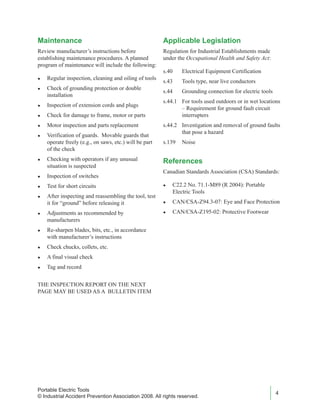
Maintenance
Review manufacturer’s instructions before
establishing maintenance procedures. A planned
program of maintenance will include the following:
Regular inspection, cleaning and oiling of tools●●
Check of grounding protection or double●●
installation
Inspection of extension cords and plugs●●
Check for damage to frame, motor or parts●●
Motor inspection and parts replacement●●
Verification of guards. Movable guards that●●
operate freely (e.g., on saws, etc.) will be part
of the check
Checking with operators if any unusual●●
situation is suspected
Inspection of switches●●
Test for short circuits●●
After inspecting and reassembling the tool, test●●
it for “ground” before releasing it
Adjustments as recommended by●●
manufacturers
Re-sharpen blades, bits, etc., in accordance●●
with manufacturer’s instructions
Check chucks, collets, etc.●●
A final visual check●●
Tag and record●●
THE INSPECTION REPORT ON THE NEXT
PAGE MAY BE USED AS A BULLETIN ITEM
Applicable Legislation
Regulation for Industrial Establishments made
under the Occupational Health and Safety Act:
s.40	 Electrical Equipment Certification
s.43	 Tools type, near live conductors
s.44	 Grounding connection for electric tools
s.44.1	 For tools used outdoors or in wet locations
– Requirement for ground fault circuit
interrupters
s.44.2	 Investigation and removal of ground faults
that pose a hazard
s.139	 Noise
References
Canadian Standards Association (CSA) Standards:
C22.2 No. 71.1-M89 (R 2004): Portable●●
Electric Tools
CAN/CSA-Z94.3-07: Eye and Face Protection●●
CAN/CSA-Z195-02: Protective Footwear●●
Portable Electric Tools
© Industrial Accident Prevention Association 2008. All rights reserved.
5
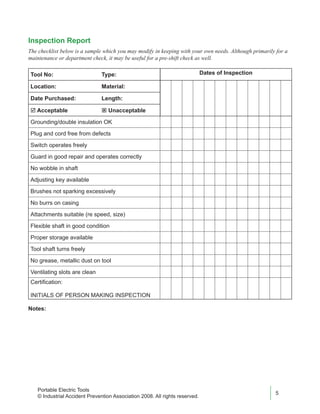
Inspection Report
The checklist below is a sample which you may modify in keeping with your own needs. Although primarily for a
maintenance or department check, it may be useful for a pre-shift check as well.
Tool No: Type: Dates of Inspection
Location: Material:
Date Purchased: Length:
þ Acceptable ý Unacceptable
Grounding/double insulation OK
Plug and cord free from defects
Switch operates freely
Guard in good repair and operates correctly
No wobble in shaft
Adjusting key available
Brushes not sparking excessively
No burrs on casing
Attachments suitable (re speed, size)
Flexible shaft in good condition
Proper storage available
Tool shaft turns freely
No grease, metallic dust on tool
Ventilating slots are clean
Certification:
INITIALS OF PERSON MAKING INSPECTION
Notes:
Portable Electric Tools
© INDUSTRIAL ACCIDENT PREVENTION
ASSOCIATION, 2002, 2005, 2006, 2008.
All rights reserved. As part of IAPA’s mission to inform and
educate, IAPA permits users to reproduce this material for their
own internal training and educational purposes only. For any
other purpose, including use in conjunction with fee for service
or other commercial activities, no part of this material may be
used, reproduced, stored in a retrieval system, or transmitted in
any form or by any means, electronic, mechanical, photocopy,
recorded, or otherwise, without the express prior written
permission of the Industrial Accident Prevention Association.
The information contained in this material is provided
voluntarily as a public service. No warranty, guarantee
or representation is made by IAPA as to the correctness,
suitability, fitness, or sufficiency of any information contained
in this material. Use of this material means that the user agrees
that IAPA and its employees will not have and are released
from any liability whatsoever, however caused or arising, in
connection therewith. Users also acknowledge that it cannot
be assumed that all acceptable safety measures are contained
in this material or that additional measures may not be required
in the conditions or circumstances that are applicable to the
user or his/her organization, and that the user will personally
make his/her own assessment of the information contained in
this material.
While IAPA does not undertake to provide a revision service
or guarantee accuracy, we shall be pleased to respond to your
individual requests for information.
Revised: May 2008
Industrial Accident Prevention Association
Toll-free: 1-800-406-IAPA (4272)
Website: www.iapa.ca

Portable electrical tools

  • 1.
    A Health andSafety Guideline for Your Workplace © Industrial Accident Prevention Association 2008. All rights reserved. Portable Electric Tools Types Portable electric tools commonly used in industry are: drills, saws, sanders, buffers, grinders, impact wrenches, planers, etc. Hazards The hazards associated with portable electric tools include: electric shock, electrocution, burns;●● heat, sparks (fire);●● cuts, abrasions, punctures;●● dust/flying particles (eyes);●● entrapment of clothing, etc.;●● sprains and strains (wrist, hand, arm, shoulder);●● noise (hearing);●● vibration (“white fingers”).●● Safe Use Of Tools Some of the hazards associated with these tools can be controlled through their proper use and care. Establish safe practices and rules for the use of portable electric tools. Train employees in these and make sure they are followed. See page 3 for some “Do’s” and “Don’ts” that should be observed when using portable electric tools. Ergonomic Considerations Ensure that workers do not have to bend their wrists when using tools, by: purchasing tools that have handles designed to●● keep the wrist straight, and designing workstations that allow workers to●● operate the tool properly. The handle of a tool should: have grips that allow the hand to wrap around●● the handle easily; be long enough so all fingers can grip the●● handle; be rounded to prevent any pressure points;●● have triggers large enough for gripping with●● 2-3 fingers; have no grooves.●●
  • 2.
    Portable Electric Tools ©Industrial Accident Prevention Association 2008. All rights reserved. 2 Provide lightweight tools that can be easily supported by one hand, or provide tools with two handles to permit better handling. If the tool weighs more than 0.5 kg (1 lb), support it with a counter balanced harness. Provide tools with handles covered with cork, rubber or plastic to reduce vibration transmitted to the hand. Instruct workers to: hold the tool so that its centre of gravity is●● located close to the body; minimize kickback from the tool;●● rest their hands by laying the tool down or●● inserting it in a holster when it is not being used. Training Ontario’s Occupational Health and Safety Act requires that every precaution be taken to ensure the safety of workers (s.25). Where portable electric tools are concerned, there are pitfalls for the inexperienced and the uninformed. Because accidents involving electrical tools can result in fatalities, electrical hazards should be emphasized during training. Using a tool in a flammable atmosphere can cause an explosion and is perhaps the second most dangerous hazard. To help avoid serious injury, include the following in any training program. What to use the tool for and how to hold and●● operate it Hazards of improper use●● Manufacturer’s directions●● Protective equipment to be used●● Operating problems that could happen (i.e.,●● binding, seizing, breakage) Pre-use checks to be carried out●● How to evaluate possible environmental●● hazards (i.e., flammability of substances, lighting, water) Use of attachments – proper selection (size,●● speed) and installation Inspection procedures●● Health effects of noise and vibration and what●● is being done to control the noise and vibration produced by tools used in the workplace How to transport and store the tools●●
  • 3.
    Portable Electric Tools ©Industrial Accident Prevention Association 2008. All rights reserved. 3 Use Tools Safely Follow These Rules Always review the manufacturer’s●● instructions before use. Know the hazards.●● Know the personal protective equipment needs.●● Inspect the tool before use.●● DO DON’T Check the nameplate to ensure that the power55 source is correct for the tool. Test tools before starting work.55 Make sure the tool is in safe condition –55 cleaned, repaired, oiled. Make sure the ground pin is in place and that55 there are no cuts in the cord. Test the ground connection on 3 wire system55 or check that tool is double insulated. Make sure switch is operating freely. Keep55 finger off switch when carrying a tool. Ensure that guards (e.g., on saws, etc.) are in55 place and that they are functioning properly. If brushes are sparking excessively, obtain a55 replacement tool. Wear suitable eye and foot protection.55 Avoid accidental starting.55 Remove adjusting keys/wrenches before55 turning tool on or plugging it in. Pull out power plug before adjusting or55 making changes, or when the tool is not in use. Always hold the tool firmly.55 Hoist tools up a ladder instead of carrying55 them. Store tool where it won’t be damaged.55 Work where floor is wet or damp without44 extreme precautions. Carry tools up a ladder.44 Operate grinding wheels at speeds beyond44 their rating. Use the cord to pull out plugs or lift tools.44 Use tools where flammable gases or vapours44 may be present. Make improvised repairs.44 Work on makeshift platforms.44 Use tools with defective guards.44 Hang cord over sharp edges, through water,44 where they can be run over by vehicles or tripped over. Tape cords to repair them.44 Wear loose clothing or gloves.44
  • 4.
    Portable Electric Tools ©Industrial Accident Prevention Association 2008. All rights reserved. 4 Maintenance Review manufacturer’s instructions before establishing maintenance procedures. A planned program of maintenance will include the following: Regular inspection, cleaning and oiling of tools●● Check of grounding protection or double●● installation Inspection of extension cords and plugs●● Check for damage to frame, motor or parts●● Motor inspection and parts replacement●● Verification of guards. Movable guards that●● operate freely (e.g., on saws, etc.) will be part of the check Checking with operators if any unusual●● situation is suspected Inspection of switches●● Test for short circuits●● After inspecting and reassembling the tool, test●● it for “ground” before releasing it Adjustments as recommended by●● manufacturers Re-sharpen blades, bits, etc., in accordance●● with manufacturer’s instructions Check chucks, collets, etc.●● A final visual check●● Tag and record●● THE INSPECTION REPORT ON THE NEXT PAGE MAY BE USED AS A BULLETIN ITEM Applicable Legislation Regulation for Industrial Establishments made under the Occupational Health and Safety Act: s.40 Electrical Equipment Certification s.43 Tools type, near live conductors s.44 Grounding connection for electric tools s.44.1 For tools used outdoors or in wet locations – Requirement for ground fault circuit interrupters s.44.2 Investigation and removal of ground faults that pose a hazard s.139 Noise References Canadian Standards Association (CSA) Standards: C22.2 No. 71.1-M89 (R 2004): Portable●● Electric Tools CAN/CSA-Z94.3-07: Eye and Face Protection●● CAN/CSA-Z195-02: Protective Footwear●●
  • 5.
    Portable Electric Tools ©Industrial Accident Prevention Association 2008. All rights reserved. 5 Inspection Report The checklist below is a sample which you may modify in keeping with your own needs. Although primarily for a maintenance or department check, it may be useful for a pre-shift check as well. Tool No: Type: Dates of Inspection Location: Material: Date Purchased: Length: þ Acceptable ý Unacceptable Grounding/double insulation OK Plug and cord free from defects Switch operates freely Guard in good repair and operates correctly No wobble in shaft Adjusting key available Brushes not sparking excessively No burrs on casing Attachments suitable (re speed, size) Flexible shaft in good condition Proper storage available Tool shaft turns freely No grease, metallic dust on tool Ventilating slots are clean Certification: INITIALS OF PERSON MAKING INSPECTION Notes:
  • 6.
    Portable Electric Tools ©INDUSTRIAL ACCIDENT PREVENTION ASSOCIATION, 2002, 2005, 2006, 2008. All rights reserved. As part of IAPA’s mission to inform and educate, IAPA permits users to reproduce this material for their own internal training and educational purposes only. For any other purpose, including use in conjunction with fee for service or other commercial activities, no part of this material may be used, reproduced, stored in a retrieval system, or transmitted in any form or by any means, electronic, mechanical, photocopy, recorded, or otherwise, without the express prior written permission of the Industrial Accident Prevention Association. The information contained in this material is provided voluntarily as a public service. No warranty, guarantee or representation is made by IAPA as to the correctness, suitability, fitness, or sufficiency of any information contained in this material. Use of this material means that the user agrees that IAPA and its employees will not have and are released from any liability whatsoever, however caused or arising, in connection therewith. Users also acknowledge that it cannot be assumed that all acceptable safety measures are contained in this material or that additional measures may not be required in the conditions or circumstances that are applicable to the user or his/her organization, and that the user will personally make his/her own assessment of the information contained in this material. While IAPA does not undertake to provide a revision service or guarantee accuracy, we shall be pleased to respond to your individual requests for information. Revised: May 2008 Industrial Accident Prevention Association Toll-free: 1-800-406-IAPA (4272) Website: www.iapa.ca