Imrana Y. Hamdi MD
Graduate Student
MPH Program
Department of Health and
Kinesiology
Purdue University.
1
Awareness Campaign
for
Early Detection and Prevention of
Diabetes
2
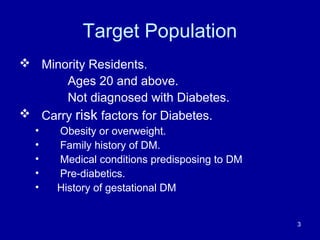
Target Population
 Minority Residents.
Ages 20 and above.
Not diagnosed with Diabetes.
 Carry risk factors for Diabetes.
• Obesity or overweight.
• Family history of DM.
• Medical conditions predisposing to DM
• Pre-diabetics.
• History of gestational DM
3
Questions to address:
 How important is the problem perceived to be.
 What are some changeable factors?
 Number of undiagnosed cases in the group.
 How can we encourage public participation.
 Can we reduce the incidence with a reasonable
cost benefit ratio.
4
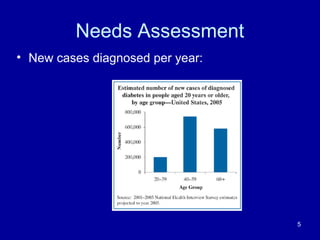
Needs Assessment
• New cases diagnosed per year:
5
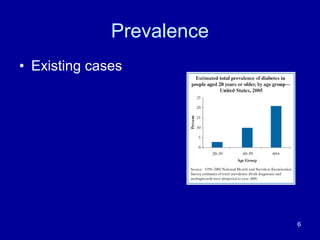
Prevalence
• Existing cases
6
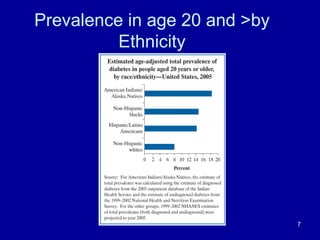
Prevalence in age 20 and >by
Ethnicity
7
Demographics
• Diabetes is most common in people over
60.
• Aging itself is not responsible for Diabetes.
• The Risk of death with Diabetes is twice
the risk of Non Diabetics.
• By 2050 almost half of the population
other than whites will have diabetes.
• Costs 13,243 $ compared with 2,560 $.
8
Disparities
• Ethnic disparities.
• Socio-economic disparities.
• Age related disparities
http://www.ahrq.gov/research/diabdisp.htm
9
Potential Reasons For a Greater Burden
• Greater number of people with Diabetes.
• Greater complications of diabetes.
• Inadequate access to proper programs
• Improper care
• Lack of awareness.
• Personal behaviors
10
Determinants of Personal behavior
• Westernization
• Decreased Physical activity.
- Increased television watching
- Increased videogames addiction
- Lack of awareness.
11
CHAMPS.
UCSF.
 CHAMPS 1 and 2.
 Small steps big rewards program.
http://www.ndep.nih.gov/campaigns/SmallSteps/SmallSteps_index.htm
12
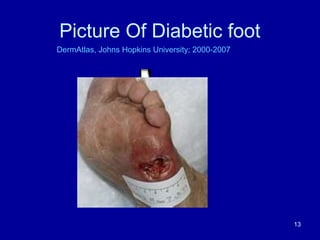
Picture Of Diabetic foot
Diabeticdermopathy.htm
DermAtlas, Johns Hopkins University; 2000-2007
13
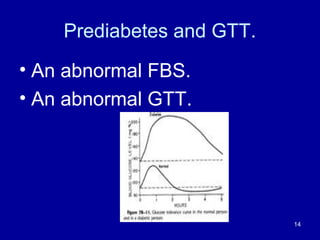
Prediabetes and GTT.
• An abnormal FBS.
• An abnormal GTT.
14
Goals
Beauty
To
 Reduce Mortality and Morbidity
 Reduce economic burden
15
Smart Objectives
Are derived towards health and behavior
outcomes and quality of life
Using the HBM to improve Perceived
Susceptibility + P. Risks= Perceived
threat, to bring a behavior change.
Community Organization and Social
Networks
Create an awareness Campaign
Local Health Departments services
16
16
Objectives Continued
 Develop an advisory committee
 Recruit and train Volunteers
 Evaluate the Process.
 Collect post campaign data
-Behavior change
-Incidence, Prevalence.
17
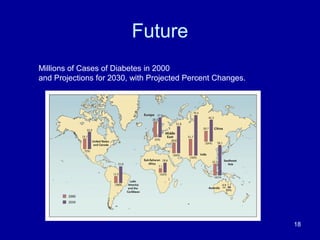
Future
Millions of Cases of Diabetes in 2000
and Projections for 2030, with Projected Percent Changes.
18
References
• http://www.medscape.com/diabetes-endocrinology
• The International Electronic Journal of Health
Education, 2001; 4:276-282
• The International Electronic Journal of Health
Education 2004; 7:27-37 27
http://www.iejhe.org
• http://www.ahrq.org/
• http://www.ahrq.gov/research/diabdisp.htm
• http://www.cdc.gov/diabetes/pubs/factsheet.htm.
19
Additional references.
• United States Department of Agriculture (USDA)
www.nutrition.gov
• Food and Drug Administration's (FDA) Nutrition Facts Label
www.cfsan.fda.gov/~dms/foodlab.html
• Weight-Control Information Network
www.win.nih.gov/index.htm
• American Diabetes Association
www.diabetes.org
• American Dietetic Association
www.eatright.org
• © DermAtlas, Johns Hopkins University; 2000-2007
20
21

Intervention power point

  • 1.
    Imrana Y. HamdiMD Graduate Student MPH Program Department of Health and Kinesiology Purdue University. 1
  • 2.
    Awareness Campaign for Early Detectionand Prevention of Diabetes 2
  • 3.
    Target Population  MinorityResidents. Ages 20 and above. Not diagnosed with Diabetes.  Carry risk factors for Diabetes. • Obesity or overweight. • Family history of DM. • Medical conditions predisposing to DM • Pre-diabetics. • History of gestational DM 3
  • 4.
    Questions to address: How important is the problem perceived to be.  What are some changeable factors?  Number of undiagnosed cases in the group.  How can we encourage public participation.  Can we reduce the incidence with a reasonable cost benefit ratio. 4
  • 5.
    Needs Assessment • Newcases diagnosed per year: 5
  • 6.
  • 7.
    Prevalence in age20 and >by Ethnicity 7
  • 8.
    Demographics • Diabetes ismost common in people over 60. • Aging itself is not responsible for Diabetes. • The Risk of death with Diabetes is twice the risk of Non Diabetics. • By 2050 almost half of the population other than whites will have diabetes. • Costs 13,243 $ compared with 2,560 $. 8
  • 9.
    Disparities • Ethnic disparities. •Socio-economic disparities. • Age related disparities http://www.ahrq.gov/research/diabdisp.htm 9
  • 10.
    Potential Reasons Fora Greater Burden • Greater number of people with Diabetes. • Greater complications of diabetes. • Inadequate access to proper programs • Improper care • Lack of awareness. • Personal behaviors 10
  • 11.
    Determinants of Personalbehavior • Westernization • Decreased Physical activity. - Increased television watching - Increased videogames addiction - Lack of awareness. 11
  • 12.
    CHAMPS. UCSF.  CHAMPS 1and 2.  Small steps big rewards program. http://www.ndep.nih.gov/campaigns/SmallSteps/SmallSteps_index.htm 12
  • 13.
    Picture Of Diabeticfoot Diabeticdermopathy.htm DermAtlas, Johns Hopkins University; 2000-2007 13
  • 14.
    Prediabetes and GTT. •An abnormal FBS. • An abnormal GTT. 14
  • 15.
    Goals Beauty To  Reduce Mortalityand Morbidity  Reduce economic burden 15
  • 16.
    Smart Objectives Are derivedtowards health and behavior outcomes and quality of life Using the HBM to improve Perceived Susceptibility + P. Risks= Perceived threat, to bring a behavior change. Community Organization and Social Networks Create an awareness Campaign Local Health Departments services 16 16
  • 17.
    Objectives Continued  Developan advisory committee  Recruit and train Volunteers  Evaluate the Process.  Collect post campaign data -Behavior change -Incidence, Prevalence. 17
  • 18.
    Future Millions of Casesof Diabetes in 2000 and Projections for 2030, with Projected Percent Changes. 18
  • 19.
    References • http://www.medscape.com/diabetes-endocrinology • TheInternational Electronic Journal of Health Education, 2001; 4:276-282 • The International Electronic Journal of Health Education 2004; 7:27-37 27 http://www.iejhe.org • http://www.ahrq.org/ • http://www.ahrq.gov/research/diabdisp.htm • http://www.cdc.gov/diabetes/pubs/factsheet.htm. 19
  • 20.
    Additional references. • UnitedStates Department of Agriculture (USDA) www.nutrition.gov • Food and Drug Administration's (FDA) Nutrition Facts Label www.cfsan.fda.gov/~dms/foodlab.html • Weight-Control Information Network www.win.nih.gov/index.htm • American Diabetes Association www.diabetes.org • American Dietetic Association www.eatright.org • © DermAtlas, Johns Hopkins University; 2000-2007 20
  • 21.