Our  Health  Counts Launched December 2011
Unique Partnership Our Health Counts was a collaborative effort by: Ontario Federation of Indian Friendship Centres (OFIFC) Métis Nation of Ontario  (MNO) Ontario Native Women’s Association  (ONWA) Tungasuvvingat Inuit  (TI) Urban First Nations Health - Project Team   De dwa da dehs ney.>s Aboriginal Health Access Centre   Hamilton Executive Directors Aboriginal Coalition Centre for Research on Inner City Health  (CRICH) - Led by  Dr. Janet Smylie Multiple funders:  OFIFC, MOHLTC, AHTF, CRICH Data linked to Institute for Clinical & Evaluative Sciences
Research Findings  Historic Study A lack of population-based data for urban Aboriginal people - has led to poor planning & policy neglect Findings confirm community’s belief regarding poor health status Results significantly higher than Stats Canada figures 790 people recruited (554 adults, 236 children)  92% of participants agreed to link to OHIP - access to detailed health information through ICES - first time access
Unique Approach Community-based urban setting Participatory research design Multi-sector collaboration Shared decision making Respondent driven sampling Community capacity building Trained First Nations interviewers   Reflective of Aboriginal beliefs Concept mapping - health dimensions Holistic  - health linked to social determinants  Respectful engagement vs rapid response
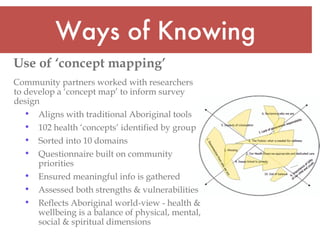
Ways of Knowing Use of ‘concept mapping’ Community partners worked with researchers to develop a ‘concept map’ to inform survey design Aligns with traditional Aboriginal tools 102 health ‘concepts’ identified by group Sorted into 10 domains Questionnaire built on community priorities Ensured meaningful info is gathered Assessed both strengths & vulnerabilities Reflects Aboriginal world-view - health & wellbeing is a balance of physical, mental, social & spiritual dimensions
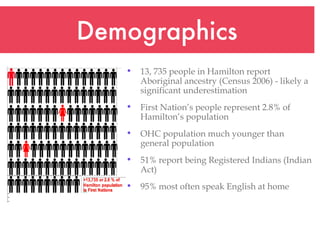
Demographics 13, 735 people in Hamilton report Aboriginal ancestry (Census 2006) - likely a significant underestimation First Nation’s people represent 2.8% of Hamilton’s population  OHC population much younger than general population  51% report being Registered Indians (Indian Act) 95% most often speak English at home
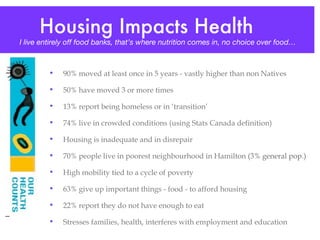
Housing Impacts Health    I live entirely off food banks, that’s where nutrition comes in, no choice over food… 90% moved at least once in 5 years - vastly higher than non Natives 50% have moved 3 or more times  13% report being homeless or in ‘transition’ 74% live in crowded conditions (using Stats Canada definition) Housing is inadequate and in disrepair 70% people live in poorest neighbourhood in Hamilton  (3% general pop.) High mobility tied to a cycle of poverty  63% give up important things - food - to afford housing 22% report they do not have enough to eat  Stresses families, health, interferes with employment and education
Education/Employment Low levels of formal education: 57% First Nations adults over 18 completed some high school  20% report completing high school  5%  completed some/all university Women trend to more education Income & employment:  28% income from wages & salaries,  8% from self-employment  69% provincial/municipal social assistance, 10% EI, 17% Child Tax Benefits,  13% other income sources 18% earn less than $4,999,  22% between $5,000 & $15,000,  15% earn between $15,000 &  $20,000  Only 22% earn over $20,000 (compared to 57% of Hamilton residents)  Only 2% First Nations in highest income quartile
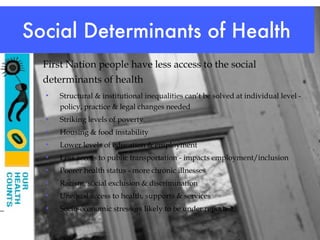
First Nation people have less access to the social determinants of health   Structural & institutional inequalities can’t be solved at individual level - policy, practice & legal changes needed Striking levels of poverty  Housing & food instability Lower levels of education & employment Less access to public transportation - impacts employment/inclusion Poorer health status - more chronic illnesses Racism, social exclusion & discrimination Unequal access to health, supports & services Socio-economic stressors likely to be under reported Social Determinants of Health
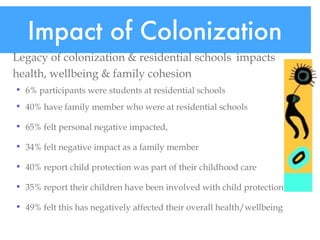
Impact of Colonization Legacy of colonization & residential schools impacts health, wellbeing & family cohesion  6% participants were students at residential schools  40% have family member who were at residential schools 65% felt personal negative impacted,  34% felt negative impact as a family member 40% report child protection was part of their childhood care 35% report their children have been involved with child protection 49% felt this has negatively affected their overall health/wellbeing
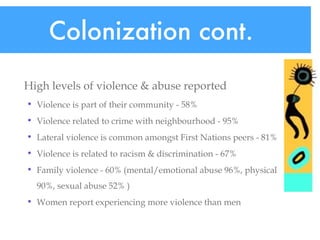
Colonization cont.  High levels of violence & abuse reported Violence is part of their community - 58% Violence related to crime with neighbourhood - 95%  Lateral violence is common amongst First Nations peers - 81%  Violence is related to racism & discrimination - 67%  Family violence - 60% (mental/emotional abuse 96%, physical 90%, sexual abuse 52% )  Women report experiencing more violence than men
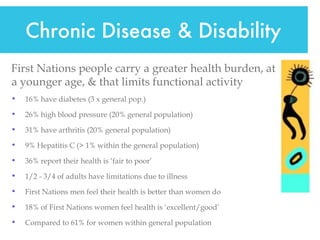
Chronic Disease & Disability First Nations people carry a greater health burden, at a younger age, & that limits functional activity 16% have diabetes (3 x general pop.) 26% high blood pressure (20% general population) 31% have arthritis (20% general population) 9% Hepatitis C (> 1% within the general population) 36% report their health is ‘fair to poor’  1/2 - 3/4 of adults have limitations due to illness First Nations men feel their health is better than women do 18% of First Nations women feel health is ‘excellent/good’  Compared to 61% for women within general population
Health Care Access   “Our health deserves appropriate and dedicated care” Urgent need for improved health care access 40% rate access to health care as ‘fair to poor’ Barriers to care reported: Long waiting lists - 48% Access to transportation - 35% Can’t afford direct costs - 32% Doctors are not available  Lack of trust in health care providers - 24% Stigma & discrimination play a contributing role “ We need more Aboriginal people in health care, education, places where people are looking up to other people.  More native role models.”
Emergency Room Use First Nations more likely to use Emergency Room  Using emergency department for acute & non-acute illness  50% report using ER in past year (22% general population)  11% had more than 6 visits  (<2% general population) ER use holds for both children and adults   Children less likely to be admitted  Compared to non native children - lower rates of admission With comparable or more severe symptoms of illness  Is there a systemic bias toward admitting non-native children?
Challenges & Strengths  Main challenges people identified Drugs & alcohol are major concerns - 68%  Housing - 61%  Crime, poverty & employment - 60% Community strengths Strong family values - 53% Awareness of First Nations culture - 41% Community health programs/ traditional ceremonies - 38%  Presence of elders within community - 36% Social connections within the community - 35%
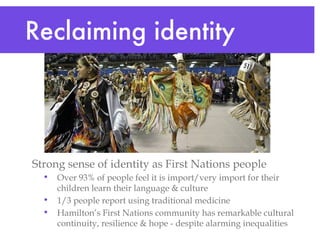
Strong sense of identity as First Nations people Over 93% of people feel it is import/very import for their children learn their language & culture  1/3 people report using traditional medicine Hamilton’s First Nations community has remarkable cultural continuity, resilience & hope - despite alarming inequalities  Reclaiming identity
Whole Government Approach Problems facing Urban Aboriginals in Hamilton are complex  Solutions require a whole government approach - working collaboratively with First Nations leaders  Our Health Data demonstrates increasing disparities in the social determinants of health for urban Aboriginals  Needs inter sectorial partnerships to resolve An urban Aboriginal specific, culturally based,  community - driven strategy is required Address inequalities in accessing  social determinants of health  in accordance with human rights legislation (housing, food security) Chronic disease & disability  is disproportionally felt.  Municipal & provincial governments need to work with Aboriginal community to set priorities, preventative action & health promotion plans
Work with Aboriginal community leaders,  municipal, provincial & federal governments to...   Remove barriers to equitable access to community health care, emergency departments & inpatient hospital services Fund the development & expansion of culturally reflective, community based traditional family treatment centres, mental & maternal health programs & services Build cultural safety & competence skills recognizing Aboriginal world-view & healing practices Promote self-determination in health care delivery, governance, research, planning, development, delivery & evaluation  Whole government cont...
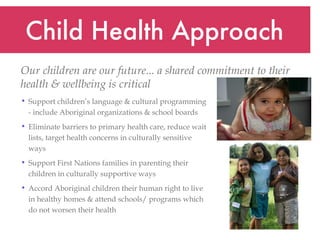
Child Health Approach Support children’s language & cultural programming - include Aboriginal organizations & school boards Eliminate barriers to primary health care, reduce wait lists, target health concerns in culturally sensitive ways Support First Nations families in parenting their children in culturally supportive ways  Accord Aboriginal children their human right to live in healthy homes & attend schools/ programs which do not worsen their health Our children are our future... a shared commitment to their health & wellbeing is critical
‘ Our Health Counts’ demonstrates research can be successfully done by Aboriginal people for the benefit of their community  Fund First Nations led applied service research  Planning is best done in respectful partnership Support interagency collaboration & cooperation Work with Aboriginal agencies & organizations to gain knowledge, promote self-determination in planning, design, development & delivery of culturally specific health services programs & policies Research & Planning

Our health counts powerpoint

  • 1.
    Our Health Counts Launched December 2011
  • 2.
    Unique Partnership OurHealth Counts was a collaborative effort by: Ontario Federation of Indian Friendship Centres (OFIFC) Métis Nation of Ontario (MNO) Ontario Native Women’s Association (ONWA) Tungasuvvingat Inuit (TI) Urban First Nations Health - Project Team De dwa da dehs ney.>s Aboriginal Health Access Centre Hamilton Executive Directors Aboriginal Coalition Centre for Research on Inner City Health (CRICH) - Led by Dr. Janet Smylie Multiple funders: OFIFC, MOHLTC, AHTF, CRICH Data linked to Institute for Clinical & Evaluative Sciences
  • 3.
    Research Findings Historic Study A lack of population-based data for urban Aboriginal people - has led to poor planning & policy neglect Findings confirm community’s belief regarding poor health status Results significantly higher than Stats Canada figures 790 people recruited (554 adults, 236 children) 92% of participants agreed to link to OHIP - access to detailed health information through ICES - first time access
  • 4.
    Unique Approach Community-basedurban setting Participatory research design Multi-sector collaboration Shared decision making Respondent driven sampling Community capacity building Trained First Nations interviewers Reflective of Aboriginal beliefs Concept mapping - health dimensions Holistic - health linked to social determinants Respectful engagement vs rapid response
  • 5.
    Ways of KnowingUse of ‘concept mapping’ Community partners worked with researchers to develop a ‘concept map’ to inform survey design Aligns with traditional Aboriginal tools 102 health ‘concepts’ identified by group Sorted into 10 domains Questionnaire built on community priorities Ensured meaningful info is gathered Assessed both strengths & vulnerabilities Reflects Aboriginal world-view - health & wellbeing is a balance of physical, mental, social & spiritual dimensions
  • 6.
    Demographics 13, 735people in Hamilton report Aboriginal ancestry (Census 2006) - likely a significant underestimation First Nation’s people represent 2.8% of Hamilton’s population OHC population much younger than general population 51% report being Registered Indians (Indian Act) 95% most often speak English at home
  • 7.
    Housing Impacts Health I live entirely off food banks, that’s where nutrition comes in, no choice over food… 90% moved at least once in 5 years - vastly higher than non Natives 50% have moved 3 or more times 13% report being homeless or in ‘transition’ 74% live in crowded conditions (using Stats Canada definition) Housing is inadequate and in disrepair 70% people live in poorest neighbourhood in Hamilton (3% general pop.) High mobility tied to a cycle of poverty 63% give up important things - food - to afford housing 22% report they do not have enough to eat Stresses families, health, interferes with employment and education
  • 8.
    Education/Employment Low levelsof formal education: 57% First Nations adults over 18 completed some high school 20% report completing high school 5% completed some/all university Women trend to more education Income & employment: 28% income from wages & salaries, 8% from self-employment 69% provincial/municipal social assistance, 10% EI, 17% Child Tax Benefits, 13% other income sources 18% earn less than $4,999, 22% between $5,000 & $15,000, 15% earn between $15,000 & $20,000 Only 22% earn over $20,000 (compared to 57% of Hamilton residents) Only 2% First Nations in highest income quartile
  • 9.
    First Nation peoplehave less access to the social determinants of health Structural & institutional inequalities can’t be solved at individual level - policy, practice & legal changes needed Striking levels of poverty Housing & food instability Lower levels of education & employment Less access to public transportation - impacts employment/inclusion Poorer health status - more chronic illnesses Racism, social exclusion & discrimination Unequal access to health, supports & services Socio-economic stressors likely to be under reported Social Determinants of Health
  • 10.
    Impact of ColonizationLegacy of colonization & residential schools impacts health, wellbeing & family cohesion 6% participants were students at residential schools 40% have family member who were at residential schools 65% felt personal negative impacted, 34% felt negative impact as a family member 40% report child protection was part of their childhood care 35% report their children have been involved with child protection 49% felt this has negatively affected their overall health/wellbeing
  • 11.
    Colonization cont. High levels of violence & abuse reported Violence is part of their community - 58% Violence related to crime with neighbourhood - 95% Lateral violence is common amongst First Nations peers - 81% Violence is related to racism & discrimination - 67% Family violence - 60% (mental/emotional abuse 96%, physical 90%, sexual abuse 52% ) Women report experiencing more violence than men
  • 12.
    Chronic Disease &Disability First Nations people carry a greater health burden, at a younger age, & that limits functional activity 16% have diabetes (3 x general pop.) 26% high blood pressure (20% general population) 31% have arthritis (20% general population) 9% Hepatitis C (> 1% within the general population) 36% report their health is ‘fair to poor’ 1/2 - 3/4 of adults have limitations due to illness First Nations men feel their health is better than women do 18% of First Nations women feel health is ‘excellent/good’ Compared to 61% for women within general population
  • 13.
    Health Care Access “Our health deserves appropriate and dedicated care” Urgent need for improved health care access 40% rate access to health care as ‘fair to poor’ Barriers to care reported: Long waiting lists - 48% Access to transportation - 35% Can’t afford direct costs - 32% Doctors are not available Lack of trust in health care providers - 24% Stigma & discrimination play a contributing role “ We need more Aboriginal people in health care, education, places where people are looking up to other people. More native role models.”
  • 14.
    Emergency Room UseFirst Nations more likely to use Emergency Room Using emergency department for acute & non-acute illness 50% report using ER in past year (22% general population) 11% had more than 6 visits (<2% general population) ER use holds for both children and adults Children less likely to be admitted Compared to non native children - lower rates of admission With comparable or more severe symptoms of illness Is there a systemic bias toward admitting non-native children?
  • 15.
    Challenges & Strengths Main challenges people identified Drugs & alcohol are major concerns - 68% Housing - 61% Crime, poverty & employment - 60% Community strengths Strong family values - 53% Awareness of First Nations culture - 41% Community health programs/ traditional ceremonies - 38% Presence of elders within community - 36% Social connections within the community - 35%
  • 16.
    Strong sense ofidentity as First Nations people Over 93% of people feel it is import/very import for their children learn their language & culture 1/3 people report using traditional medicine Hamilton’s First Nations community has remarkable cultural continuity, resilience & hope - despite alarming inequalities Reclaiming identity
  • 17.
    Whole Government ApproachProblems facing Urban Aboriginals in Hamilton are complex Solutions require a whole government approach - working collaboratively with First Nations leaders Our Health Data demonstrates increasing disparities in the social determinants of health for urban Aboriginals Needs inter sectorial partnerships to resolve An urban Aboriginal specific, culturally based, community - driven strategy is required Address inequalities in accessing social determinants of health in accordance with human rights legislation (housing, food security) Chronic disease & disability is disproportionally felt. Municipal & provincial governments need to work with Aboriginal community to set priorities, preventative action & health promotion plans
  • 18.
    Work with Aboriginalcommunity leaders, municipal, provincial & federal governments to... Remove barriers to equitable access to community health care, emergency departments & inpatient hospital services Fund the development & expansion of culturally reflective, community based traditional family treatment centres, mental & maternal health programs & services Build cultural safety & competence skills recognizing Aboriginal world-view & healing practices Promote self-determination in health care delivery, governance, research, planning, development, delivery & evaluation Whole government cont...
  • 19.
    Child Health ApproachSupport children’s language & cultural programming - include Aboriginal organizations & school boards Eliminate barriers to primary health care, reduce wait lists, target health concerns in culturally sensitive ways Support First Nations families in parenting their children in culturally supportive ways Accord Aboriginal children their human right to live in healthy homes & attend schools/ programs which do not worsen their health Our children are our future... a shared commitment to their health & wellbeing is critical
  • 20.
    ‘ Our HealthCounts’ demonstrates research can be successfully done by Aboriginal people for the benefit of their community Fund First Nations led applied service research Planning is best done in respectful partnership Support interagency collaboration & cooperation Work with Aboriginal agencies & organizations to gain knowledge, promote self-determination in planning, design, development & delivery of culturally specific health services programs & policies Research & Planning