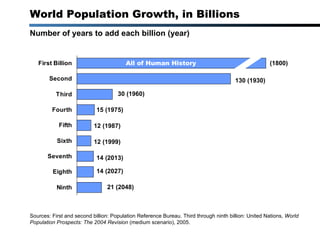
World Population Growth, in Billions Number of years to add each billion (year) All of Human History (1800) 130 (1930) 30 (1960) 15 (1975) 12 (1987) 12 (1999) 14 (2013) 14 (2027) 21 (2048) Sources: First and second billion: Population Reference Bureau. Third through ninth billion: United Nations,  World Population Prospects: The 2004 Revision  (medium scenario), 2005.
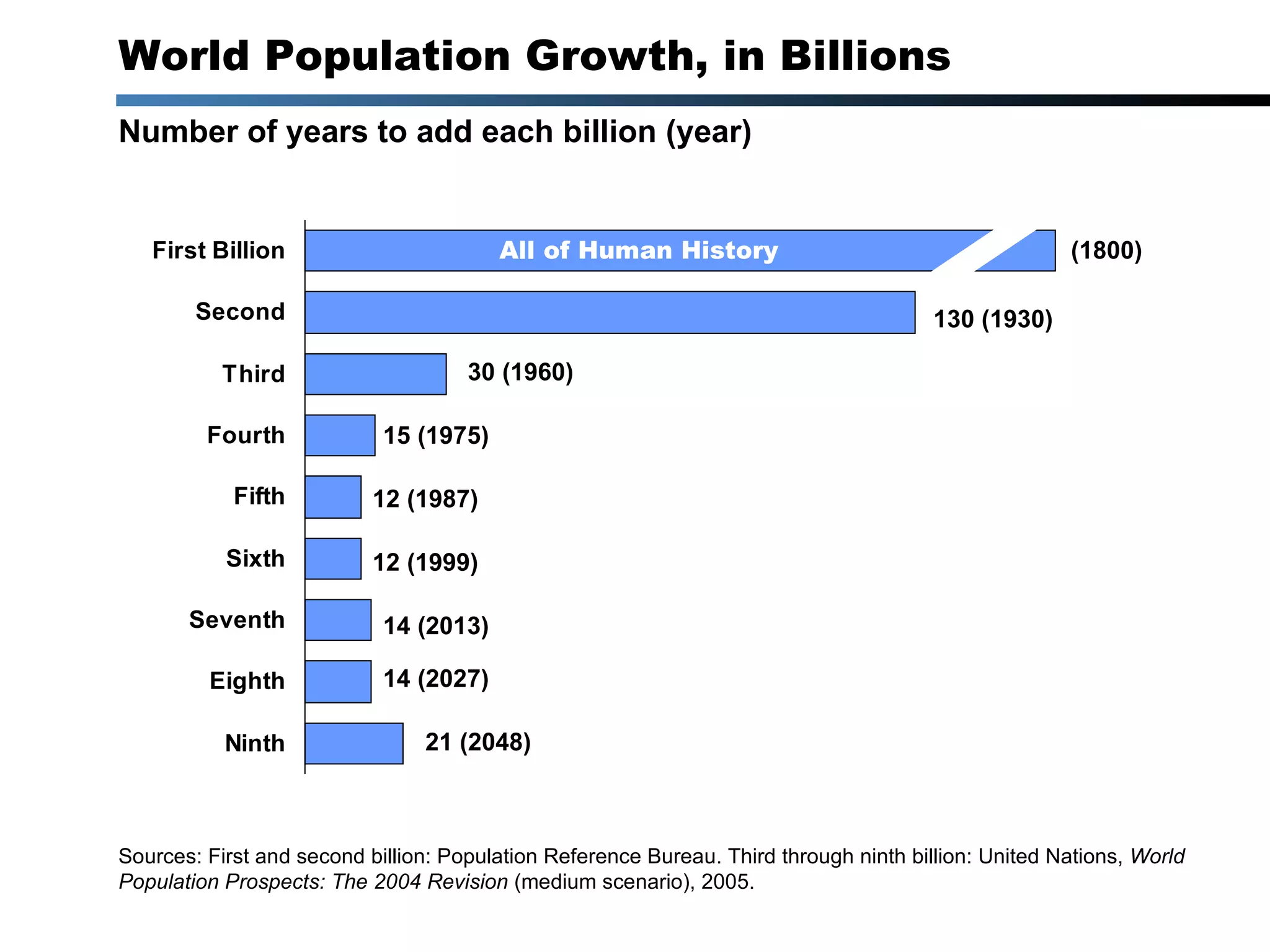
World, 1950 - 1995: Total Population (in billion) and Average  Number of Children (Total Fertility Rate, TFR) High, Medium  and Low Variants Headline: World population will grow significantly - despite falling fertility!
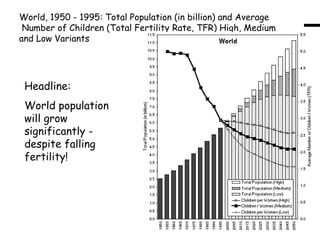
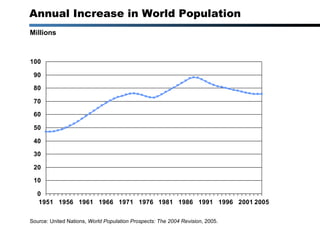
Millions Annual Increase in World Population Source: United Nations,  World Population Prospects: The 2004 Revision , 2005.
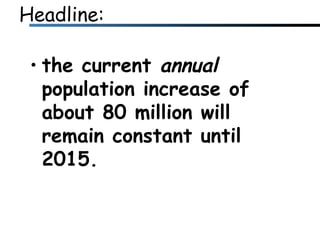
Headline: the current  annual  population increase of about 80 million will remain constant until 2015.
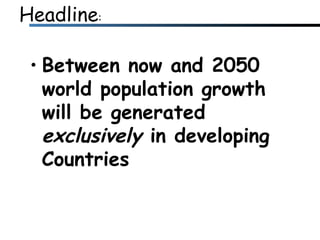
Headline : Between now and 2050 world population growth will be generated  exclusively  in developing Countries
Headline: World population increase is concentrated in Asia.
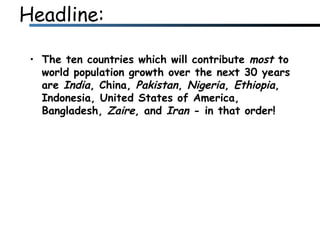
Headline: The ten countries which will contribute  most  to world population growth over the next 30 years are  India , China,  Pakistan ,  Nigeria ,  Ethiopia , Indonesia, United States of America, Bangladesh,  Zaire , and  Iran  - in that order!
Headline: By far the highest  rates  of population growth can be found in Western Asia and Africa South of the Sahara.
Headline: India will out-grow China.
Headline: Nigeria and Pakistan: emerging population giants
Headline: The global balance of population has shifted significantly between 1950 and 1995. It will change even more dramatically between now and 2050.
Headline: Worldwide , the population will age.
What is IIASA? The International Institute for Applied Systems Analysis (IIASA) is an international research organization located near Vienna, Austria. The institute conducts inter-disciplinary scientific studies on environmental, economic, technological and social issues in the context of human dimensions of global change. It is sponsored by its National Member Organizations in Africa, Asia, Europe, and North America.
 

Population Headlines

  • 1.
    World Population Growth,in Billions Number of years to add each billion (year) All of Human History (1800) 130 (1930) 30 (1960) 15 (1975) 12 (1987) 12 (1999) 14 (2013) 14 (2027) 21 (2048) Sources: First and second billion: Population Reference Bureau. Third through ninth billion: United Nations, World Population Prospects: The 2004 Revision (medium scenario), 2005.
  • 2.
    World, 1950 -1995: Total Population (in billion) and Average  Number of Children (Total Fertility Rate, TFR) High, Medium and Low Variants Headline: World population will grow significantly - despite falling fertility!
  • 3.
    Millions Annual Increasein World Population Source: United Nations, World Population Prospects: The 2004 Revision , 2005.
  • 4.
    Headline: the current annual population increase of about 80 million will remain constant until 2015.
  • 5.
    Headline : Betweennow and 2050 world population growth will be generated exclusively in developing Countries
  • 6.
    Headline: World populationincrease is concentrated in Asia.
  • 7.
    Headline: The tencountries which will contribute most to world population growth over the next 30 years are India , China, Pakistan , Nigeria , Ethiopia , Indonesia, United States of America, Bangladesh, Zaire , and Iran - in that order!
  • 8.
    Headline: By farthe highest rates of population growth can be found in Western Asia and Africa South of the Sahara.
  • 9.
    Headline: India willout-grow China.
  • 10.
    Headline: Nigeria andPakistan: emerging population giants
  • 11.
    Headline: The globalbalance of population has shifted significantly between 1950 and 1995. It will change even more dramatically between now and 2050.
  • 12.
    Headline: Worldwide ,the population will age.
  • 13.
    What is IIASA?The International Institute for Applied Systems Analysis (IIASA) is an international research organization located near Vienna, Austria. The institute conducts inter-disciplinary scientific studies on environmental, economic, technological and social issues in the context of human dimensions of global change. It is sponsored by its National Member Organizations in Africa, Asia, Europe, and North America.
  • 14.