YEAR POPULATION (IN BILLIONS)
1700 0.6
1850 1
1930 2
1960 3
1987 5
2000 6.1
2050 9.1
• Population growth is determined mainly by
birth rate , death rate and migration patterns.
• For instance the population in the developed
countries like Europe and America is growing
at rate of only 0.1% per year while in
developing countries the growth rate is over
1.5% per year.
Largest countries (Projected for 2050)
Country Population (In Millions)
India 1628
China 1369
United States 404
Indonesia 312
Nigeria 304
Pakistan 285
Brazil 244
Bangladesh 211
Ethiopia 188
Congo 182
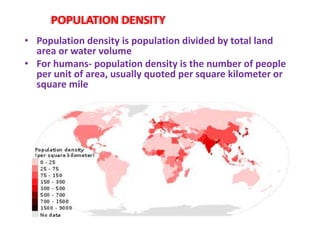
• Population density is population divided by total land
area or water volume
• For humans- population density is the number of people
per unit of area, usually quoted per square kilometer or
square mile
POPULATION DENSITY
IMPACTS OF POPULATION GROWTH
It is now estimated that the world population will be around 9.1 billion by the
year 2050. The very high population growth has raised concerns that the
planet may not be able to sustain such population in the long run.
Increasing population will mean increased demand for food, water, and other
resources such as fossil fuel. The impact of population growth can be seen
by everyone who care for the world that we live in. Over the last few
decades there has been large scale destruction of the tropical forests
mainly to make land available for agriculture and for urbanization. In order
to produce enough food to meet the demand of growing population,
forests have been cleared to undertake farming. Due to increased
industrialization and urbanization, there has been great increase in the
pollution of air, water and the environment of the planet. Growing
population will result in the depletion of natural resources such as water,
fossil fuels (Hubert, 1982); deforestation and loss of ecosystems; and
emergence of new diseases. It will also lead to more starvation, hunger
and unhygienic living conditions in poor countries.
Human pollution & environment

Human pollution & environment

  • 3.
    YEAR POPULATION (INBILLIONS) 1700 0.6 1850 1 1930 2 1960 3 1987 5 2000 6.1 2050 9.1
  • 4.
    • Population growthis determined mainly by birth rate , death rate and migration patterns. • For instance the population in the developed countries like Europe and America is growing at rate of only 0.1% per year while in developing countries the growth rate is over 1.5% per year.
  • 6.
    Largest countries (Projectedfor 2050) Country Population (In Millions) India 1628 China 1369 United States 404 Indonesia 312 Nigeria 304 Pakistan 285 Brazil 244 Bangladesh 211 Ethiopia 188 Congo 182
  • 7.
    • Population densityis population divided by total land area or water volume • For humans- population density is the number of people per unit of area, usually quoted per square kilometer or square mile POPULATION DENSITY
  • 8.
    IMPACTS OF POPULATIONGROWTH It is now estimated that the world population will be around 9.1 billion by the year 2050. The very high population growth has raised concerns that the planet may not be able to sustain such population in the long run. Increasing population will mean increased demand for food, water, and other resources such as fossil fuel. The impact of population growth can be seen by everyone who care for the world that we live in. Over the last few decades there has been large scale destruction of the tropical forests mainly to make land available for agriculture and for urbanization. In order to produce enough food to meet the demand of growing population, forests have been cleared to undertake farming. Due to increased industrialization and urbanization, there has been great increase in the pollution of air, water and the environment of the planet. Growing population will result in the depletion of natural resources such as water, fossil fuels (Hubert, 1982); deforestation and loss of ecosystems; and emergence of new diseases. It will also lead to more starvation, hunger and unhygienic living conditions in poor countries.