PelvicOrgan Prolapse
(POP)
DR RAISHEM ALI FCPS
Associate Prof. of
obstetrics & gynecology
PUMHS
DEFINITION
Osama Warda 3
• Pelvic organ prolapse
(POP) can be defined as
descent of the pelvic
organ(s) ; bladder,
rectum, vagina, uterus;
below their normal
anatomical position.
Relevant Anatomy
Osama Warda 4
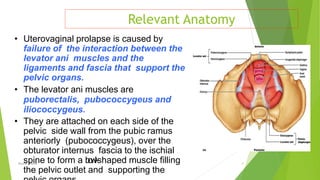
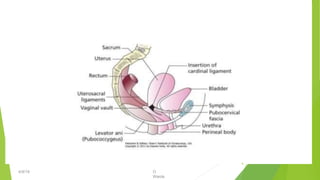
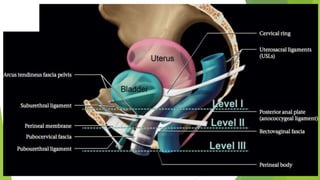
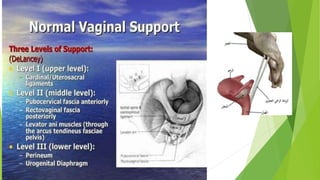
• Uterovaginal prolapse is caused by
failure of the interaction between the
levator ani muscles and the
ligaments and fascia that support the
pelvic organs.
• The levator ani muscles are
puborectalis, pubococcygeus and
iliococcygeus.
• They are attached on each side of the
pelvic side wall from the pubic ramus
anteriorly (pubococcygeus), over the
obturator internus fascia to the ischial
spine to form a b
o
w
l
-
‐shaped muscle filling
the pelvic outlet and supporting the
Relevant Anatomy
Osama Warda 5
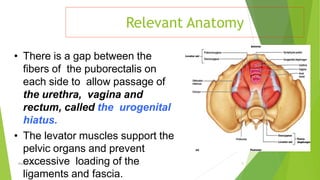
• There is a gap between the
fibers of the puborectalis on
each side to allow passage of
the urethra, vagina and
rectum, called the urogenital
hiatus.
• The levator muscles support the
pelvic organs and prevent
excessive loading of the
ligaments and fascia.
4/9/19 O
Warda
6
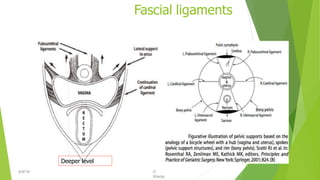
Fascial ligaments
7
Deeper level
4/9/19 O
Warda
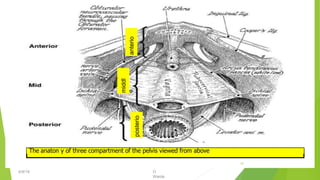
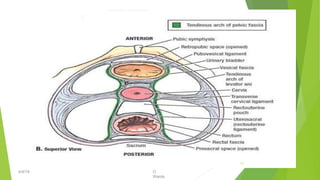
The anatomy of three compartment of the pelvis viewed from above
anterio
r
middl
e
posterio
r
4/9/19 O
Warda
10
4/9/19 O
Warda
11
ETIOLOGY OF POP
Osama Warda 12
Congenital
Acquired .
• Obstetric trauma
• Childbirth, repeated & frequent, faulty management of
labour
• Early resumption of sternous work
• Increase intra abdominal pressure
• Age / menopause
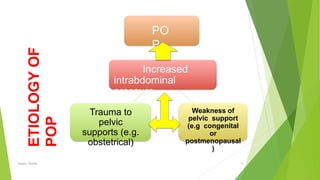
ETIOLOGY
OF
POP
Increased
intrabdominal
pressure
PO
P
Osama Warda 13
Weakness of
pelvic support
(e.g congenital
or
postmenopausal
)
Trauma to
pelvic
supports (e.g.
obstetrical)
Symptoms from POP
Osama Warda 14
• POP can cause symptoms directly due to the
prolapsed organ or indirectly due to organ
dysfunction secondary to displacement from the
anatomical position.
• Direct POP symptoms include:
(1)a sensation of vaginal bulge,
(2)heaviness or a visible protrusion at or beyond the
introitus.
(3) lower abdominal or back pain, or a dragging
discomfort relieved by lying or sitting.
Symptoms from POP
Osama Warda 15
• Indirect symptoms: will depend on which other
organs are involved in the prolapse. They include:
(1)difficulty in urination or defecation (obstructive defecation)
(2) sensations of incomplete emptying of bladder or rectum.
(3)Patients may have to support or reduce the prolapse with
their fingers to be able to void or evacuate stool completely
(i.e. digitation)
(4) Urinary or fecal incontinence may also be present
(5) Sexual dysfunction due to introital laxity
(6) Bleeding from abrasion of the prolapsed part/decubitus
ulcer
Osama Warda 16
Clinical assessment of prolapse
Osama Warda 17
THE HISTORY:
• You should elicit the presenting symptom(s) and
severity, and include questions to ascertain if the
patient has any coexisting urinary, fecal or sexual
symptoms .
• One should be sensitive to the emotional aspect
of the problem, but specific questions should be
asked about sexual discomfort and difficulty
achieving orgasm.
Clinical assessment of prolapse
Osama Warda 18
CLINICAL EXAM
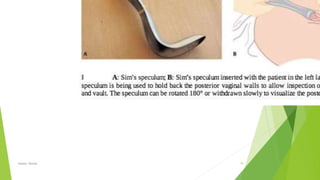
• should ideally be done in the lithotomy position with a
Sims speculum . This allows retraction of the anterior
and posterior vaginal wall in turn, to allow full
assessment of the degree of prolapse and to assess
how much descent of the cervix and uterus is present.
• Prolapse is classically described in three stages of
descent, and note should be made of whether it occurs
at patient straining or at rest and whether traction has
been applied:
Osama Warda 19
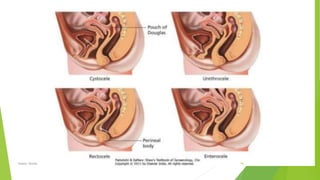
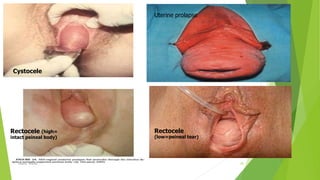
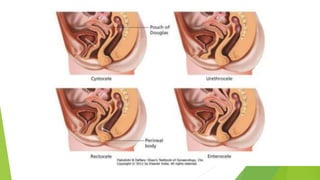
Cystocele
Uterine prolapse
Osama Warda 20
Rectocele (high=
intact peineal body)
Rectocele
(low=peineal tear)
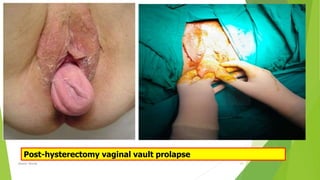
Post-hysterectomy vaginal vault prolapse
Osama Warda 21
Stages of POP
Osama Warda 22
Vaginal prolapse is formally staged using
different methods, but the most important
assessment is whether the vaginal prolapse
reaches to, or beyond, the hymen.
Subjective classification
Objective classification
Stages of POP
Osama Warda 23
Shawa classification ( ref pt introitus)
Baden walker hallway system ( ref pt hymen)
POPQ system. ( ref pt hymen)
Stages of
POP
Osama Warda 24
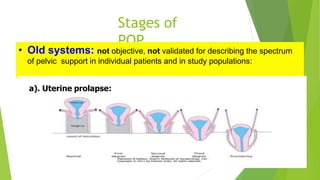
• Old systems: not objective, not validated for describing the spectrum
of pelvic support in individual patients and in study populations:
a). Uterine prolapse:
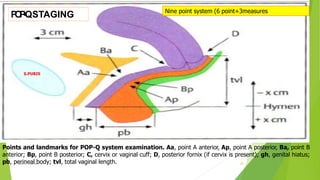
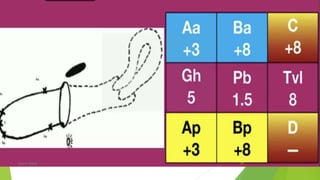
Points and landmarks for POP-Q system examination. Aa, point A anterior, Ap, point A posterior, Ba, point B
anterior; Bp, point B posterior; C, cervix or vaginal cuff; D, posterior fornix (if cervix is present); gh, genital hiatus;
pb, perineal body; tvl, total vaginal length.
Nine point system (6 point+3measures
Osama Warda 25
S.PUBIS
P
O
P
-
‐
QSTAGING
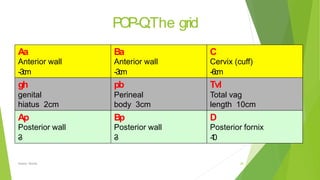
POP-‐Q:The grid
Osama Warda 26
Aa
Anterior wall
-
‐
3
c
m
Ba
Anterior wall
-
‐
3
c
m
C
Cervix (cuff)
-
‐
6
c
m
gh
genital
hiatus 2cm
pb
Perineal
body 3cm
Tvl
Total vag
length 10cm
Ap
Posterior wall
-
‐
3
Bp
Posterior wall
-
‐
3
D
Posterior fornix
-
‐
1
0
P
O
P
-
‐
QStages of POP
Osama Warda 27
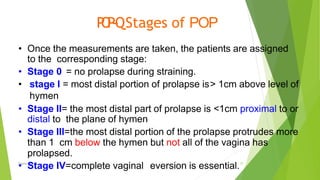
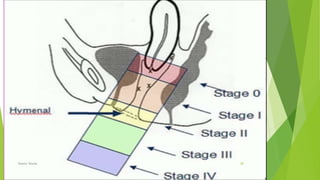
• Once the measurements are taken, the patients are assigned
to the corresponding stage:
• Stage 0 = no prolapse during straining.
• stage I = most distal portion of prolapse is> 1cm above level of
hymen
• Stage II= the most distal part of prolapse is <1cm proximal to or
distal to the plane of hymen
• Stage III=the most distal portion of the prolapse protrudes more
than 1 cm below the hymen but not all of the vagina has
prolapsed.
• Stage IV=complete vaginal eversion is essential.
Osama Warda 28
Osama Warda 29
Treatment for
prolapse
Osama Warda 30
Conservative treatment:
includes
1
-
‐
pelvic floor muscle exercises
and
2
- The use of supportive vaginal pessaries.
-
‐For women with urinary or bowel symptoms as well,
conservative treatment for these symptoms can be
commenced at the same time as for the prolapse.
Treatment for
prolapse
Osama Warda 31
Conservative treatment: Pelvic floor exercises
– A course of supervised pelvic floor exercises will
reduce the symptoms of prolapse and for women
who are keen to avoid surgical treatment, this can
be an effective first step, although there is less
evidence that pelvic floor exercise will reduce the
anatomical extent of the prolapse and it is unlikely
to be helpful for women whose prolapse is beyond
the vaginal introitus.
Treatment for
prolapse
Osama Warda 32
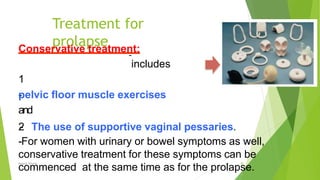
Conservative treatment: Pessary treatment:
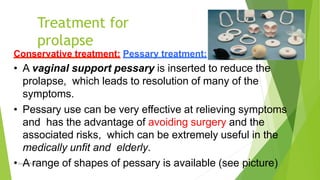
• A vaginal support pessary is inserted to reduce the
prolapse, which leads to resolution of many of the
symptoms.
• Pessary use can be very effective at relieving symptoms
and has the advantage of avoiding surgery and the
associated risks, which can be extremely useful in the
medically unfit and elderly.
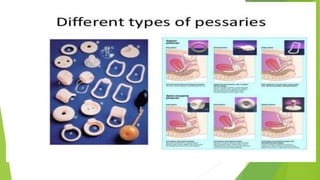
• A range of shapes of pessary is available (see picture)
Conservative treatment: Pessary treatment: (cont.)
• Ring pessaries are usually tried first, but an intact
perineal body is necessary for these to be retained.
• Shelf pessaries, Gelhorn pessaries and others are
useful for women with deficient perineal bodies.
• It is usual practice to replace a pessary every 6
months and to examine the patient for signs of
vaginal ulceration, although this frequency is
traditional and not based on any evidence.
Osama Warda 33
Conservative treatment: Pessary treatment:
(cont.)
Osama Warda 35
• Complications are uncommon
• usually minor (bleeding, discharge),
• incarcerated,
• rectovaginal or vesicovaginal fistula formation
• Difficult sexul intercourse.
SURGERY FOR
POP
Osama Warda 36
• There are a wide range of specific procedures .
• The procedure chosen depends on
(1).which compartment is affected,
(2).whether the woman wishes to retain her uterus/fertility
(3).whether the vaginal or abdominal route of surgery is
chosen.
• The essential principles of prolapse surgery apply
for all procedures.
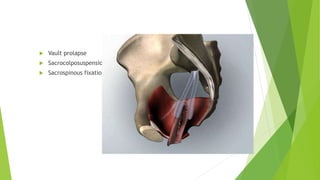
• 4) Vault prolapse
Principles of POP
surgery
Osama Warda 37
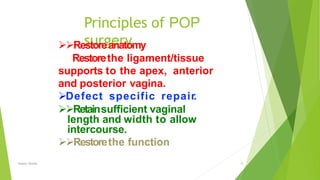
Restoreanatomy
Restorethe ligament/tissue
supports to the apex, anterior
and posterior vagina.
Defect specific repair.
Retainsufficient vaginal
length and width to allow
intercourse.
Restorethe function
SURGERY FOR POP
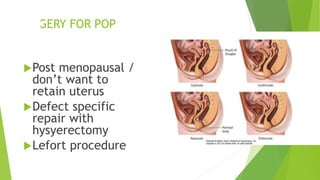
Post menopausal /
don’t want to
retain uterus
Defect specific
repair with
hysyerectomy
Lefort procedure
SURGERY FOR POP
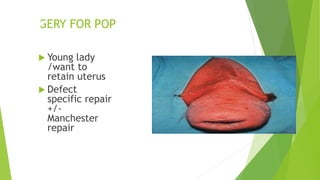
 Young lady
/want to
retain uterus
 Defect
specific repair
+/-
Manchester
repair
 Vault prolapse
 Sacrocolposuspension
 Sacrospinous fixation
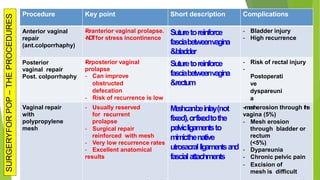
Procedure Key point Short description Complications
Anterior vaginal
repair
(ant.colporrhaphy)
-
‐
F
o
ranterior vaginal prolapse.
-
‐
N
O
Tfor stress incontinence
Suturetoreinforce
fasciabetweenvagina
&bladder
-
‐ Bladder injury
-
‐ High recurrence
Posterior
vaginal repair
Post. colporrhaphy
-
‐
F
o
rposterior vaginal
prolapse
-
‐ Can improve
obstructed
defecation
-
‐ Risk of recurrence is low
Suturetoreinforce
fasciabetweenvagina
&rectum
-
‐ Risk of rectal injury
-
‐
Postoperati
ve
dyspareuni
a
Vaginal repair
with
polypropylene
mesh
-
‐ Usually reserved
for recurrent
prolapse
-
‐ Surgical repair
reinforced with mesh
-
‐ Very low recurrence rates
-
‐ Excellent anatomical
results
M
e
s
hcanbeinlay(not
fixed),orfixedtothe
pelvicligamentsto
mimicthenative
utrosacralligamentsand
fascialattachments
-‐mesherosion through t
h
e
vagina (5%)
-
‐ Mesh erosion
through bladder or
rectum
(<5%)
-
‐ Dypareunia
-
‐ Chronic pelvic pain
-
‐ Excision of
mesh is difficult
SURGERYFOR
POP
–
THE
PROCEDURES
Key points
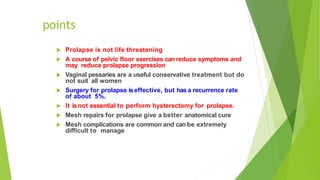
 Prolapse is not life threatening
 A course of pelvic floor exercises can reduce symptoms and
may reduce prolapse progression
 Vaginal pessaries are a useful conservative treatment but do
not suit all women
 Surgery for prolapse iseffective, but has a recurrence rate
of about 5%.
 It isnot essential to perform hysterectomy for prolapse.
 Mesh repairs for prolapse give a better anatomical cure
 Mesh complications are common and can be extremely
difficult to manage
Thank
you
Osama Warda 44
https://www.slideshare.net/OSAMAWARDA/pepvic-
‐
organ-
‐
prolapseprof-
‐
osama
-
‐
warda

POP PPT.pptx

  • 1.
    PelvicOrgan Prolapse (POP) DR RAISHEMALI FCPS Associate Prof. of obstetrics & gynecology PUMHS
  • 3.
    DEFINITION Osama Warda 3 •Pelvic organ prolapse (POP) can be defined as descent of the pelvic organ(s) ; bladder, rectum, vagina, uterus; below their normal anatomical position.
  • 4.
    Relevant Anatomy Osama Warda4 • Uterovaginal prolapse is caused by failure of the interaction between the levator ani muscles and the ligaments and fascia that support the pelvic organs. • The levator ani muscles are puborectalis, pubococcygeus and iliococcygeus. • They are attached on each side of the pelvic side wall from the pubic ramus anteriorly (pubococcygeus), over the obturator internus fascia to the ischial spine to form a b o w l - ‐shaped muscle filling the pelvic outlet and supporting the
  • 5.
    Relevant Anatomy Osama Warda5 • There is a gap between the fibers of the puborectalis on each side to allow passage of the urethra, vagina and rectum, called the urogenital hiatus. • The levator muscles support the pelvic organs and prevent excessive loading of the ligaments and fascia.
  • 6.
  • 7.
  • 10.
    The anatomy ofthree compartment of the pelvis viewed from above anterio r middl e posterio r 4/9/19 O Warda 10
  • 11.
  • 12.
    ETIOLOGY OF POP OsamaWarda 12 Congenital Acquired . • Obstetric trauma • Childbirth, repeated & frequent, faulty management of labour • Early resumption of sternous work • Increase intra abdominal pressure • Age / menopause
  • 13.
    ETIOLOGY OF POP Increased intrabdominal pressure PO P Osama Warda 13 Weaknessof pelvic support (e.g congenital or postmenopausal ) Trauma to pelvic supports (e.g. obstetrical)
  • 14.
    Symptoms from POP OsamaWarda 14 • POP can cause symptoms directly due to the prolapsed organ or indirectly due to organ dysfunction secondary to displacement from the anatomical position. • Direct POP symptoms include: (1)a sensation of vaginal bulge, (2)heaviness or a visible protrusion at or beyond the introitus. (3) lower abdominal or back pain, or a dragging discomfort relieved by lying or sitting.
  • 15.
    Symptoms from POP OsamaWarda 15 • Indirect symptoms: will depend on which other organs are involved in the prolapse. They include: (1)difficulty in urination or defecation (obstructive defecation) (2) sensations of incomplete emptying of bladder or rectum. (3)Patients may have to support or reduce the prolapse with their fingers to be able to void or evacuate stool completely (i.e. digitation) (4) Urinary or fecal incontinence may also be present (5) Sexual dysfunction due to introital laxity (6) Bleeding from abrasion of the prolapsed part/decubitus ulcer
  • 16.
  • 17.
    Clinical assessment ofprolapse Osama Warda 17 THE HISTORY: • You should elicit the presenting symptom(s) and severity, and include questions to ascertain if the patient has any coexisting urinary, fecal or sexual symptoms . • One should be sensitive to the emotional aspect of the problem, but specific questions should be asked about sexual discomfort and difficulty achieving orgasm.
  • 18.
    Clinical assessment ofprolapse Osama Warda 18 CLINICAL EXAM • should ideally be done in the lithotomy position with a Sims speculum . This allows retraction of the anterior and posterior vaginal wall in turn, to allow full assessment of the degree of prolapse and to assess how much descent of the cervix and uterus is present. • Prolapse is classically described in three stages of descent, and note should be made of whether it occurs at patient straining or at rest and whether traction has been applied:
  • 19.
  • 20.
    Cystocele Uterine prolapse Osama Warda20 Rectocele (high= intact peineal body) Rectocele (low=peineal tear)
  • 21.
    Post-hysterectomy vaginal vaultprolapse Osama Warda 21
  • 22.
    Stages of POP OsamaWarda 22 Vaginal prolapse is formally staged using different methods, but the most important assessment is whether the vaginal prolapse reaches to, or beyond, the hymen. Subjective classification Objective classification
  • 23.
    Stages of POP OsamaWarda 23 Shawa classification ( ref pt introitus) Baden walker hallway system ( ref pt hymen) POPQ system. ( ref pt hymen)
  • 24.
    Stages of POP Osama Warda24 • Old systems: not objective, not validated for describing the spectrum of pelvic support in individual patients and in study populations: a). Uterine prolapse:
  • 25.
    Points and landmarksfor POP-Q system examination. Aa, point A anterior, Ap, point A posterior, Ba, point B anterior; Bp, point B posterior; C, cervix or vaginal cuff; D, posterior fornix (if cervix is present); gh, genital hiatus; pb, perineal body; tvl, total vaginal length. Nine point system (6 point+3measures Osama Warda 25 S.PUBIS P O P - ‐ QSTAGING
  • 26.
    POP-‐Q:The grid Osama Warda26 Aa Anterior wall - ‐ 3 c m Ba Anterior wall - ‐ 3 c m C Cervix (cuff) - ‐ 6 c m gh genital hiatus 2cm pb Perineal body 3cm Tvl Total vag length 10cm Ap Posterior wall - ‐ 3 Bp Posterior wall - ‐ 3 D Posterior fornix - ‐ 1 0
  • 27.
    P O P - ‐ QStages of POP OsamaWarda 27 • Once the measurements are taken, the patients are assigned to the corresponding stage: • Stage 0 = no prolapse during straining. • stage I = most distal portion of prolapse is> 1cm above level of hymen • Stage II= the most distal part of prolapse is <1cm proximal to or distal to the plane of hymen • Stage III=the most distal portion of the prolapse protrudes more than 1 cm below the hymen but not all of the vagina has prolapsed. • Stage IV=complete vaginal eversion is essential.
  • 28.
  • 29.
  • 30.
    Treatment for prolapse Osama Warda30 Conservative treatment: includes 1 - ‐ pelvic floor muscle exercises and 2 - The use of supportive vaginal pessaries. - ‐For women with urinary or bowel symptoms as well, conservative treatment for these symptoms can be commenced at the same time as for the prolapse.
  • 31.
    Treatment for prolapse Osama Warda31 Conservative treatment: Pelvic floor exercises – A course of supervised pelvic floor exercises will reduce the symptoms of prolapse and for women who are keen to avoid surgical treatment, this can be an effective first step, although there is less evidence that pelvic floor exercise will reduce the anatomical extent of the prolapse and it is unlikely to be helpful for women whose prolapse is beyond the vaginal introitus.
  • 32.
    Treatment for prolapse Osama Warda32 Conservative treatment: Pessary treatment: • A vaginal support pessary is inserted to reduce the prolapse, which leads to resolution of many of the symptoms. • Pessary use can be very effective at relieving symptoms and has the advantage of avoiding surgery and the associated risks, which can be extremely useful in the medically unfit and elderly. • A range of shapes of pessary is available (see picture)
  • 33.
    Conservative treatment: Pessarytreatment: (cont.) • Ring pessaries are usually tried first, but an intact perineal body is necessary for these to be retained. • Shelf pessaries, Gelhorn pessaries and others are useful for women with deficient perineal bodies. • It is usual practice to replace a pessary every 6 months and to examine the patient for signs of vaginal ulceration, although this frequency is traditional and not based on any evidence. Osama Warda 33
  • 35.
    Conservative treatment: Pessarytreatment: (cont.) Osama Warda 35 • Complications are uncommon • usually minor (bleeding, discharge), • incarcerated, • rectovaginal or vesicovaginal fistula formation • Difficult sexul intercourse.
  • 36.
    SURGERY FOR POP Osama Warda36 • There are a wide range of specific procedures . • The procedure chosen depends on (1).which compartment is affected, (2).whether the woman wishes to retain her uterus/fertility (3).whether the vaginal or abdominal route of surgery is chosen. • The essential principles of prolapse surgery apply for all procedures. • 4) Vault prolapse
  • 37.
    Principles of POP surgery OsamaWarda 37 Restoreanatomy Restorethe ligament/tissue supports to the apex, anterior and posterior vagina. Defect specific repair. Retainsufficient vaginal length and width to allow intercourse. Restorethe function
  • 39.
    SURGERY FOR POP Postmenopausal / don’t want to retain uterus Defect specific repair with hysyerectomy Lefort procedure
  • 40.
    SURGERY FOR POP Young lady /want to retain uterus  Defect specific repair +/- Manchester repair
  • 41.
     Vault prolapse Sacrocolposuspension  Sacrospinous fixation
  • 42.
    Procedure Key pointShort description Complications Anterior vaginal repair (ant.colporrhaphy) - ‐ F o ranterior vaginal prolapse. - ‐ N O Tfor stress incontinence Suturetoreinforce fasciabetweenvagina &bladder - ‐ Bladder injury - ‐ High recurrence Posterior vaginal repair Post. colporrhaphy - ‐ F o rposterior vaginal prolapse - ‐ Can improve obstructed defecation - ‐ Risk of recurrence is low Suturetoreinforce fasciabetweenvagina &rectum - ‐ Risk of rectal injury - ‐ Postoperati ve dyspareuni a Vaginal repair with polypropylene mesh - ‐ Usually reserved for recurrent prolapse - ‐ Surgical repair reinforced with mesh - ‐ Very low recurrence rates - ‐ Excellent anatomical results M e s hcanbeinlay(not fixed),orfixedtothe pelvicligamentsto mimicthenative utrosacralligamentsand fascialattachments -‐mesherosion through t h e vagina (5%) - ‐ Mesh erosion through bladder or rectum (<5%) - ‐ Dypareunia - ‐ Chronic pelvic pain - ‐ Excision of mesh is difficult SURGERYFOR POP – THE PROCEDURES
  • 43.
    Key points  Prolapseis not life threatening  A course of pelvic floor exercises can reduce symptoms and may reduce prolapse progression  Vaginal pessaries are a useful conservative treatment but do not suit all women  Surgery for prolapse iseffective, but has a recurrence rate of about 5%.  It isnot essential to perform hysterectomy for prolapse.  Mesh repairs for prolapse give a better anatomical cure  Mesh complications are common and can be extremely difficult to manage
  • 44.