PUERPERIUM
PUERPERIUM
PUERPERIUM
DR RAISHEM
ASSOCIATE PROFESSOR
OBGYN
PUERPERIUM
PUERPERIUM
PUERPERIUM
Puerperium, also known as the
postpartum period, is the time after
delivery when the body returns to its pre-
pregnant state. It lasts approximately six
weeks and is divided into three phases:
immediate, early, and late. During this
time, the uterus undergoes involution,
hormones readjust, and breastfeeding is
established.
Puerperium, also known as the
postpartum period, is the time after
delivery when the body returns to its pre-
pregnant state. It lasts approximately six
weeks and is divided into three phases:
immediate, early, and late. During this
time, the uterus undergoes involution,
hormones readjust, and breastfeeding is
established.
Puerperium, also known as the
postpartum period, is the time after
delivery when the body returns to its pre-
pregnant state. It lasts approximately six
weeks and is divided into three phases:
immediate, early, and late. During this
time, the uterus undergoes involution,
hormones readjust, and breastfeeding is
established.
The immediate puerperium is the first 24
hours after delivery. During this time, the
focus is on monitoring the mother's vital
signs, managing pain, and assessing for
any complications. The baby is also
assessed for any immediate concerns.
The immediate puerperium is the first 24
hours after delivery. During this time, the
focus is on monitoring the mother's vital
signs, managing pain, and assessing for
any complications. The baby is also
assessed for any immediate concerns.
The immediate puerperium is the first 24
hours after delivery. During this time, the
focus is on monitoring the mother's vital
signs, managing pain, and assessing for
any complications. The baby is also
assessed for any immediate concerns.
IMMEDIATE PUERPERIUM
EARLY PUERPERIUM
EARLY PUERPERIUM
EARLY PUERPERIUM
The early puerperium lasts from day 2 to
day 7 postpartum. During this time, the
mother is monitored for any signs of
infection, hemorrhage, or thrombosis.
Breastfeeding is established, and the
mother and baby are assessed for any
feeding difficulties.
The early puerperium lasts from day 2 to
day 7 postpartum. During this time, the
mother is monitored for any signs of
infection, hemorrhage, or thrombosis.
Breastfeeding is established, and the
mother and baby are assessed for any
feeding difficulties.
The early puerperium lasts from day 2 to
day 7 postpartum. During this time, the
mother is monitored for any signs of
infection, hemorrhage, or thrombosis.
Breastfeeding is established, and the
mother and baby are assessed for any
feeding difficulties.
LATE PUERPERIUM
LATE PUERPERIUM
LATE PUERPERIUM
The late puerperium lasts from day 8 to
week 6 postpartum. During this time, the
mother's body continues to heal and
return to its pre-pregnant state. The focus
is on promoting maternal and infant
bonding, providing support for
breastfeeding, and assessing for any
postpartum depression.
The late puerperium lasts from day 8 to
week 6 postpartum. During this time, the
mother's body continues to heal and
return to its pre-pregnant state. The focus
is on promoting maternal and infant
bonding, providing support for
breastfeeding, and assessing for any
postpartum depression.
The late puerperium lasts from day 8 to
week 6 postpartum. During this time, the
mother's body continues to heal and
return to its pre-pregnant state. The focus
is on promoting maternal and infant
bonding, providing support for
breastfeeding, and assessing for any
postpartum depression.
COMPLICATIONS
COMPLICATIONS
COMPLICATIONS
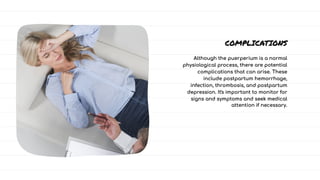
Although the puerperium is a normal
physiological process, there are potential
complications that can arise. These
include postpartum hemorrhage,
infection, thrombosis, and postpartum
depression. It's important to monitor for
signs and symptoms and seek medical
attention if necessary.
Although the puerperium is a normal
physiological process, there are potential
complications that can arise. These
include postpartum hemorrhage,
infection, thrombosis, and postpartum
depression. It's important to monitor for
signs and symptoms and seek medical
attention if necessary.
Although the puerperium is a normal
physiological process, there are potential
complications that can arise. These
include postpartum hemorrhage,
infection, thrombosis, and postpartum
depression. It's important to monitor for
signs and symptoms and seek medical
attention if necessary.
CONCLUSION
CONCLUSION
CONCLUSION
The puerperium is a critical time for both the mother and
baby. Monitoring and support are essential to ensure a
healthy recovery for the mother and a positive start for the
baby. With proper care, the postpartum period can be a time
of joy and bonding for the whole family.
The puerperium is a critical time for both the mother and
baby. Monitoring and support are essential to ensure a
healthy recovery for the mother and a positive start for the
baby. With proper care, the postpartum period can be a time
of joy and bonding for the whole family.
The puerperium is a critical time for both the mother and
baby. Monitoring and support are essential to ensure a
healthy recovery for the mother and a positive start for the
baby. With proper care, the postpartum period can be a time
of joy and bonding for the whole family.
Someone Famous
Someone Famous
Someone Famous
THANKS!
THANKS!
THANKS!
Do you have any questions?
youremail@freepik.com
+91 620 421 838
yourcompany.com ​
Do you have any questions?
youremail@freepik.com
+91 620 421 838
yourcompany.com ​
Do you have any questions?
youremail@freepik.com
+91 620 421 838
yourcompany.com ​

puerperium

  • 1.
  • 2.
    PUERPERIUM PUERPERIUM PUERPERIUM Puerperium, also knownas the postpartum period, is the time after delivery when the body returns to its pre- pregnant state. It lasts approximately six weeks and is divided into three phases: immediate, early, and late. During this time, the uterus undergoes involution, hormones readjust, and breastfeeding is established. Puerperium, also known as the postpartum period, is the time after delivery when the body returns to its pre- pregnant state. It lasts approximately six weeks and is divided into three phases: immediate, early, and late. During this time, the uterus undergoes involution, hormones readjust, and breastfeeding is established. Puerperium, also known as the postpartum period, is the time after delivery when the body returns to its pre- pregnant state. It lasts approximately six weeks and is divided into three phases: immediate, early, and late. During this time, the uterus undergoes involution, hormones readjust, and breastfeeding is established.
  • 3.
    The immediate puerperiumis the first 24 hours after delivery. During this time, the focus is on monitoring the mother's vital signs, managing pain, and assessing for any complications. The baby is also assessed for any immediate concerns. The immediate puerperium is the first 24 hours after delivery. During this time, the focus is on monitoring the mother's vital signs, managing pain, and assessing for any complications. The baby is also assessed for any immediate concerns. The immediate puerperium is the first 24 hours after delivery. During this time, the focus is on monitoring the mother's vital signs, managing pain, and assessing for any complications. The baby is also assessed for any immediate concerns. IMMEDIATE PUERPERIUM IMMEDIATE PUERPERIUM IMMEDIATE PUERPERIUM
  • 4.
    EARLY PUERPERIUM EARLY PUERPERIUM EARLYPUERPERIUM The early puerperium lasts from day 2 to day 7 postpartum. During this time, the mother is monitored for any signs of infection, hemorrhage, or thrombosis. Breastfeeding is established, and the mother and baby are assessed for any feeding difficulties. The early puerperium lasts from day 2 to day 7 postpartum. During this time, the mother is monitored for any signs of infection, hemorrhage, or thrombosis. Breastfeeding is established, and the mother and baby are assessed for any feeding difficulties. The early puerperium lasts from day 2 to day 7 postpartum. During this time, the mother is monitored for any signs of infection, hemorrhage, or thrombosis. Breastfeeding is established, and the mother and baby are assessed for any feeding difficulties.
  • 5.
    LATE PUERPERIUM LATE PUERPERIUM LATEPUERPERIUM The late puerperium lasts from day 8 to week 6 postpartum. During this time, the mother's body continues to heal and return to its pre-pregnant state. The focus is on promoting maternal and infant bonding, providing support for breastfeeding, and assessing for any postpartum depression. The late puerperium lasts from day 8 to week 6 postpartum. During this time, the mother's body continues to heal and return to its pre-pregnant state. The focus is on promoting maternal and infant bonding, providing support for breastfeeding, and assessing for any postpartum depression. The late puerperium lasts from day 8 to week 6 postpartum. During this time, the mother's body continues to heal and return to its pre-pregnant state. The focus is on promoting maternal and infant bonding, providing support for breastfeeding, and assessing for any postpartum depression.
  • 6.
    COMPLICATIONS COMPLICATIONS COMPLICATIONS Although the puerperiumis a normal physiological process, there are potential complications that can arise. These include postpartum hemorrhage, infection, thrombosis, and postpartum depression. It's important to monitor for signs and symptoms and seek medical attention if necessary. Although the puerperium is a normal physiological process, there are potential complications that can arise. These include postpartum hemorrhage, infection, thrombosis, and postpartum depression. It's important to monitor for signs and symptoms and seek medical attention if necessary. Although the puerperium is a normal physiological process, there are potential complications that can arise. These include postpartum hemorrhage, infection, thrombosis, and postpartum depression. It's important to monitor for signs and symptoms and seek medical attention if necessary.
  • 7.
    CONCLUSION CONCLUSION CONCLUSION The puerperium isa critical time for both the mother and baby. Monitoring and support are essential to ensure a healthy recovery for the mother and a positive start for the baby. With proper care, the postpartum period can be a time of joy and bonding for the whole family. The puerperium is a critical time for both the mother and baby. Monitoring and support are essential to ensure a healthy recovery for the mother and a positive start for the baby. With proper care, the postpartum period can be a time of joy and bonding for the whole family. The puerperium is a critical time for both the mother and baby. Monitoring and support are essential to ensure a healthy recovery for the mother and a positive start for the baby. With proper care, the postpartum period can be a time of joy and bonding for the whole family. Someone Famous Someone Famous Someone Famous
  • 8.
    THANKS! THANKS! THANKS! Do you haveany questions? youremail@freepik.com +91 620 421 838 yourcompany.com ​ Do you have any questions? youremail@freepik.com +91 620 421 838 yourcompany.com ​ Do you have any questions? youremail@freepik.com +91 620 421 838 yourcompany.com ​