Pelvic Organ Prolapse
(POP)
Osama	
  M	
  Warda	
  MD	
  
Prof.	
  of	
  obstetrics	
  &	
  gynecology	
  
Mansoura	
  University	
  
 
DEFINITION	
  	
  
•  Pelvic	
  organ	
  prolapse	
  (POP)	
  can	
  be	
  defined	
  as	
  descent	
  
of	
  the	
  pelvic	
  organ(s)	
  ;	
  bladder,	
  rectum,	
  vagina,	
  uterus;	
  
below	
  their	
  normal	
  anatomical	
  posi=on	
  due	
  to	
  
distor=on	
  of	
  their	
  dynamic	
  and	
  integrated	
  support.	
  
Osama	
  	
  Warda	
   2	


Symptoms	
  from	
  POP	
  
•  POP	
  can	
  cause	
  symptoms	
  directly	
  due	
  to	
  the	
  prolapsed	
  
organ	
  or	
  indirectly	
  due	
  to	
  organ	
  dysfunc=on	
  secondary	
  to	
  
displacement	
  from	
  the	
  anatomical	
  posi=on.	
  	
  
•  Direct	
  POP	
  symptoms	
  include:	
  	
  
(1) a	
  sensa=on	
  of	
  vaginal	
  bulge,	
  	
  
(2) heaviness	
  or	
  a	
  visible	
  protrusion	
  at	
  or	
  beyond	
  the	
  introitus.	
  	
  
(3) 	
  lower	
  abdominal	
  or	
  back	
  pain,	
  or	
  a	
  dragging	
  discomfort	
  
relieved	
  by	
  lying	
  or	
  siEng.	
  
Osama	
  	
  Warda	
   3	


Symptoms	
  from	
  POP	
  
•  Indirect	
  symptoms:	
  	
  will	
  depend	
  on	
  which	
  other	
  organs	
  are	
  
involved	
  in	
  the	
  prolapse.	
  	
  They	
  include:	
  	
  
(1)difficulty	
  in	
  urina&on	
  or	
  defeca&on	
  (obstruc=ve	
  defeca=on)	
  
(2)	
  sensa=ons	
  of	
  incomplete	
  emptying	
  of	
  bladder	
  or	
  rectum.	
  	
  
(3)Pa=ents	
  may	
  have	
  to	
  support	
  or	
  reduce	
  the	
  prolapse	
  with	
  their	
  
fingers	
  to	
  be	
  able	
  to	
  void	
  or	
  evacuate	
  stool	
  completely	
  (i.e.	
  
digita=on)	
  
(4)	
  Urinary	
  or	
  fecal	
  incon&nence	
  may	
  also	
  be	
  present	
  
(5)	
  Sexual	
  dysfunc=on	
  due	
  to	
  introital	
  laxity	
  
(6)	
  Bleeding	
  from	
  abrasion	
  of	
  the	
  prolapsed	
  part	
  
Osama	
  	
  Warda	
   4	


ETIOLOGY	
  OF	
  POP	
  
•  Risk	
  factors	
  predisposing	
  to	
  prolapse	
  either	
  congenital	
  
weakness	
  of	
  the	
  mesenchyme	
  or	
  due	
  to	
  obstetric	
  trauma.	
  	
  
•  Obstetric	
  trauma	
  causes:	
  
1-­‐	
  Pudendal	
  nerves	
  	
  damaged	
  ,	
  with	
  increased	
  nerve	
  conduc=on	
  
=mes	
  
2-­‐Thinning	
  or	
  avulsion	
  of	
  the	
  puborectalis	
  muscle	
  from	
  its	
  
inser=on	
  on	
  the	
  pubic	
  ramus	
  on	
  one	
  or	
  both	
  sides.	
  
Osama	
  	
  Warda	
   5	


ETIOLOGY	
  OF	
  POP	
  
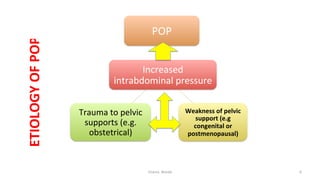
Increased	
  
intrabdominal	
  pressure	
  
POP	
  
Weakness	
  of	
  pelvic	
  
support	
  (e.g	
  
congenital	
  or	
  
postmenopausal)	
  
Trauma	
  to	
  pelvic	
  
supports	
  (e.g.	
  
obstetrical)	
  
Osama	
  	
  Warda	
   6	


Relevant	
  Anatomy	
  
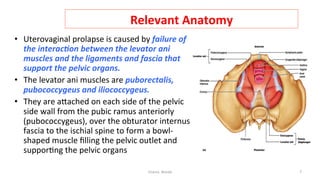
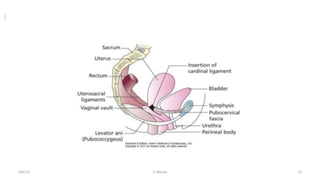
•  Uterovaginal	
  prolapse	
  is	
  caused	
  by	
  failure	
  of	
  
the	
  interac.on	
  between	
  the	
  levator	
  ani	
  
muscles	
  and	
  the	
  ligaments	
  and	
  fascia	
  that	
  
support	
  the	
  pelvic	
  organs.	
  	
  
•  The	
  levator	
  ani	
  muscles	
  are	
  puborectalis,	
  
pubococcygeus	
  and	
  iliococcygeus.	
  	
  
•  They	
  are	
  aRached	
  on	
  each	
  side	
  of	
  the	
  pelvic	
  
side	
  wall	
  from	
  the	
  pubic	
  ramus	
  anteriorly	
  
(pubococcygeus),	
  over	
  the	
  obturator	
  internus	
  
fascia	
  to	
  the	
  ischial	
  spine	
  to	
  form	
  a	
  bowl-­‐
shaped	
  muscle	
  filling	
  the	
  pelvic	
  outlet	
  and	
  
suppor=ng	
  the	
  pelvic	
  organs	
  
Osama	
  	
  Warda	
   7	


Relevant	
  Anatomy	
  
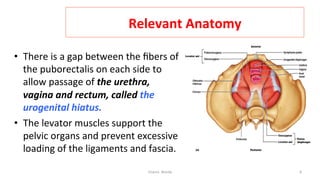
•  There	
  is	
  a	
  gap	
  between	
  the	
  fibers	
  of	
  
the	
  puborectalis	
  on	
  each	
  side	
  to	
  
allow	
  passage	
  of	
  the	
  urethra,	
  
vagina	
  and	
  rectum,	
  called	
  the	
  
urogenital	
  hiatus.	
  	
  
•  The	
  levator	
  muscles	
  support	
  the	
  
pelvic	
  organs	
  and	
  prevent	
  excessive	
  
loading	
  of	
  the	
  ligaments	
  and	
  fascia.	
  
Osama	
  	
  Warda	
   8	


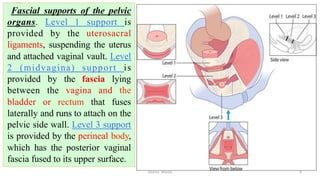
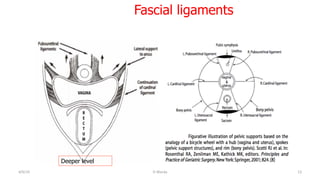
Fascial supports of the pelvic
organs. Level 1 support is
provided by the uterosacral
ligaments, suspending the uterus
and attached vaginal vault. Level
2 (midvagina) support is
provided by the fascia lying
between the vagina and the
bladder or rectum that fuses
laterally and runs to attach on the
pelvic side wall. Level 3 support
is provided by the perineal body,
which has the posterior vaginal
fascia fused to its upper surface.
Osama	
  	
  Warda	
   9	
  
 
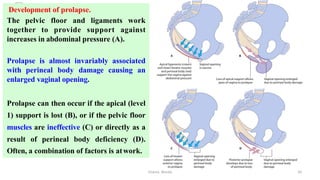
Development of prolapse.
The pelvic floor and ligaments work
together to provide support against
increases in abdominal pressure (A).
Prolapse is almost invariably associated
with perineal body damage causing an
enlarged vaginal opening.
Prolapse can then occur if the apical (level
1) support is lost (B), or if the pelvic floor
muscles are ineffective (C) or directly as a
result of perineal body deficiency (D).
Often, a combination of factors is atwork.
Osama	
  	
  Warda	
   10	
  
 
Relevant	
  Anatomy	
  
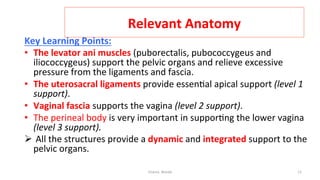
Key	
  Learning	
  Points:	
  
•  The	
  levator	
  ani	
  muscles	
  (puborectalis,	
  pubococcygeus	
  and	
  
iliococcygeus)	
  support	
  the	
  pelvic	
  organs	
  and	
  relieve	
  excessive	
  
pressure	
  from	
  the	
  ligaments	
  and	
  fascia.	
  
•  The	
  uterosacral	
  ligaments	
  provide	
  essen=al	
  apical	
  support	
  (level	
  1	
  
support).	
  
•  Vaginal	
  fascia	
  supports	
  the	
  vagina	
  (level	
  2	
  support).	
  
•  The	
  perineal	
  body	
  is	
  very	
  important	
  in	
  suppor=ng	
  the	
  lower	
  vagina	
  
(level	
  3	
  support).	
  
Ø 	
  All	
  the	
  structures	
  provide	
  a	
  dynamic	
  and	
  integrated	
  support	
  to	
  the	
  
pelvic	
  organs.	
  
Osama	
  	
  Warda	
   11	


4/9/19	
   O	
  Warda	
   12	
  
 
Fascial ligaments
4/9/19	
   O	
  Warda	
   13	
  
Deeper level


4/9/19	
   O	
  Warda	
   14	
  
 
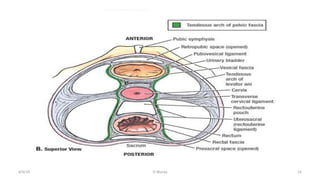
4/9/19	
   O	
  Warda	
   15	
  
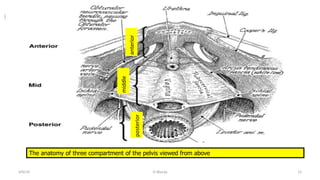
The anatomy of three compartment of the pelvis viewed from above
anterior	
  
middle	
  
posterior	
  
 
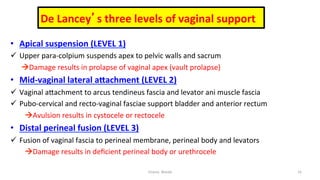
De	
  Lancey’s	
  three	
  levels	
  of	
  vaginal	
  support	
  
•  Apical	
  suspension	
  (LEVEL	
  1) 	


ü  Upper	
  para-­‐colpium	
  suspends	
  apex	
  to	
  pelvic	
  walls	
  and	
  sacrum	


  !Damage	
  results	
  in	
  prolapse	
  of	
  vaginal	
  apex	
  (vault	
  prolapse)	
  
•  Mid-­‐vaginal	
  lateral	
  aQachment	
  (LEVEL	
  2)	
  
ü  Vaginal	
  aRachment	
  to	
  arcus	
  tendineus	
  fascia	
  and	
  levator	
  ani	
  muscle	
  fascia	
  
ü  Pubo-­‐cervical	
  and	
  recto-­‐vaginal	
  fasciae	
  support	
  bladder	
  and	
  anterior	
  rectum	


  !Avulsion	
  results	
  in	
  cystocele	
  or	
  rectocele	
  
•  Distal	
  perineal	
  fusion	
  (LEVEL	
  3)	
  
ü  Fusion	
  of	
  vaginal	
  fascia	
  to	
  perineal	
  membrane,	
  perineal	
  body	
  and	
  levators	


  !Damage	
  results	
  in	
  deficient	
  perineal	
  body	
  or	
  urethrocele	
  
Osama	
  	
  Warda	
   16	


  Clinical	
  assessment	
  of	
  prolapse 	
  	
  
THE	
  HISTORY:	
  
•  You	
  should	
  elicit	
  the	
  presen=ng	
  symptom(s)	
  and	
  severity,	
  
and	
  include	
  ques=ons	
  to	
  ascertain	
  if	
  the	
  pa=ent	
  has	
  any	
  
coexis=ng	
  urinary,	
  fecal	
  or	
  sexual	
  symptoms	
  .	
  
•  One	
  should	
  be	
  sensi=ve	
  to	
  the	
  emo=onal	
  aspect	
  of	
  the	
  
problem,	
  but	
  specific	
  ques=ons	
  should	
  be	
  asked	
  about	
  
sexual	
  discomfort	
  and	
  difficulty	
  achieving	
  orgasm.	
  	
  
Osama	
  	
  Warda	
   17	


Clinical	
  assessment	
  of	
  prolapse	
  
CLINICAL	
  EXAM	
  
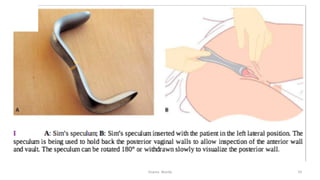
•  should	
  ideally	
  be	
  done	
  in	
  the	
  lithotomy	
  posi=on	
  with	
  a	
  Sims	
  
speculum	
  .	
  This	
  allows	
  retrac=on	
  of	
  the	
  anterior	
  and	
  posterior	
  
vaginal	
  wall	
  in	
  turn,	
  to	
  allow	
  full	
  assessment	
  of	
  the	
  degree	
  of	
  
prolapse	
  and	
  to	
  assess	
  how	
  much	
  descent	
  of	
  the	
  cervix	
  and	
  
uterus	
  is	
  present.	
  	
  
•  Prolapse	
  is	
  classically	
  described	
  in	
  three	
  stages	
  of	
  descent,	
  and	
  
note	
  should	
  be	
  made	
  of	
  whether	
  it	
  occurs	
  at	
  pa=ent	
  straining	
  
or	
  at	
  rest	
  and	
  whether	
  trac=on	
  has	
  been	
  applied:	
  
Osama	
  	
  Warda	
   18	


Osama	
  	
  Warda	
   19	


Osama	
  	
  Warda	
   20	


Osama	
  	
  Warda	
   21	
  
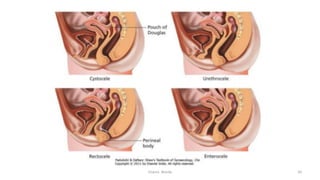
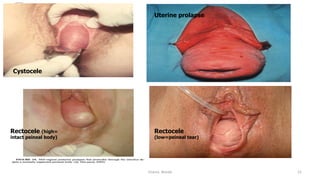
Cystocele
Rectocele (high=
intact peineal body)
Rectocele
(low=peineal tear)
Uterine prolapse
 
Osama	
  	
  Warda	
   22	
  
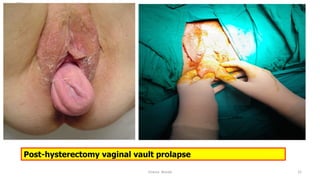
Post-hysterectomy vaginal vault prolapse
 
Clinical	
  assessment	
  of	
  prolapse	
  
•  In	
  view	
  of	
  the	
  complex	
  rela=onship	
  between	
  prolapse	
  and	
  bladder	
  or	
  
bowel	
  func=ons,	
  if	
  women	
  have	
  addi=onal	
  indirect	
  symptoms,	
  then	
  it	
  is	
  
prudent	
  to	
  arrange	
  urodynamic	
  assessment	
  or	
  func&onal	
  tests	
  of	
  the	
  
lower	
  bowel,	
  which	
  may	
  include	
  	
  
1-­‐	
  Endo-­‐anal	
  ultrasound	
  to	
  check	
  for	
  anal	
  	
  sphincter	
  defects,	


2-­‐	
  Rectal	
  manometry,	


  3-­‐Flexible	
  sigmoidoscopy	
  ,	


4-­‐	
  defaeca&ng	
  proctogram.	
  
•  Ideally,	
  such	
  pa=ents	
  should	
  be	
  reviewed	
  with	
  the	
  completed	
  
inves=ga=ons	
  in	
  a	
  MDT	
  mee=ng	
  including	
  a	
  gynecologist,	
  colorectal	
  
surgeon,	
  con=nence	
  nurse	
  and	
  physiotherapist.	
  
Osama	
  	
  Warda	
   23	


Stages	
  of	
  POP	
  
Vaginal	
  prolapse	
  is	
  formally	
  staged	
  using	
  different	
  
methods,	
  but	
  the	
  most	
  important	
  assessment	
  is	
  
whether	
  the	
  vaginal	
  prolapse	
  reaches	
  to,	
  or	
  beyond,	
  
the	
  hymen.	
  Finally,	
  it	
  is	
  important	
  to	
  assess	
  whether	
  
the	
  perineal	
  body	
  is	
  intact	
  or	
  has	
  become	
  aRenuated,	
  
resul=ng	
  in	
  an	
  enlarged	
  vaginal	
  opening.	
  
Osama	
  	
  Warda	
   24	


Stages	
  of	
  POP	
  
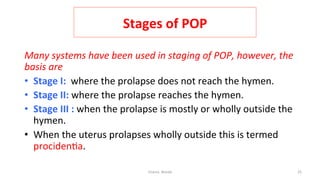
Many	
  systems	
  have	
  been	
  used	
  in	
  staging	
  of	
  POP,	
  however,	
  the	
  
basis	
  are	
  
•  Stage	
  I:	
  	
  where	
  the	
  prolapse	
  does	
  not	
  reach	
  the	
  hymen.	
  
•  Stage	
  II:	
  where	
  the	
  prolapse	
  reaches	
  the	
  hymen.	
  
•  Stage	
  III	
  :	
  when	
  the	
  prolapse	
  is	
  mostly	
  or	
  wholly	
  outside	
  the	
  
hymen.	
  	
  
•  When	
  the	
  uterus	
  prolapses	
  wholly	
  outside	
  this	
  is	
  termed	
  
prociden=a.	


Osama	
  	
  Warda	
   25	


Stages	
  of	
  POP	
  
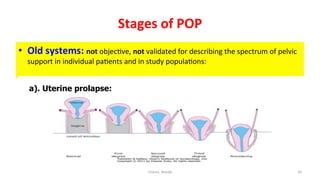
•  Old	
  systems:	
  not	
  objec=ve,	
  not	
  validated	
  for	
  describing	
  the	
  spectrum	
  of	
  pelvic	
  
support	
  in	
  individual	
  pa=ents	
  and	
  in	
  study	
  popula=ons:	


Osama	
  	
  Warda	
   26	
  
a). Uterine prolapse:


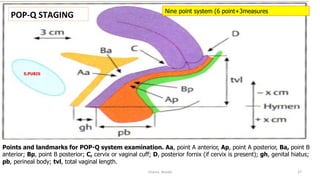
Points and landmarks for POP-Q system examination. Aa, point A anterior, Ap, point A posterior, Ba, point B
anterior; Bp, point B posterior; C, cervix or vaginal cuff; D, posterior fornix (if cervix is present); gh, genital hiatus;
pb, perineal body; tvl, total vaginal length.
Osama	
  	
  Warda	
   27	
  
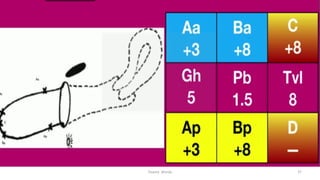
Nine point system (6 point+3measures
S.PUBIS
POP-­‐Q	
  STAGING	
  
 
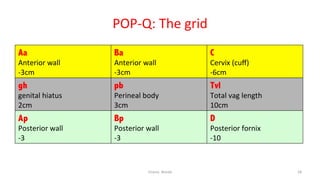
POP-­‐Q:	
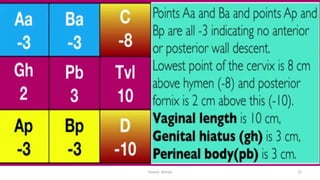
  The	
  grid	
  
Aa
Anterior	
  wall	
  
-­‐3cm	
  
Ba
Anterior	
  wall	
  
-­‐3cm	
  
C
Cervix	
  (cuff)	
  
-­‐6cm	
  
gh
genital	
  hiatus	
  
2cm	
  
pb
Perineal	
  body	
  
3cm	
  
Tvl
Total	
  vag	
  length	
  
10cm	
  
Ap
Posterior	
  wall	
  
-­‐3	
  
Bp
Posterior	
  wall	
  
-­‐3	
  
D
Posterior	
  fornix	
  
-­‐10	
  
Osama	
  	
  Warda	
   28	


POP-­‐Q	
  Stages	
  of	
  POP	
  
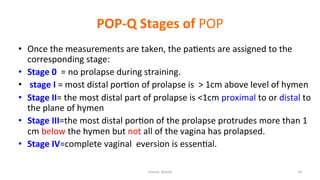
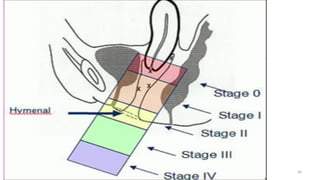
•  Once	
  the	
  measurements	
  are	
  taken,	
  the	
  pa=ents	
  are	
  assigned	
  to	
  the	
  
corresponding	
  stage:	
  	
  
•  Stage	
  0	
  	
  =	
  no	
  prolapse	
  during	
  straining.	
  
•  	
  stage	
  I	
  =	
  most	
  distal	
  por=on	
  of	
  prolapse	
  is	
  	
  >	
  1cm	
  above	
  level	
  of	
  hymen	
  	
  
•  Stage	
  II=	
  the	
  most	
  distal	
  part	
  of	
  prolapse	
  is	
  <1cm	
  proximal	
  to	
  or	
  distal	
  to	
  
the	
  plane	
  of	
  hymen	
  
•  Stage	
  III=the	
  most	
  distal	
  por=on	
  of	
  the	
  prolapse	
  protrudes	
  more	
  than	
  1	
  
cm	
  below	
  the	
  hymen	
  but	
  not	
  all	
  of	
  the	
  vagina	
  has	
  prolapsed.	
  	
  
•  Stage	
  IV=complete	
  vaginal	
  	
  eversion	
  is	
  essen=al.	


Osama	
  	
  Warda	
   29	


Osama	
  	
  Warda	
   30	
  
 
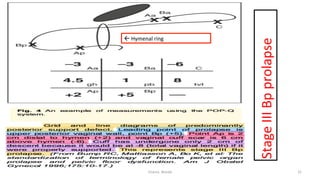
Stage	
  III	
  Bp	
  prolapse	
  
31	
  
ß	
  Hymenal	
  ring	
  
Osama	
  	
  Warda	
  
 
Osama	
  	
  Warda	
   32	
  
 
Osama	
  	
  Warda	
   33	
  
 
Osama	
  	
  Warda	
   34	
  
 
Osama	
  	
  Warda	
   35	
  
 
Osama	
  	
  Warda	
   36	
  
 
Osama	
  	
  Warda	
   37	
  
 
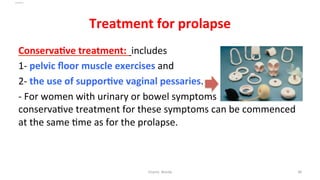
Treatment	
  for	
  prolapse	
  
ConservaYve	
  treatment:	
  	
  includes	
  	
  
1-­‐	
  pelvic	
  floor	
  muscle	
  exercises	
  and	
  	
  
2-­‐	
  the	
  use	
  of	
  supporYve	
  vaginal	
  pessaries.	
  	
  
-­‐	
  For	
  women	
  with	
  urinary	
  or	
  bowel	
  symptoms	
  as	
  well,	
  
conserva=ve	
  treatment	
  for	
  these	
  symptoms	
  can	
  be	
  commenced	
  
at	
  the	
  same	
  =me	
  as	
  for	
  the	
  prolapse.	
  	
  
Osama	
  	
  Warda	
   38	


Treatment	
  for	
  prolapse	
  
ConservaYve	
  treatment:	
  Pelvic	
  floor	
  exercises	
  	
  
– A	
  course	
  of	
  supervised	
  pelvic	
  floor	
  exercises	
  will	
  reduce	
  
the	
  symptoms	
  of	
  prolapse	
  and	
  for	
  women	
  who	
  are	
  keen	
  
to	
  avoid	
  surgical	
  treatment,	
  this	
  can	
  be	
  an	
  effec=ve	
  first	
  
step,	
  although	
  there	
  is	
  less	
  evidence	
  that	
  pelvic	
  floor	
  
exercise	
  will	
  reduce	
  the	
  anatomical	
  extent	
  of	
  the	
  prolapse	
  
and	
  it	
  is	
  unlikely	
  to	
  be	
  helpful	
  for	
  women	
  whose	
  prolapse	
  
is	
  beyond	
  the	
  vaginal	
  introitus.	
  
Osama	
  	
  Warda	
   39	


Treatment	
  for	
  prolapse	
  
ConservaYve	
  treatment:	
  Pessary	
  treatment:	
  
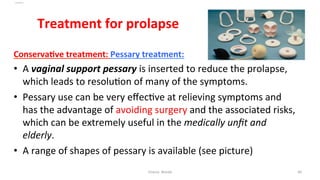
•  A	
  vaginal	
  support	
  pessary	
  is	
  inserted	
  to	
  reduce	
  the	
  prolapse,	
  
which	
  leads	
  to	
  resolu=on	
  of	
  many	
  of	
  the	
  symptoms.	
  	
  
•  Pessary	
  use	
  can	
  be	
  very	
  effec=ve	
  at	
  relieving	
  symptoms	
  and	
  
has	
  the	
  advantage	
  of	
  avoiding	
  surgery	
  and	
  the	
  associated	
  risks,	
  
which	
  can	
  be	
  extremely	
  useful	
  in	
  the	
  medically	
  unfit	
  and	
  
elderly.	
  	
  
•  A	
  range	
  of	
  shapes	
  of	
  pessary	
  is	
  available	
  (see	
  picture)	
  	
  
Osama	
  	
  Warda	
   40	


  ConservaYve	
  treatment:	
  Pessary	
  treatment:	
  (cont.)	
  
•  Ring	
  pessaries	
  are	
  usually	
  tried	
  first,	
  but	
  an	
  intact	
  perineal	
  
body	
  is	
  necessary	
  for	
  these	
  to	
  be	
  retained.	
  	
  
•  Shelf	
  pessaries,	
  Gelhorn	
  pessaries	
  and	
  others	
  are	
  useful	
  for	
  
women	
  with	
  deficient	
  perineal	
  bodies.	
  	
  
•  It	
  is	
  usual	
  prac=ce	
  to	
  replace	
  a	
  pessary	
  every	
  6	
  months	
  and	
  
to	
  examine	
  the	
  pa=ent	
  for	
  signs	
  of	
  vaginal	
  ulcera=on,	
  
although	
  this	
  frequency	
  is	
  tradi=onal	
  and	
  not	
  based	
  on	
  any	
  
evidence.	
  	
  
Osama	
  	
  Warda	
   41	


  ConservaYve	
  treatment:	
  Pessary	
  treatment:	
  (cont.)	
  
•  ComplicaYons	
  are	
  uncommon	
  and	
  usually	
  minor	
  (bleeding,	
  
discharge),	
  although	
  rarely	
  the	
  pessary	
  can	
  become	
  
incarcerated,	
  requiring	
  general	
  anesthesia	
  to	
  remove,	
  and	
  
rare	
  cases	
  of	
  rectovaginal	
  or	
  vesicovaginal	
  fistula	
  forma&on	
  
have	
  been	
  reported.	
  	
  
•  Sexual	
  intercourse	
  remains	
  theore=cally	
  possible	
  with	
  a	
  
well-­‐placed	
  ring	
  pessary,	
  but	
  not	
  with	
  the	
  others,	
  so	
  would	
  
not	
  generally	
  be	
  suitable	
  for	
  women	
  who	
  are	
  sexually	
  ac&ve.	


•  Mo=vated	
  pa=ents	
  can	
  be	
  taught	
  to	
  insert	
  and	
  remove	
  their	
  
own	
  pessaries	
  if	
  they	
  do	
  wish	
  to	
  remain	
  sexually	
  ac=ve.	
  
Osama	
  	
  Warda	
   42	


SURGERY	
  FOR	
  POP	
  
	
  •  Surgical	
  treatment	
  for	
  prolapse	
  is	
  common,	
  and	
  can	
  be	
  offered	
  
if	
  conserva=ve	
  treatments	
  have	
  failed	
  or	
  if	
  the	
  pa=ent	
  chooses	
  
surgery	
  from	
  the	
  outset.	
  	
  
•  There	
  are	
  a	
  wide	
  range	
  of	
  specific	
  procedures	
  .	
  	
  
•  The	
  procedure	
  chosen	
  depends	
  on	


  (1).which	
  compartment	
  is	
  affected,	


  (2).whether	
  the	
  woman	
  wishes	
  to	
  retain	
  her	
  uterus	
  and	
  
(3).whether	
  the	
  vaginal	
  or	
  abdominal	
  route	
  of	
  surgery	
  is	
  chosen.	
  	
  
•  The	
  essen=al	
  principles	
  of	
  prolapse	
  surgery	
  apply	
  for	
  all	
  
procedures.	
  	
  
Osama	
  	
  Warda	
   43	


SURGERY	
  FOR	
  POP	


•  Prolapse	
  surgery	
  is	
  performed	
  through	
  the	
  vagina	
  to	
  restore	
  
the	
  ligamentous	
  =ssue	
  supports	
  to	
  the	
  apex,	
  anterior	
  and	
  
posterior	
  vagina	
  (anterior	
  repair,	
  posterior	
  repair)	
  and	
  
repair	
  of	
  the	
  perineal	
  body.	
  
•  	
  The	
  vaginal	
  route	
  can	
  also	
  be	
  used	
  for	
  pos-­‐thysterectomy	
  
vault	
  prolapse,	
  aRaching	
  the	
  vaginal	
  vault	
  to	
  the	
  right	
  
sacrospinous	
  ligament	
  with	
  non-­‐absorbable	
  or	
  slowly	
  
absorbable	
  sutures,	
  but	
  here	
  an	
  abdominal	
  approach	
  to	
  
perform	
  a	
  sacrocolpopexy	
  is	
  an	
  op=on	
  that	
  will	
  provide	
  
excellent,	
  durable	
  long-­‐term	
  cure.	
  	
  
Osama	
  	
  Warda	
   44	


SURGERY	
  FOR	
  POP	
  
	
  •  In	
  the	
  last	
  3–5	
  years,	
  there	
  has	
  been	
  an	
  increasing	
  number	
  of	
  
women	
  wishing	
  to	
  avoid	
  hysterectomy	
  during	
  prolapse	
  
surgery,	
  so	
  both	
  sacrospinous	
  fixa.on	
  and	
  sacrocolpopexy	
  can	
  
be	
  performed	
  by	
  aRaching	
  a	
  mesh	
  or	
  sutures	
  to	
  the	
  cervix	
  
rather	
  than	
  the	
  vaginal	
  vault.	
  
•  Vaginal	
  repair	
  using	
  mesh	
  improves	
  the	
  anatomical	
  outcome	
  
and	
  reduces	
  the	
  risk	
  of	
  recurrent	
  prolapse.	
  No	
  difference	
  in	
  
symptom	
  relief	
  between	
  standard	
  repair	
  and	
  mesh	
  repair.	
  
Mesh	
  repair	
  carries	
  the	
  risk	
  of	
  later	
  erosion	
  and	
  need	
  for	
  
removal,	
  which	
  is	
  challenging	
  surgery.	
  	
  
Osama	
  	
  Warda	
   45	


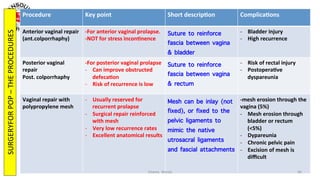
Procedure	
  	
   Key	
  point	
   Short	
  descripYon	
  	
   ComplicaYons	
  	
  
Anterior	
  vaginal	
  repair	
  
(ant.colporrhaphy)	
  
-­‐For	
  anterior	
  vaginal	
  prolapse.	
  
-­‐NOT	
  for	
  stress	
  inconYnence	
  
Suture to reinforce
fascia between vagina
& bladder ︎
-­‐  Bladder	
  injury	
  
-­‐  High	
  recurrence	
  
Posterior	
  vaginal	
  
repair	
  
Post.	
  colporrhaphy	
  
-­‐For	
  posterior	
  vaginal	
  prolapse	
  
-­‐  Can	
  improve	
  obstructed	
  
defecaYon	
  
-­‐  Risk	
  of	
  recurrence	
  is	
  low	
  
Suture to reinforce
fascia between vagina
& rectum︎
-­‐  Risk	
  of	
  rectal	
  injury	
  
-­‐  PostoperaYve	
  
dyspareunia	
  
Vaginal	
  repair	
  with	
  
polypropylene	
  mesh	
  
-­‐  Usually	
  reserved	
  for	
  
recurrent	
  prolapse	
  
-­‐  Surgical	
  repair	
  reinforced	
  
with	
  mesh	
  
-­‐  Very	
  low	
  recurrence	
  rates	
  
-­‐  Excellent	
  anatomical	
  results	
  
Mesh can be inlay (not
fixed), or fixed to the
pelvic ligaments to
mimic the native
utrosacral ligaments
and fascial attachments︎
-­‐mesh	
  erosion	
  through	
  the	
  
vagina	
  (5%)	
  
-­‐  Mesh	
  erosion	
  through	
  
bladder	
  or	
  rectum	
  
(<5%)	
  
-­‐  Dypareunia	
  
-­‐  Chronic	
  pelvic	
  pain	
  
-­‐  Excision	
  of	
  mesh	
  is	
  
difficult	
  	
  
Osama	
  	
  Warda	
   46	
  
SURGERYFOR	
  POP	
  –	
  THE	
  PROCEDURES	
  
 
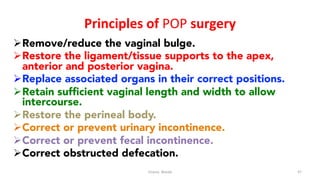
Principles	
  of	
  POP	
  surgery	
  
Ø Remove/reduce the vaginal bulge.
Ø Restore the ligament/tissue supports to the apex,
anterior and posterior vagina.
Ø Replace associated organs in their correct positions.
Ø Retain sufficient vaginal length and width to allow
intercourse.
Ø Restore the perineal body.
Ø Correct or prevent urinary incontinence.
Ø Correct or prevent fecal incontinence.
Ø Correct obstructed defecation.
Osama	
  	
  Warda	
   47	


KEY	
  LEARNING	
  POINTS	
  
•  Uterovaginal prolapse causes troublesome symptoms but is not life
threatening.
•  A course of pelvic floor exercises can reduce symptoms and may
reduce prolapse progression in women with mild/moderate prolapse.
•  Vaginal pessaries are a useful conservative treatment but do not suit
all women.
•  Surgery for prolapse is effective, but has a recurrence rate of about
5%.
•  It is not essential to perform hysterectomy for prolapse.
•  Mesh repairs for prolapse give a better anatomical cure, but there is
no convincing evidence that symptom relief is different from standard
surgery.
•  Mesh complications are common and can be extremely difficult to
manage.
Osama	
  	
  Warda	
   48	


Thank	
  you	
  
	
  hRps://www.slideshare.net/OSAMAWARDA/pepvic-­‐organ-­‐prolapseprof-­‐osama-­‐warda	
  
Osama	
  	
  Warda	
   49	


Pop (post graduate). prof. osama warda

  • 1.
    Pelvic Organ Prolapse (POP) Osama  M  Warda  MD   Prof.  of  obstetrics  &  gynecology   Mansoura  University  
  • 2.
      DEFINITION     • Pelvic  organ  prolapse  (POP)  can  be  defined  as  descent   of  the  pelvic  organ(s)  ;  bladder,  rectum,  vagina,  uterus;   below  their  normal  anatomical  posi=on  due  to   distor=on  of  their  dynamic  and  integrated  support.   Osama    Warda   2          
  • 3.
      Symptoms  from  POP   •  POP  can  cause  symptoms  directly  due  to  the  prolapsed   organ  or  indirectly  due  to  organ  dysfunc=on  secondary  to   displacement  from  the  anatomical  posi=on.     •  Direct  POP  symptoms  include:     (1) a  sensa=on  of  vaginal  bulge,     (2) heaviness  or  a  visible  protrusion  at  or  beyond  the  introitus.     (3)   lower  abdominal  or  back  pain,  or  a  dragging  discomfort   relieved  by  lying  or  siEng.   Osama    Warda   3          
  • 4.
      Symptoms  from  POP   •  Indirect  symptoms:    will  depend  on  which  other  organs  are   involved  in  the  prolapse.    They  include:     (1)difficulty  in  urina&on  or  defeca&on  (obstruc=ve  defeca=on)   (2)  sensa=ons  of  incomplete  emptying  of  bladder  or  rectum.     (3)Pa=ents  may  have  to  support  or  reduce  the  prolapse  with  their   fingers  to  be  able  to  void  or  evacuate  stool  completely  (i.e.   digita=on)   (4)  Urinary  or  fecal  incon&nence  may  also  be  present   (5)  Sexual  dysfunc=on  due  to  introital  laxity   (6)  Bleeding  from  abrasion  of  the  prolapsed  part   Osama    Warda   4          
  • 5.
      ETIOLOGY  OF  POP   •  Risk  factors  predisposing  to  prolapse  either  congenital   weakness  of  the  mesenchyme  or  due  to  obstetric  trauma.     •  Obstetric  trauma  causes:   1-­‐  Pudendal  nerves    damaged  ,  with  increased  nerve  conduc=on   =mes   2-­‐Thinning  or  avulsion  of  the  puborectalis  muscle  from  its   inser=on  on  the  pubic  ramus  on  one  or  both  sides.   Osama    Warda   5          
  • 6.
      ETIOLOGY  OF  POP   Increased   intrabdominal  pressure   POP   Weakness  of  pelvic   support  (e.g   congenital  or   postmenopausal)   Trauma  to  pelvic   supports  (e.g.   obstetrical)   Osama    Warda   6            
  • 7.
      Relevant  Anatomy   • Uterovaginal  prolapse  is  caused  by  failure  of   the  interac.on  between  the  levator  ani   muscles  and  the  ligaments  and  fascia  that   support  the  pelvic  organs.     •  The  levator  ani  muscles  are  puborectalis,   pubococcygeus  and  iliococcygeus.     •  They  are  aRached  on  each  side  of  the  pelvic   side  wall  from  the  pubic  ramus  anteriorly   (pubococcygeus),  over  the  obturator  internus   fascia  to  the  ischial  spine  to  form  a  bowl-­‐ shaped  muscle  filling  the  pelvic  outlet  and   suppor=ng  the  pelvic  organs   Osama    Warda   7          
  • 8.
      Relevant  Anatomy   • There  is  a  gap  between  the  fibers  of   the  puborectalis  on  each  side  to   allow  passage  of  the  urethra,   vagina  and  rectum,  called  the   urogenital  hiatus.     •  The  levator  muscles  support  the   pelvic  organs  and  prevent  excessive   loading  of  the  ligaments  and  fascia.   Osama    Warda   8          
  • 9.
      Fascial supports ofthe pelvic organs. Level 1 support is provided by the uterosacral ligaments, suspending the uterus and attached vaginal vault. Level 2 (midvagina) support is provided by the fascia lying between the vagina and the bladder or rectum that fuses laterally and runs to attach on the pelvic side wall. Level 3 support is provided by the perineal body, which has the posterior vaginal fascia fused to its upper surface. Osama    Warda   9  
  • 10.
      Development of prolapse. Thepelvic floor and ligaments work together to provide support against increases in abdominal pressure (A). Prolapse is almost invariably associated with perineal body damage causing an enlarged vaginal opening. Prolapse can then occur if the apical (level 1) support is lost (B), or if the pelvic floor muscles are ineffective (C) or directly as a result of perineal body deficiency (D). Often, a combination of factors is atwork. Osama    Warda   10  
  • 11.
      Relevant  Anatomy   Key  Learning  Points:   •  The  levator  ani  muscles  (puborectalis,  pubococcygeus  and   iliococcygeus)  support  the  pelvic  organs  and  relieve  excessive   pressure  from  the  ligaments  and  fascia.   •  The  uterosacral  ligaments  provide  essen=al  apical  support  (level  1   support).   •  Vaginal  fascia  supports  the  vagina  (level  2  support).   •  The  perineal  body  is  very  important  in  suppor=ng  the  lower  vagina   (level  3  support).   Ø   All  the  structures  provide  a  dynamic  and  integrated  support  to  the   pelvic  organs.   Osama    Warda   11          
  • 12.
      4/9/19   O  Warda   12  
  • 13.
      Fascial ligaments 4/9/19  O  Warda   13   Deeper level          
  • 14.
      4/9/19   O  Warda   14  
  • 15.
      4/9/19   O  Warda   15   The anatomy of three compartment of the pelvis viewed from above anterior   middle   posterior  
  • 16.
      De  Lancey’s  three  levels  of  vaginal  support   •  Apical  suspension  (LEVEL  1)       ü  Upper  para-­‐colpium  suspends  apex  to  pelvic  walls  and  sacrum              !Damage  results  in  prolapse  of  vaginal  apex  (vault  prolapse)   •  Mid-­‐vaginal  lateral  aQachment  (LEVEL  2)   ü  Vaginal  aRachment  to  arcus  tendineus  fascia  and  levator  ani  muscle  fascia   ü  Pubo-­‐cervical  and  recto-­‐vaginal  fasciae  support  bladder  and  anterior  rectum                  !Avulsion  results  in  cystocele  or  rectocele   •  Distal  perineal  fusion  (LEVEL  3)   ü  Fusion  of  vaginal  fascia  to  perineal  membrane,  perineal  body  and  levators                  !Damage  results  in  deficient  perineal  body  or  urethrocele   Osama    Warda   16          
  • 17.
       Clinical  assessment  of  prolapse     THE  HISTORY:   •  You  should  elicit  the  presen=ng  symptom(s)  and  severity,   and  include  ques=ons  to  ascertain  if  the  pa=ent  has  any   coexis=ng  urinary,  fecal  or  sexual  symptoms  .   •  One  should  be  sensi=ve  to  the  emo=onal  aspect  of  the   problem,  but  specific  ques=ons  should  be  asked  about   sexual  discomfort  and  difficulty  achieving  orgasm.     Osama    Warda   17          
  • 18.
      Clinical  assessment  of  prolapse   CLINICAL  EXAM   •  should  ideally  be  done  in  the  lithotomy  posi=on  with  a  Sims   speculum  .  This  allows  retrac=on  of  the  anterior  and  posterior   vaginal  wall  in  turn,  to  allow  full  assessment  of  the  degree  of   prolapse  and  to  assess  how  much  descent  of  the  cervix  and   uterus  is  present.     •  Prolapse  is  classically  described  in  three  stages  of  descent,  and   note  should  be  made  of  whether  it  occurs  at  pa=ent  straining   or  at  rest  and  whether  trac=on  has  been  applied:   Osama    Warda   18          
  • 19.
      Osama    Warda   19          
  • 20.
      Osama    Warda   20          
  • 21.
      Osama    Warda   21   Cystocele Rectocele (high= intact peineal body) Rectocele (low=peineal tear) Uterine prolapse
  • 22.
      Osama    Warda   22   Post-hysterectomy vaginal vault prolapse
  • 23.
      Clinical  assessment  of  prolapse   •  In  view  of  the  complex  rela=onship  between  prolapse  and  bladder  or   bowel  func=ons,  if  women  have  addi=onal  indirect  symptoms,  then  it  is   prudent  to  arrange  urodynamic  assessment  or  func&onal  tests  of  the   lower  bowel,  which  may  include     1-­‐  Endo-­‐anal  ultrasound  to  check  for  anal    sphincter  defects,               2-­‐  Rectal  manometry,                                                    3-­‐Flexible  sigmoidoscopy  ,                                                           4-­‐  defaeca&ng  proctogram.   •  Ideally,  such  pa=ents  should  be  reviewed  with  the  completed   inves=ga=ons  in  a  MDT  mee=ng  including  a  gynecologist,  colorectal   surgeon,  con=nence  nurse  and  physiotherapist.   Osama    Warda   23            
  • 24.
      Stages  of  POP   Vaginal  prolapse  is  formally  staged  using  different   methods,  but  the  most  important  assessment  is   whether  the  vaginal  prolapse  reaches  to,  or  beyond,   the  hymen.  Finally,  it  is  important  to  assess  whether   the  perineal  body  is  intact  or  has  become  aRenuated,   resul=ng  in  an  enlarged  vaginal  opening.   Osama    Warda   24            
  • 25.
      Stages  of  POP   Many  systems  have  been  used  in  staging  of  POP,  however,  the   basis  are   •  Stage  I:    where  the  prolapse  does  not  reach  the  hymen.   •  Stage  II:  where  the  prolapse  reaches  the  hymen.   •  Stage  III  :  when  the  prolapse  is  mostly  or  wholly  outside  the   hymen.     •  When  the  uterus  prolapses  wholly  outside  this  is  termed   prociden=a.     Osama    Warda   25            
  • 26.
      Stages  of  POP   •  Old  systems:  not  objec=ve,  not  validated  for  describing  the  spectrum  of  pelvic   support  in  individual  pa=ents  and  in  study  popula=ons:         Osama    Warda   26   a). Uterine prolapse:        
  • 27.
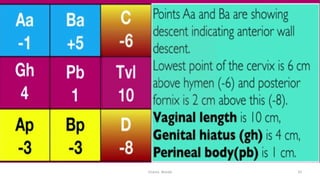
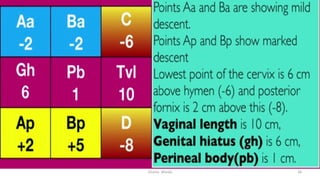
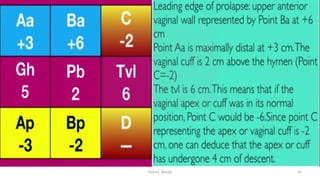
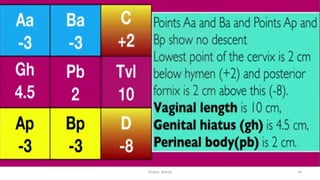
      Points and landmarksfor POP-Q system examination. Aa, point A anterior, Ap, point A posterior, Ba, point B anterior; Bp, point B posterior; C, cervix or vaginal cuff; D, posterior fornix (if cervix is present); gh, genital hiatus; pb, perineal body; tvl, total vaginal length. Osama    Warda   27   Nine point system (6 point+3measures S.PUBIS POP-­‐Q  STAGING  
  • 28.
      POP-­‐Q:  The  grid   Aa Anterior  wall   -­‐3cm   Ba Anterior  wall   -­‐3cm   C Cervix  (cuff)   -­‐6cm   gh genital  hiatus   2cm   pb Perineal  body   3cm   Tvl Total  vag  length   10cm   Ap Posterior  wall   -­‐3   Bp Posterior  wall   -­‐3   D Posterior  fornix   -­‐10   Osama    Warda   28          
  • 29.
      POP-­‐Q  Stages  of  POP   •  Once  the  measurements  are  taken,  the  pa=ents  are  assigned  to  the   corresponding  stage:     •  Stage  0    =  no  prolapse  during  straining.   •   stage  I  =  most  distal  por=on  of  prolapse  is    >  1cm  above  level  of  hymen     •  Stage  II=  the  most  distal  part  of  prolapse  is  <1cm  proximal  to  or  distal  to   the  plane  of  hymen   •  Stage  III=the  most  distal  por=on  of  the  prolapse  protrudes  more  than  1   cm  below  the  hymen  but  not  all  of  the  vagina  has  prolapsed.     •  Stage  IV=complete  vaginal    eversion  is  essen=al.     Osama    Warda   29          
  • 30.
  • 31.
      Stage  III  Bp  prolapse   31   ß  Hymenal  ring   Osama    Warda  
  • 32.
  • 33.
  • 34.
  • 35.
  • 36.
  • 37.
  • 38.
      Treatment  for  prolapse   ConservaYve  treatment:    includes     1-­‐  pelvic  floor  muscle  exercises  and     2-­‐  the  use  of  supporYve  vaginal  pessaries.     -­‐  For  women  with  urinary  or  bowel  symptoms  as  well,   conserva=ve  treatment  for  these  symptoms  can  be  commenced   at  the  same  =me  as  for  the  prolapse.     Osama    Warda   38          
  • 39.
      Treatment  for  prolapse   ConservaYve  treatment:  Pelvic  floor  exercises     – A  course  of  supervised  pelvic  floor  exercises  will  reduce   the  symptoms  of  prolapse  and  for  women  who  are  keen   to  avoid  surgical  treatment,  this  can  be  an  effec=ve  first   step,  although  there  is  less  evidence  that  pelvic  floor   exercise  will  reduce  the  anatomical  extent  of  the  prolapse   and  it  is  unlikely  to  be  helpful  for  women  whose  prolapse   is  beyond  the  vaginal  introitus.   Osama    Warda   39          
  • 40.
      Treatment  for  prolapse   ConservaYve  treatment:  Pessary  treatment:   •  A  vaginal  support  pessary  is  inserted  to  reduce  the  prolapse,   which  leads  to  resolu=on  of  many  of  the  symptoms.     •  Pessary  use  can  be  very  effec=ve  at  relieving  symptoms  and   has  the  advantage  of  avoiding  surgery  and  the  associated  risks,   which  can  be  extremely  useful  in  the  medically  unfit  and   elderly.     •  A  range  of  shapes  of  pessary  is  available  (see  picture)     Osama    Warda   40          
  • 41.
         ConservaYve  treatment:  Pessary  treatment:  (cont.)   •  Ring  pessaries  are  usually  tried  first,  but  an  intact  perineal   body  is  necessary  for  these  to  be  retained.     •  Shelf  pessaries,  Gelhorn  pessaries  and  others  are  useful  for   women  with  deficient  perineal  bodies.     •  It  is  usual  prac=ce  to  replace  a  pessary  every  6  months  and   to  examine  the  pa=ent  for  signs  of  vaginal  ulcera=on,   although  this  frequency  is  tradi=onal  and  not  based  on  any   evidence.     Osama    Warda   41          
  • 42.
                   ConservaYve  treatment:  Pessary  treatment:  (cont.)   •  ComplicaYons  are  uncommon  and  usually  minor  (bleeding,   discharge),  although  rarely  the  pessary  can  become   incarcerated,  requiring  general  anesthesia  to  remove,  and   rare  cases  of  rectovaginal  or  vesicovaginal  fistula  forma&on   have  been  reported.     •  Sexual  intercourse  remains  theore=cally  possible  with  a   well-­‐placed  ring  pessary,  but  not  with  the  others,  so  would   not  generally  be  suitable  for  women  who  are  sexually  ac&ve.       •  Mo=vated  pa=ents  can  be  taught  to  insert  and  remove  their   own  pessaries  if  they  do  wish  to  remain  sexually  ac=ve.   Osama    Warda   42          
  • 43.
        SURGERY  FOR  POP    •  Surgical  treatment  for  prolapse  is  common,  and  can  be  offered   if  conserva=ve  treatments  have  failed  or  if  the  pa=ent  chooses   surgery  from  the  outset.     •  There  are  a  wide  range  of  specific  procedures  .     •  The  procedure  chosen  depends  on      (1).which  compartment  is  affected,      (2).whether  the  woman  wishes  to  retain  her  uterus  and   (3).whether  the  vaginal  or  abdominal  route  of  surgery  is  chosen.     •  The  essen=al  principles  of  prolapse  surgery  apply  for  all   procedures.     Osama    Warda   43          
  • 44.
        SURGERY  FOR  POP     •  Prolapse  surgery  is  performed  through  the  vagina  to  restore   the  ligamentous  =ssue  supports  to  the  apex,  anterior  and   posterior  vagina  (anterior  repair,  posterior  repair)  and   repair  of  the  perineal  body.   •   The  vaginal  route  can  also  be  used  for  pos-­‐thysterectomy   vault  prolapse,  aRaching  the  vaginal  vault  to  the  right   sacrospinous  ligament  with  non-­‐absorbable  or  slowly   absorbable  sutures,  but  here  an  abdominal  approach  to   perform  a  sacrocolpopexy  is  an  op=on  that  will  provide   excellent,  durable  long-­‐term  cure.     Osama    Warda   44          
  • 45.
        SURGERY  FOR  POP    •  In  the  last  3–5  years,  there  has  been  an  increasing  number  of   women  wishing  to  avoid  hysterectomy  during  prolapse   surgery,  so  both  sacrospinous  fixa.on  and  sacrocolpopexy  can   be  performed  by  aRaching  a  mesh  or  sutures  to  the  cervix   rather  than  the  vaginal  vault.   •  Vaginal  repair  using  mesh  improves  the  anatomical  outcome   and  reduces  the  risk  of  recurrent  prolapse.  No  difference  in   symptom  relief  between  standard  repair  and  mesh  repair.   Mesh  repair  carries  the  risk  of  later  erosion  and  need  for   removal,  which  is  challenging  surgery.     Osama    Warda   45          
  • 46.
      Procedure    Key  point   Short  descripYon     ComplicaYons     Anterior  vaginal  repair   (ant.colporrhaphy)   -­‐For  anterior  vaginal  prolapse.   -­‐NOT  for  stress  inconYnence   Suture to reinforce fascia between vagina & bladder ︎ -­‐  Bladder  injury   -­‐  High  recurrence   Posterior  vaginal   repair   Post.  colporrhaphy   -­‐For  posterior  vaginal  prolapse   -­‐  Can  improve  obstructed   defecaYon   -­‐  Risk  of  recurrence  is  low   Suture to reinforce fascia between vagina & rectum︎ -­‐  Risk  of  rectal  injury   -­‐  PostoperaYve   dyspareunia   Vaginal  repair  with   polypropylene  mesh   -­‐  Usually  reserved  for   recurrent  prolapse   -­‐  Surgical  repair  reinforced   with  mesh   -­‐  Very  low  recurrence  rates   -­‐  Excellent  anatomical  results   Mesh can be inlay (not fixed), or fixed to the pelvic ligaments to mimic the native utrosacral ligaments and fascial attachments︎ -­‐mesh  erosion  through  the   vagina  (5%)   -­‐  Mesh  erosion  through   bladder  or  rectum   (<5%)   -­‐  Dypareunia   -­‐  Chronic  pelvic  pain   -­‐  Excision  of  mesh  is   difficult     Osama    Warda   46   SURGERYFOR  POP  –  THE  PROCEDURES  
  • 47.
      Principles  of  POP  surgery   Ø Remove/reduce the vaginal bulge. Ø Restore the ligament/tissue supports to the apex, anterior and posterior vagina. Ø Replace associated organs in their correct positions. Ø Retain sufficient vaginal length and width to allow intercourse. Ø Restore the perineal body. Ø Correct or prevent urinary incontinence. Ø Correct or prevent fecal incontinence. Ø Correct obstructed defecation. Osama    Warda   47          
  • 48.
      KEY  LEARNING  POINTS   •  Uterovaginal prolapse causes troublesome symptoms but is not life threatening. •  A course of pelvic floor exercises can reduce symptoms and may reduce prolapse progression in women with mild/moderate prolapse. •  Vaginal pessaries are a useful conservative treatment but do not suit all women. •  Surgery for prolapse is effective, but has a recurrence rate of about 5%. •  It is not essential to perform hysterectomy for prolapse. •  Mesh repairs for prolapse give a better anatomical cure, but there is no convincing evidence that symptom relief is different from standard surgery. •  Mesh complications are common and can be extremely difficult to manage. Osama    Warda   48          
  • 49.
      Thank  you    hRps://www.slideshare.net/OSAMAWARDA/pepvic-­‐organ-­‐prolapseprof-­‐osama-­‐warda   Osama    Warda   49