


Pooled Referrals
Dr Corrine Jabs
This Session is sponsored by:
Pooled Referrals
Dr. Corrine Jabs
Dept Head, Obstetrics & Gynecology
Regina Qu’Appelle Health Region
Inspire Conference, Regina, April 2013
Disclosures
• Speaker’s bureau
– Pfizer
– Astellas
Objectives
• Understand:
– The concept of pooled referrals
– The challenges encountered in implementing the
concept of pooled referrals
– The rewards and advantages of pooled referrals
Regina Department of Obstetrics and
Gynecology
Department Obstetrics & Gynecology
Regina
The Problem
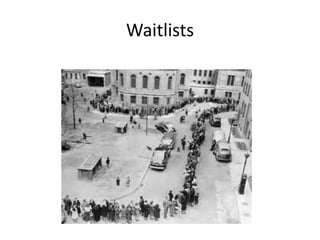
Waitlists
Waitlists
Referral
Consultation
Surgery
Patient need
Department of Obstetrics and Gynecology December
2010
Saskatchewan Specialist Registry
0 0 7 14 14 21 28
365 365 365 365 365
A B C D E F G H I J K L
Days for elective gyne referral to be seen
Issues:
• Long waits for some patients and very short for some patients
• Referring docs do not have consistent information regarding
waiting lists.
• Overload of some offices, concerns about job security in
others
• Multiple requests for referral/lost referrals
• Redirected referrals due to overload
• Redirected referrals due to skill set
• No control over inflow when ill, on leave, etc.
• Don’t know overall capacity or backlog in the dept and can’t
predict manpower needs
• Demand = patient need
• Supply = capacity of the providers
• The trick is to balance these
Pooled Referrals
Why consider
pooled referrals?
Why Pooled Referrals?
• Patients, through the Patient First Review,
stated they want improved access and well
coordinated care.
• Pooled referrals is a strategy to reduce wait
time variability among a group of specialists
that perform similar procedures and helps
improve access
The Solution?
What did we want to do?
• Level the workload / Work as a team
• Determine our capacity and backlog as a group
• Reduce wait times for consultation
• Ensure patients are seen by the appropriate
specialist/subspecialist (skill task alignment)
• Ensure GPs and patients are kept informed about the
status of their referral and appointment
Dept of Obstetrics & Gynecology Regina
“Our Plan”
• As a Department, we agreed to adopt pooled
referrals as a quality improvement project to
streamline the referral process and improve patient
access to our specialists
• Patients now have a CHOICE:
1. they can select a particular specialist, or
2. they can choose to see the next available specialist able to
treat their condition
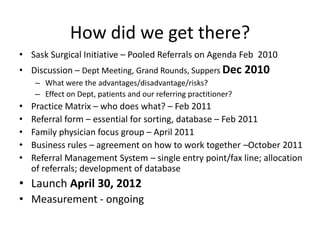
How did we get there?
• Sask Surgical Initiative – Pooled Referrals on Agenda Feb 2010
• Discussion – Dept Meeting, Grand Rounds, Suppers Dec 2010
– What were the advantages/disadvantage/risks?
– Effect on Dept, patients and our referring practitioner?
• Practice Matrix – who does what? – Feb 2011
• Referral form – essential for sorting, database – Feb 2011
• Family physician focus group – April 2011
• Business rules – agreement on how to work together –October 2011
• Referral Management System – single entry point/fax line; allocation
of referrals; development of database
• Launch April 30, 2012
• Measurement - ongoing
• We were eager to start
• We did not expect
perfection from the start
• We anticipated change and
challenges
• We are making changes
“Our Challenges”
• Unlike the other early adopters of pooled referrals, our 15
specialists do not share a single office
• Multiple offices multiple fax lines
• Consulting with GPs not an easy task
• Database and Referral Management Service did not exist
• Perfection was expected. People confused because they were
expecting this to be a traditional project. We used the PDSA
approach: moving from good to better over time
What we did…
Patient Allocation
Impact of Pooling Referrals on:
Patient choice
Our Information Given to Referral
Management Service
Distribution of Patients in Obstetrics
Based on Capacity
Distribution of Patients in Gynecology
Based on Capacity and Demand
Other valuable information
Where should we direct our attention?
Impact of Pooling Referrals on:
Wait times
Determine our capacity and backlog
as a group
Determine our capacity and backlog
as a group
Counter measure: urgent wait times
Backlog Reduction
Where is our backlog?
Reducing wait times
What is the Data telling us?
• Wait times for our department are coming down and
becoming more consistent.
• For obstetrics: women appear to value their
relationship with a particular specialist
• For urgent and elective gynecology issues: women
appear to want to have their issues addressed
quickly
• We do not need to pool all patients to see
improvement (~ 40% of obs, ~ 50% of gyne)
The Value of Data
• This data includes
• number of referrals received,
• reasons for referral,
• capacity of the department as a whole and
• data related to patient waits
The Value of Data
• For the first time ever, we have valuable data about
our entire department’s workload
• This data is already proving to be a valuable planning
tool for further quality improvement and access
initiatives in our department
The Value of Data
• Outliers and anomalies can be identified
• countermeasures can be determined
Who is/will be pooling referrals?
Department Region No. of Surgeons “Go Live” Date
Orthopedics PAPRHA 4 Live Mar 19, 2012
Ob/gyn RQHR 15 Live -April 30, 2012
Neurosurgery** RQHR 5 Live - June 23, 2011
Neurosurgery** SHR 5 Live -June 23, 2011
General Surgery PAPRHA 5 Live -Nov 22, 2012
Ob/gyn* SHR 9 Live Jan 12, 2013
Thoracic Surgery SHR 3 Self-initiated
Vascular Surgery SHR 4 Self-initiated
Urology SHR 7 Self-initiated
Vascular Surgery RQHR 3 Self-initiated
Cardio-thoracic RQHR 3 Self-initiated
Ob/gyn FHHR 3 Spring 2013
Ob/gyn PNHR 3 Spring 2013
General Surgery PNHR 4 Spring 2013
Plastics SHR 4 Summer 2013
Cardiology SHR 13 Summer 2013
* A group practice of 9 surgeons
** Back pain patients are pooled through the spine pathway, includes several orthopedic
surgeons
Thoughts/Discussion/Questions
Thank you

Pooled Referrals

  • 1.
    Pooled Referrals Dr CorrineJabs This Session is sponsored by:
  • 2.
    Pooled Referrals Dr. CorrineJabs Dept Head, Obstetrics & Gynecology Regina Qu’Appelle Health Region Inspire Conference, Regina, April 2013
  • 3.
  • 4.
    Objectives • Understand: – Theconcept of pooled referrals – The challenges encountered in implementing the concept of pooled referrals – The rewards and advantages of pooled referrals
  • 5.
    Regina Department ofObstetrics and Gynecology
  • 6.
    Department Obstetrics &Gynecology Regina
  • 7.
  • 8.
  • 9.
  • 10.
  • 11.
    Department of Obstetricsand Gynecology December 2010 Saskatchewan Specialist Registry 0 0 7 14 14 21 28 365 365 365 365 365 A B C D E F G H I J K L Days for elective gyne referral to be seen
  • 12.
    Issues: • Long waitsfor some patients and very short for some patients • Referring docs do not have consistent information regarding waiting lists. • Overload of some offices, concerns about job security in others • Multiple requests for referral/lost referrals • Redirected referrals due to overload • Redirected referrals due to skill set • No control over inflow when ill, on leave, etc. • Don’t know overall capacity or backlog in the dept and can’t predict manpower needs
  • 13.
    • Demand =patient need • Supply = capacity of the providers • The trick is to balance these
  • 14.
  • 15.
  • 16.
    Why Pooled Referrals? •Patients, through the Patient First Review, stated they want improved access and well coordinated care. • Pooled referrals is a strategy to reduce wait time variability among a group of specialists that perform similar procedures and helps improve access
  • 17.
  • 18.
    What did wewant to do? • Level the workload / Work as a team • Determine our capacity and backlog as a group • Reduce wait times for consultation • Ensure patients are seen by the appropriate specialist/subspecialist (skill task alignment) • Ensure GPs and patients are kept informed about the status of their referral and appointment
  • 19.
    Dept of Obstetrics& Gynecology Regina
  • 20.
    “Our Plan” • Asa Department, we agreed to adopt pooled referrals as a quality improvement project to streamline the referral process and improve patient access to our specialists • Patients now have a CHOICE: 1. they can select a particular specialist, or 2. they can choose to see the next available specialist able to treat their condition
  • 21.
    How did weget there? • Sask Surgical Initiative – Pooled Referrals on Agenda Feb 2010 • Discussion – Dept Meeting, Grand Rounds, Suppers Dec 2010 – What were the advantages/disadvantage/risks? – Effect on Dept, patients and our referring practitioner? • Practice Matrix – who does what? – Feb 2011 • Referral form – essential for sorting, database – Feb 2011 • Family physician focus group – April 2011 • Business rules – agreement on how to work together –October 2011 • Referral Management System – single entry point/fax line; allocation of referrals; development of database • Launch April 30, 2012 • Measurement - ongoing
  • 22.
    • We wereeager to start • We did not expect perfection from the start • We anticipated change and challenges • We are making changes
  • 23.
    “Our Challenges” • Unlikethe other early adopters of pooled referrals, our 15 specialists do not share a single office • Multiple offices multiple fax lines • Consulting with GPs not an easy task • Database and Referral Management Service did not exist • Perfection was expected. People confused because they were expecting this to be a traditional project. We used the PDSA approach: moving from good to better over time
  • 24.
  • 26.
  • 27.
    Impact of PoolingReferrals on: Patient choice
  • 28.
    Our Information Givento Referral Management Service
  • 29.
    Distribution of Patientsin Obstetrics Based on Capacity
  • 30.
    Distribution of Patientsin Gynecology Based on Capacity and Demand
  • 31.
  • 32.
    Where should wedirect our attention?
  • 33.
    Impact of PoolingReferrals on: Wait times
  • 34.
    Determine our capacityand backlog as a group
  • 35.
    Determine our capacityand backlog as a group
  • 36.
  • 37.
  • 38.
    Where is ourbacklog?
  • 39.
  • 40.
    What is theData telling us? • Wait times for our department are coming down and becoming more consistent. • For obstetrics: women appear to value their relationship with a particular specialist • For urgent and elective gynecology issues: women appear to want to have their issues addressed quickly • We do not need to pool all patients to see improvement (~ 40% of obs, ~ 50% of gyne)
  • 41.
    The Value ofData • This data includes • number of referrals received, • reasons for referral, • capacity of the department as a whole and • data related to patient waits
  • 42.
    The Value ofData • For the first time ever, we have valuable data about our entire department’s workload • This data is already proving to be a valuable planning tool for further quality improvement and access initiatives in our department
  • 43.
    The Value ofData • Outliers and anomalies can be identified • countermeasures can be determined
  • 44.
    Who is/will bepooling referrals? Department Region No. of Surgeons “Go Live” Date Orthopedics PAPRHA 4 Live Mar 19, 2012 Ob/gyn RQHR 15 Live -April 30, 2012 Neurosurgery** RQHR 5 Live - June 23, 2011 Neurosurgery** SHR 5 Live -June 23, 2011 General Surgery PAPRHA 5 Live -Nov 22, 2012 Ob/gyn* SHR 9 Live Jan 12, 2013 Thoracic Surgery SHR 3 Self-initiated Vascular Surgery SHR 4 Self-initiated Urology SHR 7 Self-initiated Vascular Surgery RQHR 3 Self-initiated Cardio-thoracic RQHR 3 Self-initiated Ob/gyn FHHR 3 Spring 2013 Ob/gyn PNHR 3 Spring 2013 General Surgery PNHR 4 Spring 2013 Plastics SHR 4 Summer 2013 Cardiology SHR 13 Summer 2013 * A group practice of 9 surgeons ** Back pain patients are pooled through the spine pathway, includes several orthopedic surgeons
  • 45.
  • 46.