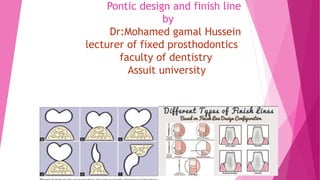
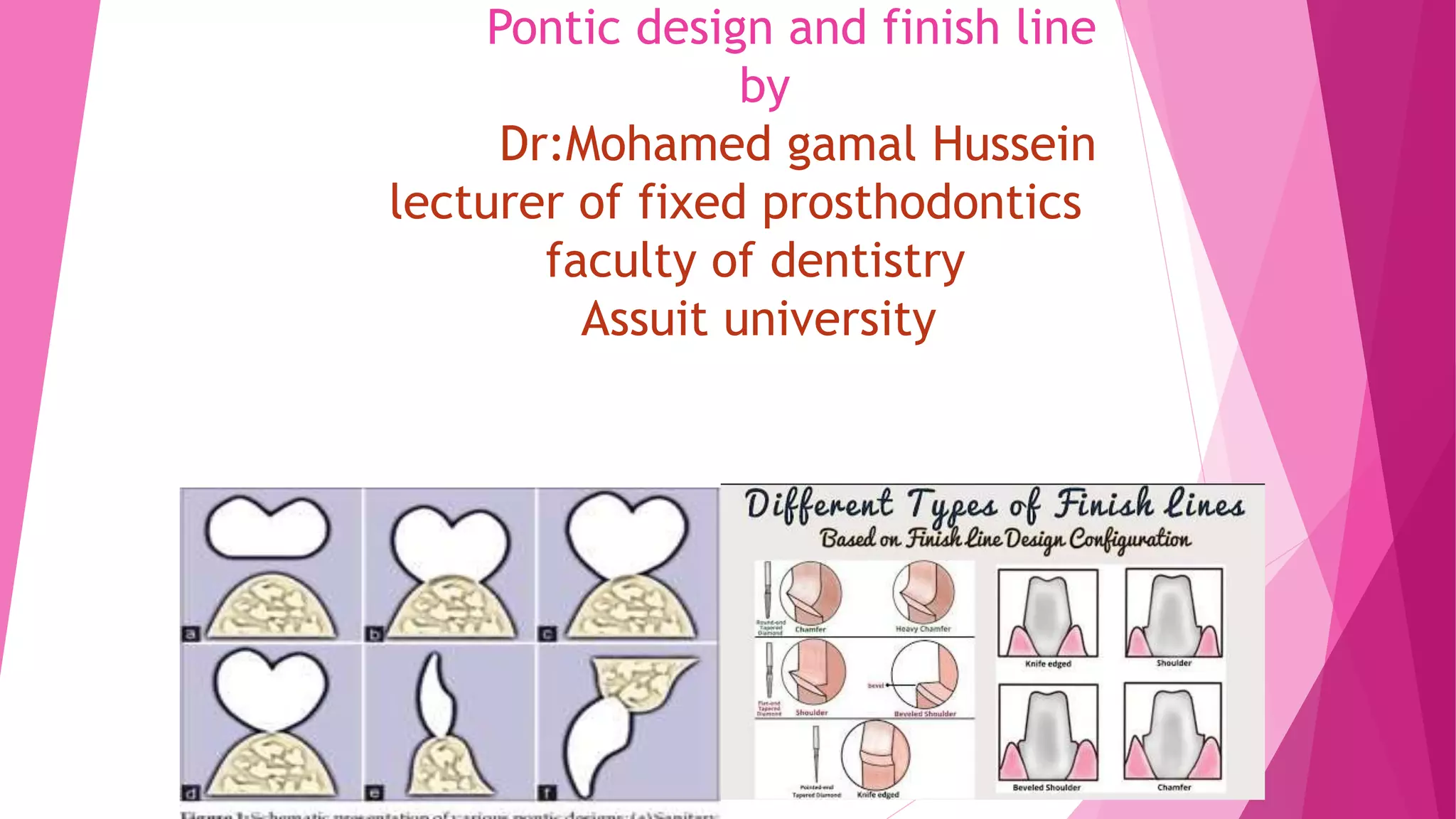
Pontic design and finish line
by
Dr:Mohamed gamal Hussein
lecturer of fixed prosthodontics
faculty of dentistry
Assuit university
Questions:

1-identify different types of pontic and discuss sanitary type
2-describe the proper design of pontics.
3-enumerate mucosa contact pontics and discuss one of them .

4- define f.l ,enumerate types of finish line and discuss shoulder finish
line.
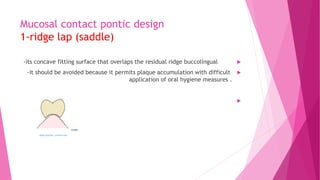
Mucosal contact pontic design
1-ridge lap (saddle)

-its concave fitting surface that overlaps the residual ridge buccolingual

-it should be avoided because it permits plaque accumulation with difficult
application of oral hygiene measures .

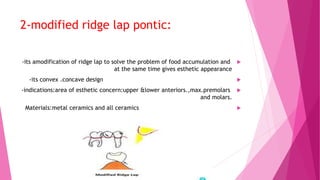
2-modified ridge lap pontic:

-its amodification of ridge lap to solve the problem of food accumulation and
at the same time gives esthetic appearance

-its convex .concave design

-indications:area of esthetic concern:upper &lower anteriors.,max.premolars
and molars.

Materials:metal ceramics and all ceramics
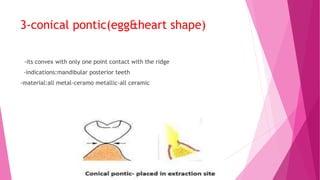
3-conical pontic(egg&heart shape)
-its convex with only one point contact with the ridge
-indications:mandibular posterior teeth
-material:all metal-ceramo metallic-all ceramic
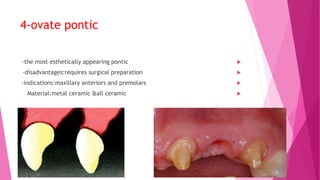
4-ovate pontic

-the most esthetically appearing pontic

-disadvantages:requires surgical preparation

-indications:maxillary anteriors and premolars

Material:metal ceramic &all ceramic
Non mucosal contact pontic design
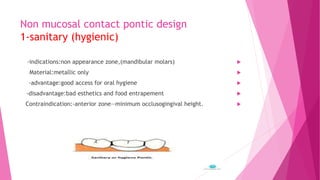
1-sanitary (hygienic)

-indications:non appearance zone,(mandibular molars)

Material:metallic only

-advantage:good access for oral hygiene

-disadvantage:bad esthetics and food entrapement

Contraindication:-anterior zone—minimum occlusogingival height.
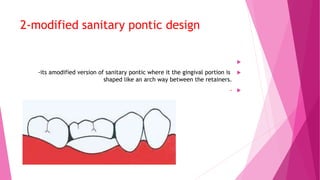
2-modified sanitary pontic design


-its amodified version of sanitary pontic where it the gingival portion is
shaped like an arch way between the retainers.

-
Finish line

Definition:it’s the line of demarcation between prepared and unprepared
tooth structure.

Criteria of ideal finish line:

-smooth&continuous

-well defined&distinct

-easily identified on the impression & die

-conservative

-distinct boundary for wax pattern construction

-sufficient bulk for the material
Types of finish line
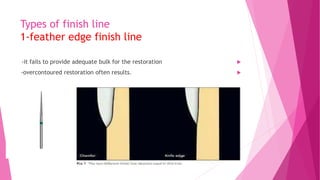
1-feather edge finish line

-it fails to provide adequate bulk for the restoration

-overcontoured restoration often results.
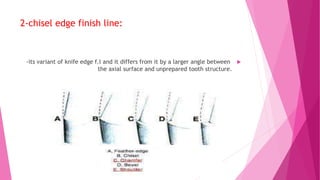
2-chisel edge finish line:

-its variant of knife edge f.l and it differs from it by a larger angle between
the axial surface and unprepared tooth structure.
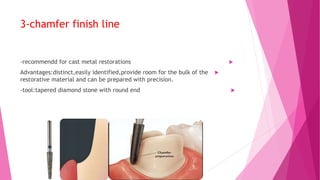
3-chamfer finish line

-recommendd for cast metal restorations

Advantages:distinct,easily identified,provide room for the bulk of the
restorative material and can be prepared with precision.

-tool:tapered diamond stone with round end
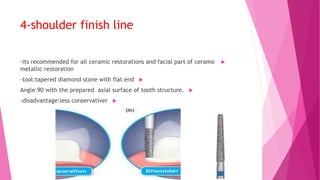
4-shoulder finish line

-its recommended for all ceramic restorations and facial part of ceramo
metallic restoration

-tool:tapered diamond stone with flat end

Angle:90 with the prepared axial surface of tooth structure.

-disadvantage:less conservativer
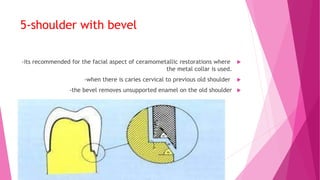
5-shoulder with bevel

-its recommended for the facial aspect of ceramometallic restorations where
the metal collar is used.

-when there is caries cervical to previous old shoulder

-the bevel removes unsupported enamel on the old shoulder
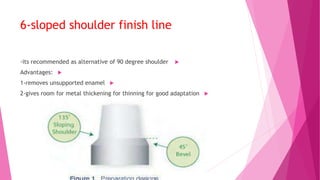
6-sloped shoulder finish line

-its recommended as alternative of 90 degree shoulder

Advantages:

1-removes unsupported enamel

2-gives room for metal thickening for thinning for good adaptation

Pontic design and finish line.pptx

  • 1.
    Pontic design andfinish line by Dr:Mohamed gamal Hussein lecturer of fixed prosthodontics faculty of dentistry Assuit university
  • 2.
    Questions:  1-identify different typesof pontic and discuss sanitary type 2-describe the proper design of pontics. 3-enumerate mucosa contact pontics and discuss one of them .  4- define f.l ,enumerate types of finish line and discuss shoulder finish line.
  • 3.
    Mucosal contact ponticdesign 1-ridge lap (saddle)  -its concave fitting surface that overlaps the residual ridge buccolingual  -it should be avoided because it permits plaque accumulation with difficult application of oral hygiene measures . 
  • 4.
    2-modified ridge lappontic:  -its amodification of ridge lap to solve the problem of food accumulation and at the same time gives esthetic appearance  -its convex .concave design  -indications:area of esthetic concern:upper &lower anteriors.,max.premolars and molars.  Materials:metal ceramics and all ceramics
  • 5.
    3-conical pontic(egg&heart shape) -itsconvex with only one point contact with the ridge -indications:mandibular posterior teeth -material:all metal-ceramo metallic-all ceramic
  • 6.
    4-ovate pontic  -the mostesthetically appearing pontic  -disadvantages:requires surgical preparation  -indications:maxillary anteriors and premolars  Material:metal ceramic &all ceramic
  • 7.
    Non mucosal contactpontic design 1-sanitary (hygienic)  -indications:non appearance zone,(mandibular molars)  Material:metallic only  -advantage:good access for oral hygiene  -disadvantage:bad esthetics and food entrapement  Contraindication:-anterior zone—minimum occlusogingival height.
  • 8.
    2-modified sanitary ponticdesign   -its amodified version of sanitary pontic where it the gingival portion is shaped like an arch way between the retainers.  -
  • 9.
    Finish line  Definition:it’s theline of demarcation between prepared and unprepared tooth structure.  Criteria of ideal finish line:  -smooth&continuous  -well defined&distinct  -easily identified on the impression & die  -conservative  -distinct boundary for wax pattern construction  -sufficient bulk for the material
  • 10.
    Types of finishline 1-feather edge finish line  -it fails to provide adequate bulk for the restoration  -overcontoured restoration often results.
  • 11.
    2-chisel edge finishline:  -its variant of knife edge f.l and it differs from it by a larger angle between the axial surface and unprepared tooth structure.
  • 12.
    3-chamfer finish line  -recommenddfor cast metal restorations  Advantages:distinct,easily identified,provide room for the bulk of the restorative material and can be prepared with precision.  -tool:tapered diamond stone with round end
  • 13.
    4-shoulder finish line  -itsrecommended for all ceramic restorations and facial part of ceramo metallic restoration  -tool:tapered diamond stone with flat end  Angle:90 with the prepared axial surface of tooth structure.  -disadvantage:less conservativer
  • 14.
    5-shoulder with bevel  -itsrecommended for the facial aspect of ceramometallic restorations where the metal collar is used.  -when there is caries cervical to previous old shoulder  -the bevel removes unsupported enamel on the old shoulder
  • 15.
    6-sloped shoulder finishline  -its recommended as alternative of 90 degree shoulder  Advantages:  1-removes unsupported enamel  2-gives room for metal thickening for thinning for good adaptation