POLYNOMIAL FUNCTIONS
Lesson Objectives:
identify polynomials and their degree
evaluate polynomials using synthetic substitution
illustrate polynomials equations and;
solve problems involving polynomials
In this lesson, you will be able to :
Pre-assessment
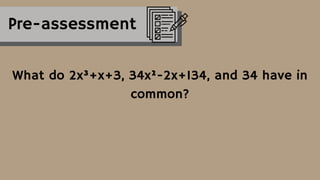
What do 2x³+x+3, 34x²-2x+134, and 34 have in
common?
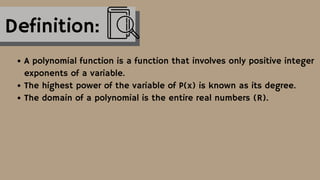
Definition:
A polynomial function is a function that involves only positive integer
exponents of a variable.
The highest power of the variable of P(x) is known as its degree.
The domain of a polynomial is the entire real numbers (R).
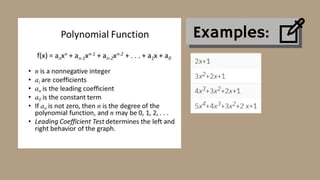
Examples:
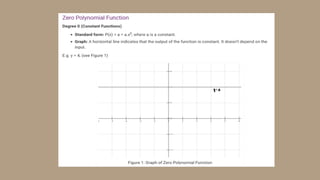
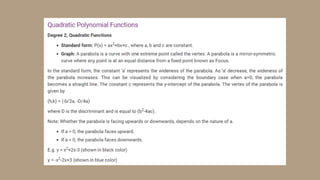
Types of Polynomial Functions
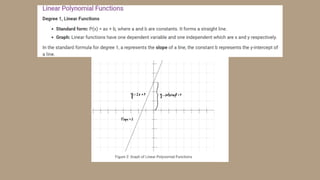
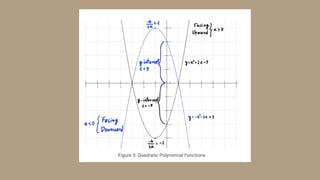
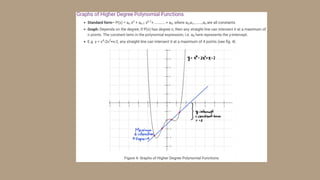
Graphs of Polynomial Functions
Evaluating Polynomial Functions
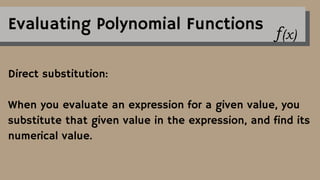
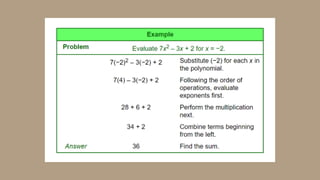
Direct substitution:
When you evaluate an expression for a given value, you
substitute that given value in the expression, and find its
numerical value.
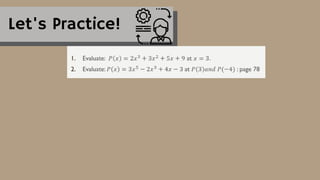
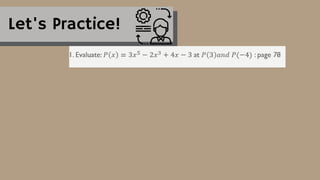
Let's Practice!
Evaluating Polynomial Functions
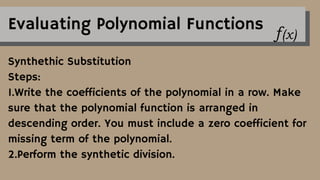
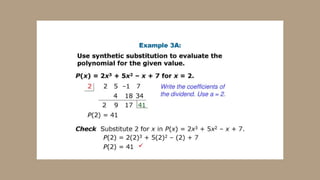
Synthethic Substitution
Steps:
1.Write the coefficients of the polynomial in a row. Make
sure that the polynomial function is arranged in
descending order. You must include a zero coefficient for
missing term of the polynomial.
2.Perform the synthetic division.
Evaluating Polynomial Functions
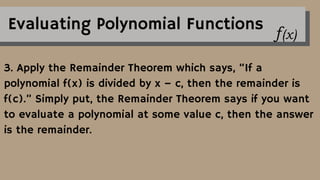
3. Apply the Remainder Theorem which says, “If a
polynomial f(x) is divided by x – c, then the remainder is
f(c).” Simply put, the Remainder Theorem says if you want
to evaluate a polynomial at some value c, then the answer
is the remainder.
Let's Practice!
Polynomial Functions.pdf

Polynomial Functions.pdf