Polymeric materials –
Formation of polymer
structure
N J Maharajan
Engg design dept
Introduction
Polymer is a substance which has a molecular structure built up chiefly
or completely from a large number of similar units bonded together.
Polymers are classified into
• Based on source
Natural (Proteins, Enzymes)
Synthetic(Plastics, Rubbers)
• Based on application
Thermosetting plastic(Bakelite, epoxy resin)
Thermoplastic (polythene, polyvinyl chloride)
POLYMER STRUCTURE
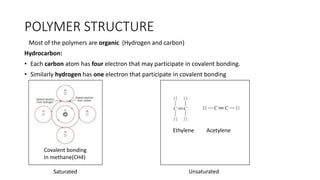
Most of the polymers are organic (Hydrogen and carbon)
Hydrocarbon:
• Each carbon atom has four electron that may participate in covalent bonding.
• Similarly hydrogen has one electron that participate in covalent bonding
Covalent bonding
In methane(CH4)
Saturated
Ethylene Acetylene
Unsaturated
Formation of polymer structures
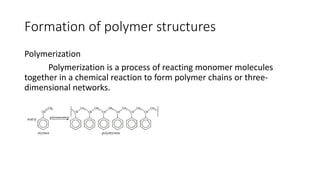
Polymerization
Polymerization is a process of reacting monomer molecules
together in a chemical reaction to form polymer chains or three-
dimensional networks.
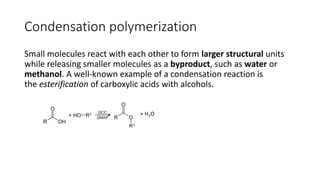
Condensation polymerization
Small molecules react with each other to form larger structural units
while releasing smaller molecules as a byproduct, such as water or
methanol. A well-known example of a condensation reaction is
the esterification of carboxylic acids with alcohols.
+ H2O
Polyethylene terephthalate(condensation
polymerization)
• Polyethylene terephthalate is produced
from ethyleneglycol and dimethalterephthalate(DMT)
(C6H4(CO2CH3)2) or terephthalic acid.
• The former is a transesterification reaction, whereas the
latter is an esterification reaction.
The reactions are idealized as follows:
First step
C6H4(CO2CH3)2 + 2 HOCH2CH2OH → C6H4(CO2CH2CH2OH)2 + 2 CH3OH
DMT + ethylene glycol terephthalic acid + methanol
Second step
n C6H4(CO2CH2CH2OH)2 → [(CO)C6H4(CO2CH2CH2O)]n + n HOCH2CH2OH
terephthalic acid PET + ethylene glycol
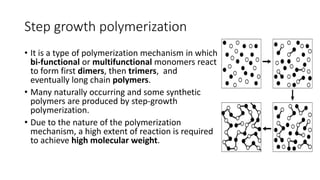
Step growth polymerization
• It is a type of polymerization mechanism in which
bi-functional or multifunctional monomers react
to form first dimers, then trimers, and
eventually long chain polymers.
• Many naturally occurring and some synthetic
polymers are produced by step-growth
polymerization.
• Due to the nature of the polymerization
mechanism, a high extent of reaction is required
to achieve high molecular weight.
Polyether ether ketone(Step growth
polymerization)
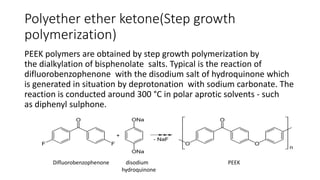
PEEK polymers are obtained by step growth polymerization by
the dialkylation of bisphenolate salts. Typical is the reaction of
difluorobenzophenone with the disodium salt of hydroquinone which
is generated in situation by deprotonation with sodium carbonate. The
reaction is conducted around 300 °C in polar aprotic solvents - such
as diphenyl sulphone.
Difluorobenzophenone disodium PEEK
hydroquinone
Ring opening polymerization
• A ring-opening polymerization (ROP) is form of chain-growth
polymerization in which the terminal end group of a polymer chain
acts as a reactive center where further cyclic monomers can be
added by ring-opening.
• Typical cyclic monomers that can be polymerized via ROP are
di-functional monomers that carry two different reactive groups like
one amine or alcohol and one carboxylic acid that have undergone a
cyclization reaction.
Amide + Acid
Nylon-6 (ROP)
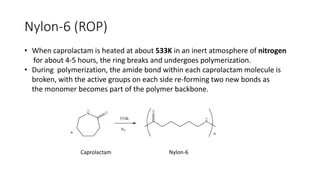
• When caprolactam is heated at about 533K in an inert atmosphere of nitrogen
for about 4-5 hours, the ring breaks and undergoes polymerization.
• During polymerization, the amide bond within each caprolactam molecule is
broken, with the active groups on each side re-forming two new bonds as
the monomer becomes part of the polymer backbone.
Caprolactam Nylon-6
Refernces
• http://www.polymerdatabase.com
• https://en.wikipedia.org

Polymeric materials – Formation of polymer structure

  • 1.
    Polymeric materials – Formationof polymer structure N J Maharajan Engg design dept
  • 2.
    Introduction Polymer is asubstance which has a molecular structure built up chiefly or completely from a large number of similar units bonded together. Polymers are classified into • Based on source Natural (Proteins, Enzymes) Synthetic(Plastics, Rubbers) • Based on application Thermosetting plastic(Bakelite, epoxy resin) Thermoplastic (polythene, polyvinyl chloride)
  • 3.
    POLYMER STRUCTURE Most ofthe polymers are organic (Hydrogen and carbon) Hydrocarbon: • Each carbon atom has four electron that may participate in covalent bonding. • Similarly hydrogen has one electron that participate in covalent bonding Covalent bonding In methane(CH4) Saturated Ethylene Acetylene Unsaturated
  • 4.
    Formation of polymerstructures Polymerization Polymerization is a process of reacting monomer molecules together in a chemical reaction to form polymer chains or three- dimensional networks.
  • 5.
    Condensation polymerization Small moleculesreact with each other to form larger structural units while releasing smaller molecules as a byproduct, such as water or methanol. A well-known example of a condensation reaction is the esterification of carboxylic acids with alcohols. + H2O
  • 6.
    Polyethylene terephthalate(condensation polymerization) • Polyethyleneterephthalate is produced from ethyleneglycol and dimethalterephthalate(DMT) (C6H4(CO2CH3)2) or terephthalic acid. • The former is a transesterification reaction, whereas the latter is an esterification reaction. The reactions are idealized as follows: First step C6H4(CO2CH3)2 + 2 HOCH2CH2OH → C6H4(CO2CH2CH2OH)2 + 2 CH3OH DMT + ethylene glycol terephthalic acid + methanol Second step n C6H4(CO2CH2CH2OH)2 → [(CO)C6H4(CO2CH2CH2O)]n + n HOCH2CH2OH terephthalic acid PET + ethylene glycol
  • 7.
    Step growth polymerization •It is a type of polymerization mechanism in which bi-functional or multifunctional monomers react to form first dimers, then trimers, and eventually long chain polymers. • Many naturally occurring and some synthetic polymers are produced by step-growth polymerization. • Due to the nature of the polymerization mechanism, a high extent of reaction is required to achieve high molecular weight.
  • 8.
    Polyether ether ketone(Stepgrowth polymerization) PEEK polymers are obtained by step growth polymerization by the dialkylation of bisphenolate salts. Typical is the reaction of difluorobenzophenone with the disodium salt of hydroquinone which is generated in situation by deprotonation with sodium carbonate. The reaction is conducted around 300 °C in polar aprotic solvents - such as diphenyl sulphone. Difluorobenzophenone disodium PEEK hydroquinone
  • 9.
    Ring opening polymerization •A ring-opening polymerization (ROP) is form of chain-growth polymerization in which the terminal end group of a polymer chain acts as a reactive center where further cyclic monomers can be added by ring-opening. • Typical cyclic monomers that can be polymerized via ROP are di-functional monomers that carry two different reactive groups like one amine or alcohol and one carboxylic acid that have undergone a cyclization reaction. Amide + Acid
  • 10.
    Nylon-6 (ROP) • Whencaprolactam is heated at about 533K in an inert atmosphere of nitrogen for about 4-5 hours, the ring breaks and undergoes polymerization. • During polymerization, the amide bond within each caprolactam molecule is broken, with the active groups on each side re-forming two new bonds as the monomer becomes part of the polymer backbone. Caprolactam Nylon-6
  • 11.