Polyglot persistence with Spring Data
Corneil du Plessis
corneil.duplessis@gmail.com
https://about.me/corneil
@corneil
Quotes
Everything should be made as simple as
possible, but not simpler.
Albert Einstein
Definitions
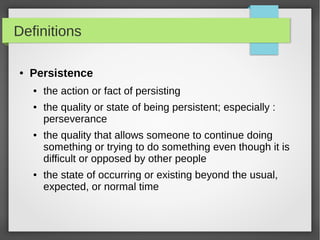
● Persistence
● the action or fact of persisting
● the quality or state of being persistent; especially :
perseverance
● the quality that allows someone to continue doing
something or trying to do something even though it is
difficult or opposed by other people
● the state of occurring or existing beyond the usual,
expected, or normal time
Definitions
● Polyglot
● knowing or using several languages
● computer program or script written in a valid form of
multiple programming languages
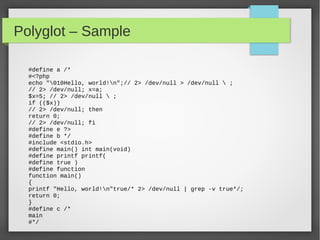
Polyglot – Sample
#define a /*
#<?php
echo "010Hello, world!n";// 2> /dev/null > /dev/null  ;
// 2> /dev/null; x=a;
$x=5; // 2> /dev/null  ;
if (($x))
// 2> /dev/null; then
return 0;
// 2> /dev/null; fi
#define e ?>
#define b */
#include <stdio.h>
#define main() int main(void)
#define printf printf(
#define true )
#define function
function main()
{
printf "Hello, world!n"true/* 2> /dev/null | grep -v true*/;
return 0;
}
#define c /*
main
#*/
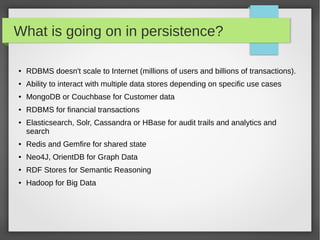
What is going on in persistence?
● RDBMS doesn't scale to Internet (millions of users and billions of transactions).
● Ability to interact with multiple data stores depending on specific use cases
● MongoDB or Couchbase for Customer data
● RDBMS for financial transactions
● Elasticsearch, Solr, Cassandra or HBase for audit trails and analytics and
search
● Redis and Gemfire for shared state
● Neo4J, OrientDB for Graph Data
● RDF Stores for Semantic Reasoning
● Hadoop for Big Data
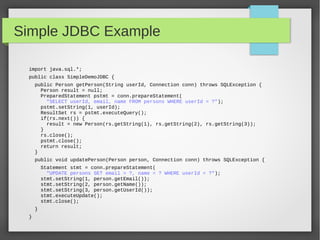
Simple JDBC Example
import java.sql.*;
public class SimpleDemoJDBC {
public Person getPerson(String userId, Connection conn) throws SQLException {
Person result = null;
PreparedStatement pstmt = conn.prepareStatement(
"SELECT userId, email, name FROM persons WHERE userId = ?");
pstmt.setString(1, userId);
ResultSet rs = pstmt.executeQuery();
if(rs.next()) {
result = new Person(rs.getString(1), rs.getString(2), rs.getString(3));
}
rs.close();
pstmt.close();
return result;
}
public void updatePerson(Person person, Connection conn) throws SQLException {
Statement stmt = conn.prepareStatement(
"UPDATE persons SET email = ?, name = ? WHERE userId = ?");
stmt.setString(1, person.getEmail());
stmt.setString(2, person.getName());
stmt.setString(3, person.getUserId());
stmt.executeUpdate();
stmt.close();
}
}
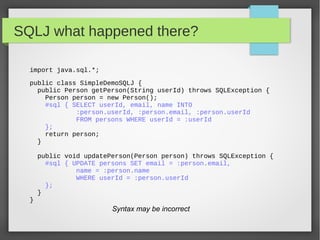
SQLJ what happened there?
import java.sql.*;
public class SimpleDemoSQLJ {
public Person getPerson(String userId) throws SQLException {
Person person = new Person();
#sql { SELECT userId, email, name INTO
:person.userId, :person.email, :person.userId
FROM persons WHERE userId = :userId
};
return person;
}
public void updatePerson(Person person) throws SQLException {
#sql { UPDATE persons SET email = :person.email,
name = :person.name
WHERE userId = :person.userId
};
}
}
Syntax may be incorrect
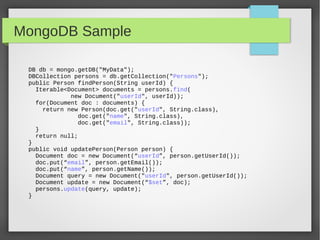
MongoDB Sample
DB db = mongo.getDB("MyData");
DBCollection persons = db.getCollection("Persons");
public Person findPerson(String userId) {
Iterable<Document> documents = persons.find(
new Document("userId", userId));
for(Document doc : documents) {
return new Person(doc.get("userId", String.class),
doc.get("name", String.class),
doc.get("email", String.class));
}
return null;
}
public void updatePerson(Person person) {
Document doc = new Document(“userId”, person.getUserId());
doc.put(“email”, person.getEmail());
doc.put(“name”, person.getName());
Document query = new Document("userId", person.getUserId());
Document update = new Document(“$set”, doc);
persons.update(query, update);
}
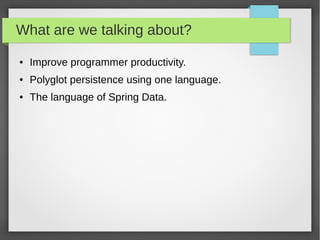
What are we talking about?
● Improve programmer productivity.
● Polyglot persistence using one language.
● The language of Spring Data.
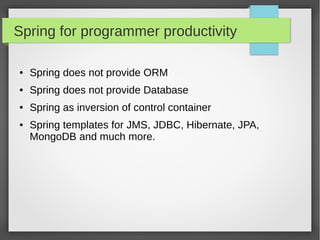
Spring for programmer productivity
● Spring does not provide ORM
● Spring does not provide Database
● Spring as inversion of control container
● Spring templates for JMS, JDBC, Hibernate, JPA,
MongoDB and much more.
Why Spring Data?
● Best practice indicates you should have Data Access
Components or a Data Service Layer.
● How often do you make simple mistakes interacting with
EntityManager?
● Different API for each store.
● It should be easier...
What is Spring Data?
● Spring Data is an open source project at
http://projects.spring.io/spring-data/ managed by Pivotal Software.
● Spring Data relies on Spring Framework.
● Spring Data provides a set of common patterns for persisting data
using existing libraries.
● Spring Data provides a Repository Interface
● Spring Data provides finder methods
● Spring Data provides support for QueryDSL
● Spring Data simplifies persistence
● Spring Data enables polyglot persistence
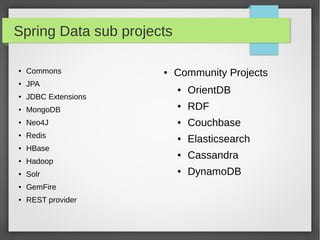
Spring Data sub projects
● Commons
● JPA
● JDBC Extensions
● MongoDB
● Neo4J
● Redis
● HBase
● Hadoop
● Solr
● GemFire
● REST provider
● Community Projects
● OrientDB
● RDF
● Couchbase
● Elasticsearch
● Cassandra
● DynamoDB
How Spring Data?
● Configure Spring Data for specific technology
● Define Entity as per relevant library or framework
● Declare Repository Interface
● Spring Data provides Repository Implementation
● Spring Framework injects Repository implementation
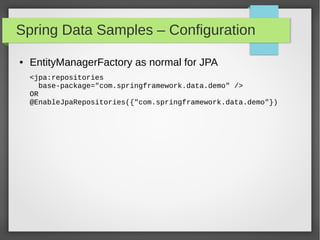
Spring Data Samples – Configuration
● EntityManagerFactory as normal for JPA
<jpa:repositories
base-package="com.springframework.data.demo" />
OR
@EnableJpaRepositories({"com.springframework.data.demo"})
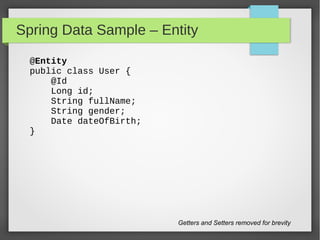
Spring Data Sample – Entity
@Entity
public class User {
@Id
Long id;
String fullName;
String gender;
Date dateOfBirth;
}
Getters and Setters removed for brevity
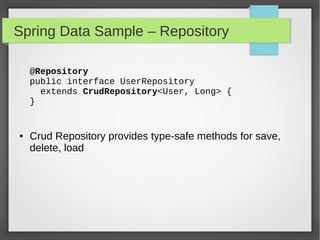
Spring Data Sample – Repository
public interface UserRepository
extends CrudRepository<User, Long> {
}
● Crud Repository provides type-safe methods for save,
delete, load
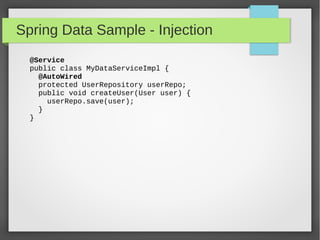
Spring Data Sample - Injection
@Service
public class MyDataServiceImpl {
@AutoWired
protected UserRepository userRepo;
public void createUser(User user) {
userRepo.save(user);
}
}
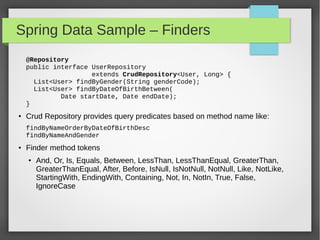
Spring Data Sample – Finders
public interface UserRepository
extends CrudRepository<User, Long> {
List<User> findByGender(String genderCode);
List<User> findByDateOfBirthBetween(
Date startDate, Date endDate);
}
● Crud Repository provides query predicates based on method name like:
findByNameOrderByDateOfBirthDesc
findByNameAndGender
● Finder method tokens
● And, Or, Is, Equals, Between, LessThan, LessThanEqual, GreaterThan,
GreaterThanEqual, After, Before, IsNull, IsNotNull, NotNull, Like,
NotLike, StartingWith, EndingWith, Containing, Not, In, NotIn, True,
False, IgnoreCase
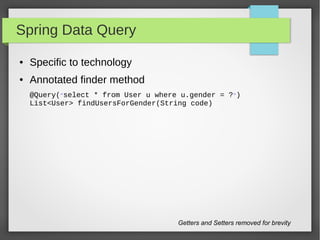
Spring Data Query
● Specific to technology
● Annotated finder method
@Query("select * from User u where u.gender = ?")
List<User> findUsersForGender(String code)
Getters and Setters removed for brevity
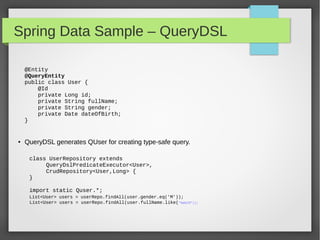
Spring Data Sample – QueryDSL
@Entity
@QueryEntity
public class User {
@Id
private Long id;
private String fullName;
private String gender;
private Date dateOfBirth;
}
● QueryDSL generates QUser for creating type-safe query.
class UserRepository extends
QueryDslPredicateExecutor<User>,
CrudRepository<User,Long> {
}
import static Quser.*;
List<User> users = userRepo.findAll(user.gender.eq('M'));
List<User> users = userRepo.findAll(user.fullName.like("%abc%"));
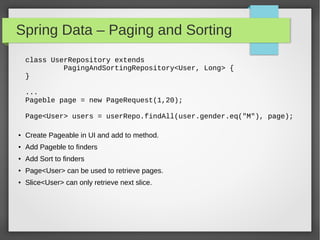
Spring Data – Paging and Sorting
class UserRepository extends
PagingAndSortingRepository<User, Long> {
}
...
Pageble page = new PageRequest(1,20);
Page<User> users = userRepo.findAll(user.gender.eq("M"), page);
● Create Pageable in UI and add to method.
● Add Pageble to finders
● Add Sort to finders
● Page<User> can be used to retrieve pages.
● Slice<User> can only retrieve next slice.
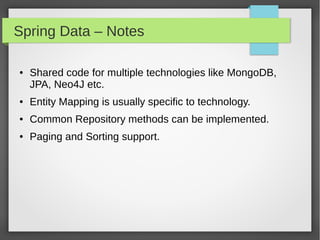
Spring Data – Notes
● Shared code for multiple technologies like MongoDB,
JPA, Neo4J etc.
● Entity Mapping is usually specific to technology.
● Common Repository methods can be implemented.
● Paging and Sorting support.
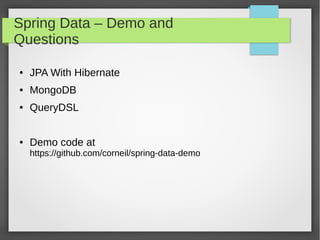
Spring Data – Demo and
Questions
● JPA With Hibernate
● MongoDB
● QueryDSL
● Demo code at
https://github.com/corneil/spring-data-demo

Polyglot persistence with Spring Data

  • 1.
    Polyglot persistence withSpring Data Corneil du Plessis corneil.duplessis@gmail.com https://about.me/corneil @corneil
  • 2.
    Quotes Everything should bemade as simple as possible, but not simpler. Albert Einstein
  • 3.
    Definitions ● Persistence ● theaction or fact of persisting ● the quality or state of being persistent; especially : perseverance ● the quality that allows someone to continue doing something or trying to do something even though it is difficult or opposed by other people ● the state of occurring or existing beyond the usual, expected, or normal time
  • 4.
    Definitions ● Polyglot ● knowingor using several languages ● computer program or script written in a valid form of multiple programming languages
  • 5.
    Polyglot – Sample #definea /* #<?php echo "010Hello, world!n";// 2> /dev/null > /dev/null ; // 2> /dev/null; x=a; $x=5; // 2> /dev/null ; if (($x)) // 2> /dev/null; then return 0; // 2> /dev/null; fi #define e ?> #define b */ #include <stdio.h> #define main() int main(void) #define printf printf( #define true ) #define function function main() { printf "Hello, world!n"true/* 2> /dev/null | grep -v true*/; return 0; } #define c /* main #*/
  • 6.
    What is goingon in persistence? ● RDBMS doesn't scale to Internet (millions of users and billions of transactions). ● Ability to interact with multiple data stores depending on specific use cases ● MongoDB or Couchbase for Customer data ● RDBMS for financial transactions ● Elasticsearch, Solr, Cassandra or HBase for audit trails and analytics and search ● Redis and Gemfire for shared state ● Neo4J, OrientDB for Graph Data ● RDF Stores for Semantic Reasoning ● Hadoop for Big Data
  • 7.
    Simple JDBC Example importjava.sql.*; public class SimpleDemoJDBC { public Person getPerson(String userId, Connection conn) throws SQLException { Person result = null; PreparedStatement pstmt = conn.prepareStatement( "SELECT userId, email, name FROM persons WHERE userId = ?"); pstmt.setString(1, userId); ResultSet rs = pstmt.executeQuery(); if(rs.next()) { result = new Person(rs.getString(1), rs.getString(2), rs.getString(3)); } rs.close(); pstmt.close(); return result; } public void updatePerson(Person person, Connection conn) throws SQLException { Statement stmt = conn.prepareStatement( "UPDATE persons SET email = ?, name = ? WHERE userId = ?"); stmt.setString(1, person.getEmail()); stmt.setString(2, person.getName()); stmt.setString(3, person.getUserId()); stmt.executeUpdate(); stmt.close(); } }
  • 8.
    SQLJ what happenedthere? import java.sql.*; public class SimpleDemoSQLJ { public Person getPerson(String userId) throws SQLException { Person person = new Person(); #sql { SELECT userId, email, name INTO :person.userId, :person.email, :person.userId FROM persons WHERE userId = :userId }; return person; } public void updatePerson(Person person) throws SQLException { #sql { UPDATE persons SET email = :person.email, name = :person.name WHERE userId = :person.userId }; } } Syntax may be incorrect
  • 9.
    MongoDB Sample DB db= mongo.getDB("MyData"); DBCollection persons = db.getCollection("Persons"); public Person findPerson(String userId) { Iterable<Document> documents = persons.find( new Document("userId", userId)); for(Document doc : documents) { return new Person(doc.get("userId", String.class), doc.get("name", String.class), doc.get("email", String.class)); } return null; } public void updatePerson(Person person) { Document doc = new Document(“userId”, person.getUserId()); doc.put(“email”, person.getEmail()); doc.put(“name”, person.getName()); Document query = new Document("userId", person.getUserId()); Document update = new Document(“$set”, doc); persons.update(query, update); }
  • 10.
    What are wetalking about? ● Improve programmer productivity. ● Polyglot persistence using one language. ● The language of Spring Data.
  • 11.
    Spring for programmerproductivity ● Spring does not provide ORM ● Spring does not provide Database ● Spring as inversion of control container ● Spring templates for JMS, JDBC, Hibernate, JPA, MongoDB and much more.
  • 12.
    Why Spring Data? ●Best practice indicates you should have Data Access Components or a Data Service Layer. ● How often do you make simple mistakes interacting with EntityManager? ● Different API for each store. ● It should be easier...
  • 13.
    What is SpringData? ● Spring Data is an open source project at http://projects.spring.io/spring-data/ managed by Pivotal Software. ● Spring Data relies on Spring Framework. ● Spring Data provides a set of common patterns for persisting data using existing libraries. ● Spring Data provides a Repository Interface ● Spring Data provides finder methods ● Spring Data provides support for QueryDSL ● Spring Data simplifies persistence ● Spring Data enables polyglot persistence
  • 14.
    Spring Data subprojects ● Commons ● JPA ● JDBC Extensions ● MongoDB ● Neo4J ● Redis ● HBase ● Hadoop ● Solr ● GemFire ● REST provider ● Community Projects ● OrientDB ● RDF ● Couchbase ● Elasticsearch ● Cassandra ● DynamoDB
  • 15.
    How Spring Data? ●Configure Spring Data for specific technology ● Define Entity as per relevant library or framework ● Declare Repository Interface ● Spring Data provides Repository Implementation ● Spring Framework injects Repository implementation
  • 16.
    Spring Data Samples– Configuration ● EntityManagerFactory as normal for JPA <jpa:repositories base-package="com.springframework.data.demo" /> OR @EnableJpaRepositories({"com.springframework.data.demo"})
  • 17.
    Spring Data Sample– Entity @Entity public class User { @Id Long id; String fullName; String gender; Date dateOfBirth; } Getters and Setters removed for brevity
  • 18.
    Spring Data Sample– Repository public interface UserRepository extends CrudRepository<User, Long> { } ● Crud Repository provides type-safe methods for save, delete, load
  • 19.
    Spring Data Sample- Injection @Service public class MyDataServiceImpl { @AutoWired protected UserRepository userRepo; public void createUser(User user) { userRepo.save(user); } }
  • 20.
    Spring Data Sample– Finders public interface UserRepository extends CrudRepository<User, Long> { List<User> findByGender(String genderCode); List<User> findByDateOfBirthBetween( Date startDate, Date endDate); } ● Crud Repository provides query predicates based on method name like: findByNameOrderByDateOfBirthDesc findByNameAndGender ● Finder method tokens ● And, Or, Is, Equals, Between, LessThan, LessThanEqual, GreaterThan, GreaterThanEqual, After, Before, IsNull, IsNotNull, NotNull, Like, NotLike, StartingWith, EndingWith, Containing, Not, In, NotIn, True, False, IgnoreCase
  • 21.
    Spring Data Query ●Specific to technology ● Annotated finder method @Query("select * from User u where u.gender = ?") List<User> findUsersForGender(String code) Getters and Setters removed for brevity
  • 22.
    Spring Data Sample– QueryDSL @Entity @QueryEntity public class User { @Id private Long id; private String fullName; private String gender; private Date dateOfBirth; } ● QueryDSL generates QUser for creating type-safe query. class UserRepository extends QueryDslPredicateExecutor<User>, CrudRepository<User,Long> { } import static Quser.*; List<User> users = userRepo.findAll(user.gender.eq('M')); List<User> users = userRepo.findAll(user.fullName.like("%abc%"));
  • 23.
    Spring Data –Paging and Sorting class UserRepository extends PagingAndSortingRepository<User, Long> { } ... Pageble page = new PageRequest(1,20); Page<User> users = userRepo.findAll(user.gender.eq("M"), page); ● Create Pageable in UI and add to method. ● Add Pageble to finders ● Add Sort to finders ● Page<User> can be used to retrieve pages. ● Slice<User> can only retrieve next slice.
  • 24.
    Spring Data –Notes ● Shared code for multiple technologies like MongoDB, JPA, Neo4J etc. ● Entity Mapping is usually specific to technology. ● Common Repository methods can be implemented. ● Paging and Sorting support.
  • 25.
    Spring Data –Demo and Questions ● JPA With Hibernate ● MongoDB ● QueryDSL ● Demo code at https://github.com/corneil/spring-data-demo