Spring Data in 10 minutes
Corneil du Plessis
corneil.duplessis@gmail.com
about.me/corneil
@corneil
Introduction
● Assumptions
– You know JPA the Java Persistence API
– You know the Spring Framework or Dependency
Injection
● Take away
– Some appreciation for polyglot persistence
– Some understanding of Spring Data
What is Polyglot persistence?
● RDBMS doesn't scale to Internet (millions of users and billions of
transactions).
● Ability to interact with multiple data stores depending on specific use
cases
● MongoDB or Couchbase for Customer data
● RDBMS for financial transactions
● Elasticsearch, Cassandra or HBase for site clicks and audit trails
● Hadoop for Big Data
● Neo4J, OrientDB for Graph Data
● RDF Stores for Semantic Reasoning
Why Spring Data?
● Best practice indicates you should have Data Access
Components or a Data Service Layer.
● How often do you make simple mistakes interacting with
EntityManager?
● Different API for each store.
● It should be easier...
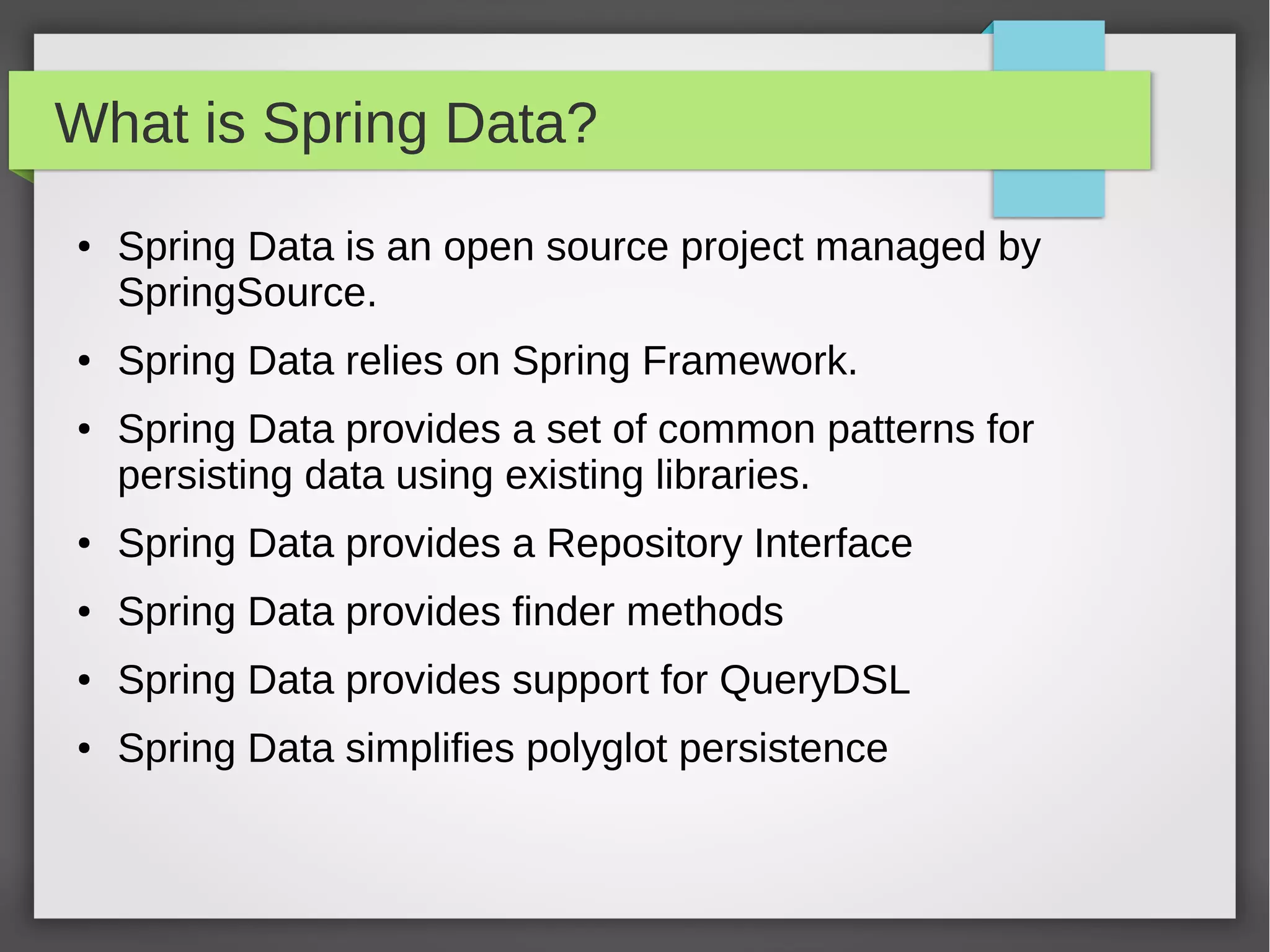
What is Spring Data?
● Spring Data is an open source project managed by
SpringSource.
● Spring Data relies on Spring Framework.
● Spring Data provides a set of common patterns for
persisting data using existing libraries.
● Spring Data provides a Repository Interface
● Spring Data provides finder methods
● Spring Data provides support for QueryDSL
● Spring Data simplifies polyglot persistence
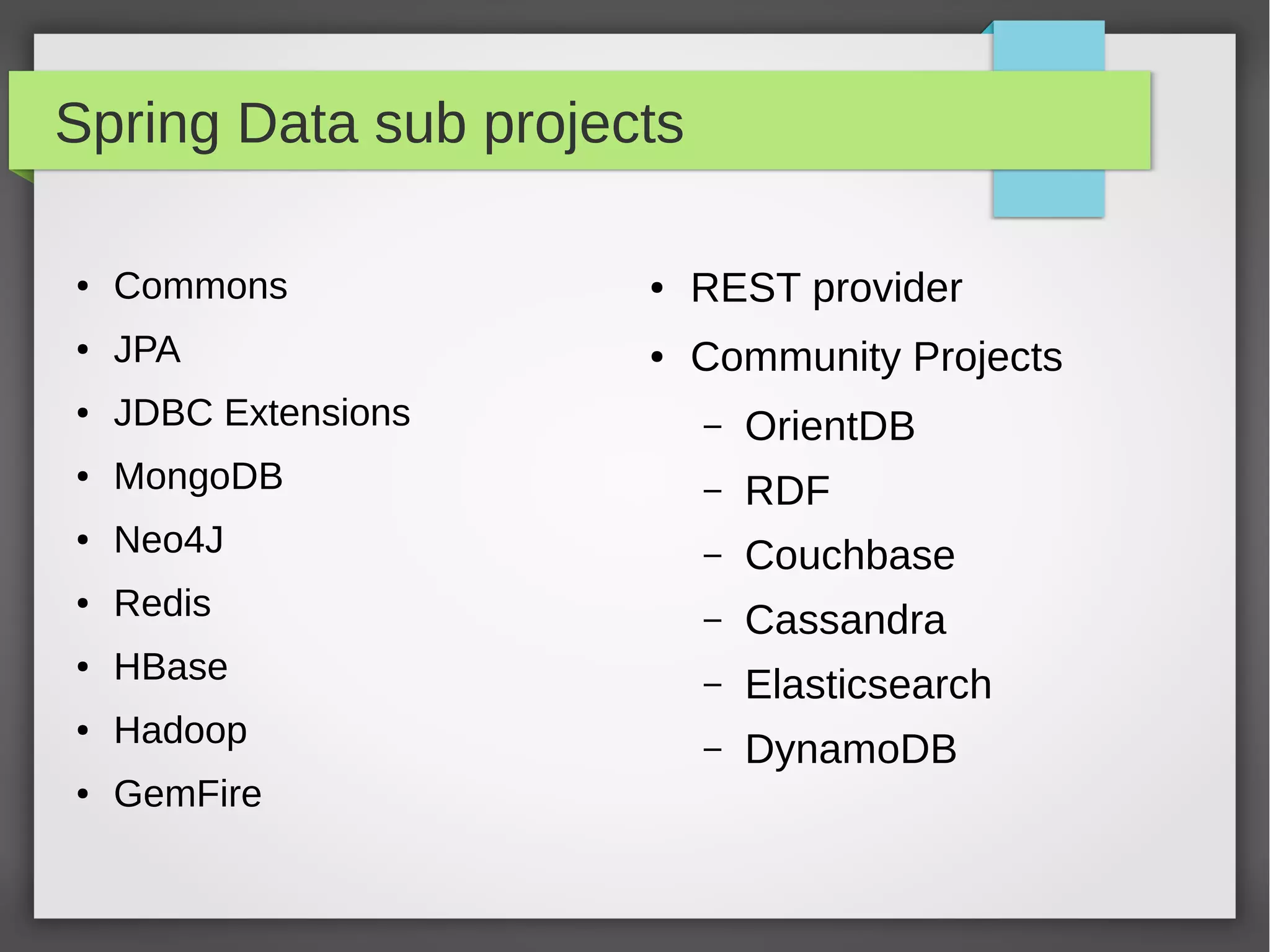
Spring Data sub projects
● Commons
● JPA
● JDBC Extensions
● MongoDB
● Neo4J
● Redis
● HBase
● Hadoop
● GemFire
● REST provider
● Community Projects
– OrientDB
– RDF
– Couchbase
– Cassandra
– Elasticsearch
– DynamoDB
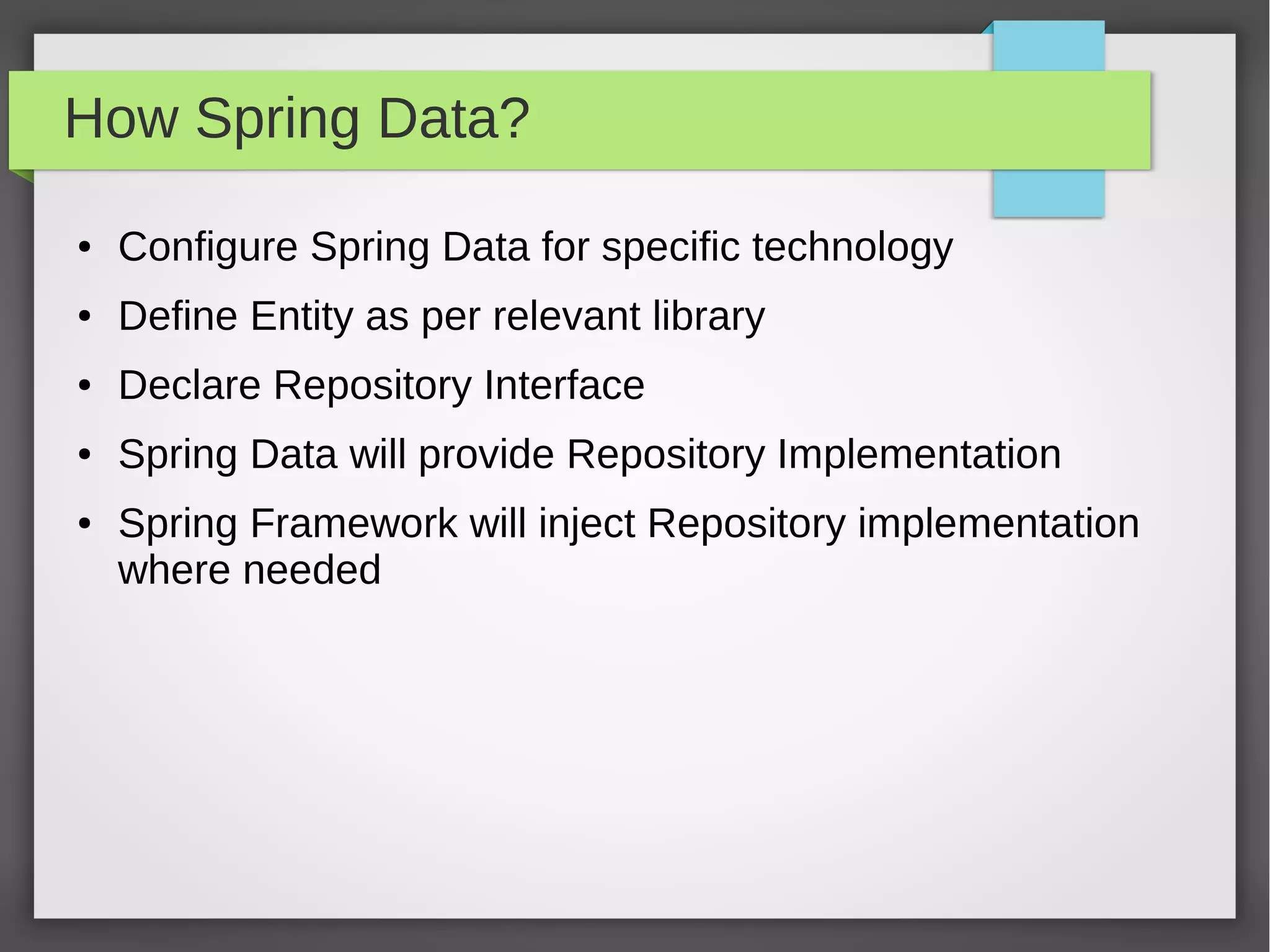
How Spring Data?
● Configure Spring Data for specific technology
● Define Entity as per relevant library
● Declare Repository Interface
● Spring Data will provide Repository Implementation
● Spring Framework will inject Repository implementation
where needed
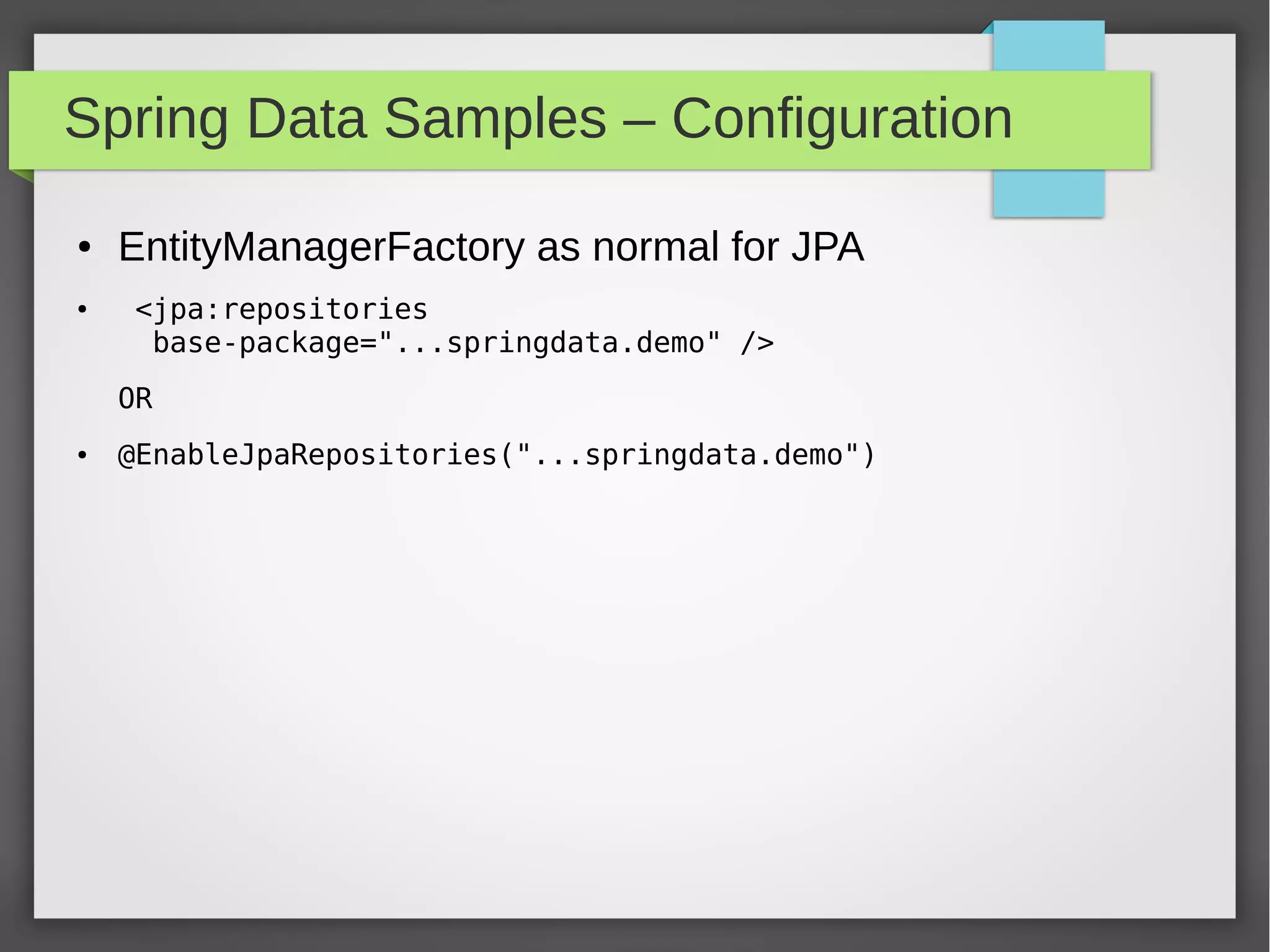
Spring Data Samples – Configuration
● EntityManagerFactory as normal for JPA
● <jpa:repositories
base-package="...springdata.demo" />
OR
● @EnableJpaRepositories("...springdata.demo")
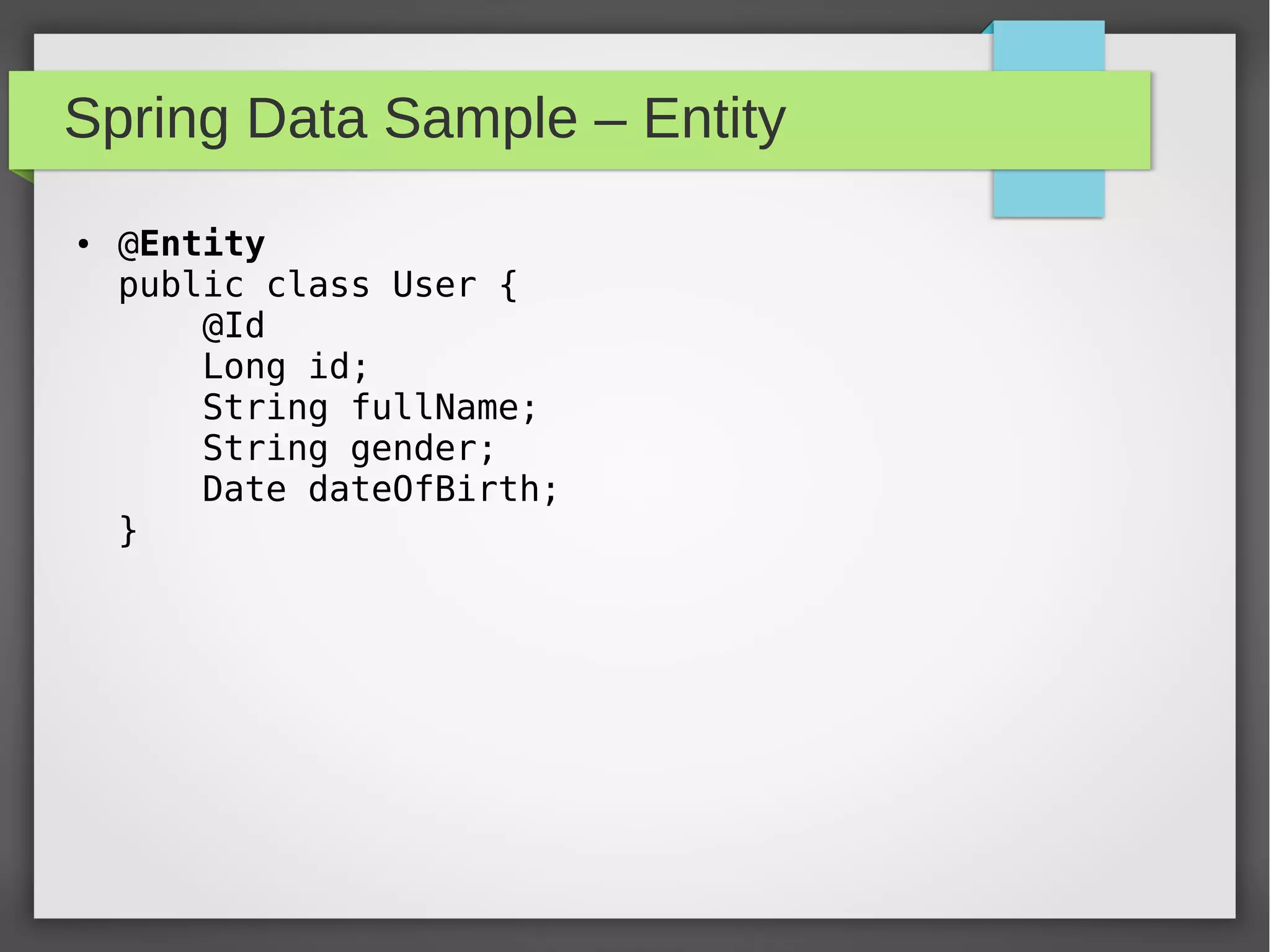
Spring Data Sample – Entity
● @Entity
public class User {
@Id
Long id;
String fullName;
String gender;
Date dateOfBirth;
}
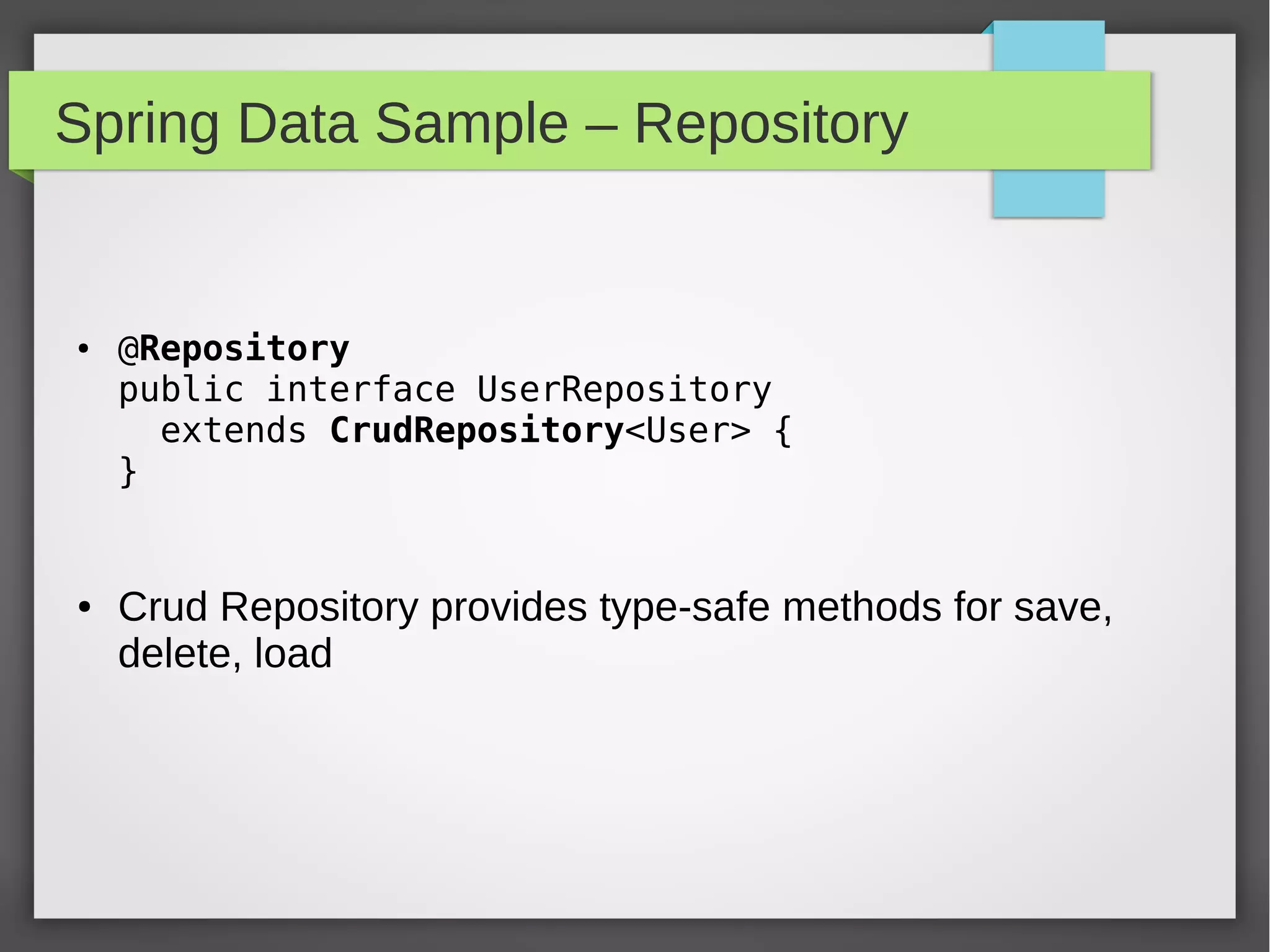
Spring Data Sample – Repository
● @Repository
public interface UserRepository
extends CrudRepository<User> {
}
● Crud Repository provides type-safe methods for save,
delete, load
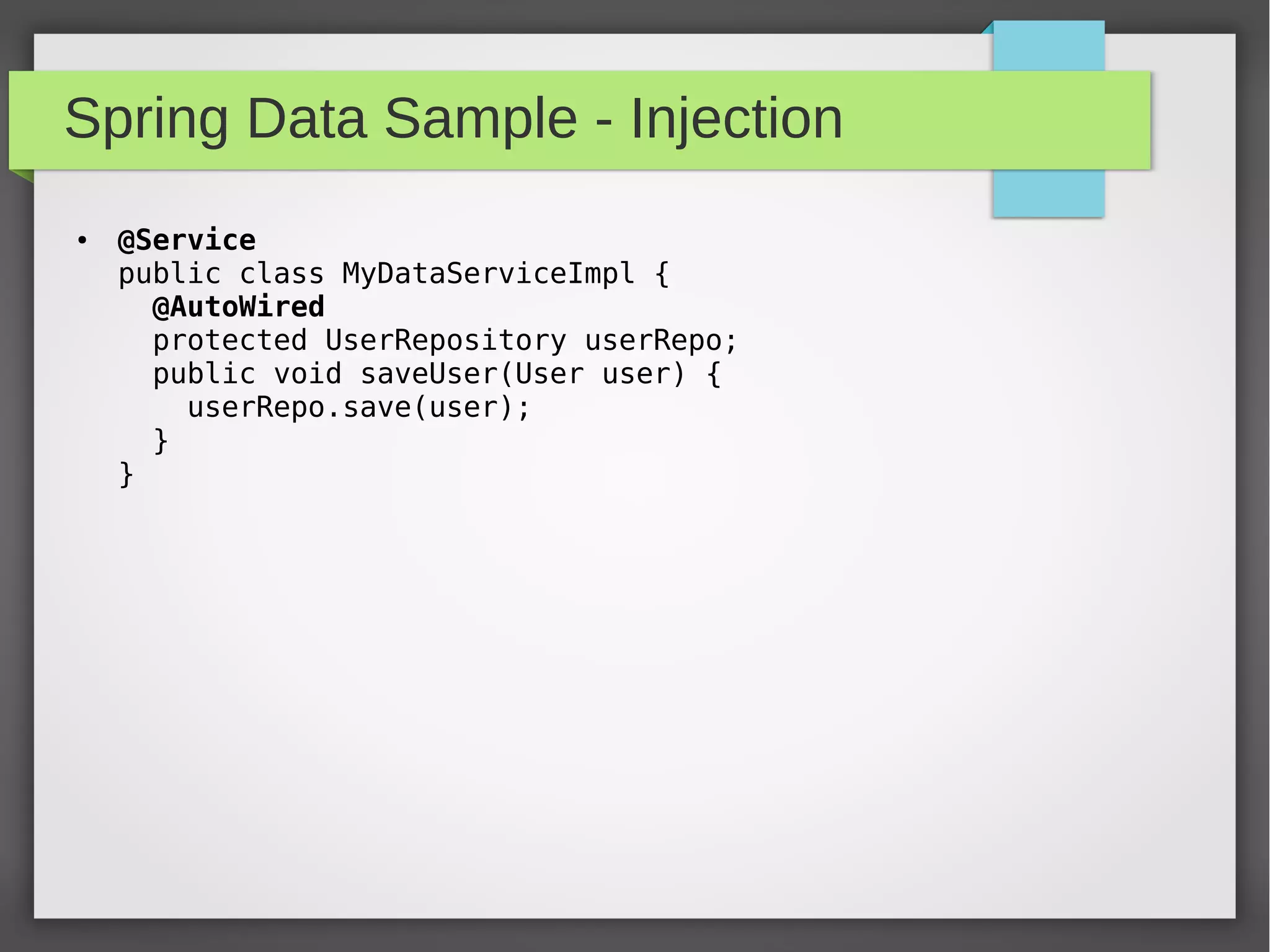
Spring Data Sample - Injection
● @Service
public class MyDataServiceImpl {
@AutoWired
protected UserRepository userRepo;
public void saveUser(User user) {
userRepo.save(user);
}
}
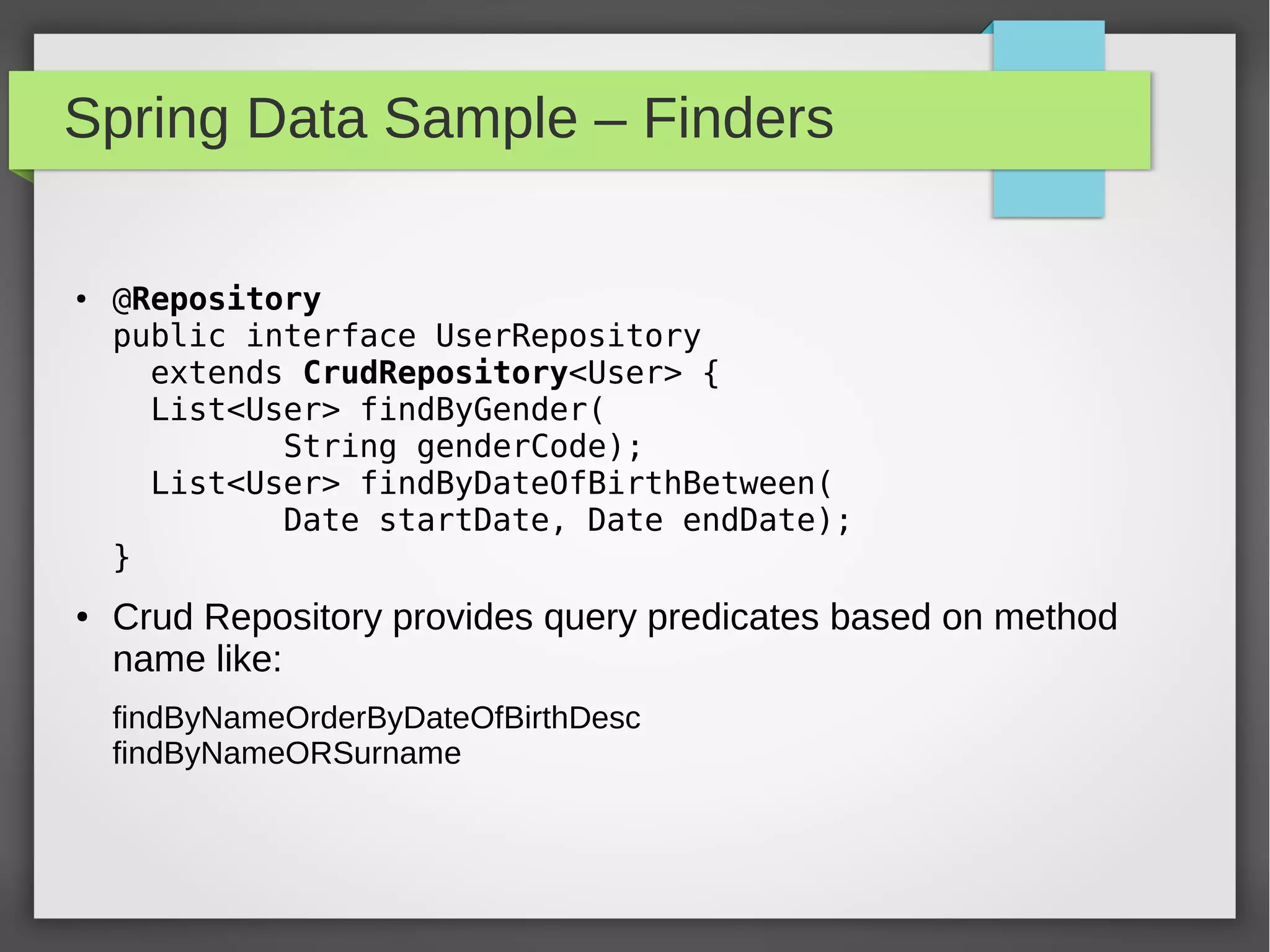
Spring Data Sample – Finders
● @Repository
public interface UserRepository
extends CrudRepository<User> {
List<User> findByGender(
String genderCode);
List<User> findByDateOfBirthBetween(
Date startDate, Date endDate);
}
● Crud Repository provides query predicates based on method
name like:
findByNameOrderByDateOfBirthDesc
findByNameORSurname
Spring Data Sample – QueryDSL
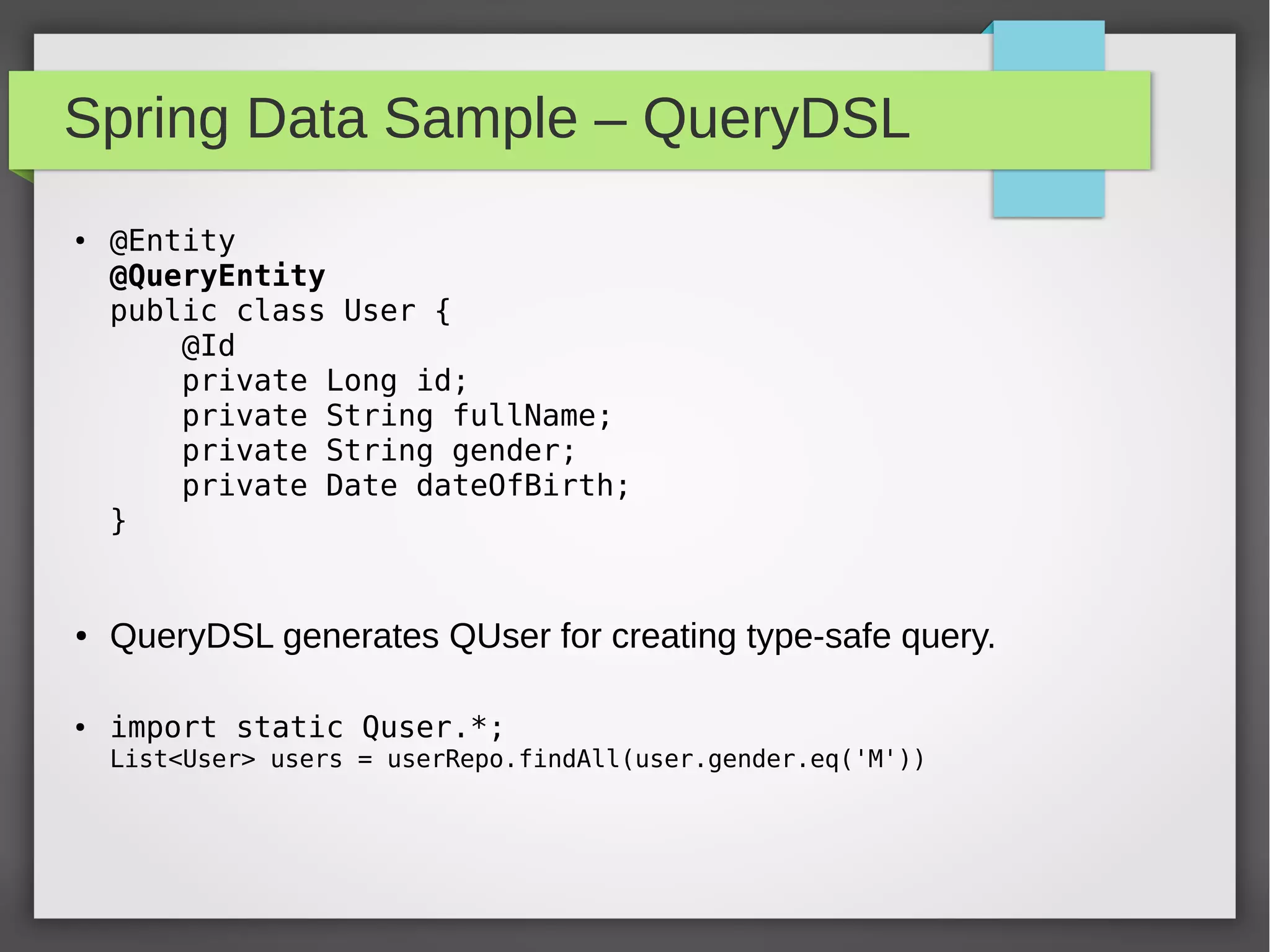
● @Entity
@QueryEntity
public class User {
@Id
private Long id;
private String fullName;
private String gender;
private Date dateOfBirth;
}
● QueryDSL generates QUser for creating type-safe query.
● import static Quser.*;
List<User> users = userRepo.findAll(user.gender.eq('M'))
Spring Data – Notes
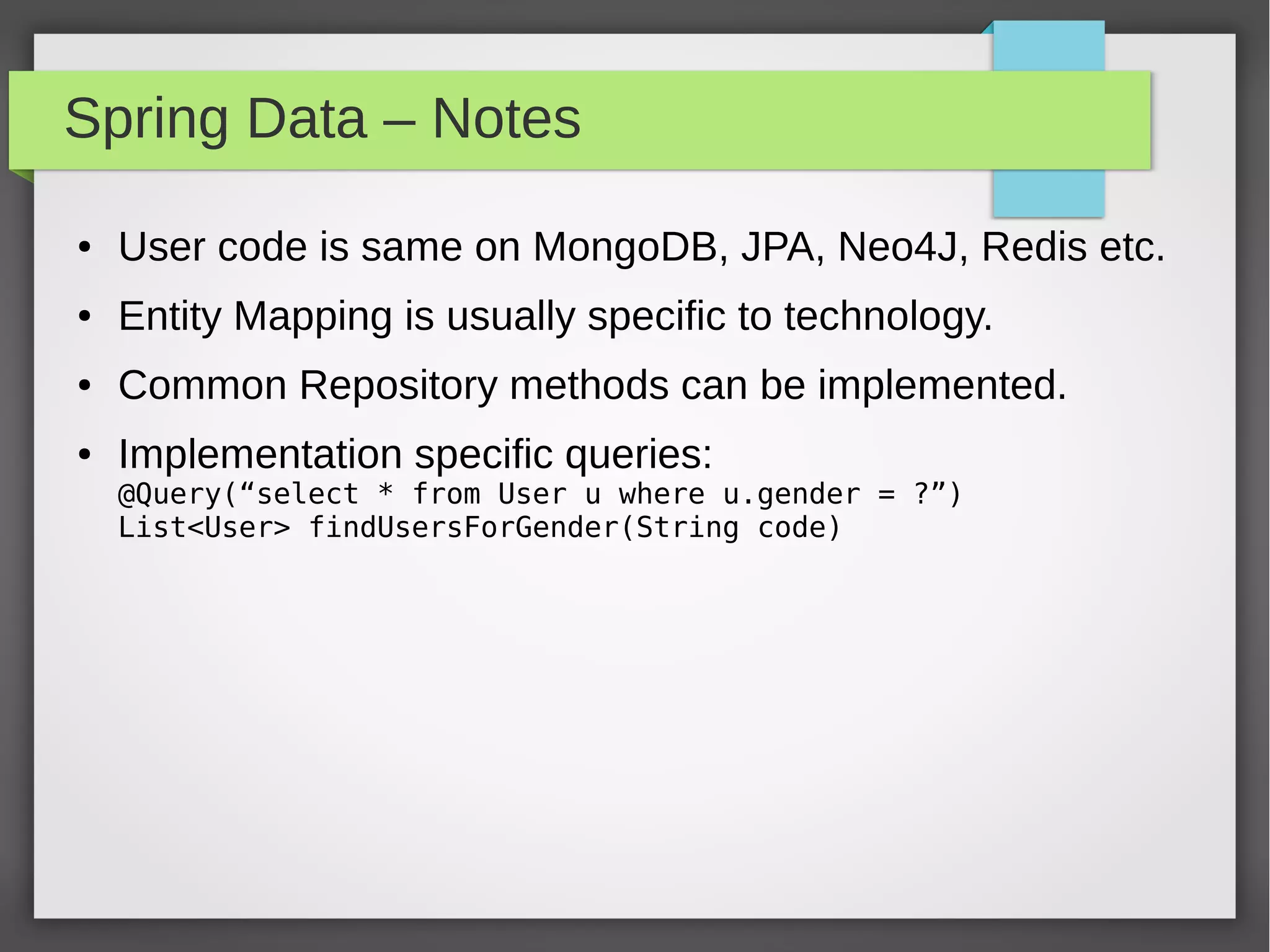
● User code is same on MongoDB, JPA, Neo4J, Redis etc.
● Entity Mapping is usually specific to technology.
● Common Repository methods can be implemented.
● Implementation specific queries:
@Query(“select * from User u where u.gender = ?”)
List<User> findUsersForGender(String code)
Spring Data – Questions
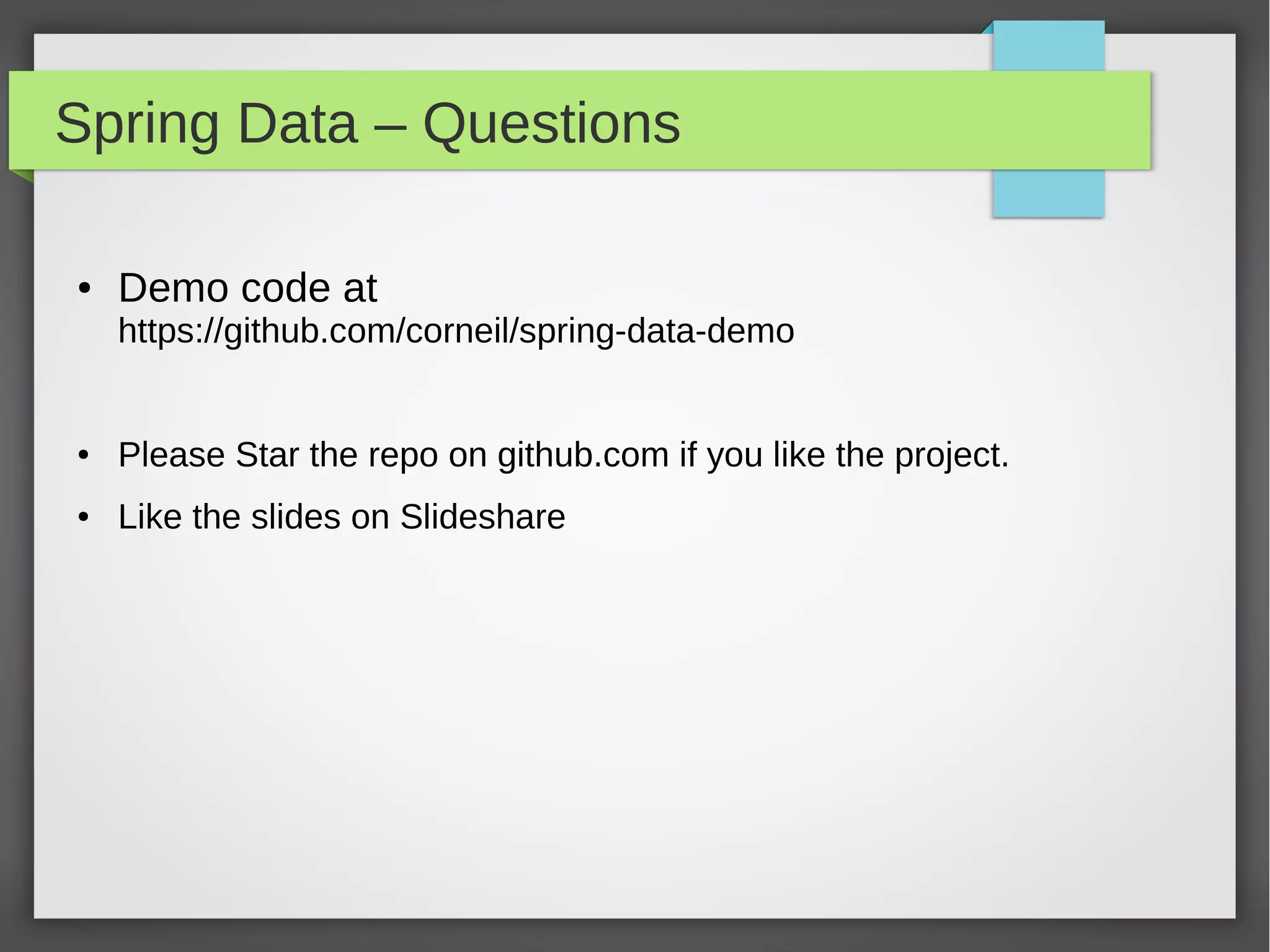
● Demo code at
https://github.com/corneil/spring-data-demo
● Please Star the repo on github.com if you like the project.
● Like the slides on Slideshare

Spring Data in 10 minutes

  • 1.
    Spring Data in10 minutes Corneil du Plessis corneil.duplessis@gmail.com about.me/corneil @corneil
  • 2.
    Introduction ● Assumptions – Youknow JPA the Java Persistence API – You know the Spring Framework or Dependency Injection ● Take away – Some appreciation for polyglot persistence – Some understanding of Spring Data
  • 3.
    What is Polyglotpersistence? ● RDBMS doesn't scale to Internet (millions of users and billions of transactions). ● Ability to interact with multiple data stores depending on specific use cases ● MongoDB or Couchbase for Customer data ● RDBMS for financial transactions ● Elasticsearch, Cassandra or HBase for site clicks and audit trails ● Hadoop for Big Data ● Neo4J, OrientDB for Graph Data ● RDF Stores for Semantic Reasoning
  • 4.
    Why Spring Data? ●Best practice indicates you should have Data Access Components or a Data Service Layer. ● How often do you make simple mistakes interacting with EntityManager? ● Different API for each store. ● It should be easier...
  • 5.
    What is SpringData? ● Spring Data is an open source project managed by SpringSource. ● Spring Data relies on Spring Framework. ● Spring Data provides a set of common patterns for persisting data using existing libraries. ● Spring Data provides a Repository Interface ● Spring Data provides finder methods ● Spring Data provides support for QueryDSL ● Spring Data simplifies polyglot persistence
  • 6.
    Spring Data subprojects ● Commons ● JPA ● JDBC Extensions ● MongoDB ● Neo4J ● Redis ● HBase ● Hadoop ● GemFire ● REST provider ● Community Projects – OrientDB – RDF – Couchbase – Cassandra – Elasticsearch – DynamoDB
  • 7.
    How Spring Data? ●Configure Spring Data for specific technology ● Define Entity as per relevant library ● Declare Repository Interface ● Spring Data will provide Repository Implementation ● Spring Framework will inject Repository implementation where needed
  • 8.
    Spring Data Samples– Configuration ● EntityManagerFactory as normal for JPA ● <jpa:repositories base-package="...springdata.demo" /> OR ● @EnableJpaRepositories("...springdata.demo")
  • 9.
    Spring Data Sample– Entity ● @Entity public class User { @Id Long id; String fullName; String gender; Date dateOfBirth; }
  • 10.
    Spring Data Sample– Repository ● @Repository public interface UserRepository extends CrudRepository<User> { } ● Crud Repository provides type-safe methods for save, delete, load
  • 11.
    Spring Data Sample- Injection ● @Service public class MyDataServiceImpl { @AutoWired protected UserRepository userRepo; public void saveUser(User user) { userRepo.save(user); } }
  • 12.
    Spring Data Sample– Finders ● @Repository public interface UserRepository extends CrudRepository<User> { List<User> findByGender( String genderCode); List<User> findByDateOfBirthBetween( Date startDate, Date endDate); } ● Crud Repository provides query predicates based on method name like: findByNameOrderByDateOfBirthDesc findByNameORSurname
  • 13.
    Spring Data Sample– QueryDSL ● @Entity @QueryEntity public class User { @Id private Long id; private String fullName; private String gender; private Date dateOfBirth; } ● QueryDSL generates QUser for creating type-safe query. ● import static Quser.*; List<User> users = userRepo.findAll(user.gender.eq('M'))
  • 14.
    Spring Data –Notes ● User code is same on MongoDB, JPA, Neo4J, Redis etc. ● Entity Mapping is usually specific to technology. ● Common Repository methods can be implemented. ● Implementation specific queries: @Query(“select * from User u where u.gender = ?”) List<User> findUsersForGender(String code)
  • 15.
    Spring Data –Questions ● Demo code at https://github.com/corneil/spring-data-demo ● Please Star the repo on github.com if you like the project. ● Like the slides on Slideshare