ARTICLE I NATIONAL
TERRITORY
ARTICLE 1, SECTION 1
The national territory comprises the
Philippine archipelago, with all the islands
and waters embraced therein, and all other
territories over which the Philippines has
sovereignty or jurisdiction, consisting of its
terrestrial, fluvial, maritime, and aerial
domains, including its territorial sea, the
seabed, the subsoil, the insular shelves,
and other submarine areas. The waters
around, between, and connecting the
islands of the archipelago, regardless of
their breadth and dimensions, form part of
internal waters of the Philippines.
NECESSITY OF
CONSTITUTIONAL
PROVISION ON NATIONAL
TERRITORYBinding force of such provision under
international law.
Value of provision defining our national
territory.
Acquisition of other territories.
Binding
force of
such
provision
under
internationa
l law
A State under the
international law has the
unquestioned right to
assert jurisdiction
throughout the extent of
its territory
If there is a territorial
dispute it should be
settled according to the
international law.
Value of
provisio
n
defining
our
national
territory
.
It is important to know
so that we and the other
nations would know the
boundaries of our
country.
the Philippines can
promulgate and enforce
its laws within our
country.
ACQUISITION OF OTHER
TERRITORIES.
does not prevent the Philippines
from acquiring new territories
by means of purchase,
exchange, and such.
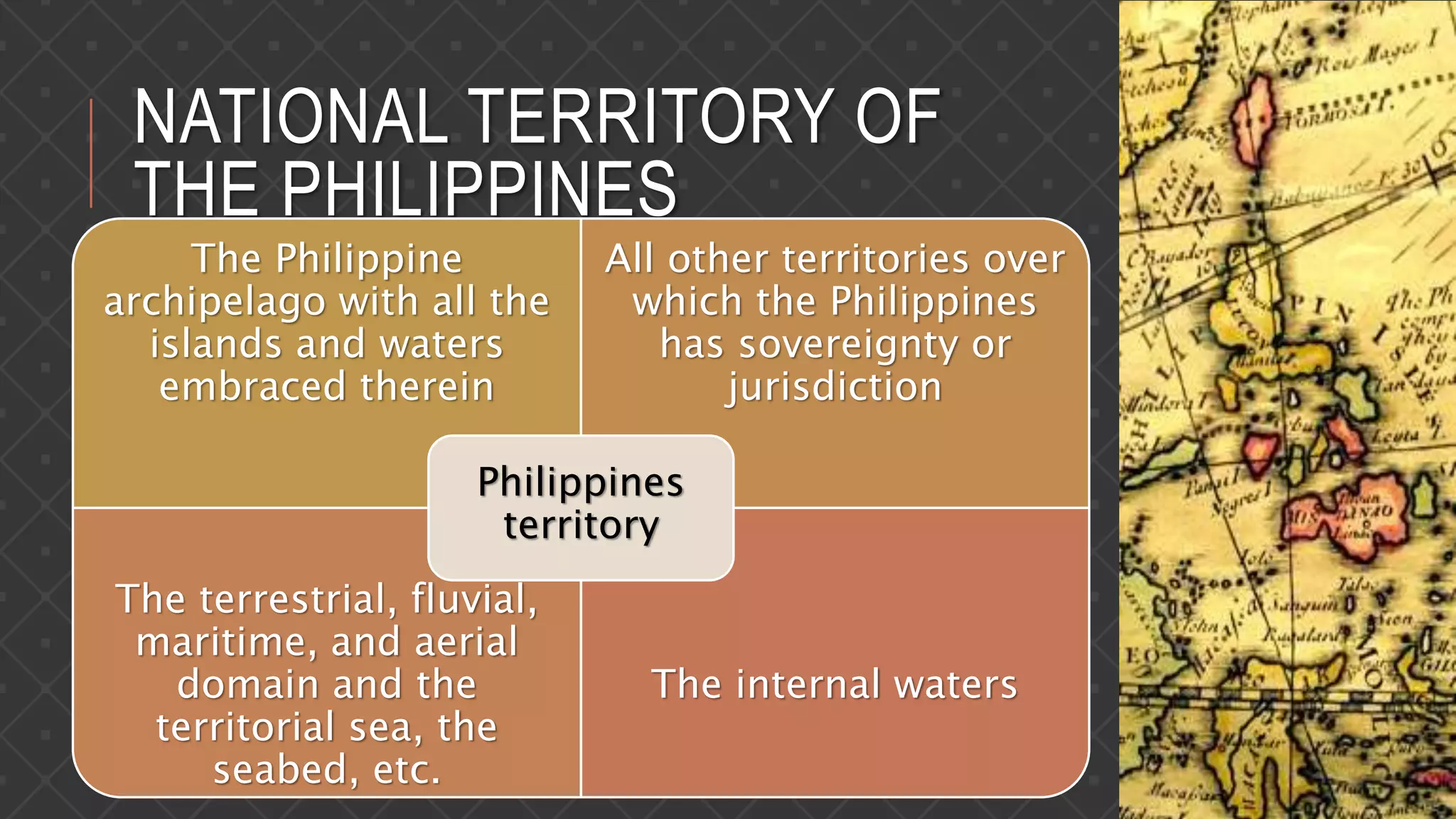
NATIONAL TERRITORY OF
THE PHILIPPINES
The Philippine
archipelago with all the
islands and waters
embraced therein
All other territories over
which the Philippines
has sovereignty or
jurisdiction
The terrestrial, fluvial,
maritime, and aerial
domain and the
territorial sea, the
seabed, etc.
The internal waters
Philippines
territory
OTHER TERRITORIES OVER
WHICH THE PHILIPPINES HAS
SOVEREIGNTY OR JURISDICTION
PENDING PHILIPPINE CLAIM
TO SABAH, ETC
According
to the 1973
constitution
,
“all the other
territories belonging to
the Philippines by
historic right or legal
title”
It was amended during
the 1987 Phil.
Constitution.
PENDING PHILIPPINE CLAIM
TO SABAH, ETC
Any other territory
over which the
Philippines has
sovereignty or
jurisdiction
FUTURE CLAIMS BY THE
PHILIPPINES TO OTHER
AREAS
The deletion of “by historic right
or legal title” is designed to
improve our relations with
Malaysia while allowing
flexibility in pursuing the Sabah
claim
OTHER AREAS INCLUDED IN THE
PHILIPPINE ARCHIPELAGO.
Territorial sea
•Part of the sea
extending 12
nautical miles
(19km) from the
low water mark
Seabed
•The land that
holds the sea
Subsoil
•Refers to
everything
beneath the
surface soil and
the seabed
Insular shelves
• Submerged portions
of a continent or
offshore island
Other submarine
areas
• All areas under the
territorial sea like
seamount, trough,
trench, basin, deep,
bank, etc
THREE-FOLD DIVISION OF
NAVIGABLE WATERS.
Waters of the earth (international
law)
Inland or
internal
waters
Territorial
sea
High
open seas
THE SOUTH CHINA SEA
ARBITRATION
(THE REPUBLIC OF THE
PHILIPPINES V. THE
PEOPLE’S REPUBLIC OF
CHINA)
Historic Rights and the ‘Nine-
Dash Line’
Status of Features
Lawfulness of Chinese Actions
Harm to Marine Environment
Aggravation of Dispute
1734 VELARDE MAP
THE PHILIPPINE POSITION
FATAL EFFECT APPLICATION
OF 12 MILE RULE
It would mean the
dismemberment of the
archipelago with:
the Sibuyan sea separating the
Visayas,
the Mindanao Strait and the Sulu
isolating Palawan from the rest of
the archipelago.
of waters
would cease
to be
Philippine
waters;
They would
become
international
waters or high
seas,
And fishing vessels
from all nations
can enter
Fatal effect
application
of 12-mile
rule
And fishing vessels
from all nations can
enter
Warships of unfriendly
nations could enter these
waters and stay
We would lose a
large part of our
Fatal effect
application
of 12-mile
rule
A SINGLE NATION AND A
UNITED STATEOne whole
unitary
government
Bound by a
common
heritage,
Beholden to
the same
tradition
Pursuing the
same ideals
Interdepen-
dent and
united
politically
Economicall
y and
socially as
one
RECOGNIZED BY U.N.
CONVENTION ON LAW OF
THE SEA (UNCLOS)
The archipelago principle and
the exclusive economic zone
(EEZ) rights are now fully
recognized in the U.N. Law of
the Sea Convention.
It was approved by the interim
Batasang Pambansa on February
27, 1984.
END

Polsc2 8 national territory

  • 1.
  • 2.
    ARTICLE 1, SECTION1 The national territory comprises the Philippine archipelago, with all the islands and waters embraced therein, and all other territories over which the Philippines has sovereignty or jurisdiction, consisting of its terrestrial, fluvial, maritime, and aerial domains, including its territorial sea, the seabed, the subsoil, the insular shelves, and other submarine areas. The waters around, between, and connecting the islands of the archipelago, regardless of their breadth and dimensions, form part of internal waters of the Philippines.
  • 4.
    NECESSITY OF CONSTITUTIONAL PROVISION ONNATIONAL TERRITORYBinding force of such provision under international law. Value of provision defining our national territory. Acquisition of other territories.
  • 5.
    Binding force of such provision under internationa l law AState under the international law has the unquestioned right to assert jurisdiction throughout the extent of its territory If there is a territorial dispute it should be settled according to the international law.
  • 6.
    Value of provisio n defining our national territory . It isimportant to know so that we and the other nations would know the boundaries of our country. the Philippines can promulgate and enforce its laws within our country.
  • 7.
    ACQUISITION OF OTHER TERRITORIES. doesnot prevent the Philippines from acquiring new territories by means of purchase, exchange, and such.
  • 8.
    NATIONAL TERRITORY OF THEPHILIPPINES The Philippine archipelago with all the islands and waters embraced therein All other territories over which the Philippines has sovereignty or jurisdiction The terrestrial, fluvial, maritime, and aerial domain and the territorial sea, the seabed, etc. The internal waters Philippines territory
  • 9.
    OTHER TERRITORIES OVER WHICHTHE PHILIPPINES HAS SOVEREIGNTY OR JURISDICTION
  • 10.
    PENDING PHILIPPINE CLAIM TOSABAH, ETC According to the 1973 constitution , “all the other territories belonging to the Philippines by historic right or legal title” It was amended during the 1987 Phil. Constitution.
  • 11.
    PENDING PHILIPPINE CLAIM TOSABAH, ETC Any other territory over which the Philippines has sovereignty or jurisdiction
  • 14.
    FUTURE CLAIMS BYTHE PHILIPPINES TO OTHER AREAS The deletion of “by historic right or legal title” is designed to improve our relations with Malaysia while allowing flexibility in pursuing the Sabah claim
  • 19.
    OTHER AREAS INCLUDEDIN THE PHILIPPINE ARCHIPELAGO.
  • 20.
    Territorial sea •Part ofthe sea extending 12 nautical miles (19km) from the low water mark Seabed •The land that holds the sea Subsoil •Refers to everything beneath the surface soil and the seabed
  • 21.
    Insular shelves • Submergedportions of a continent or offshore island Other submarine areas • All areas under the territorial sea like seamount, trough, trench, basin, deep, bank, etc
  • 22.
    THREE-FOLD DIVISION OF NAVIGABLEWATERS. Waters of the earth (international law) Inland or internal waters Territorial sea High open seas
  • 24.
    THE SOUTH CHINASEA ARBITRATION (THE REPUBLIC OF THE PHILIPPINES V. THE PEOPLE’S REPUBLIC OF CHINA)
  • 25.
    Historic Rights andthe ‘Nine- Dash Line’ Status of Features Lawfulness of Chinese Actions Harm to Marine Environment Aggravation of Dispute
  • 26.
  • 27.
  • 28.
    FATAL EFFECT APPLICATION OF12 MILE RULE It would mean the dismemberment of the archipelago with: the Sibuyan sea separating the Visayas, the Mindanao Strait and the Sulu isolating Palawan from the rest of the archipelago.
  • 29.
    of waters would cease tobe Philippine waters; They would become international waters or high seas, And fishing vessels from all nations can enter Fatal effect application of 12-mile rule
  • 30.
    And fishing vessels fromall nations can enter Warships of unfriendly nations could enter these waters and stay We would lose a large part of our Fatal effect application of 12-mile rule
  • 31.
    A SINGLE NATIONAND A UNITED STATEOne whole unitary government Bound by a common heritage, Beholden to the same tradition Pursuing the same ideals Interdepen- dent and united politically Economicall y and socially as one
  • 32.
    RECOGNIZED BY U.N. CONVENTIONON LAW OF THE SEA (UNCLOS) The archipelago principle and the exclusive economic zone (EEZ) rights are now fully recognized in the U.N. Law of the Sea Convention. It was approved by the interim Batasang Pambansa on February 27, 1984.
  • 33.